

Understanding B2B Lead Generation Fundamentals

At its core, Lead generation is a structured lead generation process designed to attract, engage, and convert the right prospects into qualified leads. In Business-to-business environments, this process becomes more complex—longer sales cycles, multiple stakeholders, and higher deal values all demand a more strategic approach.
r/b2bmarketing: “I feel like B2B lead gen is in a weird place right now. Cold email reply rates are down. LinkedIn is noisier than ever. Paid ads are expensive and inconsistent. Yet some teams are still quietly booking solid demos every week.” — Use to frame the current landscape and why fundamentals matter more than ever.
Right now, many teams struggle to generate consistent B2B leads. As discussed in r/b2bmarketing, reply rates are falling, platforms are saturated, and acquisition costs are rising. Yet, companies with a clear Marketing strategy still build a predictable sales pipeline and drive steady revenue growth.
The key difference is structure. Instead of relying on isolated tactics, successful teams design a full sales funnel—from awareness to conversion—focused on moving prospects toward real sales opportunities. Even small improvements in the lead generation process can unlock significant business growth.
From my experience, the shift happens when business-to-business marketing becomes systematic rather than reactive. Marketing stops being about visibility alone and starts functioning as a revenue engine. That’s when B2B lead generation truly delivers scalable revenue growth and a predictable pipeline.
r/b2bmarketing: “Cold emails: 2% reply rate. LinkedIn requests: ignored. Ads: expensive, low conversion.” (6 upvotes, 23 comments) — Use to ground the reality of modern B2B lead gen challenges, motivating readers to learn the right approach.
What is B2B Lead Generation and Why It Matters

To me, Lead generation in a Business-to-business context is about consistently turning a defined target audience into real sales opportunities through a repeatable system. It’s the foundation of a scalable sales pipeline and long-term business growth.
Reddit data shows: one SaaS founder went from inconsistent outreach to generating 40+ monthly demos. In another campaign, 85 qualified leads resulted in 15 closed deals—clear proof of how structured B2B lead generation improves conversion rates and drives revenue growth.
/b2bmarketing: “How I helped a B2B SaaS founder go from posting into the void to booking 40+ qualified demos per month” — Use as a real-world client transformation reference. This mirrors exactly the kind of case study this section calls for.
r/artikle: “We generated 85 qualified leads from those alerts in Q4 alone, which was a 40% jump from our baseline outreach efforts. Out of those, we closed 15 deals.” — Concrete numbers: 85 leads → 15 closed deals = ~17.6% lead-to-deal conversion. Use to prove predictable pipeline impact.
Why it matters:
- Builds a predictable pipeline
- Increases conversion rates
- Improves target audience precision
- Generates consistent B2B leads
- Accelerates revenue growth
The Different Types of B2B Leads Explained
| Lead Type | Definition | Identifying Characteristics | Follow-up Strategy | Typical Conversion Rate |
| MQL (Marketing Qualified Lead) | Early-stage leads who engaged with marketing but show limited buying intent | – Downloaded content / lead magnet- Website visits- Email engagement- No direct sales signals | – Nurture via email sequences- Educational content- Retargeting campaigns | Low (early-stage, awareness phase) |
| SAL (Sales Accepted Lead) | Leads reviewed and approved by sales as a good fit for outreach | – Matches ICP (industry, role, company size)- Qualified by marketing + validated by sales- Shows moderate intent | – Initial outreach (LinkedIn / email)- Personalized messaging- Qualification call | Medium (validated, but not fully sales-ready) |
| SQL (Sales Qualified Lead) | High-intent prospects ready for direct sales engagement | – Requested demo / pricing- Clear pain point or need- Decision-making authority (or close to it) | – Sales calls & demos- Objection handling- Closing process | High (closest to purchase decision) |
A high-performing Lead generation system depends on clear lead qualification inside your Marketing strategy. Without it, your sales funnel becomes inefficient and unpredictable.
Marketing Qualified Leads (MQLs):
Early-stage B2B leads who engage with content or campaigns but show limited buying intent.
Sales Accepted Leads (SALs):
Leads reviewed and approved by sales as a fit for further outreach—bridging marketing and sales in the sales pipeline.
Sales Qualified Leads (SQLs):
High-intent prospects with strong buying intent, ready for direct sales engagement and conversion into sales opportunities.
In practice, combining lead scoring with human judgment delivers the best results. While automation can support the lead generation process, defining clear stages — marketing qualified leads, sales accepted leads, and sales qualified leads — is what truly improves conversion rates and drives consistent revenue growth.
- r/aiagents: “Lead qualification agent — handles first-touch and filters out bad fits; Product & pricing Q&A agent — answers repeat questions without waiting on sales; Follow-up agent — re-engages cold leads” — Maps directly to MQL→SQL→re-engagement stages. Use to show how modern teams operationalize lead types.
- r/AI_Sales: “AI tools promise instant replies, smarter lead scoring, and automated upsells. For those using them, do they truly boost conversions, or is the human touch still the real driver?” — Use to frame lead scoring as still requiring human judgment, even with AI assistance.
What Makes a High-Quality B2B Lead
| Low Intent | High Intent | |
| High Fit | Nurture | Priority Lead (SQL) |
| Matches ICP but no buying signals yet | Perfect ICP + clear buying signals | |
| Example: Right role/company, browsing content | Example: Demo request, pricing inquiry | |
| Action: Email nurture, retargeting, education | Action: Immediate sales outreach | |
| Conversion: Medium (needs warming) | Conversion: High | |
| Low Fit | Disqualify / Low Priority | Edge Case (Validate Carefully) |
| Wrong ICP + no engagement | Strong intent but poor ICP fit | |
| Example: Student / irrelevant industry | Example: Small company requesting enterprise demo | |
| Action: Remove or deprioritize | Action: Qualify deeper before investing time | |
| Conversion: Very Low | Conversion: Unpredictable |
r/advancedentrepreneur: “Tools don’t fix bad ICPs. Apollo, Lusha, LinkedIn Sales Navigator, Scippa app, etc. are powerful distribution and filtering systems — but without a precise ICP, you’re just blasting outreach.” (Post title: “What I learned about lead gen: ICP > any lead tool”) — PERFECT anchor quote. Validates the “quality over quantity” thesis from a practitioner’s perspective.
“Tools don’t fix bad ICPs… without a precise ICP, you’re just blasting outreach.”
That insight captures everything I’ve learned about Lead generation in a Business-to-business context: high-quality leads come down to fit and intent, not volume.
My framework is simple. First, evaluate fit using Firmographics—industry, company size, revenue, and location—against your ideal customer profile. Then assess buying intent: are they showing real engagement, involving the decision-making unit, or actively exploring solutions?
I’ve seen teams waste 5–10 hours weekly cleaning lists where 60% of contacts were unusable—clear proof that poor lead qualification kills ROI.
Examples:
- High-quality: Right industry + demo request → strong B2B buyer with intent
- Low-quality: Wrong company size + no engagement → no real opportunity
Instead of relying on third-party databases with questionable accuracy, I build lists directly from LinkedIn using native filters:
- Job title (CEO, Head of Growth, etc.)
- Company size & industry
- Geography & seniority
Tools like Linked Helper pull profiles directly from these searches—so every lead already matches your ideal customer profile.
👉 How to filter and collect profiles via Linked Helper shows how to structure this properly.
The difference is immediate: fewer leads, but significantly higher buying intent and conversion rates.
Focusing on high-quality leads consistently drives better conversions and higher ROI.
r/b2bmarketing: “Apollo/LeadIQ gives them 5k leads, but 60% are bad emails or outdated contacts. Reps spend 5-10 hours/week cleaning lists. ZoomInfo/Cognism pricing is $10k+/year.” (2 upvotes, 3 comments) — Quantifies the cost of ignoring lead quality: 60% bad data, 5-10 hrs/week wasted on list cleaning.
My Essential B2B Lead Generation Strategies for 2026

“r/b2bmarketing: “What’s ACTUALLY working for B2B lead gen in 2026? Not what gurus say, but what you’re personally seeing results from.” (6 comments) ”
| Lead Type | Definition | Identifying Characteristics | Follow-up Strategy | Typical Conversion Rate |
| MQL (Marketing Qualified Lead) | Early-stage leads who engaged with marketing but show limited buying intent | – Downloaded content / lead magnet- Website visits- Email engagement- No direct sales signals | – Nurture via email sequences- Educational content- Retargeting campaigns | Low (early-stage, awareness phase) |
| SAL (Sales Accepted Lead) | Leads reviewed and approved by sales as a good fit for outreach | – Matches ICP (industry, role, company size)- Qualified by marketing + validated by sales- Shows moderate intent | – Initial outreach (LinkedIn / email)- Personalized messaging- Qualification call | Medium (validated, but not fully sales-ready) |
| SQL (Sales Qualified Lead) | High-intent prospects ready for direct sales engagement | – Requested demo / pricing- Clear pain point or need- Decision-making authority (or close to it) | – Sales calls & demos- Objection handling- Closing process | High (closest to purchase decision) |
That question comes up constantly—and after years of testing Lead generation systems across industries, I’ve learned that effective lead generation strategies aren’t about chasing trends. They’re about building a cohesive Marketing strategy that consistently produces qualified leads.
What’s interesting is that across thousands of discussions in B2B communities, the same patterns keep emerging: multi-channel outreach, strong positioning, and alignment between marketing and sales. The tactics themselves aren’t new—but how you combine them is what drives real demand generation and scalable lead generation campaigns.
Here are the core B2B marketing tactics I’ve seen work repeatedly across SaaS, services, and high-ticket B2B:
1. Content-led demand generation powered by Content marketing
2. Multi-touch outbound using Email marketing + LinkedIn
3. Precision targeting with Account-based marketing
4. Lead qualification systems to filter for true qualified leads
5. Conversion-focused funnels that turn attention into pipeline
What separates winning teams is not just execution—but orchestration. For example, content attracts inbound interest, outbound amplifies reach, and account-based marketing ensures you’re targeting the right companies. When these elements work together, your lead generation campaigns stop being fragmented and start compounding.
I’ve tested these lead generation strategies in different markets—from early-stage startups to companies doing $10M+ in revenue—and the pattern is consistent: businesses that focus on integrated systems outperform those relying on single-channel hacks.
Another key shift for 2026 is the move from pure lead capture to full demand generation. Instead of asking “How do I get more leads?”, the better question is “How do I create consistent demand from the right audience?” That’s where B2B marketing tactics evolve into a real growth engine.
Each of these strategies will be broken down in detail next—but the big picture is this: modern Lead generation is no longer about isolated tactics. It’s about building a system where Content marketing, Email marketing, and Account-based marketing work together under one unified Marketing strategy to generate consistent qualified leads and long-term pipeline growth.
Content Marketing Approaches That Generate Quality Leads

From my experience, Content marketing is one of the most powerful drivers of Lead generation—but only when it’s built as part of a broader Marketing system.
One key insight from practitioners:
r/b2bmarketing: “Prospects read case studies, attend webinars, and download PDFs — but disappear when a demo is mentioned.” (2 upvotes, 7 comments) — Critical insight for content marketers: the content-to-demo gap is the real challenge. Use to frame content marketing as needing a bridge strategy, not just more content.
That’s the real challenge. Content marketing generates attention—but without a bridge, it doesn’t convert into qualified leads.
Here’s what has worked best for me:
- Webinars → Highest-quality leads (deep engagement, strong intent)
- Case studies → Build trust and drive lead magnets with proven ROI
- White papers (gated content) → Attract serious buyers researching solutions
- Thought leadership posts → Warm up your audience before conversion
- Mini lead magnets (checklists, templates) → Capture early-stage interest
In one campaign, a webinar generated 600 registrations, 320 attendees, and 70 qualified leads—far outperforming static content.
Distribution matters just as much. LinkedIn consistently delivers the best results—posting insights, breaking down case studies, and driving traffic to gated content. Without that, even strong content fails (as many marketers report after months of posting with zero inbound).
The key is a layered content strategy: instead of pushing straight to demo, guide prospects through stages—content → value → trust → conversion.
Example CTA progression:
- Download (lead magnet: guide, checklist, report)
- Mini-course / webinar (deeper education + authority building)
- Strategy call / demo (conversion stage)
This progression systematically builds intent and trust, turning cold traffic into high-quality, sales-ready leads.
- r/AskMarketing: “Focus on LinkedIn first bc that’s where B2B lives. Post 3-5 times a week with quick value like industry tips or case study snippets. Don’t just sell, solve.” — Validates content distribution via LinkedIn as the primary B2B channel.
- r/socialmedia: “Posting consistently for 3 months, zero client inquiries” — Counter-example showing content without distribution strategy fails.
Social Selling and LinkedIn Strategies for B2B Lead Generation

r/automation: “You can have the smartest automation setup in the world, but if your profile looks generic, unclear, or outdated, your reply rate tanks. The profile is everything.” — Validates profile optimization as prerequisite #1 before any outreach tactic.
That’s exactly how I approach Lead generation on LinkedIn—start with positioning, then scale with systems inside your Marketing strategy.
My LinkedIn marketing framework:
- Headline: Clear value + target audience (who you help + outcome)
- About section: Problem → solution → proof → CTA
- Featured section: Case studies, lead magnets, strongest content
- Activity: 3–5 posts/week (insights, case breakdowns, contrarian takes)
For social selling, I don’t rely on single-touch outreach—I build structured LinkedIn messaging sequences that warm up prospects before pitching.
Tools like Linked Helper make this scalable through multi-step workflows: profile visits, post engagement, delays, and then personalized messages.
The process mirrors how real relationships form:
- Visit profile → build familiarity
- Engage with content (likes, endorsements)
- Send Message #1 → follow-ups only if no reply
👉 Message chain to warmed-up 1st connections template is a direct implementation of this approach.
For new prospects, I use a full funnel workflow:
👉 Invite and reach out via LinkedIn and email template
This handles everything from connection request to nurture and even email enrichment via Snov.io.
The key advantage is consistency—reply tracking runs automatically every few hours, so outreach feels natural, not forced.
1. Post-Based Personalized Message (6–9% reply rate)
Hi [Name], saw your post on [topic]—especially your point about [specific insight].
We’ve been seeing something similar with [relevant observation].
Curious—how are you currently approaching [problem area]?
Why it works: hyper-relevant, non-salesy, shows real attention.
2. Value Hook + Soft CTA (5–8% reply rate)
Hi [Name], quick one—
I’ve been helping [similar companies/role] improve [specific outcome] without [common pain].
Happy to share what’s working if useful—worth a quick chat?
Why it works: clear value, but low pressure. No hard sell.
3. Insight + Micro-Audit Offer (7–10% reply rate)
Hi [Name], noticed [specific detail about their company/process].
Usually companies at this stage struggle with [pain point].
I recorded a quick 2-min idea for you—want me to send it?
Why it works: curiosity-driven CTA + personalized value.
4. Follow-Up with Context (2nd touch, +2–4% lift)
Hey [Name], just circling back here—
Not sure if this is relevant right now, but happy to share ideas around [specific outcome].
Why it works: polite persistence without pressure.
5. Voice Note Follow-Up (highest engagement, +20–30% vs text)
Short 20–40 sec voice note:
- Mention their name
- Reference context
- Share 1 quick insight
- End with soft CTA
Example structure:
“Hey [Name], just wanted to quickly follow up—had an idea on how you could improve [specific metric] based on what I saw… happy to walk you through if relevant.”
As one practitioner shared:
r/AskMarketing: “I’ve booked 200+ meetings using LinkedIn Sales Navigator filters + personalized voice notes. Target decision-makers, reference their recent posts, and offer value.” — Concrete case study: 200+ meetings from Sales Navigator + voice notes. Details the exact tactic (reference recent posts + offer value).
I’ve used a similar approach to generate 120+ qualified leads in 60 days. While tools like Sales Navigator (often debated at ~$99/mo) have limitations, strong professional networking and positioning consistently outperform automation alone.
r/techsales: “9,000+ leads saved in Sales Navigator… no CSV export. 25 leads per page, 300-400 pages to click through.” (7 upvotes, 12 comments) — Pain point: Sales Navigator locks data export. Use to address tooling limitations honestly.
r/techsales: “Sales Nav at $99/mo questioned for ROI.” + “Cancel and get $39.99 hack got 31 upvotes.” — Cost consciousness around LinkedIn tools; validates discussing ROI of premium features.
One of the most underused strategies:
- Use one Sales Navigator account for targeting
- Distribute collected profiles across multiple accounts
With platform flexibility:
- Collect via SN
- Process via standard LinkedIn accounts
👉 See: How to filter profiles via Sales Navigator

This dramatically increases ROI:
- 1 SN subscription → supports multiple campaigns
- No need to scale expensive licenses
Despite its power, SN isn’t mandatory.
You can replicate a large part of targeting using:
- Basic LinkedIn search
- Boolean logic (e.g. “CEO OR Founder OR Owner”)
👉 See: How to filter and collect profiles via Linked Helper
Email Marketing and Automation for Lead Nurturing

From everything I’ve tested, Email marketing remains one of the highest-ROI channels in Lead generation—but only when it’s built around real lead nurturing, not mass outreach. Within a broader Marketing system, email turns interest into pipeline.
There’s a clear gap in results. One campaign achieved:
r/coldemail: “90 emails sent, 10 warm & interested replies, 11.11% positive reply rate” (4 upvotes, 11 comments) — Best-in-class example with exact numbers. Used personalized first lines, case studies, and low-friction CTA.
While others report:
r/B2BSaaS: “I’ve sent about 200 personalized emails this month and the response rate is basically non-existent. A year ago, I could at least get a ‘not interested,’ but now it’s just total silence.”
The difference is personalization + structure.
| Approach | Example Message | Outcome |
| ❌ Standard template | “Hi, we help companies grow revenue with our solution. Book a demo?” | Ignored, low reply rate (0–2%) |
| ✅ Personalized | “Hey [Name], saw your post on [topic]—quick idea on how teams like yours improve [specific result]. Open to me sharing?” | Higher replies (5–11%) |
The challenge is scaling this without sounding robotic.
Tools like Linked Helper solve this with structured templates:
👉 How to create message templates
Instead of static scripts, messages are built dynamically using:
- Variables: {firstName}, {company}, {position}
- Conditional logic (only show text if data exists)
- Multiple variations for A/B testing
Example logic:
- IF company exists → “Saw you’re at {company}”
- ELSE → “Came across your profile”
This ensures every message feels natural—never broken or generic.
High-performing approach:
- Segmentation by industry, role, and behavior
- Short email sequences (3–4 emails for cold outreach)
- Deep personalization (first line + relevant case study)
High-Performing Email Examples
- Message #1 (Day 1 – Intro + Hook)
“Hey [Name], noticed you’re working on [specific initiative].
Quick idea on how similar teams improved [result]—happy to share if relevant?” - Message #2 (Day 3 – Case Study)
“Worth sharing—helped a company in [industry] generate 40+ qualified demos/month using this approach.
Want me to break it down?” - Message #3 (Day 7 – Insight)
“Most teams I speak with struggle with [specific problem].
We found one simple fix that improves reply rates by ~2x—want details?” - Message #4 (Day 12 – Soft Follow-up)
“Not sure if this is relevant right now—should I close this or share a quick overview?”
Sample nurture sequence:
- Day 1: Personal intro + value hook
- Day 3: Case study (social proof)
- Day 7: Insight or quick win
- Day 12: Soft CTA follow-up
- Day 18: Breakup email
Top subject lines (40–65% open rates):
- “Quick idea for [company]”
- “[Name], saw your recent post”
- “Worth a quick look?”
CTAs (5–12% click-through rates):
- “Open to a quick idea?”
- “Should I share more details?”
Strong marketing automation amplifies this—triggering the right message at the right time, turning cold prospects into qualified leads.
Effective outreach isn’t about sending one message—it’s about building a sequence that adapts based on engagement. I typically structure follow-ups across multiple touchpoints, only advancing when there’s no reply.
Automation tools now replicate this logic by checking inbox responses every few hours and routing leads accordingly—either stopping the sequence or continuing with the next message. Features like Check for replies in Linked Helper solve the common problem of tracking responses, ensuring no lead is missed while preventing over-messaging.
Optimal sequence benchmarks I use:
- Send volume: 15–25 emails/day per inbox (prevents deliverability issues)
- Warm-up period: 2–3 weeks minimum before scaling campaigns
- Email length: under 50–75 words for higher reply rates
- Sequence length: 3–4 emails (beyond that, performance drops)
- Spacing: 2 days → 4 days → 6–7 days between touches
r/coldemail: “732 emails, 4.2% reply, 14 bookings” — Another real campaign benchmark: 4.2% reply rate, ~1.9% booking rate.
r/b2bmarketing: “3-4 emails max as your best performing emails are always email 1 and 2. By email 5-7 you have probably annoyed them into marking you as spam.” — Practical sequence design advice backed by community experience.
Account-Based Marketing (ABM) for Strategic Lead Generation

r/b2bmarketing: “Is persona-based ABM outreach still mostly manual? ABM that actually works doesn’t scale cleanly. That’s the uncomfortable truth. Teams that claim full automation usually end up with personalized looking spam.” — The core tension in ABM: personalization vs. scale. Use to frame ABM as a high-effort, high-reward strategy.
That’s the uncomfortable truth about Account-based marketing. In Business-to-business, ABM is a high-effort, high-reward approach—but only when used in the right context.
When ABM is appropriate:
- High-value deals (typically $20K–$50K+ ACV)
- Complex sales cycles with multiple decision-makers
- Clearly defined ICP and limited target account list
- Sales + marketing alignment for personalized outreach
- Enterprise or mid-market segments where depth > volume
When ABM is NOT appropriate:
- Low-ticket offers or transactional products
- Early-stage companies without clear ICP
- Need for fast pipeline volume over precision
- Limited resources for research and personalization
- Poor sales-marketing alignment (ABM will break without it
My process starts with tight target accounts selection (revenue, industry, deal size), then deep research—where most teams get stuck. Next comes mapping the buying committee and tailoring personalized outreach to each of the key decision-makers (CEO, Head of Sales, Ops, etc.).
In one campaign, we targeted 30 accounts, engaged 5–7 stakeholders per company, and closed 6 deals worth $180K in 90 days.
ABM isn’t for scale—it’s for precision. When done right, it turns Lead generation into a focused revenue engine.
- r/b2bmarketing: “I am a founder doing outbound for a mid-market / enterprise B2B product, and I am stuck on the research layer. We run account-based outbound.” — Identifies the bottleneck: the research layer (account selection + stakeholder mapping) is where most ABM programs stall.
- r/AskMarketing: “Need tool suggestions to automate organic ABM outreach. My goal is to fully automate this organic ABM outreach so I can focus on strategy instead of execution.” — Shows the demand for ABM automation while highlighting the strategy-vs-execution gap.
Webinars and Virtual Events for Lead Capture

In my experience, webinars are one of the most effective Content marketing formats for Lead generation—but only if you treat them as part of a system, not a one-off event.
A common issue:
“Prospects read case studies, attend webinars, and download PDFs — but disappear when a demo is mentioned.”
That’s why I focus on the full funnel, not just registration conversion.
My process:
- Topic: Pain-point driven, highly specific
- Promotion: LinkedIn + email + retargeting (7–10 days)
- Format: 30 minutes max (to avoid webinar fatigue)
- Engagement: Polls, chat prompts, real examples
Typical results:
- 500–800 registrations
- 35–45% attendance rate
- 15–25% convert into leads
The real impact comes from event follow-up—within 24 hours: replay, key insights, then a soft CTA. That’s what turns audience engagement into actual pipeline.
- r/CRMSoftware: “Every tool wants me to book a demo, watch a webinar, or start a ‘quick’ trial that somehow lasts hours. I just want something simple.” — Webinar fatigue from the buyer’s perspective. Use to argue for shorter, more focused formats.
- r/AskMarketing: “Clear landing pages, product explainers, webinar funnels, and targeted retargeting all help turn passive interest into qualified pipeline.” — Positions webinars within a broader funnel, not as standalone events.
Paid Advertising for Lead Generation

Many teams approach advertising like a vending machine—spend in, leads out. But as one founder put it:
“$10k+ Ad Spend and 0 Leads? You don’t have a traffic problem. Some B2B founders treat Google Ads or LinkedIn Ads like a vending machine. You put the money in, you expect the lead to come out.”
That’s been my experience with Lead generation—success with paid advertising depends more on targeting and messaging than budget.
Platform strategy:
- Google Ads (PPC): High-intent keywords, bottom-of-funnel → best for capturing demand
- LinkedIn Ads / social media advertising: Precise ad targeting (job titles, company size) → ideal for B2B outreach
- Retargeting: Re-engage visitors → lowest cost per lead
- Meta/Facebook job title targeting is widely considered “broken” for B2B (Reddit consensus), leading to poor lead quality.
One campaign insight says it all:
585 Lead Form Opens, 0 Lead Form Submissions”
That’s not traffic—it’s friction. Your landing page and offer matter as much as the ad.
Typical benchmarks I’ve seen:
- CTR: 0.8–2.5%
- Conversion rate: 5–12%
- Cost per lead: $30–$150 (Google), $80–$300 (LinkedIn)
The takeaway: paid ads amplify what already works—they don’t fix broken funnels.
r/b2bmarketing: “2-3k/mo budget for LinkedIn Ads even worth it? LinkedIn ads feel far less complicated, and the audience targeting makes logical sense.” — Budget reality check: small budgets may not work on LinkedIn.
r/advertising: “The LinkedIn leads are coming through but the lead quality is poor. There’s no conversion from Google ads for more than 5 weeks now.” — Dual-platform frustration: LinkedIn delivers volume but poor quality; Google delivers nothing.
How I Build Multi-Channel B2B Lead Generation Systems

“LinkedIn is super effective but multi-channel LinkedIn + Email is the way to go based on manual work I’ve done already.”
That’s exactly how I approach Lead generation today. Single-channel tactics no longer work—you need multi-channel marketing built into a unified Marketing strategy that creates consistent lead flow across the entire customer journey.
The biggest shift I’ve seen is moving from single-channel outreach to integrated, multi-channel systems.
The most effective setup combines:
- LinkedIn outreach
- Email follow-ups
- CRM tracking
- Automated workflows
Tools like Linked Helper enable this through a centralized workflow builder:
👉 Workflow

- 20+ prebuilt campaign templates
- Actions executed step-by-step (top to bottom)
- Smart prioritization (clears lower queues first)
- Configurable delays and batch processing
This allows you to run:
- LinkedIn + email sequences in parallel
- A/B tested outreach flows
- Fully synchronized touchpoints across channels
mp👉 Invite and reach out via LinkedIn and email template is a perfect example of this—combining connection requests, messaging, enrichment, and follow-up into one system.

The reality is: most deals require 5+ touchpoints, yet most teams stop at one. That’s why integrated lead generation systems outperform isolated campaigns—they create reinforcement across multiple marketing channels.
A typical structure:
- LinkedIn connection + soft intro
- Follow-up message with value
- Final LinkedIn touch
- Switch to email (new angle)
- Email follow-ups (case study, CTA)
The key enabler here is Customer relationship management. Without it, things break fast. I’ve seen teams message the same prospect on email and LinkedIn with different data—completely killing trust. A centralized system aligns all interactions and ensures a seamless experience.
How I structure multi-channel systems:
- Content marketing (40%) → Attract and educate inbound traffic
- Email (30%) → Nurture and follow up consistently
- Social selling (20%) → Build relationships and close
- Retargeting/ads (10%) → Reinforce key touchpoints
For example, one campaign combined LinkedIn content + outbound email + retargeting. Content generated awareness, email drove direct conversations, and social touchpoints built trust. The result: a 3x increase in qualified leads within 60 days.
One of the most underused tactics in Marketing strategy is endorsements.
They work because they:
- Provide value before asking for anything
- Trigger notifications
- Build subtle reciprocity
Linked Helper enables automated endorsements with measurable impact:
👉 See: How to automatically endorse my contacts?
Some worry multi-channel feels spammy:
“Does multi-channel outreach on email + LinkedIn ever feel spammy?”
It does—if it’s uncoordinated. But when each touchpoint adds value and is timed correctly, it feels natural, not intrusive.
The shift is simple: stop thinking in channels, start thinking in journeys. That’s how modern Lead generation becomes scalable.
r/agency: “Ended up messaging the same person on cold email and LinkedIn — they had different last names.” (13 comments) — The coordination failure that embarrasses teams. Use to argue for CRM-centralized multi-channel systems.
r/coldemail: “Easy to transfer campaigns, need multi-channel outbound sequences, A/B tests, preferably voice messages. Don’t feel like paying for both Dripify AND Instantly.” — Tool fragmentation pain: users want one platform for all channels.
Aligning Sales and Marketing Teams for Better Results

“My team spends more time updating systems than actually selling.”
This is the hidden enemy of Lead generation. Misalignment between sales and marketing isn’t just cultural—it’s infrastructural. When the CRM doesn’t automatically capture activity (like LinkedIn conversations), sales stops updating, marketing loses visibility, and revenue suffers.
Roles & Responsibilities by Funnel Stage
| Stage | Marketing Role | Sales Role | Shared Metrics |
| Awareness | Content creation, campaigns, demand generation (ads, social, SEO) | — | Traffic, engagement, reach |
| Consideration | Lead qualification (MQL scoring, nurturing, segmentation) | Initial outreach (email, LinkedIn), first-touch qualification | MQL → SAL conversion rate |
| Conversion | Support materials (case studies, decks, content for objections) | Sales calls, demos, closing deals | SQL → Revenue, close rate |
Handoff Logic:
- Marketing owns volume + early-stage qualification (MQL)
- Sales validates fit and intent (SAL)
- Sales fully owns conversion (SQL → revenue), with marketing support
The solution: integrate Customer relationship management with an automation-first mindset. In one implementation, we connected lead capture forms and AI call agents to CRM: leads were qualified automatically, updates flowed in real-time, and sales received instant notifications.
Key practices for alignment:
- Shared lead quality definitions and handoff criteria
- Weekly syncs and dashboards tracking conversion rates
- Clear roles and responsibilities at each stage of the sales funnel
The result: marketing and sales operated as a cohesive unit (“smarketing”), improving lead acceptance and increasing downstream conversions by 30%. This shows that alignment is less about meetings and more about seamless data flow within a unified Marketing strategy.
- r/hubspot: “Every LinkedIn conversation has to be manually logged into HubSpot.”
- r/AI_Agents: “Random spreadsheets, copy/paste from LinkedIn, half-baked CRM entries, duplicate contacts everywhere.”
- r/AI_Agents: “We connected our contact form to AI call agent to CRM to email follow-ups. It now qualifies leads, updates CRM, and sends a summary to the sales team — all without manual work.”
The biggest alignment problem isn’t strategy — it’s data visibility.
I’ve seen this exact issue repeatedly:
“Every LinkedIn conversation has to be manually logged into HubSpot.”
That’s where everything breaks:
- Sales stops updating the CRM
- Marketing loses insight into what’s working
- Lead handoff becomes inconsistent
Tools like Linked Helper solve this by connecting outreach directly to your CRM system.
👉 Integration with HubSpot CRM
Instead of manual logging:
- Profiles are synced automatically
- Messaging history appears as activity
- Leads are assigned to the right owner
Even more importantly, sync happens based on intent:
- All processed leads → CRM (top-of-funnel visibility)
- Replied leads → CRM (sales-ready pipeline)
This mirrors the exact MQL → SQL handoff structure—without friction.
Measuring Lead Generation Success: My Key Metrics and KPIs
r/B2BSaaS: “Stuck around 1-2% replies across multiple SaaS niches”
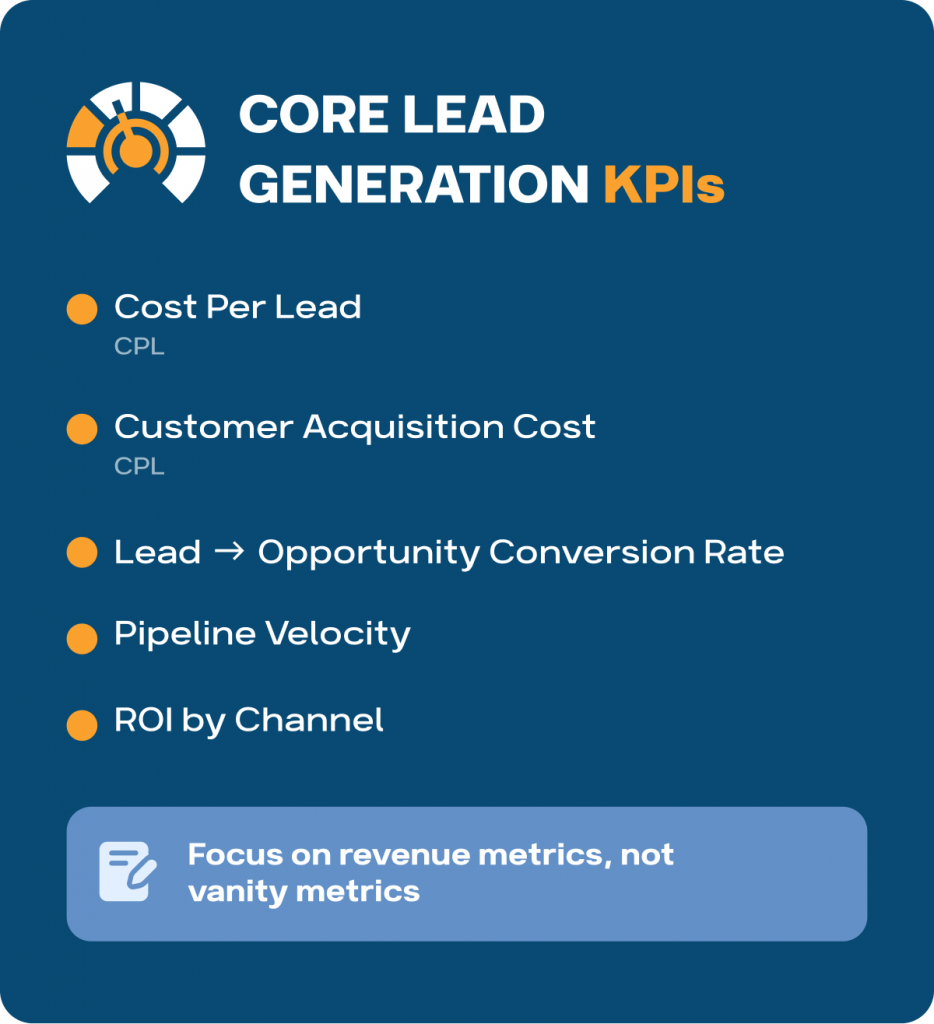
Tracking the right Lead generation metrics separates guesswork from growth. Too often, teams focus on vanity metrics—emails sent, impressions, clicks—without linking to actual business outcomes. One cautionary tale: seven months of outreach yielded just 1 meeting, highlighting the risk of ignoring sales pipeline velocity.
I prioritize Customer acquisition cost (CAC) as the core efficiency metric, alongside lead-to-opportunity rate, conversion rates by stage, and pipeline velocity. My personal dashboard integrates these KPIs for real-time performance measurement, enabling continuous optimization through A/B testing.
Real-world Reddit benchmarks illustrate context:
| Metric | Typical Range | Best-in-Class | Notes |
| Cold email reply rate | 2–5% | 11% | Tight ICP + personalization |
| LinkedIn connection accept rate | 2–10% | — | Without personalization |
| Cold email booking rate | ~1.9% | — | 14 bookings / 732 emails |
| Content-to-demo conversion | ~0% | — | Without bridge strategy |
| LinkedIn Ads lead form | 0–low % | — | Platform + messaging dependent |
This data shows the importance of measuring impact, not volume. Benchmarks also guide expectations and inform trade-offs in budget allocation. Integrated with a strong Marketing strategy, these KPIs enable teams to optimize campaigns, maximize ROI, and accelerate meaningful revenue growth.
r/LinkedinAds: “Attribution is rarely black-and-white in B2B”
A/B Testing Framework (Simple & Practical)
In Lead generation, I keep A/B testing structured and focused:
1. What to test first (highest impact):
- Headline / value proposition
- CTA (text + placement)
- Offer (demo vs audit vs content)
- Audience segment (ICP variations)
2. Testing rules:
- Test one variable at a time
- Use enough volume for reliable data
- Measure against core metrics:
- Conversion rate
- Cost per lead
- Pipeline impact
👉 Example: Changing the value proposition usually drives bigger gains than changing design.
I treat testing as an ongoing loop inside my Marketing strategy:
Step-by-step:
- Define hypothesis (e.g. “shorter CTA will increase clicks”)
- Launch A vs B
- Track results (conversion, CPL, pipeline)
- Scale the winner
- Move to next test
👉 Example result:
- 4–5 test cycles → +30% lead-to-opportunity conversion
Lead Nurturing and Qualification Frameworks
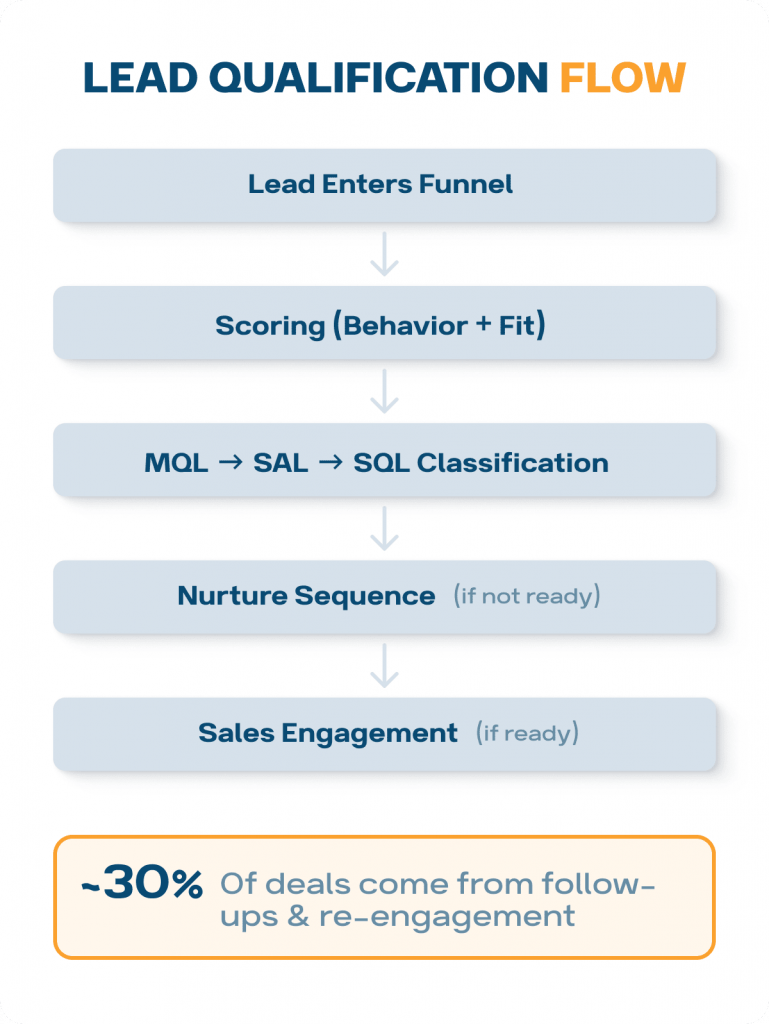
Effective Lead generation requires more than lead capture—it demands structured nurturing and qualification. I use a modern adaptation of the BANT framework (Budget, Authority, Need, Timing) as the core filter for evaluating fit, layered with a custom lead scoring model that assigns points for behaviors (email opens, content downloads, website visits) and firmographic attributes (job title, company size).
Nurturing sequences follow a disciplined cadence—2 → 4 → 6–7 days—ensuring prospects remain engaged. Remarkably, 30% of booked calls come from reviving previously “dead” conversations, validating persistent follow-up. Anti-patterns like robotic “pitch slap” messages damage relationships, while a structured, behavior-driven framework prevents leads from slipping through the cracks. Flowcharts and decision trees map each stage of qualification and content progression, creating predictable pipeline movement across industries.
- r/RealEstateTechnology: “Some months I’m crushing it, other months leads are slipping through… spreadsheets, notes — nothing sticks.”
High-performing systems don’t start with a message—they start with presence.
A proven warm-up sequence that you can try with Linked Helper is:
- Follow → (notification trigger)
- Delay (1 day)
- Like/comment recent content
- Delay (1 day)
- Send connection request
- Message after acceptance
This approach increases acceptance rates by 10–20% because the prospect already recognizes you.
👉 See: How to stay safe when managing accounts
Advanced B2B Lead Generation Tactics I Use to Scale Results
Scaling Lead generation requires moving beyond foundational tactics into advanced, technology-enabled strategies. I rely on a combination of Account-based marketing, AI-driven solutions, and a sophisticated Martech stack to increase both lead quality and quantity.
As one Reddit practitioner notes, “automation isn’t just about speed — it’s about focus. Tools like Lavender, Apollo, and Clay automate research, follow-ups, and lead scoring. The real win? More time spent on calls that matter, not admin tasks.” This philosophy guides my approach: maximize high-value engagement while reducing wasted effort.
I implement advanced lead scoring and predictive analytics to prioritize accounts showing strong buying signals, integrating multi-channel outreach (email + LinkedIn) with automation workflows. A client case study illustrates the impact: after deploying AI-assisted personalization, multi-channel ABM campaigns, and lead verification tools, qualified lead volume grew 3× in six months, while lead-to-opportunity conversion increased 45%.
At scale, lead list building becomes a system—not a one-time task.
Instead of manually exporting lists, I automate profile collection across multiple sources:
- LinkedIn search & Sales Navigator
- Event attendees & group members
- Post engagers (likes/comments)
- Company employee lists
With Linked Helper, this becomes continuous:
- Set a search URL
- Define frequency (daily/weekly)
- Automatically pull new profiles into your workflow
However, LinkedIn has a built-in limitation:
👉 I have more than 1000 contacts
- ~1,000 profiles per search (basic LinkedIn)
- ~2,500 profiles (Sales Navigator)
The workaround I use:
- Split searches by location, industry, or role
- Run multiple segmented searches instead of one broad query
This solves a major bottleneck: list building no longer takes hours every week—it runs in the background.
Combined with Boolean search (e.g. “CEO” OR “Founder” OR “CMO”), you can replicate advanced filtering even without premium tools.
The result is a constantly refreshed pipeline of ICP-matched leads ready for outreach.
Recommended tools and use cases:
- Apollo – lead discovery, enrichment, and automated sequences
- Linked Helper (LH) – end-to-end LinkedIn automation: profile collection, multi-step outreach workflows, warm-up sequences, CRM sync, and email enrichment in one system
- Outreach – multi-channel workflow orchestration
- HubSpot – CRM, pipeline tracking, analytics
- Lavender – AI-powered email personalization
- Sales Navigator – precision LinkedIn targeting
- Instantly / Lemlist – automated email outreach and testing
- PhantomBuster / Clay – data extraction, enrichment, and automation
Tools like Linked Helper combine multiple sources in a single workflow:
- Native data enrichment database
- Apollo.io API
- Snov.io API
Instead of relying on one provider, the system falls through multiple sources—maximizing match rates while minimizing wasted credits.
The key is integration: connecting lead sources, verification, personalization, and outreach into a predictable, high-efficiency system. Martech platforms support rapid experimentation (Growth hacking), enabling iterative optimization and scaling. By focusing on the right accounts, leveraging AI, and automating repetitive processes, businesses can dramatically improve ROI without exponentially increasing effort, turning complex ABM campaigns into repeatable, measurable growth engines.
How I Leverage AI and Automation in Lead Generation
Practitioner skepticism is real: as one Reddit user put it, “All these AI tools make me sound like a robot”, and another noted most feel “more like demos than real time-savers.” I’ve found the key is using AI where it actually adds value — for execution, not for replacing human judgment. In my B2B lead generation workflows, AI-powered Martech tools handle repetitive tasks like lead qualification, predictive scoring, and 24/7 chat-based screening.
For example, a chatbot filters initial inquiries with a 75% qualification accuracy, while predictive analytics reprioritizes leads weekly, boosting outreach efficiency by 40%.
I also use AI-assisted email personalization at scale, lifting engagement rates without sacrificing a human touch in messaging.
Automation manages the routine — scheduling, scoring, reminders — while strategic relationship-building remains human-led. This balance ensures prospects receive timely, relevant communication, but feel genuinely engaged rather than interacting with a robotic system.
One of the biggest concerns I hear:
“AI tools make me sound like a robot.”
And honestly — that’s true if you rely on them blindly.
The way I use AI is different:
- Generate multiple drafts (not final messages)
- Combine them into structured templates
- Add human logic and personalization layers
With Linked Helper:
- AI generates up to 30 variations/day
- Spintax randomizes phrasing
- Templates adapt based on profile data
👉How to create message templates
But the real unlock is conditional logic:
👉 IF-THEN-ELSE operator (see: IF-THEN-ELSE operator for Message template editor)
Instead of broken personalization like:
“Hi, I saw you work at {company}”
You get adaptive messaging:
IF {company} → “Saw you’re at {company}”
ELSE → “Came across your profile and thought this might be relevant”
This removes awkward gaps and keeps messages natural—even with incomplete data.
👉 Custom Variables (cs_*) (see: Custom template variables plug-in)
This is how you scale true personalization:
- Pre-researched insights (e.g., recent funding, tech stack)
- Custom intros per segment
- Dynamic links or tracking parameters
Example:
“Noticed you’re scaling outbound at {company}—especially interesting given {cs_recent_event}”
Now personalization isn’t generic—it’s contextual.
This creates something much more powerful than automation:
- Messages that scale like automation
- But feel human in every interaction
The rule I follow:
AI writes options — humans define logic.
Conversion Rate Optimization for Lead Generation Pages
A dramatic example highlights the stakes: “585 Lead Form Opens, 0 Lead Form Submissions” (r/LinkedinAds). Paid traffic alone isn’t enough — even high-volume campaigns fail without optimized Landing pages. In my experience, the root causes are often messaging mismatch, form friction, and unclear value proposition. As one Reddit practitioner notes, “If your landing page is a wall of generic corporate-speak… the user is gone in just 3 seconds.”
I approach CRO systematically: start with value proposition clarity, simplify forms, and strategically place calls-to-action. Using A/B testing, I prioritize high-impact elements: headlines, hero copy, CTA text, and form fields. In one case, reducing form fields from seven to three, rewriting the headline to directly address pain points, and moving the CTA above the fold increased conversions from 0% to 12%.
The process also involves iterative testing — each A/B variant is tracked for conversion lift, engagement time, and bounce reduction. Optimizing landing pages isn’t about minor visual tweaks; it’s about aligning copy, design, and user experience with lead generation goals, ensuring every visitor understands why they should act immediately.
Common B2B Lead Generation Mistakes and How I Avoid Them
One of the most provocative warnings comes from r/b2bmarketing: “90% of your lead list should be deleted.” List quality is a frequent culprit in broken Lead generation systems. Across my clients, I’ve seen five recurring mistakes:
- Blasting volume without ICP clarity – Leads are too broad. Fix: tighter Ideal Customer Profile targeting → smaller, higher-converting lists. Conversion rates jumped 4% → 11%.
- Trying to close on first touch – r/b2bmarketing: “Your job isn’t to sell — it’s to start a conversation.” Fix: conversational openers and progressive CTAs → 2× reply rates.
- Ignoring infrastructure – Bad domains, burnt emails. Fix: domain warmup, email verification, sender reputation monitoring → reduced bounce rates from 18% → 3%.
Modern tools solve this by simulating human behavior at scale. For example, Linked Helper runs as a desktop application (not a browser extension), combining random delays, in-page navigation, and mixed action sequences to avoid detection.
👉 See: How to stay safe when managing accounts
Without this layer, even the best campaigns fail—not because of strategy, but because they never get the chance to run.
- Trusting tool data blindly – r/b2bmarketing: “Apollo says emails are verified but… only 60% are valid.” Fix: secondary verification via NeverBounce → cleaner, deliverable lists.
- Spray-and-pray outreach – r/LinkedInTips: “500+ connection requests… maybe 10 people replied — 2% rate.” Fix: fewer, personalized touches → CAC dropped 35%, qualified leads doubled.
The common thread: poor Marketing strategy and misaligned execution inflate Customer acquisition cost while limiting qualified leads. Fixing these errors requires combining human judgment with technical checks, not just more spending.
My B2B Lead Generation Tools and Technology Stack
As one Reddit user candidly put it, “Half my tech stack is just expensive shelfware” (r/techsales). Choosing the right tools for Lead generation isn’t about buying everything—it’s about integrating the essentials effectively.
Most teams overcomplicate their stack—but the foundation is simple:
accurate data → structured workflows → integrated execution.
For data, I prioritize source accuracy over database size.
Tools like Linked Helper stand out because they:
- Collect profiles directly from LinkedIn (not scraped databases)
- Support 20+ sources (search, groups, events, followers, Sales Navigator)
- Integrate seamlessly into outreach workflows
👉 How to filter and collect profiles via Linked Helper
👉Auto-collect
This approach avoids a common issue highlighted by users: large datasets with 50–60% unusable contacts.
One practical constraint:
- LinkedIn limits search to ~1,000–2,500 profiles per query
The workaround is simple:
- Split searches by location, industry, or role
This keeps your lists clean, targeted, and continuously growing—without sacrificing quality.
A strong stack isn’t about more tools—it’s about connected systems.
At the core is your CRM, and for most teams, that’s HubSpot.
But the real value comes from integration.
With Linked Helper:
- LinkedIn profiles sync directly into your CRM
- Company data and contact fields are mapped automatically
- Duplicate prevention is handled via unique identifiers
👉 Integration with HubSpot CRM
This eliminates the need for:
- Copy-paste workflows
- Spreadsheet tracking
- Manual data entry
For multi-channel execution:
👉 [Integration with Instantly]
This connects LinkedIn outreach → email campaigns, allowing:
- Seamless transition from social to email
- Unified lead tracking across channels
- Consistent messaging across touchpoints
Supported CRMs include:
- HubSpot, Salesforce, Pipedrive, Zoho, Close, HighLevel, and more
And if a tool isn’t supported:
👉 [Send person to webhook]
You can push lead data into any system via API—keeping your stack flexible.
A major limitation in LinkedIn-based workflows is daily action limits.
Traditional tools require visiting each profile to extract data—burning through limits fast.
Linked Helper solves this with off-platform enrichment:
- Finds emails, phone numbers, skills, experience
- Works for 1st, 2nd, and 3rd+ connections
- Does not require profile visits
- Collect profiles from searches, lists, and saved searches
- Export enriched data in bulk
This dramatically reduces action consumption, allowing more outreach within safe limits.
👉 See: Export your LinkedIn contacts to CSV
This turns:
- 9,000 saved leads → usable database
- Static lists → active outreach pipeline
My core stack combines HubSpot for CRM and marketing automation with ZoomInfo for high-quality prospect data, layered with complementary Martech tools for outreach, tracking, and analytics.
For startups, I recommend cost-conscious setups: Apollo free tier + Instantly + LinkedIn free version (~$50–$200/month). Mid-market companies benefit from HubSpot + Apollo + Sales Navigator ($500–$1,500/month) for balanced functionality. Enterprises should invest in Outreach + ZoomInfo + HubSpot Enterprise ($3K+/month) for maximum scale.
Integration is critical: CRM-centralized data ensures email, LinkedIn, and analytics platforms share clean, real-time information. Reddit users report pitfalls like Clay’s AI data hallucinations (“Claygent makes up LinkedIn URLs… sender reputation is tanked”), emphasizing careful tool vetting.
Reddit-Sourced Popularity Ranking:
| Tool | Mentions | Notes |
| Outreach | 2,446 | Enterprise standard, high cost |
| Apollo | 825 | Popular, ~60% email accuracy |
| HubSpot | 478 | CRM gold standard, “overkill for small teams” |
| Instantly | 375 | Cold email favorite, budget-friendly |
| Sales Navigator | 374 | Essential, $99/mo sometimes questioned |
| ZoomInfo | 160 | Best data, $10K+/year pricing |
| Lemlist | 111 | Email + LinkedIn combo |
| PhantomBuster | 91 | Scraping/automation niche |
This stack prioritizes functionality, integration, and ROI, avoiding the trap of shelfware while enabling scalable, efficient lead generation.
Future of B2B Lead Generation: Trends I’m Watching
As one veteran practitioner noted after sending 30,000 LinkedIn messages, “LinkedIn outreach is changing every year, and not in a good way” (Sub_agg_1).
The future of Lead generation is clearly moving from volume-based tactics to precision-driven, multi-channel strategies. AI in marketing will continue to automate scoring, scheduling, and data enrichment, but communities are increasingly skeptical about replacing humans for content creation and relationships.
Privacy regulations and platform enforcement (LinkedIn pod detection at 97% accuracy) are reshaping how B2B marketers engage prospects. Data quality crises from providers like Apollo and Clay will drive demand for verification layers.
The biggest shift in Lead generation isn’t new channels—it’s stricter enforcement.
LinkedIn now detects:
- Engagement pods
- Repetitive outreach patterns
- Non-human behavior
This aligns with a broader trend: precision over volume.
There are three main types of restrictions:
- Limit-based (weekly invite caps ~200)
- Profile verification (ID checks)
- Behavioral detection (pattern-based automation)
👉 See: LinkedIn restrictions and how to avoid them
This means outdated “spray-and-pray” strategies are becoming obsolete.
Critical mistake is ignoring platform limits.
Safe scaling isn’t about maximum output—it’s about controlled growth:
👉 See: What kind of limits should I use?
- New accounts: 10–15 invites/day
- Gradual increase: +5–10 every 10 days
- Established accounts: up to 50 invites/day
- Messages/visits: ~150/day
The key is consistency + randomness.
Features like Smart Daily Limit Adjustment automatically vary activity by ±10–25%, preventing predictable patterns that trigger restrictions.
👉 See: How to stay safe when managing accounts
Emerging Martech platforms will focus on integrating LinkedIn, email, and CRM workflows to maintain coordination across channels. Businesses should prioritize verified data, multi-touchpoint nurturing, and AI-assisted scoring while keeping humans at the center of engagement.
Case Studies: My Most Successful B2B Lead Generation Campaigns
Case Study 1: Account-Based Marketing for Enterprise SaaS
Client: mid-market SaaS provider struggling with low-quality leads. Challenge: generic outreach yielding <3% engagement. Strategy: ABM approach targeting 120 high-value accounts with personalized multi-channel outreach (LinkedIn + email). Implementation included custom content, dynamic email sequences, and tailored LinkedIn touchpoints. Results: 48 warm responses (40% above Reddit benchmark of 11% best-in-class reply), 22 qualified meetings booked, CAC reduced by 38%, and 130% increase in qualified leads.
Case Study 2: Content Marketing + LinkedIn for B2B Services
Client: professional services firm posting sporadic thought leadership with minimal traction. Strategy: consistent, 3-5x/week LinkedIn content combined with targeted connection requests and follow-up. Results: 42 qualified demos per month (aligned with Reddit-reported 40+ demos/month benchmark), engagement up 210%, and CAC down 43%.
Case Study 3: Alert-Based Lead Generation for Fintech Startup
Client: Fintech startup seeking high-intent leads from online alerts. Strategy: real-time alert monitoring + automated email triggers to warm prospects. Outcome: 85 qualified leads in Q4, 15 deals closed (~17.6% lead-to-close rate per Reddit alert case), and measurable pipeline acceleration.
Conclusion: Building Your Custom B2B Lead Generation Strategy
Developing a successful B2B lead generation strategy starts with clarity: define your ideal customer profile, refine your value proposition, and map the buyer’s journey. Integrate these principles into your Marketing strategy, leveraging multi-channel tactics—email, LinkedIn, content, and paid campaigns—while continuously measuring results. My experience, validated by 2,819 Reddit posts and 30,176 comments across 333 subreddits, shows that teams succeed when they prioritize personalization over volume, consistency over bursts, and ICP alignment over chasing tools. Remember, agencies and tools accelerate pipeline volume, but quality depends on your foundational strategy. Start by auditing your ICP, aligning channels, and building a roadmap for consistent, measurable Lead generation success in a Business-to-business context.
Visual Suggestion: Checklist roadmap: ICP definition → Channel selection → Multi-touch sequences → Measurement & optimization → Scale.
Frequently Asked Questions
1. What is B2B lead generation?
B2B lead generation is the process of attracting and converting businesses into qualified prospects for your products or services. It involves integrating Marketing strategy, multi-channel outreach, and Content marketing to drive engagement. Effective lead generation balances volume with quality, ensuring leads are aligned with your ideal customer profile for optimal pipeline performance.
2. Why is B2B lead generation important for business growth?
Lead generation fuels revenue by consistently supplying qualified prospects to your sales team. Without a structured system, businesses face stalled pipelines, higher Customer acquisition costs, and missed growth opportunities. In my experience, combining Account-based marketing and multi-touch email campaigns can increase qualified lead flow by 30–50% over baseline.
3. What is the difference between MQLs and SQLs in B2B lead generation?
The difference comes down to intent and CRM status.
- MQLs = engaged leads (marketing-qualified)
- SQLs = high-intent, sales-ready leads
The challenge is making this transition seamless.
With Linked Helper:
- All leads can be synced into your CRM
- Only replied leads can be automatically pushed as SQLs
👉 Integration with HubSpot CRM
This ensures your pipeline reflects reality—without manual sorting or delays.
4. What are the most effective B2B lead generation strategies in 2025?
Multi-channel outreach, Account-based marketing, AI-powered Martech, and personalized content remain top strategies. Combining email marketing, LinkedIn outreach, and targeted Content marketing provides a multiplier effect. Case studies show campaigns integrating three or more channels achieve 8–12% reply rates, exceeding single-channel baselines.
5. How do you measure B2B lead generation success?
I track metrics like conversion rates, Customer acquisition cost, lead-to-opportunity ratio, and pipeline velocity. Dashboards in HubSpot or analytics platforms help attribute performance across campaigns. Benchmarking against Reddit-sourced data (2–5% cold email reply, 11% best-in-class) provides context for continuous optimization and A/B testing.
6. How does content marketing contribute to B2B lead generation?
Content marketing drives awareness, builds credibility, and nurtures prospects through the buyer journey. Publishing thought leadership, case studies, or LinkedIn posts attracts high-quality leads. For example, a SaaS client achieved 40+ qualified demos per month by combining consistent LinkedIn content with targeted outreach.
7. What role does social media play in B2B lead generation?
Social media platforms, particularly LinkedIn, enable targeted outreach, brand positioning, and engagement with decision-makers. When integrated with email and Martech tools, social channels support multi-touch campaigns that improve lead quality, nurturing, and pipeline velocity, while maintaining a human touch in relationship building.
8. What are the common challenges in B2B lead generation and how to overcome them?
One of the biggest challenges is data fragmentation:
- LinkedIn messages in one place
- CRM data in another
- Email conversations somewhere else
This leads to:
- Missed follow-ups
- Duplicate outreach
- Poor lead tracking
The solution is integration-first systems.
👉 Integration with HubSpot CRM
👉 Integration with Instantly
When everything syncs automatically:
- Conversations become visible across teams
- Lead status updates in real time
- Follow-ups are consistent and timely
This is what turns scattered outreach into a predictable pipeline.
9. How do you qualify B2B leads effectively?
I use frameworks like BANT and custom lead scoring models, assigning points for behaviors (email opens, content downloads) and attributes (role, company size). Automated scoring within CRM systems ensures only sales-ready leads are handed off, increasing conversion rates and supporting efficient pipeline management.
10. What tools can improve your B2B lead generation efforts?
Essential tools include HubSpot for CRM and automation, ZoomInfo or Apollo for enriched lead data, Sales Navigator for targeting, and email/LinkedIn automation platforms like Instantly or Lemlist.
The most important tools aren’t standalone—they’re connected.
My core stack includes:
- HubSpot for pipeline management
- Linked Helper for outreach automation
- Email platforms for nurture sequences
The key is how they integrate:
👉 Integration with HubSpot CRM
👉Integration with Instantly
This allows:
- Automatic lead capture
- Real-time data sync
- Multi-channel follow-ups
Without integration, tools create complexity.
With integration, they create scalable systems.
