
 Updated: October 26, 2026
 16 min read

Affiliate software helps a business run its own partner program: assign referral links or codes, attribute purchases, calculate commissions, and organize payments. You're buying the system behind your program. An affiliate network may also help you find partners; a publisher's link-management tool serves the person promoting products instead.
Quick picks by program type
I'd start with Rewardful for a Stripe SaaS business, FirstPromoter for more flexible subscription rewards, and Refersion for an ecommerce program with lots of affiliates. Tapfiliate suits mixed website and checkout setups; impact.com makes more sense when partner contracts and a wider partnership operation justify the extra cost.
I checked account setup and pricing selectors where accessible, examined official setup and payout guides, and calculated three matching SaaS workloads; these checks don't measure live attribution accuracy or payment delivery.
The buying mistake I'd avoid: treating “tracks commissions” and “pays affiliates” as the same feature. An approved commission can still need a funded payment account, a higher plan, or a manual payout run.
Affiliate software at a glance
| Tool | Best for | Standout | Starting price, USD | Main trade-off |
|---|---|---|---|---|
| Rewardful | Stripe SaaS programs | Recurring commissions without a revenue percentage fee | $49/month or $490/year | Starter stops at $7,500/month attributed revenue; managed payouts cost extra |
| FirstPromoter | Flexible SaaS reward rules | Billing-provider choice and commission-length controls | $49/month or $490/year | Starter's revenue cap is $5,000/month; managed payouts need Enterprise 2+ |
| Tapfiliate | Multiple website and checkout setups | Recurring rewards, coupon tracking and integration options | $89/month or $890/year | Launch allows 50 affiliates; automated Trolley payouts need Scale |
| Refersion | Ecommerce programs with many affiliates | Unlimited affiliates, clicks and conversions on Launch | $39/month plus 3% of affiliate-driven sales | Revenue fee keeps rising as your program grows |
| impact.com | Larger partnership operations | Marketplace, contracts and payment administration | Starter: greater of $30/month or 2.5% of relevant revenue; Essentials: $500/month | Starter has narrower ecommerce scope; advanced capabilities need higher tiers |
Prices checked October 23, 2026. Affiliate commissions, taxes and payment-provider charges are additional. Annual figures are upfront subscription charges, not month-to-month prices.
What makes the best affiliate software?
The right tool fits your checkout, reward rules and payout process before it wins on dashboard design. I used five criteria to separate these options:
-
Integration fit. Your billing provider and version need explicit support. A Stripe subscription business and a Shopify store have different setup work.
-
Attribution rules. Decide who gets credit when a buyer uses one affiliate's link and another's coupon. A long cookie window won't settle that disagreement by itself.
-
Commission control. Look for the reward duration, refund adjustment and approval controls your offer actually needs. A lifetime commission is a long commitment.
-
Payment workflow. Separate calculating a balance, exporting a payment file, initiating a payout and outsourcing distribution. Each removes a different amount of work.
-
Cost at your workload. Count affiliate revenue, active partners, clicks and conversions against the relevant limits. “Unlimited affiliates” can coexist with a revenue fee.
For a sales-led B2B program, also decide what qualifies for a reward: an accepted lead, a closed deal or collected revenue. Your CRM can own qualification while affiliate software owns commission records, provided the integration passes that event correctly.
1. Rewardful: Best for Stripe SaaS programs

Inside Rewardful, the yearly selector shows the full upfront annual charge for each plan.
Rewardful pros
-
Unlimited affiliates on Starter
-
Recurring commission support for subscription businesses
-
No percentage fee on affiliate-attributed revenue
Rewardful cons
-
Starter permits one campaign and $7,500 monthly attributed revenue
-
Managed Payouts adds a 3% processing fee
-
Paddle integration guides specify Classic, not Paddle Billing
Rewardful is my first pick for a Stripe SaaS business launching a straightforward recurring affiliate offer. You can start with unlimited affiliates, so a large recruitment list doesn't force an upgrade before those partners produce sales.
After creating an isolated account, I reached the plan selector and switched it to yearly billing. Starter showed $490 upfront, with the same $7,500 monthly affiliate-revenue ceiling as the $49 monthly option. I'd choose annual billing once the integration fits; it saves $98 against twelve monthly payments.
What I like about the pricing is that growth doesn't trigger a percentage cut of every referred sale. You still move through revenue tiers, but the software subscription and the commission you promise partners remain easy to distinguish. Starter's one-campaign limit is the more immediate catch if you want separate offers for customers, agencies and content creators.
Payment handling deserves its own decision. Optional Managed Payouts charges 3% of payouts, requires a USD program and ACH-capable funding, and needs activation. On $2,000 of commissions, that processing fee is $60. I'd budget it separately from the headline 0% revenue fee.
I'd skip Rewardful if your billing stack needs an integration it doesn't support. In particular, its Paddle guides name Paddle Classic and exclude Paddle Billing. That's a bigger buying constraint than a small subscription-price difference.
Rewardful pricing
Rewardful pricing: Starter $49/month or $490/year; Growth $99/month or $990/year; Enterprise from $149/month or $1,490/year. A 14-day trial is available; commissions and optional payout fees are extra.
2. FirstPromoter: Best for flexible SaaS reward rules
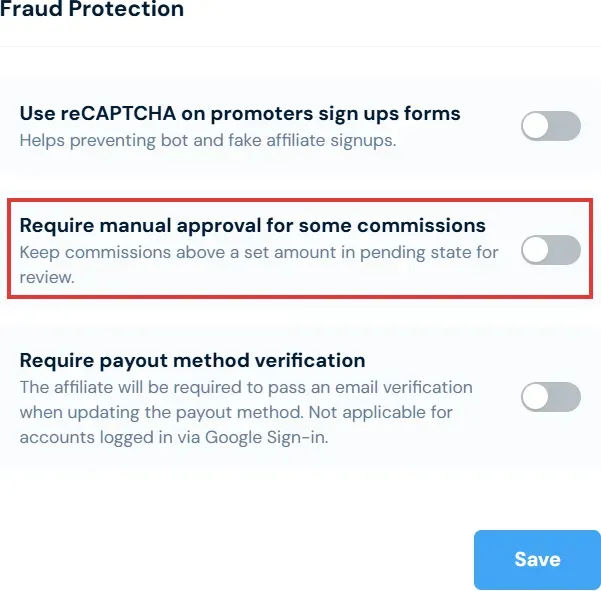
Inside FirstPromoter, manual approval keeps commissions above your chosen amount pending review. (Image source: FirstPromoter)
FirstPromoter pros
-
Stripe, Paddle, Chargebee, Recurly and Braintree integrations
-
Starter includes three campaigns and 1,000 affiliates
-
Commission length can follow months or payment counts
FirstPromoter cons
-
Starter's affiliate-revenue ceiling is $5,000/month
-
Direct one-click PayPal payouts need Business or Enterprise
-
Managed Auto Payouts requires Enterprise 2+ and approval
FirstPromoter is the option I'd choose when the reward offer needs more shaping than “pay a percentage forever.” You can limit recurring commissions by time span or payment count, so a twelve-month offer doesn't have to turn into a lifetime obligation.
Its billing-provider range also gives you more room to work with an existing SaaS stack. Starter includes three campaigns: useful if you're separating customer referrals from professional affiliates without immediately buying the next tier. I like the manual-approval threshold in its Fraud Protection settings, too. Large commissions can wait for review while smaller ones follow the normal process.
I switched its public pricing selector between yearly and monthly. Starter changed from $490 a year to $49 a month, but the $5,000 monthly affiliate-revenue allowance stayed put. At $6,000 of monthly referrals, you'll need Business even if your affiliate count is still small.
Things I Noted — FirstPromoter
FirstPromoter has three meaningfully different payment routes. Mass-payout methods appear across plans; direct one-click PayPal needs Business or Enterprise plus a PayPal Business account with Payouts API access. Managed Auto Payouts goes further: it requires Enterprise 2 or higher, a SaaS business and account approval.
That last requirement is easy to miss because the pricing matrix groups Enterprise together. I wouldn't buy the entry $149 Enterprise plan on the assumption that fully managed distribution is included. Choose FirstPromoter for its reward controls and billing fit; skip it if your main requirement is outsourced payouts at Starter pricing.
FirstPromoter pricing
FirstPromoter pricing: Starter $49/month or $490/year; Business $99/month or $990/year; Enterprise from $149/month or $1,490/year. A 14-day trial requires no card; managed-payout eligibility needs a separate tier check.
3. Tapfiliate: Best for mixed website and checkout setups
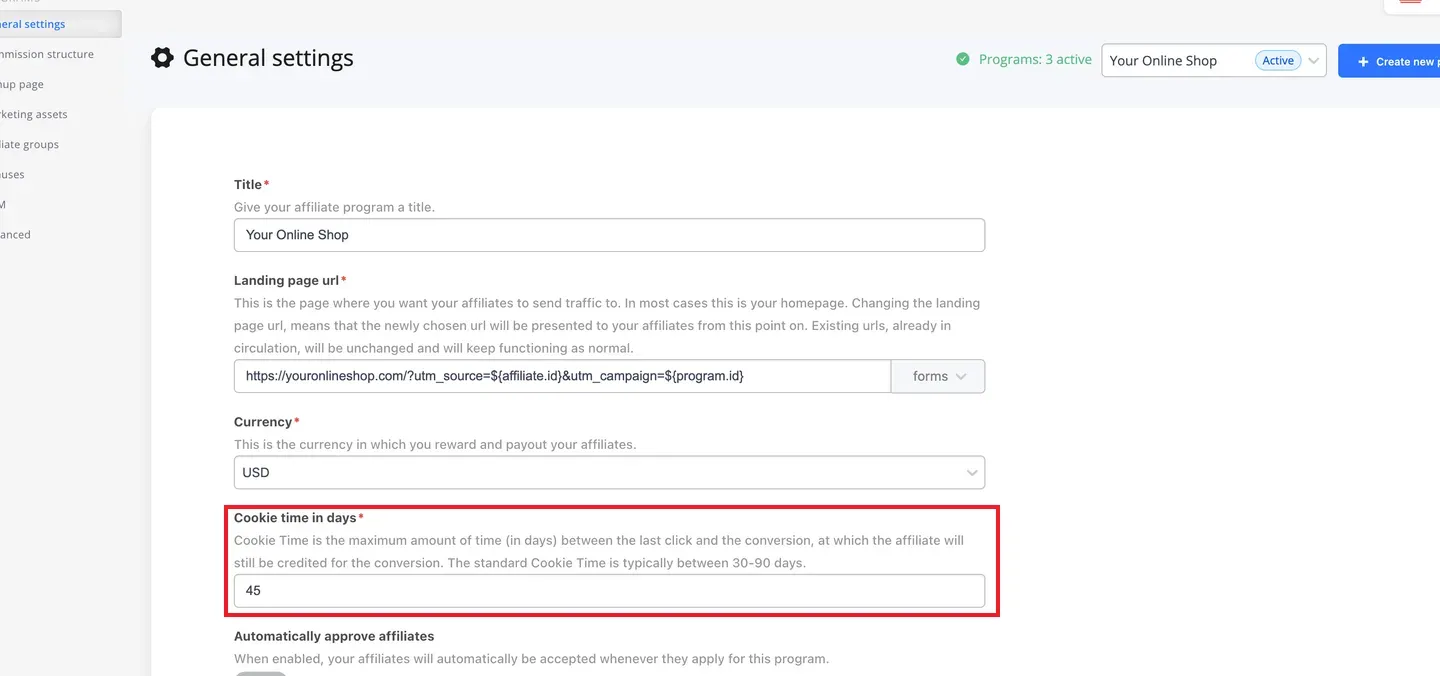
Inside Tapfiliate, Cookie time sets the referral window in days. (Image source: Tapfiliate)
Tapfiliate pros
-
30+ integrations, including Shopify, BigCommerce and Stripe
-
Recurring commissions and coupon tracking on Launch
-
Scale includes unlimited affiliates and programs
Tapfiliate cons
-
Launch caps affiliates at 50
-
Click and conversion allowances can trigger overage charges
-
Automated Trolley payouts require Scale
Tapfiliate is worth a close look if your program has to fit a website and checkout combination rather than a single SaaS billing system. Its prebuilt integrations and developer routes give you options, although the tracking still needs implementing for your actual setup.
Launch is a modest-program plan: one program, 50 affiliates, 5,000 monthly clicks and 500 monthly conversions. I'd use those limits as a launch checklist. If you're recruiting 100 partners from day one, Scale is the relevant comparison even before you consider its automated payouts.
I followed Launch signup to payment activation: the seven-day trial asked for a card or PayPal before starting. I'd have the integration checklist ready before activating it so that short trial goes toward a useful checkout check.
The distinction I like is between commission approval and settlement. Its attribution guide puts commissions through manual approval by default, with automatic approval available. You can review the amount first and then decide how to move the money. Scale adds automated payouts through Trolley; that provider's charges belong in the payment budget.
Things I Noted — Tapfiliate
Tapfiliate's attribution guide gives an assigned coupon priority over a referral-link cookie. If one partner introduced the buyer and another supplied the code, that rule can change who gets paid. I'd put the priority in your partner terms before recruiting anyone.
Refund handling depends on your connection. Tapfiliate's refund guide gives Stripe, WooCommerce, its Shopify app and Wix automatic adjustments; a basic tracking script or code-based Shopify pixel doesn't receive those refund events. I'd choose the supported smart integration where possible. Skip a script-only setup if you expect refunds to reconcile themselves.
Tapfiliate pricing
Tapfiliate pricing: Launch $89/month or $890/year, with a seven-day trial; Scale $179/month or $1,790/year, with a 14-day trial. Enterprise is custom-priced. Overages and payment-provider fees can apply.
4. Refersion: Best for ecommerce programs with many affiliates
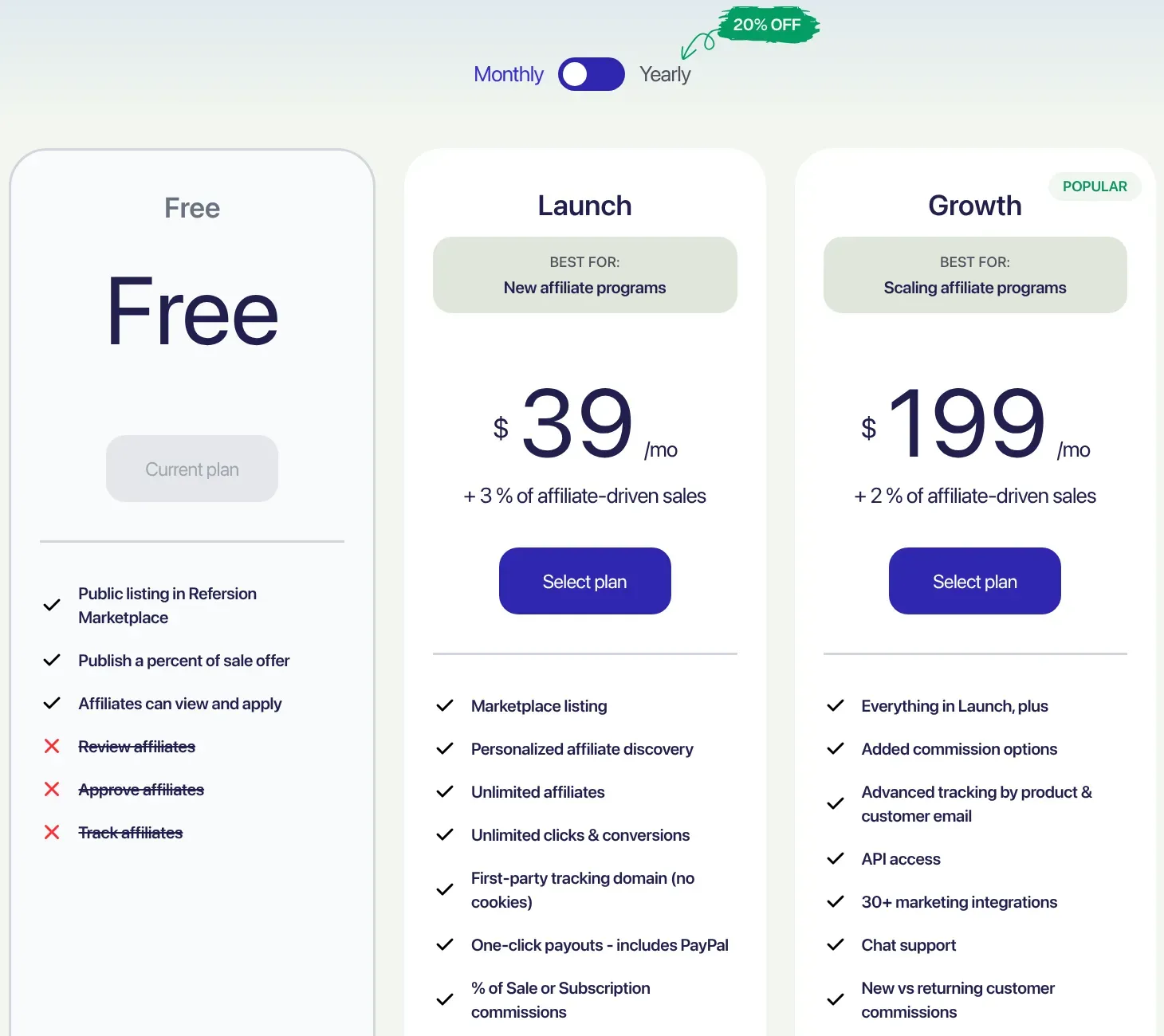
Inside Refersion, editing the default offer from a free account opens the upgrade screen.
Refersion pros
-
Launch includes unlimited affiliates, clicks and conversions
-
Percent-of-sale and subscription commission options
-
Growth adds multi-store management and API access
Refersion cons
-
Launch charges 3% of affiliate-driven sales
-
Growth still charges 2% alongside its subscription
-
Free Marketplace Listing isn't full program management
Refersion is the ecommerce option I'd compare first when partner count is your biggest constraint. Launch lets you add affiliates without a numerical ceiling, and its click and conversion allowances don't create another volume meter to watch.
I created a free Refersion account and opened its default 10% offer without connecting a store. Clicking Edit Offer took me to an upgrade screen. I'd treat the free listing as a discovery option, not a working replacement for the paid management plan.
Launch's model suits a store recruiting a broad mix of smaller creators. You'll pay for the revenue they produce through Refersion's percentage fee, alongside your agreed affiliate commissions. I prefer that trade-off when recruitment is growing faster than sales; it becomes less attractive when a few productive partners drive substantial revenue.
Growth adds a different reason to upgrade: advanced commission options, new-versus-returning-customer rules, product and customer-email tracking, and multi-store management. Those are useful controls if acquiring a first-time buyer deserves a different reward from bringing back an existing customer.
Things I Noted — Refersion
Refersion: the $16,000 monthly sales break-even point
On monthly billing, Launch costs $39 plus 3% of affiliate-driven sales; Growth costs $199 plus 2%. At $16,000 in monthly affiliate sales, both cost $519 before partner commissions, payment fees and taxes. Above that point, Growth's lower percentage can outweigh its larger subscription even if you don't need its extra features.
For example, $20,000 of referred monthly sales means $639 on Launch versus $599 on Growth. I'd run that calculation against your forecast before choosing the cheaper-looking plan. Skip Refersion if a percentage of sales is a deal-breaker; unlimited affiliates won't remove that expense.
Refersion pricing
Refersion pricing: Launch $39/month plus 3% of affiliate-driven sales; Growth $199/month plus 2%; Scale uses custom flat monthly pricing. Annual discounts are available. The free Marketplace Listing covers discovery and applications, not the full paid management feature set.
5. impact.com: Best for larger partnership operations
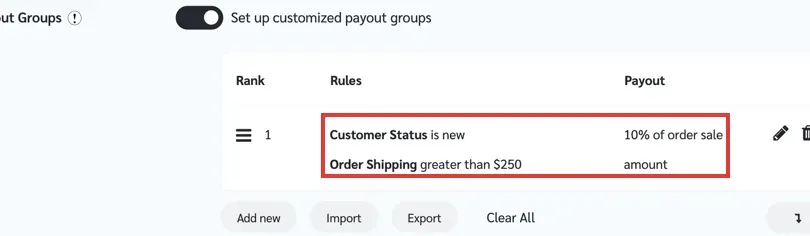
Inside impact.com, payout groups tie a commission to conditions such as customer status and shipping amount. (Image source: impact.com)
impact.com pros
-
Essentials combines marketplace access and multi-domain programs
-
Contract terms separate commission rules from payment timing
-
Pro adds API tracking and custom commission rates
impact.com cons
-
Starter is restricted to supported ecommerce platforms
-
Higher plans carry much larger fees and contract commitments
-
Partner commissions still need funding separately
impact.com is my pick when you're building a partnership operation with formal contracts, several partner types and a team to manage it. I wouldn't choose it solely because the entry price looks lower than a lightweight SaaS affiliate tool.
Starter and the higher plans serve different buying situations. Starter supports a named list of ecommerce platforms and uses a minimum-or-percentage model. Essentials starts at $500 a month and adds marketplace access and multi-domain programs; Pro adds API tracking and custom commission rates at a substantially higher price.
The contract workflow is what earns the extra attention. Template Terms organize the payout conditions and payment schedule partners accept. I like that structure when you're juggling different commercial arrangements: the reward is attached to an agreement instead of living only in a spreadsheet beside your dashboard.
Things I Noted — impact.com
In the template-terms guide, payout groups operate at the same level as the default payout. An SKU-based condition can therefore affect the whole order if the default is order-level. I'd check that setting before assuming a special product commission applies only to one item.
The budget also needs care. Essentials' $2,500 monthly payout-volume allowance doesn't supply $2,500 of free affiliate commissions: you still fund partner payments. Higher-tier onboarding services are available at $250 an hour, and the pricing FAQ sets out a twelve-month contract. I'd skip this route for a simple program whose main goal is to reduce monthly administration cheaply.
impact.com pricing
impact.com pricing: Starter charges the greater of $30/month or 2.5% of monthly revenue associated with locked partner costs; a card is required. Essentials starts at $500/month, Pro $2,500/month and Enterprise $10,000/month. Confirm implementation and payout-volume costs for the selected agreement.
What will the same SaaS program cost?
Rewardful and FirstPromoter cost the same at two of these workloads, but their different Starter revenue caps create a $500 annual gap in the middle.
I calculated a Stripe SaaS program with 100 affiliates, one campaign and basic recurring percentage commissions. Each scenario holds the stated affiliate-attributed revenue constant for twelve months. Both tools support that affiliate and campaign count on the selected plans. These are annual prepaid software charges in USD, checked October 23, 2026.
| Monthly attributed revenue | Rewardful plan / annual software charge | FirstPromoter plan / annual software charge | Annual partner commissions at 20% |
|---|---|---|---|
| $4,000 | Starter / $490 | Starter / $490 | $9,600 |
| $6,000 | Starter / $490 | Business / $990 | $14,400 |
| $12,000 | Growth / $990 | Business / $990 | $28,800 |
The commission pool is monthly attributed revenue × 12 × 20%. It's payable to affiliates in addition to the software charge. Taxes and the fees of your chosen payment method are extra; managed payout services, custom branding and private-campaign requirements are excluded from this comparison.
At $6,000, I'd favor Rewardful on price if its billing integration and one campaign are enough. FirstPromoter's extra campaign capacity or billing-provider support can still be worth the difference. I haven't included the ecommerce plans here because a shared “affiliate software” label doesn't make them equivalent SaaS configurations.
Check your existing platform before adding another tool
Your checkout may already cover a small referral program. Shopify merchants should compare Shopify Collabs with a separate affiliate app; its automatic commission payments carry a 2.9% processing fee. That percentage applies to commissions, unlike Refersion's percentage of affiliate-driven sales.
A CRM can hold partner contacts and qualified opportunities, but you'll still need a reliable connection between the sale, commission and refund. For a handful of partners, an agreed coupon scheme and a reconciled spreadsheet may be enough initially. I'd move to dedicated software when recurring commissions, overlapping referrals or payment reconciliation start consuming regular staff time.
LeadDyno is another option worth considering for a straightforward ecommerce program. Its Lite plan starts at $49 a month for 50 active affiliates, so compare that active-partner allowance with Refersion's unlimited count and revenue fee.
Which affiliate software should you choose?
Choose by the decision that'll be hardest to change after partners join:
| Your scenario | My pick and deciding factor |
|---|---|
| You're starting a Stripe subscription program | I'd start with Rewardful and check the revenue tier against your forecast. |
| You need more campaign and reward flexibility | FirstPromoter is my choice, especially when its billing integrations fit your stack better. |
| Your website and checkout need flexible integration | Look at Tapfiliate, then test coupon priority and refund reconciliation before launch. |
| You want lots of ecommerce affiliates | Compare Refersion's unlimited counts against the revenue fee at your expected sales volume. |
| You need formal contracts and a broader partner operation | Budget for the relevant impact.com tier, implementation and funded payouts together. |
Before inviting partners, use a synthetic checkout test to check one sale, a recurring charge where relevant, a refund and a competing coupon/link. Record the expected commission first. That small acceptance check will tell you more about your configuration than another feature-list comparison.