
 Updated: October 12, 2026
 26 min read
Key takeaways
- An exported record generally uses one data credit, while views are a separate meter and Professional's included allowance was not publicly established; list size alone therefore cannot predict export cost.
- The free-access paths carry different exchanges: Lite Standard does not require contact sharing, Community Edition trades connected-source or data contribution for a larger allowance, and the typically seven-day trial is not documented to convert automatically to Lite; buyers should not treat 'free' as one uniform data-sharing or transition policy.
- CRM/MAP destinations, the Enterprise API, the Zapier app, and selected WebSights webhooks are distinct integration layers; their existence does not establish identical package access, directionality, writable objects, or economics, so each quote needs endpoint and field-level validation.
- Our static inspection of the public Chrome extension found broad page scope, DOM injection, and AED visibility, but did not find LinkedIn-cookie transfer or an action engine; that shipped-code result does not establish authenticated runtime or server behavior, so browser visibility and session custody remain separate questions.
- The local review corpus is historically weighted: 1,220 of 1,595 deduplicated G2, Capterra, and Trustpilot voices date to 2023–2024, while 109 of 116 G2 rows published on June 12, 2024 were rated 4.5–5★; the cluster's origin is unknown, so these local cohorts do not establish a current universal reputation.
This review is published by Linked Helper and written by Milosh Potikj, who works there. I've made every effort to represent ZoomInfo accurately using verified data — our own first-hand testing, ZoomInfo's own documentation, and independently sourced reviews.
ZoomInfo is an enterprise B2B sales-intelligence and go-to-market platform for internal sales, marketing, and RevOps teams. Its documented scope spans contact and company search, enrichment, intent and visitor signals, CRM/API routing, AI assistance, and email/call workflows. Paid numeric pricing is not publicly disclosed. Total cost can depend on packages, authorized users, connectors, contract terms, and several meters (current package data). ZoomInfo publishes security and privacy controls, but our work did not include logged-in network testing or a controlled accuracy benchmark. It also is not documented as a native automated LinkedIn sender.
Verdict
Evaluate ZoomInfo if proprietary B2B data, intent signals, enrichment, and routing can justify a negotiated enterprise contract. Reconsider it if you need a self-serve price, a short cancellation path, independently benchmarked contact accuracy, or native LinkedIn sequencing.
The case for ZoomInfo is its breadth from data discovery through CRM/API and email/call work. The caveat is commercial and operational. Public paid prices and many allowances remain undisclosed. The agreed Term is generally non-cancellable before expiry, and non-renewal requires action at least 60 days before renewal (license terms; non-renewal instructions). Usability, realized ROI, and data accuracy were not tested, so none is part of this verdict.
| Evaluate when | Reconsider when |
|---|---|
| Negotiated data, signals, routing, and email/call tools fit the job | Public pricing or a short exit path is required |
| The team can validate entitlements and data before signing | Native automated LinkedIn sending is required |
ZoomInfo decision summary
Pros
- Data discovery through export. Company/contact search, enrichment, list building, and export form one documented workflow.
- Intent and visitor signals. Intent, WebSights, and account prioritization can move research signals toward action, subject to package access.
- CRM and programmable access. Named CRM destinations, an enterprise API, Zapier, and selected webhooks cover several handoff routes.
- Email and call orchestration. Engage documents email, calls, manual tasks, scheduling, reply threading, and email-step A/B testing.
- Account-level ICP scoring. Account Fit Score adds predictive account prioritization, although output quality was not tested.
- Free access route. Lite Standard is ongoing, while Community Edition has a separate contribution-based route with a larger allowance.
- Security documentation. Encryption and certification, privacy-rights, and subprocessor information are published, though their audit scope was not independently validated.
Cons
- No public paid price. Packages, seats, connectors, and most allowances are not disclosed together.
- Several capacity meters. Data credits, Bulk Credits, views, AI Action Credits, Talent AI views, and Engage email quotas follow different rules.
- Fixed-term exposure. The agreed paid Term is generally non-cancellable; turning off renewal does not end the current Term.
- A 60-day renewal deadline. An account administrator must act at least 60 days before renewal to prevent auto-renewal.
- Entitlements depend on the deal. API data, connectors, workflows, and allowances can depend on the package or Ordering Document.
- No documented native LinkedIn sender. LinkedIn connection requests appear as manual tasks rather than automated invitation or message steps.
- Accuracy remains unbenchmarked here. Mixed review evidence identifies what buyers should test, but it cannot supply a general accuracy percentage.
ZoomInfo Pricing: Plans, Traps, and Hidden Costs
The headline is quote-only: ZoomInfo's current package data lists paid package names but no numeric public prices. That means a buyer cannot responsibly calculate a monthly equivalent, annual discount, per-seat rate, or representative total from the public page alone.
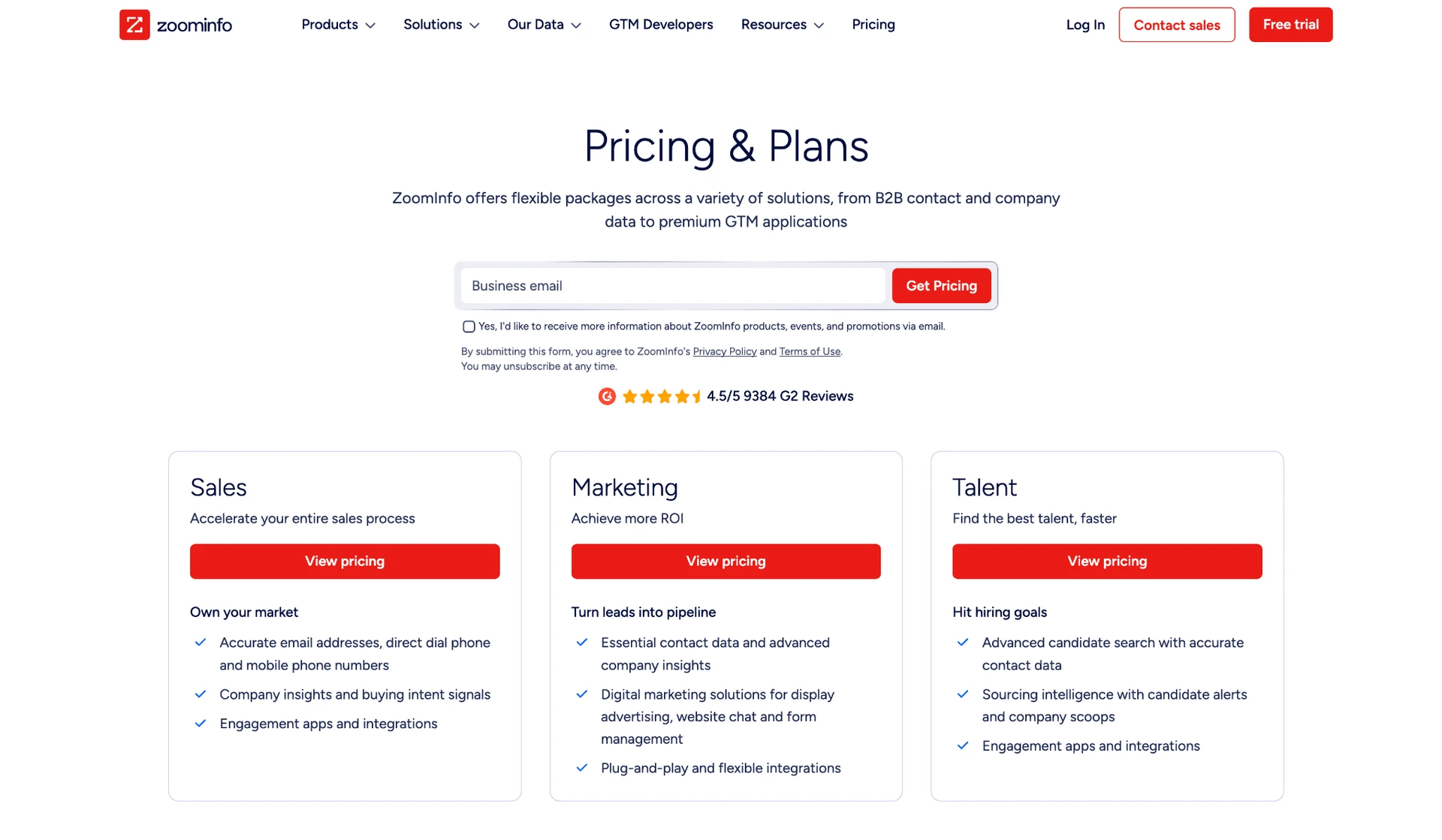
| Package | Published price | Known role | Allowance / entitlement boundary |
|---|---|---|---|
| Professional | Not publicly disclosed | Paid data, search, and export package identified in the pricing materials | Included seats, credits, views, and connectors are not publicly settled |
| Copilot Advanced | Not publicly disclosed | Documented signal, visitor, and workflow tier | Exact AI Action Credits and feature entitlements require the quote |
| Copilot Enterprise | Not publicly disclosed | Enterprise Copilot package | Numeric allowances and contract economics are undisclosed |
| Marketing Demand | Not publicly disclosed | Current Marketing package | Included users, connectors, and meters are undisclosed |
| ABM Lite | Not publicly disclosed | Current ABM package | Numeric price and allowances are undisclosed |
| ABM Enterprise | Not publicly disclosed | Current enterprise ABM package | Numeric price and allowances are undisclosed |
ZoomInfo packages and pricing boundaries (August 2026)
Cost formula: selected package → Authorized Users → connector or add-on quote → relevant data credits and views → AI Action or Talent AI meters → Engage capacity effects → taxes and negotiated payment frequency. These components should be itemized separately because the existence of one meter does not establish that every package charges it in the same way. Pre-packaged integrations may carry a base install/use cost and a minimum Bulk Credit purchase, but that is not documented as a universal setup fee.
The contract trap is exit timing. ZoomInfo's Customer License Terms say the agreed paid Term is generally non-cancellable before expiry; installments do not create monthly cancellation rights. Preventing renewal is a separate action that an account administrator must complete at least 60 days before renewal under the published opt-out process. No general money-back window is published; the terms describe narrower prorated remedies for specified failures.
Price boundary: Current paid numeric pricing is not publicly disclosed. Require the quote to name packages, Authorized Users, connectors, included allowances, every applicable meter, the Term, and the renewal deadline.
There is no defensible repricing trend to show: the evidence contains no two comparable dated public numeric prices for the same current tier.
Search, Contact and Company Data, and Exports
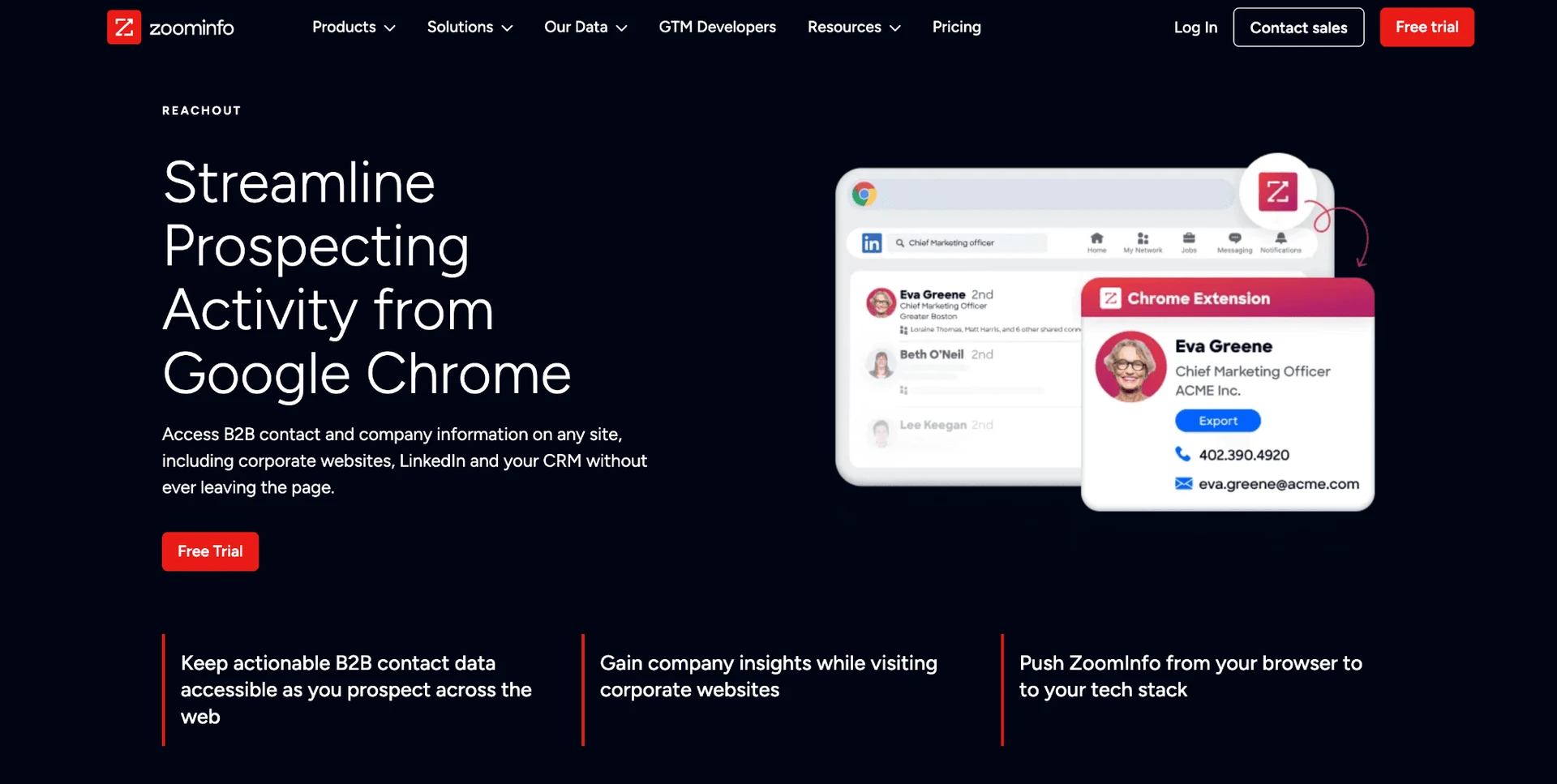
Like most sales-intelligence tools, ZoomInfo documents company and contact search, lists and filters, business email and mobile data, enrichment, and CSV/CRM export. The practical path is search → reveal or enrich → verify for the intended use → export. ReachOut can place company/person context over LinkedIn, company sites, CRM pages, and an inbox, then send data downstream; that overlay is a lookup and enrichment surface, not an automated LinkedIn sender (ReachOut overview).
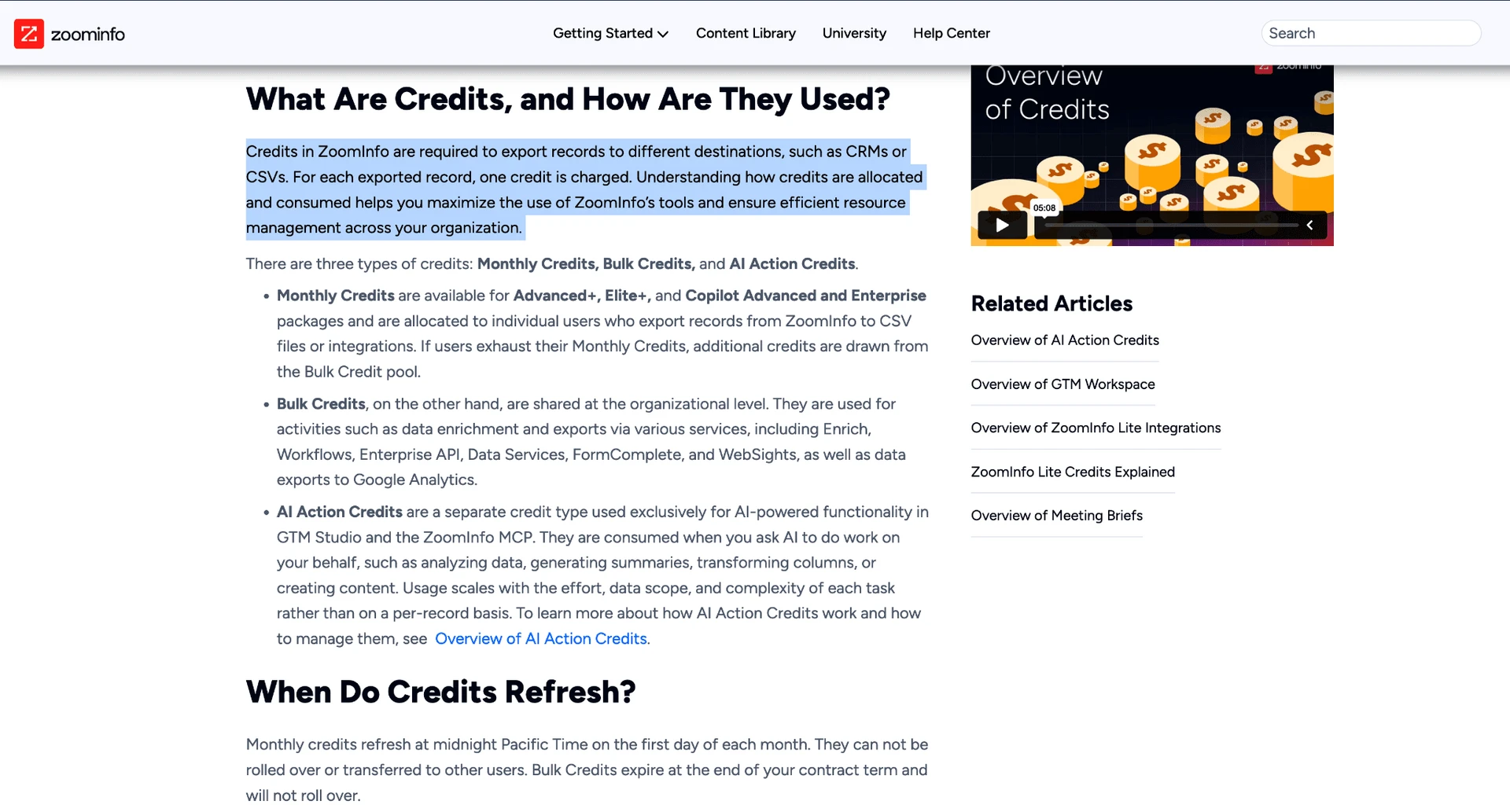
Credits apply at output: the credit documentation says an exported record generally consumes one data credit, while viewing and exporting use separate meters. In practice, list size alone does not reveal export cost: the buyer also needs the package's included allowance, which was not publicly established for Professional.
Business email and mobile lookup are documented in ZoomInfo's current pricing data. Native mass Sales Navigator list scraping, a per-record freshness-date field, badge-field export, and a batch organization-URL-to-decision-maker workflow were not established; those evidence gaps do not prove the capabilities are absent.
No controlled contact-data accuracy, freshness, deliverability, or export-cleanliness benchmark was run. Positive and negative reviews therefore define a test plan—not an accuracy rate. A procurement sample should check email, phone, current employer, geography, freshness, and export cleanliness before a large contract.
Accuracy boundary: The search-to-export workflow is documented, but this research did not run a controlled contact-data accuracy benchmark and cannot assign an accuracy percentage.
Intent, WebSights, Copilot, and Workflow Signals
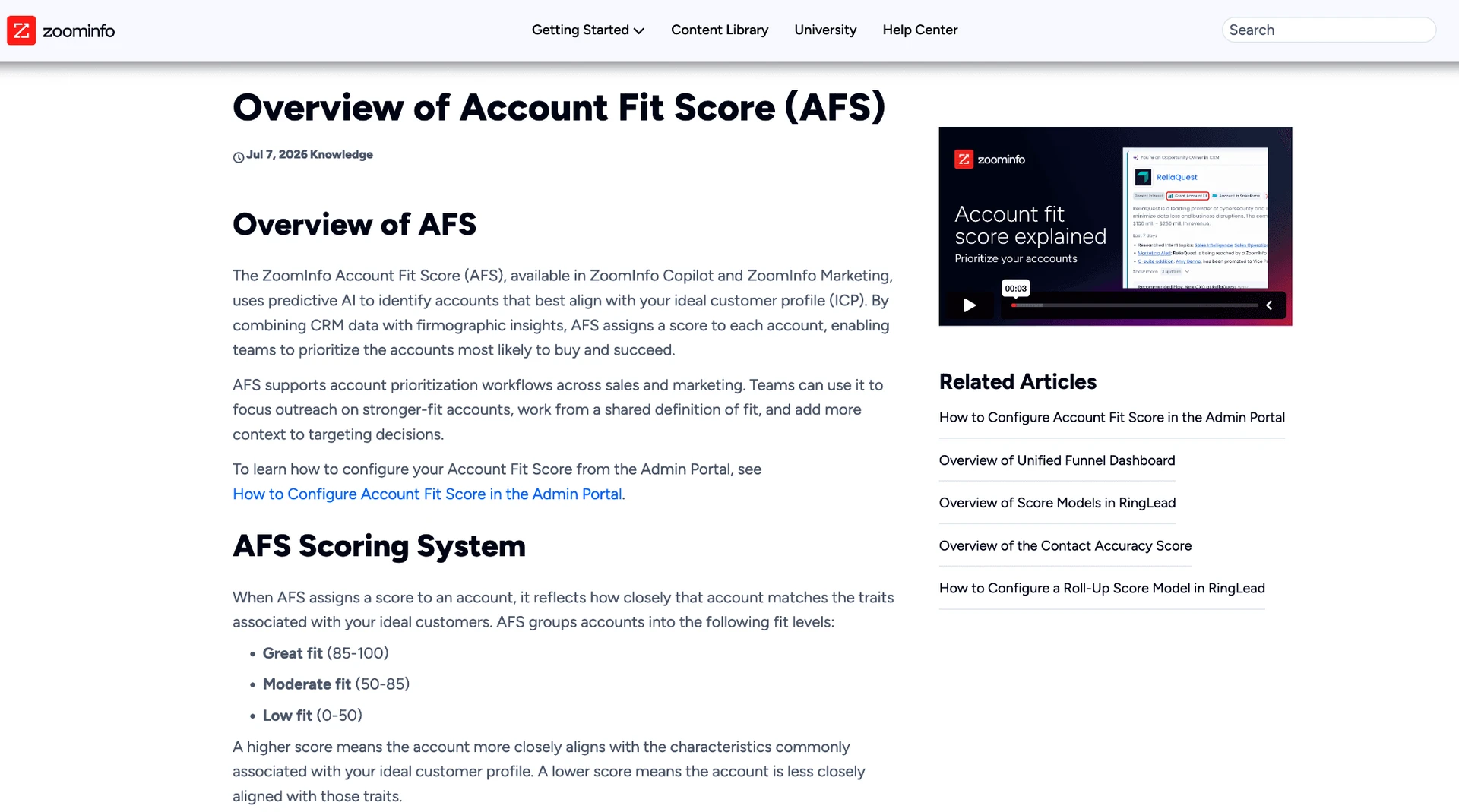
ZoomInfo documents Intent, WebSights visitor identification, Copilot, workflow signals, Account Fit Score, and AI-supported email work. Together they form a signal path: account activity or site visit → identification and prioritization → account context → workflow or handoff. Account Fit Score is specifically account-level ICP scoring, which means it prioritizes companies rather than proving person-level fit (Account Fit Score documentation).
AI availability is not AI performance. Copilot Advanced and Copilot Enterprise are current package names, while GTM Studio uses AI Action Credits. Talent's AI Emailer uses a different view meter: one view per generated email, capped at 100 per day and 2,000 per month in that documented Talent surface (Talent AI Emailer documentation). Those are separate limits; the Talent figures should not be carried over to every Copilot or GTM Studio workflow.
The underlying model providers, complete package entitlements, AI Action Credit burn, and output quality were not publicly established or tested. AI drafting is documented for email, but native AI-generated LinkedIn invitations, messages, post comments, or boost-post tagging are not documented because no native LinkedIn execution engine was established. Nested personalization logic and company/name-normalization audit behavior were also not established; that uncertainty is not proof of absence.
Entitlement boundary: The signal and AI capabilities are documented, but exact package access, credit burn, and output quality were not verified in a logged-in workspace.
Engage Email, Call, and Manual Tasks
The closed action set documented for Engage Salesflows and Talentflows is: automated email, manual email, calls, manual tasks, intervals, schedules, reply threading, and email-step A/B testing. The Salesflow instructions also represent a LinkedIn connection request as a manual Other task. In practice, Engage can coordinate a rep's email/call work, but it is not documented as executing the LinkedIn invitation itself.
| Mechanic | Documented limit or behavior | Decision implication |
|---|---|---|
| Email sending | Up to 500 emails per day; overflow queues to the next day | A larger queue does not increase same-day send capacity |
| Active flow population | Up to 1,000 active contacts plus 5,000 waiting in one Salesflow | Waiting capacity and active capacity are separate |
| Talent AI Emailer | 100 generated emails/day and 2,000/month in the documented Talent surface | These Talent view limits do not establish every Engage or Copilot allowance |
| LinkedIn connection | Manual Other task | The rep, not a documented native sender, performs the LinkedIn action |
ZoomInfo Engage documented limits (August 2026)
Several controls remain unresolved. Full workflow branching and ordinary stop-on-any-human-reply were not confirmed; the evidence documents out-of-office pause/resume, no-reply follow-up, and removal on an action. A separate unified Engage inbox was not established, while documented replies return to connected Gmail or Microsoft 365. Concurrent-flow maximums, sending-inbox allowances, and Professional/Engage package gates were not publicly settled.
Because no native LinkedIn action engine was documented, native invite cancellation/re-inviting, message-history regex filters, Recruiter-to-regular-LinkedIn execution, skill endorsements, post-engager collection, and automated LinkedIn comments were likewise not documented. This defines the verified action boundary; it does not establish what an unobserved future or private product surface could do.
LinkedIn boundary: LinkedIn connection requests are documented as manual tasks, not native automated steps; no native automated LinkedIn invitation or message action was established.
CRM, API, Zapier, and Package-Dependent Integration Gates
ZoomInfo documents named CRM and marketing destinations including Salesforce, HubSpot, Dynamics, Pipedrive, Zoho, SugarCRM, and Bullhorn. It also documents an enterprise API, a native Zapier app, and selected product-specific webhooks (integration inventory; Zapier directory). The exact native-integration count was not established, so no total is printed.
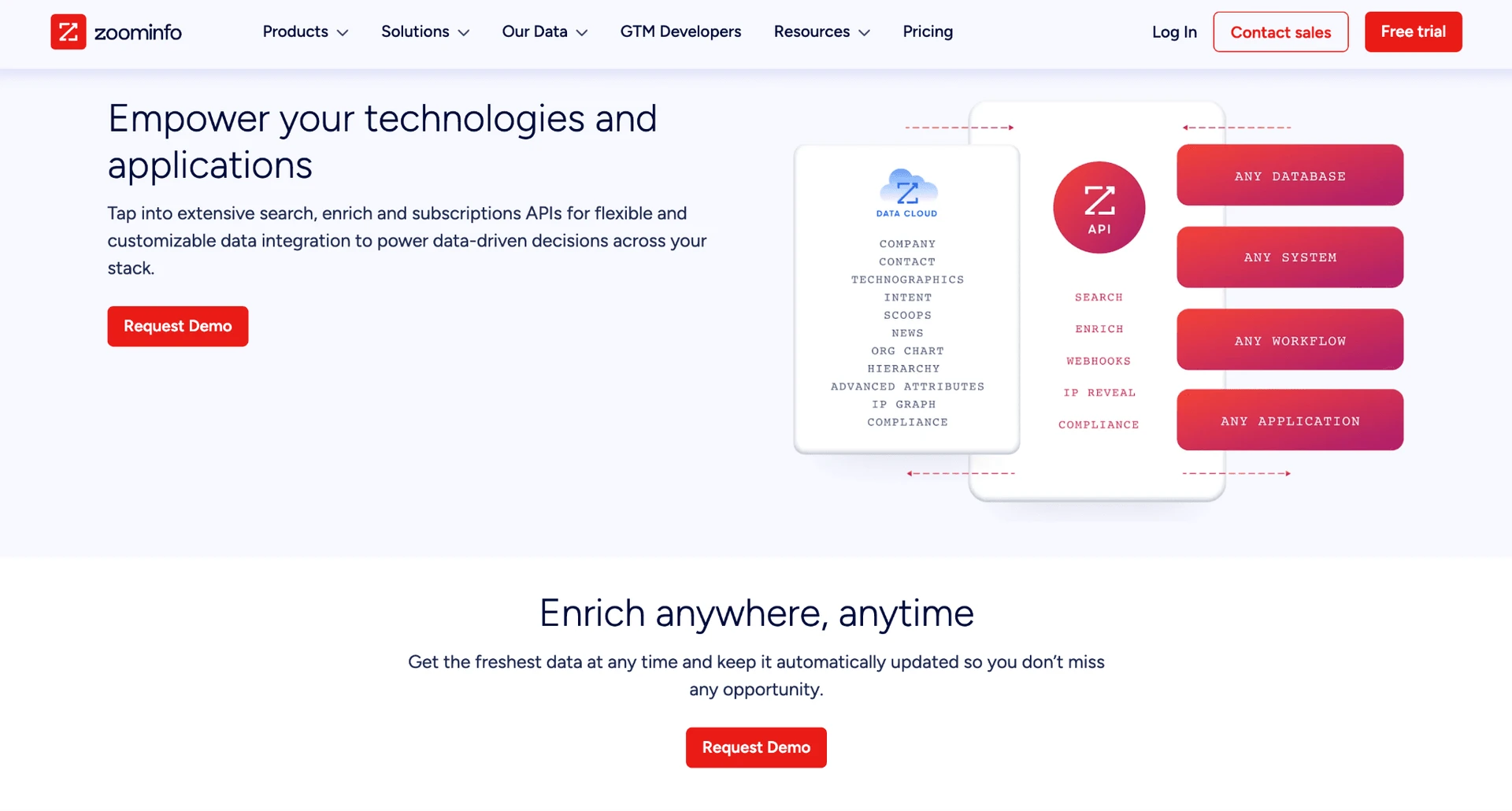
The layers are distinct: CRM/MAP connectors handle packaged destinations; the Enterprise API exposes search, enrichment, and subscription-oriented access; Zapier supplies partner-listed actions; and WebSights webhooks cover a selected workflow. A webhook in one product does not establish universal inbound and outbound webhook access across the portfolio.
| Layer | Verified | Not established in live testing |
|---|---|---|
| CRM/MAP | Named destinations exist | Connector price, OAuth flow, mappings, directionality, writable objects, errors, and recovery |
| API | Access was announced for customers including trials | Which endpoints and data each package receives, plus successful authenticated execution |
| Zapier | Native app and listed actions exist | Customer-specific entitlement and economics |
| Webhooks | Selected WebSights/workflow use exists | Universal availability and inbound profile-URL campaign feeding |
ZoomInfo integration evidence boundary (August 2026)
Make support, post-sequence late-reply resync semantics, identifier-cascade merge logic, and full message-thread CSV export were not established. These are evidence gaps, not proof of absence. The API announcement also keeps endpoint and data access package-dependent (access announcement), which means “API included” is not enough for procurement without an endpoint schedule.
Live-fire boundary: Integration existence is documented; connector pricing, mappings, directionality, writable objects, error handling, recovery, and live success were not tested.
Credit, View, AI, Email Meters, and Total Cost
ZoomInfo does not have one interchangeable “credit” pool. Its credit documentation, pricing materials, and product help describe at least six operational meters with different units and clocks.
| Meter | Known behavior | Economics or boundary not established |
|---|---|---|
| Monthly Credits | An exported record generally consumes one; monthly balances reset and fall back to organizational Bulk | Professional included allowance and universal overage price |
| Bulk Credits | Organizational pool; expires at contract end | Generic public pack price and package minimums outside specified connectors |
| Views | Separate from export credits | Included view allowance by package |
| AI Action Credits | Used by GTM Studio AI actions | Exact burn by action and package allowance |
| Talent AI views | One per generated email; 100/day and 2,000/month in the documented Talent AI Emailer | Applicability outside that Talent surface |
| Engage email and flow limits | 500 emails/day; overflow queues to the next day; 1,000 active contacts plus 5,000 waiting per active flow | Sending-inbox allowance and package gate |
ZoomInfo operating meters (August 2026)
Reset is not rollover. Lite monthly credits reset and do not carry forward; organizational Bulk Credits have a contract-end expiry; over-limit Engage email moves into the next day's queue. Views and AI actions use other rules. That means unused capacity in one meter cannot be assumed to cover a shortage in another.
The same separation matters for total cost. A quote may combine licenses or Authorized Users, features, add-ons, integrations, data credits, views, AI actions, email capacity, negotiated payment frequency, and taxes (current pricing data). Without each allowance and unit price, a base package quote is not a full operating-cost model.
TCO boundary: Monthly Credits, Bulk Credits, views, AI Action Credits, Talent AI views, and email capacity are separate meters; no single unit price represents total throughput.
ZoomInfo Lite, Community Edition, and Trial Transition
ZoomInfo has three distinct low-commitment access paths, and they should not be blended.
| Path | Documented exchange | Known allowance | Unresolved boundary |
|---|---|---|---|
| Lite Standard | Ongoing free access without required contact sharing | 10 starting credits; Reveal costs 1 credit; balances reset monthly and do not roll over | Current later monthly allowance is undisclosed |
| Community Edition | Connected-source or data contribution in exchange for a larger allowance and additional functions | Larger than Standard, but no current exact ongoing allowance established here | Eligibility and full contribution scope |
| Free trial | Typically 7 days, no card, business-email verification; ends automatically | Package and numerical allowance are undisclosed | No documented promise of automatic transition to Lite |
ZoomInfo Lite, Community Edition, and trial (August 2026)
The Lite and Community Edition FAQ supports the ongoing free routes and their different value exchanges. Standard access does not require contact sharing; Community Edition offers more allowance in exchange for connected-source or data contribution. That distinction matters because “free” does not describe one uniform data-sharing arrangement.
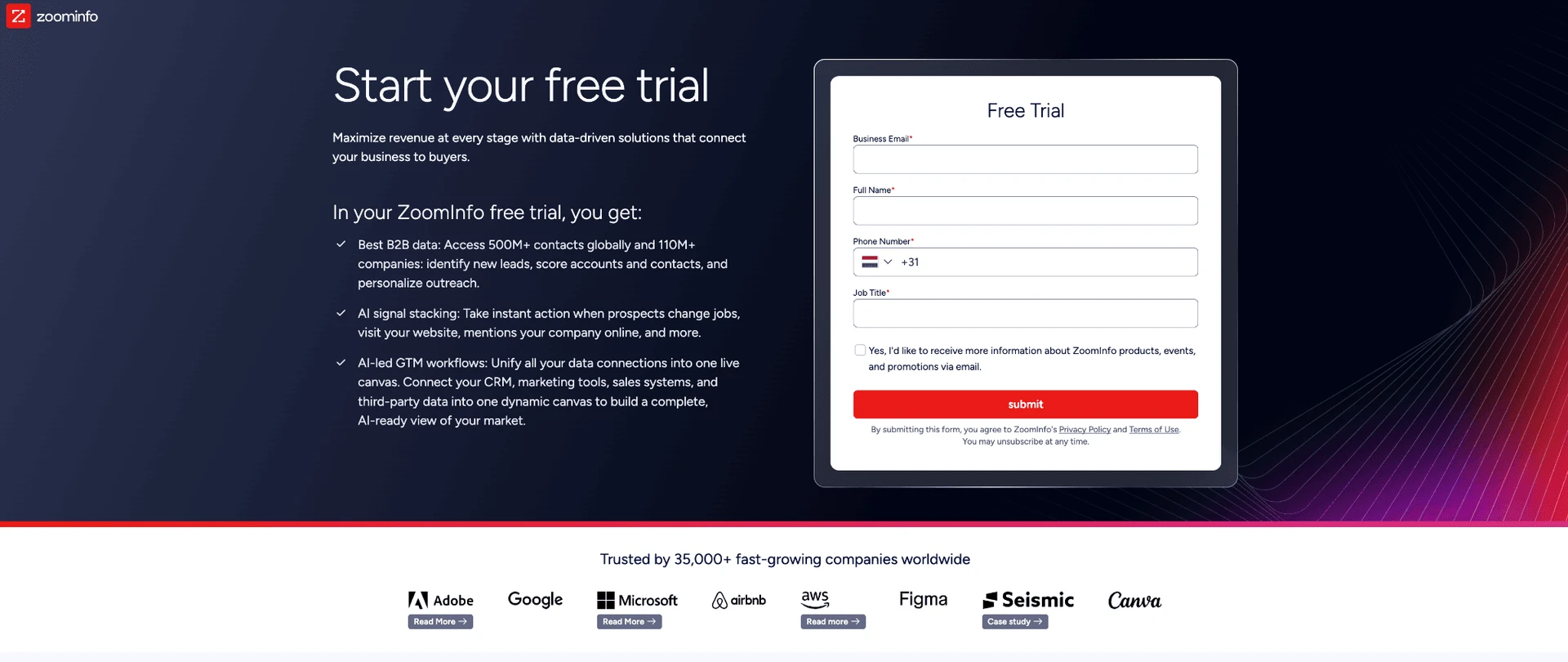
The trial page says the trial is typically seven days and no-card, so the duration qualifier must remain. It ends automatically, but the evidence did not establish a promised trial-to-Lite transition or settle every former-trial eligibility edge case.
Transition boundary: A typically seven-day trial does not document an automatic conversion to ZoomInfo Lite; Standard and Community Edition also have different contribution terms.
Chrome Extension Architecture, Permissions, and Live-Evidence Boundary
ZoomInfo's architecture spans cloud web, API, integrations, mobile access, and a browser-local overlay. The cloud core does not require a user's computer to remain on. The overlay operates while the relevant browser page is open. The public ZoomInfo Chrome extension was inspected statically at version 12.14.6.
| Evidence class | Finding | What it means |
|---|---|---|
| Observed | Manifest V3; contextMenus, cookies, sidePanel, storage, tabs, webNavigation, and <all_urls> scope with exclusions | The package can observe broad page context and maintain ZoomInfo-side state |
| Observed | Local DOM/page-context capture, ZoomInfo enrichment, DOM injection, and access to the ZoomInfo ziaccesstoken on ZoomInfo origin | The overlay can read page context and authenticate to ZoomInfo; this is not by itself evidence of LinkedIn session transfer |
| Not found in static strings/flows | li_at, li_a, JSESSIONID, LinkedIn-cookie upload, Voyager replay, connect/message actions, or a campaign scheduler | Static inspection did not establish those mechanisms; absence from static code is not proof they cannot occur dynamically or server-side |
| Cannot prove | Authenticated network behavior, server processing, payload retention, session revocation, or dynamically constructed access | Those questions require logged-in runtime testing |
ZoomInfo Chrome extension static evidence (v12.14.6)
The extension ID also appeared in the local Active Extension Detection (AED) reference. AED is the label used for LinkedIn's page-code probes of specific browser-extension IDs: if an ID is probed, installation can be visible before an extension performs an action. This is a visibility signal, not an enforcement verdict (how extension probing works).
Static-only evidence: Permissions and source strings show capability and shipped-code evidence; they do not establish authenticated transmission, retention, server behavior, or universal absence of dynamically constructed behavior.
Is ZoomInfo Safe? Security, Privacy, and Data-Subject Risk
ZoomInfo's safety answer is not one score. Enterprise security, data-subject privacy, browser-extension custody, and LinkedIn action risk are different domains, each with a different evidence boundary.
| Risk domain | What is documented or observed | What remains unverified |
|---|---|---|
| Enterprise security | Vendor states AES-256 at rest, TLS 1.2+ in transit, salted SHA-256 password hashes, ISO 27001/27701, TRUSTe, and SOC 2 Type II | Independent validation of certificate and audit scope |
| Data-subject privacy | Privacy rights, lawful-basis framing, SCCs, subprocessors, and multi-country processing are published | A customer-executed DPA, customer-specific residency, and live correction/deletion outcomes |
| Browser extension | v12.14.6 statically showed broad page scope, DOM injection, ZoomInfo-auth cookie access, and AED visibility; no LinkedIn-cookie upload or action engine was found | Authenticated cookie/network behavior, retention, server behavior, and dynamically constructed access |
| LinkedIn actions | No native automated LinkedIn invitation/message sender was documented; connection requests appear as manual tasks | No ZoomInfo restriction rate can be inferred, and no cloud-IP test applied without a LinkedIn execution bridge |
ZoomInfo security, privacy, extension, and LinkedIn-risk boundaries
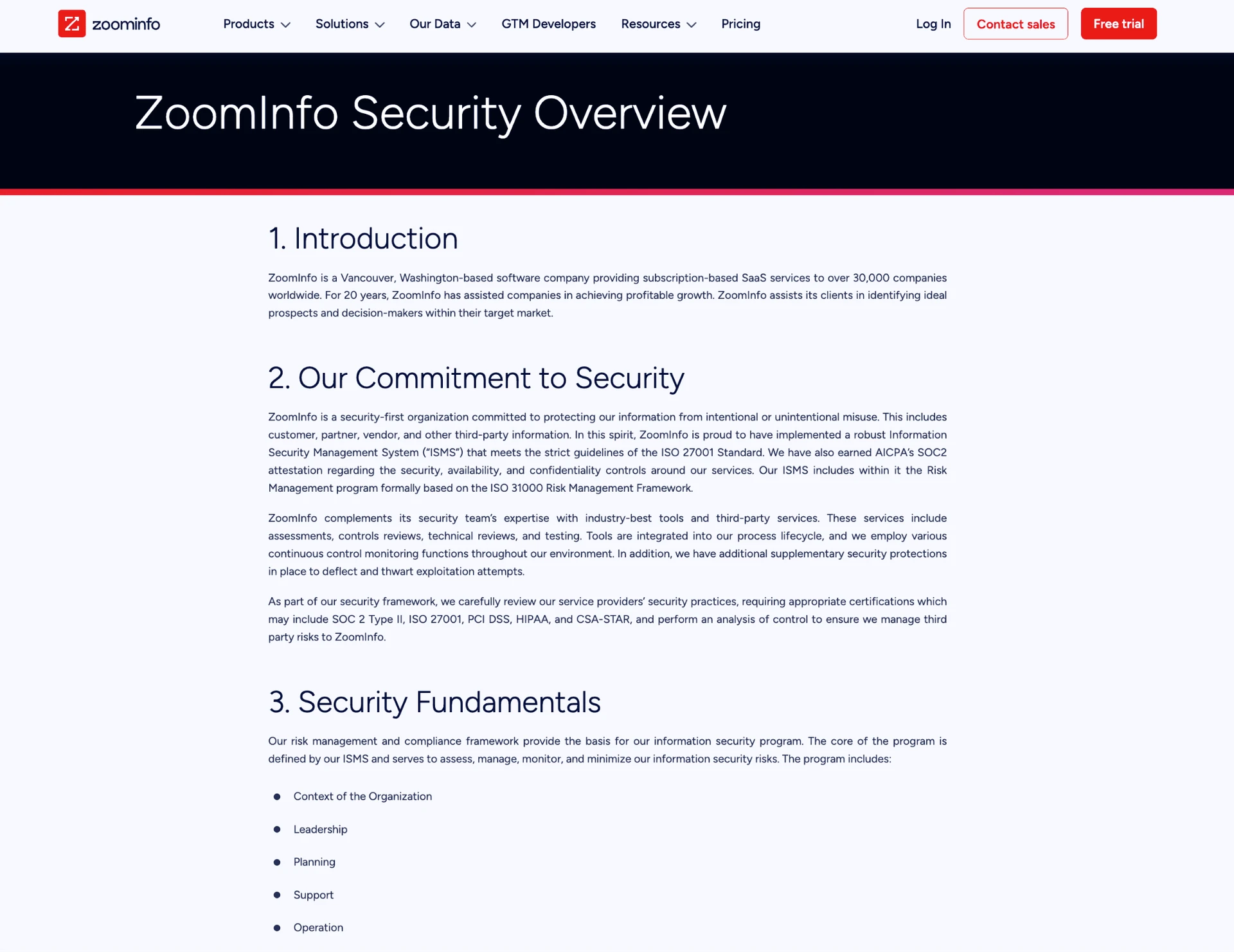
Published controls: ZoomInfo's security overview states the encryption and certification controls above. These are vendor claims; we did not independently validate audit scope. The existence of security documentation therefore supports a procurement review, not a blanket trust conclusion.
Privacy and residency: the privacy policy and subprocessor list describe rights processes, transfers, and a multi-country processing footprint. In practice, a buyer should map where each data flow goes rather than assume US-only residency. The public provider-DPA material does not establish the customer-executed DPA offered in a particular contract.
Data-subject path: identify the record → use the published rights/correction channel → verify the requested correction or deletion → retain evidence of the outcome. Complaints about unwanted calls, inaccurate personal details, or consent are reports worth testing; they do not, by themselves, establish causality or a legal violation.
First-hand static finding: I inspected the current v12.14.6 package and observed broad page scope, DOM injection, and ZoomInfo-auth cookie use. I did not find LinkedIn-cookie transfer or a Voyager action engine in the shipped static code. This does not prove what authenticated runtime or server-side behavior may do.
LinkedIn boundary: no cloud-IP test applied because no LinkedIn cloud session or execution bridge was found. Manual behavior can also trigger warnings when people open many profile URLs or act at unrealistic speed; this restrictions explainer gives additional context. No tool eliminates restriction risk.
Risk categories: Enterprise security claims, data-subject privacy, extension permissions, and LinkedIn action risk must be assessed separately; evidence in one domain does not settle another.
What ZoomInfo Reviews and Community Data Actually Show
Each platform is its own cohort. Among reviews dated February 3, 2019 through April 3, 2026, G2 averages 4.69★ across 1,000 raw rows. For that same review window, Capterra averages 4.11★ across 304 raw rows. For that same review window, Trustpilot averages 2.28★ across 293 rows. Those figures cannot be blended into one reputation score. In the combined G2/Capterra/Trustpilot window from February 1 through August 1, 2026, 22 rated rows averaged 1.73★.
After removing two cross-platform duplicate pairs, 1,597 raw rows became 1,595 unique voices: 1,000 G2, 302 Capterra, and 293 Trustpilot. Of those 1,595 voices, 1,220 (76.5%) date to 2023–2024, weighting the corpus toward that historical period. Data-quality sentiment runs both ways; pricing, pricing transparency, reliability, and compliance are cleaner complaint lanes.