
 Updated: August 29, 2026
 26 min read
Key takeaways
- “Unlimited Email Accounts” refers to email-account connection and warmup, while the Terms cap Connected Accounts at 100 per workspace; agencies needing true client isolation also need separately subscribed workspaces, so inbox scale and tenant separation must be budgeted together.
- The AI Sales Agent can be constrained by both shared Instantly Credits and its separate daily send/enrich limit of 10–10,000, with a default of 10. Access to the feature does not reveal its usable volume.
- The local G2 corpus snapshot computed July 29, 2026 averages 4.78★ across 1,000 rated reviews, while the Trustpilot corpus through April 10, 2026 averages 4.02★ across 1,009 rated reviews and includes 212 one-star rows; a blended score would hide that platform split.
- Cancellation and data exit are coupled: product families have separate cancellation paths, while export requires an active main subscription. Buyers should export before expiry and map every service they need to cancel.
This review is published by Linked Helper and written by Ryan Frawley, who works there. Every effort has been made to represent Instantly accurately using verified data — our own first-hand testing, Instantly's own documentation, and independently sourced reviews.
Instantly is a cloud cold-email and outbound platform. Teams can connect multiple sending inboxes, run email sequences, and add lead-search or AI modules as needed. Email Outreach starts at $47 per month, but that price covers one product family. Credits, CRM, Inbox Placement, managed inboxes, domains, and extra workspaces add separate charges. Its documented sending limits, warmup tools, and 5% high-bounce pause help operators manage sender risk. They don’t establish deliverability outcomes or remove spam, compliance, and sender-reputation risk.
Verdict
Instantly's documented scope covers multiple sending inboxes, configurable account and campaign limits, and conditional email automation. It also covers a centralized reply view and optional lead-data or AI products. The default high-bounce pause and documented warmup controls add concrete operational guardrails.
The conditions are cost, channel, and evidence. The $47 Growth plan is not an all-in stack. Credits, CRM, Inbox Placement, managed inboxes, domains, and isolated workspaces sit behind separate products or charges. The Growth plan also doesn’t let you invite teammates. It can preview Unibox without replying there. Instantly can coordinate LinkedIn steps, but paid partner tools execute those actions. Native LinkedIn invitations and messages are not part of the product.
Several outcome questions remain open. Our evidence doesn’t establish inbox-placement rates, lead-data accuracy, AI output quality, or a measured support response time. Current first-party pages also conflict on Growth API and integration entitlements. So the decision depends on whether the confirmed cold-email workflow matches your requirements. Model the additional modules before buying.
Pros
- Multiple sending inboxes: Own Google, Microsoft, or SMTP/IMAP accounts can be connected without a per-inbox slot charge, although the Terms cap Connected Accounts at 100 per workspace.
- Concrete volume controls: Per-account and per-campaign limits, multiple schedules, sender rotation, and a default 5% high-bounce pause give operators several ways to constrain sending.
- Conditional email automation: Automation Builder supports if/else paths with AND/OR conditions, while reply, company-reply, and auto-reply controls can stop follow-ups.
- Modular lead and AI functions: SuperSearch, verification, enrichment, sequence writing, reply handling, and sales-agent actions are available, with separate credit economics.
- Centralized reply view: Like many tools in this category, Unibox gathers replies; the plan comparison places replying inside it at Hyper Growth rather than Growth.
- Agency controls: Custom branding and client access, roles, workspace groups, and audit logs are documented, with separate workspaces available when real client isolation is required.
Cons
- The $47 price is not inclusive: Email Outreach pricing covers one layer; Credits, CRM, Inbox Placement, managed inboxes, domains, and some capacity are separately priced.
- “Unlimited” has a ceiling: The marketed scope is unlimited email-account connection and warmup, while the Terms cap Connected Accounts at 100 per workspace.
- LinkedIn execution is external: Automations hand actions to paid partners such as HeyReach, Aimfox, or Valley; Instantly does not send native LinkedIn invitations or messages.
- Growth gates collaboration: The plan comparison says Growth cannot invite teammates and allows Unibox preview without in-app replies.
- Credit demand is shared: Search, enrichment, verification, and AI actions draw from Instantly Credits. Feature availability alone does not reveal effective usage cost.
- Exit paths are fragmented: Subscriptions follow separate cancellation paths, and data should be exported before the main subscription expires.
- Two plan facts conflict: First-party pages do not settle Growth API V2 access or whether Hyper Growth includes 100,000 or 125,000 monthly emails.
Documented ceiling: The Terms cap Connected Accounts at 100 per workspace. “Unlimited Email Accounts” describes the connection and warmup billing model, not an uncapped workspace.
Instantly Pricing: Plans, Traps, and Hidden Costs
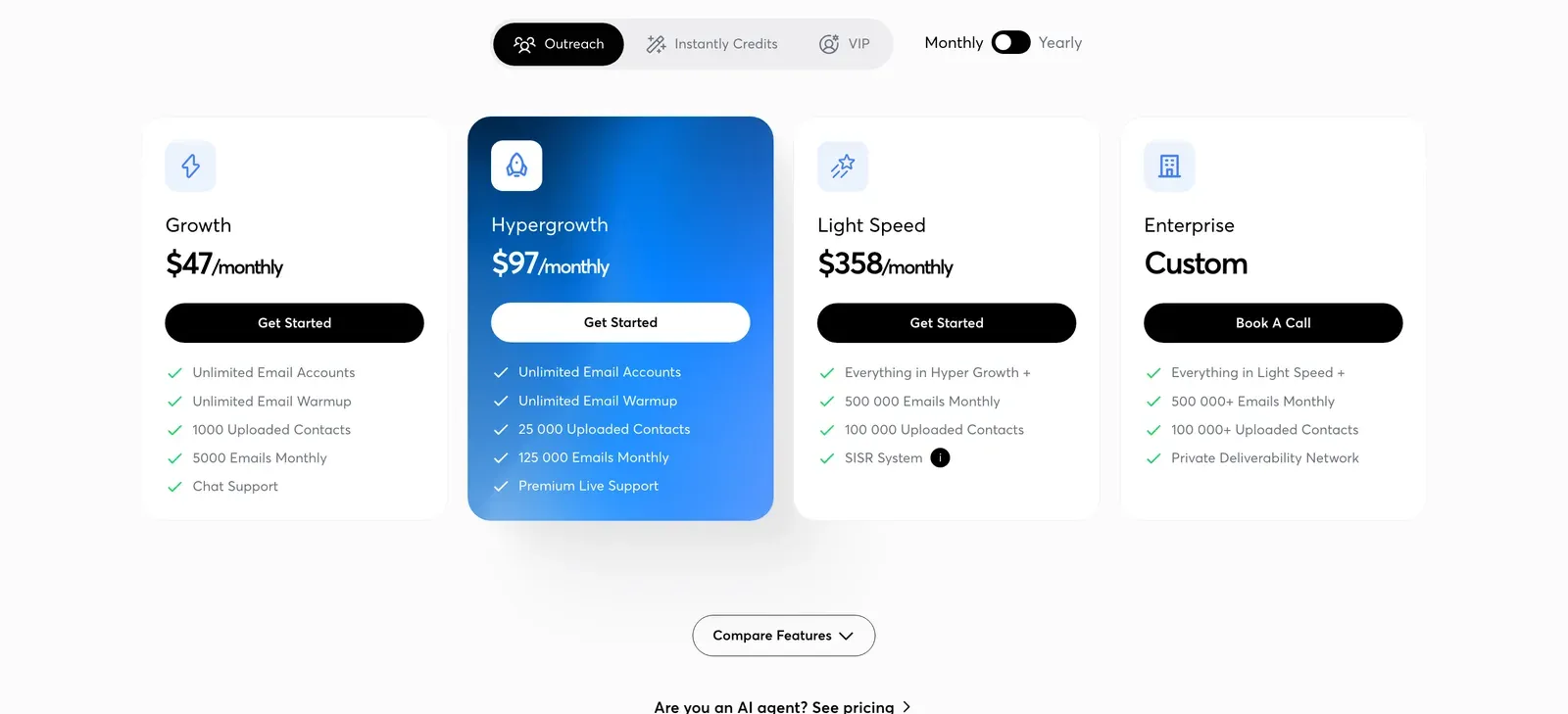
The pattern is modular billing: the July 2026 Email Outreach cards start at $47 per month. Cost also depends on credits, reply handling, inbox testing, domains, managed inboxes, and workspace isolation. The entry card compares email sending; it doesn’t predict every buyer's bill.
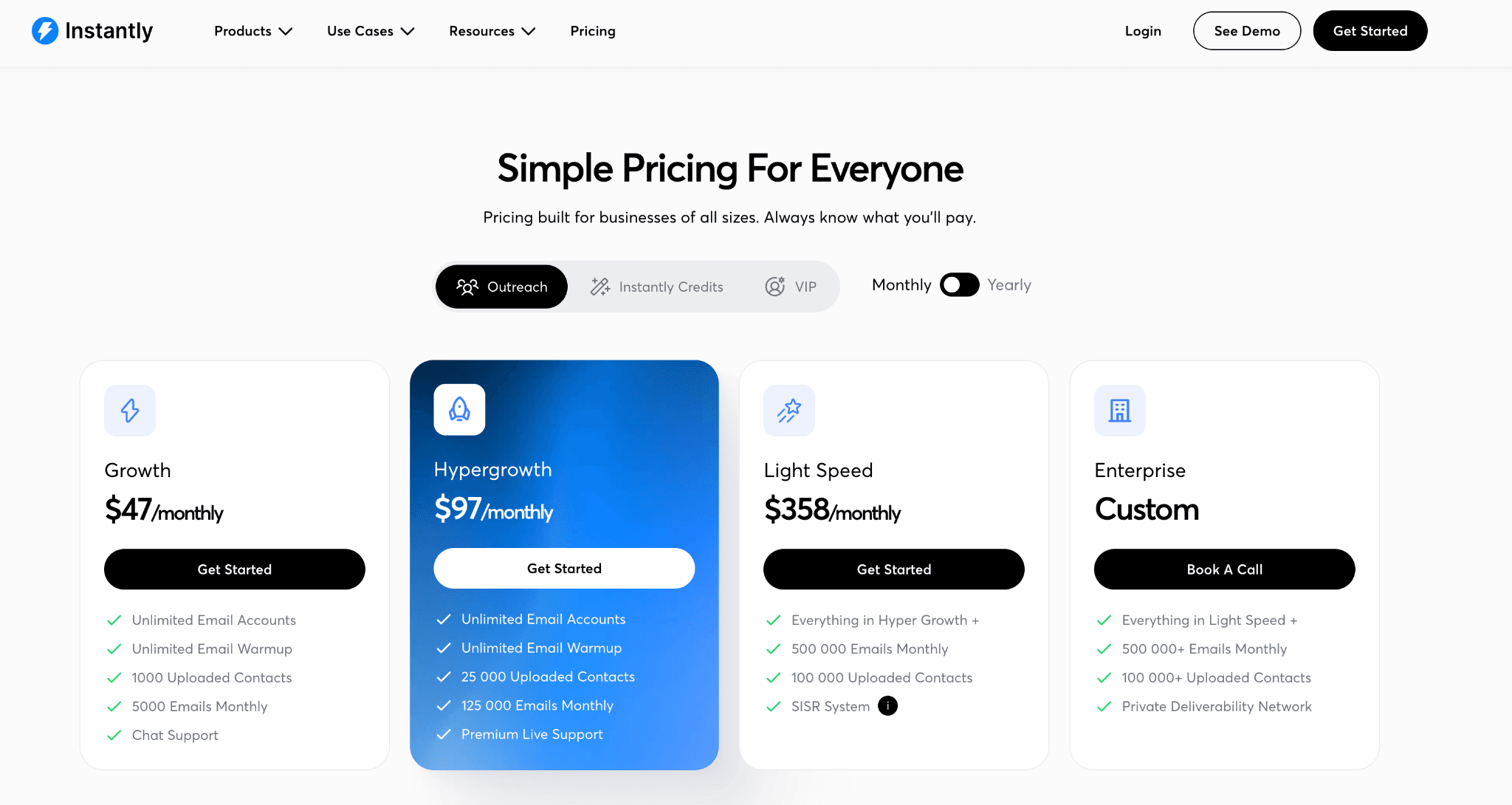
| Plan | Monthly | Annual monthly equivalent | Uploaded contacts | Monthly emails | Verification note |
|---|---|---|---|---|---|
| Growth | $47 | $37.60 | Not established in the reviewed evidence | Not established in the reviewed evidence | Team invites are unavailable; Growth API/integration entitlement remains conflicted |
| Hyper Growth | $97 | $77.60 | Not established in the reviewed evidence | 100,000 or 125,000 in conflicting current first-party pages | Reply from Unibox and teammate access are consistently documented |
| Light Speed | $358 | $286.30 | Not established in the reviewed evidence | Not established in the reviewed evidence | Higher-tier deliverability controls and SISR are documented |
| Enterprise | Custom | Custom | Not established in the reviewed evidence | Not established in the reviewed evidence | A current quote is required |
Instantly Email Outreach pricing tiers (July 2026)
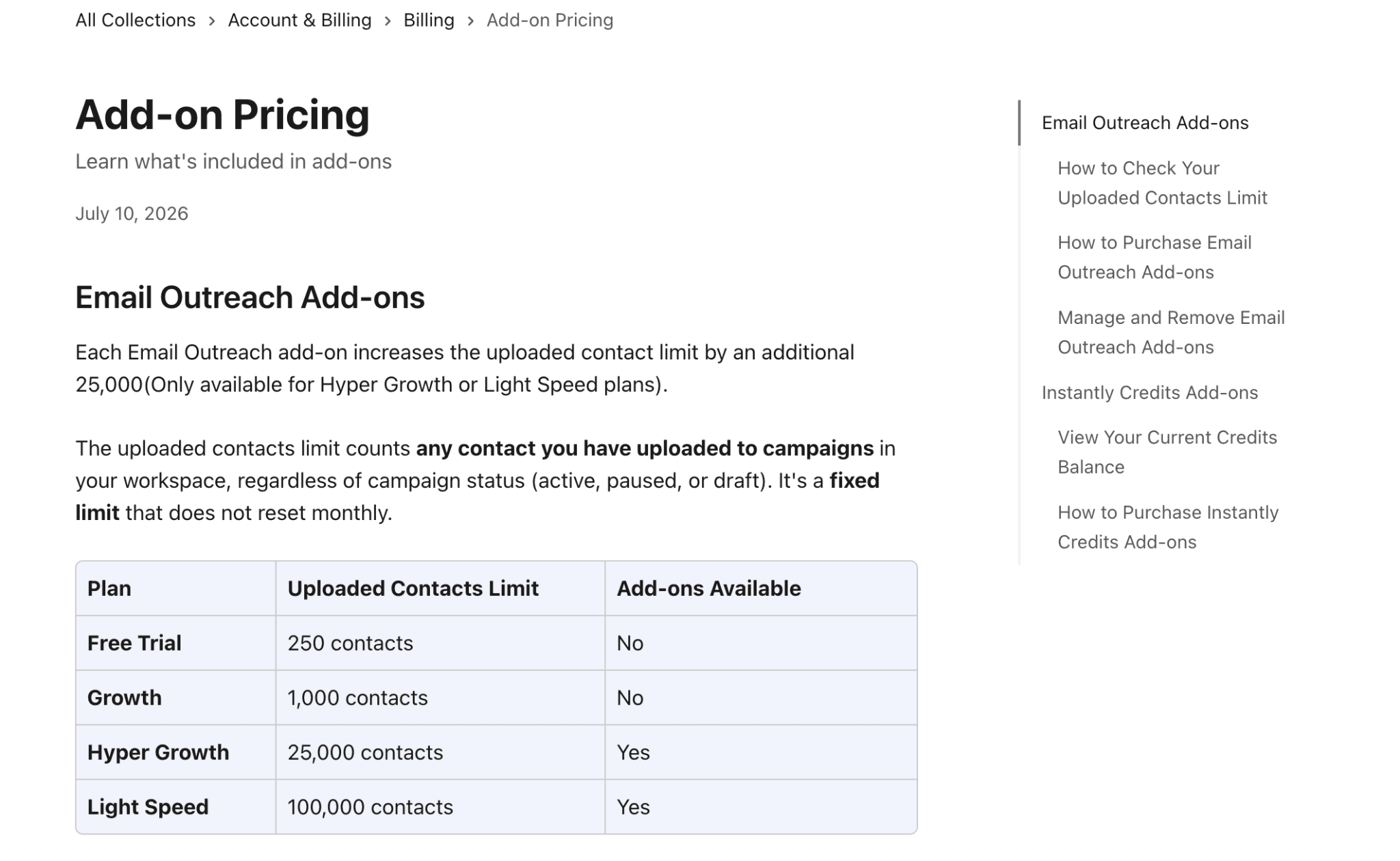
Separate products change the total: Instantly Credits have a public $47/$97/from-$197 ladder, while the Help Center add-on pricing documents plans from Nano at $9 through Hyper 6 at $1,700. Monthly-plan credits expire after two months; annual-plan credits after one year. Verified work emails can consume 1–2+ credits, verification about 0.25 credit per lead, and generated AI replies or leads 5 credits each. Database and AI use must be estimated separately from email volume.
| Module or service | Price or credit basis | Separate cancellation? | Boundary |
|---|---|---|---|
| Instantly Credits | Public plans $47, $97, and from $197; Help Center ladder $9–$1,700 | Yes | Search, enrichment, verification, and AI share the credit system |
| CRM | Separate paid product; exact current tier price not established here | Yes | Email Outreach pricing does not include this product |
| Inbox Placement | Separate paid product; exact current tier price not established here | Yes | Availability does not prove primary-inbox delivery |
| Managed sending inboxes | AirMail $4/mo; Google $5/mo; pre-warmed Google $10/mo | Separate service path | Own inboxes have no per-inbox slot charge |
| Domains | $15/year | Separate service path | Taxes are excluded from displayed fees |
| Bundles | $94/$194/$555 monthly; $85/$175/$500 annual equivalent | Product-specific | Bundle cards were present in the pricing-page HTML but hidden from normal navigation |
Instantly optional subscriptions and services (July 2026)
The trial is narrow: it lasts 14 days, requires no card, and includes 2 email accounts, 250 uploaded leads, 1,000 campaign emails, 100 credits, and 2 inbox-placement tests. There’s no permanent free tier afterward, and the Help Center says an unupgraded trial account is eventually deleted.
Exit terms matter after payment: the Terms state that fees, Credits, and add-ons are non-refundable and non-cancellable. That’s the documented policy, not a legal conclusion for every jurisdiction. Multiple subscriptions require separate cancellation, and export depends on an active main subscription.
Cost boundary: $47 covers Email Outreach Growth, not Credits, CRM, Inbox Placement, managed inboxes, domains, or additional isolated workspaces. Add only the modules the workflow actually needs to keep costs down.
Before cancellation: Export required data while the main subscription is active and cancel each product family through its documented path.
Instantly's public Email Outreach and add-on pricing - July 2026
Instantly Features: What You Get
Instantly's documented feature set falls into six modules with different plan, evidence, or billing boundaries. The links below separate campaign logic from deliverability controls, credit-metered AI and data, integration mechanisms, and workspace administration.
- Automation & Campaign Controls
- Email Warmup, Deliverability Controls & Inbox Placement
- AI Agents & Instantly Credits
- SuperSearch, Enrichment & Website Visitors
- Unibox, CRM & Integrations
- Team, Agency & Workspace Controls
Automation & Campaign Controls
The documented action set is specific:
- Multistep email follow-ups.
- Automation Builder if/else branches with multiple AND/OR conditions and triggers based on replies, status, and list changes.
- Higher-tier Subsequences.
- Stop-on-reply, stop-company-on-reply, and stop-on-auto-reply controls.
- A/Z testing with up to 26 variants and optional auto-optimization.
- Multiple schedules, sender rotation, and per-account or per-campaign limits.
In practice, this is an email automation engine with branching around documented events. It doesn’t make every outreach action native.
| Control | Verified behavior | Plan gate | Risk boundary |
|---|---|---|---|
| Account and Campaign Limits | Separate daily-email controls at account and campaign level | Documented across Email Outreach plans | Warmup email is excluded from these counters |
| Automation Builder | If/else paths with AND/OR conditions and reply/status/list-change triggers | Across Email Outreach plans | Authenticated execution was not tested |
| Subsequences | Conditional in-campaign follow-up behavior | Higher tiers | Exact depth beyond the documented mechanism was not checked |
| A/Z testing | Up to 26 variants with optional auto-optimization | Capability confirmed; Growth entitlement conflicted | No outcome lift was measured |
| Reply stops | Stop on reply, company reply, or auto-reply | Documented | Generic-reply semantic ignoring was not established |
| High Bounce Auto-Pause | Pauses above 5% bounce rate and is enabled by default | All users | A pause limits continued sending; it does not establish list quality |
Instantly campaign controls (July 2026)
The confirmed native scope excludes LinkedIn invitations, LinkedIn messages, LinkedIn profile scraping, Sales Navigator execution, Recruiter automation, post liking or commenting, skill endorsements, scheduled post-engager collection, canceled-invite re-engagement lists, and Sales Navigator “Save as lead” control.
Channel boundary: The automation engine executes email actions. LinkedIn invitations, messages, profile collection, and engagement actions are not native Instantly steps.
Email Warmup, Deliverability Controls & Inbox Placement
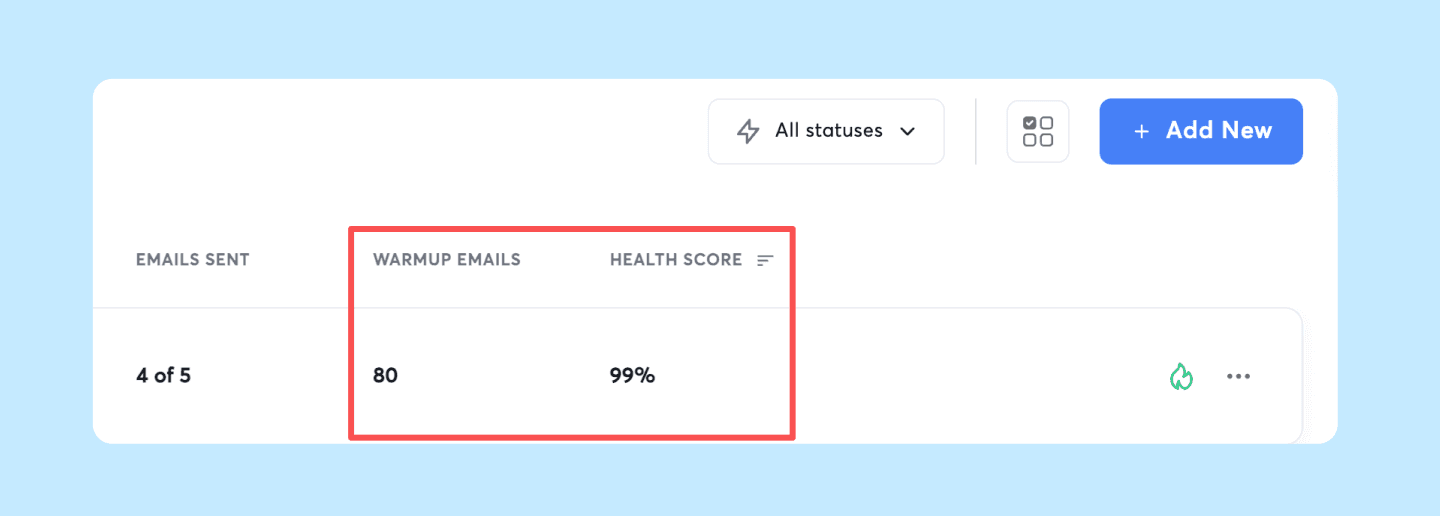
Like many cold-email platforms, Instantly combines warmup with schedules, sender rotation, and sending limits. It also publishes a Warmup Health Score formula and a target above 90%. That target is a vendor control benchmark, not a measured inbox-placement result.
| Mechanism | What is verified | What remains unverified |
|---|---|---|
| Warmup | Built-in warmup and a published Health Score formula with a >90% target | Comparative warmup performance and delivery outcomes |
| High Bounce Auto-Pause | Campaign pauses above 5% bounce rate by default | Whether the underlying list or domain recovers |
| Account/campaign limits | Operators can constrain sending at two levels | A safe volume for every mailbox, domain, or jurisdiction |
| Inbox Placement | A separately priced testing module exists | Primary-inbox rate in actual campaigns |
| Company Send Limits and hostile-prospect filtering | Higher-tier controls are documented | Effect on complaint or conversion rates |
| SISR | Dedicated/private server and IP blocks are allocated and rotated on higher tiers | Comparative reputation or inboxing outcomes |
Instantly deliverability mechanisms and evidence limits (July 2026)
Advanced-deliverability documentation warns that HyperSend prioritizes speed over standard checks for advanced operators. That means the control should be evaluated as a throughput option, not as a deliverability guarantee. The presence of warmup, placement tests, sharding, or automated pauses shows which levers exist; no permitted campaign or seed-panel test established the result of using them.
Mechanism is not outcome: Warmup, Inbox Placement, SISR, and bounce pausing are documented controls. Their availability does not prove delivery to the primary inbox.
AI Agents & Instantly Credits
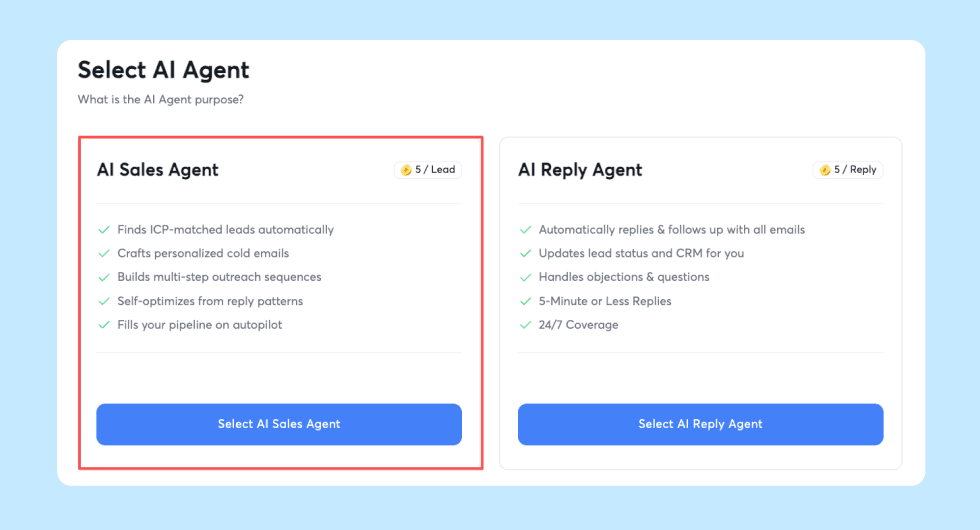
The July 2026 documentation names AI Sequence Writer, Spintax Writer, spam-word checks, custom AI prompts, AI Reply Agent, and AI Sales Agent. Some prompt and reply functions can use a buyer's own model key. Other actions consume Instantly Credits. The documentation establishes those functions, while output accuracy, message quality, and conversion impact remain untested.
| Action | Credits | Additional limit |
|---|---|---|
| AI-generated reply | 5 per generated reply | Shared Instantly Credits pool |
| AI-generated Sales Agent lead | 5 per generated lead | Shared daily send/enrich limit |
| Sales Agent send/enrich | Credit use varies by action | Daily limit 10–10,000; default 10 |
| Custom AI prompt / sequence functions | Shared credits or BYOK, depending on feature | Exact output quality not tested |
| Score leads (ICP fit) | Custom AI-prompt operation | Fixed scoring method not established |
Instantly AI credit consumption (July 2026)
Two meters operate at once: the Sales Agent draws from the shared credit system and has an independent daily send/enrich limit. That means a plan can expose the agent while either credits or the daily setting constrains effective usage. Search, enrichment, verification, and AI also share the broader credit economy. Buyers should model actions rather than count feature labels to get a realistic picture of the true cost.
An exact hold-for-review/edit gate for AI messages was not checked. That gap isn’tproof that the control is unavailable. AI-generated LinkedIn post comments, however, are confirmed absent; Instantly doesn’t execute native LinkedIn engagement actions.
Two usage constraints: AI actions can consume shared Instantly Credits while the Sales Agent also enforces a separate daily send/enrich limit.
SuperSearch, Enrichment & Website Visitors
SuperSearch is documented as searching a 450M+ B2B contact database. Note that this is a vendor inventory claim, not an independent audit of contact freshness, match quality, or usefulness. Built-in email finding, verification, enrichment, custom company/job/technology/news/funding fields, and Website Visitors extend the data layer, with these modules separately metered or productized.
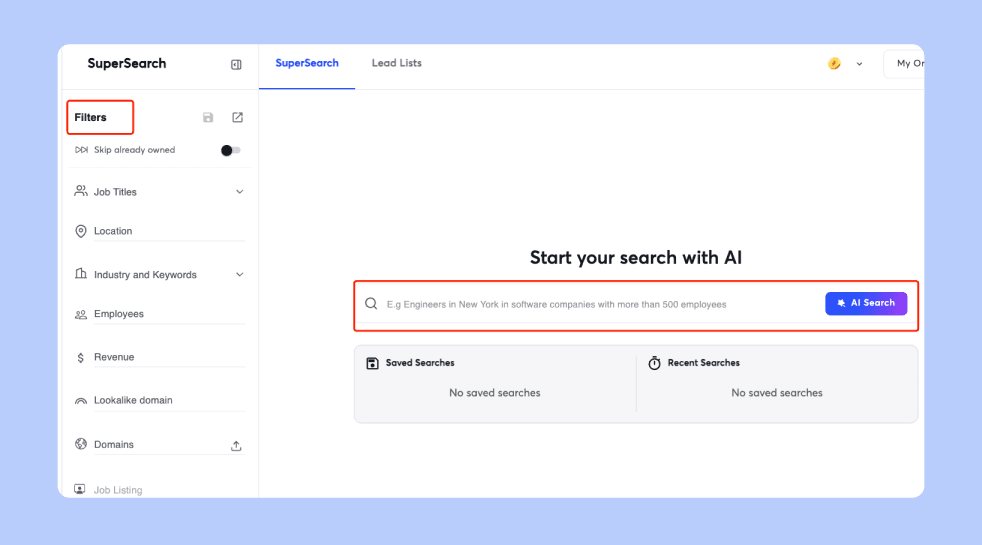
Company-data enrichment is confirmed, but its provider waterfall names are undisclosed. Coverage by geography, field type, or record age therefore remains unestablished.
| Module | Documented scope | Credit use | Evidence boundary |
|---|---|---|---|
| SuperSearch | Vendor-stated 450M+ B2B database | Credit-metered search and lead access | Inventory size does not establish accuracy |
| Email finder | Waterfall work-email discovery | 1–2+ credits for a verified work email | Provider coverage and freshness vary; outcomes were not tested |
| Email verifier | Built-in verification | About 0.25 credit per lead | A verification result doesn’t establish current job fit |
| Enrichment | Company, job, technology, news, and funding fields | Credit-metered | A per-record freshness date was not checked |
| Website Visitors | Visitor-resolution module is separately productized | Exact per-resolution rate not established here | Resolution quality was not tested |
| AI Sales Agent | Generated lead creation | 5 credits per generated lead | Lead usefulness was not tested |
Instantly lead-data modules and credit use (July 2026)
The native data scope doesn’tinclude live LinkedIn profile scraping, employee extraction from LinkedIn organization URLs, Open-to-Work badge collection, post-engager collection, inline company extraction during LinkedIn visits, or a Recruiter-to-regular-LinkedIn execution override. Those are confirmed channel limits. Message-history regex dedup, full per-message export, and a per-record enrichment freshness date were not checked; those gaps are uncertainty, not absence.
Inventory versus fit: A 450M+ stated database and built-in verification describe available data operations. They don’testablish contact accuracy, freshness, or ICP fit.
Unibox, CRM & Integrations
Unibox centralizes email replies. The plan comparison says Growth can preview the inbox but can’t reply there; reply-from-Unibox is consistently documented at Hyper Growth and above. Instantly CRM is a separate paid product, so the reply surface and CRM layer shouldn’t be assumed to be included in the $47 Email Outreach entry card.
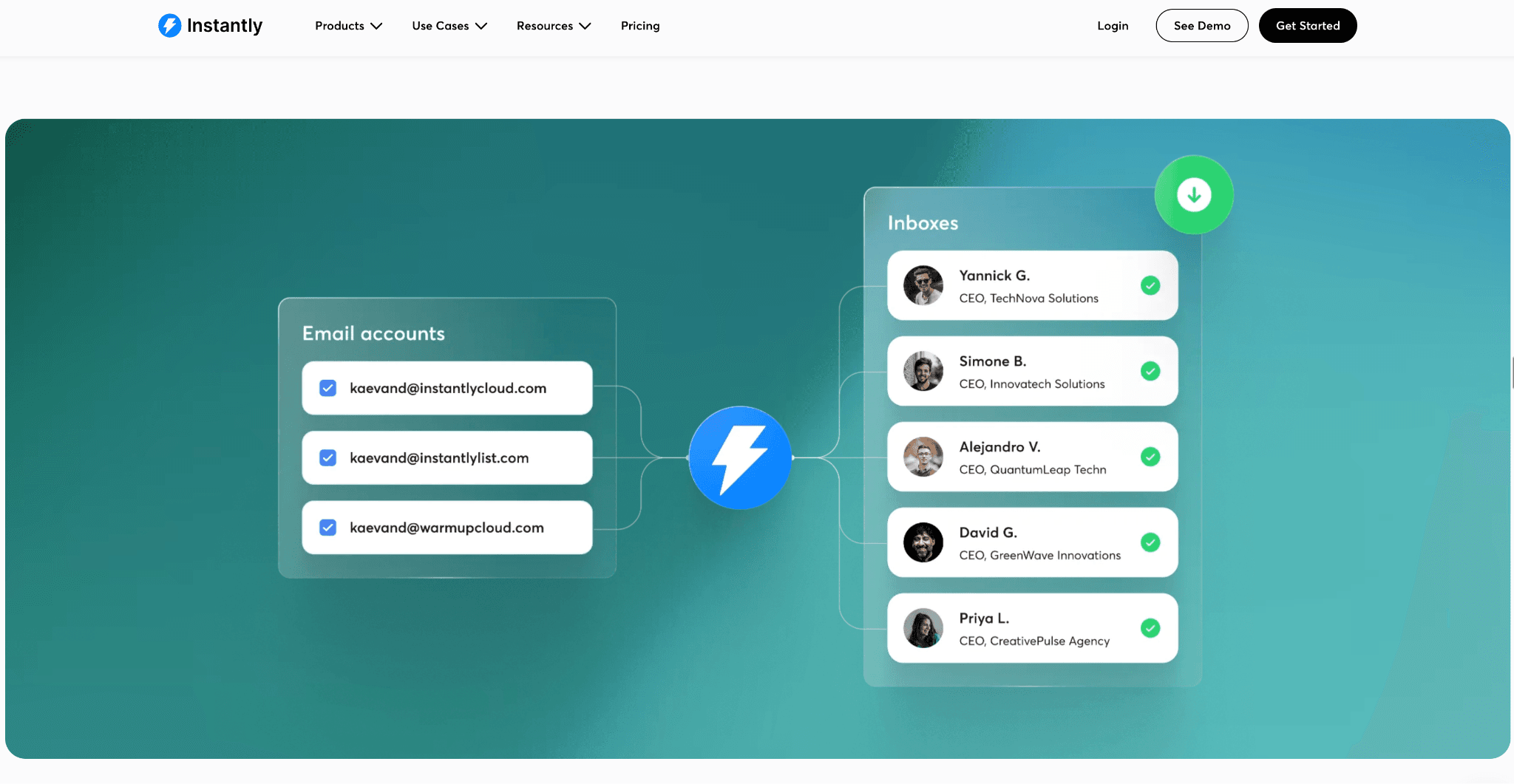
The public integration documentation separately covers direct HubSpot and Pipedrive connections, Salesforce through paid OutboundSync middleware, the Zapier app, outgoing webhooks, and API V2. These are different mechanisms and shouldn’t be rolled into one native-connector count.
For neutral handoff context, Linked Helper's Send person to webhook documentation shows how a LinkedIn-side record can be passed to another system. It doesn’t turn that handoff into an Instantly-native connector.
| Function | Mechanism | Native or partner | Plan or verification status |
|---|---|---|---|
| CRM connectors | HubSpot and Pipedrive | 2 confirmed direct CRM connectors | Confirmed |
| HighLevel | Automation action | Native action | Confirmed |
| Salesforce | OutboundSync | Paid middleware | Confirmed; not a direct connector |
| Close | Zapier recipe | Partner automation | Confirmed; not a direct connector |
| Zapier | Native Zapier app | Native app | Confirmed |
| Make | Generic webhook/API recipes | Native Make app not established | Evidence gap; do not infer absence |
| Outgoing webhooks | Event POSTs with custom headers | Native webhook | Dedicated article gates at Hyper Growth+ |
| API V2 | Scoped API with multiple keys | Native API | Exists; Growth/trial entitlement remains conflicted |
| LinkedIn actions | HeyReach, Aimfox, or Valley handoff | Paid partner execution | Instantly does not execute the LinkedIn action |
Instantly integration mechanisms (July 2026)
No trustworthy all-native integration count was established, so the table states the two confirmed direct CRM connectors and separates apps, middleware, recipes, webhooks, and partner execution. This matters, because counting every route as “native” would hide both the extra vendor and the extra bill.
Like most tools in this space, API, webhook, and automation-platform connectivity is a standard buying criterion; the mechanism and plan gate still matter.
Incoming webhooks, late-reply CRM resync, full message-content export, and identifier-cascade merge semantics were not checked, and their status remains unresolved. The confirmed outgoing-webhook mechanism doesn’t mean that a dedicated inbound-webhook feature exists.
Handoff is not native execution: Automation Builder can send a lead to a paid LinkedIn partner, but that partner—not Instantly—runs the invitation, message, or other LinkedIn action.
Team, Agency & Workspace Controls
The workspace documentation says separate workspaces isolate client data, but each workspace needs its own product subscriptions. In practice, real tenant separation multiplies subscription sets.
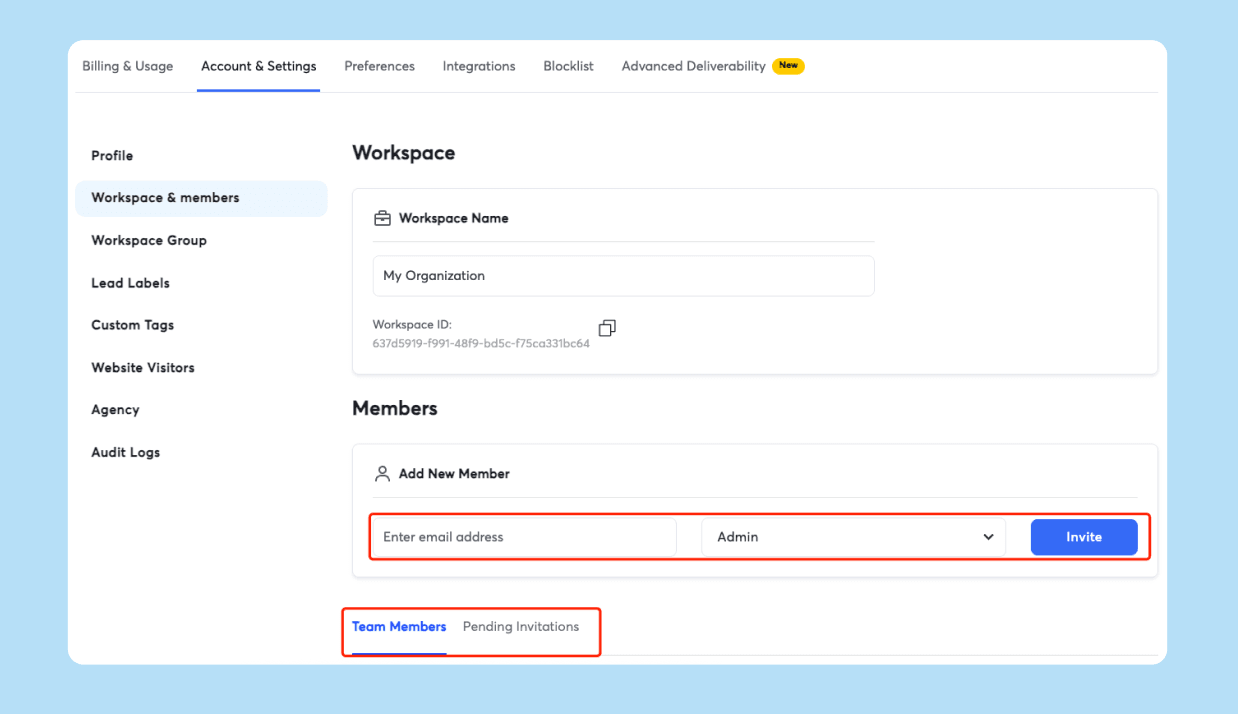
- Roles: Owner, Admin, Editor, View-VA, and Client differentiate access at the workspace level.
- Client portal: Agency White Labeling on Hyper Growth and Light Speed supports custom domain/logo branding and per-module client access. Clients given Campaigns access can see every campaign in that workspace.
- Workspace Groups: Groups organize workspaces but provide no consolidated dashboard, so portfolio reporting remains distributed.
- Billing unit: Team invitations add no per-seat charge on a qualifying tier; the paid unit is the workspace/product subscription.
- Exit administration: Several product families have separate cancellation paths, and some managed services require support to cancel.
One Agency bundle is documented at $555 per month, but its portal doesn’t have campaign-level tenant isolation. A 20-client scenario ranges from one $555 portal without full isolation to $940 per month for 20 Growth workspaces or $1,940 for 20 Hyper Growth workspaces. Those figures are scenario math, not universal quotes.
No workspace-volume discount was found, and exact SSO entitlement was not established. These are evidence gaps rather than proof that no negotiated discount or qualifying SSO plan exists. Local-first storage is confirmed absent: the documented architecture is a cloud web app with US data processing.
Isolation multiplies subscriptions: Client portal access and branding don’t create campaign-level tenant isolation. Separate workspaces do, and each requires its own subscription set.
Is Instantly Safe?
For Instantly, safety means sender-risk controls, data handling, and operator compliance—not LinkedIn session or extension risk. The product doesn’t connect a LinkedIn session, and its LinkedIn partners execute that channel. We therefore evaluated the account/campaign limits, bounce auto-pause, and other email/cloud controls documented through July 2026 without treating unavailable LinkedIn-specific tests as evidence for or against the product.
| Risk area | Verified control | What remains unverified |
|---|---|---|
| Sending volume | Per-account and per-campaign daily limits; multiple schedules | A safe volume for every mailbox, domain, list, and jurisdiction |
| Bounce exposure | Automatic pause above 5%, enabled by default | Whether list quality or sender reputation recovers afterward |
| Warmup | Built-in warmup and published Health Score formula with a >90% target | Comparative warmup performance or inbox placement |
| Placement testing | Separately priced Inbox Placement module | Real campaign delivery to primary inboxes |
| Higher-speed sending | HyperSend warns that speed takes priority over standard checks | Downstream complaint, spam, or reputation effects |
| Higher-tier infrastructure | SISR assigns and rotates dedicated/private server and IP blocks | Independent reputation or deliverability result |
| Data handling | US processing, a public DPA, GDPR representatives, and a subprocessor list | Exact SSO entitlement; no confirmed SOC 2/ISO ownership was found |
| Connected accounts | “Unlimited Email Accounts” billing model with a 100-Connected-Accounts Terms ceiling | Operational effect at the ceiling |
Instantly sender-risk controls and evidence limits (July 2026)
The controls manage exposure, but don’t settle outcomes. The 5% pause can stop a campaign after a high bounce rate, and limits can constrain volume. Neither tells us whether the source list was accurate or whether messages reached the primary inbox. Likewise, the Warmup Health Score and Inbox Placement module provide measurement surfaces, but no permitted seed-panel or authenticated campaign test established their results.
The higher-tier trade-off is explicit: Company Send Limits, hostile-prospect filtering, SISR, and HyperSend add infrastructure and throughput controls. HyperSend's own warning that speed is prioritized over standard checks means operators must decide when that trade-off is acceptable.
Privacy evidence has a boundary: the Privacy Policy and DPA support US processing, GDPR representation, and a subprocessor list. Public SOC 2 or ISO ownership was not found in the reviewed evidence. “Not found” is an evidence gap, not proof that no certification exists, and the exact SSO plan remains unsettled.
No cold-email platform completely eliminates spam, compliance, or sender-reputation risk. List sourcing, consent or lawful basis, copy, domain configuration, volume, and handling of replies remain operator responsibilities.
Risk can’t be outsourced: Instantly supplies limits, warmup, bounce pausing, and testing controls. No cold-email platform eliminates spam, compliance, or sender-reputation risk.
What Independent Editorial Reviews Actually Show
The platforms point in different directions, so each aggregate needs its own denominator. The local G2 corpus snapshot computed on July 29, 2026 contains 1,000 rated reviews averaging 4.78★. Separately, the G2 profile fetched April 23, 2026 showed 4.8★ across 3,486 profile reviews. Its distribution belongs only to that profile denominator. The local Trustpilot corpus through April 10, 2026 contains 1,009 rated reviews averaging 4.02★. This includes 212 one-star rows (21.0% of those 1,009 Trustpilot reviews). No Capterra rating was available in the local snapshot. That’s missing evidence, not proof of no Capterra presence.
Across the combined local G2 and Trustpilot corpus, the six-month window from January 29 to July 29, 2026 contains 98 rated reviews averaging 3.72★. This lower recent mean is an observation about that exact two-platform window, not a product-performance result.
For discovery and external context, we also checked Snov.io's 2026 Instantly review and Saleshandy's review. We used them to surface claims for first-party verification, not as substitutes for Instantly's documentation or the dated local review corpus.
| Evidence can support | Evidence cannot support |
|---|---|
| Platform-specific ratings, counts, distributions, dated quotes, and topic patterns | Universal sentiment, deliverability, data accuracy, or a measured support SLA |
| A 2,009-row local corpus: 1,000 G2 and 1,009 Trustpilot reviews | A blended denominator presented as if it came from one platform |
| Weekly volume buckets and same-day negative clusters | Why reviews arrived, or any claim of solicitation, duplication, or manipulation |
What the dated Instantly evidence supports (July 2026)