
 Updated: August 29, 2026
 24 min read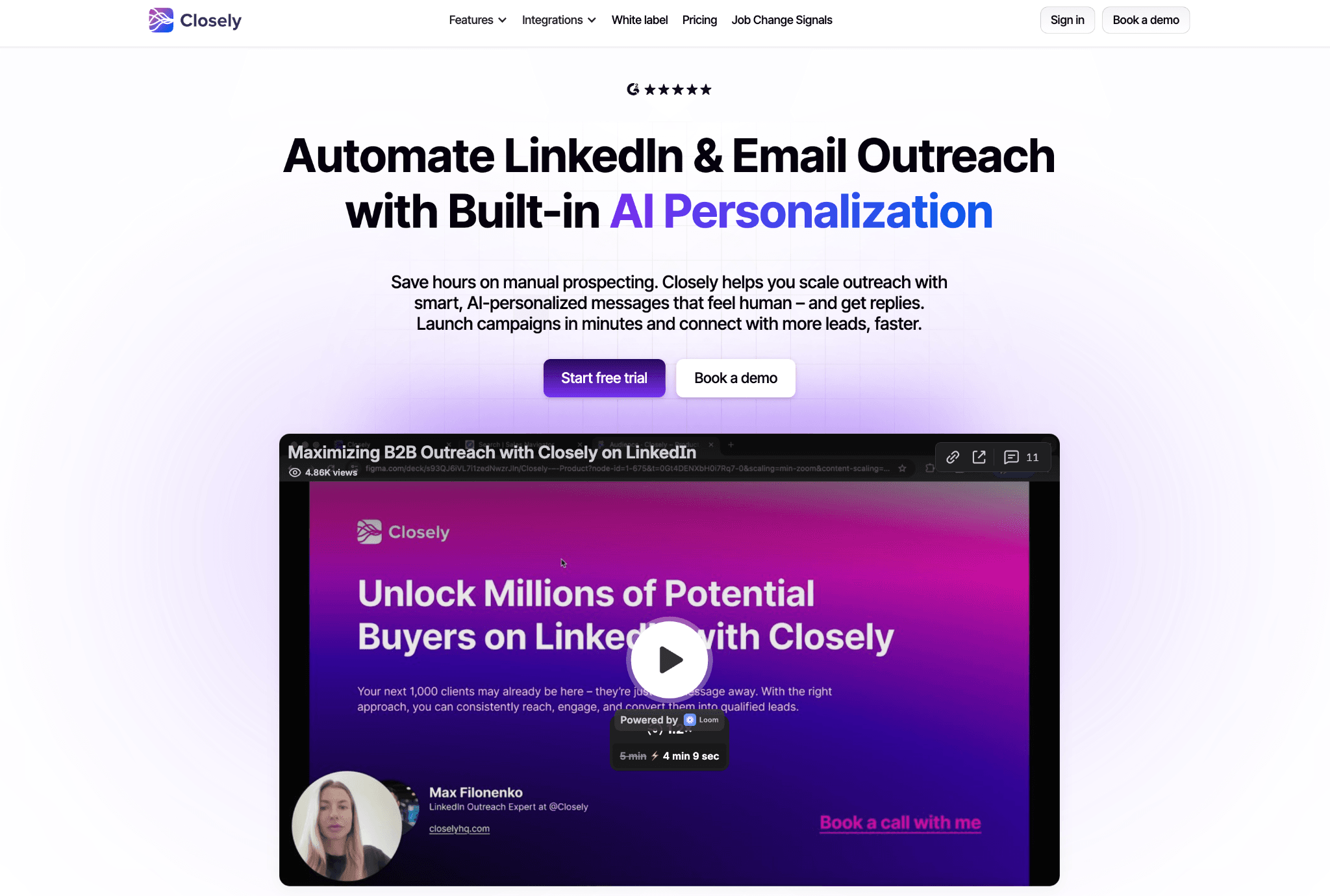
Key takeaways
- Growth's 3,000 shared credits equal 750 email lookups, 150 phone lookups, or 1,500 AI personalizations at the pricing-page rates, while the Help Center separately lists two credits per successful email find; budget by action mix rather than treating credits as a lead count (pricing; email finder).
- Native email shares a campaign and inbox with LinkedIn activity, but “unlimited email accounts” coexists with one email inbox per sender or seat and a documented 200-email daily maximum; verify standalone-inbox capacity separately from sending volume (pricing; seat definition; daily limits).
- The multichannel campaign builder documents only four event conditions, opt-in duplicate exclusion within the same user and account scope, and manual comparison of parallel campaigns; complex routing, cross-account protection, or automated test selection needs an authenticated fit check (conditions; campaign guide; A/B guidance).
- The July 2026 local review snapshot contains 192 G2 rows and 75 raw Trustpilot rows spanning December 23, 2021, to January 15, 2026; 222 of 267 date to 2022 and none falls in the trailing six months, so the corpus is better for finding questions than proving current product performance (G2; Trustpilot).
This review is published by Linked Helper and written by Milosh Potikj, who works there. I've made every effort to represent Closely accurately using verified data — our own first-hand testing, Closely's own documentation, and independently sourced reviews.
Closely is a cloud workspace for LinkedIn outreach and native email in the same campaign. Starter costs $49/month for core sequencing; enrichment and AI begin on the $127/month Growth plan (pricing). Campaigns continue without the operator’s computer staying on (product page).
The safety verdict is conditional. Reading the shipped source code of its current extension found a LinkedIn-session upload path, while assigned-proxy type and live observed-IP behavior remain unresolved. That makes plan scope and session handling the key checks. No automation tool eliminates LinkedIn restriction risk.
Verdict
Closely combines cloud-run LinkedIn and native-email sequences, enrichment, AI-assisted research, optional inbox sharing, and five CRM connections in one workspace (campaigns; CRM set). Those functions reduce the systems an operator must coordinate, but the buying decision remains conditional.
The reservations are commercial and architectural. The $999 offer sits beside a contractual cap of 100 LinkedIn and 100 email accounts (offer; Terms). Cancel opens support, and the first-purchase refund window is two days (process; policy).
Rotation, cross-account deduplication, lead distribution, and audit logs were not documented. Current residential wording also conflicts with older VPN-like wording (older guide). Until live observed-IP behavior is checked, the proxy mechanism is not established. Buyers who accept those boundaries still have a documented multichannel workflow to evaluate.
Pros
- LinkedIn and email share one sequence: Connection requests, profile views, messages, and native email can sit in one campaign (documentation).
- Cloud campaigns continue without a local computer: The vendor describes server-run operation, removing the always-on workstation requirement (product page).
- Enrichment and AI share the product: Growth and higher tiers add email and phone lookup, research, scoring, and personalization with shared credits (pricing).
- Replies can stop follow-ups: A LinkedIn reply stops that contact’s sequence by default (reply behavior).
- Five CRM connections are documented: HubSpot, Salesforce, Pipedrive, Zoho CRM, and GoHighLevel (CRM collection).
- White-label branding is listed: Named plans include branding; the client-workspace layer has separate scope (white-label page).
- Preventive controls are documented: Like most category tools, Closely offers warm-up, working hours, schedules, and randomized limits (limit guide).
Cons
- “Unlimited” has a contractual ceiling: The $999 offer is capped at 100 LinkedIn plus 100 email accounts (marketing; Terms).
- The $49 tier omits data and AI: Growth at $127 is the lowest listed tier with enrichment, research, scoring, personalization, and 3,000 credits (pricing).
- Annual figures conflict: Named cards differ from calculator results for three and five senders; checkout was not observed (pricing).
- Cancellation is support-mediated: Cancel opens support instead of stopping the subscription itself (guide).
- The refund window is narrow: A no-refund baseline has a two-calendar-day first-purchase exception (policy).
- Inbox wording is unresolved: “Unlimited email accounts” sits beside a one-LinkedIn-account and one-email-inbox seat definition (seat definition).
- Proxy and agency controls need qualification: Proxy type is not established; rotation, deduplication, distribution, and audit logs were not documented (proxy guide; white label).
The contract defines the ceiling: White-Label Unlimited is marketed for 300+ seats, but the July 2026 Terms cap it at 100 LinkedIn and 100 email accounts. Buyers planning beyond that boundary need written clarification before purchase.
Closely Pricing: Plans, Traps, and Hidden Costs
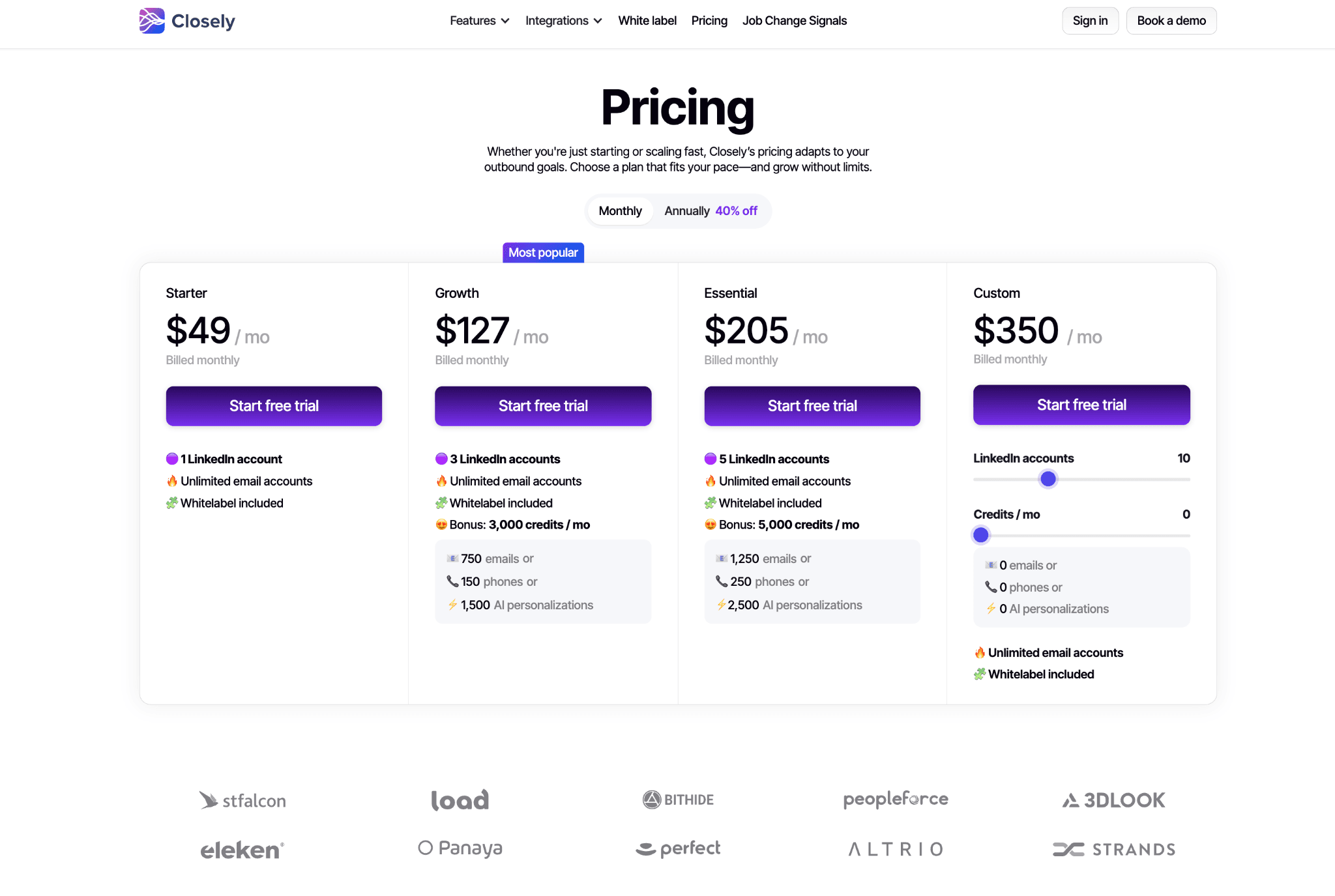
Closely’s July 2026 pricing separates sequencing from enrichment and AI. Starter is $49/month, but those data and AI functions begin on Growth. Buyers who need them therefore enter at $127/month.
| Plan | Monthly price | Annual monthly equivalent | Credits / scope | What's not included or unresolved |
|---|---|---|---|---|
| Starter | $49 | $29 | Core LinkedIn and email sequencing; no bonus credits | Data enrichment and AI are not documented |
| Growth | $127 | $87 | 3,000 shared credits: 750 emails, 150 phones, or 1,500 AI personalizations | Actions consume the pool at different rates |
| Essential | $205 | $145 | 5,000 shared credits: 1,250 emails, 250 phones, or 2,500 AI personalizations | Card math gives a 29.3% annual reduction, not 40% |
| White-Label Unlimited | $999 | Not established | Multi-client offer | Terms cap 100 LinkedIn and 100 email accounts |
Closely pricing tiers (July 2026)
As of July 2026 · Source: Closely pricing, white-label offer, and Terms.
Credits change the workload. The pricing page uses four credits per email, 20 per phone, and two per AI personalization. An email-finder Help Center page separately says two per successful email find, so that rate is unresolved. Extra credits list at $10 per 1,000 monthly and $6 per 1,000 in the annual calculator (pricing).
| Marketing or card | Primary-source boundary | Buying implication |
|---|---|---|
| White-Label Unlimited; 300+ seats | Terms cap 100 LinkedIn plus 100 email accounts | The contract is not uncapped |
| Unlimited email accounts | One seat documents one LinkedIn account plus one email inbox | Extra inbox capacity is not established |
| Growth $87 and Essential $145 annually | Calculator returned $75 for three and $121 for five senders | Checkout must establish the payable amount |
| Free-trial CTA | Duration and card requirement were not disclosed | A trial exists; its terms remain unresolved |
Closely marketing and primary-source boundaries (July 2026)
As of July 2026 · Sources: pricing, seat definition, and Terms.
Exit terms matter. Cancel opens support and does not itself stop billing. The no-refund baseline has a two-calendar-day first-purchase request window and narrow exceptions (cancellation process; refund policy).
Confirm scale and checkout before paying: Get the account ceiling, inbox count, and annual amount in writing. The public sources do not produce one reconciled answer.
Closely Features: What You Get
Closely’s feature set is easier to evaluate as seven separate axes because each has a different plan, credit, documentation, or live-check boundary:
- Automation and campaign engine
- AI personalization, scoring, and research
- Lead targeting, enrichment, and credits
- Native email and Smart Inbox
- CRM, API, and automation handoffs
- Team, agency, and white-label controls
- Analytics and reporting
Automation & Campaign Engine
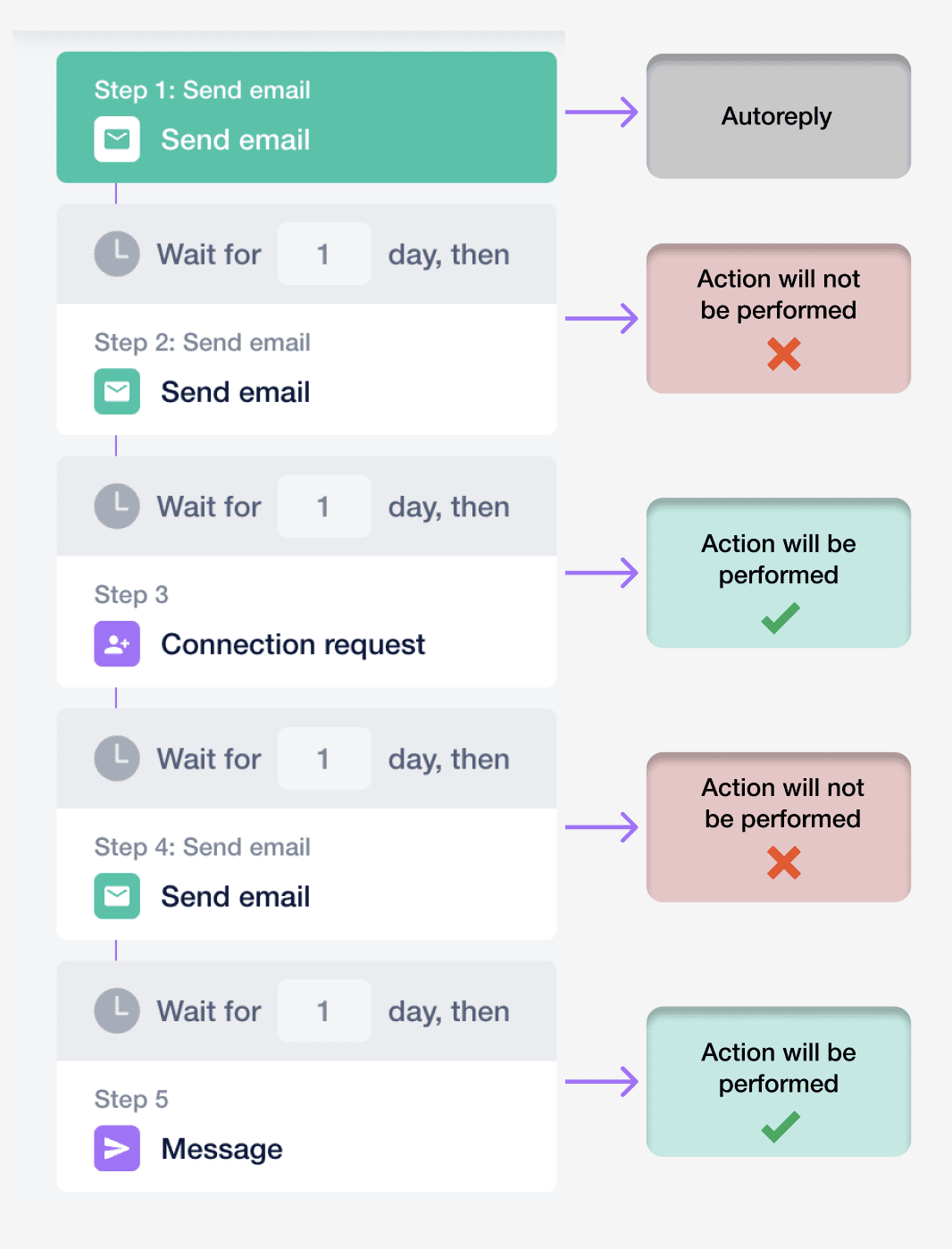
The documented campaign actions are connection requests, profile views, LinkedIn messages, and native email. These actions can run in one multichannel sequence, with a minimum documented one-hour delay after an added action. Like most tools in this category, Closely also provides working hours, timezone scheduling, warm-up, and manually configured randomized daily limits (campaign guide; working hours).
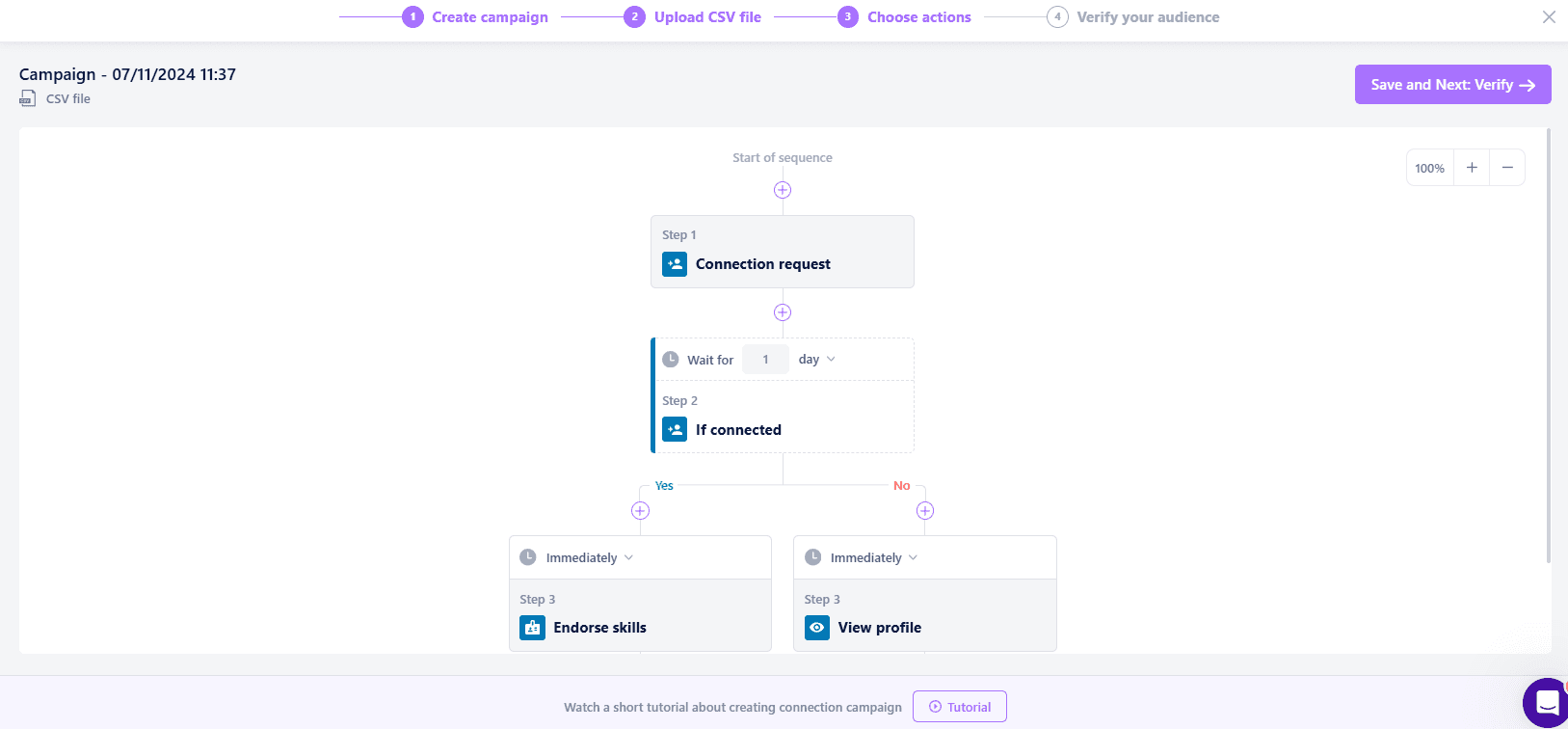
Branching is narrower than a generic “conditions” label suggests. The documented conditions are exactly: connected, email opened, email clicked, and email found. Nested arbitrary IF-THEN-ELSE branching is not available in the documented model (conditions guide).
| Capability | Verified scope | What remains unresolved |
|---|---|---|
| Sequence actions | Connection request, profile view, LinkedIn message, native email | Current Recruiter extraction, native Like, and InMail sending remain unresolved |
| Conditions | Connected, email opened, email clicked, email found | No broader or nested arbitrary branching is established |
| Reply handling | LinkedIn reply stops the contact's sequence; email autoreply or bounce stops email steps only | No broader reply-based branching is established |
| Duplicate exclusion | Opt-in exclusion within the same user/account campaign scope | Cross-account deduplication is not documented |
| A/B behavior | Official guidance compares parallel campaigns manually | A native audience split and winner-selection engine remain unresolved |
Closely campaign-engine scope
As of July 2026 · Sources: campaign actions, conditions, reply behavior, and A/B guidance.
Duplicate protection has a documented scope: The available exclusion is opt-in and applies within the same user/account campaign scope. Cross-account duplicate protection was not documented; this is an evidence gap, not proof that no private workflow exists.
For neutral background on why campaign-level and cross-account duplicate checks are different controls, see how duplicate filtering works across campaign data.
AI Personalization, Scoring & Research
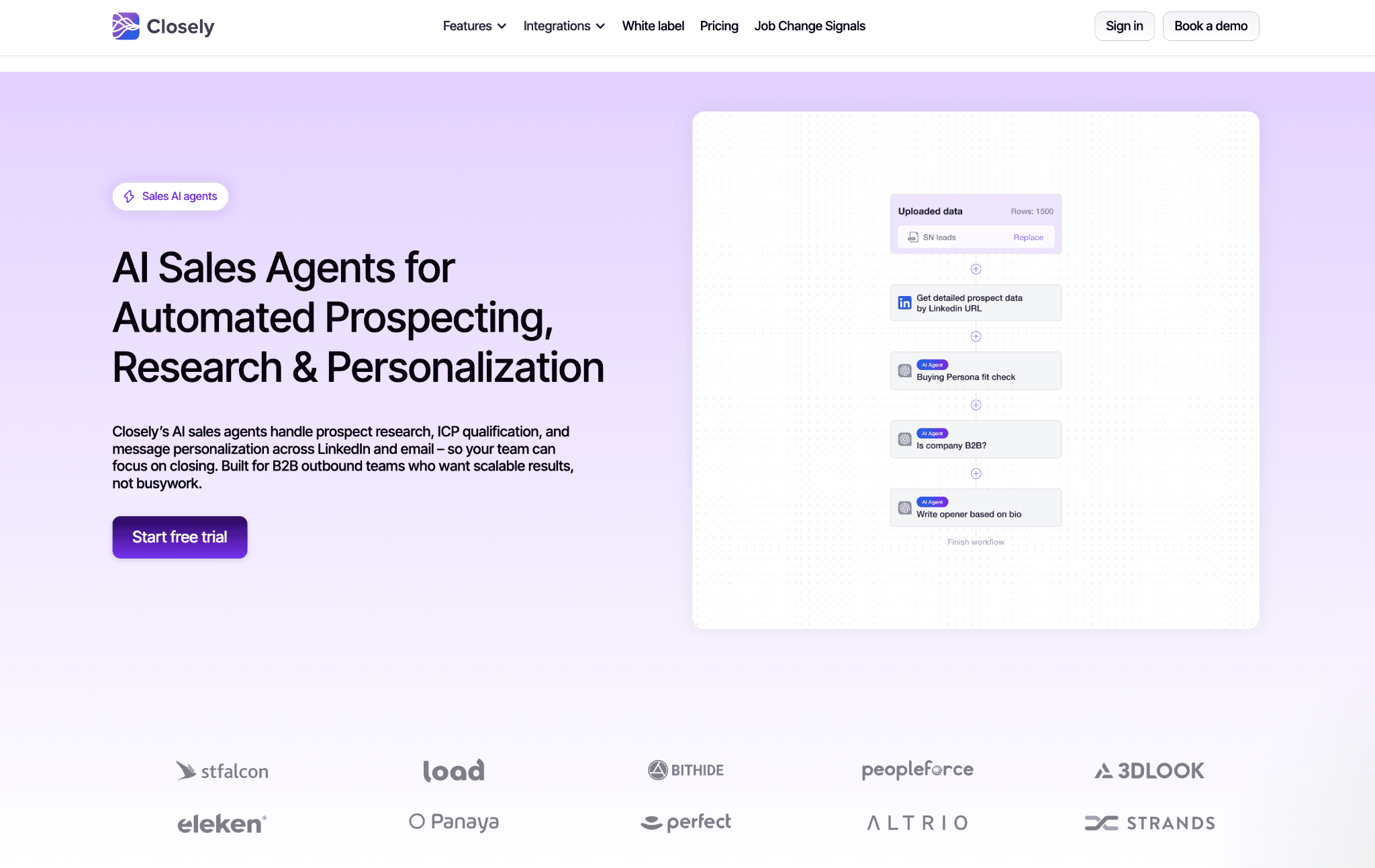
As of August 2026, Closely documents three AI-assisted functions: message personalization, prospect research, and qualification or lead scoring. Growth and higher tiers offer these functions, and AI personalization consumes two shared credits per use. These are assistance functions; they do not establish an autonomous conversational reply agent or any measured lift in response or pipeline.
| Documented AI function | Credit cost or boundary |
|---|---|
| Message personalization | Two shared credits per use; Growth or higher |
| Prospect research | Web and offline research modes are documented; outcome accuracy is not established |
| Qualification / lead scoring | Prompt-based qualification is documented; scoring accuracy is not established |
| Autonomous conversational replies | Not established in the public evidence |
| AI-generated post comments | No built-in capability was documented; the separate Like action still needs an authenticated check |
Documented Closely AI functions
As of July 2026 · Sources: AI personalization, AI research, and qualification prompts.
Vendor statements about response improvement, time saved, or pipeline growth are marketing claims, not results from this review. In practice, buyers can verify whether the assistance functions match their workflow, but the available evidence does not convert feature presence into a performance conclusion.
Assistance is not autonomous reply handling: Research, scoring, and personalization are documented. A conversational agent that independently handles live replies was not established.
Lead Targeting, Enrichment & Credit Economics
Closely documents inputs from LinkedIn search, Sales Navigator, posts, groups, and CSV, alongside Explorer, work-email lookup, phone lookup, web research, and qualification. Current Recruiter behavior remains unresolved. Sales Navigator sourcing is documented up to 2,500 contacts, which defines a list-size boundary rather than a quality claim (multichannel guide).
The shared credit pool connects targeting choices to cost. On the pricing page, phone lookup consumes five times the credits of an email lookup and ten times an AI personalization. Therefore, “3,000 credits” is not a stable lead-volume number.
| Action | Credits | Evidence boundary |
|---|---|---|
| Email lookup | 4 on the pricing page | A Help Center page separately says 2 per successful find; the sources conflict |
| Phone lookup | 20 | Growth or higher; availability does not establish accuracy |
| AI personalization | 2 | Growth or higher; availability does not establish response lift |
Closely shared-credit usage
As of July 2026 · Sources: pricing and credit ratios, email finder, and enrichment workflow.
A separate email-verifier step was not documented, and no deliverability or inbox-placement test was completed. Those gaps cannot be converted into claims that found data is inaccurate or that email will not deliver.
One pool supports unequal workloads: Email, phone, and AI actions draw from the same allowance at different rates. Estimate the mix of actions before treating a tier's credit total as a prospect count.
Native Email, Smart Inbox & the One-Inbox-Per-Seat Rule
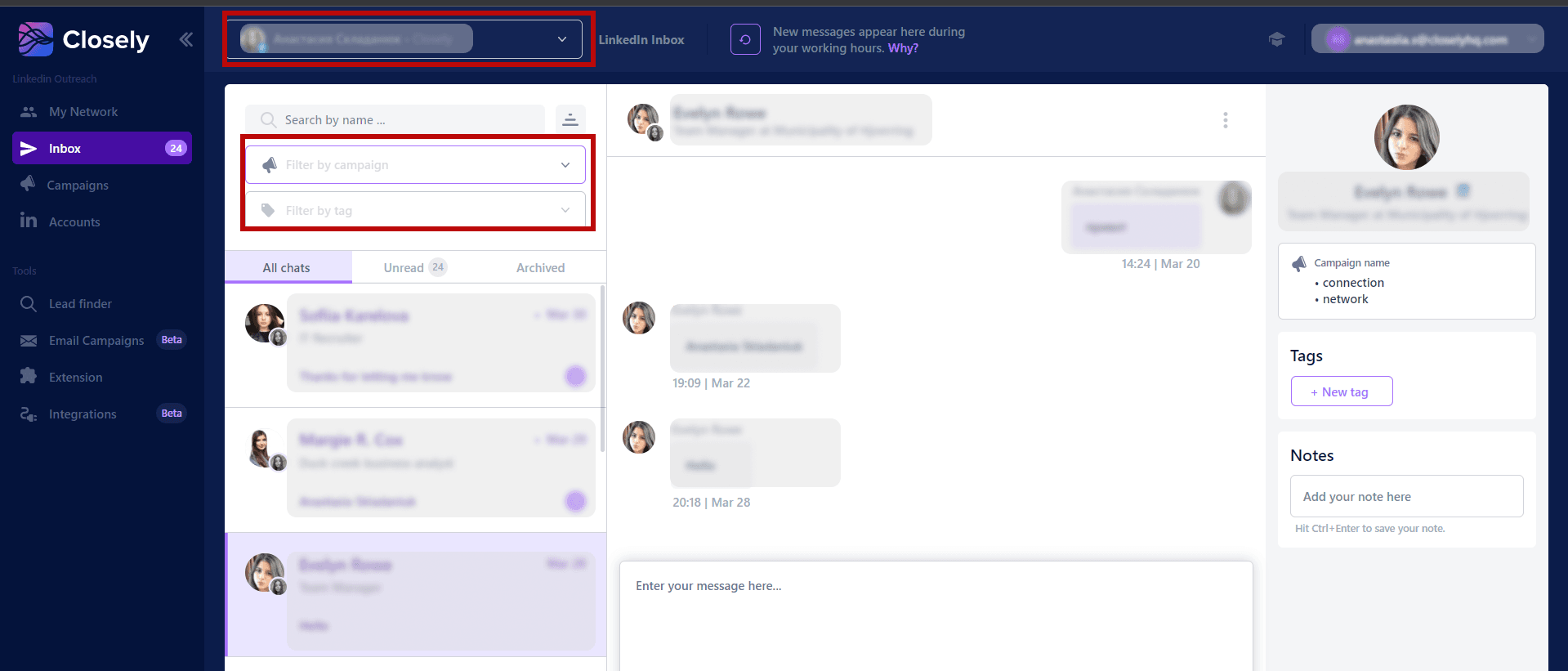
Closely can place native email beside LinkedIn actions, connect Gmail or Outlook through OAuth, or connect other mailboxes through SMTP/IMAP. Smart Inbox brings LinkedIn and email replies into one interface; its Inbox documentation covers conversation management and LinkedIn-message handling. A LinkedIn reply stops the whole sequence for that contact, while an email autoreply or bounce stops email steps only (email outreach; reply handling).
| Marketing wording | Documented seat relationship | Test needed |
|---|---|---|
| Unlimited email accounts | One sender or seat includes one LinkedIn account plus one email inbox | Whether extra standalone inboxes can be added remains unresolved |
| Native email outreach | Gmail/Outlook OAuth and SMTP/IMAP connections are documented | No measured deliverability result is established |
| Email sending | Default 50 emails/day; documented maximum 200/day | Actual provider limits and inbox placement were not tested |
Closely email-account wording and documented limits
As of July 2026 · Sources: pricing, seat relationship, OAuth setup, SMTP/IMAP setup, and daily email limits.
The word “unlimited” is an account-marketing claim. It does not erase the separate one-inbox-per-seat documentation or the daily send cap. An authenticated capacity check is required before assuming unlimited standalone sending inboxes.
Unlimited does not resolve inbox or send caps: The public evidence preserves three separate qualifiers: unlimited-email-account wording, one email inbox per sender or seat, and a documented 200-email daily maximum.
CRM Integrations, API & Automation Handoffs
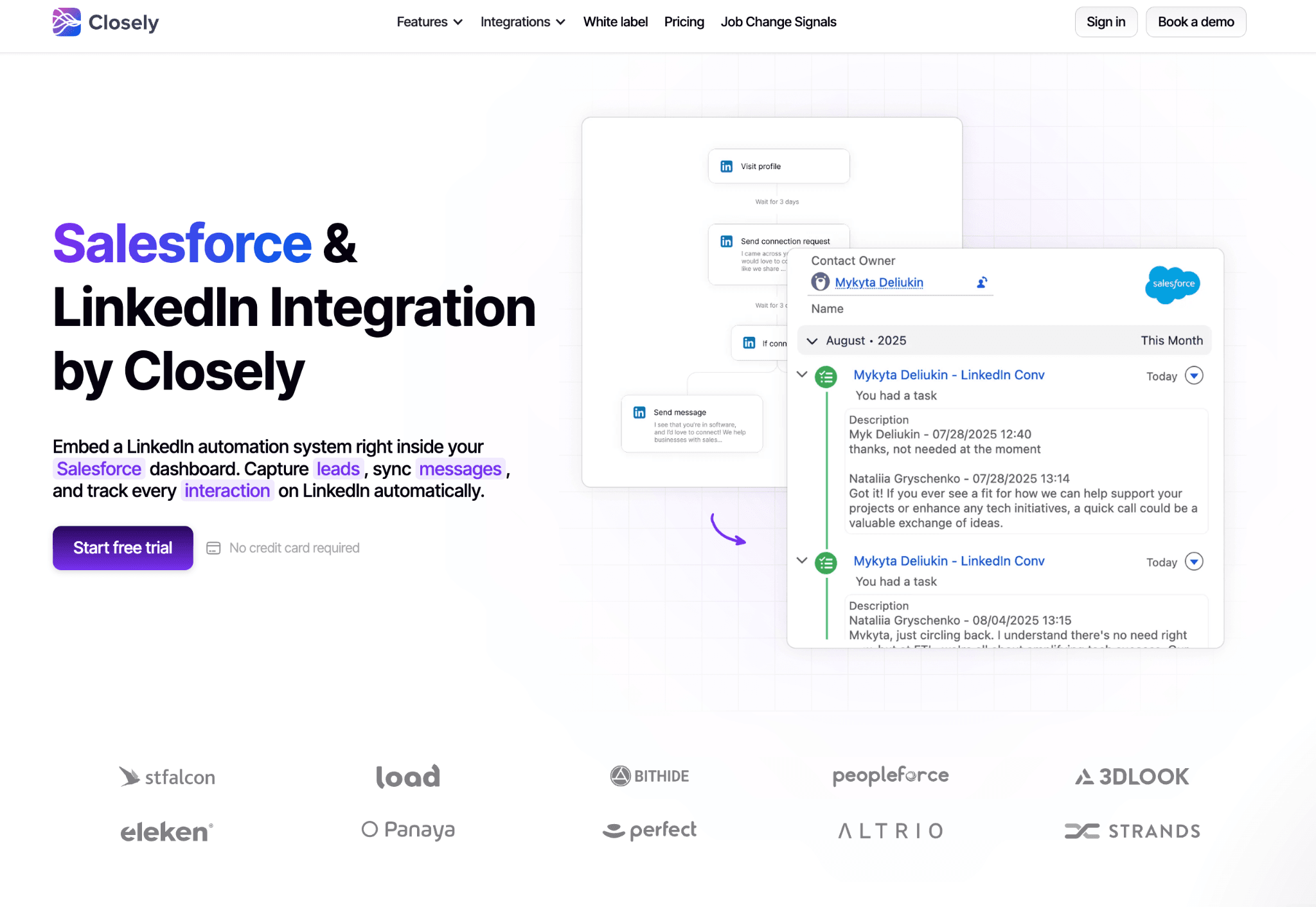
Closely documents exactly five native CRM connections: HubSpot, Salesforce, Pipedrive, Zoho CRM, and GoHighLevel. The count is a plain inventory, not a claim about sync depth. Generic webhooks are also documented, including a “Webhooks by Zapier” recipe; that mechanism is not a dedicated Closely Zapier app (CRM collection; webhook guide).
| Connection | Documented mechanism | Verification status |
|---|---|---|
| Native CRM | HubSpot, Salesforce, Pipedrive, Zoho CRM, GoHighLevel | Five connections documented |
| Zapier | Generic Webhooks by Zapier recipe | No dedicated Closely Zapier app was found |
| Make | No current public mechanism was established | Support remains unresolved |
| Webhooks | Generic webhook mechanism documented | Authenticated inbound/outbound behavior remains incompletely checked |
| REST API | No public developer portal or documented REST API was found | This does not establish that no internal API exists |
Closely integration status
As of July 2026 · Sources: CRM integrations and webhooks.
For background on mechanism rather than competitor evidence, compare the data a CRM, webhook, or CSV handoff can carry with how a webhook-based Zapier connection differs from a dedicated app.
Public documentation sets a narrow boundary: The supported conclusion is no public documented REST API. It is not evidence that Closely has no internal API or authenticated integration surface.
Team, Agency & White-Label Controls
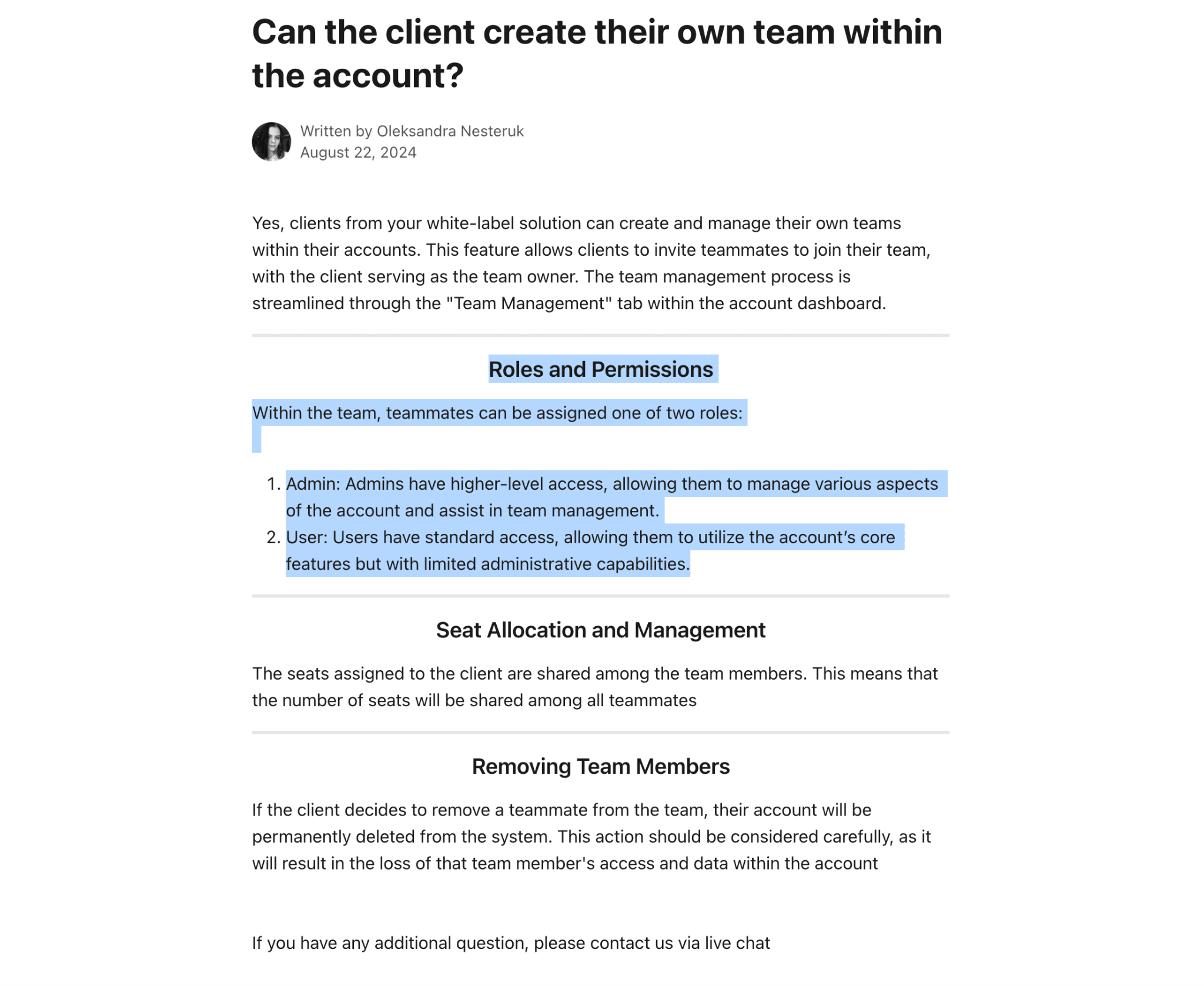
White-label branding appears on Starter, Growth, and Essential, while the $999 offer adds a deeper multi-client layer. Client workspaces and teams are documented within that white-label layer, so basic branding and multi-client operation should not be treated as the same capability (pricing; client workspace guide).
| Promoted agency capability | Documented operational control |
|---|---|
| White-label branding on named tiers | Brand customization is documented |
| $999 White-Label Unlimited | Multi-client layer is documented, subject to the Terms' 100 LinkedIn plus 100 email-account cap |
| Client workspaces and teams | Documented inside the white-label layer |
| Sender rotation | Not documented |
| Cross-account deduplication | Not documented |
| Lead distribution | Not documented |
| Audit logs | Not documented |
Closely agency capability and control depth
As of July 2026 · Sources: plan grid, white-label offer, client teams, and Terms.
These are documentation gaps, not proof that an authenticated or private workflow cannot perform the missing functions. For an agency, the practical implication is to inspect how work is assigned, deduplicated, and audited before treating white-label branding as a complete control plane.
Branding and operational controls are separate: White-label availability is established. Sender rotation, cross-account deduplication, lead distribution, and audit logs were not documented.
Analytics & Reporting
Closely documents campaign statistics and CSV export for prospects and statistics. Chat transcripts use TXT rather than a full per-message history CSV, so the formats do not preserve the same structure. Metric definitions, reporting lag, cross-client attribution, and pipeline accuracy were not publicly established.
| Documented | Not established |
|---|---|
| Prospect and statistics export as CSV | Metric freshness, data lag, and attribution quality |
| Chat transcript export as TXT | Full per-message history CSV |
| Campaign reporting presence | Measured pipeline impact |
Closely reporting evidence
As of July 2026 · Sources: statistics export guide and inbox/export overview.
Reporting presence is not an outcome measure: The documented exports show that reporting exists. They do not establish real-time freshness, attribution accuracy, or pipeline improvement.
Is Closely Safe?
Closely is cloud-run and documents two account-sync paths: LinkedIn credentials or extension-assisted session sync. Warm-up, randomized limits, working hours, and schedules address behavior, but they do not resolve the live observed IP (cloud operation; session sync).
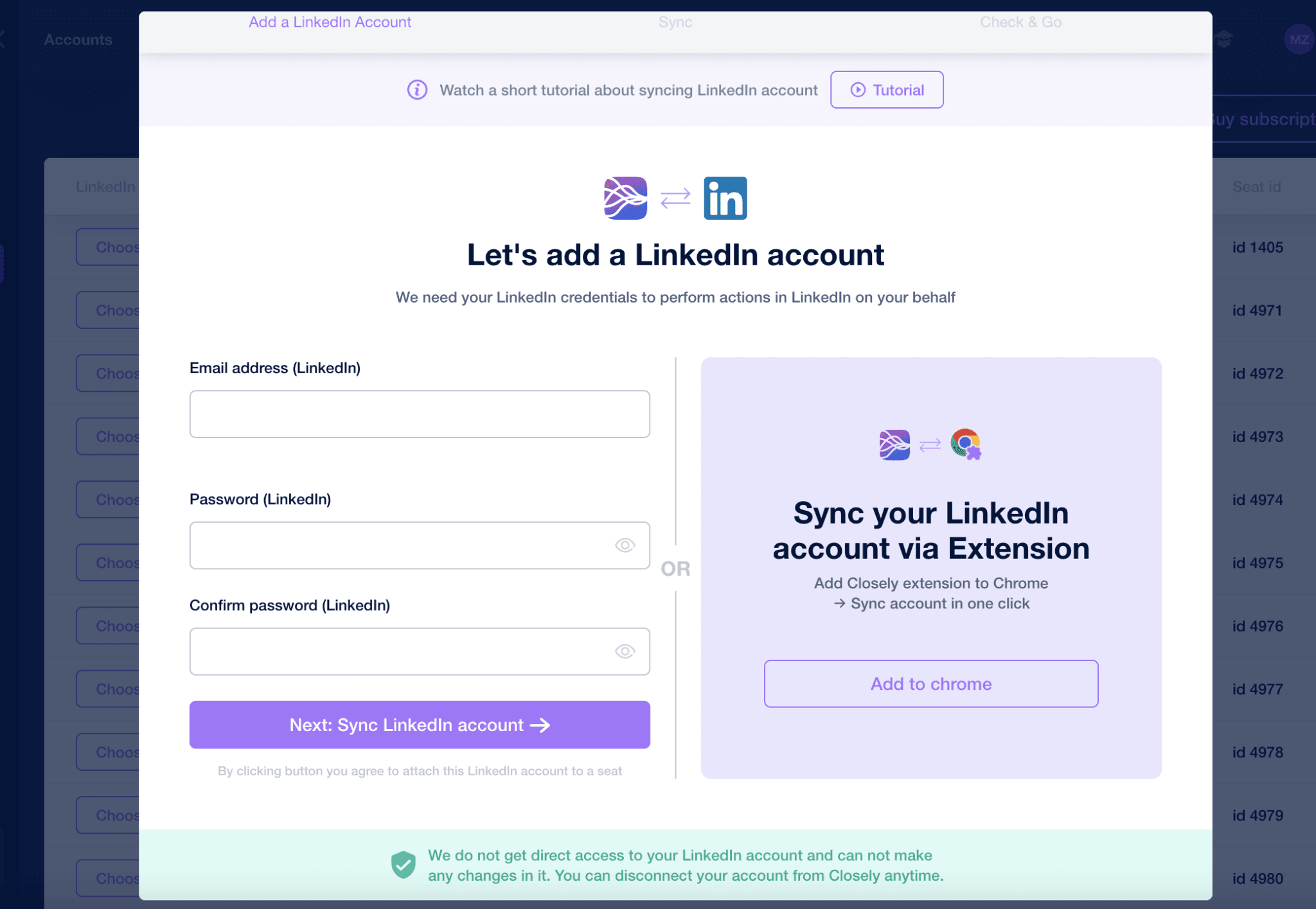
What I verified first-hand. I read Closely Assistant v2.0.4, identified by its Chrome Web Store listing. Its code can send li_at—the LinkedIn login in cookie form—or a fallback full cookie jar plus user agent to Closely account API endpoints.
That is a cloud-bridge: an extension copies login material to vendor infrastructure. The code proves the upload path, not retention, execution frequency, observed IP, or restriction outcomes.
The extension ID appeared in an undated Active Extension Detection (AED) list checked for this review. The missing dateline prevents a current-status conclusion. See BrowserGate’s general mechanism explanation.
| Claim or document | What it says | Evidence status |
|---|---|---|
| Current marketing | Assigned residential IP/network | Vendor claim; live proxy type is unresolved |
| Older Help Center wording | USA-based, VPN-like assigned route; no local proxy | Stale official wording conflicts with current marketing |
| Assistant v2.0.4 static reading | Session cookie or full cookie jar plus user agent can reach Closely account APIs | First-hand code finding; no retention or outcome inference |
| Preventive controls | Warm-up, randomized limits, schedules, working hours | Documented; cap honesty and reactive cooldown were not tested |
| User-supplied proxy and visible quality checker | No local/BYO route or public checker documented | Documentation boundary; live route remains unresolved |
Closely safety claims and evidence (July 2026)
Current product documents checked July 2026; extension package version 2.0.4 has no audit dateline · Sources: proxy claim, older proxy guide, daily limits, and working hours.
| Targeted test | Observation needed |
|---|---|
| Two-account cloud/IP check | Each exit IP, provider/subnet relationship, residential-versus-datacenter type, location, timezone, and independent IP-quality signals |
| Live session exposure and revocation | Whether the cloud session appears in LinkedIn active sessions and what revocation changes |
Remaining targeted Closely safety checks (July 2026)
Status as of July 2026 · No applicable live Cloud-IP result was completed, so no IP, ASN, provider, or proxy classification is stated.
A residential or mobile IP comes from a home or phone connection; a datacenter IP comes from rented server infrastructure. Server origin can make a personal session look unusual, but Closely’s classification is not established. See what a per-account proxy changes.
Behavior also matters. High-speed manual work, repeated direct profile-URL opening, or rapid invitation cleanup can trigger warnings. See restriction patterns and activity limits.
Controls reduce exposure; they do not create immunity: No automation tool eliminates LinkedIn restriction risk. Closely's preventive controls are documented, while its live exit-IP mechanism remains unresolved.
What Reviews and Reddit Actually Show
The reviewed platform sample is useful for finding questions, not declaring current sentiment. It spans December 23, 2021 through January 15, 2026: 192 G2 rows and 75 raw Trustpilot rows. Removing six wrong-entity Trustpilot rows creates a separate 69-row subset. Capterra contributes zero local rows.
| Corpus | Sample and dates | Exclusions | Permitted inference |
|---|---|---|---|
| G2 snapshot | 192 rows in the combined 2021-12-23 to 2026-01-15 window | None listed | Question discovery, not current-product proof |
| Trustpilot raw snapshot | 75 rows in that window | 6 wrong-entity rows identified | Raw distribution only |
| Trustpilot cleaned subset | 69 relevant rows | 6 wrong-entity rows removed | Qualitative patterns, not a live aggregate |
| Capterra snapshot | 0 rows | No cards | No inference |
| Reddit filter | 7 posts through 2026-02-12; 3 name Closely in the body | Comment tags and LTD/resale context | Sparse context, not satisfaction or safety evidence |
Closely review and Reddit corpus method (July 2026)
Local samples evaluated July 2026 · Platform attribution: G2, Trustpilot, and Capterra.
The time distribution is concentrated. Of 267 raw rows, 222 date to 2022; the trailing-six-month window has zero. Four weeks had concentrated volume: April 25, 30 rows (11.2% of 267); September 5, 37 (13.9%); September 19, 32 (12.0%); and October 24, 46 (17.2%). This does not establish why they appeared.
| Pattern | Count | Corroboration status |
|---|---|---|
| Reliability | 34/267 raw labeled rows | Hypothesis only; current behavior remains unresolved |
| Complexity | 28/267 raw labeled rows | Hypothesis only; current behavior remains unresolved |
| Lead targeting | 25/267 raw labeled rows | Hypothesis only; current quality remains unresolved |
| Cost | 24/267 raw labeled rows | Hypothesis only; current pricing is separately documented |
| Safety/detection | 21/267 raw labeled rows | Hypothesis only; current incidence remains unresolved |
| Scaling | 11/267 raw labeled rows | Hypothesis only; current controls are separately documented |
| Pricing transparency | 8/267 raw labeled rows | Hypothesis only; current pricing conflicts are separately documented |
Closely problem patterns and corroboration status (July 2026)
As of July 2026 · Counts describe the stated local snapshots and must not be read as current platform totals.
No duplicate-review cluster was detected; four volume windows were. Neither result establishes manipulation, purchase, fraud, or solicitation. Reviews alone do not support a current reliability or safety verdict.
Who Closely Is For — and Who Should Look Elsewhere
The decision turns less on a persona label than on whether Closely’s documented workflow and unresolved boundaries match the buyer’s operating requirements.
| A fit when | Look elsewhere when |
|---|---|
| You want LinkedIn and native email in one cloud-run sequence | You require a user-supplied local proxy or a verified exit-IP classification |
| You want Explorer, enrichment, research, scoring, and personalization and accept Growth at $127 as the relevant starting tier | You need enrichment and AI at the $49 Starter price |
| You use HubSpot, Salesforce, Pipedrive, Zoho CRM, or GoHighLevel | You require a public documented REST API or established Make support |
| You need white-label branding or the documented multi-client layer | You require documented sender rotation, cross-account deduplication, lead distribution, or audit logs |
| You can validate the annual checkout amount and account capacity before buying | You need annual economics and standalone inbox capacity to be unambiguous before procurement |
| You accept documented preventive controls while live proxy type remains unresolved | You require a completed live IP/proxy test before connecting a LinkedIn account |
Who Closely fits — and who should look elsewhere
Public documents checked July 2026 · Sources: campaigns, pricing, CRM set, webhooks, white label, proxy guide, and Terms.
Closely’s native-email convenience is material for teams that want both channels inside one sequence. The same buyer must account for shared-credit consumption, one-inbox-per-seat documentation, and daily email limits. Agencies can likewise use branding and client workspaces, but the missing documentation for rotation, distribution, cross-account deduplication, and audit logs calls for an authenticated control review before scaling.
How Closely Compares to Alternatives
Current public primary URLs were not established for Waalaxy, Instantly, or Salesforge, so their unverified cells remain pending.
| Tool | Architecture | Native channels/actions | Entry price as of date | One sourced convenience | One sourced drawback | Primary source |
|---|---|---|---|---|---|---|
| Linked Helper | Desktop + VPS/Web Version | LinkedIn-first workflows | $15/month | User-controlled LinkedIn execution on a desktop or VPS | No native non-LinkedIn email sequence builder; a dedicated email tool is required | Published security architecture study; official pricing |
| Waalaxy | Chrome extension (main); cloud solution offered | LinkedIn and native-email sequences | $42/month | Free tier documented in the reviewed matrix | Not established from the reviewed evidence | Current public primary source not established |
| Instantly | Cloud | Native email sequences | $47/month | Cold-email-first category with AI personalization | Not established from the reviewed evidence | Current public primary source not established |
| Salesforge | Cloud | Native email sequences and LinkedIn-invite support | $48/month | Cold-email-first category in the reviewed matrix | Not established from the reviewed evidence | Current public primary source not established |
How Closely compares (July 2026)
Research snapshot dated July 2026 · Prices and feature records may change.
The table names no winner. Missing public source coverage limits three rows, which buyers should verify on current vendor pages before procurement. This evidence gap prevents a fuller fact-by-fact comparison without introducing unsupported claims.
Where Linked Helper Fits
If Closely’s unresolved assigned-proxy type, session-upload path, and lack of a documented user-supplied proxy matter to you, a user-controlled execution model is worth evaluating.
Linked Helper is a desktop application that runs LinkedIn actions on the user’s computer or VPS. Its Web Version is login-based browser access to the instance running on that VPS, so campaigns can operate around the clock while the LinkedIn session remains on hardware the user controls. Linked Helper’s published security study explains the desktop, extension, and cloud architecture boundary.
- Session custody maps to the cloud-bridge finding: LinkedIn actions run from the desktop or VPS instance instead of uploading the session to a vendor execution cloud.
- Proxy choice maps to the unresolved assigned route: A separate HTTP, HTTPS, SOCKS, or SOCKS5 proxy can be assigned per account, and a built-in IPQualityScore check exposes fraud, proxy, VPN, bot, and abuse signals before use (proxy-safety guide). IPQualityScore is an independent IP-quality signal, not LinkedIn’s enforcement verdict.
- Message logic maps to the four-condition ceiling: Message templates support nested IF-THEN-ELSE conditions and spintax, while campaign workflows themselves remain linear rather than arbitrary branching trees (message-template guide).
- Deduplication maps to the agency-control gap: Message-history filters can exclude contacts by prior message content, including regular expressions, even when an earlier campaign record is unavailable (message-content filter).
- Reactive pauses map to the undocumented cooldown gap: Five identical failures in sequence trigger a four-hour pause for the affected action, while other actions can continue (recurring-error pause).
The channel trade-off remains important: Linked Helper does not replace Closely’s native non-LinkedIn email sequences, so teams that need that channel use a dedicated email tool. Closely starts at $49/month; Linked Helper starts at $15/month. Teams prioritizing user-controlled LinkedIn execution, proxy choice, and deeper LinkedIn-specific controls may want to evaluate Linked Helper too.