
 Updated: October 12, 2026
 25 min read
Key takeaways
- At 10 Finder credits per found non-EU mobile number, Basic's 1,000-credit Finder pool covers at most 100 phone results if used only for phones; teams mixing phone and email searches should budget by successful outcome, not read the allowance as 1,000 contacts. Pricing →
- The API documentation → publishes a 300-request general ceiling alongside caps of five for domain finder and 30 for business-profile finder, so capacity planning should follow each endpoint in the actual chain rather than the general number.
- LinkedIn and Sales Navigator collection runs in the live browser tab, while submitted cloud data jobs can continue after that browser action; operators therefore need separate interruption and completion checks for the extension path → and cloud jobs →.
- The historical G2 local-corpus aggregate → is 4.85★ across 48 reviews dated February 21, 2023 through December 18, 2024; that positive but stale cohort cannot fill the controlled-test gap, so buyers should benchmark current coverage and accuracy on their own sample.
This review is published by Linked Helper and written by Milosh Potikj, who works there. I've made every effort to represent Findymail accurately using verified data — our own first-hand testing, Findymail's own documentation, and independently sourced reviews.
Findymail is a verification-first B2B contact-data platform for teams that need work emails, phone numbers, company discovery, and CRM enrichment before outreach. Its August 2026 Basic plan starts at $49 per month for 1,000 Finder and 1,000 Verifier credits; the free account provides 10 starting credits without a card. LinkedIn and Sales Navigator collection runs in the Chrome extension's live browser context, while API, Intellimatch, Signals, and Datacare jobs use cloud services. The inspected LinkedIn session stayed in the browser, but the extension remains technically detectable. The verdict is conditional: Findymail can supply and verify contact data, then hands records to an external sequencer. It does not natively run email or LinkedIn campaigns or manage replies, so $49 is the data-layer entry price rather than a complete outreach budget for the buyer's full stack.
Verdict
Findymail covers contact discovery and verification when that is the missing part of your stack. The current product surface includes separate Finder and Verifier balances, phone lookup, company discovery, intent signals, files, API access, CRM maintenance, and sender handoffs. The Basic plan is the data-layer entry point.
The qualification is economic as much as functional. Finder charges a successful working-email result, the API Verifier charges an attempted verification, a found phone consumes 10 Finder credits, and Intellimatch has separate company meters. A headline allowance therefore does not reveal cost per unique decision maker after overlap and deduplication. Cross-member duplicate protection and a controlled coverage or accuracy result were not established in this research.
| Use | Verify first | Look elsewhere |
|---|---|---|
| Contact data — find and verify work emails, enrich files, and discover companies before outreach. | Unit economics — model the endpoints you will actually call, then track unique post-dedupe contacts. | Native execution — choose another category when you need email or LinkedIn sequences and reply handling in the same product. |
| Existing stack — add a data layer to a CRM, API workflow, or external sender. | Operational outcomes — test coverage, accuracy, freshness, exports, billing, and runtime handoffs on your own sample. | Agency control plane — client workspaces, granular roles, white-labeling, and user 11+ were not established. |
Conditional Findymail verdict
That is a conditional FOR on enrichment and verification, and AGAINST treating Findymail as an outreach engine or assuming its nominal credits equal unique usable contacts.
Pros
- Multiple documented inputs — like most contact-data tools, Finder accepts name and domain, profile or social URL, CSV/XLS, Intellimatch, and CRM records.
- Separate credit pools — paid plans publish Finder and Verifier allowances independently, which makes the two workloads visible.
- Finder plus real-time verification — a found work email is verified in the result workflow, including a documented catch-all path.
- Current plan access — the public pricing page presents core data features and API access across paid tiers.
- Six named native CRM connectors — HubSpot, Salesforce, Pipedrive, Zoho, Close, and Copper have documented native connections.
- Shared credits through the documented team scope — ordinary members draw from the owner's master pool without an ordinary per-member charge.
- Documented data-processing terms — the public DPA identifies hosting, subprocessors, deletion, and breach-notice mechanics.
Cons
Findymail's main limitations come from product scope and unresolved operating details. The historical 55-review set contains no strict negative card.
- Outreach stays external — native email sequences, LinkedIn invites/messages, a conversation inbox, reply detection, and campaign A/B tests are outside the documented product.
- Credit rules vary by endpoint — Finder success, Verifier attempt, phone, and Intellimatch consumption cannot be reduced to one “pay only for results” rule.
- Unique-contact cost is unresolved — a 30-day no-recharge rule exists, but cross-query identity resolution and cross-member duplicate protection were not established.
- Browser context matters — LinkedIn and Sales Navigator acquisition runs in the live browser tab; closing that context stops browser-local collection.
- Team scale is disputed — shared credits are documented through 10 users as a safe public bound; user 11+ is not established.
| Limitation | Evidence class | Status |
|---|---|---|
| Team scale is disputed | Conflicting first-party pages | Shared credits are documented through 10 users as a safe public bound; user 11+ is not established. |
| Agency governance is not established | Public-evidence search | Client workspaces, granular RBAC, white-labeling, lead distribution, and a cross-account dashboard were not confirmed in public evidence. |
| Commercial gaps remain | Public terms and Help Center | Top-ups exist, but their public price and expiry were not found; paid amounts are non-refundable. |
Findymail limitations and evidence status
Historical high-rated reviews add hypotheses rather than current defect rates: one reviewer questioned charges while explicitly allowing that they might be mistaken, another described thin coverage for some batches, and another objected to the 2× rollover cap. Those examples justify testing the exact workflow, but the cohort ends in December 2024 and cannot establish present prevalence.
Findymail Pricing
The August 2026 ladder starts at $49 per month. The vendor advertises two months free on annual billing, so the yearly figures below are arithmetic—monthly price multiplied by 10—not captured checkout totals. Annual-offer source → Current plan source →
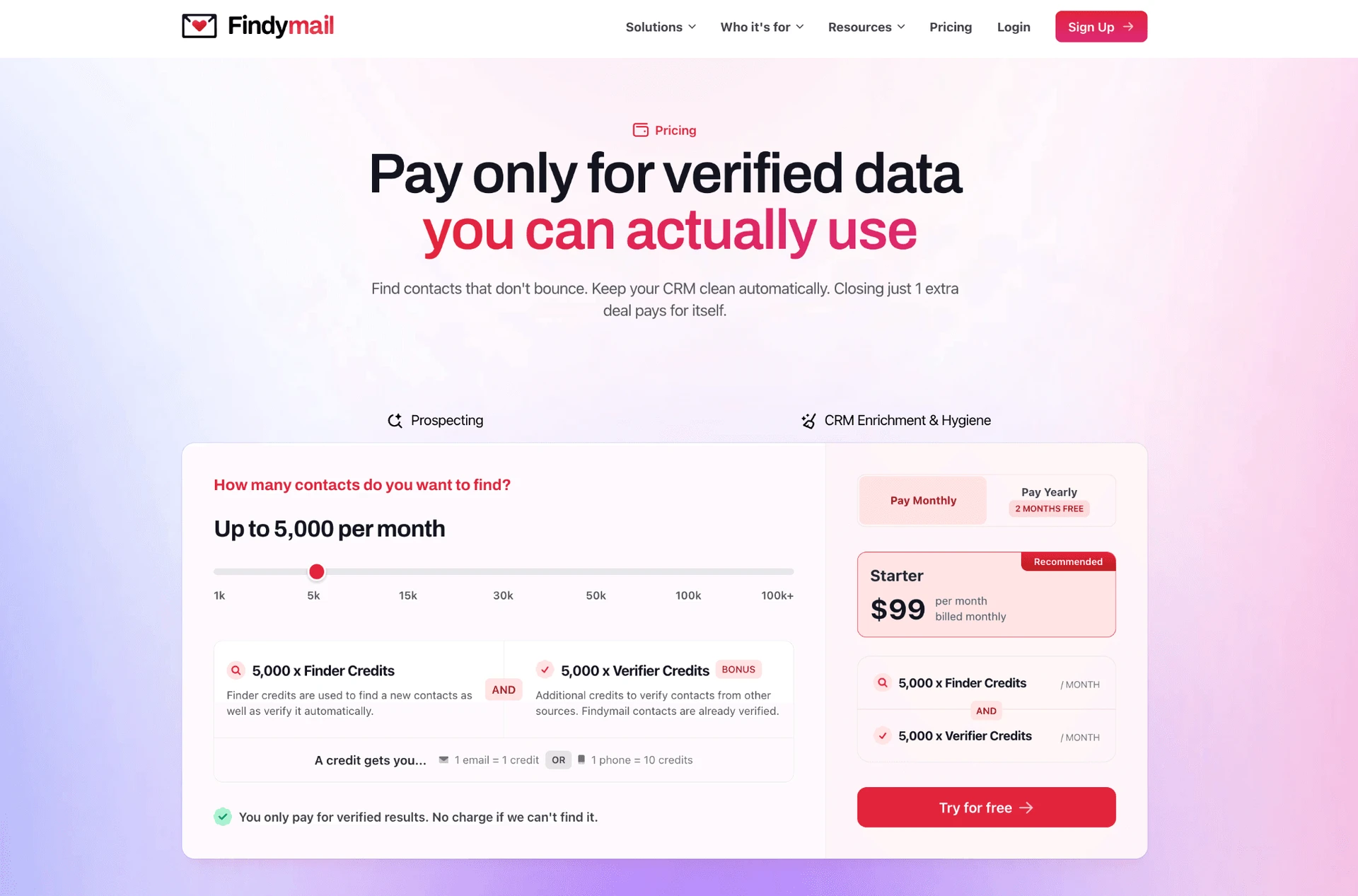
| Plan | Price | Finder credits | Verifier credits | What's NOT included |
|---|---|---|---|---|
| Basic | $49/mo; derived $490/yr | 1,000 | 1,000 | Native sender, inbox, or LinkedIn execution |
| Starter | $99/mo; derived $990/yr | 5,000 | 5,000 | Native sender, inbox, or LinkedIn execution |
| Business | $249/mo; derived $2,490/yr | 15,000 | 15,000 | Native sender, inbox, or LinkedIn execution |
| Business Plus | $399/mo; derived $3,990/yr | 30,000 | 30,000 | Native sender, inbox, or LinkedIn execution |
| Scale 50K | $549/mo; derived $5,490/yr | Not established in this evidence | Not established in this evidence | Native sender, inbox, or LinkedIn execution |
| Scale 100K | $849/mo; derived $8,490/yr | Not established in this evidence | Not established in this evidence | Native sender, inbox, or LinkedIn execution |
| Enterprise | Custom | Custom | Custom | Public seat curve and complete terms not established |
Findymail pricing tiers
The first trap is mixed currencies. Finder charges one credit for a found working email and no credit for a failed lookup, while the API Verifier charges one Verifier credit for every attempt. A found phone costs 10 Finder credits. Intellimatch Broad costs one credit per 10 companies, Targeted costs one per company, and enrichment consumes more. That makes unique post-dedupe decision makers the useful budget unit. Endpoint rules → Phone meter → Intellimatch meters →
The second trap is balance lifecycle. Monthly rollover stops at twice the allowance; cancellation clears the remaining balance at period end. One-time top-ups exist, but public price and expiry terms were not found. Top-up terms → Datacare is separate, annual, and starts at a vendor-published $500 per month floor. Datacare source → Paid amounts are non-refundable; the bounce remedy returns credits rather than cash. Rollover terms →
Pricing boundary: $49 covers the data layer only. Add the separately chosen CRM, sender, inbox, LinkedIn execution, and any Sales Navigator subscription to model total outreach cost.
A fixed 8,000-found-email workload fits within Business's 15,000 Finder allowance at $249 per month, but overlap, verification attempts, phones, and the external execution layer still change cost per usable decision maker. The free account's 10 starting credits is a microtest, not a fixed-duration trial; replenishment, expiry, and complete feature gates were not disclosed.
Email Finder, Verifier, Catch-All, and Credit Outcomes
Like most tools in this category, Findymail accepts several inputs: name plus domain, a profile or social URL, CSV/XLS, Intellimatch output, or a CRM record. Finder looks for a work email and verifies the found result in real time; Verifier processes addresses already in hand, including catch-all workflows. Those documented paths support workflow design, not an independent accuracy verdict. Finder documentation → · Verifier documentation →
| Workflow | Outcome | Credit pool | Charge rule |
|---|---|---|---|
| Finder | Working email found and verified | Finder | 1 credit on a found result; failed lookup is free |
| API Verifier | Address verification attempted | Verifier | 1 credit for every attempt |
| Catch-all verification | Catch-all address processed | Verifier | Documented workflow; independent precision not measured |
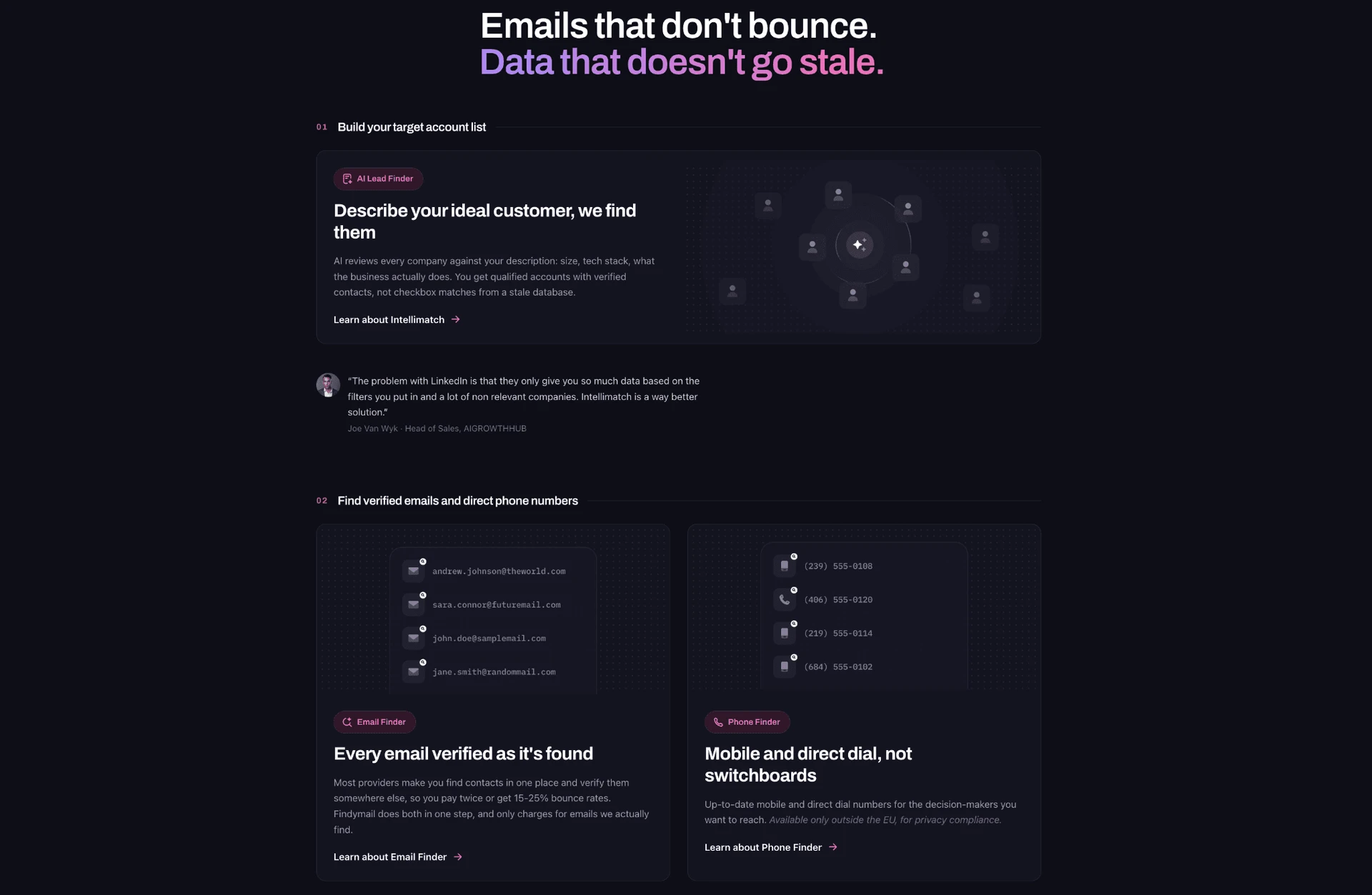
| Phone Finder | Non-EU mobile number found in the documented flow | Finder | 10 credits per found phone |
| Recent duplicate | Email found within the prior 30 days | Finder | No recharge under the documented rule |
Findymail endpoint, outcome, and credit rules
The sub-5% bounce promise is a vendor remedy: after review, credits may be returned. It is not a cash refund or a controlled measure of coverage, catch-all precision, inbox placement, or deliverability. The 30-day duplicate rule does not establish export cleanliness, freshness, failed-profile diagnostics, cross-query identity matching, or cross-member duplicate protection. For neutral context on how profile data and email enrichment differ, see getting emails beyond visible profile fields.
Measurement limit: Do not convert the bounce-credit guarantee or historical reviewer praise into an accuracy percentage; a controlled truth-set and bounce panel were not run.
Chrome Extension, LinkedIn/Sales Navigator, and Browser-Local Collection
Findymail uses a hybrid execution model. Its public Manifest V3 Chrome extension handles LinkedIn and Sales Navigator acquisition in the user's live browser, while submitted API, Intellimatch, Signals, and Datacare jobs use cloud services. That means closing the relevant tab can stop local pagination and CSV collection, whereas a submitted cloud data job can continue. Chrome extension listing →
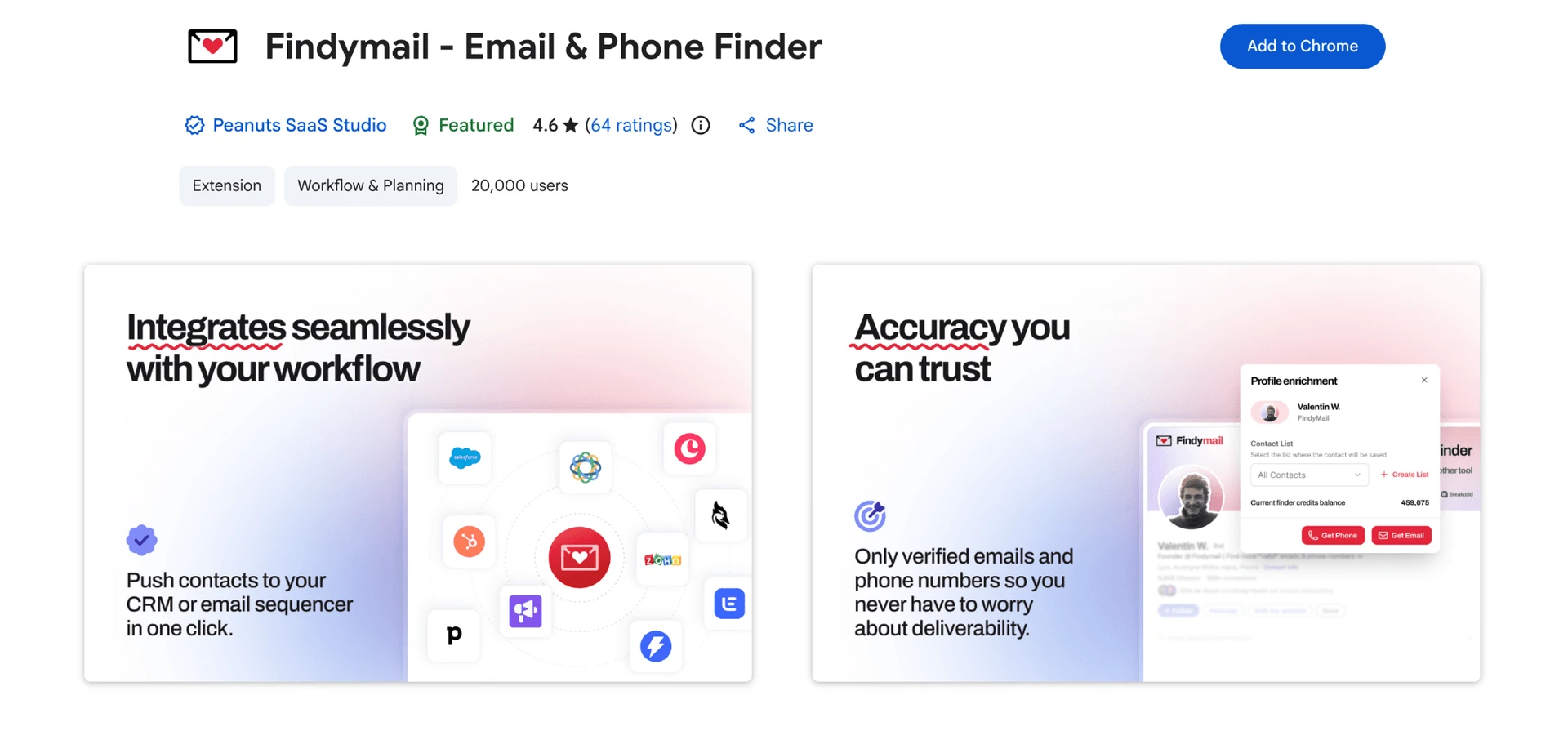
The August 29, 2026 static inspection covered extension v1.0.41. It found storage and tabs permissions, code injected into LinkedIn, Sales Navigator, Recruiter, the Apollo platform, and Crunchbase pages, and a background service worker. LinkedIn profile and Sales Navigator bulk collection are confirmed, including in-page pagination and CSV construction. Sales Navigator workflow →
li_at and JSESSIONID are the LinkedIn session and CSRF-token cookies; whoever holds the session material can act as the account. The inspected path read JSESSIONID locally to derive a CSRF token for browser-local Voyager requests, but found no li_at read, Chrome cookie permission, or LinkedIn cookie-jar upload. The vendor request carried the profile URL and list under a Findymail bearer token, which supports the local-scrape classification without proving every backend-retention branch.
| Browser-local surface | Cloud data surface | |
|---|---|---|
| Trigger | LinkedIn profile or Sales Navigator tab | API, Intellimatch, Signals, or Datacare submission |
| Execution | Content script, in-page pagination, CSV construction | Vendor data job and documented callback |
| Operating boundary | Relevant Chrome tab must remain open | Submitted job may continue after the browser action |
| What remains unresolved | Live traffic, exit IP, persistence, bulk Recruiter support | Payload completeness, retries, and runtime reliability |
Where Findymail collection runs
Recruiter per-profile code exists, but bulk Recruiter export remains disputed; one surface does not prove the other. A standalone desktop or VPS client was not found in the public product surface, which is an evidence gap rather than proof that none exists. Sales Navigator “Save as lead” control, profile-badge extraction, current-organization traversal semantics, and post-age collection were not checked.
Static-inspection boundary: Version 1.0.41 supports a browser-local classification; it does not establish a live restriction outcome, data accuracy, exit IP, every code path, or bulk Recruiter behavior.
Phone Finder, Intellimatch, and Signals
Findymail extends the data layer in three different directions, and their meters should not be blended. Pricing documents phone consumption, product documentation describes company discovery and scoring, and the Signals page documents event monitoring.
| Product | Input | Output | Meter | Boundary |
|---|---|---|---|---|
| Phone Finder | Supported profile or contact lookup | Found non-EU mobile number in the documented flow | 10 Finder credits per found phone | Basic's 1,000 Finder credits cover at most 100 found phones if used only for phone results |
| Intellimatch Broad | Plain-English company criteria | Ranked company set | 1 credit per 10 companies | Optional contact enrichment consumes additional credits |
| Intellimatch Targeted | Tighter company criteria | Ranked company set | 1 credit per company | Result quality was not independently benchmarked |
| Signals | ICP filters plus monitored events | New Hire, Job Title Change, Keyword Mention, Topic Engagement | Product meter not established in this evidence | Event relevance and freshness were not independently benchmarked |
Findymail phone, company-discovery, and signal meters
Phone lookup is its own workload. Ten Finder credits per successful number means a phone-heavy Basic account can exhaust the same pool used for work-email finding. The documented non-EU boundary also means the output is not a universal phone-coverage claim.
Intellimatch discovers companies. Broad and Targeted modes turn plain-language criteria into ranked company results; optional email or phone enrichment then draws additional balance. In practice, a company list and enriched decision makers are separate economic steps.
Signals scores events. AI evaluates relevance for four named signal types. That is lead discovery and scoring, not message generation: no native AI outreach-copy generation, AI post-comment action, or message-review gate is documented. Employees-from-organization extraction, profile-badge scraping, company-field derivation, scheduled commenter collection, and exposed per-record freshness dates were not checked, so no absence claim follows.
AI boundary: Intellimatch and Signals rank companies or events; they do not turn Findymail into a native message writer, sender, or reply inbox.
CSV/XLS, API, Webhooks, Jobs, and Throughput
Like most data platforms, Findymail supports CSV/XLS import and export. Verifier describes files of any size, but credits remain the practical commercial boundary. For upstream context, see what a LinkedIn-profile CSV can contain before an enrichment layer adds contact fields.
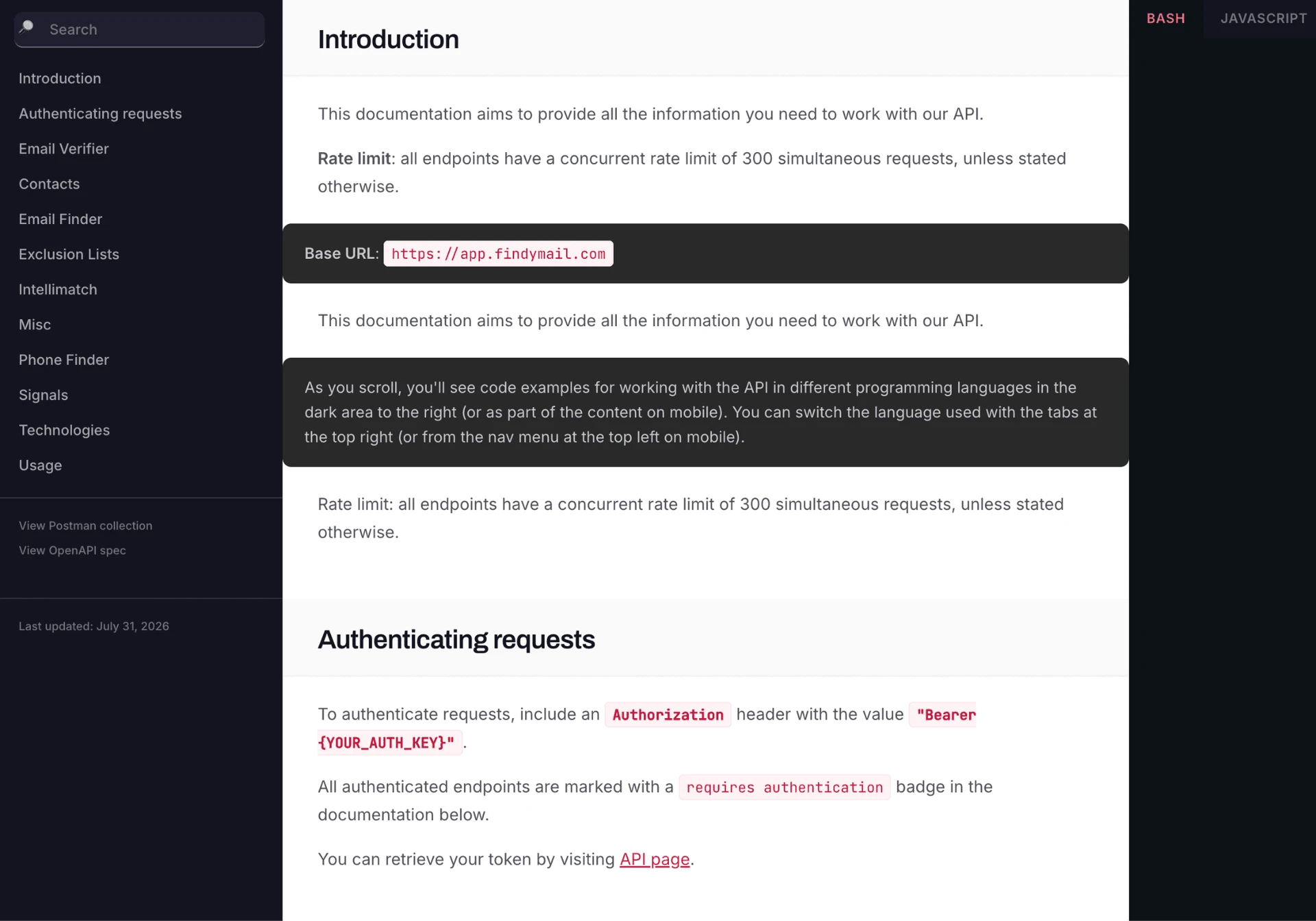
The public API documentation uses Bearer authentication and covers lists, contacts, verification, email/domain/business-profile search, Intellimatch, Signals, technologies, usage, and asynchronous jobs. “API included” does not mean uniform throughput: each endpoint keeps its documented ceiling.
| Endpoint or job | Limit | Execution mode | Runtime status |
|---|---|---|---|
| General API | 300 simultaneous requests unless stricter | Synchronous or asynchronous by endpoint | Documented; not live-fired in this review |
| Domain finder | 5 concurrent | Synchronous | Documented; retries not tested |
| Business-profile finder | 30 concurrent | Synchronous | Documented; payload completeness not tested |
| Async search | Up to 24 hours | Job plus outbound completion callback | Callback documented; signature and retry behavior not tested |
| Intellimatch export task | 5,000 companies | Asynchronous task | Runtime reliability not tested |
| Credit exhaustion | HTTP 402 | Request rejected | Documented response; billing recovery not tested |
Findymail API and job limits
The documented webhook_url is an outbound callback: Findymail sends completion results to a supplied destination. It does not establish an inbound webhook that starts a Findymail workflow. That distinction matters because sending a record outward by webhook is a different mechanism from accepting an inbound trigger.
No authenticated live-fire run established payload completeness, retry semantics, callback signatures, CRM mappings, or runtime reliability. Those are test gaps, not evidence that the functions fail.
Capacity planning: Model the strictest endpoint in the chain—5, 30, 300, or a 5,000-company task—not the largest general API number.
CRM Datacare, Integrations, and External-Sender Handoff
Findymail documents six native CRM connectors: HubSpot, Salesforce, Pipedrive, Zoho, Close, and Copper. The wider handoff surface also names Zapier, Make, n8n, API, CSV, and external senders, but those are different connector types and should not be collapsed into a single “native integrations” count. Pricing and integration inventory →
Datacare is the continuous CRM-maintenance layer: the vendor documents enrichment, job-change updates, and duplicate merging. Its annual price starts from a vendor-published $500 per month floor. Datacare pricing → Exact identifier matching, overwrite rules, OAuth mappings, and failure handling were not authenticated end to end.
| Source | Findymail layer | Destination | Execution owner | |
|---|---|---|---|---|
| Profile | LinkedIn or Sales Navigator | Finder / Phone Finder | CRM or external sequencer | Destination product |
| File | CSV or XLS | Finder / Verifier | CSV export, CRM, or API consumer | Destination product |
| Discovery | Intellimatch or Signals | Company/event scoring and optional enrichment | Signals Feed, CRM, or external tool | Destination product |
| Maintenance | CRM records | Datacare | Updated CRM | Datacare for data changes; CRM for downstream work |
Findymail data handoff
Vendor copy says contacts can be pushed to the Instantly platform, Smartlead, Lemlist, or a CRM. This proves a handoff, not native campaign ownership: Findymail's documented product has no email sender, multistep message sequence, unified conversation inbox, reply detection, campaign A/B tests, or LinkedIn invite/message action. Sequencer handoff →
For a neutral explanation of field-level handoffs, see how CSV, CRM, and webhook exports differ.
Integration boundary: A connector can move or maintain a contact record; it does not make Findymail the system that sends the campaign or manages the reply.
Teams, Agencies, Shared Credits, Dedupe, and Governance
Findymail's documented collaboration model is a team owner with a master credit pool. Ordinary members use that balance without an ordinary per-member charge, contacts remain separate by default, and a list owner can optionally share a list. That supports lightweight collaboration without proving tenant-style agency isolation. Team behavior →
| Capability | Proven | Unclear | Not found |
|---|---|---|---|
| Shared credits | Owner's master pool funds ordinary members in the documented flow | Commercial behavior beyond the supported public scope | — |
| Team size | Collaboration through 10 users is the safe public bound | User 11+; first-party copy conflicts with broader team wording | — |
| Contacts and lists | Contacts are separate by default; owner can enable list sharing | Cross-member identity matching and duplicate no-recharge | — |
| Usage reporting | Owner-only team usage reporting exists in API docs | Authenticated report completeness | — |
| Agency governance | — | Client workspace and client isolation were not established | Granular RBAC, white-label, client portal, lead distribution, sender rotation, and cross-account dashboard were not found in public evidence |
Findymail team and agency controls
The 30-day duplicate rule covers an email that Findymail found recently. It does not establish cross-member protection when separate contact lists hold the same person, so an agency should test duplicate charging with two members before forecasting unique-contact cost. For conceptual context, workflow-level duplicate controls are distinct from billing dedupe.
Public pages conflict between “up to ten users” and broader entire-team or unlimited wording. We therefore keep user 11+, cross-member dedupe, client isolation, granular permissions, and full agency total cost unresolved. “Not found” here is a public-evidence gap, never proof that a capability is absent.
Agency boundary: Do not price 20 or 50 users from the public copy: user 11+, cross-member duplicate protection, client isolation, and seat economics were not established.
Is Findymail Safe?
Findymail has no native LinkedIn invitation or messaging engine, but its store-listed data-collection extension still interacts with LinkedIn. In a labeled first-hand check, we separated extension detectability from data protection and from actual account outcomes.
What I verified first-hand
| Claim or check | Evidence | What it supports | What remains untested |
|---|---|---|---|
| v1.0.41 architecture | Static inspection: Medium / LOCAL_SCRAPE | LinkedIn acquisition ran in the browser; no cookie-jar upload was found | Live traffic, every branch, and backend retention |
| Session handling | No li_at read or Chrome cookie permission; local JSESSIONID use for CSRF | The inspected path kept the LinkedIn session local | Universal behavior beyond v1.0.41 |
| Detectability | All-frame injection, web-accessible resources, direct Voyager calls, synthetic-event surface, AED ID listing | A technically observable extension surface | Current restriction or blocklist outcome |
| Action automation | No invite/message spam, remote code, telemetry blocking, proxy setting, or user-configurable pacing found | Scope is data collection, not action automation | The older pacing finding conflicts with changed v1.0.41 code |
| Data protection | DPA documents TLS 1.2, SCCs, deletion, subprocessors, and 72-hour breach notice | Documentary controls and Finland/Ireland/France plus US-subprocessor topology | Encryption at rest; operational audit; SOC 2 scope |
Findymail safety and data-protection checks
Active Extension Detection (AED) is LinkedIn's target list of extension IDs that its page code can probe; a listed ID can make installation visible before the extension performs a task. Findymail's ID appears in the target data, but the recorded probe filename is stale for v1.0.41, so this is technical-detection evidence rather than a current blocklist or restriction result.
No tool eliminates ban risk. Manual behavior can also look automated when users open many profiles directly by URL or process actions at unrealistic speed. IP consistency is a separate concept; see why account IP context matters.
Safety limit: Local session handling reduces one custody surface; it does not remove extension detectability, behavioral enforcement, data-protection duties, or account-restriction risk.
What Reviews and Community Mining Actually Show
Pricing, Teams, Safety, and this review-corpus section exceed their locked prose ranges because their required tier-and-credit, governance, safety, and corpus evidence is carried in visible tables and review cards; removing those rows would drop material support. The FAQ wrapper stays below 35 words because its eight separately budgeted child answers carry the evidence and the wrapper only introduces them.
The historical review set is positive but stale. G2 shows 4.85★ across 48 reviews dated February 2023 through December 2024: 35 were 5★, 12 were 4.5★, and one was 4★. Capterra contributes seven reviews over the same research window, too few for an independent mean. This research set contains no local Trustpilot reviews, and the trailing six months ending August 30, 2026 contains zero rated reviews.
| Corpus | Sample | Date window | Supported use | Unsupported inference |
|---|---|---|---|---|
| G2 | 48 local-corpus reviews | 2023-02-21–2024-12-18 | Historical satisfaction examples and 4.85★ aggregate | Current accuracy, support, billing, or incident rate |
| Capterra | 7 local-corpus reviews | Within the same historical cohort | Qualitative examples with thin-sample warning | Independent platform mean or trend |
| Reddit tags | Aggregate count not established in the reviewed public evidence | Through 2026-03-31 | Workflow hypotheses after visible-text review | Product-wide sentiment or prevalence |
Findymail corpus scope and evidence limits
The weekly scan found five reviews in the week of January 8, 2024 and four in the week of October 21, 2024, with no negative cluster. Those are volume patterns, not evidence of solicitation, incentives, or manipulation. The visible Reddit complaint about roughly 30% overlap came from one workflow and is a test hypothesis, not a measured product rate.