
 Updated: September 13, 2026
 32 min read
Key takeaways
- Biz costs $10 more month to month than Start, doubles the published invitation and InMail allowances to 800 each, and raises AI Optimizations fivefold to 2,500, while Pro leaves those outreach allowances at 800 each (pricing); the quota that blocks the workflow—not the tier name—is the useful upgrade criterion.
- The branded finder names Prospeo, while the documented Send Now path does not establish sender identity, mailbox authentication, allowance, deliverability, or a combined LinkedIn-plus-email sequence; buyers should test lookup, one-off sending, and multichannel sequencing as separate capabilities.
- Team bundles five LinkedIn accounts at a flat plan price, but public materials do not establish human seats, roles, isolated client workspaces, or an official sixth-account path; agencies should treat it as account capacity until governance and tenancy are validated.
- The annual-equivalent discount lowers the headline rate, but the Terms and Refund Policy conflict on refund and cancellation wording, unused annual time is not refunded, and post-cancellation data access is not documented; a month-to-month test is the more reversible way to verify fit.
This review is published by Linked Helper and written by Milosh Potikj, who works there. I've made every effort to represent LinkedRadar accurately using verified data — our own first-hand testing, LinkedRadar's own documentation, and independently sourced reviews.
LinkedRadar is a Chrome and Edge extension for solo operators running separate invitation, first-degree message, and InMail campaigns. It also includes search imports, a built-in sales CRM (SCRM), AI-assisted copy, and a Prospeo-backed email finder (product scope).
Start costs $19.90 month to month or $13.90 per month equivalent when $166.80 is prepaid yearly (pricing). Our workflow verdict is conditional, while overall safety is not established.
Public evidence did not establish whether raw li_at—the LinkedIn login in cookie form—moves from the browser to the vendor SCRM. Nor did it establish the proposed direct-write, injection, synthetic-event, or extension-detection surfaces. A live cloud/IP test was not run.
Verdict
LinkedRadar is a conditional option for a buyer who accepts browser-bound, linear LinkedIn automation. Its published month-to-month entry price is below $20. Current vendor pages show three LinkedIn campaign types, regular-search and Sales Navigator imports, CSV movement, AI text generation, and per-action pacing controls. They also show a five-account Team allowance (pricing).
The safety evidence limits that recommendation. The Store listing identifies the v1.8.23 package, but no direct public URL was found for the static technical cluster. Public evidence therefore does not establish the reported raw-session path, direct writes, content injection, synthetic events, telemetry behavior, or extension-detection surface. Those gaps are part of the verdict rationale, not proof that any mechanism is absent. The required live cloud/IP test was not run, so overall safety is not established. Because the applicable live cloud/IP test was not run, this draft remains blocked from publication. The static teardown does not replace that required test.
Public materials also did not establish multistep branching, a reply-triggered stop, A/B variants, or a unified inbox as of September 2026. No current $0 plan card or timed trial is published, and the available 45 raw reviews end in 2023. They cannot establish present product behavior or current consensus.
Low published entry pricing, linear campaign capability, and Chrome/Edge distribution. Not established: the reported session-handoff and detection-surface mechanics, overall safety, current free access, reply-aware workflow behavior, and current user consensus.
Pros
- Three distinct LinkedIn campaign surfaces: Invitation, first-degree message, and InMail flows are documented separately (tutorial hub). Each action type stays explicit rather than sitting behind a generic automation label.
- Published entry pricing: Start is $19.90 month to month or $13.90 monthly equivalent on annual prepayment (pricing). The commitment trade-off is calculable.
- Search-to-list workflow: Regular LinkedIn search, Sales Navigator search, CSV/XLSX import, lists, tags, and contact export cover common list-building tasks (extension page).
- AI text allowances are quantified: Every paid tier lists a monthly AI Optimization allowance, making generation volume visible before checkout (pricing).
- Pacing controls are visible: Invitation and message settings expose separate Daily Limit and Interval Seconds fields (settings tutorial). The operator controls queue timing directly.
- Five-account commercial option: Team bundles five LinkedIn accounts at one flat plan price (pricing). That gives a small multi-account operator a known subscription floor.
Cons
- Overall safety is not established: The required live cloud/IP test was not run. A static teardown cannot replace that blocking test or establish a live restriction outcome.
- The technical cluster lacks public support: The Store listing identifies the package, but no direct public URL was found for the reported
li_atpath, direct writes, injection, synthetic events, telemetry behavior, or extension-detection status. Those mechanisms remain not established for publication. - Browser-runtime dependence needs validation: Chrome and Edge distribution is public, but current human-readable documentation does not establish the complete runtime dependency or whether normal LinkedIn use can continue while a campaign runs.
- Workflow depth is unresolved beyond linear actions: Public materials did not establish multistep branching or a reply-triggered stop. They also did not establish A/B variants or a unified inbox as of September 2026 (message tutorial).
- Email production detail is unresolved: A “Send Now” UI is visible (InMail tutorial). Mailbox authentication, sender identity, allowance, and deliverability were not established.
- Commercial documents conflict: The Terms use categorical no-refund language. The Refund Policy describes a narrow 24-hour exception for a first-payment system error.
- Current market evidence is thin: The 45-review raw sample ends in 2023 and contains only one strict negative record. It provides no current six-month ratings, so it cannot support a 2026 consensus.
LinkedRadar Pricing: Monthly Reality Behind the Annual Default
LinkedRadar’s pricing page defaults to annual-equivalent figures. Start first appears at $13.90 per month, but that requires a $166.80 yearly prepayment. The cancellable month-to-month state is $19.90. The displayed equivalent is about 30% below monthly billing, but it is not a monthly commitment.
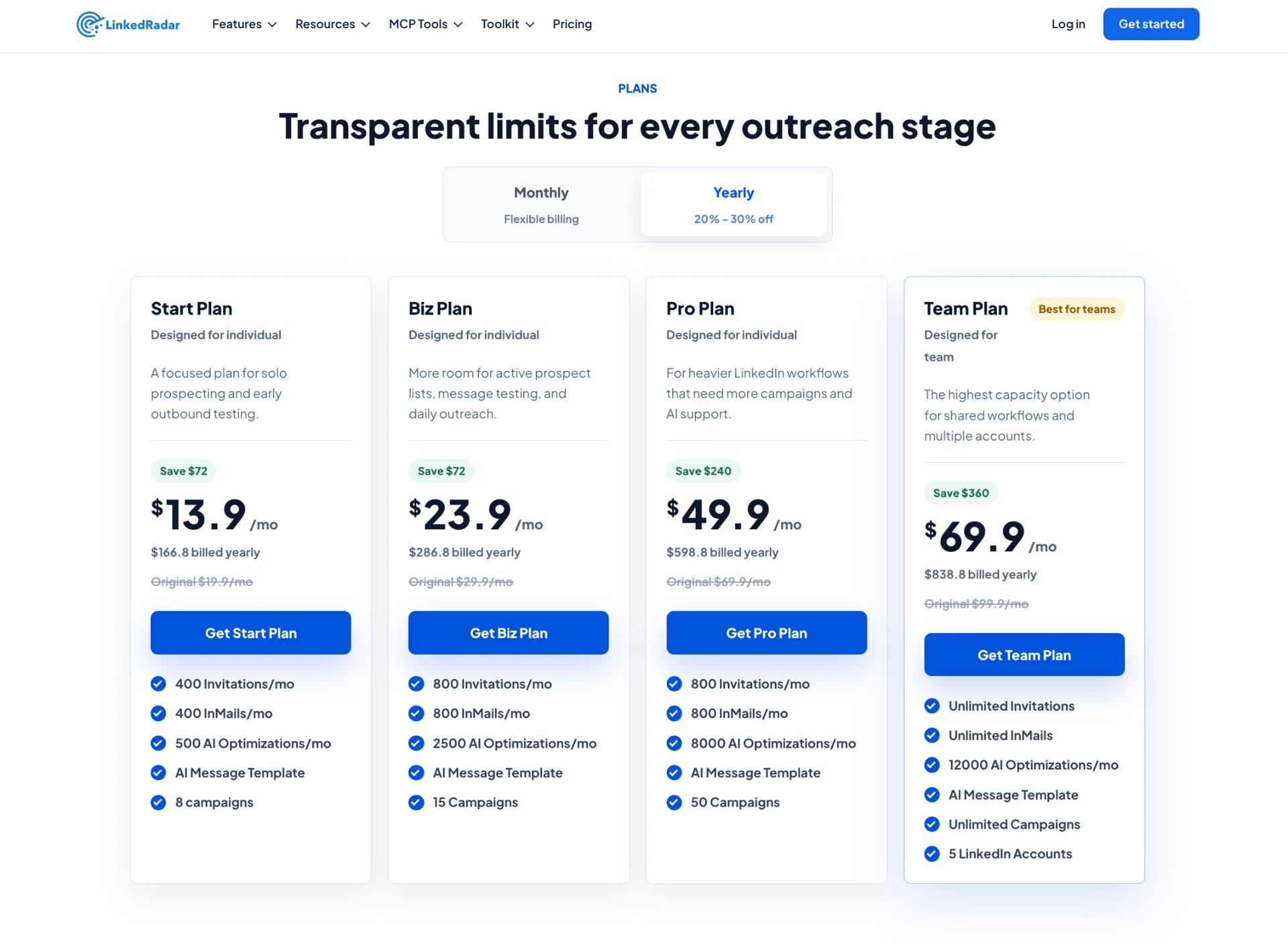
| Plan | Price | What's included | What's NOT included or established |
|---|---|---|---|
| Start | $19.90 month to month; $13.90/mo equivalent, $166.80 billed yearly | 400 invitations/mo; 400 InMails/mo; 500 AI Optimizations/mo; 8 campaigns; 1 LinkedIn account | Ordinary-message allowance, quota-exhaustion behavior, and AI rollover policy are not disclosed |
| Biz | $29.90 month to month; $23.90/mo equivalent, $286.80 billed yearly | 800 invitations/mo; 800 InMails/mo; 2,500 AI Optimizations/mo; 15 campaigns; 1 LinkedIn account | A second LinkedIn account and deeper campaign logic are not established |
| Pro | $69.90 month to month; $49.90/mo equivalent, $598.80 billed yearly | 800 invitations/mo; 800 InMails/mo; 8,000 AI Optimizations/mo; 50 campaigns; 1 LinkedIn account | More published invitations or InMails than Biz; ordinary-message cap remains undisclosed |
| Team | $99.90 month to month; $69.90/mo equivalent, $838.80 billed yearly | Unlimited plan allowances for invitations, InMails, and campaigns; 12,000 AI Optimizations/mo; 5 LinkedIn accounts | Unlimited safe LinkedIn activity, human-seat count, account six, and a fair-use rule are not established |
LinkedRadar pricing tiers (September 2026)
The upgrade pattern is quota-led: Biz doubles the published Start invitation and InMail allowances. It increases AI Optimizations fivefold for $10 more month to month. Pro keeps invitations and InMails at 800 each but raises AI Optimizations and campaign count. That means a buyer should select a tier by the limiting quota, not infer more workflow depth from the higher price.
Annual-default trap: Start's $13.90/mo headline requires $166.80 upfront for a year. The cancellable monthly price is $19.90, and annual cancellation does not produce a refund for unused time under the published policy.
“Unlimited” remains scoped: Team names unlimited invitations, unlimited InMails, and unlimited campaigns as plan allowances. It does not name ordinary first-degree messages, remove hidden daily counters, or establish unlimited safe activity. For neutral platform context, see how LinkedIn invitation limits differ from a vendor’s monthly allowance.
Free access is unresolved, not disproved: the 2026 pricing page has no $0 card and publishes no timed trial. Older reviews describe capped free access, including one report of 30 messages per day. Those historical accounts do not establish the current post-signup state. The first registration step shows no card field; that does not establish whether paid checkout later requires one (registration).
Exit terms require reading two pages: the Refund Policy describes Profile → My Plan → cancel and a narrow 24-hour first-payment/system-bug refund exception. The Terms say completed orders are non-refundable and describe contacting the company to cancel. Post-cancellation data access is not documented, so procurement should preserve that uncertainty rather than infer deletion or continued access.
The pricing page does not disclose setup fees or tax/VAT treatment. It also omits explicit currency text and a custom tier. These are unresolved invoice inputs, not evidence that the charges do not exist. Confirm the checkout total before annual prepayment.
We found one dated current tier snapshot, not two comparable price points for the same plan. A repricing trend is therefore not established.
LinkedRadar Features: Seven Evidence-Supported Axes
LinkedRadar’s visible interface, paid allowance, architecture, and outcome evidence answer different questions. A button establishes a path; it does not prove delivery, restriction avoidance, or conversion.
- Capability means a public UI or code path exists.
- Entitlement means a plan publishes an allowance.
- Architecture tracks where the session and data move.
- Outcome requires live execution.
| Axis | Established | Boundary |
|---|---|---|
| Extension architecture | Chrome and Edge extension distribution | Reported browser, action, and session paths lack a direct public source; live cloud/IP test not run |
| Campaigns | Invitation, message, and InMail paths | Branching and reply-stop not established |
| Search and SCRM | Search/CSV sources, lists, tags, contact export | External sync and row limits not established |
| AI | Vendor-managed ChatGPT/GPT-4 text | No BYO model or agentic workflow established |
| Prospeo-backed finder and visible Send Now path | Sender/authentication/deliverability unresolved | |
| Safety controls | Daily limits and fixed intervals | Static detection cluster and overall safety not established |
| Team | Five-account plan entitlement | Seats, roles, tenancy, and account six undocumented |
LinkedRadar feature-evidence index
Sources checked in September 2026: pricing, extension distribution, email finder, and safety claims.
v1.8.23 Extension: Local Scrape and Cloud Session Handoff
The Chrome Web Store listing establishes that LinkedRadar distributes an extension and identifies its package. It does not establish the source-to-sink technical cluster recorded in the static inspection. No direct, human-readable public URL was found for that cluster, so the path descriptions below preserve the research question and both reported destinations without presenting either path as publicly verified product behavior.
Voyager is the internal web interface used by LinkedIn’s own pages. JSESSIONID carries a CSRF token, while li_at is the LinkedIn login in cookie form; whoever holds the session cookie may be able to act without asking for the password again. Those definitions explain why the proposed paths matter. They do not establish that LinkedRadar used either path.
| Path in the static record | Reported movement and destination | Publication status |
|---|---|---|
| Profile/search path | LinkedIn Voyager → in-page JSESSIONID → user's browser/extension; reported destination: user browser | Not established by a direct public URL |
| Action path | User browser/content script → LinkedIn Voyager; reported destination: LinkedIn | Direct-write mechanism not established by a direct public URL |
| Session path | Browser cookie store (li_at) → runtime port → linkedradar.com SCRM; reported destination: vendor SCRM | Source-to-sink handoff not established by a direct public URL |
Two-path LinkedRadar architecture evidence gap
Evidence status checked August 29, 2026
The diagram is therefore an uncertainty map, not a finding that vendor session custody or backend replay occurred. Public evidence also did not establish the proposed permission scope, content injection, synthetic-event generation, telemetry behavior, or extension-detection surface. This overview explains generally why browser-visible extension surfaces matter, but it is not evidence about LinkedRadar.
A live cloud/IP test was not run. That missing blocking test means no cloud egress IP, subnet, IP reputation, fingerprint, live session path, or overall safety outcome was observed. The static teardown does not replace it.
Architecture evidence boundary: The static record describes a browser path and a vendor-SCRM session path, with both destinations shown above. Neither technical path is established by a direct public URL, and the required live cloud/IP test was not run.
Invitations, Messages, InMail, and Campaign Limits
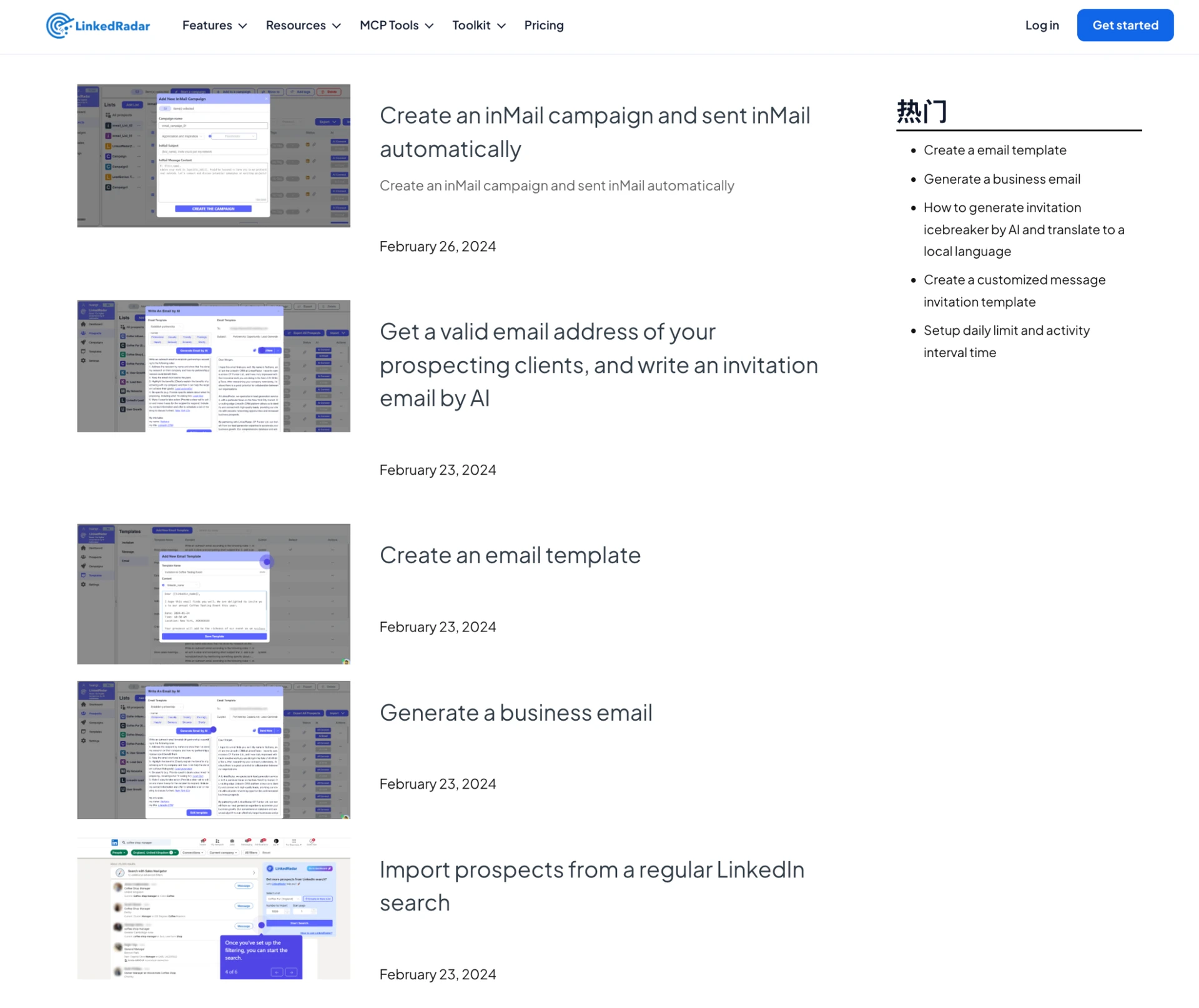
Like most tools in this category, LinkedRadar documents three common campaign types (tutorial hub):
- connection invitations
- first-degree messages
- InMail
That is the closed action list established for campaign sending in the dated public/package review as of September 2026. Follow, like, endorse, post-commenting, and post-boost automation were not found on that surface. This remains a September 2026 evidence boundary, not proof about private or future versions.
The pricing table publishes monthly invitations and InMails, AI Optimizations, campaign counts, and LinkedIn-account allowances. It does not publish a monthly allowance for ordinary first-degree messages or numeric daily package caps. The monthly plan allowances therefore cannot be converted into a supported daily sending number.
| Action | Published monthly allowance | Unresolved daily or execution boundary |
|---|---|---|
| Invitations | Start 400; Biz 800; Pro 800; Team unlimited invitation allowance | Safe daily number, concurrency, and exhaustion behavior not established |
| First-degree messages | No monthly figure published | Numeric daily counter and quota behavior not established |
| InMail | Start 400; Biz 800; Pro 800; Team unlimited InMail allowance | LinkedIn credits and safe volume remain separate from plan allowance |
| Campaigns | Start 8; Biz 15; Pro 50; Team unlimited campaign allowance | Whether count means active or total, plus concurrency, not disclosed |
LinkedRadar plan and action limits
The difference between InMail and a first-degree message matters here because the public plan table names one but omits the other. The documented message-campaign surface did not establish a multistep sequence, branching condition, or reply-triggered stop. It also did not establish a unified inbox or A/B variant. Campaigns therefore read as separate linear action queues in the evidence, not reply-aware sequences.
Campaign ceiling: Published quotas cover invitations and InMails, not ordinary messages. Multistep branching, reply-triggered stop, A/B variants, and a unified inbox were not established as of September 2026.
Search Harvesting, Lists, SCRM, and CSV
The source-to-list workflow has six parts. The inputs are regular LinkedIn People search, Sales Navigator search, and CSV/XLSX import. Prospect lists, tags, and contact CSV/Excel export complete the flow. The regular-search tutorial and Sales Navigator tutorial establish the two search sources. The extension page also names compatibility with LinkedIn Free, Premium, Sales Navigator, and Recruiter Lite.
| Source | Organization layer | Documented exit |
|---|---|---|
| Regular LinkedIn People search | Built-in SCRM lists and tags | Campaign or contact CSV/Excel export |
| Sales Navigator search | Built-in SCRM lists and tags | Campaign or contact CSV/Excel export |
| CSV/XLSX profile URLs | Built-in SCRM lists and tags | Campaign or contact CSV/Excel export |
Source to SCRM to campaign or export
Vendor pages checked August 18, 2026
This supports list movement, not every data operation. The dated review did not establish:
- import/export row caps
- full message-history export
- post, group, or event collection
- duplicate handling
- company-data enrichment
- native ICP scoring
A buyer can plan a search-or-file-to-campaign workflow. Broader audience sources and conversation portability remain unresolved. This guide gives neutral context on moving Sales Navigator leads into a spreadsheet.
The SCRM is built into LinkedRadar; it is not evidence of external CRM sync. A native-integration count was not established because no named external native connector was found. The vendor’s generic CRM article uses unnamed “System A/B/C” examples. The live /api response establishes an auth-gated backend route, not a documented customer API. Public Zapier and Make apps were not found as of September 2026. Neither were customer-webhook or named CRM routes. The same dated review did not establish late-reply CRM resync or identifier-cascade/fill-empty merge rules. It also did not establish a named Snov.io campaign handoff. Those are evidence gaps around external sync, not proof about an unseen implementation. For conceptual background, see how LinkedIn-to-CRM data transfer differs from an actual connector.
Integration boundary: Built-in SCRM is confirmed, but no named external native connector, documented customer API, Zapier app, Make app, or customer webhook route was established on the September 2026 public surface.
AI Personalization and Template Boundaries
LinkedRadar’s homepage documents vendor-managed ChatGPT/GPT-4 copy, AI Connect, and profile-based icebreaker text. The product evidence therefore supports AI message generation, AI personalization, and AI icebreakers. Like much of the category, this is text generation. It does not prove originality, reply awareness, conversion lift, or campaign-level decision-making.
| Plan or capability | Confirmed text-generation scope | Not established |
|---|---|---|
| Start | 500 AI Optimizations/mo; AI Message Template | Credit rollover, separate top-up, or BYO model |
| Biz | 2,500 AI Optimizations/mo; AI Message Template | Additional campaign conditions or reply awareness |
| Pro | 8,000 AI Optimizations/mo; AI Message Template | Agentic campaign operation or native ICP scoring |
| Team | 12,000 AI Optimizations/mo; AI Message Template | Unlimited AI generation; allowance remains 12,000/mo |
| Template surface | Invitation, message, and email template sections | Complete variable catalog, nested conditions, spintax, or A/B measurement |
LinkedRadar AI allowances and workflow boundaries
The quota implication is narrow: moving from 500 to 12,000 monthly AI Optimizations buys more text-generation allowance, not more sequence depth. The dated public sweep did not find a user-supplied model key or provider choice beyond vendor-managed ChatGPT/GPT-4. It also did not establish:
- native AI ICP scoring
- AI post commenting
- campaign-level agentic logic
Those gaps remain evidence boundaries rather than claims about an unseen implementation.
The complete template-variable catalog was also not established. That matters because AI-generated wording and field substitution are separate layers. Generation volume cannot show whether every merged field will render cleanly for every prospect.
For practical context, this guide shows how AI-assisted LinkedIn message personalization differs from workflow logic. A personalized sentence can improve copy relevance. It cannot decide whether a lead replied or stop a later action unless the campaign engine exposes that control.
AI scope: The confirmed AI layer generates message and icebreaker text within monthly allowances. It does not establish ICP scoring, reply-aware automation, BYO models, or campaign-level agentic logic.
Email Finder and Direct Email: Third-Party and Sender Gaps
LinkedRadar’s branded email-finder page names Prospeo’s Email Finder as the underlying lookup service. It says the finder returns contact information and uses “Only pay for valid email addresses” language. That is a vendor claim about the finder; no independent accuracy, catch-all, freshness, or deliverability test was run for this review.
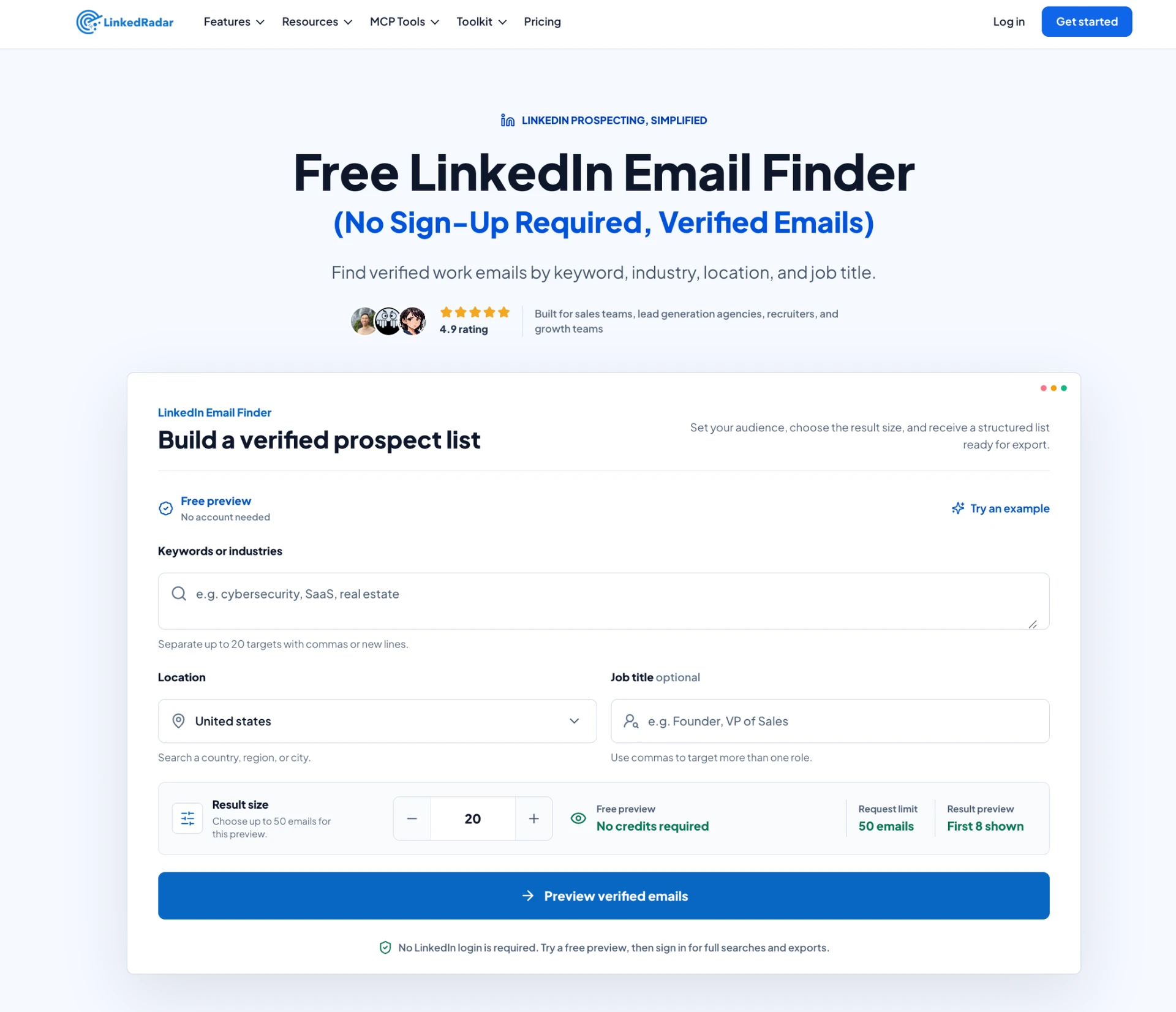
The sending path is separate. An official InMail tutorial shows a “Write An Email by AI” modal. It includes recipient, subject, body, and “Send Now.” That establishes a visible one-recipient send path. It does not establish the sending domain or whether a user mailbox is authenticated through OAuth or SMTP. The allowance and inbox delivery also remain unresolved.
| Stage | Established | Unresolved |
|---|---|---|
| Lookup | Prospeo-backed profile lookup | Independent accuracy and freshness |
| Prospect record | Email/contact data can enter the SCRM surface | Exact verification mechanism and pricing allowance |
| Composer | Recipient, subject, AI body, and Send Now control are visible | Sender identity, mailbox authentication, and delivery |
| Campaign | One-recipient email UI is visible | Native email sequence and LinkedIn-plus-email branching |
Finder to contact to email-composer flow
Vendor pages checked August 18, 2026
The dated public review did not establish:
- a connected-mailbox screen
- a named OAuth provider
- SMTP setup
- a published email allowance
- a native email sequence
- a LinkedIn-plus-email campaign
No company-data enrichment or freshness-date field was found beyond the Prospeo-backed email/phone lookup. That remains a bounded August finding.
The main pricing grid contains no email-credit or mailbox line, while the finder page uses pay-for-valid language without a public pack price. The plan allowance, finder total cost, rollover rule, and sender cost therefore cannot be derived from the current public pages. Test those inputs before treating the visible composer as a production email channel.
That uncertainty matters because lookup, one-off sending, and a reply-aware multichannel sequence are three different capabilities. This overview of combining LinkedIn and cold-email workflows provides neutral context for the distinction.
Sender boundary: A visible Send Now control is capability evidence only. Sender identity, mailbox authentication, allowance, inbox placement, and LinkedIn-plus-email sequencing remain unresolved.
Safety Controls Versus Detection Surfaces
LinkedRadar documents separate Daily Limit and Interval Seconds fields for invitation and message activity in its settings tutorial. The vendor’s safety page says the queue adjusts to the user’s sending limit. In practice, those controls can reduce bursts and stop the queue at the configured threshold.
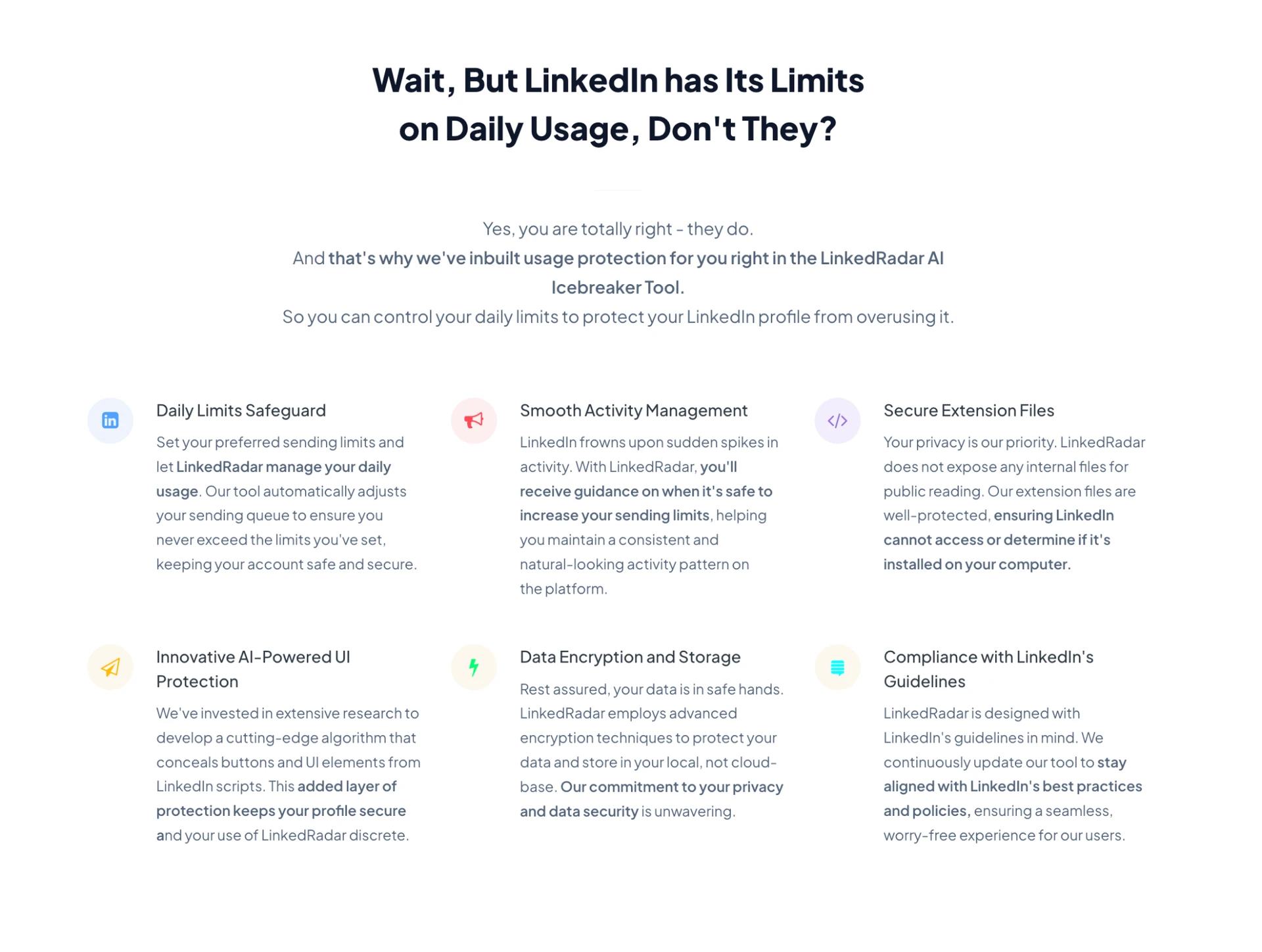
The homepage promises random delays and gradual increases. The documented settings screen shows one Interval Seconds value rather than a min-max range. Current public evidence therefore establishes user-configured pacing, not independently verified randomization. Its “up to 100 invites and 100 messages in one day” language is marketing guidance. It is not a supported safe volume or a substitute for LinkedIn-side limits.
These controls also do not establish package detectability. The Store listing identifies the extension, but no direct public URL was found for the reported probeable-resource, injection, synthetic-event, direct-write, or telemetry cluster. Those mechanisms remain not established for publication. An evidence gap is not proof that the surfaces are absent; it means pacing claims cannot support an overall safety conclusion.
| Control | What it may reduce | Residual signal or unknown |
|---|---|---|
| Invitation Daily Limit | Invitation bursts above the chosen value | No supported safe daily number; plan and LinkedIn limits remain separate |
| Message Daily Limit | Message bursts above the chosen value | Numeric package cap was not exposed in the evidence |
| Interval Seconds | Back-to-back action speed | The shown field is fixed; random-delay behavior was not independently established |
| Queue adjustment | Actions above the user's configured threshold | Automatic risk scoring or risk-triggered pause was not established |
| Browser extension distribution | Chrome/Edge availability is public | Runtime path, injection, synthetic events, direct writes, and extension-detection status are not publicly established |
LinkedRadar controls and residual detection surfaces
The dated public review did not find:
- working hours
- a proxy layer
- a proxy-quality checker
- randomized min-max delays
- automatic risk-triggered pausing
That is not proof these controls can never exist. Do not include them in a buying decision without current product evidence. Team’s unlimited invitation and InMail allowances also remain commercial entitlements, not safety controls.
Residual uncertainty: Daily limits and intervals change timing. They do not establish whether the reported session, direct-write, injection, synthetic-event, or extension-detection mechanisms occur, and they cannot replace the required live cloud/IP test.
Team Accounts, Roles, and Agency Ceiling
The Team plan bundles five LinkedIn accounts. It costs $99.90 month to month or $69.90 per month equivalent with $838.80 prepaid yearly. This is a flat plan allowance, not a published per-account price, and the page does not define five human seats.
| Team element | Confirmed | Undisclosed or not established |
|---|---|---|
| LinkedIn accounts | 5 per Team subscription | Official account-six price or add-on path |
| Campaigns | Unlimited campaign allowance | Concurrent-campaign behavior and priority |
| Invitations / InMails | Unlimited plan allowances for each | Ordinary-message cap and safe operating volume |
| Human users | Team language appears in marketing | Seat count, invited-member model, and manager pricing |
| Governance | No current public model established | Roles, permissions, audit log, and lead distribution |
| Client operations | No current public model established | Isolated client workspaces, white label, sender rotation, and cross-account deduplication |
LinkedRadar Team: confirmed entitlements and undisclosed controls
The implication is a ceiling, not an allegation. Five account slots do not establish five isolated client tenants or five independent human seats. Public materials did not document:
- roles or permissions
- client workspaces or white labeling
- sender rotation or lead distribution
- cross-account duplicate protection
- an official path above five accounts
A small operator can evaluate the entitlement. An agency should validate tenancy and governance rather than infer them from the plan name.
There is no custom, Enterprise, or Agency card on the dated pricing grid, and no per-account add-on was documented. Creating multiple separate subscriptions is therefore not an official bulk offer and should not be used as a vendor price.
The public contact page lists support email and a VIP WhatsApp route. No tier-specific SLA or dedicated success manager is documented. Paying for Team therefore establishes account capacity, not a higher support outcome.
Agency ceiling: Team confirms five LinkedIn account slots. It does not establish five seats, five isolated client workspaces, role-based permissions, white label, or an official sixth-account path.
Is LinkedRadar Safe?
Short answer: overall safety is not established. The vendor’s safety page says data is stored “in your local, not cloud-base” and claims LinkedIn cannot determine that the extension is installed. Those are vendor claims, not verification of session custody, detectability, or live outcomes.
What I verified first-hand. I inspected a v1.8.23 MV3 package record in September 2026. The Chrome Web Store page publicly identifies the extension and ID. No direct human-readable public URL was found for the accompanying static technical cluster, so I do not present the reported source-to-sink paths or detection mechanisms as publicly established findings.
Active Extension Detection (AED) is a label used for LinkedIn extension-scanning events, not an official LinkedIn feature name. In general, a known extension resource can make installation visible before an automation action runs. LinkedRadar’s AED-list status was not established by a direct public URL, so it cannot support this verdict. This overview gives general context on browser-extension detection, not evidence about LinkedRadar.
| What was checked | Result |
|---|---|
| Public extension package | Yes — the Store page identifies v1.8.23 MV3 and ID kgpckhbdfdhbkfkepcoebpabkmnbhoke |
| Vendor local-storage and concealment claims | Yes — published on the vendor safety page; claims only |
| Local profile/search path and destination | Not publicly established — no direct public URL found for the static path |
| Raw li_at path and vendor-SCRM destination | Not publicly established — no direct public URL found for the source-to-sink claim |
| Direct writes, WAR/injection, synthetic events, and telemetry behavior | Not publicly established — no direct public URL found for the technical cluster |
| AED-list status | Not publicly established for LinkedRadar |
| Live cloud/IP test | MISSING-BLOCKING — not run; no cloud egress, IP reputation, subnet, fingerprint, or live session result |
LinkedRadar safety checks
Honest read: A live cloud/IP test was not run. The required live cloud/IP test was not run, so overall safety is not established. The static teardown does not replace this required test. It also cannot support a claim that vendor session custody, backend replay, direct writes, injection, synthetic events, telemetry behavior, or an AED-visible detection surface occurred when the direct public source for that cluster was not found. That uncertainty is not proof that any mechanism is absent.
The Privacy Policy permits international transfers to the United States, Russia, Japan, China, and India. It does not identify exact storage residency or a public subprocessor list. A general GDPR section is present; a separate public DPA was not established. Public contact and Terms materials use conflicting company and location references, so procurement should verify the contracting entity rather than infer one.
Safety verdict: No tool eliminates LinkedIn restriction risk. The required live cloud/IP test is MISSING-BLOCKING, the static teardown does not replace it, and the static technical cluster lacks a direct public source. Overall safety is not established and the draft remains blocked from publication.
Manual behavior also matters: opening many profiles directly by URL or processing actions at unrealistic speed can trigger warnings without automation. LinkedRadar’s pacing controls may reduce bursts, but vendor allowances remain separate from LinkedIn-side limits. This restriction overview explains the broader behavioral layer.
What LinkedRadar Review Research Actually Shows
The available review evidence is historical. Our review sample contains 45 records through 2023. Within that sample, G2 contributes 30 reviews averaging 4.63/5 through 2023. Capterra contributes 13 reviews averaging 4.85/5 in the same sample and time window. Trustpilot contributes 2 reviews through 2023—too few to print a mean. These are not live August 2026 platform totals.
Cross-platform author deduplication reduces the same review sample to 41 voices: G2 30, Capterra 9, and Trustpilot 2. That denominator is separate from the 45 raw records, so no percentage derived from one should be read as using the other. The trailing six-month window ending August 3, 2026 contains 0 rated reviews and is too thin to calculate a trend.
We found one weekly volume spike. In the week beginning June 5, 2023, 5 of the 45 raw reviews appeared, or 11.1% of that raw sample. We found no cluster of negative reviews. This is a date pattern, not evidence of why the reviews appeared. It is not proof of solicitation, manipulation, purchase, fabrication, or fraud.
We found no LinkedRadar mention in the Reddit posts we reviewed. The 45 reviews also contained no switched-from or switched-to story. These are bounded sample findings, not proof of market-wide absence. These reviews can illustrate historical perceptions. They cannot validate v1.8.23, current pricing, present cancellation behavior, or current safety.