
 Updated: September 20, 2026
 32 min read
Key takeaways
- The 10-day no-card trial carries unusual weight: purchases are final, yet its tier mapping and CRM/export gates are not disclosed, so test the required accounts and full campaign path before paying. (Terms; pricing)
- Documentation drift extends beyond tier labels: one current guide says up to six sequence actions while another live page says unlimited steps, and invitation figures describe a 20/day FAQ default, 25 in homepage artwork, and 50–100/day advice rather than one verified cap. Verify the exact sequence and limit behavior your workflow needs. (Campaign guide; FAQ; homepage)
- Reply awareness is an operator setting rather than a guaranteed stop: release v2.8.0 allows campaign messages to continue after a reply, while the public pacing record documents static delays and pauses but does not establish adaptive throttling. Define both follow-up and volume rules during the trial. (v2.8.0 release; sequence guide; FAQ)
- The January 8–March 23, 2026 local Trustpilot corpus contains four unverified records, while separate September 29, 2026 inventories contain Trustpilot N=5 and G2 N=2. These platform-specific samples can surface questions, but they are too thin for a score, consensus, trend, or restriction-rate claim. (Trustpilot; G2)
This review is published by Linked Helper and written by Milosh Potikj, who works there. I've made every effort to represent Bindago accurately using verified data — our own first-hand testing, Bindago's own documentation, and independently sourced reviews.
Bindago is a desktop LinkedIn automation app for Windows, macOS, and Linux. The provisional use case is a solo operator running one to three accounts from an always-on computer. Standard is $9.99 per month; Scale is $24.99 and advertises no account-count cap, subject to the capacity of one machine; Supra is $39.99 and adds AI message personalization. The local-first model keeps campaign execution on the user's host according to Bindago, but that is a documented posture rather than an observed network result. Our verdict is conditional: the low price and LinkedIn action set are credible, while plan entitlements, CRM behavior, team governance, host capacity, and runtime resilience still need validation. (Bindago pricing; FAQ)
| Field | Finding |
|---|---|
| Current build | v2.8.1 was available in September 2026 |
| Entry price | Standard: $9.99/month |
| Runtime | Local desktop app; host and app must stay running |
| Strongest verified capability | Standard allows up to three LinkedIn accounts |
| Largest unresolved risk | Current first-party pages conflict on tier entitlements and CRM behavior |
Bindago at a glance (September 2026)
Verdict
Bindago is a trial candidate for one person who wants LinkedIn-only outreach, works mainly through CSV, has an always-on computer, and needs no more than three accounts. At $9.99 monthly, Standard gives that operator a low software floor and a documented set of connection, messaging, profile-engagement, sourcing, chat, and analytics functions. The 10-day no-card trial makes the unresolved parts testable before purchase. (Pricing; product overview)
The case weakens when the workflow depends on uninterrupted execution, authenticated native CRM sync, or several managers. Bindago says work stops with the computer or app, while its homepage describes native synchronization and its release record documents export support. Scale's account allowance is also tied to one machine and does not establish roles, client workspaces, white-label reporting, or practical multi-account capacity. (FAQ; homepage; CRM/Zapier release; agency limitations)
Pros
- Low entry price: Standard is $9.99 monthly for up to three LinkedIn accounts, which keeps the software subtotal low for a single operator. (Pricing)
- Flat Scale allowance: Scale is $24.99 monthly with no license account-count cap, although one computer's capacity remains the boundary. (FAQ)
- Three desktop operating systems: Published downloads cover Windows, macOS on Intel and Apple Silicon, and Linux. (FAQ)
- Local-first data posture: Bindago says LinkedIn session and campaign data remain on the user's machine, reducing the stated vendor-side data surface. (Privacy)
- Documented LinkedIn workflow coverage: The public product supports invitations, messages, InMails, profile visits, follows, recent-post likes, delays, and acceptance or reply conditions. (Product overview; campaign guide)
- No-card evaluation window: The public offer provides ten days to test before entering payment details. (Terms)
- Dated release record: Releases document CSV upload, chat export, Sales Navigator export, CRM/Zapier export, and a reply-stop override instead of leaving those features as undated marketing copy. (v1.6.0; v2.2.0; v2.4.1; v2.6.0; v2.8.0)
Cons
- Host-dependent execution: Automations stop when the computer is off or the app closes, putting every local account on the same host fault domain. (FAQ)
- One-machine licensing: A license works on one machine at a time; transfer requires support and deactivates the former host, which constrains concurrent managers. (FAQ)
- No documented team layer: Bindago's own comparison copy says it does not provide team or multi-seat management or white-label agency features. (Agency comparison)
- Contradictory product claims: Checkout splits Standard, Scale, and Supra, while another live first-party page still advertises $9.99 with “all features”; sequence-depth claims also conflict. (Pricing; comparison page)
- Static controls, untested outcomes: Random delays, defaults, and pauses are documented, but adaptive throttling, restriction rates, and control enforcement were not established. (FAQ; Terms)
- Final-sale policy: Purchases have no published refund window, so the ten-day trial carries most of the buyer's validation burden. (Terms)
- Very thin reputation evidence: The January 8–March 23, 2026 local Trustpilot corpus has N=4; separate September 29, 2026 live inventories were Trustpilot N=5 and G2 N=2. Each sample is too small for consensus or performance claims.
- No documented failover: Campaigns stop when the host or app stops, and the public material does not establish an uninterrupted remote worker or redundant host. (FAQ)
Bindago Pricing: $9.99 Standard, $24.99 Scale, and the Real Operating Cost
The current public pricing surface shows three monthly USD plans. Standard costs $9.99 per month and permits up to three LinkedIn accounts. Scale costs $24.99 per month and advertises no account-count cap, but Bindago qualifies that allowance by the capacity of one machine. Supra costs $39.99 per month and adds AI message personalization and intelligent campaigns on top of the Scale entitlements. Billing renews every 30 days; no annual term or annual discount is published, and the public cards show no mandatory setup fee. (Pricing; Terms; FAQ)
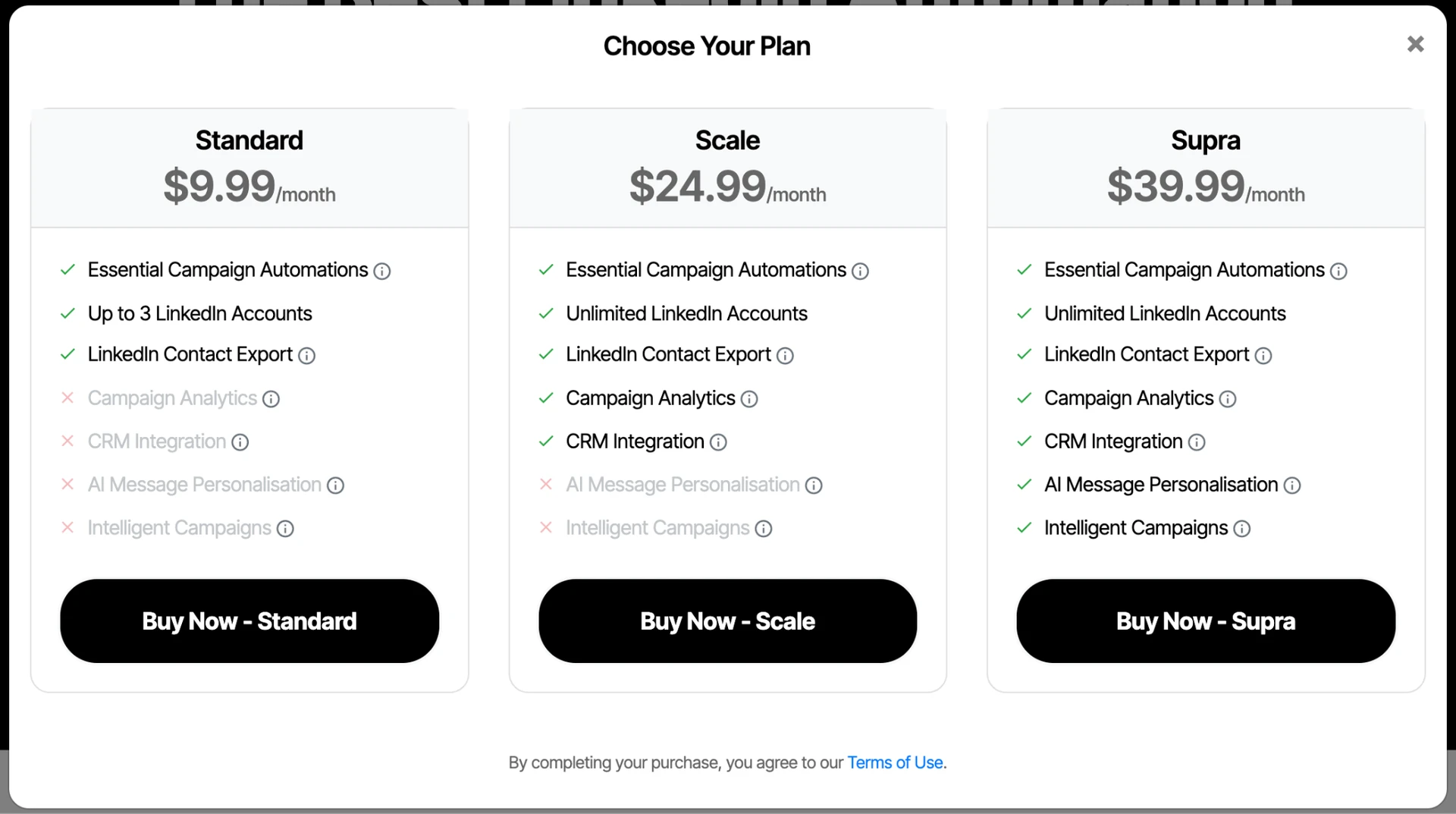
| Plan | Price | What's included | What's NOT included |
|---|---|---|---|
| Standard | $9.99/month | Up to 3 LinkedIn accounts; monthly one-machine license | Campaign analytics, CRM integration, AI message personalization, an annual discount, or a multi-user seat |
| Scale | $24.99/month | No license account-count cap, subject to host capacity; campaign-analytics and CRM-integration labels shown on pricing | AI message personalization, intelligent campaigns, proven unlimited throughput, team management, tenant isolation, or a second machine |
| Supra | $39.99/month | The Scale entitlements plus AI message personalization and intelligent campaigns | Proven unlimited throughput, team management, tenant isolation, or a second machine |
Bindago pricing tiers (September 2026)
The pricing trap is claim drift. A simultaneously live first-party comparison page says $9.99 includes “all features,” while checkout separates Standard, Scale, and Supra and labels CRM Integration as a Scale item. Scale adds $15 monthly, roughly two and a half times the Standard charge, but it does not establish what the authenticated CRM feature does. (Current pricing; conflicting comparison copy; v2.6.0 export wording)
The sticker is also not complete operating cost. A solo user can have a $9.99 software subtotal if an existing computer stays on and no external enrichment or email tool is needed. For twenty accounts, the software-only branches are $24.99 monthly on one Scale host or $124.95 monthly across five machine-bound Scale licenses. The first assumes one host can carry the accounts; the second still does not establish five-manager concurrency. Both exclude computers or hosted machines and external finders and email tools. (Terms; pricing)
| Scenario | Software floor | External costs | Unresolved assumption |
|---|---|---|---|
| Solo, ≤3 accounts, existing computer | $9.99/month | Optional finder/email tool | Host remains available and Standard entitlements suffice |
| 20 accounts, one Scale host | $24.99/month | Host and finder/email workflow | One machine has workable capacity and one operator surface is acceptable |
| 20 accounts, five Scale hosts | $124.95/month | Five hosts and finder/email workflow | Five licenses provide the required manager topology |
Bindago total-cost scenarios (September 2026)
Pricing boundary: Scale's unlimited-account wording removes a license account counter; it does not remove one-machine licensing, hardware limits, or external-tool costs.
Desktop Architecture, Local Data, and the Continuity Question
Bindago is a standalone desktop application for Windows, macOS Intel, macOS Apple Silicon, and Linux. It is not presented as a vendor-hosted campaign worker: Bindago says the computer must remain on and the app open, and queued work resumes from where it stopped after relaunch. In practice, a power loss, OS restart, app crash, or closed process pauses every campaign on that host rather than handing execution to a remote worker. (FAQ)
Like any local campaign tool, this operating model separates installation from continuous execution. This installation-to-first-campaign guide provides general background on that distinction; it is not evidence about Bindago's binary.
Local does not mean no network traffic. Bindago's Privacy page says LinkedIn cookies or tokens, prospects, messages, templates, and campaign state stay on the local machine. It separately describes direct traffic to LinkedIn, machine-ID and license-key traffic to Bindago's licensing servers, and website payment or analytics processing. That narrows the vendor-stated custody boundary, but no binary or packet inspection independently established the exact path. The precise login UI and authentication method were also not documented. (Privacy)
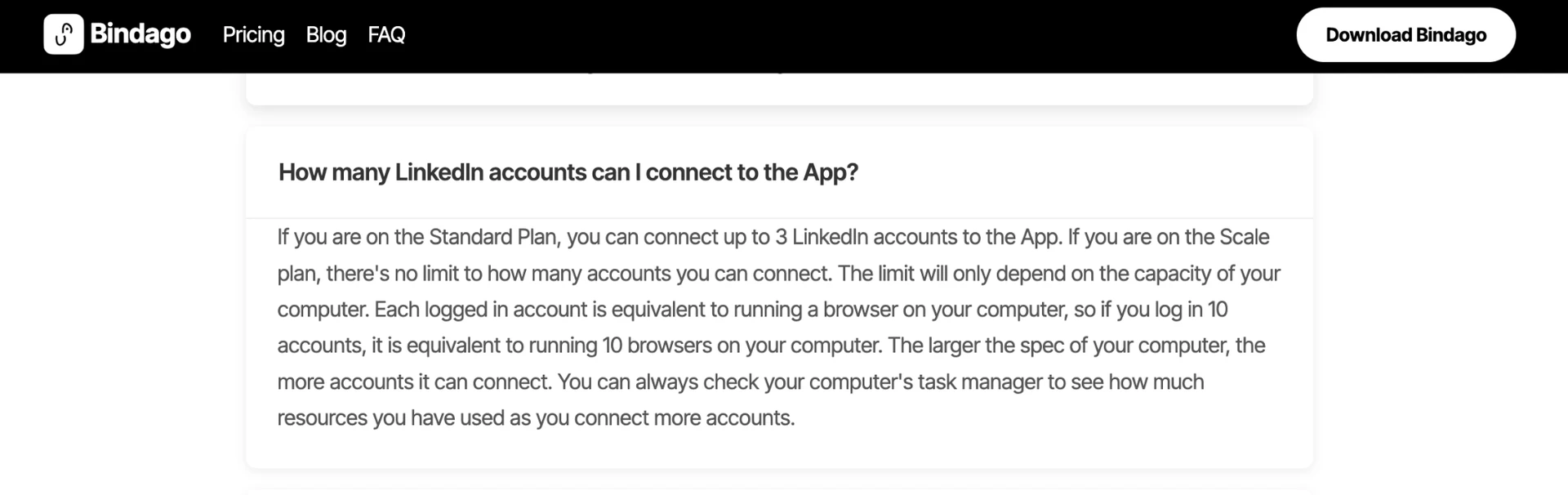
Bindago says LinkedIn sees the computer's normal IP or a system VPN IP rather than a vendor proxy. That can preserve the user's normal network context, but it is a vendor statement, not an observed IP result. Ordinary per-account custom-proxy controls and a proxy-quality checker were not established on the public surface. (FAQ)
| Path or event | Documented destination/state | Observed boundary |
|---|---|---|
| LinkedIn session and campaign data | Stored locally according to Bindago | No binary, login-flow, or packet audit was performed |
| LinkedIn traffic | Direct from the user's computer or system VPN | Exit path was not independently observed |
| License verification | Machine ID and license key go to Bindago servers | Local-first is not zero egress |
| Host or app stops | Campaigns stop; queue resumes after relaunch | No uninterrupted worker or redundancy is established |
| Current public surface | Live site and v2.8.1 release available in September 2026 | Current availability does not establish runtime failover |
Bindago's documented data paths and continuity evidence (September 2026)
The continuity question is operational. The site and v2.8.1 release were publicly available in September 2026, but current availability does not give a local campaign a remote worker or failover when its host stops. (Current site; v2.8.1 release; FAQ)
Single-host fault domain: Every logged-in account depends on one powered-on machine and one running app; resume after relaunch is queue continuation, not uninterrupted execution or failover.
Campaign Builder, LinkedIn Actions, and Reply-Stop Override
Bindago's documented campaign action list is specific: connection request, InMail, message or follow-up, Profile View, Like Recent Post, Follow User, delay, and acceptance or reply condition. These actions can be arranged in multistep LinkedIn sequences, while reusable templates and basic merge variables personalize message text. Like most tools in this category, it also detects replies and normally stops inappropriate follow-ups. (Product overview; campaign guide)
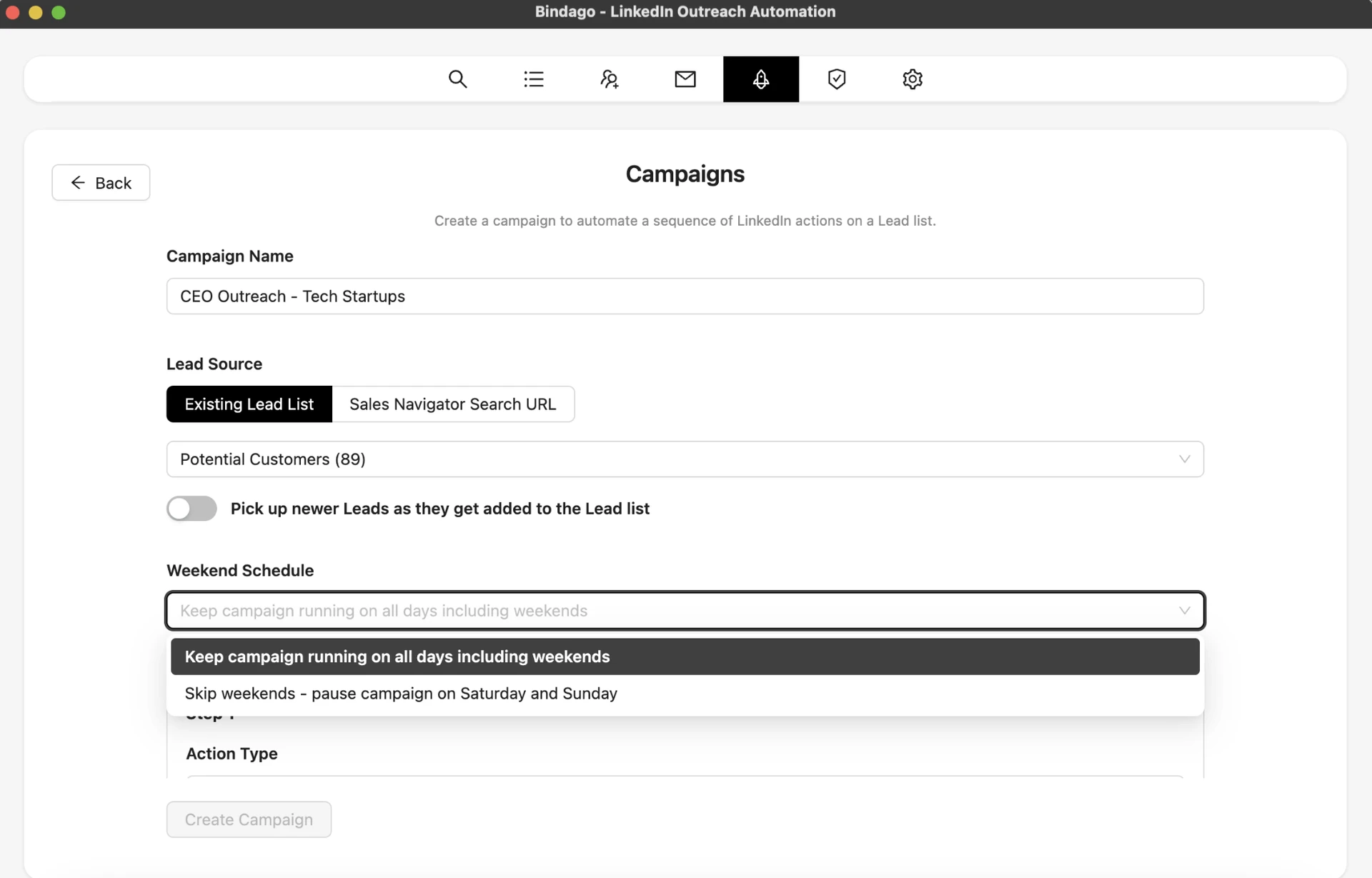
The public record does not support one clean depth limit. A current operational guide says a sequence can contain up to six actions; another live first-party surface says steps are unlimited. Without an authenticated campaign build, neither statement establishes the enforced maximum. The same guide documents up to five active campaigns, but does not say whether that limit applies per LinkedIn account, license, or machine. (Campaign guide)
Reply handling is configurable, not immutable. Default reply awareness is documented, and release v2.8.0 added an operator option to keep sending campaign messages after a lead replies. That can support an intentional sequence, but it also means operators must govern the override rather than assume every response always stops later steps. (v2.8.0 release)
Smart tracking is described as preventing duplicate messages and unsuitable follow-ups within a sequence. That does not establish cross-campaign or cross-account deduplication. For general context, duplicate prevention can operate at several scopes; Bindago's public evidence establishes only the narrower sequence behavior. (Message-sequence guide)
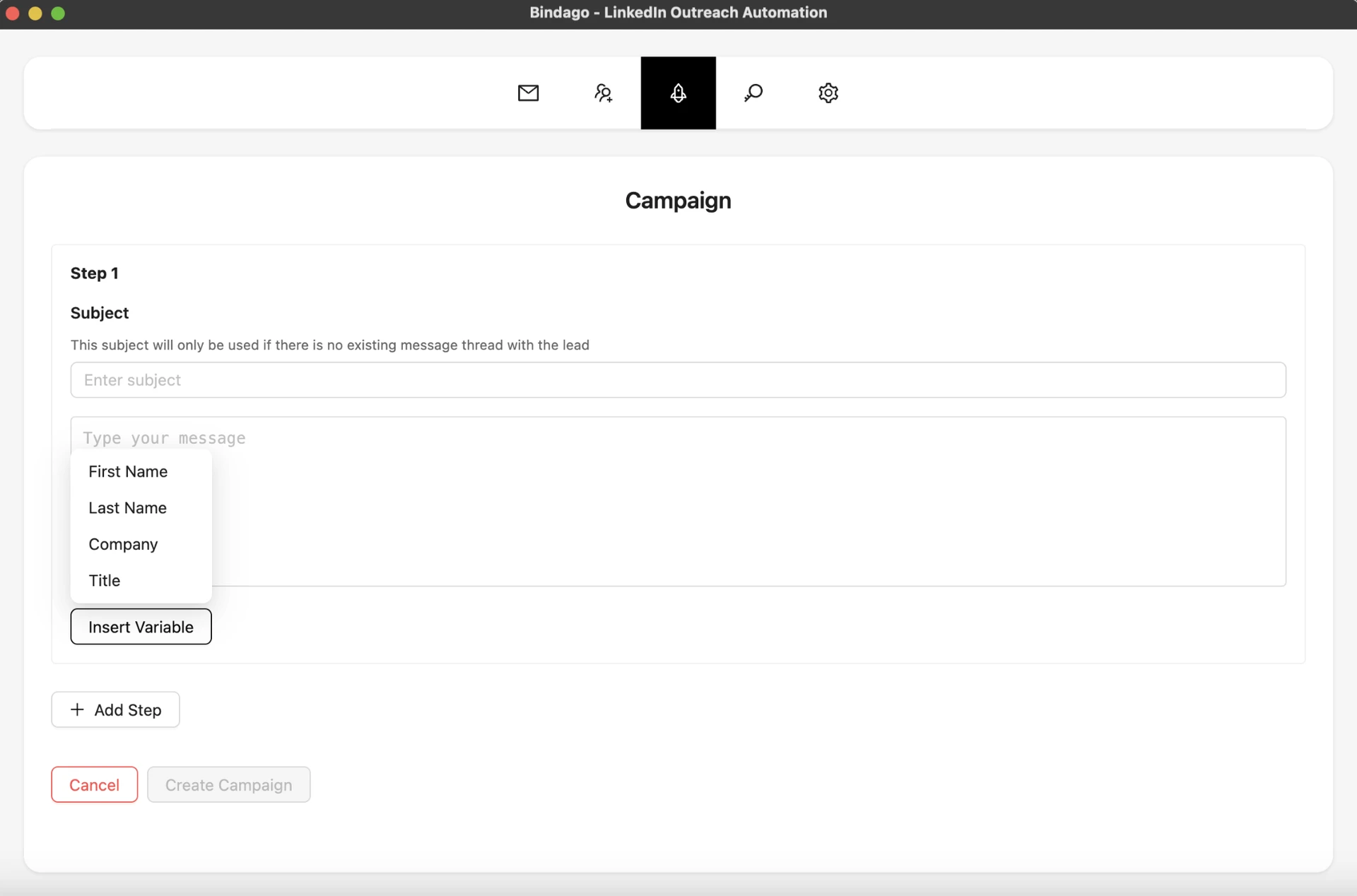
| Action or control | Documented behavior | Dispute or boundary |
|---|---|---|
| Sequence actions | Invite, InMail, message/follow-up, profile visit, recent-post like, follow, delay, conditions | Endorsement and post commenting are not documented on the public action surface |
| Conditions | Branches on acceptance and reply | Nested campaign-level IF/THEN/ELSE is not established |
| Sequence depth | One guide says 6 actions; another says unlimited steps | Authenticated maximum is unresolved |
| Reply handling | Default reply stop; override added in v2.8.0 | Override can continue after a reply |
| Templates | Reusable templates and basic merge variables | Native A/B allocation is not documented |
| Analytics | Acceptance/reply rates, InMail tracking, daily/weekly views, campaign comparisons | Team reporting is not established |
Bindago campaign and sequence claims (September 2026)
Bindago documents an in-app LinkedIn Chat, but a cross-account or team-unified inbox was not established. Native A/B testing, AI-generated in-flow messages, AI post comments, AI ICP scoring, and endorsement are not documented on the public product surface; buyers needing them should verify rather than infer them from the automation label. (Product overview; self-described A/B/AI boundaries; action comparison)
Sequence boundary: Bindago documents acceptance/reply conditions and a reply override, but its live sources disagree on six actions versus unlimited steps, and no authenticated maximum was established.
Daily Limits, Scheduling, and What Safety Controls Actually Do
Bindago publishes three invitation numbers that refer to different evidence layers. Its FAQ gives a default of 20 connection requests per day. Homepage artwork shows 25. An operational guide advises 50–100 as a range. These cannot be collapsed into one cap: the public pages do not establish whether the figures are per account, editable, enforced, or reset on a calendar or rolling window, and none is a measured safe volume. (FAQ; homepage; campaign guide)
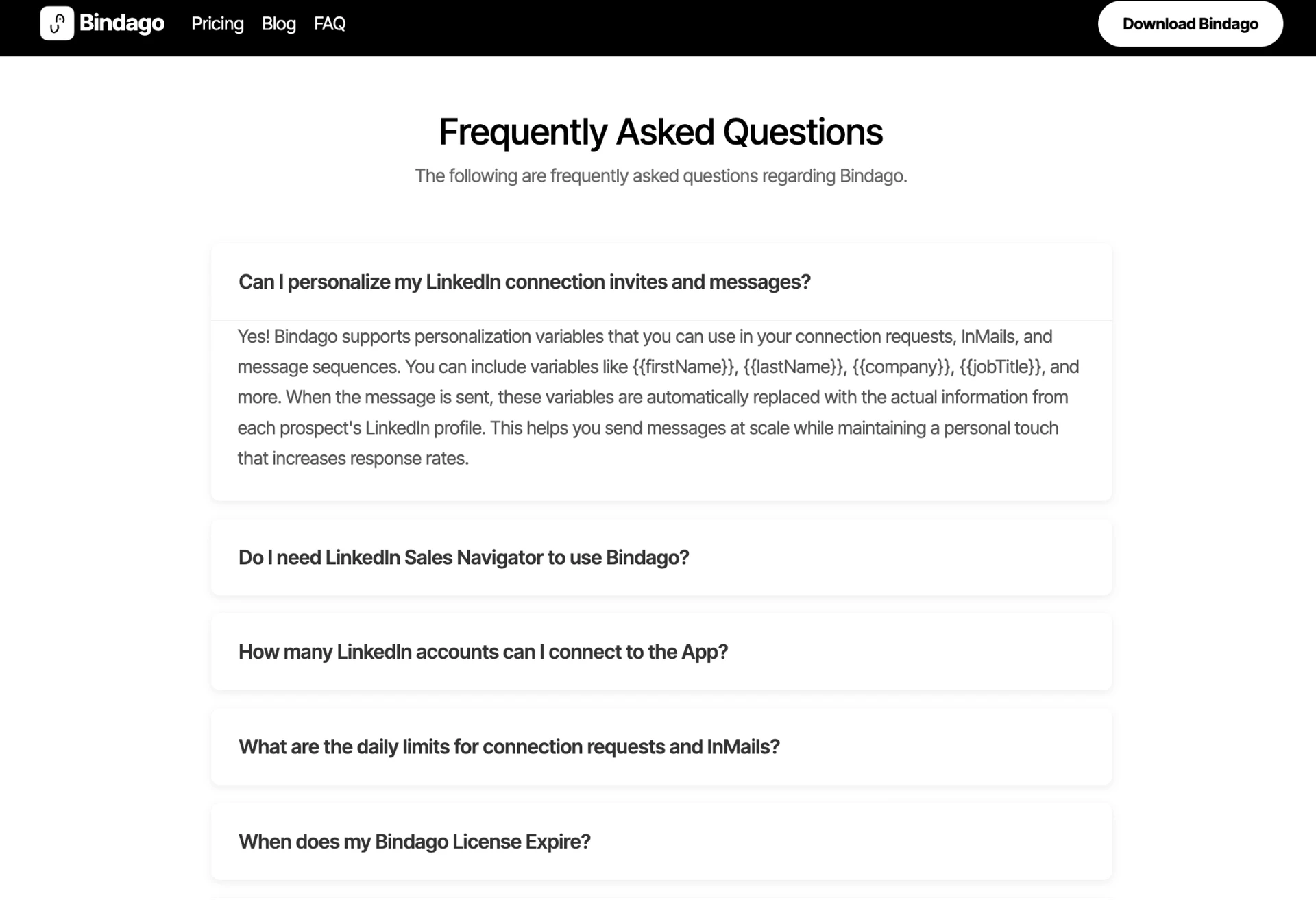
The FAQ separately states a default of up to 20 InMails daily. LinkedIn supplies those InMail credits, and Bindago does not document credit-aware reservation or a separate ordinary-message cap. That means “20” must retain its action label; it is not a universal daily ceiling. For neutral background on why defaults, per-action limits, working hours, and timeouts are distinct controls, see What kind of limits should I use? and Working Hours and Limits.
Pacing is static in the published record. Bindago documents random delays, generic rate limiting, longer pauses after batches, and a weekend-skip toggle. Delay configurability, a global intraday schedule and timezone, risk-triggered volume reduction, an account-health score, and automatic stopping on restriction signals were not established. This means the controls can space activity, but public evidence does not show that they adapt to changing account risk. (FAQ; message-sequence guide)
| Number or control | What the source actually says | What it does not prove |
|---|---|---|
| 20 connection requests/day | FAQ default | Per-account scope, editable maximum, reset, enforcement, or safe outcome |
| 25/day | Homepage interface artwork | A current default or hard cap |
| 50–100/day | Operational advice | An enforced or measured safe range |
| 20 InMails/day | FAQ default; LinkedIn supplies credits | Credit-aware protection or a cap on ordinary messages |
| Up to 5 active campaigns | Operational guide | Whether the count is per account, license, or machine |
| 500 pasted URLs | One bulk-input operation | Total campaign capacity |
| 1,000 regular-search / 2,000 Sales Navigator results | Documented export scopes | Saved-list capacity or execution throughput |
Bindago limit claims reconciled (September 2026)
Search and input limits are likewise scoped. Bindago documents up to 500 pasted profile URLs in one operation, 1,000 entries from regular LinkedIn Search, and 2,000 Sales Navigator search results after v2.4.1. These are collection boundaries, not proof that one host can process the same number safely or concurrently. (Bulk-input guide; v2.4.1 release)
Treat each number separately: Validate connection defaults, InMail defaults, campaign slots, import sizes, reset behavior, and stop/queue behavior independently during the trial; the published figures do not form one global limit system.
CSV, Sales Navigator, Chat, CRM, and Zapier: A Dated Claim Map
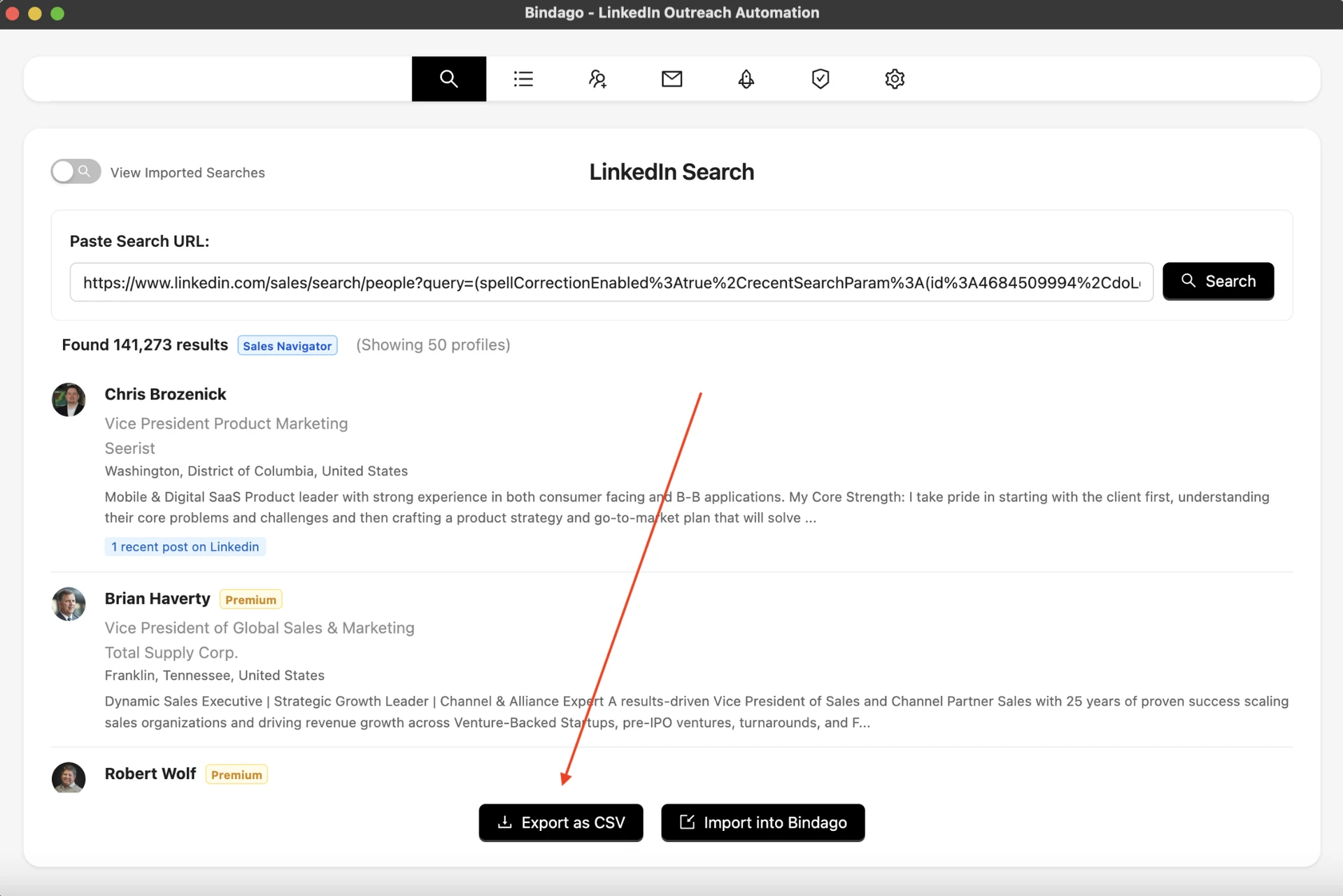
Bindago documents five lead-entry routes: LinkedIn Search, Sales Navigator search or lists, pasted profile URLs, lead lists, and CSV. Sales Navigator is not required for ordinary LinkedIn outreach. Release v1.6.0 added CSV campaign uploads; v2.4.1 raised Sales Navigator search-result export to 2,000. These records establish sourcing and file transfer, which means a CSV-centered operator has a documented way to move leads in and out. (FAQ; v1.6.0; v2.4.1)
Release v2.2.0 also added export of existing connections and chats, but the public note does not establish full history, per-message timestamps, schema, or completeness. In-app Chat is documented, yet it is not evidence of a built-in CRM or team-unified inbox. (v2.2.0 release; product overview)
CRM is the disputed axis. The homepage says Pipedrive, HubSpot, and Zapier auto-sync; pricing shows a CRM Integration label on Scale; and v2.6.0 documents “CRM and Zapier export support.” The public record safely establishes export support; these public sources do not establish how the broader homepage claim works. Native bidirectional sync, field mapping, retries, triggers, direction, and the authenticated plan gate are not established, so a numeric native-integration count is not defensible. (Homepage; pricing; v2.6.0)
| Dated source | Claimed mechanism | What is established |
|---|---|---|
| Current homepage, September 2026 | Native Pipedrive, HubSpot, and Zapier auto-sync | A live vendor claim; authenticated behavior untested |
| Current pricing, September 2026 | CRM Integration marked for Scale | A pricing label, not the mechanism |
| Release v2.6.0 | CRM and Zapier export support | Export support is documented |
Bindago CRM and Zapier claim map (September 2026)
Native email sending and a built-in finder or verifier are not established. Bindago instead describes CSV export to an external finder and separate email-sequence tool, so this is a bridge rather than one native multichannel sequence. Public API documentation, native webhooks, Make setup, incoming webhooks, and a developer surface were not found; this is an evidence gap, not proof no private implementation exists. Vendor comparison copy says custom scripting/API automation is unavailable. (Email workflow guide; API comparison)
For context, webhook-mediated Zapier routing differs from a dedicated native app; that background does not verify Bindago's implementation.
Integration claim conflict: Only CRM/Zapier export support is safely established. Do not plan around native two-way HubSpot, Pipedrive, Zapier, Make, API, or webhook behavior until it is verified in the product.
Scale, Agencies, One-Machine Licensing, and Real TCO
Scale's $24.99 monthly allowance is unlimited only in one specific sense: Bindago says the plan has no license account-count cap. It also says capacity depends on the host and that each logged-in account consumes resources like another browser process. Thus five, twenty, or fifty accounts can reduce the arithmetic license cost per account, but those figures do not establish throughput, reliability, or safe concurrency. (FAQ; pricing)
The agency guide supports client-specific campaigns inside one app. That can separate campaign definitions, but it does not establish client tenants, client logins, or manager permissions. Bindago's own comparison copy says there is no team or multi-seat management and no white-label agency feature. Manager roles, approval controls, audit trails, client-facing reporting, sender rotation, lead distribution, and cross-account deduplication were not documented; preserve those as governance gaps rather than inferred hidden capabilities. (Agency guide; agency comparison)
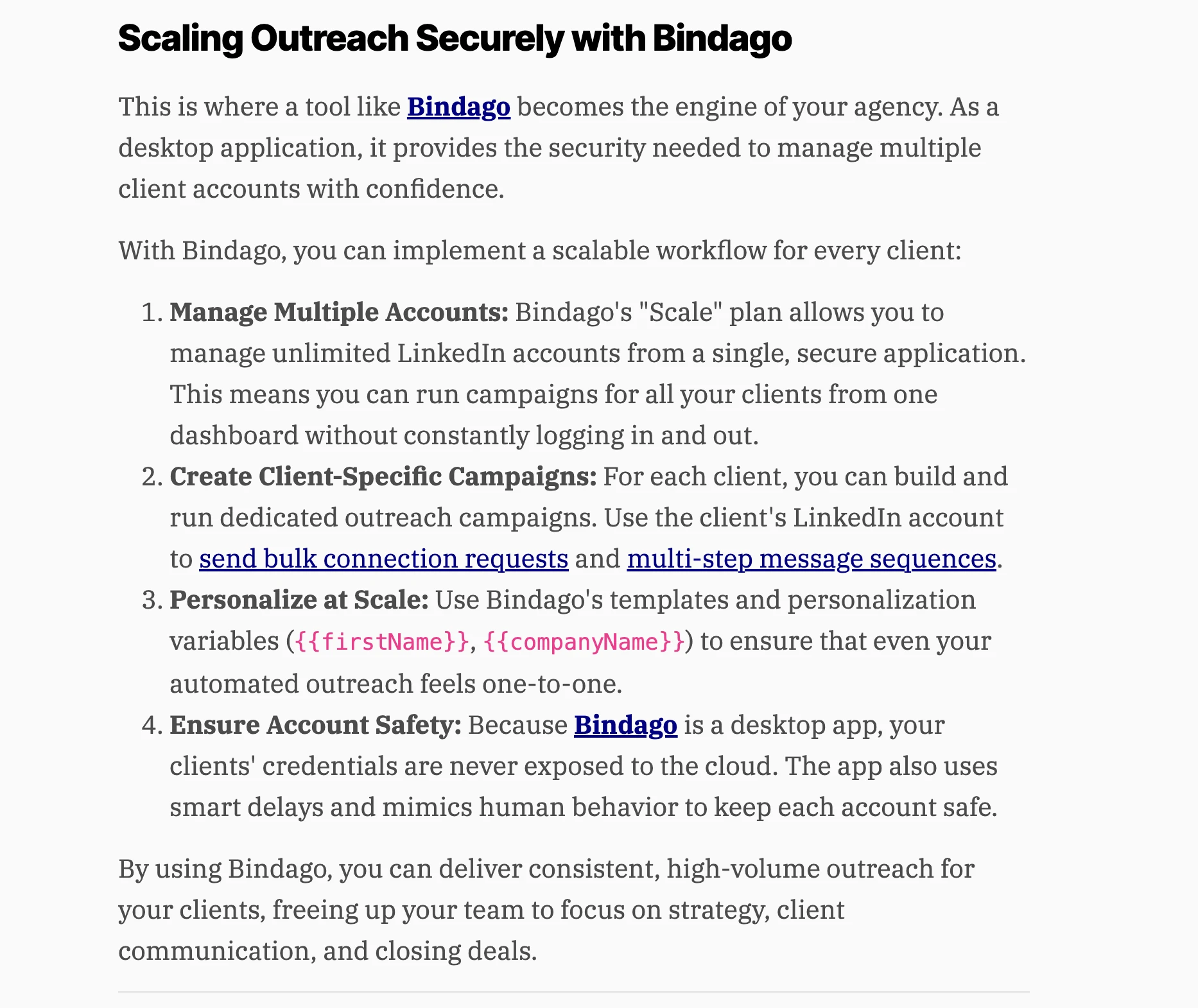
One host and five managers are different topologies. A twenty-account setup on one Scale license has a $24.99 monthly software floor, but concentrates execution and management on one machine. Five Scale licenses cost $124.95 monthly before infrastructure, but each is machine-bound and that arithmetic still does not establish concurrent remote access, cross-host coordination, or account isolation. Computers or hosted machines and external enrichment/email services remain outside both figures. (Terms; pricing)
| Topology | License floor | Control or capacity boundary |
|---|---|---|
| One operator, up to 3 accounts | $9.99/month Standard | One machine; Standard entitlements must be validated |
| One operator, many accounts | $24.99/month Scale | No license account cap, but one-host hardware and fault-domain limits |
| 20 accounts on one host | $24.99/month Scale | Capacity, resilience, and multi-manager access unproven |
| 20 accounts across 5 hosts | $124.95/month for 5 Scale licenses | No documented shared governance, tenant isolation, or cross-host controls |
Bindago agency topology scenarios (September 2026)
The public evidence does not establish a settled team workspace, white label, branded client dashboard, per-account proxy-quality gate, or broad native CRM connector layer. Those boundaries matter because “multiple accounts” describes account density, while an agency operating system also needs people, permissions, isolation, reporting, and recovery. Bindago publicly establishes the former allowance, not the latter operating model.
Unlimited means account allowance: Scale advertises unlimited LinkedIn accounts on one machine, subject to hardware capacity. It does not mean unlimited operators, CPU/RAM, isolated clients, sender rotation, reporting, or failure recovery.
Trial, Cancellation, Refunds, and Local Data After Purchase
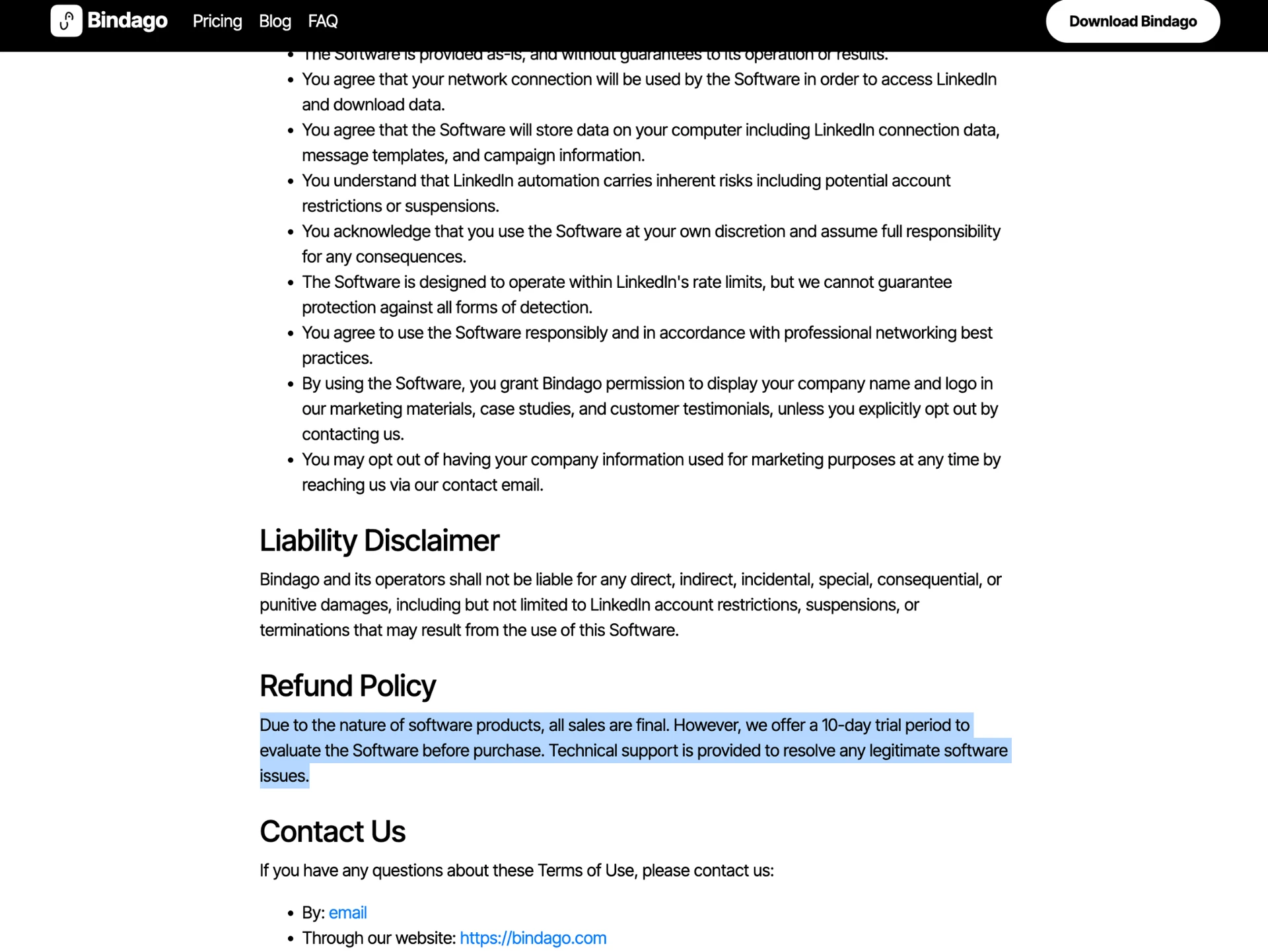
Bindago advertises a 10-day trial with no credit card, accessed through desktop downloads. That lowers pre-purchase billing exposure, but installation and activation were not performed. The current trial's plan mapping, account allowance, campaign and action quotas, export access, CRM gate, and ability to complete an end-to-end campaign are not disclosed. An older first-party “test all features” statement predates the current Standard/Scale split, so it cannot settle today's trial entitlements. (Pricing; Terms)
No permanent free tier was established. A separate promotion offers one free month for a qualifying public social post, but that is a conditional advocacy reward with undisclosed key entitlements, not an ongoing free plan. (Promotion terms)
After purchase, Bindago documents self-service cancellation through the Stripe Customer Portal. Future charges stop and access continues to the end of the paid period. The flow was not executed in this review. Purchases are final, with no published money-back window, so unresolved plan behavior should be tested during the no-card trial rather than after payment. (Cancellation guide; Terms)
| Stage | Known | Verify |
|---|---|---|
| Trial | 10 days; no card advertised | Plan mapping, quotas, CRM/export gates, activation |
| Purchase | Monthly license; all sales final | Authenticated entitlements |
| Cancellation | Stripe portal; access through paid period | Actual flow and timing |
| After cancellation | General product data is described as local | Retention, export, deletion, and license-state behavior after cancellation |
Bindago trial-to-cancellation evidence (September 2026)
Cancellation-specific data retention, export, and deletion behavior is not documented. General statements that logout removes cookies and uninstall or clear-data removes local data do not establish what cancellation itself changes. (Privacy)
Use the trial as the decision gate: The no-card trial is documented, but its tier and quotas are not. With all sales final, validate the required accounts, CRM/export behavior, limits, and full campaign path before purchase.
Is Bindago Safe?
Bindago's safety case starts with architecture. The vendor describes a local desktop app where LinkedIn cookies or tokens and campaign data stay on the user's machine, while LinkedIn traffic uses the user's normal IP or system VPN. If accurate, that reduces the stated vendor-side session surface. It does not establish the exact login flow, binary behavior, packet path, or detection outcome, because none was independently inspected. (Privacy; FAQ)
The second layer is pacing. Bindago documents default daily guidance, random delays, generic rate limiting, pauses after batches, weekend scheduling, duplicate-message prevention, and reply awareness. These controls can reduce repetitive timing and unsuitable follow-ups, but the public record does not establish their enforcement, per-account scope, reset windows, adaptive response, or effect on restrictions. The reply-stop behavior can also be overridden by the operator. (FAQ; message-sequence guide; v2.8.0)
What I verified first-hand. I checked Bindago's dated public pages, Help and FAQ material, legal pages, sitemap, checkout, releases, and browser responses in September 2026. Those checks found a standalone desktop product surface and no public companion extension. I did not install the app, inspect its binary or traffic, run campaigns, test account restrictions, or measure safety-control behavior; no runtime safety verdict follows from the public check.
| What was checked | Result |
|---|---|
| Architecture and session custody | Vendor states local cookies/tokens, local campaign data, and user-IP/system-VPN execution; network behavior was not independently observed |
| Pacing controls | Defaults, random delays, batch pauses, and weekend scheduling are documented; enforcement and efficacy were not tested |
| Reply and duplicate handling | Default reply stop and within-sequence duplicate prevention are documented; reply stop can be overridden |
| Restriction language | Terms warn automation can cause restrictions or suspension, and the vendor does not guarantee protection from detection |
| Proxy controls | System VPN inheritance is documented; ordinary per-account proxy UI and a proxy-quality checker were not established |
| Compliance package | Privacy notice exists; a public DPA, SCC package, full subprocessor list, SOC 2/ISO evidence, and explicit encryption claim were not found |
Bindago safety controls and evidence status (September 2026)
The legal text is appropriately cautious. Bindago's Terms warn that LinkedIn automation can result in account restriction or suspension and say the product cannot guarantee protection from detection. That matches the evidence: static pacing and local custody are controls, not immunity. Manual behavior can also look automated—for example, opening many profiles by direct URL or acting unrealistically fast—so restriction-reduction guidance is useful general context, not proof of Bindago outcomes. (Terms)
The Privacy page says some website Personal Data may be transferred to and processed in Nigeria and names Google Analytics and generic providers. That statement does not establish headquarters. A public DPA, SCC/GDPR role package, complete subprocessor register, security certification, and explicit encryption statement were not found in the reviewed public surface; these remain procurement questions, not proof that protections are absent. (Privacy)
Residual risk: No tool eliminates ban risk. Bindago's local-first posture and pacing controls are vendor-documented, while network behavior, adaptive throttling, restriction outcomes, and session security were not tested.
What Bindago Reviews and Social Evidence Actually Show
The local analysis contains four Trustpilot records, all individually 5★ and unverified, from January 8 through March 23, 2026. Trustpilot local N=4 is below the rating threshold; trailing-six-month Trustpilot N=2 through September 2, 2026 is also thin. We publish neither a mean nor a trend. (Trustpilot)
A separate September 29, 2026 live inventory counted Trustpilot N=5 and G2 N=2. Each platform was too thin for a score, and neither count is the denominator for the local analysis. A Capterra product inventory was not established. (Trustpilot; G2)
| Corpus | Sample and dates | What it can support | What it cannot support |
|---|---|---|---|
| Local Trustpilot | N=4, Jan 8–Mar 23, 2026; all 5★ and unverified | Statements | Mean, trend, prevalence, or restriction rate |
| Live Trustpilot | N=5 on September 29, 2026 | Inventory | Local-corpus percentages |
| Live G2 | N=2 on September 29, 2026 | Inventory | Score or consensus |
| Reddit sweep | 0 visible mentions among 5,061 posts | Observation | Sentiment estimate |
Bindago review sample audit (September 2026)
In local Trustpilot N=4, features appear in 3/4 records; pricing, support, ease, and outreach each appear in 2/4. Desktop/mobile access is the only negative topic, in 1/4. No eligible complaint or migration cluster was found; this is a small-sample evidence gap, not proof none exists.
N=4 is below the 30-review minimum for anomaly analysis, so no anomaly conclusion is available. A free-month social-post promotion has no established link to platform reviews. (Promotion)
None of the four records is a substantive negative review, so complaint cards would misrepresent the sample.
Who Bindago Is For — and Who Should Look Elsewhere
Operator topology matters more than company size. Bindago's documented limits align with a solo founder, SDR, or recruiter running one to three LinkedIn accounts from an always-on Windows, macOS, or Linux computer with a CSV-centered workflow. Standard's $9.99 price and three-account allowance match that setup, while the no-card trial lets the operator validate the disputed limits and entitlements. (Pricing; FAQ)
A single-operator agency may also evaluate Scale when flat software cost matters more than team features. That case remains conditional because “unlimited accounts” is a one-machine, hardware-qualified license allowance, not proof of multi-account capacity or an agency workspace.
Teams should look elsewhere or test first when they require concurrent managers, role-based permissions, client tenants, white-label reporting, sender rotation, audit history, resilient remote execution, native email sequences, a built-in enrichment database, or proven HubSpot/Pipedrive synchronization. These needs collide with documented limitations or unresolved public evidence rather than with a measured product failure. (Agency comparison; email bridge; CRM release)
| A provisional fit when | Look elsewhere or test first when |
|---|---|
| One operator manages 1–3 LinkedIn accounts | Several managers need concurrent seats and permissions |
| An always-on local computer is acceptable | Campaigns must continue independently of one host |
| CSV import/export is an acceptable handoff | Native two-way CRM or one-builder email outreach is required |
| Low software cost outweighs agency governance | Client isolation, white label, audit trail, and reporting are required |
| The buyer can validate needs during the no-card trial | Procurement requires a published DPA, certifications, or settled security controls |
Who Bindago fits — and who should look elsewhere (September 2026)
How Bindago Compares to Alternatives
Architecture changes what the operator must keep running. Bindago's $9.99 entry buys a standalone local desktop model. Octopus CRM uses a Chrome extension and had the same matrix entry price, but that price snapshot was more than 90 days old in September 2026. Dux-Soup centers on an extension and records a cloud option, which adds a runtime choice but starts at $14.99 in another more-than-90-day-old snapshot. Dripify uses vendor-cloud execution, removing the always-on-local-host requirement while changing the session and IP boundary; its recorded $59 entry was also more than 90 days old. These are shallow architecture and price comparisons, not full product verdicts.
| Tool | Architecture | Entry price | Best known for |
|---|---|---|---|
| Linked Helper | Desktop + VPS/Web Version | $15/month | 11 direct CRM connectors, plus Zapier and Make through outgoing webhooks |
| Octopus CRM | Chrome extension | $9.99 (checked Apr 22, 2026; >90 days old) | Extension-first execution at the recorded Bindago entry price; current price needs rechecking |
| Dux-Soup | Browser extension; cloud option recorded | $14.99 (checked Apr 22, 2026; >90 days old) | Extension-centered execution with a cloud option; current price needs rechecking |
| Dripify | Cloud | $59 (checked Apr 22, 2026; >90 days old) | No always-on local host; vendor-cloud execution changes the session/IP boundary |
How Bindago compares (September 2026)
The table's non-Bindago values are dated snapshots, so buyers should verify current pricing and features directly rather than treating the rows as complete evaluations.
See all LinkedIn automation alternatives →
Where Linked Helper Fits
If Bindago's one-machine Scale allowance is too concentrated for several managers, an operating model with switchable team licenses, remote host access, and per-account controls is worth evaluating.
Linked Helper is a desktop application for Windows, macOS, and Ubuntu with its own browser engine. It can run on a user-controlled VPS, while Web Version provides login-based browser access to that VPS instance for starting, pausing, and configuring campaigns. In practice, that preserves user-controlled execution while allowing 24/7 operation without leaving an office computer on.
- Team license handling: Organizations support bulk license management, and licenses can be switched between employees; each license runs one LinkedIn account at a time rather than promising unlimited accounts on one machine.
- CRM and automation handoff: There are 11 direct CRM connectors—ActiveCampaign, Capsule, Close.io, HighLevel, HubSpot, Instantly, Pipedrive, Salesforce, Streak, Zoho, and Zoho Recruit—plus Zapier and Make through outgoing webhooks. That addresses the unsettled CRM/export distinction identified above.
- Per-account network controls: A dedicated user-provided HTTP, HTTPS, SOCKS, or SOCKS5 proxy can be assigned to each account, with a built-in proxy-quality checker before use. That provides an account-level control not established on Bindago's public surface.
- Message and data controls: Complete message-history export with per-message metadata is available on Pro, and message-history filters can exclude people based on previous conversation content. This is relevant where Bindago's chat-export schema and completeness remain unresolved.
- Failure visibility: A sleeping campaign exposes one of seven documented causes, while an Issues to Fix view ranks failed actions. That provides named operational diagnostics rather than relying only on a generic paused state.
Bindago starts at $9.99 per month; Linked Helper starts at $15 for a one-month Standard license, or $8.25 per month equivalent on a 12-month Standard license. The latter uses time-boxed licenses without auto-renewal, not a monthly subscription promise.
Teams prioritizing several operators, direct CRM connectors, per-account proxy control, and VPS-based remote management may want to evaluate Linked Helper too.