
 Updated: September 13, 2026
 33 min read
Key takeaways
- If both charge events apply, Starter's 250 credits cover about 125 newly sourced-and-emailed contacts, and unused credits expire; budget by completed records rather than the displayed allowance (credit rules).
- Enterprise's “unlimited” allowance applies to email accounts and campaigns, while 1,000 credits per user and Email Smart Limits remain separate caps; high-volume buyers should model throughput instead of reading the plan as unlimited sending (pricing; email limits).
- The sequence surface spans email, LinkedIn actions, branching, and A/B tests, but InMail is explicitly unsupported and the central Inbox is documented per user while a team-wide inbox was not established; teams should map channel and collaboration requirements before treating it as one shared workspace (LinkedIn actions; Inbox).
- A 14-day no-card trial showed 50 credits in the dated signup observation, or about 25 sourced-and-emailed contacts if both charges apply; use that sample for a targeted accuracy and delivery benchmark, especially because the AI refund language is internally conflicting (pricing; signup; FAQ; Terms).
- In 130 G2 reviews dated October 20, 2016 through December 15, 2024, data-quality pain appears in 28 reviews (21.5%); separately, 15 of 29 reliability topic mentions in that same G2 corpus and window are negative (51.7%), so a current pilot should test both accuracy and runtime reliability rather than inherit either historical ratio (G2 profile).
This review is published by Linked Helper and written by Milosh Potikj, who works there. I've made every effort to represent Overloop accurately using verified data — our own first-hand testing, Overloop's own documentation, and independently sourced reviews.
Overloop AI is a cloud B2B prospecting product for solo sellers and small teams. It combines contact sourcing, email, and LinkedIn steps in one workflow. Starter costs $69 per user each month, or $59 per user on a yearly commitment (pricing; annual terms). Our verdict is conditional. The documented workflow is usable, but current data quality, LinkedIn exit routing, and restriction outcomes have not been measured. The central evidence problem is product lineage. Public reviews mainly cover Prospect.io and pre-AI Overloop, not the Sortlist-owned AI product sold now. Older outcomes should not be carried forward without a current pilot.
| Era | What the evidence supports |
|---|---|
| Prospect.io | Company founded in 2015; historical outreach product |
| Overloop Classic | Renamed legacy generation with its own app, Help Center, extension, and policy |
| Overloop AI / Sortlist | Current cloud AI product; Sortlist acquisition announced in December 2025 |
Overloop product-generation timeline
Sources checked September 2026: Overloop company history and Sortlist acquisition announcement.
Verdict
Overloop AI combines prospect sourcing, email verification, email sequences, and LinkedIn steps in one per-user workspace. The documented workflow includes visits, connection requests, first-degree messages, branching, A/B tests, and reply stopping (sequence editor; LinkedIn actions). This is the relevant buying case when that sequence matches the intended workflow. Starter is a functional product tier rather than a featureless trial. It includes 250 credits, one email account, three campaigns, and Zapier at $69 per user monthly (plans).
That is not yet a validated outcome case. The 450M+ database claim does not establish current accuracy or bounce rate. No authenticated campaign run established reply handling or failure recovery. For agencies, one LinkedIn identity per paid user is documented. Lower-plan user roles and client isolation are not established (connection model; agency positioning).
| Verified now | Test before scale |
|---|---|
| Current plan prices, credit events, sequence actions, conditions, A/B surfaces, Smart Limits, CRM/API plan gates, extension-side session transfer | Current data accuracy, deliverability, reply latency, duplicate suppression, cloud retention/replay, LinkedIn exit IP, lower-plan roles, client isolation |
Overloop conditional verdict
Sources checked September 2026: pricing, credit rules, and Smart Limits.
Use a pilot to settle the decision. Verify a representative data sample, seed-inbox delivery, LinkedIn network behavior, and actual teammate permissions before multiplying seats.
Pros
- One data-to-outreach path: Sourcing and email finding feed email and LinkedIn steps inside one cloud workflow, reducing manual handoffs (multichannel outreach).
- Starter keeps the outreach core: The $69 monthly plan includes 250 credits, one email account, three campaigns, Zapier, and the documented sequence surface (pricing).
- Branching is specified: Conditions use prospect data, tracking events, and participation in other sequences, so “branching” has defined inputs (conditions).
- A/B tests cover three message surfaces: Email, connection notes, and LinkedIn messages can be tested, which gives operators a defined variation workflow (A/B documentation).
- Action limits are published: Separate ramps and maxima for views, invitations, and messages make the vendor's intended operating envelope visible (Smart Limits).
- Interfaces and status are public: Growth adds a documented REST API, while beta v2/CLI documentation and a live status page make operational surfaces inspectable before an integration is designed (API and CLI).
Cons
- Credits do not equal completed leads: Sourcing and email finding are separate charge events, and unused credits expire, so 250 credits can represent about 125 sourced-and-emailed contacts rather than 250 (credit rules).
- Current data outcomes are unmeasured: A 450M+ database and documented verification checks do not establish accuracy, business relevance, bounce rate, or credit returns (verification).
- LinkedIn cloud behavior is only partly resolved: Static source review confirms full-cookie-jar transfer and some local LinkedIn requests, but backend retention, replay, campaign execution, and LinkedIn-facing IP quality remain unmeasured (AI extension).
- Agency controls are not established: Marketing promotes white-label resale, but public documentation did not establish client workspaces, custom branding controls, sender rotation, lead distribution, or an audit log (agency page).
- Refund messages conflict: The AI FAQ says no refunds after a subscription starts and also gives a request path; the Terms retain case-by-case discretion (FAQ; Terms).
- The review record predates the current product: The 130 G2 reviews analyzed end before the Sortlist acquisition. They cannot establish current AI-product reliability or quality (G2 profile; acquisition).
- Support outcomes are unmeasured: Chat and email are listed with plan gates, but no controlled response-time or escalation test was completed (pricing; FAQ).
| Limitation | Current evidence | Test needed |
|---|---|---|
| Credit economics | Two metered events and expiry are documented | Model sourcing and email-finding mix |
| Data quality | Vendor workflow is documented; current outcomes are not | Segmented accuracy and bounce benchmark |
| LinkedIn execution | Both extension teardowns confirm session transfer and local LinkedIn work | Live cloud-IP/network/session check |
| Agency topology | Resale marketing is public; operational controls are not established | Invite, permission, isolation, and billing sandbox |
| Refunds | AI FAQ and Terms use different boundaries | Written confirmation before annual prepay |
Overloop limitations and the checks they require
Sources checked September 2026: credits, agency positioning, FAQ, and Terms.
Overloop Pricing: Per-User Credits, Annual Prices, and Real TCO
Overloop AI lists Starter at $69 and Growth at $99 per user monthly. Enterprise is custom. Its Help Center, rather than the public pricing page, lists yearly-commitment equivalents of $59 and $79. The resulting reductions are 14.5% for Starter and 20.2% for Growth. These are calculated values, not percentages displayed by the vendor (monthly pricing; annual pricing).
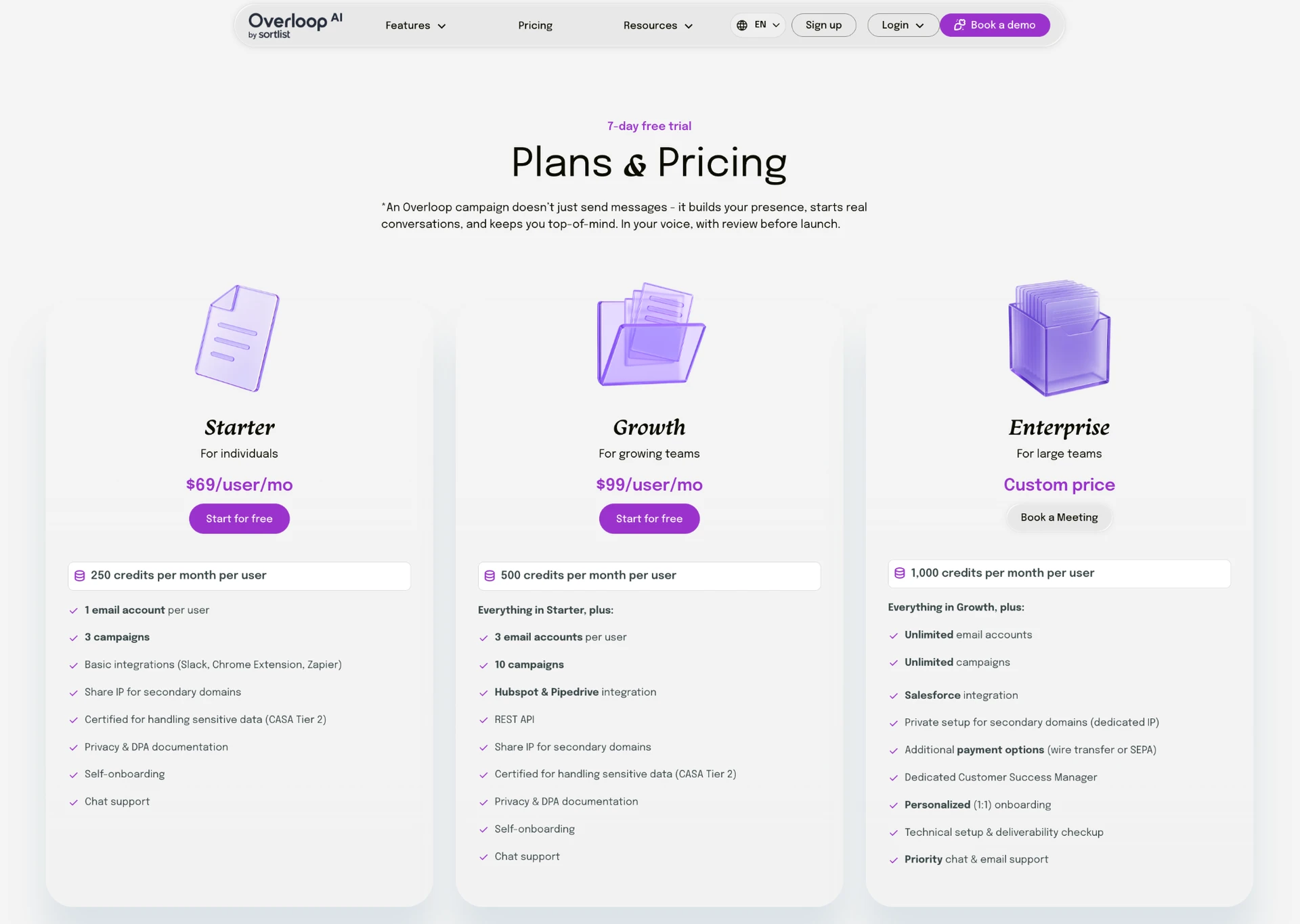
| Plan | Price | What's included | What's NOT included or unresolved |
|---|---|---|---|
| Starter | $69/user monthly; $59/user monthly equivalent on yearly commitment | 250 credits/user; 1 email account; 3 campaigns; Zapier | Native CRM and REST API; lower-plan teammate role access is unresolved |
| Growth | $99/user monthly; $79/user monthly equivalent on yearly commitment | 500 credits/user; up to 3 email accounts; 10 campaigns; HubSpot, Pipedrive, REST API | Salesforce; client-isolation controls are not established |
| Enterprise | Custom | 1,000 credits/user; unlimited email accounts and unlimited campaigns; Salesforce; expanded roles | Public price, fair-use terms, and 50-seat commercial terms are not disclosed |
Overloop pricing tiers (September 2026)
Sources checked September 2026: Overloop AI pricing and Pricing & Plans Help. “Unlimited” applies to the named email-account and campaign capacities; credits and Smart Limits remain separate caps.
The credit unit can distort lead capacity. One credit sources a prospect, and a second finds an email. A fully sourced-and-emailed contact can therefore consume two credits. Unused monthly credits expire at renewal. Annual credits arrive upfront and expire after 12 months. Running out stops new sourcing and email finding. It does not stop sequences already running for existing prospects (credit rules; FAQ). No public standalone top-up route was found. That is an evidence gap, not proof that a private sales option is unavailable.
The trial is pilot-sized. Overloop AI offers 14 days without a card at signup and no permanent free plan. A dated signup observation exposed 50 credits. That is about 25 contacts if both charge events apply. Payment-method timing and full trial gates were not authenticated (pricing; signup; billing).
| Users | Starter monthly | Growth monthly | Annual monthly equivalent |
|---|---|---|---|
| 1 | $69 | $99 | $59 Starter / $79 Growth |
| 10 | $690 | $990 | $590 Starter / $790 Growth |
| 20 | $1,380 | $1,980 | $1,180 Starter / $1,580 Growth |
Overloop cost at 1, 10, and 20 users (September 2026)
Scenario arithmetic from monthly pricing and annual rates; before VAT and conditional on lower-plan user access.
For 20 Growth identities, the annual cost is $23,760 with monthly billing or $18,960 with annual prepay, before VAT. One LinkedIn identity maps to one paid user. No public volume discount was found, so published pricing scales linearly. Private pricing remains unestablished (connection model). Cancellation is self-service, and pause costs $14.99 monthly. The refund boundary remains conflicting. Classic's separate 30-day guarantee applies only to Classic, not Overloop AI (AI billing; Classic policy).
Credits and seats compound: A fully sourced-and-emailed contact can consume two credits, unused credits expire, and each LinkedIn identity requires a paid user. Model all three before treating the plan allowance as lead capacity.
Overloop Features: Seven Evidence-Supported Axes
Overloop's feature list needs three labels: product generation, plan, and evidence status. The current AI Help Center and live AI surfaces establish the capabilities below. Classic documentation can explain lineage. It cannot establish current pricing, refunds, roles, or runtime behavior. We therefore separate documented features from authenticated results. A sequence step may exist while delivery, latency, recovery, or output quality remains unmeasured. Each axis also states what the public evidence did not establish. A documentation gap is not proof that a capability is absent.
Prospect.io, Overloop Classic, and Overloop AI
Overloop began in 2015 as Prospect.io, later became Overloop, and now sells Overloop AI. Sortlist announced its acquisition of the company in December 2025 (company history; acquisition announcement). The company is Overloop SRL in Brussels, Belgium (About; Terms). This lineage explains the overlapping names in brand searches. Company continuity does not establish continuity of product outcomes.
| Generation | Current evidence boundary | What must not transfer |
|---|---|---|
| Prospect.io | Historical outreach product and earliest review era | Old reliability, UI, and data-quality outcomes |
| Overloop Classic | Separate live app, Help Center, extension, and 30-day guarantee | Classic refund, extension, account-protection, and runtime claims |
| Overloop AI | Current cloud AI product, current pricing, 14-day trial, separate extension | No inherited reputation claim without AI-era users |
| Sortlist ownership | Acquisition announced December 2025 | Roadmap statements are not shipped-product outcomes |
Overloop generation and policy boundaries
Sources checked September 2026: About, acquisition announcement, AI Help Center, and Classic Help Center.
The separate extension listings make the boundary concrete. Overloop AI uses listing ID hehebhmhfadjangoccifmegnfacnbeff, observed as v1.0.8, while Classic uses dpkbdbpmahebenenkkjenihgfophknbm, observed as v3.45.3 (AI listing; Classic listing). They are distinct artifacts, so one listing's behavior cannot be assigned to the other.
The Help Centers also remain separate: the September 2026 count was about 41 AI articles and 105 Classic articles (AI Help; Classic Help). Those totals describe documentation volume, not support response time. Historical reviews can design current checks, but they cannot show that the AI product inherited Classic outcomes.
A shared name is not shared outcome evidence: Prospect.io, Overloop Classic, and Overloop AI have different product surfaces and policies. Historical outcomes generate test questions; they do not settle current AI-product performance.
B2B Database, Email Verification, and Credit Quality
Overloop markets a database of 450M+ contacts and combines prospect sourcing with a built-in email finder. The documented credit flow is closed. Sourcing a new prospect costs one credit, and finding an email costs one more. Message sending and LinkedIn touchpoints are not listed as credit events (database; credit usage). Plan credits therefore measure chargeable lookup events, not a fixed number of complete leads.
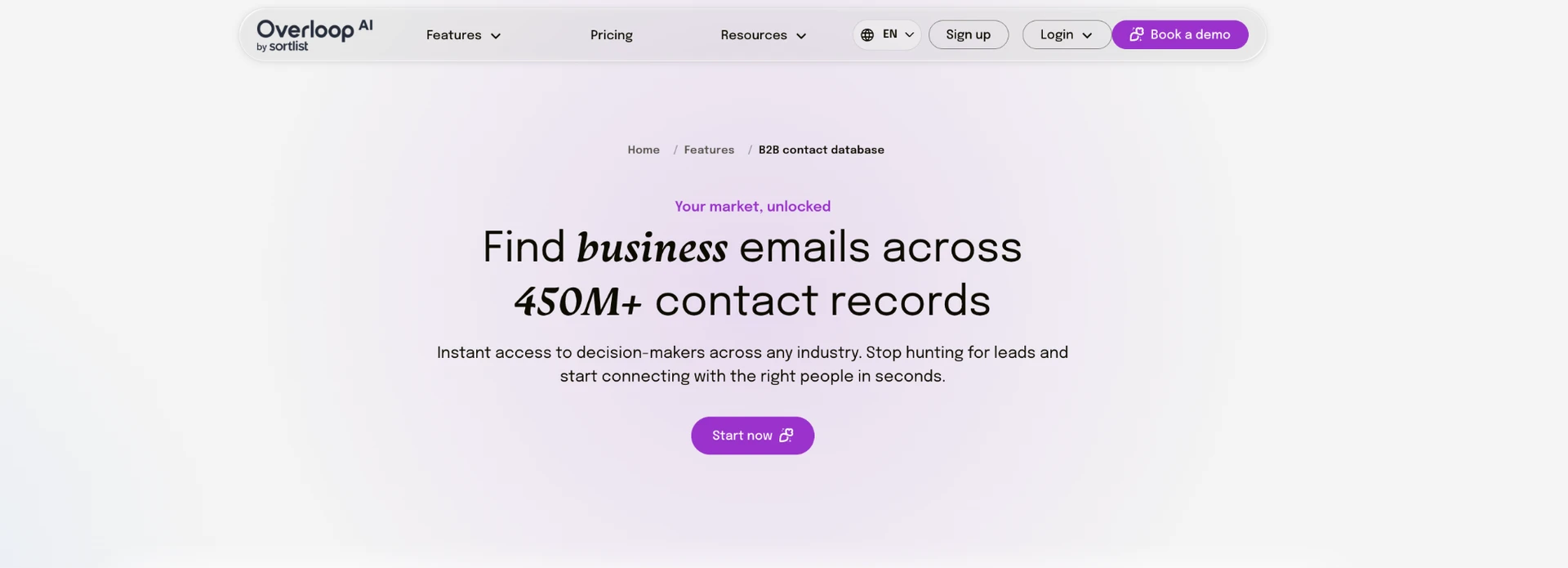
Email verification checks syntax and domain health, performs an SMTP handshake, and detects catch-all domains (verification page). Those mechanisms show what the verifier checks. They do not establish current accuracy, geography coverage, business appropriateness, bounce rate, or whether a hard bounce returns a credit.
| Stage | Documented charge or check | Outcome still needed |
|---|---|---|
| Source prospect | 1 credit | Found rate by geography and segment |
| Find email | 1 additional credit | Verified and business-appropriate rate |
| Verify email | Syntax/domain, SMTP handshake, catch-all detection | Seed-inbox delivery and bounce rate |
| Use AI sourcing | Sources against an ICP | Accuracy, false positives, and human-control quality |
Overloop credit and data-quality flow
Sources checked September 2026: credit usage, email verification, and LinkedIn automation.
Overloop documents AI sourcing against an ICP. The reviewed current catalog did not establish persistent fit scoring for an already imported list. That documentation gap does not prove that no private workflow can approximate it. Record-level data-freshness dates were not checked, so their availability is not established. Prospect/data export is documented. Full message-history export, export cleanliness, and distinct failed-profile diagnostics were not established (account overview).
For category context, use a consistent email-finder evaluation framework rather than treating database size as an accuracy result.
Database size is not an accuracy benchmark: The 450M+ claim describes inventory. It does not establish the share of current, business-appropriate, deliverable contacts in a buyer's target segment.
Multichannel Sequences, Smart Branching, and Reply Stop
The current documented catalog covers email and these LinkedIn actions:
- Visit Profile
- Connection Request
- Message
- Check Connection logic
The Help Center explicitly marks InMail as unsupported (sequence editor; LinkedIn actions). The reviewed current documentation did not establish:
- Recruiter support
- Group or event engagement
- Post-engager collection
- Post commenting
- Following
- Skill endorsement
These are documentation gaps except where the action page explicitly says unsupported.
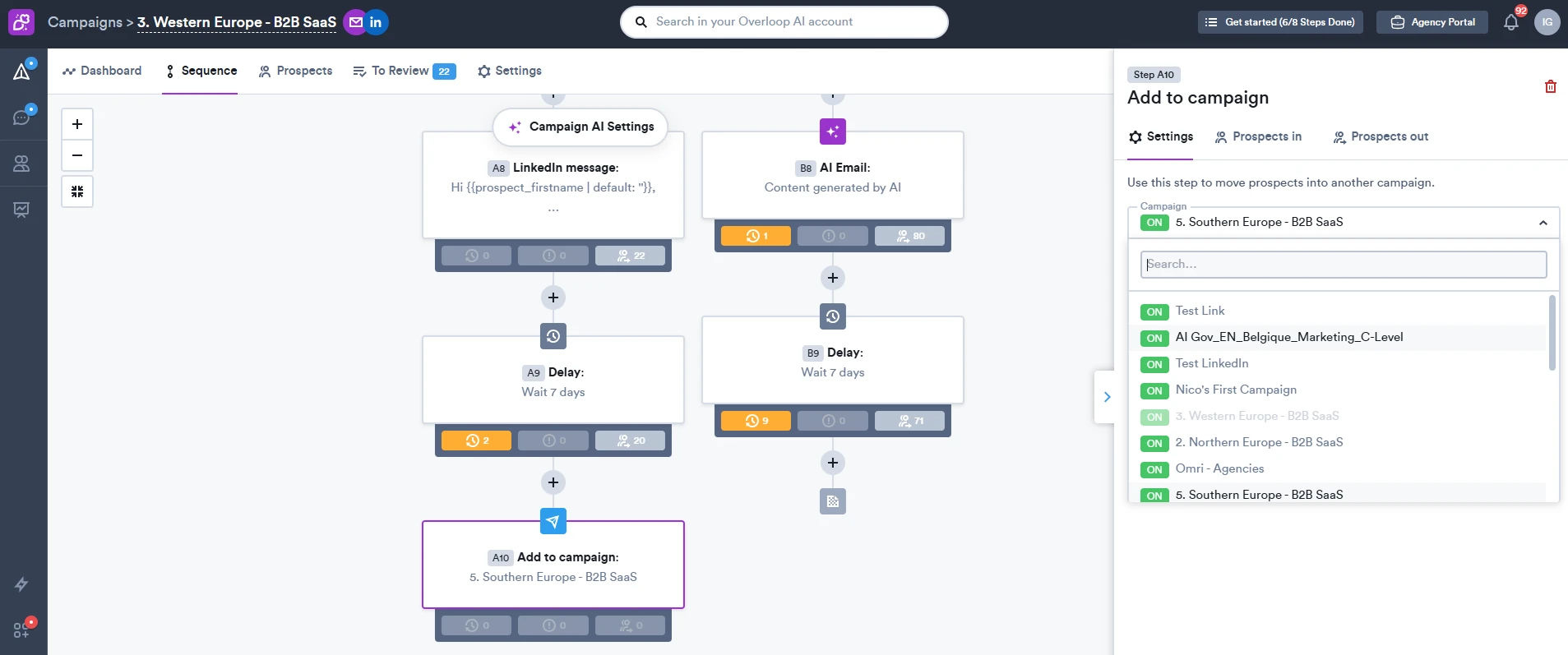
Conditions branch on three named families: prospect data, tracking events, and participation in other sequences. A/B tests cover email, LinkedIn connection notes, and LinkedIn messages (conditions; A/B testing). AI message settings expose language, formality, tone, length, and excluded terms, but output accuracy, quality, and effective human control were not tested (AI settings). Like many products in this category, Overloop also documents automatic stop on reply and a central conversation inbox (multichannel page; Inbox).
| Sequence element | Documented behavior | Runtime boundary |
|---|---|---|
| Email step in the same sequence | Delivery and bounce outcomes unmeasured | |
| Visit, connect, message, check connection | InMail unsupported; other action families not established | |
| Conditions | Prospect data, tracking events, other-sequence participation | Nesting depth and edge cases untested |
| A/B test | Email, connection notes, LinkedIn messages | Winner logic and measured lift untested |
| Reply handling | Stop/branching and per-user Inbox documented | Latency, cross-channel recognition, and failure recovery untested |
Overloop multichannel sequence scope
Sources checked September 2026: Sequence Editor, Conditions, A/B Test, and LinkedIn Actions.
The practical implication is that campaign design is more than a linear email drip, but feature presence does not prove execution quality. An authenticated run still needs to test duplicate suppression, pause and resume behavior, reply latency, cross-channel stopping, and recovery after repeated failures. For a neutral overview of channel handoffs, see how LinkedIn and cold-email steps interact.
Documented logic is not a completed delivery test: Branching, A/B surfaces, and reply stop are documented. Their nesting, latency, duplicate handling, and failure recovery remain unmeasured.
Chrome Extension, Cloud Execution, and Smart Limits
Overloop AI documents vendor-cloud execution with a companion Chrome extension. The extension connects the existing LinkedIn session. It also captures LinkedIn or Sales Navigator search results. Public documentation implies launched campaigns continue in the cloud, but no browser-off run verified that behavior (LinkedIn automation; features).
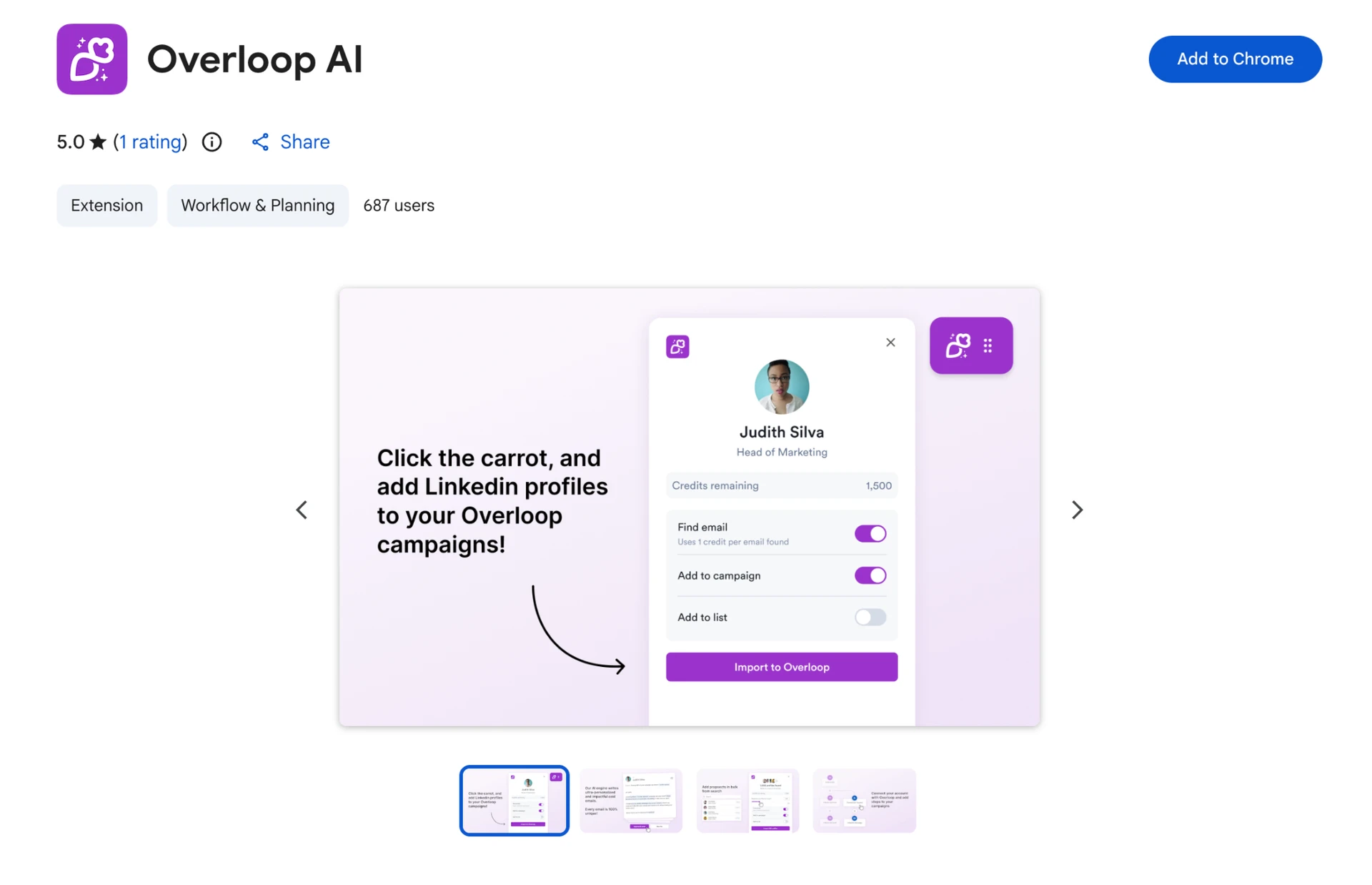
The current AI and Classic listings are separate packages. In a September 12, 2026 static source review, the AI v1.0.8 package collected the full LinkedIn cookie jar and sent it to an Overloop account endpoint at link time and after session changes. It also made local LinkedIn and Sales Navigator requests and injected code into LinkedIn pages (AI listing). The Classic v3.45.3 package separately transferred the full cookie jar to its own Overloop endpoint. It also performed some local LinkedIn page/API work (Classic listing).
A full cookie jar is the account's LinkedIn login in browser form. Transferring it gives the vendor session material without requiring the password again. The shipped code establishes that extension-side transfer and local work occurred. It does not establish backend retention, replay, cloud campaign execution, or the network origin LinkedIn sees.
| LinkedIn account type | Start | Published maxima |
|---|---|---|
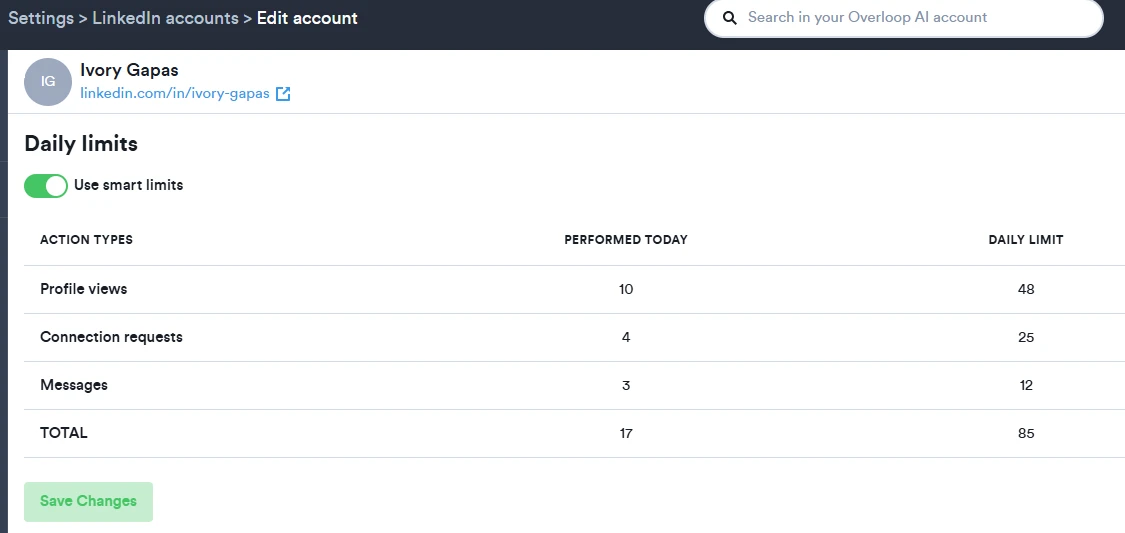
| Free LinkedIn account | 5 actions/day starting point | 50 profile views/day; 25 invitations/day or 100/week; 50 messages/day |
| Premium LinkedIn account | 5 actions/day starting point | 100 profile views/day; 29 invitations/day; 100 messages/day |
Overloop documented LinkedIn Smart Limits
Source checked September 2026: Overloop LinkedIn Smart Limits.
Smart Limits separate views, invitations, and messages. They also ramp activity and allow manual override. This makes the intended operating envelope visible. The same documentation warns that overriding limits raises flagging risk. No time-of-day working-hours control or risk-triggered automatic pause was found in the reviewed current documentation. Those capabilities remain unestablished rather than proven absent from every product surface.
For broader context, compare vendor action caps with LinkedIn's weekly invitation limit.
The cloud network remains unresolved: Both extensions transfer the full LinkedIn cookie jar, but the live test needed to measure backend campaign behavior, exit IP, IP quality, fingerprint, and location controls was not run.
Email Accounts, Deliverability, and Inbox
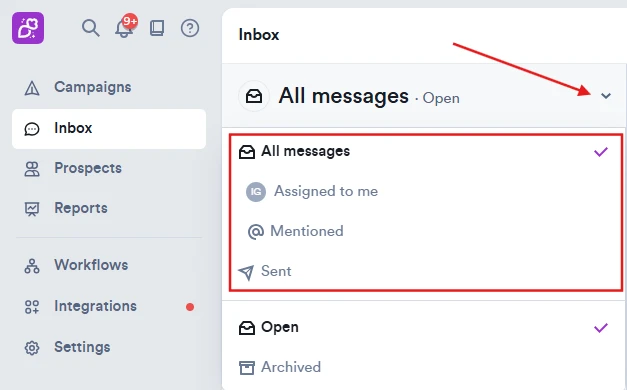
Starter includes one email account, Growth up to three, and Enterprise markets unlimited email accounts and unlimited campaigns. Those allowances remain subject to separate credit and sending limits, so “unlimited” names only the two stated capacities (pricing). One central Inbox exists per user rather than as a documented team-wide inbox (Inbox).
| Plan or function | Documented scope | Separate cap or unknown |
|---|---|---|
| Starter | 1 email account; 3 campaigns | 250 credits per user |
| Growth | Up to 3 email accounts; 10 campaigns | 500 credits per user |
| Enterprise | Unlimited email accounts; unlimited campaigns; dedicated email IP for secondary-domain infrastructure | 1,000 credits per user; public fair-use terms not disclosed |
| Email Smart Limits | New account starts at 50 emails/day and can ramp to 250/day | Provider limits and actual inbox placement unmeasured |
| Inbox | One central Inbox per user | Team-wide inbox not documented |
Overloop email capacity and evidence boundary
Sources checked September 2026: pricing, email Smart Limits, and Inbox.
The reviewed connection documentation covers Gmail and Outlook OAuth. It does not document a generic SMTP mailbox route (connection management). Enterprise's dedicated IP refers to secondary-domain email infrastructure, not a dedicated LinkedIn proxy. That distinction matters because email deliverability and LinkedIn network safety are different systems.
No current seed-inbox test established delivery, spam placement, domain health, or credit return after a bounce. The documented ramp explains intended sending volume, not outcome quality.
Unlimited capacity retains separate caps: Enterprise's unlimited email accounts and campaigns do not erase the 1,000-credit allowance per user, Email Smart Limits, or provider-level delivery constraints.
CRM Integrations, Zapier, API, and CLI
The public documentation does not establish one reliable native-integration total. It names five integration routes—Slack, Zapier, HubSpot, Pipedrive, and Salesforce—plus a REST API. Plan scope matters more than a larger implied count. Zapier is documented from Starter. HubSpot and Pipedrive arrive on Growth, while Salesforce is Enterprise-only (pricing; CRM integrations; Zapier).
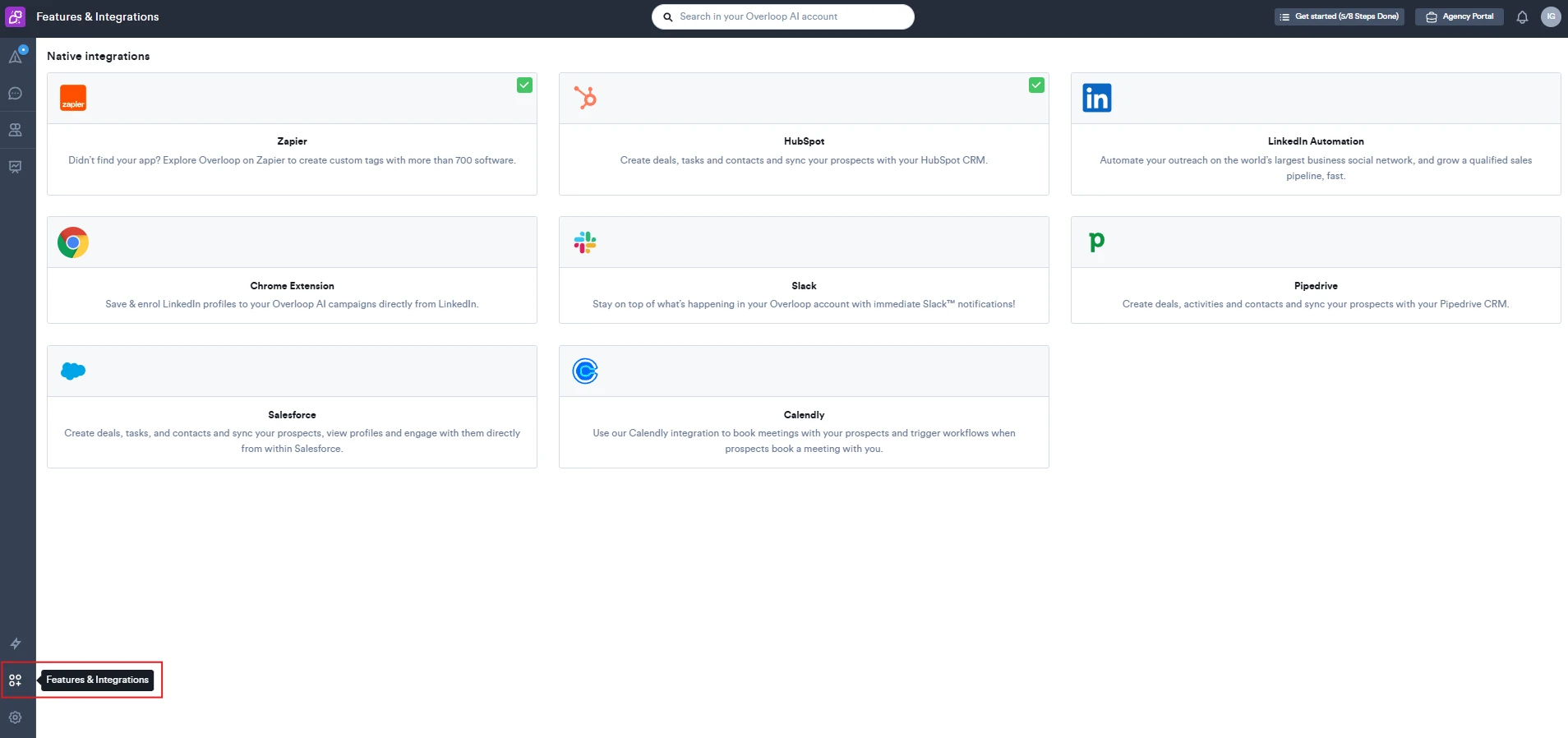
The REST API is documented as stable, while API v2 and the CLI are beta; access appears on Growth and Enterprise (API and CLI). Native Make and native webhook features were not found in the reviewed integration documentation. That is a public-documentation boundary, not proof that no private or future route exists.
| Route | Plan or status | Runtime evidence |
|---|---|---|
| Zapier | Starter onward | Documented; no live-fire test |
| HubSpot / Pipedrive | Growth onward | Documented; reads, writes, and sync fidelity untested |
| Salesforce | Enterprise | Documented; runtime untested |
| REST API | Stable; Growth/Enterprise | Authentication, rates, writes, and safeguards untested |
| API v2 / CLI | Beta | Runtime untested |
| Native Make / native webhooks | Not found in reviewed docs | Availability not established |
Overloop integration and interface status
Sources checked September 2026: CRM plan gates, Zapier, and API/CLI.
Reports cover account and campaign performance and can compare up to five campaigns, but reporting lag, attribution accuracy, and client-facing dashboards were not established (outreach results). For category context, see how CRM handoffs differ from campaign execution.
An interface listing is not a sync result: The named connectors and API are documented. Authentication, read/write behavior, rate limits, field fidelity, and destructive-operation controls were not live-tested.
Users, Agencies, Resale Claims, and Missing Client Controls
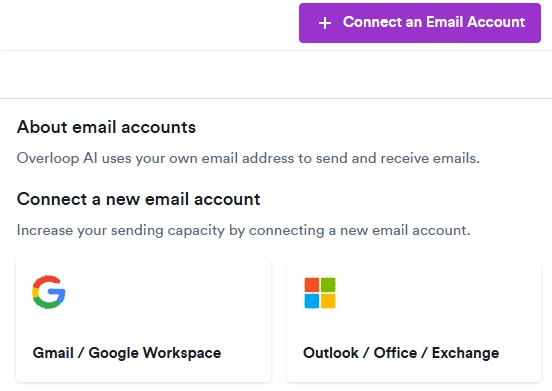
Overloop's documented licensing unit maps one paid user to one LinkedIn identity (connection management). Published Starter and Growth surfaces show an Admin role. User and View-only language appears under Enterprise. The evidence did not establish whether lower plans can add another named user or whether View-only consumes a paid seat. Multiplying seat prices therefore proves a cost scenario, not a usable lower-plan team topology.
| Role or promise | Public plan surface | Product control established? | Test required |
|---|---|---|---|
| Admin | Starter / Growth | Admin surface documented | Invite a second operator and inspect billing |
| User / View-only | Enterprise language | Lower-plan availability unresolved | Permission and paid-seat sandbox |
| White-label resale | Agency marketing | Resale message established; custom domain, logo controls, and hidden branding not documented | Branding and client-login walkthrough |
| Client operation | No public client-workspace surface established | Isolation, rotation, lead distribution, and audit log not documented | Two-client isolation test |
| Reporting | Per-user/account campaign reports | Client-facing dashboard not documented | Role-by-role report access test |
Overloop agency promises and product-control evidence
Sources checked September 2026: pricing and role wording, connection management, and agency marketing.
The agency page explicitly markets “white-label” resale and a 3–4× margin. That establishes a commercial playbook, not in-product custom domains, branding controls, client portals, workspace isolation, sender rotation, lead distribution, or audit logs. None of those controls was documented in the reviewed current surfaces; private Enterprise arrangements remain possible but unestablished.
| LinkedIn identities | Monthly-billed annual cost | Annual-prepay cost | Boundary |
|---|---|---|---|
| 10 | $11,880 | $9,480 | Before VAT; lower-plan user access unresolved |
| 20 | $23,760 | $18,960 | Before VAT; no public volume discount found |
| 50 | $59,400 | $47,400 | Before VAT; private Enterprise terms not disclosed |
Growth-plan agency cost scenarios
Scenario arithmetic from Growth monthly and annual rates; a public volume discount was not found, which does not prove private discounting is unavailable.
The agency test is operational:
- invite two roles
- assign two client identities
- inspect contact suppression and visibility
- export each report
- observe billing
Until that is done, a 20-seat quote should not be mistaken for confirmed tenant isolation. For neutral setup context, see how multiple LinkedIn identities change account management.
Resale marketing is not tenant isolation: One identity per paid user is confirmed. Lower-plan roles, client workspaces, branding controls, sender rotation, lead distribution, and audit logs remain unestablished in public documentation.
Is Overloop Safe for LinkedIn?
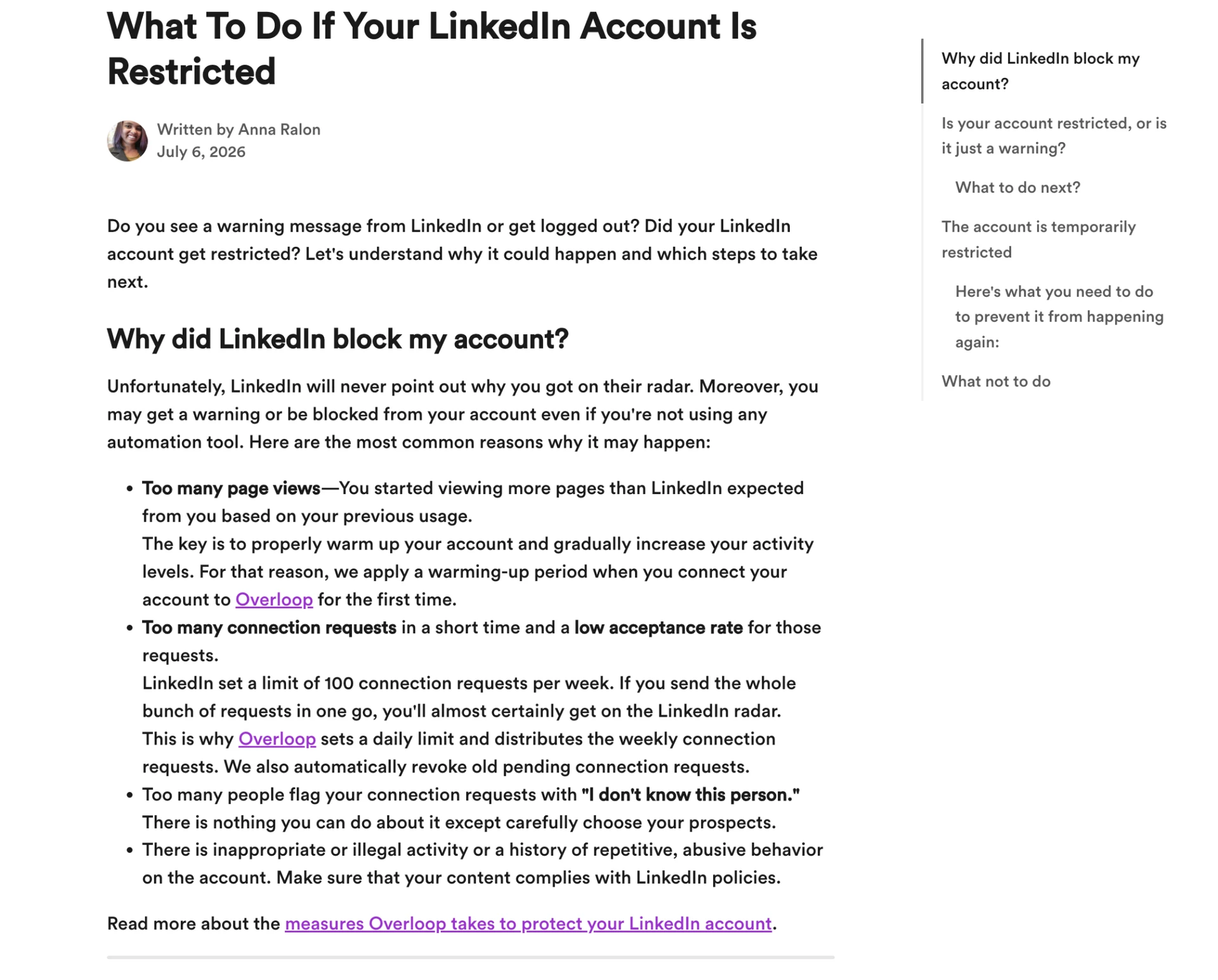
Overloop's Smart Limits and restriction-recovery guide support a conditional—not confident—safety verdict. Its marketing says “Zero accounts banned” and “completely under the radar,” while its Help Center explains warnings, temporary restrictions, repeat suspensions, and possible permanent account loss (marketing claim; restriction guidance). Side by side, these documents show acknowledged risk, not an incident rate or intent.
What I verified first-hand. On September 12, 2026, I reviewed the shipped source code for the current AI v1.0.8 package and the separate Classic v3.45.3 package. Both sent the full LinkedIn cookie jar to an Overloop account endpoint and performed some LinkedIn work locally. I found code injection into LinkedIn pages and direct LinkedIn requests, but no client-side traffic blocker. This establishes extension-side transfer and code paths—not backend retention, replay, cloud campaign execution, or the network LinkedIn sees (AI listing; Classic listing).
Both packages therefore act as session-upload bridges: they copy LinkedIn login cookies to the vendor. Whoever holds that cookie jar has session material that can authenticate without the password. Static review cannot show backend retention or replay.
Active Extension Detection (AED) is a label for LinkedIn-page code that probes specific installed extension IDs. If an ID is recognized, “installed” can be visible before a campaign acts. Current AED status was not checked for either listing, so it remains unknown. See how extension visibility works.
| What was checked | Result |
|---|---|
| Current product architecture | Vendor-cloud execution plus a companion extension is documented |
| Overloop AI extension | v1.0.8 source-reviewed; full LinkedIn cookie jar uploaded, local LinkedIn/Sales Navigator requests, DOM injection, no client-side traffic blocker found |
| Overloop Classic extension | Separate v3.45.3 source-reviewed; full cookie jar uploaded, local LinkedIn page/API work, DOM injection, no client-side traffic blocker found |
| Backend session handling | Retention, replay, and cloud campaign-action mechanism not established by static code |
| Cloud exit network | Applicable live test not run; IP, provider, quality, isolation, location, timezone, fingerprint, and restriction outcomes remain unknown |
| Extension visibility | AED status not checked for either listing |
| Preventive limits | Separate Smart Limits and published ramps/maxima documented; manual override allowed with a warning |
| Reactive control | Restriction recovery documented; a risk-triggered automatic pause was not found in reviewed docs |
| Privacy/compliance | GDPR/DPA and subprocessors published; privacy lists AWS processing “All data” in the US; exact region and backend session flow undisclosed |
Overloop safety checks and evidence boundaries (September 2026)
Extension packages checked September 12, 2026: Overloop AI listing and Overloop Classic listing. Public controls checked September 2026: Smart Limits, restriction guidance, privacy, and GDPR/DPA.
A residential or mobile IP comes from a home or phone network. A datacenter IP comes from rented server infrastructure. For a personal LinkedIn session, server origin can add a risk signal because ordinary users generally connect through residential or mobile networks. Overloop AI's IP class is unmeasured, so this is context, not a finding about its network. See how proxy class and quality affect automation.
Behavior matters too. Manual work can look automated when someone opens many profiles by URL or withdraws invitations at unrealistic speed. Smart Limits reduce volume exposure, but they cannot remove behavioral enforcement. Compare LinkedIn invitation limits.
No tool eliminates LinkedIn restriction risk.
The end-to-end verdict remains blocked: The extension-side transfer is measured. The applicable live cloud-IP/network/session test was not run, so backend retention and replay, campaign execution, exit routing, IP quality, fingerprint, and restriction outcomes remain unmeasured.
What Overloop Reviews and Reddit Actually Show
The historical review sample is substantial by count but thin for the current product. Across 130 G2 reviews dated October 20, 2016 through December 15, 2024, the mean is 4.39/5. This aggregate belongs only to that G2 sample and time window (G2 profile). The trailing six months contain zero reviews. Only six fall in the latest 24 months, so there is no current AI-era aggregate to print.
Positive themes in those older generations include workflows, email outreach, and ease of use. Negative themes include reliability, pricing, and data quality. In the same 130-review G2 sample, data-quality pain appears in 28 reviews (21.5%). A different denominator applies to reliability: 15 of 29 reliability topic mentions are negative (51.7%). Neither historical ratio establishes current Overloop AI performance.
The anomaly scan flagged four small historical weekly windows. Three weeks had 3 reviews each, or 2.3% of the 130-review G2 sample per week. One week had 4 reviews, or 3.1%. It found no negative micro-cluster. These are timing patterns, not conclusions about why reviews appeared.
A stale Capterra snapshot had conflicting overall and functionality values but no usable review count or live recheck, so no Capterra aggregate is reported. The reviewed Trustpilot records contain zero reviews, and no current aggregate was confirmed. Two switch labels do not form a current migration pattern: one records Kaspr-to-Overloop, while the other is Prospect.io-to-Overloop self-lineage.
Reddit is thinner still: 16 unique posts carry 17 tool-tag instances, but zero tags appear in the available titles or post bodies. The tags may come from comments, so no quote or sentiment can be attributed to Overloop. The tag window overlaps the Sortlist acquisition, but timing alone does not establish causation, paid activity, or seeding.
| Source | Sample and window | What it supports |
|---|---|---|
| G2 | 130 reviews; 2016-10-20 to 2024-12-15; mean 4.39/5 | Historical issue discovery, not current AI-era consensus |
| Capterra | 0 local records; live count not rechecked | No aggregate reported |
| Trustpilot | 0 local records; profile status not confirmed | No aggregate reported |
| 16 unique posts; 17 tags; 0 visible title/body mentions | Counts only; no attributable sentiment |
Overloop public-reputation evidence boundary
Platform reference: G2, Capterra, and the unconfirmed Trustpilot candidate.