

 19 min read

TL;DR
- BrightLocal combines local SEO work with review monitoring, while its Grow plan is the clearest public price in the comparison of matched review workflows below.
- NiceJob is built around follow-up campaigns for service businesses; its current public Starter and Pro prices are clear, but public usage allowances for a fixed message workload are not.
- GatherUp makes the response choice unusually explicit: publish qualifying replies automatically or keep a person in the approval loop.
- Birdeye, Podium, Reputation, and Yext bundle reviews into broader multi-location operations. Review their quotes and contract details before comparing them with a review-only subscription.
- Brand24 tracks web and social mentions by keyword. It is useful for brand monitoring, but it does not replace a tool that requests customer reviews or replies to every review source.
What reputation management software does
Reputation management software helps a business collect, monitor, and respond to customer feedback across review sites and owned channels. Some products also manage listings, surveys, and customer messages across locations. Web and social listening tools track mentions of a brand or topic instead; their keyword and mention limits do not measure how many review requests a tool can send.
Workflows, starting prices, and limits at a glance
BrightLocal pairs local SEO with review work from $65/month, NiceJob automates follow-up from $95/month, GatherUp combines requests and replies from $99/month billed annually, and Brand24 tracks web mentions from $199/month billed annually. The at-a-glance table gives one operational limit for each. Birdeye, Podium, Reputation, and Yext require custom quotes.
| Tool | Best for | Workflow | Starting price checked Nov. 12, 2026 | Important limit to check |
|---|---|---|---|---|
| BrightLocal | Local SEO teams managing reviews too | Monitor, request, respond, publish reviews | $65/month or $584/year for one location | Some monitored sites link out for replies; SMS costs extra |
| NiceJob | Service businesses automating review follow-up | Requests, reminders, widgets, AI replies on Pro | $95/month Starter; $135/month Pro | Public message cap not listed |
| GatherUp | Teams choosing approved or automatic replies | Requests, feedback, monitoring, response modes | $99/month billed annually for one location | Multi-location rate varies; native replies are source-dependent |
| Birdeye | Multi-location customer-experience teams | Reviews, messaging, assignment, approvals | Custom quote | Default terms include advance nonrenewal notice; check the order form |
| Podium | Businesses tying reviews to text conversations | Invites, inbox, messaging, and wider business tools | Custom quote | AI Employee is an add-on; default term is 12 months |
| Reputation | Enterprise location programs joining reviews and surveys | Reviews, listings, surveys, social, tickets | Custom quote | Modules and reports depend on contracted scope |
| Yext | Large location footprints already using listings tools | Listings, monitoring, response, approvals, exports | Custom quote | Review Generation may require Ultimate or an add-on |
| Brand24 | Web and social mention monitoring | Keyword tracking, triage, reports | $199/month billed annually | Individual has 3 keywords, 2,000 mentions/month, one user, and 12-hour refresh |
What makes the best reputation management software?
Reputation management software works best when it completes the actions you need at the sources and locations you use, while keeping request volume, reply approvals, and contract costs visible. Long integration lists do little for teams whose review sources still require manual replies.
Start with the action you need the software to complete. A platform can monitor a site without letting you reply there, and a feature for requesting reviews does not mean each customer receives the same number or type of reminders.
Check the source and the action separately
Ask which sources the platform can monitor, request reviews on, and reply to from its own interface. For example, BrightLocal says it monitors more than 80 sites, but its native reply support is narrower. Yelp reporting in Yext also depends on configuration and license. Thus, a site count is not a count of complete workflows.
Compare request rules with review-site policies
Reputation management software should use a neutral request process that includes every genuine customer, regardless of satisfaction. Google prohibits selectively soliciting positive reviews, and Yelp says businesses should not ask customers for reviews. If a tool offers private feedback or a satisfaction survey, confirm it is not being used to route only happy customers to public review sites.
Separate drafts from automatic publishing
“AI replies” can mean a draft for a person to approve, a suggestion that must be edited, or an automatic public response. GatherUp offers all three patterns. For a large team, test who can pause automation, approve a sensitive reply, and see whether a response actually went live.
Price the units that grow with use
Count locations, users, customer messages, SMS credits, keywords, mentions, and add-ons. BrightLocal's SMS is priced separately, while Brand24's entry plan limits keywords and mentions. A monthly invoice can still be attached to an annual commitment.
Include permissions, exports, and the work left to staff
For teams choosing reputation management software for multiple clients or locations, compare account separation, approval roles, exports, and the manual steps per location. One Reddit commenter suggested measuring “minutes of human work per location per month” (u/Repulsive_Crew_9972, r/AiAutomations, August 2026). That is a useful evaluation question, not a measured result for any product here.
Local review and listing workflows
BrightLocal, NiceJob, and GatherUp handle local review collection and response, with different source coverage, request rules, and reply controls. Compare the actions available on your review sites instead of relying on a broad “100+ sites” count.
1. BrightLocal: Best for local SEO teams that also manage reviews
BrightLocal is a sensible fit when local SEO and reputation work belong in the same small team. Its Grow plan includes review monitoring, responses, requests, and publishing reviews on a website, and the trial exposed more of the review workflow than the marketing page alone.
BrightLocal pros
- Local SEO and review requests share one dashboard
- 14-day trial; no signup card required
BrightLocal cons
- SMS costs extra; text-heavy campaigns change the total
- 80+ sites monitored; native replies cover Google and Facebook
- No-profile signup opens legacy Review Inbox in a second tab
Things I Noted — BrightLocal
After choosing the signup route without a Google Business Profile, I saw a second-tab handoff to the legacy platform. The Review Inbox separated review states and exposed templates and Auto-Replies; the two-tab transition was the catch.
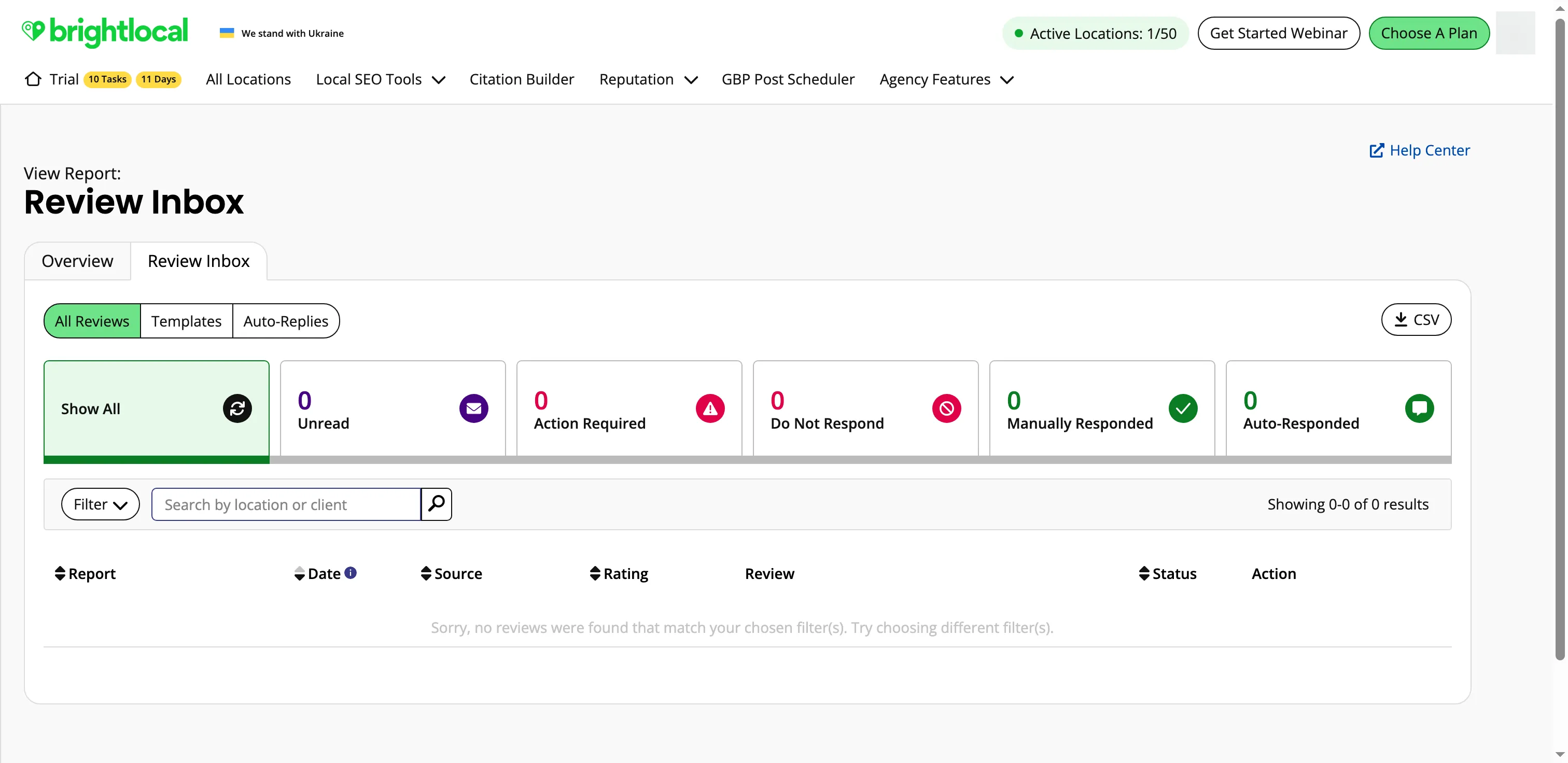
Inside BrightLocal, the Review Inbox brings location reviews and response controls into one workspace.
My choice is BrightLocal when local SEO and review follow-up sit with one small team. The split between the new platform and legacy inbox is the clearest drawback I saw. Teams that need native replies on every monitored site should skip it. The handoff shows up before review data are connected.
Product pricing — BrightLocal
Grow has one- and two-to-five-location tiers, with SMS billed separately. Annual rates appear in the at-a-glance table, with workload totals below.
2. NiceJob: Best for service businesses automating review follow-up
NiceJob is designed around review requests after customer work, with a sequence of follow-ups and website widgets. AI Replies and Net Promoter Score (NPS) are on Pro. Its public pages give no SMS and email allowance for a fixed annual volume, so the base price alone cannot show the cost of a fixed workload.
NiceJob pros
- Starter bundles SMS/email requests, sharing, and widgets
- Pro adds AI Replies, NPS, referrals, and competitive intelligence
- October 2026 accounts get four follow-ups over 12 days
NiceJob cons
- Pricing pages conflict: $75/$125 versus $95/$135
- No public message cap or overage rate for 100 customers/month
- Name matching can miss reviews; current help supports manual edits
NiceJob’s post-service cadence is more convincing than a generic “automated reviews” pitch. I wouldn't budget it for a fixed volume: its public plan doesn't list an allowance, so there's no like-for-like cost against GatherUp. Will reminders fit how customers finish service? In an October 2026 G2 review, reviewer EasternNC M. said some customers still need an in-person request. Another five-star reviewer needed help with initial campaign setup.
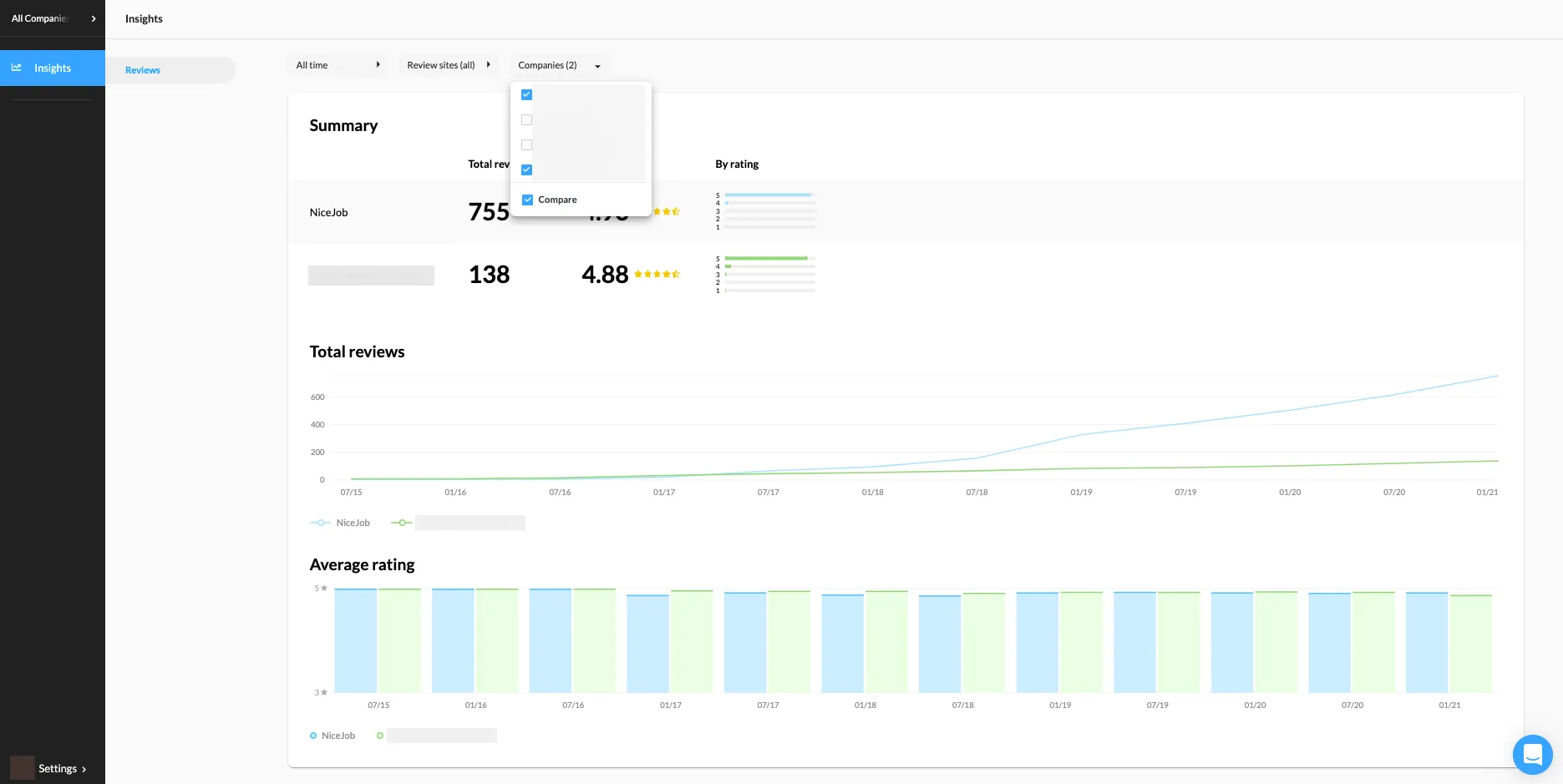
NiceJob’s Insights view compares review volume and average ratings across selected businesses. (Image source: NiceJob)
Those comments flag the handoff around the campaign. I'd map who checks for customers that still need a personal request and who fixes setup before the first messages go out.
Product pricing — NiceJob
Starter is $95/month and Pro is $135/month on the canonical pricing page, with a 14-day trial and no contract stated there. Confirm the quoted rate and message allowance before budgeting.
3. GatherUp: Best for teams choosing between approved and automatic replies
GatherUp fits teams that want to choose between suggested and automatic replies: AutoReply can publish qualifying positive Google and Facebook replies, while Suggested Reply and SmartReply leave a person in control. Its one-location plan includes up to 300 SMS and 3,000 email credits per month; multi-location rates vary by location count and billing period.
GatherUp pros
- AutoReply publishes qualifying Google and Facebook replies
- Suggested Reply and SmartReply keep a person in control
- Local Businesses includes 300 SMS and 3,000 email credits/month
I prefer Suggested Reply as the starting point: a team can learn its usual tone before letting qualifying replies publish automatically. If sensitive responses need to stay human, the mode switch matters.
GatherUp cons
- 100+ monitored sites; native replies cover Google, Facebook, and first-party reviews
- Listings and Review Defense are separate products
- Multi-location rates vary by location count and billing period
One five-star G2 reviewer in June 2026 named electronic medical record (EMR) connectivity in the Cons field. A practice team should check its exact customer relationship management (CRM) connection and upload format; other buyers can set that comment aside.
GatherUp’s response modes here come from its current help pages.
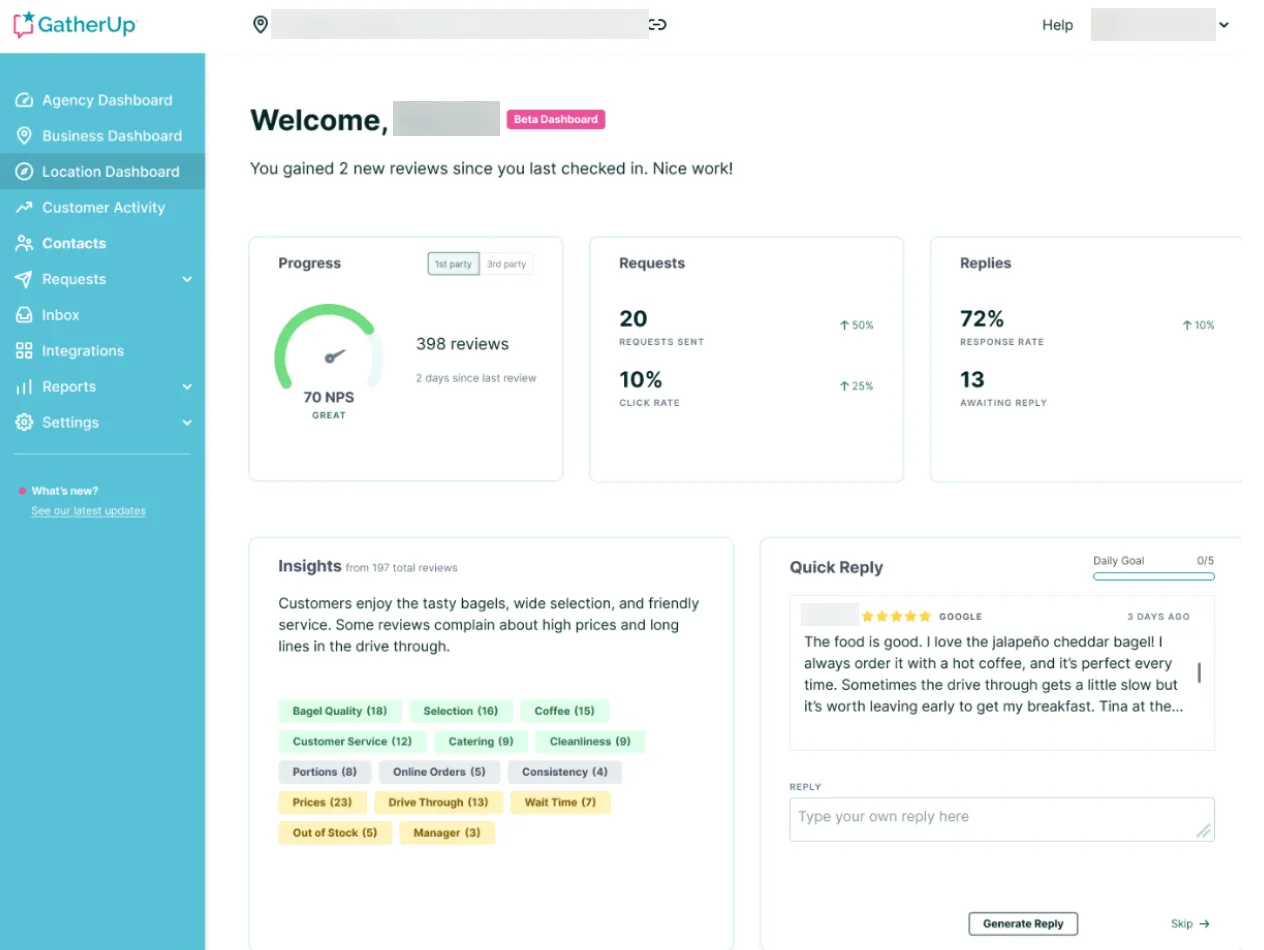
GatherUp’s Location Dashboard combines review progress, requests, replies, and feedback themes. (Image source: GatherUp)
Product pricing — GatherUp
Annual one-location plan; multi-location rates vary by location count. Listings is $40/location/month, and Review Defense starts at $45/location/month, both separate. The one-location annual rate is in the at-a-glance table; the matched annual total is below.
Multi-location customer-experience suites
Birdeye, Podium, Reputation, and Yext connect review operations to broader location, messaging, listing, or customer-experience products. A quote for one of these bundles is not directly comparable with a public review-only plan.
4. Birdeye: Best for centralized review response and approval across locations
Birdeye is built for teams that need reviews routed and governed across locations. Its product page says the dashboard monitors more than 200 review sites, but its help material makes clear that reply behavior depends on whether the source is integrated.
Birdeye pros
- Review tickets support assignment, AI drafts, and response templates
- Approval workflows allow up to 10 approvers per step
- Location suite bundles reviews with customer messaging
Birdeye cons
- Quote-only; public user and location allowances unavailable
- 200+ sources monitored; disconnected sources need manual replies
- US terms, subject to exceptions: 90-day notice and 8% renewal fee
Birdeye's approval chain beats a flat shared inbox when local managers need central oversight. I wouldn't put a single-location reply through 10 approvals. Birdeye's 90-day renewal notice belongs on the calendar before signing. One Reddit user in October 2026 recommended a reminder after a cancellation dispute. Subject to exceptions, current US terms include an 8% renewal fee.
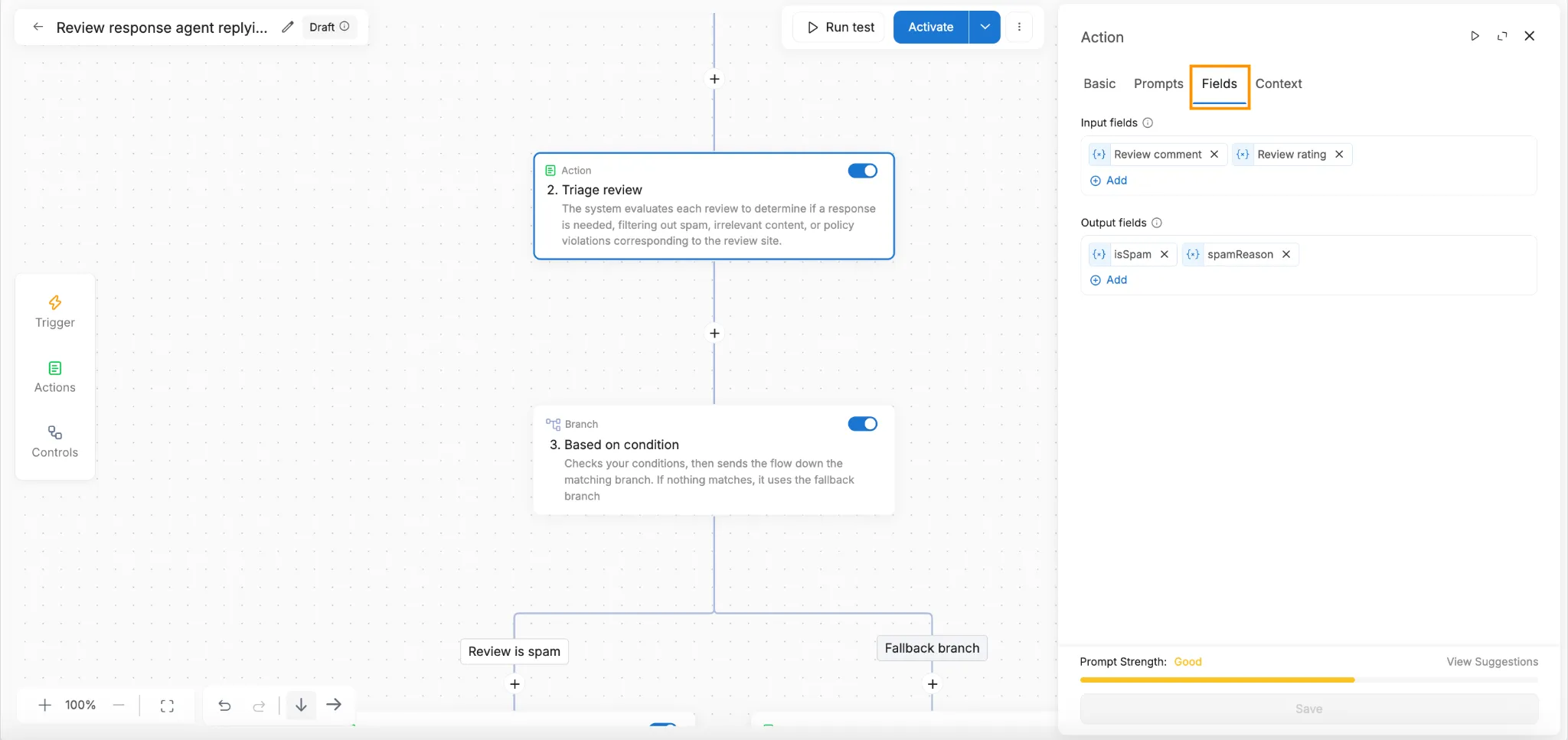
Birdeye’s response-agent editor links review inputs with triage and routing steps. (Image source: Birdeye)
The 10-approver setting matters when a local manager drafts a sensitive response and headquarters must sign off. That chain can be useful for a franchise; it also creates a queue someone has to staff every day.
Product pricing — Birdeye
Custom quote based on selected locations and capabilities. The current pricing page does not publish a standard numeric tier. Review the order form, renewal, and cancellation terms before signing.
5. Podium: Best for review workflows attached to customer messaging
Podium makes the most sense when a business already wants reviews inside a broader text, phone, or payment workflow. Its current product page shows textable invites and reminders alongside a shared customer-conversation inbox, while its pricing page sends buyers to sales.
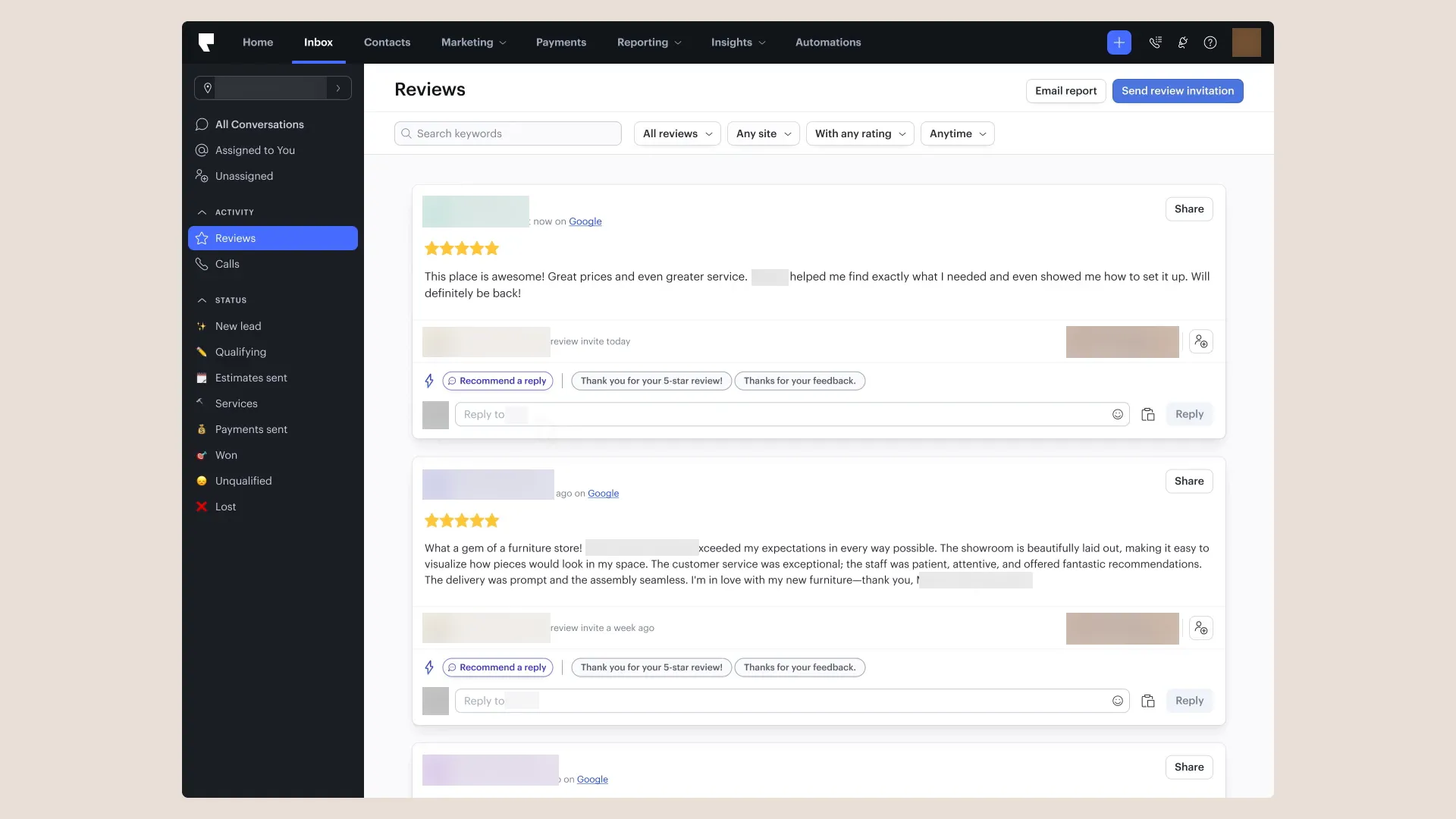
Podium’s Reviews workspace combines review filters, individual feedback, and reply controls. (Image source: Podium)
Podium pros
- Review invites and conversations share one customer inbox
- Reviews includes AI invites, replies, and mobile access
- May 2026 Reddit user: daily phone use for store messaging
Podium cons
- Custom quote; exact message and user allowances vary
- AI Employee add-on may exceed review-only needs
- Default 12-month term; 30-day nonrenewal notice
Podium earns its place if a service team already handles customer conversations there. I wouldn't buy it just for review invitations: a five-star G2 reviewer in October 2026 said AI replies went out too quickly and inaccurately. The demo needs to show pause and human-takeover controls; the quote also covers a wider text, phone, or payment workflow.
An appointment-based business may keep follow-up in the same customer record by sending an invite after a service conversation. A shop pays for a wider system to handle one review task if it needs none of Podium's messaging, phone, or payment products.
Product pricing — Podium
Custom quote; AI Employee is an add-on. Current default terms set a 12-month term with 30-day nonrenewal notice unless the order paperwork overrides it.
6. Reputation: Best for enterprise programs combining reviews and surveys across locations
Reputation is a multi-location customer-experience platform that combines reviews with surveys, listings, social, and ticket workflows. It suits buyers who need to route feedback across teams and locations, but the configured modules and their price are quote-specific.
Reputation pros
- AI responses route through responder and approver roles
- Exports support third-party reviews and scheduled sharing
- Reviews share a suite with surveys, listings, and tickets
Reputation cons
- Quote-only; no public user or location allowances
- Some reviews require manual replies on the source site
- Rep Score combines signals; compare it with the public rating average and NPS
I rate Reputation as a strong fit for a franchise group that needs central approvals and exports. Its suite routes reviews beside surveys, social, and tickets. G2 comments mention weekly updates and load time; I'd check a sample report and response screen with your own fields. Rep Score still needs a clear outcome beside it. Headquarters can use those approvals to keep response rules consistent across locations; a single office that only answers Google reviews is unlikely to need the survey and listing modules.
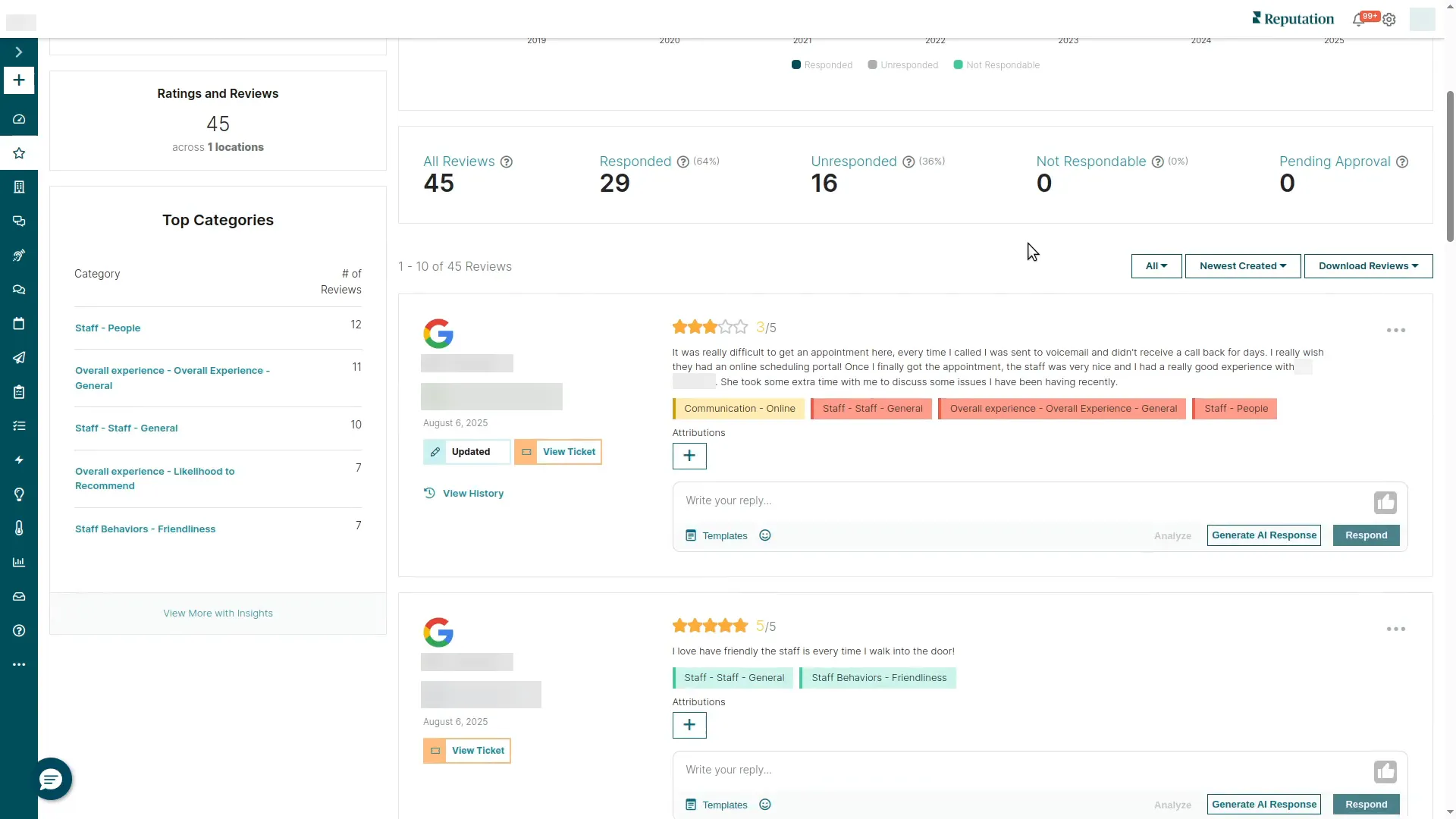
Reputation’s Reviews feed combines response status, category tags, and an AI-assisted reply editor. (Image source: Reputation)
Product pricing — Reputation
Custom quote. Confirm which review, survey, listing, reporting, and approval modules are included, along with location scope and data exports.
7. Yext: Best for review work alongside a large listings footprint
Yext connects review tools with its listings platform. This connection can help a location team that already centralizes business information there. Its Reviews product says it monitors more than 80 platforms, but individual source permissions and licenses determine what a team can do.
Yext pros
- Review tools include response roles, approvals, and scheduled exports
- Review Generation requires Ultimate or an add-on
- Listings and reviews share one vendor relationship
Yext cons
- Custom quote; no standard enterprise trial is listed
- Some Yelp configurations: 3 reviews × 150 characters; no exports
- Quote must name listing, review, and response modules
I'd choose Yext for a team that already owns its listings license and wants review operations under one vendor. Yext's 80-platform count does not remove the source gap: a review can appear in monitoring while reply access still depends on the license. Recent reviews praise integrations and raise cancellation questions. A renewal clause without terms covering data when a module ends is a hard stop for me.
The same limit matters in weekly reporting: a team that relies on an export may miss a source that the current license omits.
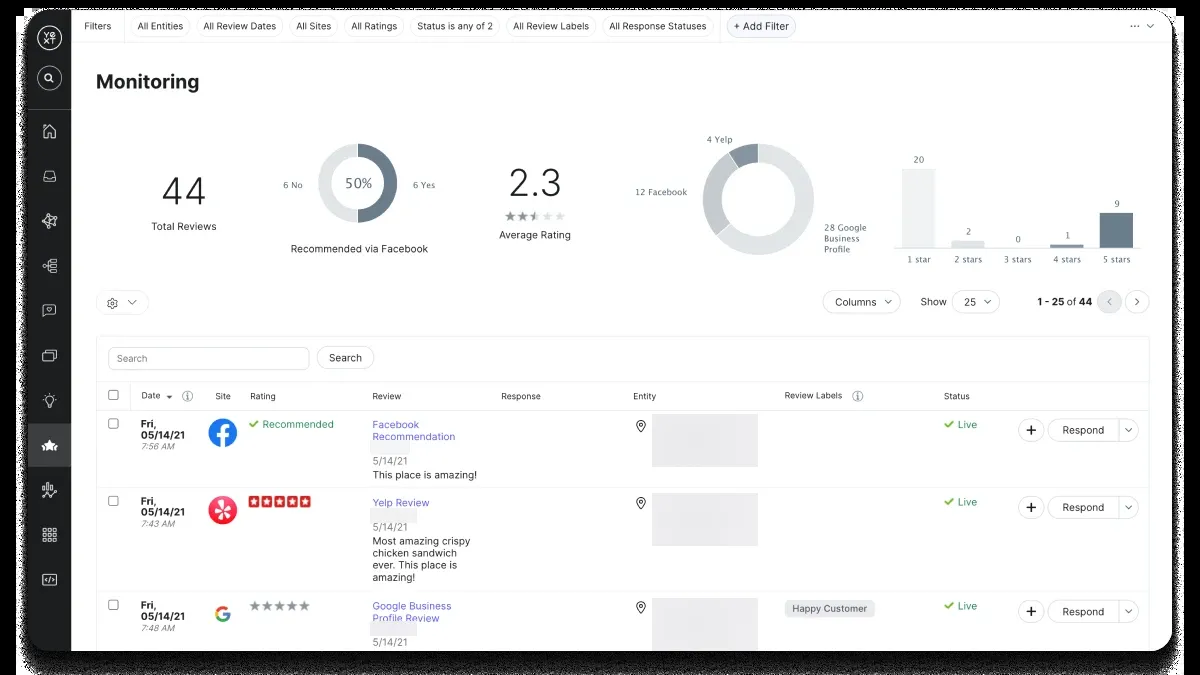
Yext’s Monitoring screen brings review sources, ratings, and individual reviews into one view.
Product pricing — Yext
Custom quote, generally scoped by locations and providers, with annual billing or longer terms listed in the current FAQ. The review and Review Generation licenses need separate line items.
Web and social listening
Brand24 covers the separate listening task: where a brand or topic is mentioned online and which mentions deserve attention. Its billing units are keywords and collected mentions, rather than customer invitations or locations.
8. Brand24: Best for tracking web and social mentions beyond review sites
Brand24 is a listening tool for tracking keyword-matched mentions across social, news, blogs, video, and other web sources. It can help a communications team investigate a brand conversation, but source monitoring does not include reply publishing everywhere.
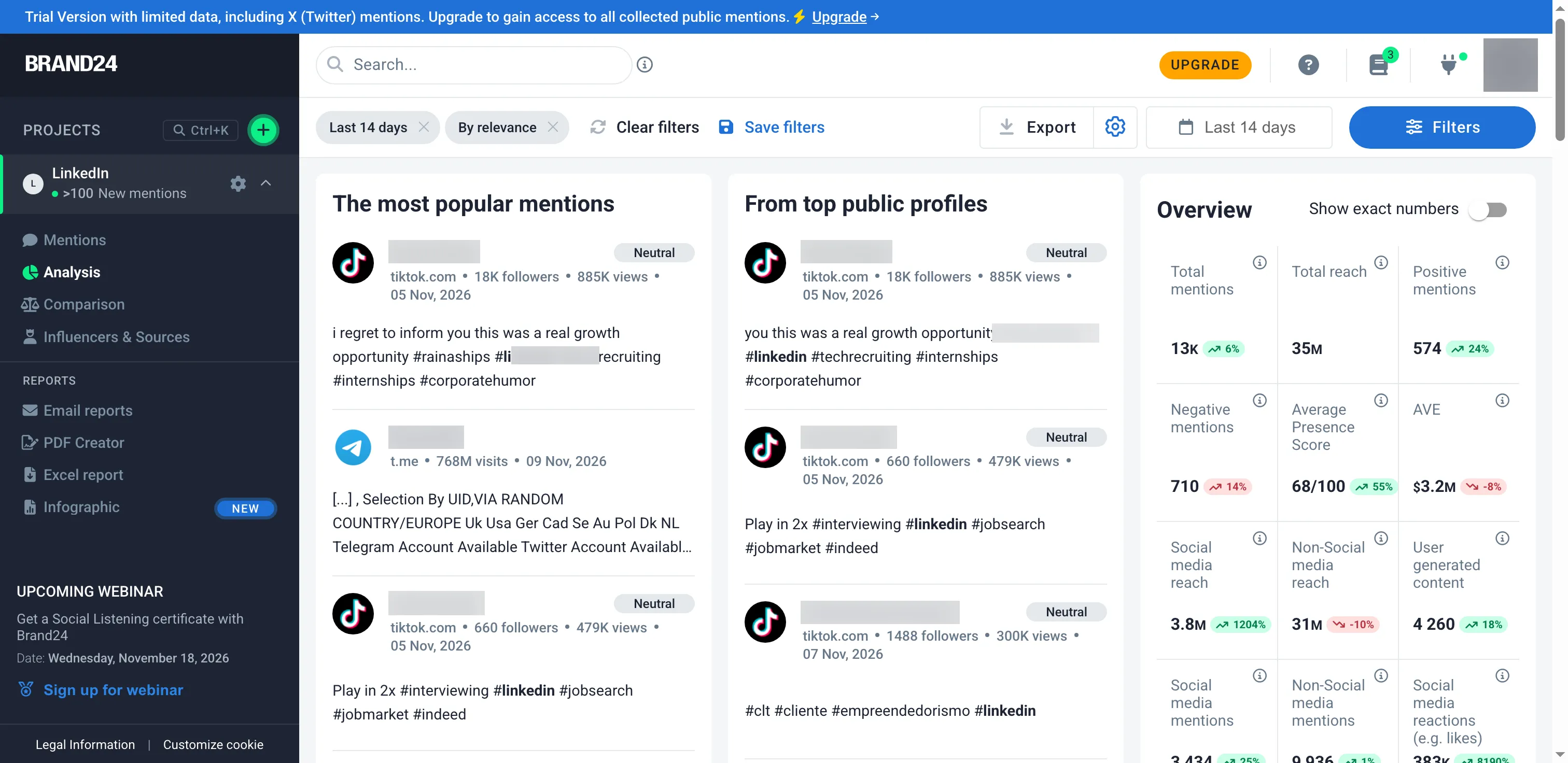
Brand24’s Analysis view combines popular mentions with reach, sentiment, and presence metrics.
Brand24 pros
- Mentions filters, tags, sentiment controls, and reports
- Web Sources include social, news, blogs, video, and forums
- Individual: $199/month annually or $249 with monthly billing
Brand24 cons
- Individual: 3 keywords, 2,000 mentions/month, and one user
- 12-hour refresh is slow for near-real-time monitoring
- Mention tracking cannot reply to every post or review
My pick for web-wide listening is Brand24. It tracks mentions beyond review sites, but it can't request reviews or reply on every source. One Reddit user said they use it to monitor “beyond just the main social platforms” (u/Which_Curve_3552, r/SocialMediaManagers, October 2026). In a trial, I'd check exact brand terms, source relevance, sentiment labels, and archive access before treating it like a reply inbox. Its 3-keyword cap matters if your product name has common variants; a launch with a forum and trade-news footprint is where the wider source mix earns its keep.
For a public-relations team, that breadth is more useful than reply automation: Brand24 surfaces conversations, and staff still decide which ones deserve a response.
Product pricing — Brand24
Individual is $199/month billed annually ($2,388/year) or $249/month on monthly billing. It includes 3 keywords, 2,000 mentions/month, one user, and 12-hour updates.
What the same review workload costs
BrightLocal costs $644/year and GatherUp $1,188/year for one US location with 100 customers per month, one SMS and one email request per customer, and a display of reviews on a website. At five locations, BrightLocal totals $1,082/year; GatherUp’s selected five-location rate is unpublished. The table compares only configurations with matching functions for requesting and displaying reviews.
| Scenario | Product and configuration | Annual subscription | Required extra | Annual total | Conditions |
|---|---|---|---|---|---|
| 1 location; 100 customers/month; 100 SMS + 100 email requests/month; website display | BrightLocal Grow, 1 location | $584 | 1,200 US SMS credits × $0.05 = $60 | $644 | Excludes the one-time 10 trial credits; taxes excluded. One SMS assumed per customer. |
| Same workload | GatherUp Local Businesses, 1 location | $99 × 12 = $1,188 | None for 100 SMS + 100 email/month within its stated 300 SMS and 3,000 email monthly credits | $1,188 | Annual commitment, even if paid monthly; taxes excluded. |
| 5 locations; 100 customers/location/month; same request and display workload | BrightLocal Grow, 2–5 location tier | $782 | 6,000 US SMS credits × $0.05 = $300 | $1,082 | Assumes one SMS per customer per location; excludes taxes and starter credits. |
| Same five-location workload | GatherUp multi-location | Rate varies by location count | Exact selected five-location rate not exposed | Not published | Do not multiply the displayed $60/location headline by five. |
BrightLocal and GatherUp both support the same request count and display of reviews on a website. Their annual totals are $644 and $1,188, respectively. These totals exclude extra reminder sequences, Listings, Review Defense, and broader messaging. NiceJob’s public message allowance for this volume is unavailable, so its price is not treated as an equivalent annual total. Birdeye, Podium, Reputation, Yext, and Brand24 do different or quote-specific work, so they have no equivalent total here.
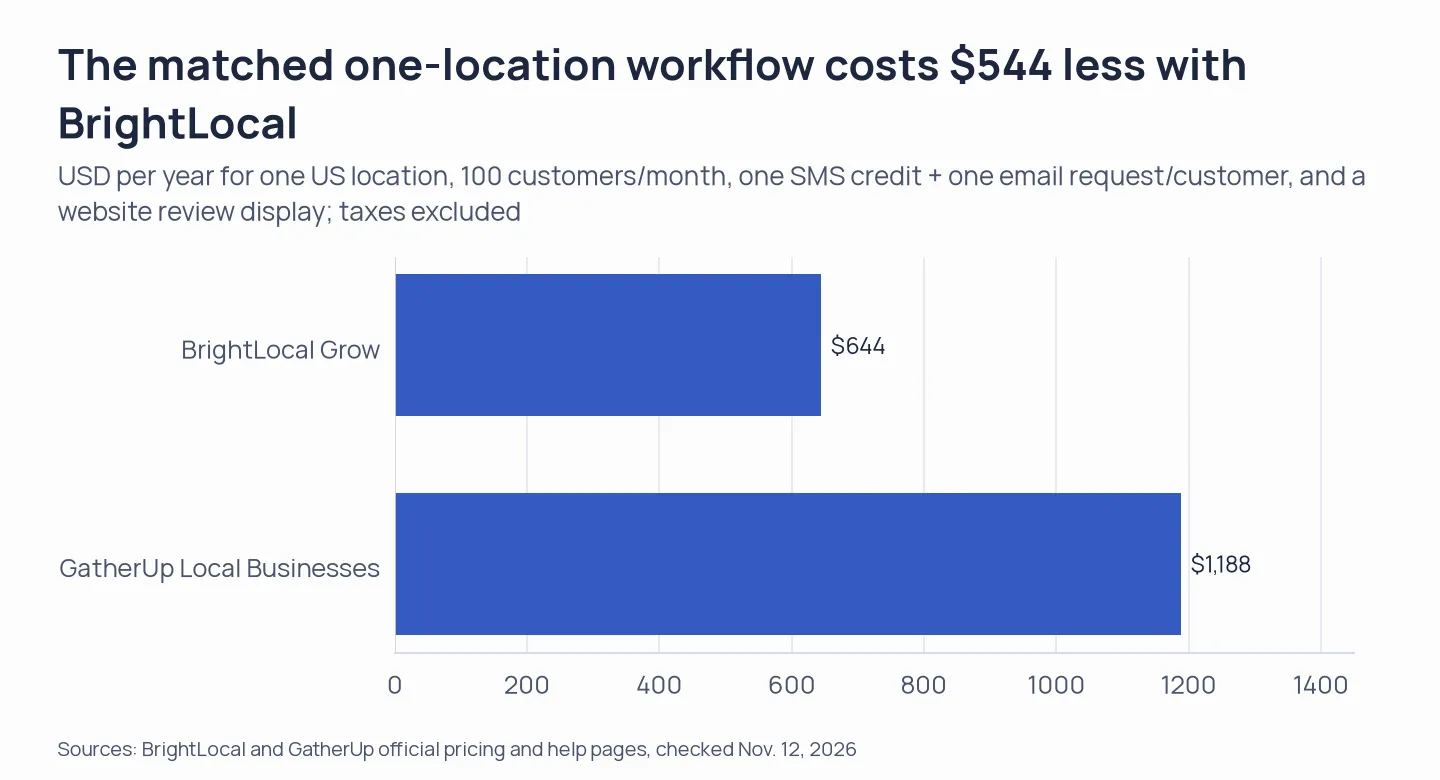
For one location and 100 customers per month, BrightLocal’s published annual plan plus SMS credits totals $644. GatherUp’s annual plan totals $1,188 within its published credit allowance. Taxes and extra reminder messages are excluded.
When your existing tools are enough
For one location, Google Business Profile can cover replies to Google reviews and review links or QR codes. A paid reputation management platform earns its cost when the team needs more review sources, automated invitations, shared inboxes, approvals, location reports, or listings management.
Which reputation management software should you choose?
Choose BrightLocal when local SEO and review operations belong together and its narrower native reply coverage works for your sources. Choose NiceJob when post-service follow-up is central, but its message allowance and checkout amount remain the deciding unknowns. Choose GatherUp when the team needs to decide between suggested replies and automatic publishing, and verify the multi-location quote.
Compare the modules and contract terms in Birdeye, Reputation, and Yext quotes for centralized multi-location governance. Choose Podium only if its customer messaging bundle is part of the job. Evaluate Brand24 separately for brand mentions across wider web and social sources, using keyword count, refresh speed, archive, and source coverage. If Google Business Profile already handles the only workflow you need, start there before adding a subscription.