

 16 min read

TL;DR: Sales Enablement Platforms in 2026
- Best for a connected enterprise stack: Seismic combines approved content, coaching, learning, and buyer engagement under one platform, with quote-based pricing.
- Best for guided selling: Highspot pairs content with plays, training, and deal context. It now shares a parent company with Seismic.
- Best for content and conversation coaching: Showpad brings content, coaching, and conversation intelligence into one enablement platform.
- Best for structured readiness: Mindtickle focuses on onboarding, learning, practice, and coaching across the sales team.
- Best for video-led coaching: Allego brings readiness, coaching, content, and conversation tools into a quote-led platform.
- Best for a listed readiness price: SalesHood Essential lists at $45 per user per month, with explicit AI-practice and learning quotas.
- Best for field teams with offline needs: SoloFire lists $30 per user per month and includes offline presenting, though training still needs an internet connection.
What sales enablement software does
Sales enablement software gives revenue teams a shared way to prepare sellers, manage approved content, and coach customer conversations. One platform may focus on searchable playbooks or onboarding paths; another may add role-play, content analytics, or field presentations. A CRM can handle basic prompts on a deal record, while buyer-room tools focus on sharing materials with prospects.
Sales enablement software at a glance
The strongest fit depends on the work your team needs to improve: Seismic covers enterprise-wide enablement, SalesHood publishes readiness quotas and pricing, and SoloFire supports offline field presentations.
| Scenario | Platform | Why it stands out | Limitation |
|---|---|---|---|
| Enterprise-wide content, coaching, and engagement | Seismic Enablement Cloud | Broad platform under one vendor after the Highspot merger | Quote-based; module scope and price require a sales conversation |
| Guided selling and contextual plays | Highspot by Seismic | Connects content and plays with training and deal context | Quote-based. Now part of Seismic, not a separate vendor |
| Content plus conversation intelligence | Showpad | Links content, coaching, and recorded sales conversations | Demo-led; no public per-seat price |
| Onboarding and rep readiness | Mindtickle | Strong learning and coaching emphasis | Quote-led. Package boundaries affect what is included |
| Coaching through recorded video | Allego | Combines readiness, content, and conversation workflows | Quote-based and contract terms vary |
| Published-cost readiness platform | SalesHood Essential | Published seat pricing with defined learning and AI-practice limits | Usage caps can matter for large or high-practice teams |
| Field and offline presentations | SoloFire | Offline content and broad bundled functionality | Training requires internet. Video-avatar coaching costs extra |
What makes the best sales enablement software?
Start with the seller behavior you need to change, not the length of a feature list. If onboarding is the only gap, a broad content-governance suite may be more than you need. A CRM playbook can handle simple deal prompts, but it won’t replace a readiness program.
1. Match the tool to the job
For sales enablement software, match the platform to the work: content governance helps reps find approved assets, readiness tools support practice, and conversation intelligence helps managers review calls. List the tasks sellers repeat, from following a play to handling an objection or presenting offline. Then check which tasks share content and measurement needs; a buyer room or CRM feature serves a different job from internal training.
2. Check content governance and adoption together
Good sales enablement software should make it easy for admins to retire an outdated deck, control access, and put approved content where sellers work. Reps still need to find the current version quickly, and leaders need to see whether they use it. A large library helps only when both sides of that process work.
3. Compare coaching depth with reporting
Sales enablement software can combine role-play, call review, and learning paths, but each solves a different problem. Check whether the platform tracks completed practice, scores behavior against a rubric, and gives managers a useful next coaching step. If a vendor shows an AI score, ask what it measures and whether admins can inspect the rubric.
4. Price the same team size and scope
Compare annual costs for the same seat count and core workflow, then add onboarding and any required fees. The enterprise vendors here require quotes; SalesHood and SoloFire publish monthly rates, but their bundles differ. A list price may still leave out implementation, storage, CRM seats, add-ons, or contract terms, so ask what goes into the total.
5. Check what you already pay for
Before adding sales enablement software, check whether your CRM seats already include playbooks for basic deal prompts. A new HubSpot Sales Hub Professional portal is different: annual billing is $90 per Sales Seat per month, plus a $1,500 onboarding fee. CRM playbooks still don’t cover a dedicated platform’s full training, coaching, content governance, and analytics workflow.
1. Seismic Enablement Cloud: Best for connected enterprise enablement
Seismic Enablement Cloud suits big revenue organizations needing approved resources, coaching, learning, and buyer engagement tied together within one governed system. Seismic splits its platform into Enablement Strategy, Enablement Execution, Buyer and Customer Engagement, and Coaching and Development — that gives admins a means to link approved content with seller development rather than operating separate libraries and training programs.
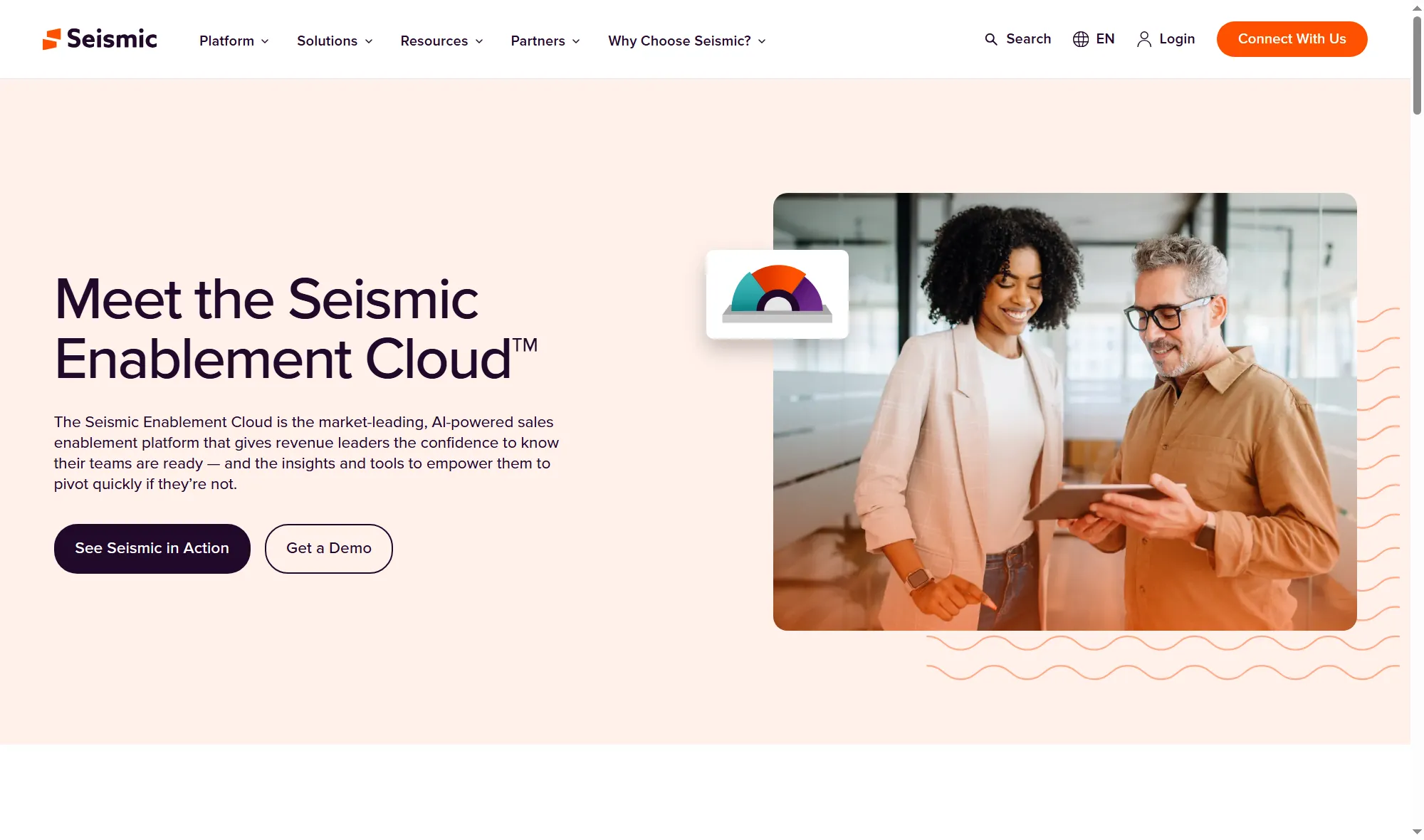
The Seismic product page calls Enablement Cloud an AI-powered platform built around team readiness.
Pros — Seismic Enablement Cloud
- Ties together coaching, customer-facing engagement, content, and training across the one platform.
- For companies that handle various seller functions and geographies, it provides a wider narrative around governance and integration.
- In August 2026, Seismic finished merging with Highspot; the merged entity, according to Seismic, operates as Seismic.
Cons — Seismic Enablement Cloud
- Seismic's public site does not give buyers a seat-based total; they need a quote.
- Scope of the package differs depending on products and add-ons, and each required workflow ought to be mapped by a demo onto the actual proposal.
- A broad platform may amount to more system than a team actually requires when onboarding or practice is its sole gap.
Seismic is a sizeable commitment. I’d choose it when governance and seller execution need one system of record; for a team with only an onboarding gap, the broader platform feels like overkill. Ask for an implementation plan mapped to each workflow.
Product pricing — Seismic Enablement Cloud
Quote-based. Public per-seat pricing is not listed.
2. Highspot by Seismic: Best for guided selling and sales plays
Highspot by Seismic fits teams that want reps to find approved content and follow sales plays in the same workflow. Its product pages connect content, plays, training, coaching, and deal guidance, which makes it a better fit when frontline execution needs a repeatable process.
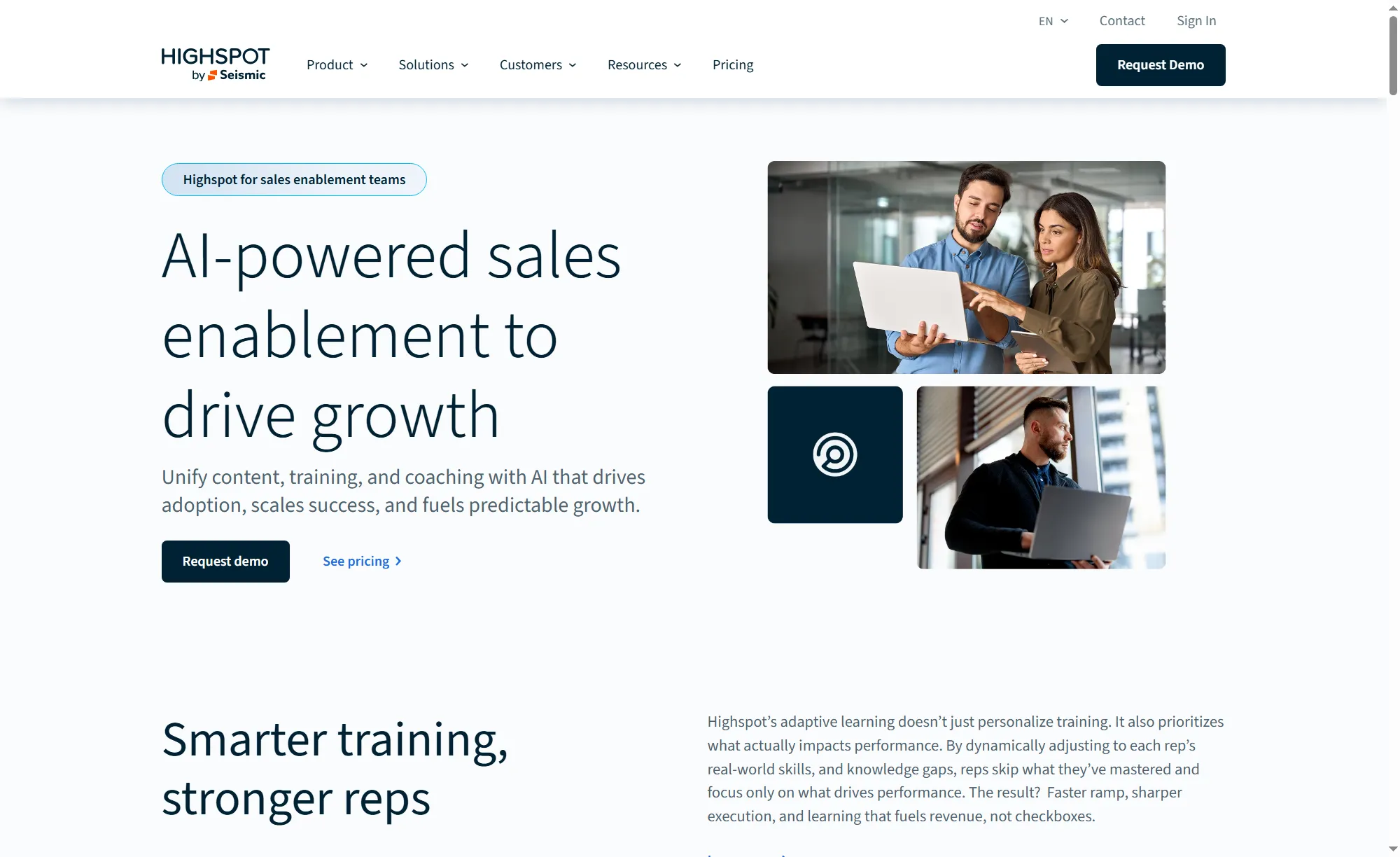
Highspot frames its platform around AI-powered sales enablement and growth.
Pros — Highspot by Seismic
- Serves to link approved content with plays, and with seller guidance.
- It also delivers analytics, training, plus coaching focused on field execution.
- Per Highspot's merger FAQ, existing Highspot logins and workflows keep going following the Seismic merger.
Cons — Highspot by Seismic
- Seismic and Highspot now belong to the same one company, so instead of viewing them as separate vendors, buyers ought to compare their product workflows.
- The public page doesn't provide a seat-based total, and pricing is quote-led.
- For groups that just require a knowledge base or brief onboarding paths, the wider package could be too much.
The trade-off is that Highspot and Seismic now share an owner. I favor Highspot when guided plays matter most, then compare each product line’s content, coaching, and analytics against what reps do every day.
Product pricing — Highspot by Seismic
Quote-based. Request a package-specific quote.
3. Showpad: Best for content and conversation intelligence
Showpad fits teams that want sales content, coaching, and conversation intelligence in one workspace. Its product materials pair a seller workspace for content and training with conversation capture, helping managers connect what reps share with what happens in customer calls.
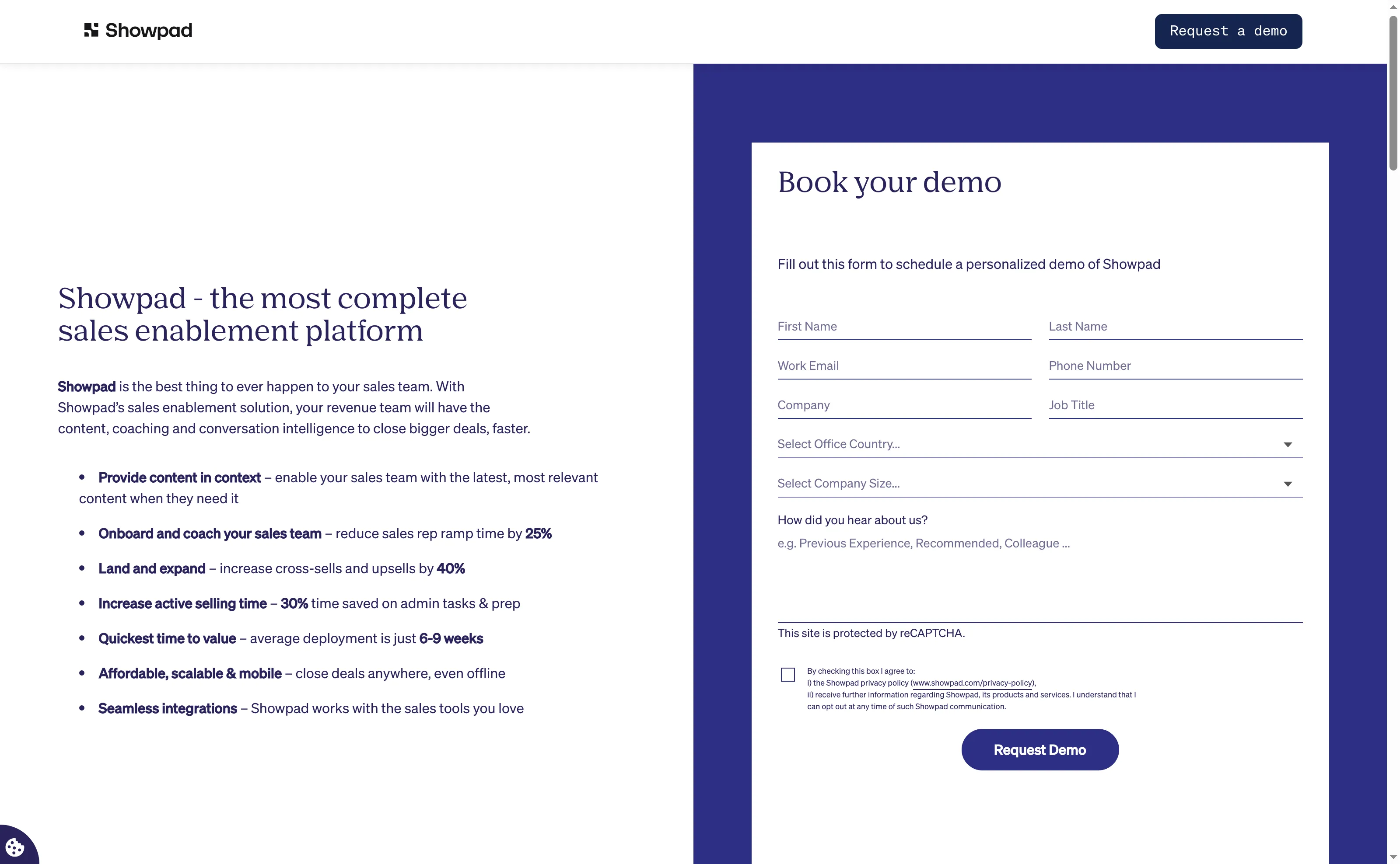
The page puts content, coaching, and conversation intelligence in one sales enablement offer.
Pros — Showpad
- Combines content management, coaching, and conversation intelligence.
- Enables a common enablement process spanning marketing, sales, training, and onboarding.
- Mobile access, along with field use, is stressed by the current product materials.
Cons — Showpad
- On the public pricing page, no self-serve seat price is offered. To get pricing, buyers must request a demo or a quote.
- A current G2 review page contains asks for more fluid page editing, along with suggestions. Such items are individual reports — they don't gauge how widespread the problems are.
- Conversation intelligence only creates value when managers possess a clear rubric, and the time, for reviewing calls.
Showpad is my pick when content and recorded conversations belong in one workflow. In a demo, watch how quickly reps can find and update a current asset; teams that only need short onboarding paths won’t use the broader mix.
Product pricing — Showpad
Request a demo for quote-based pricing; no per-seat rate is public.
4. Mindtickle: Best for structured sales readiness
Mindtickle is strongest for companies that run onboarding, learning, practice, and coaching as one readiness program. Its subscription description separates readiness from adjacent content and revenue-productivity functions, so map each proposed module to the skills and roles your team needs to build.
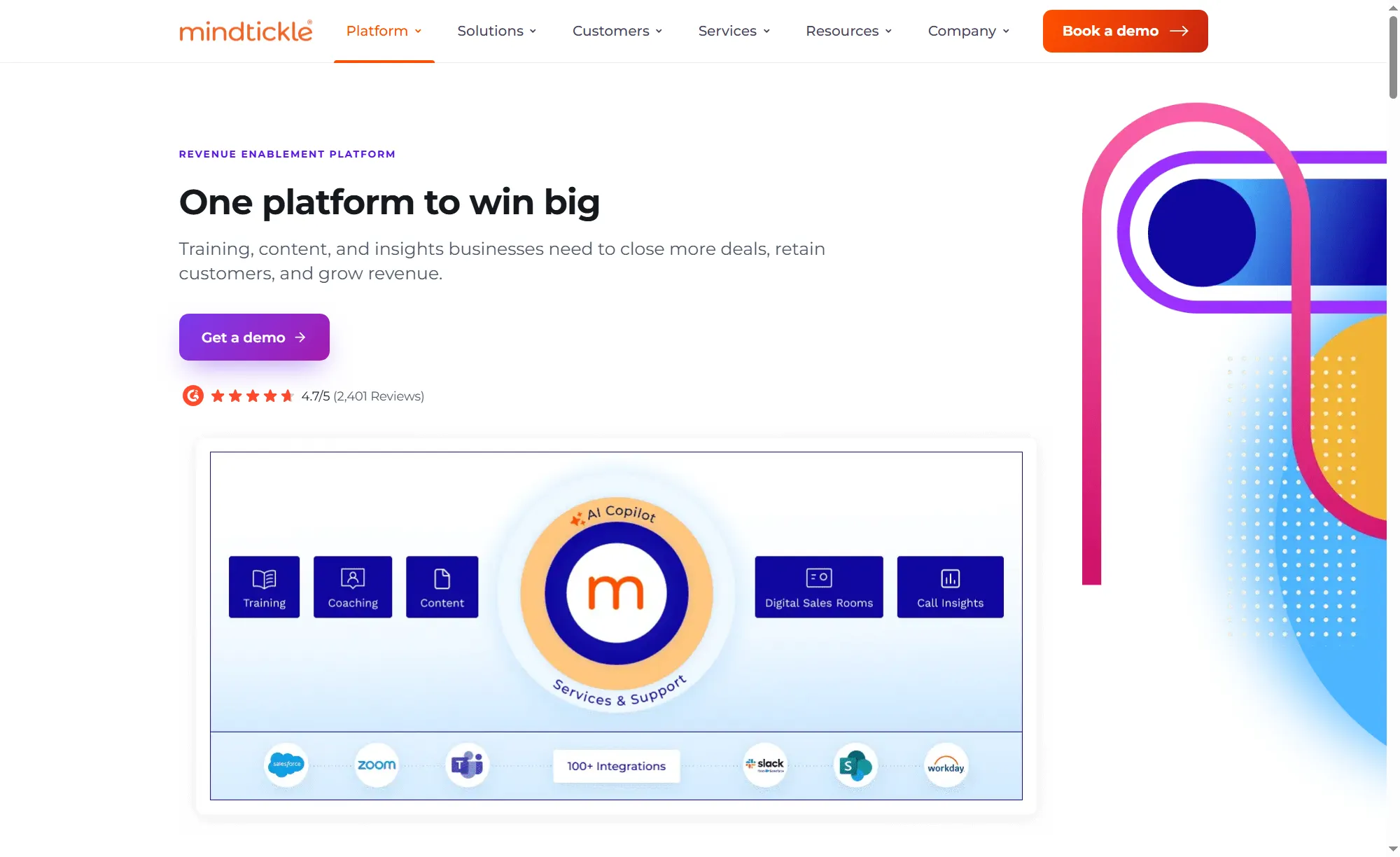
Mindtickle centers its enablement story on readiness, learning, and coaching.
Pros — Mindtickle
- Centers the platform on onboarding, learning, coaching, and practice.
- Rather than one generic training track, role-specific readiness programs can be supported.
- Reviewers on Mindtickle's G2 review page commend the structured courses together with completion tracking. As for the drawbacks noted by individual users, they include lengthy videos, complicated administration and reporting, and friction during login.
Cons — Mindtickle
- What capabilities a purchaser gets depend on where packages and add-ons are divided.
- Cost comparisons across teams are difficult to make using publicly available information because pricing is quote-based.
- If admins don’t define a simple program first, then learning that relies heavily on video, along with complicated reporting, can turn into a burden.
A readiness score won’t help managers unless the team has defined the behavior to improve. I like Mindtickle best when role-specific practice already has a place in the coaching plan; ask a pilot to show how a score becomes a manager’s next step.
Product pricing — Mindtickle
Quote-based. Ask for the required modules and implementation fees.
5. Allego: Best for coaching through video and conversation workflows
Allego fits sales teams that coach through customer conversations and want to connect that practice to digital content. The platform combines content workflows with readiness and coaching. Its pricing page says annual payment and contract terms depend on seat count and term length, so use the demo to clarify both.
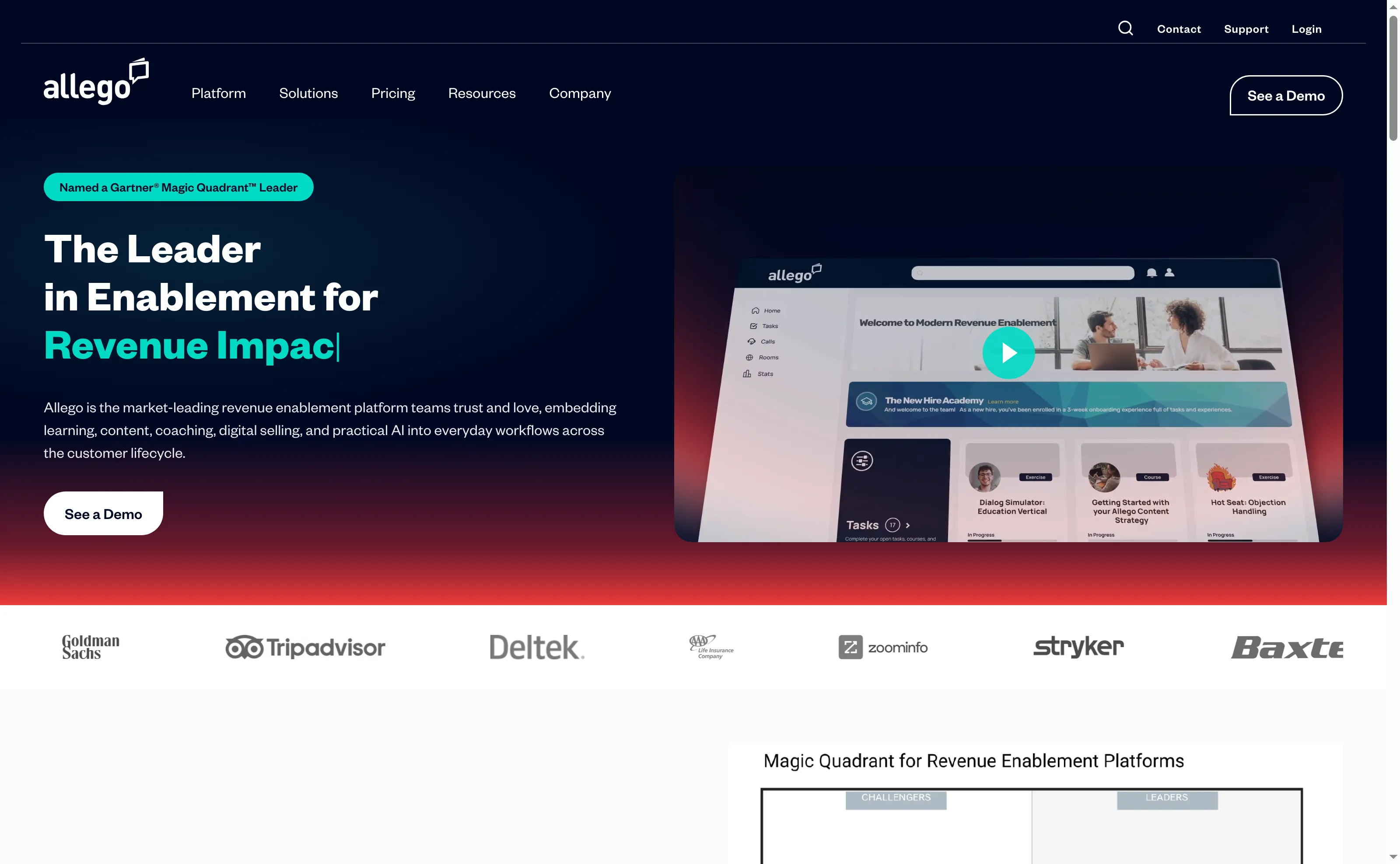
Allego’s homepage pairs its revenue enablement message with a seller learning dashboard.
Pros — Allego
- Integrates coaching, seller learning, plus content into the one platform.
- Offers conversation review plus practice built on video, for groups coaching via examples.
- Rather than a single public tier, the contract terms offered vary by duration and seats.
Cons — Allego
- The vendor doesn't publish one universal price per seat. Annual payment is required, and its pricing page notes that terms vary.
- A number of users of Allego G2 reviews report cluttered content and search experiences, and they request more robust offline access.
- For sellers to avoid a cluttered library rather than a straightforward next step, video plus content programs require unambiguous ownership.
Video practice and coaching take work to sustain week after week. Allego is worth a look when supervisors already own that schedule; a team that only needs a searchable asset library may pay for workflows it won’t use.
Product pricing — Allego
Custom quote. Annual payment and contract terms depend on seats and term.
6. SalesHood: Best for readiness with a listed seat price
SalesHood Essential costs $45 per user per month and fits teams seeking training, seller readiness, AI practice, and content. Its published limits on learning, language, and AI practice make the plan easier to compare against a team's workload.
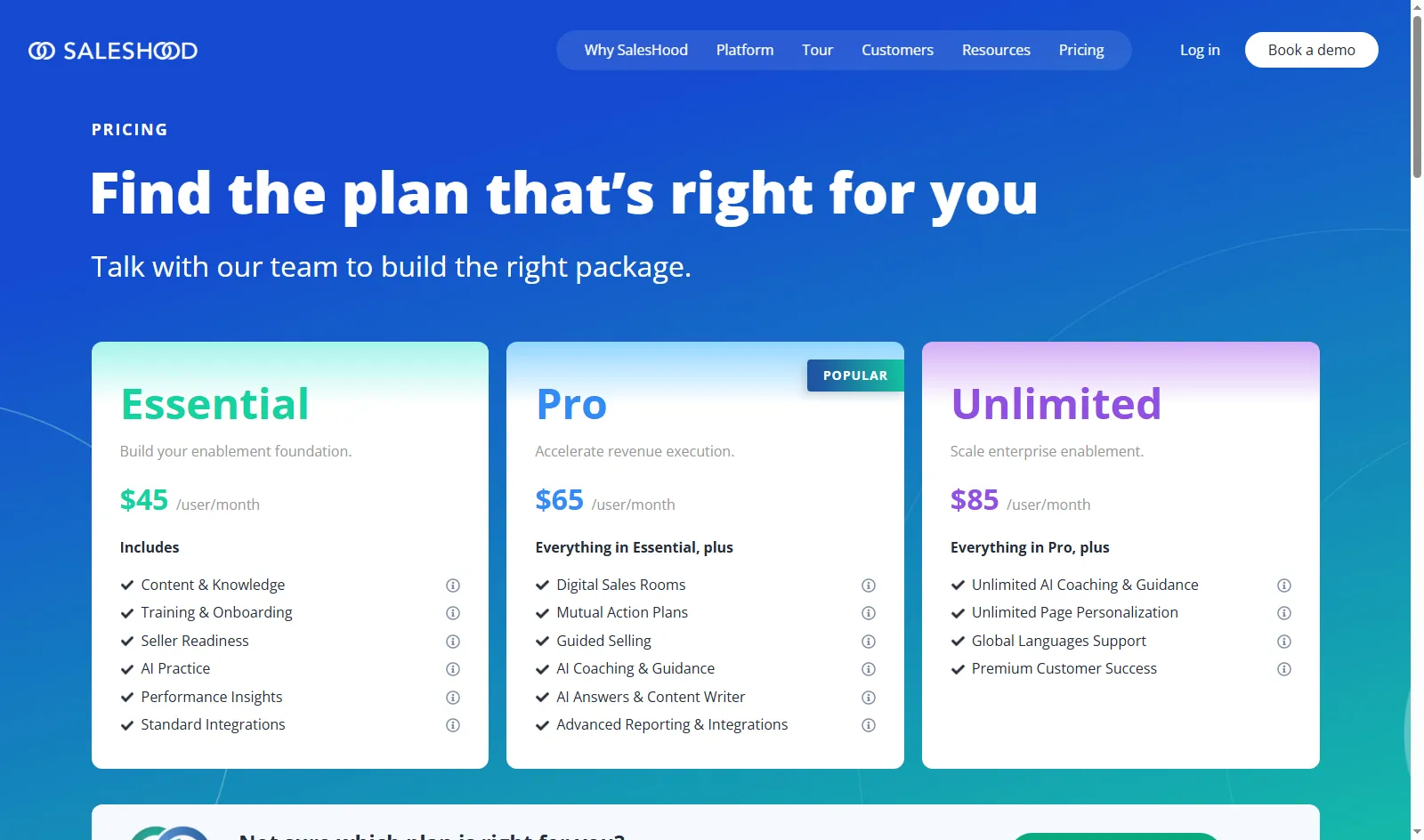
SalesHood lists Essential at $45 per user per month with content, onboarding, readiness, and AI practice.
Pros — SalesHood
- Three tiers—Unlimited, Pro, and Essential—provide teams with options as their readiness requirements expand.
- Blends onboarding, readiness, AI practice, performance insights, and knowledge and content management.
- Essential includes limits of 10 pages, 10 learning paths, 2 languages, 40 pitch-practice sessions, and 40 role-play submissions per license.
Cons — SalesHood
- When teams have large cohorts or do frequent role-play, the Essential practice quotas can place constraints on them.
- The implementation fee and billing cadence aren't specified on the pricing page.
- Under the plan, several jobs get bundled together. Readiness features that it pays for might go unused by a team that just needs content management.
At $45 per seat, SalesHood is worth evaluating if its quotas match your team’s workload. I’d ask whether unused practice capacity carries over before comparing quotes.
Product pricing — SalesHood
Essential $45/user/month, Pro $65/user/month, and Unlimited $85/user/month. Billing cadence is not specified on the pricing page.
7. SoloFire: Best for field teams that present offline
SoloFire is the clearest fit for field sellers who need approved presentations and content without a reliable connection. Its pricing page lists one monthly per-user plan with no seat minimum. Presentations work offline, but training still requires internet access.
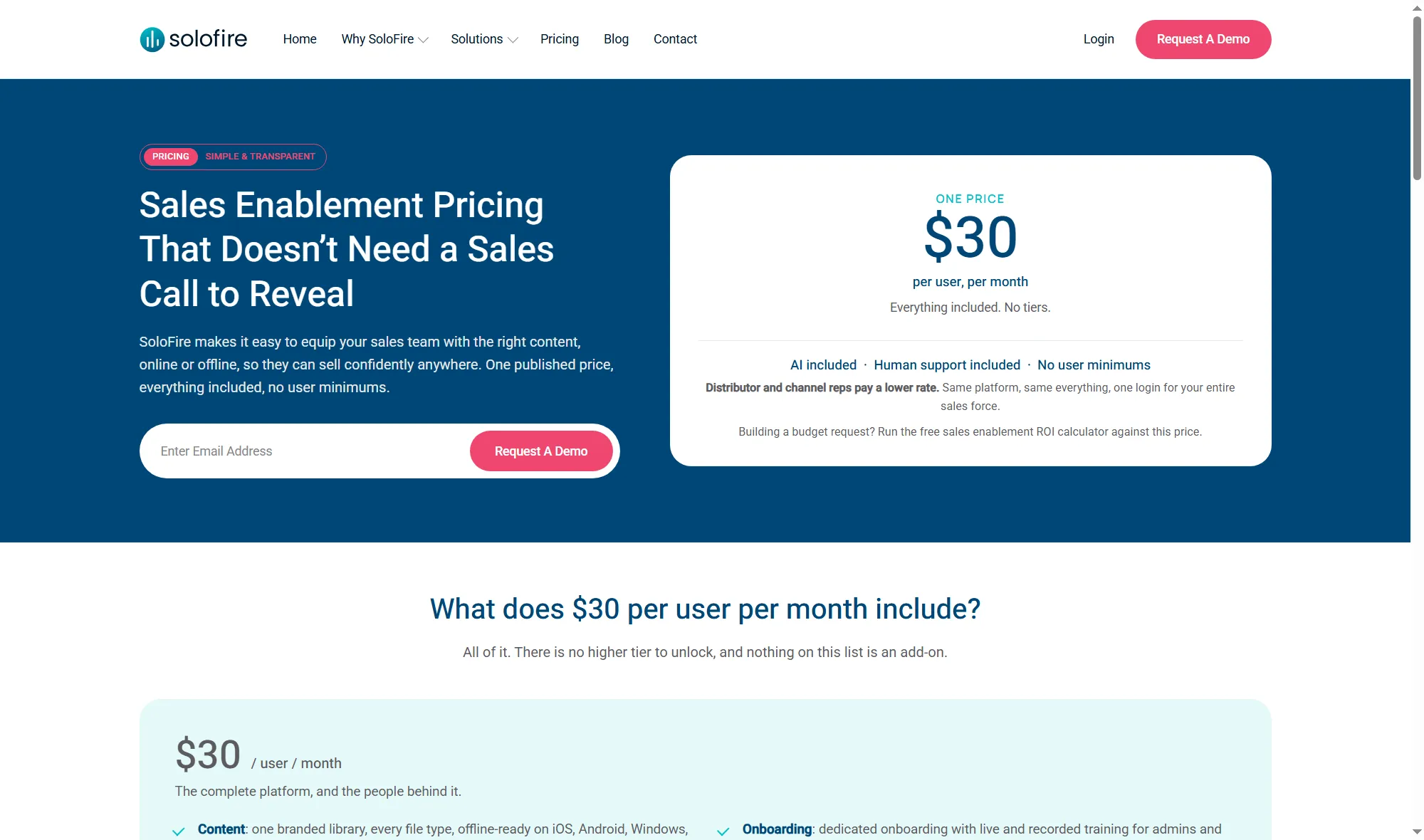
SoloFire publishes one per-user price and includes offline presenting in its platform bundle.
Pros — SoloFire
- SoloFire offers a plan with no minimum number of users.
- The published bundle contains offline presenting, analytics, LMS, buyer Spaces, AI tools, content management, and CRM integrations.
- The service provides optional monthly per-user add-on video-avatar coaching.
Cons — SoloFire
- Despite being able to function without a connection for content and presentations, training still needs internet access.
- The bundle covers more than a readiness-only plan, and billing cadence isn't specified on the pricing page.
- While ease of use gets praised by individual SoloFire G2 reviews, they also mention clunky cleanup of the library or retrieval of analytics.
I like SoloFire’s straightforward seat price and offline presentations for field reps. Before treating it as an offline training system, I’d check which reports and screens remain available without a connection.
Product pricing — SoloFire
$30/user/month. Live video-avatar coach is an optional $15/user/month. Billing cadence is not specified.
SalesHood and SoloFire pricing: $1,800–$5,400 a year for 5–10 sellers
When a team compares published list prices for content access, seller learning and practice, and basic performance visibility, SalesHood Essential comes to $2,700 annually for five seats, and $5,400 for ten; SoloFire, meanwhile, comes to $1,800 and $3,600 per year. That core job is shared by the plans (a baseline, not identical feature sets), yet SoloFire bundles additional field, buyer-room, CRM, and IT features, whereas SalesHood publishes separate practice quotas.
| Seller seats | SalesHood Essential | SoloFire | Calculation and limits |
|---|---|---|---|
| 5 | $225/month, $2,700 annualized | $150/month, $1,800 annualized | Monthly list price × seats × 12. Before tax or optional services. SalesHood includes 40 pitch-practice and 40 role-play submissions per license. |
| 10 | $450/month, $5,400 annualized | $300/month, $3,600 annualized | Same formula and published terms. Billing cadence is not stated for either plan. |
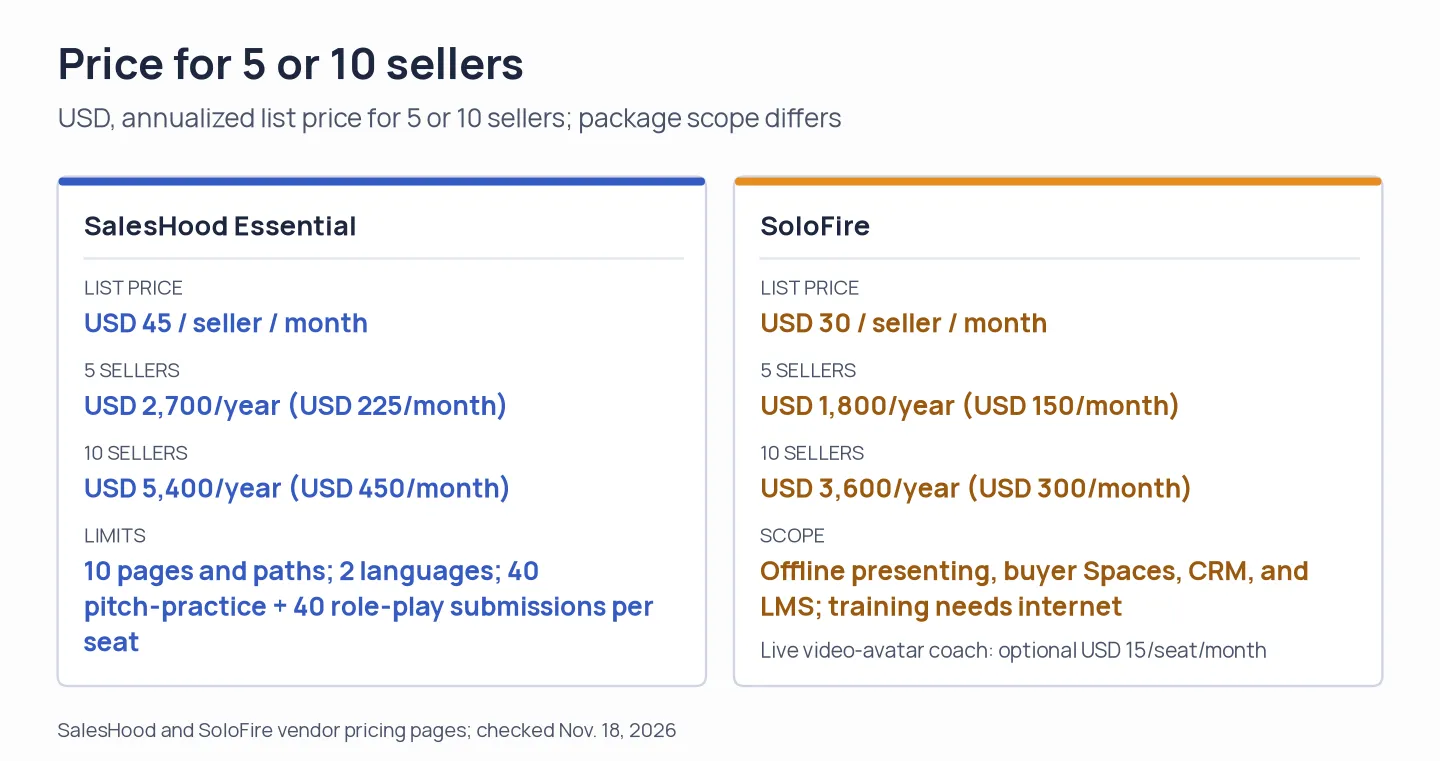
The annualized totals rise with seat count. Compare each plan's limits and billing terms before you choose.
Each month’s per-user rate gets annualized by the calculations. Payment cadence isn’t specified on either page. An implementation fee isn’t stated on SalesHood’s page, though onboarding is included with SoloFire. A comparable readiness/content baseline is covered by the two plans, yet the features aren’t identical. Before comparing proposals, you’ll want to match the limits and any required add-ons.
What else we considered
HubSpot Sales Hub, Dock, Paperflite, trumpet, and Consensus complement sales enablement software with CRM playbooks, buyer rooms, and guided demos.
- HubSpot Sales Hub: A CRM-native option if your team already pays for eligible seats and needs basic playbooks on contact, company, deal, or ticket records. New Sales Hub Professional portals list $90 per Sales Seat per month on annual billing and a $1,500 onboarding fee. That price won't make it equivalent to a full readiness platform.
- Dock and Paperflite: Buyer-facing content rooms and deal collaboration tools. Dock's free account let me create a workspace and inspect its template and internal/editor/shared views, but I could not verify the buyer-sharing flow. Paperflite publishes annual-billing seat prices and digital room features on higher tiers.
- trumpet and Consensus: Digital sales rooms and guided product demos, respectively. They help buyers explore a deal or product; they're built for the customer-side workflow, while enablement platforms coach the internal team.
Which sales enablement platform should you choose?
Pick Seismic or Highspot if seller guidance, analytics, and content governance must cover a big revenue org. Pick Showpad if content and conversation intelligence should sit inside one workflow. Pick Mindtickle or Allego if practice, coaching, and readiness are what drive the project. Comparing a published per-seat price gets simpler with SalesHood and SoloFire — SalesHood tilts toward readiness quotas, while SoloFire tilts toward a wider field-sales bundle.
Provided your team is already covering the cost of CRM seats, look through its playbooks prior to purchasing a different system for basic prompts. A buyer-room tool might suffice, though, when reps chiefly need to distribute customized materials to prospects: its focus falls on the external deal experience, whereas an enablement platform additionally takes care of internal training, readiness, and coaching.