
 Updated: August 25, 2026
 24 min read
Key takeaways
- The agency tiers change more than seat count: Micro Agency gives 25 senders but only 1,000 enrichment credits total, while white label is still plan-gated and support-request-gated, so budget modeling needs credits and setup scope beside the monthly price.
- The MCP server makes HeyReach usable inside Claude, n8n, Clay, VS Code and Make workflows, but one complaint cites MCP data that did not match the main dashboard, so agent-driven teams should test data consistency before relying on it operationally.
- Lead sourcing is narrower than the multi-sender positioning may imply: search URLs, CSVs, post reactors and manual add are confirmed, while event scraping, group scraping and native AI ICP scoring are not, so list quality still has to come from upstream work.
- The review mean needs context: the deduplicated view is heavily bimodal, with 45 exact 5-star reviews and 11 exact 1-star reviews, plus two 8-review weeks, so the evidence reads as polarized rather than steadily positive.
- The March 2026 LinkedIn removal story is a brand-asset incident, not a customer-account restriction report; it belongs beside the separate IP, session-custody and extension findings rather than being treated as proof of user account outcomes.
This review is published by Linked Helper. I've made every effort to represent HeyReach accurately using verified data — my first-hand testing, HeyReach's own documentation, and independently sourced reviews.
HeyReach is a cloud LinkedIn outreach platform for agencies and GTM teams rotating campaigns across many sender accounts from one inbox. Its self-service entry price is $79/month for one to nine senders, with annual billing at $63/month equivalent; agency pricing starts at $999/month for 25 senders.
My safety verdict is conditional: HeyReach documents rate limits, Cooldown Mode, Locks, and working-hours delays, but my June 2026 two-account test found server-hosted sessions where the vendor's own help pages described residential proxy behavior. That gap matters because cloud automation safety depends on what LinkedIn sees, not only on what the dashboard lets you configure.
Verdict
HeyReach makes the most sense when the job is multi-account LinkedIn sending, agency workspace management, and AI-assisted campaign operations from a cloud dashboard. The product's concrete evidence is operational: sender rotation works from two connected accounts, the unified inbox is central to the workflow, HubSpot timeline logging is documented, and the official MCP (Model Context Protocol) server gives AI agents a real control surface.
The conditional part is safety and pricing. The proxy and session-custody findings are too material to treat HeyReach as a low-risk cloud tool, and the Agency/Unlimited pricing page hides several costs behind a fixed-cost headline. I would evaluate HeyReach as an agency-scale cloud system with documented controls, not as a tool that removes LinkedIn-account exposure.
Pros
- Sender rotation is core, not an add-on: HeyReach supports rotation from two connected accounts on the Growth plan, which means small teams can test the workflow before moving to agency tiers.
- Agency pricing is published: Micro Agency and Agency tiers have visible prices at 25 and 50 senders, which reduces quote friction for teams comparing budget scenarios.
- AI surface is documented: HeyReach has both a built-in ChatGPT message option and an official MCP server for Claude, n8n, Clay, VS Code and Make.
- HubSpot gets timeline detail: The native HubSpot integration logs LinkedIn actions on the contact timeline, which makes reply and activity history easier to audit in CRM.
- Safety controls are documented: Daily limits, weekly limits, Cooldown Mode, Locks, random delay and working-hours scheduling are described as product mechanics across tiers.
- Cancellation is self-service: HeyReach documents dashboard-based upgrade, downgrade and cancellation, so cancellation is not framed as a support-ticket-only process.
Cons
- The proxy claim did not match my test: HeyReach described residential proxy behavior, while the observed sessions used datacenter IPs - rented-server addresses rather than home or mobile networks - with independent fraud-risk scores of 100/100.
- Session custody is cloud-side: The login extension can upload the full LinkedIn cookie jar, and the credential path sends the LinkedIn password to HeyReach for server-side login.
- Unlimited is capped: HeyReach's own help center says the Unlimited plan is capped at 300 seats, while nearby copy also describes no seat limits.
- Agency email credits fall per sender: Micro Agency gives 1,000 enrichment credits across 25 seats, which is 40 per sender versus 100 per sender on Growth.
- Reliability is the main complaint theme: The review evidence is polarized, and tool reliability is the most frequent structural complaint in the deduplicated review view.
- Some gaps are manual: Cross-workspace deduplication uses Exclude Lists and Intersect rather than automatic organization-wide protection, which matters for agencies with overlapping client lists.
HeyReach Pricing: Plans, Traps, and Hidden Costs
HeyReach's pricing is straightforward on Growth and more conditional at agency scale. The live pricing page snapshot I used shows Growth at $79/month per sender for one to nine senders, then $59/month per sender at 10 or more senders. Quarterly billing discounts those figures to $71 and $53; annual billing moves them to $63 and $47.
Pending pricing screenshot placement for the live HeyReach pricing page - July 2026
That means the entry annual equivalent is $63/month, not $59/month - $59 is the bulk monthly figure for 10 or more senders.
| Plan | Price | What's included | What's NOT included |
|---|---|---|---|
| Growth | $79/mo for 1-9 senders; $59/mo at 10+ senders | 14-day trial; vendor proxy by default; 100 email-enrichment credits per sender | Agency workspace economics; 30-day agency trial; unlimited sender pool |
| Micro Agency | $999/mo for 25 senders; $799/mo annual equivalent | 25 senders; 1,000 email-enrichment credits; agency features | Growth-level 100 credits per sender; vendor-supplied proxy by default |
| Agency | $1,399/mo for 50 senders; $1,119/mo annual equivalent | 50 senders; published checkout price; agency workspace model | More than 50 senders without moving to Unlimited; vendor-supplied proxy by default |
| Unlimited | $2,999/mo; $2,399/mo annual equivalent | Flat monthly price for a shared sender pool | Not actually uncapped: HeyReach's help center states a 300-seat shared-pool cap |
| Done for You / Early Stage | Custom | Special-case service or early-stage packaging | Self-service price certainty |
HeyReach pricing tiers (July 2026)
The main trap is the fixed-cost framing. The pricing page sells "unlimited senders, one fixed cost," but HeyReach's plan help page says the Unlimited plan is "capped at 300 seats shared pool" while also calling it a plan with "no seat limits" on the same page. For a buyer, that means "unlimited" should be read as a package name, not a capacity promise.
Pricing trap: The agency upgrade changes both price and included resources: 25 senders at $999/mo get 1,000 email-enrichment credits total, while 25 Growth senders would imply 2,500 credits at the per-sender rate.
There is also a dated repricing signal. A January 2026 Reddit pricing snapshot listed HeyReach Agency at $749/month for 50 accounts and Unlimited at $1,499/month. Against the July 2026 live pricing of $1,399/month for 50 senders and $2,999/month for Unlimited, that is an 86.8% increase on the 50-seat agency path and a 100% increase on Unlimited in roughly six months. That does not make the current price wrong; it means older price comparisons can go stale quickly.
| Plan | January 2026 independent snapshot | July 2026 live price | Reader implication |
|---|---|---|---|
| 50-seat Agency | $749/mo | $1,399/mo | Budget checks should use current pricing, not older agency comparisons |
| Unlimited | $1,499/mo | $2,999/mo | Flat-price claims need the current cap and current monthly price beside them |
HeyReach repricing signal
VAT is another practical line item.
HeyReach's own pricing and terms pages state that VAT/taxes can be added for buyers without a valid VAT number, so the advertised monthly price is not always the invoice total.
HeyReach's Automation & Campaign Engine
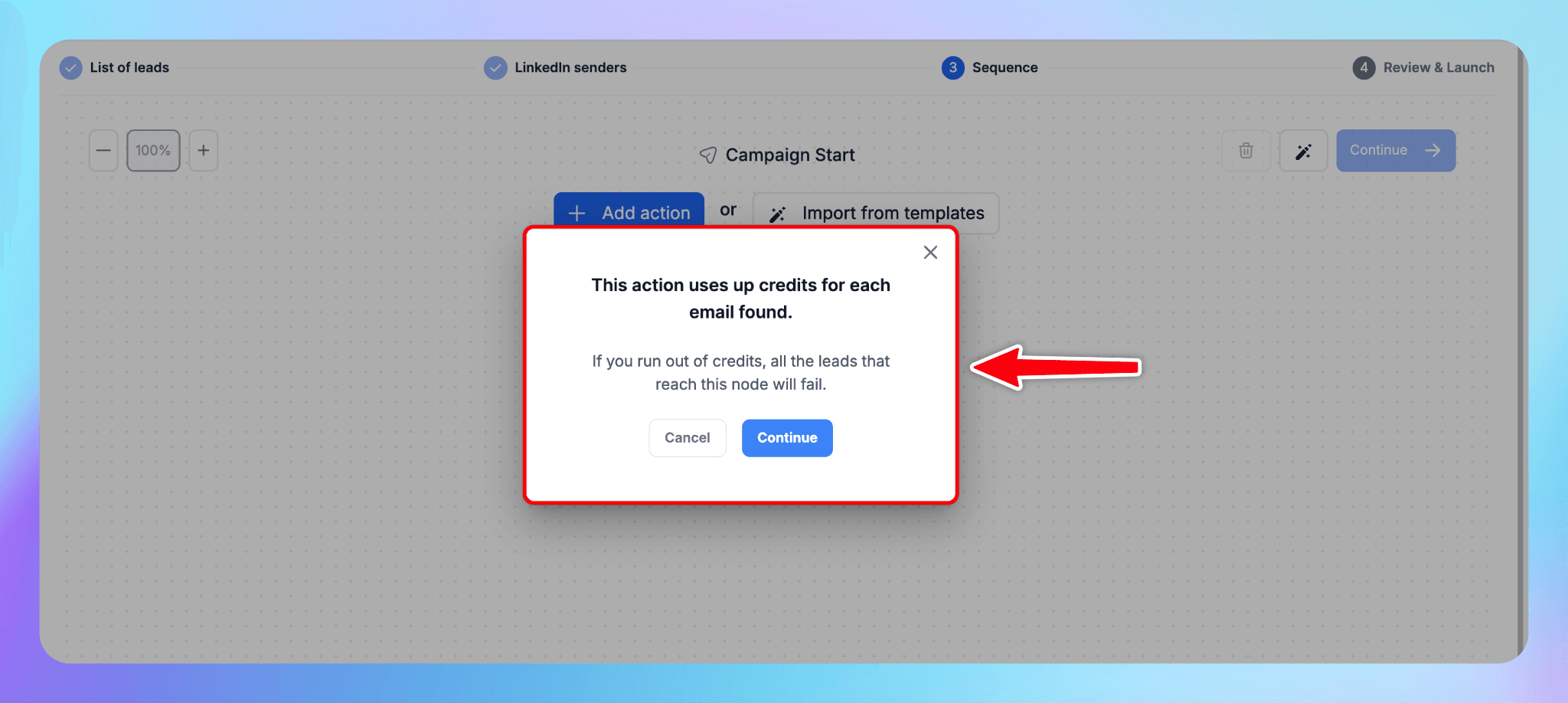
Like most LinkedIn automation tools in this category, HeyReach uses a multi-step sequence builder for outreach actions. The confirmed action list is closed and specific: Send Connection Request, If Connection, Send Message, InMail, View Profile, Follow, and Like Post. The confirmed branching conditions are also specific: If Connection, If Open Profile, and Email Found/Not Found. That gives users basic conditional flow control, but not open-ended custom triggers or reply-based workflow branching.
The main automation pattern is sender rotation. HeyReach's own help page says users should connect at least two LinkedIn accounts to experience it, and the feature is available from the Growth plan rather than being locked behind Agency. In practice, that means a small team can test multi-sender routing before buying 25 or 50 seats.
For readers comparing agency tools, that matters more than a generic "multi-account" label because it says where the workflow begins commercially.
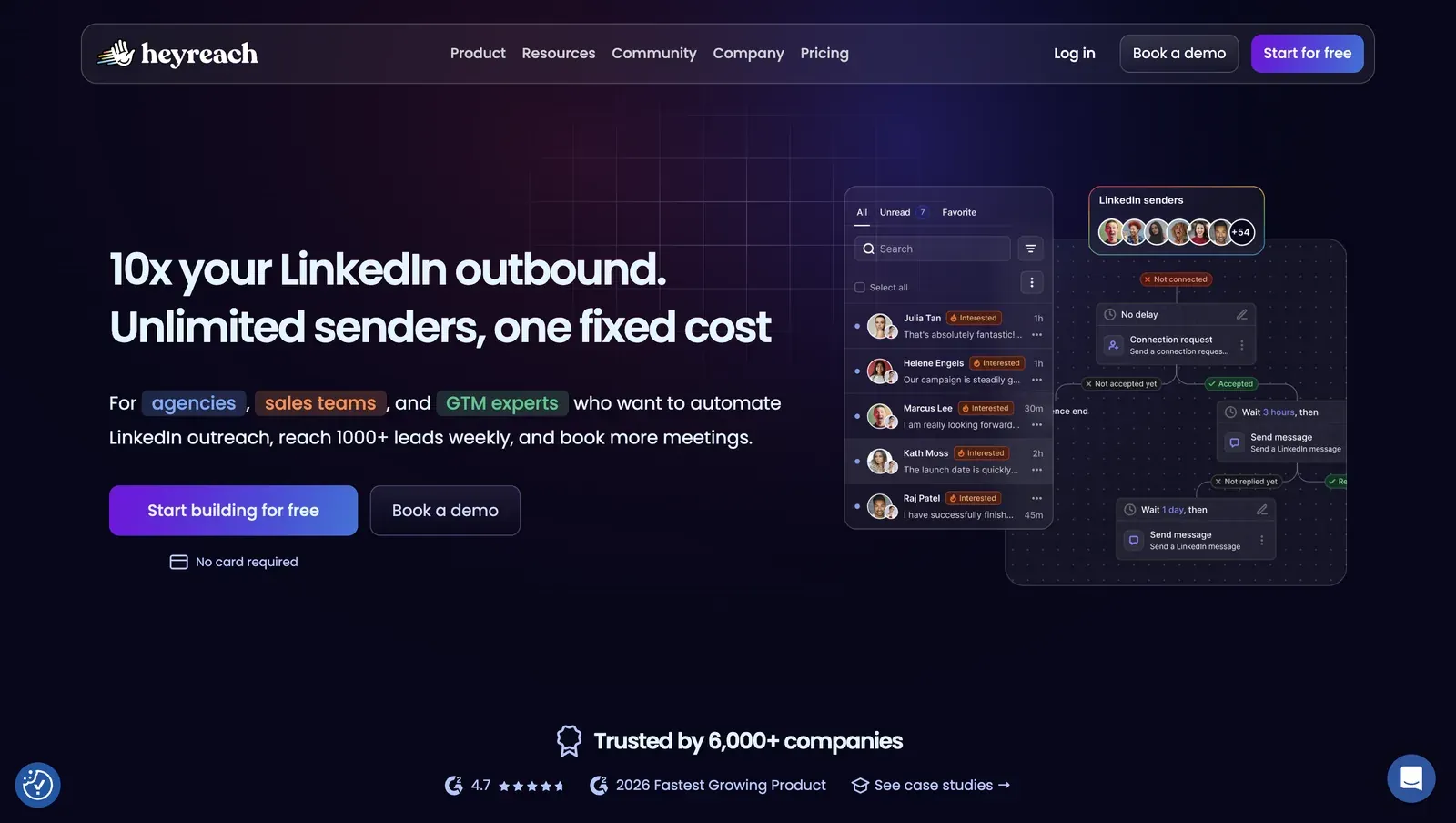
HeyReach's homepage foregrounds multi-sender outreach, fixed-cost positioning and a unified inbox preview - July 2026
The trade-off is campaign control. HeyReach's documentation warns against running more than two active campaigns per sender at the same time, and multiple campaigns share the same daily-action pool on a first-launched-wins basis. There is no confirmed campaign-priority override, so an agency has to plan sender allocation before launch rather than resolving every conflict inside the scheduler.
Deduplication is another manual boundary. HeyReach supports Exclude Lists and an Intersect tool, but the research did not find automatic organization-wide duplicate protection across all workspaces.
For an agency with overlapping client ICPs, that means duplicate control is a process requirement, not something to assume the platform enforces globally.
Automation boundary: HeyReach has sender rotation and three confirmed branch types, but no confirmed reply-based branching, custom-trigger branching, campaign-priority override, or automatic organization-wide deduplication.
For general context on running multiple accounts, the important concept is account isolation: each sender needs its own limits, session state and operating pattern, not just a shared campaign queue. This multi-account operations explainer gives background for that concept.
AI & Agentic Capabilities
HeyReach has two documented AI surfaces. It documents a ChatGPT AI message option inside the Send Connection Request step, and it documents an official MCP server that can connect HeyReach with Claude, n8n, Clay, Visual Studio Code and Make. The practical implication is that HeyReach's AI story is not just message text; it also includes an agent-control layer for teams already building workflows around external AI tools.
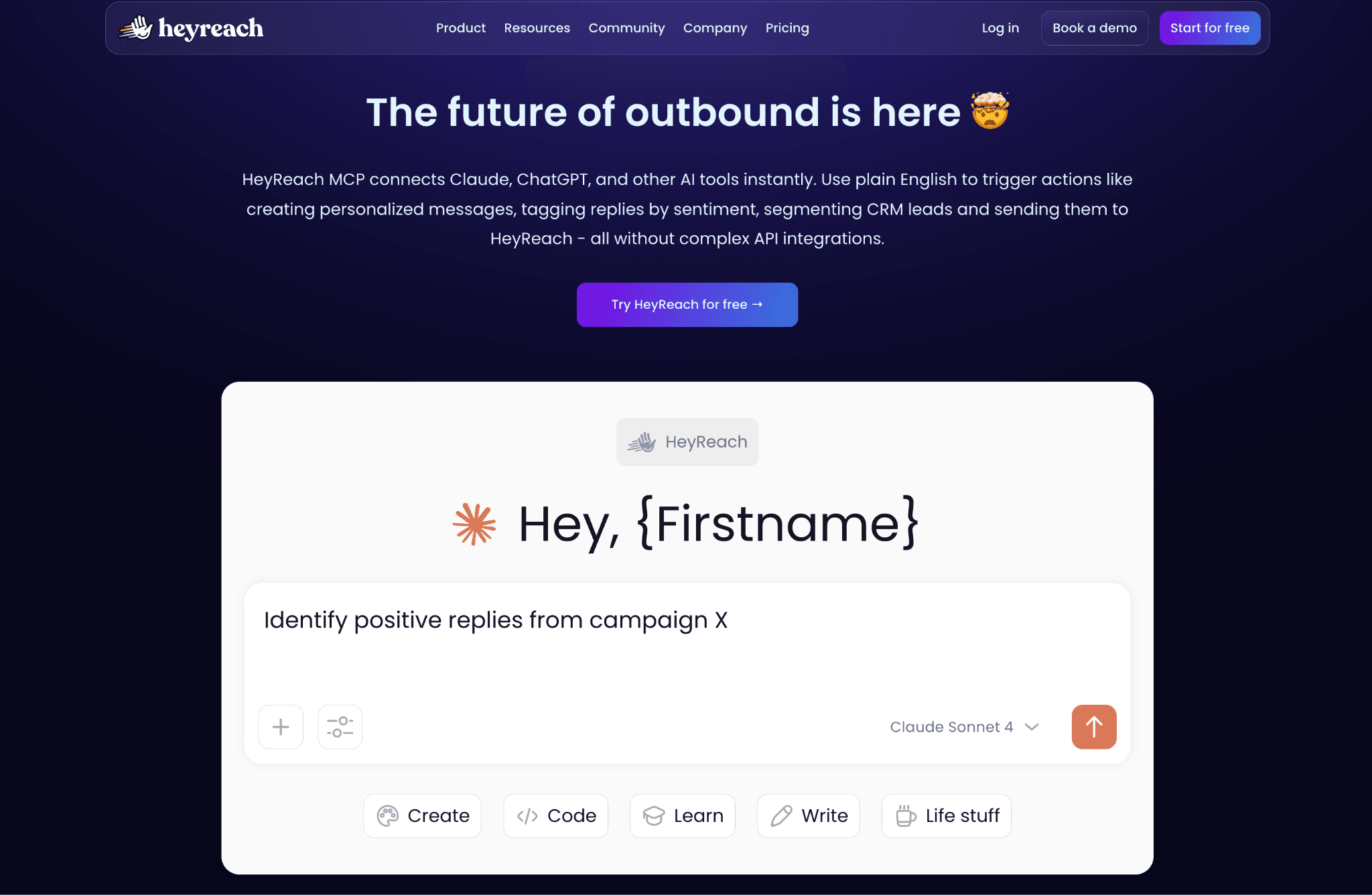
The MCP surface matters because it exposes campaign operations to systems outside the dashboard. A team using Clay or n8n can, in principle, move from lead enrichment into campaign operation without treating HeyReach as a manually operated island.
The same finding also raises the reliability bar: if an AI-agent workflow depends on live campaign data, dashboard/API consistency becomes part of the product experience, not an optional extra.
HeyReach's AI is not a full ICP scoring system in the evidence I reviewed. There is no confirmed native AI ICP scoring, no confirmed AI post-commenting, and no separate AI credit pool for the documented message and MCP features. That means the AI layer helps with message generation and external agent operation, while lead qualification still depends on upstream list quality, rules, or external tooling.
AI boundary: HeyReach's documented AI surfaces are message generation and an MCP server; native AI ICP scoring and AI post-commenting were confirmed absent in the research materials.
Personalization & Message Uniqueness
HeyReach supports personalization through variables, conditional steps and the built-in ChatGPT message option. The practical value is that an operator can avoid one static message for every lead, which matters because repetitive copy is both a conversion problem and a pattern problem.
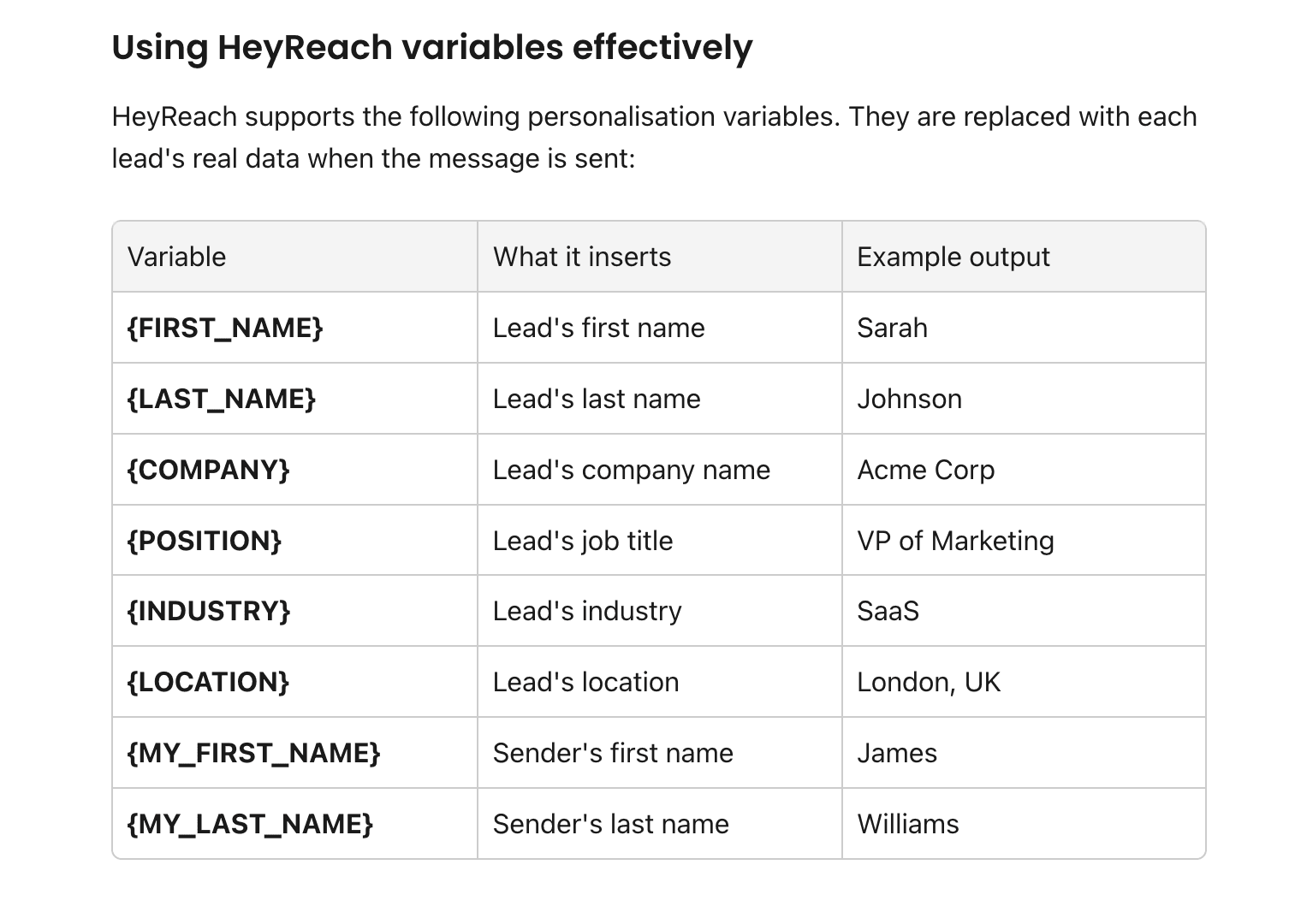
The confirmed conditional set is limited: If Connection, If Open Profile, and Email Found/Not Found. No nested message-level if/then/else system, mutual-connection variables, or spintax support was confirmed in the evidence. That does not make HeyReach unusable for personalization, but it means the reviewable evidence supports controlled variation rather than a broad personalization language.
Personalization boundary: The evidence supports variables, ChatGPT-assisted copy and three condition types; it does not confirm spintax, nested conditions, mutual-connection variables, image/video personalization, or multiple message variations within a single step for built-in A/B testing and rotation.
The clean read is copy-quality scope. HeyReach can help generate and route messages, but the quality of the source data still decides whether those messages feel relevant. A tool can vary syntax; it cannot repair a weak target list by itself.
Lead Targeting, List-Building & ICP
HeyReach's confirmed lead sources are search-bar URLs for people and companies, CSV upload, post-engagement reactors, and manual add. Sales Navigator is supported where the workflow needs Sales Navigator-only context, including InMail and open-profile status. The post-engagement import is capped at 10,000 per import and covers reactors, not commenters.
HeyReach supports importing leads from LinkedIn Event (Attendees), along with LinkedIn Search, Sales Navigator, Recruiter, and Post Reactors, but no evidence was found that it can scrape LinkedIn group members. The documented action list also does not include skill endorsement as a distinct outreach step. For teams whose GTM motion depends on group-member harvesting or skills-based warm-up, that means the workflow needs another source or a different play.
HeyReach does include a built-in Find Email step. One lookup uses one enrichment credit, and found addresses are labeled as verified inside that flow. The evidence did not confirm a standalone email-verifier action or a disclosed verification mechanism for addresses users already have. That distinction matters because "can find an email" and "can verify any uploaded email" are different jobs.
Targeting read: Use HeyReach's post-reactor import and Sales Navigator paths where they match the campaign; do not assume event, group, standalone email verification, or native AI ICP scoring exists unless your workflow has an external step for it.
LinkedIn search itself has platform limits that shape every tool in this category. This search-result cap explainer gives background when a tool claims to collect large search audiences.
Integrations & Ecosystem
HeyReach's integration layer is more specific than a simple native-CRM count suggests, but the count still needs to be stated plainly. The confirmed true native CRM integrations are 2: HubSpot and Breakcold. HubSpot is the more developed example because HeyReach documents a dedicated property group and contact-timeline logging for LinkedIn actions.
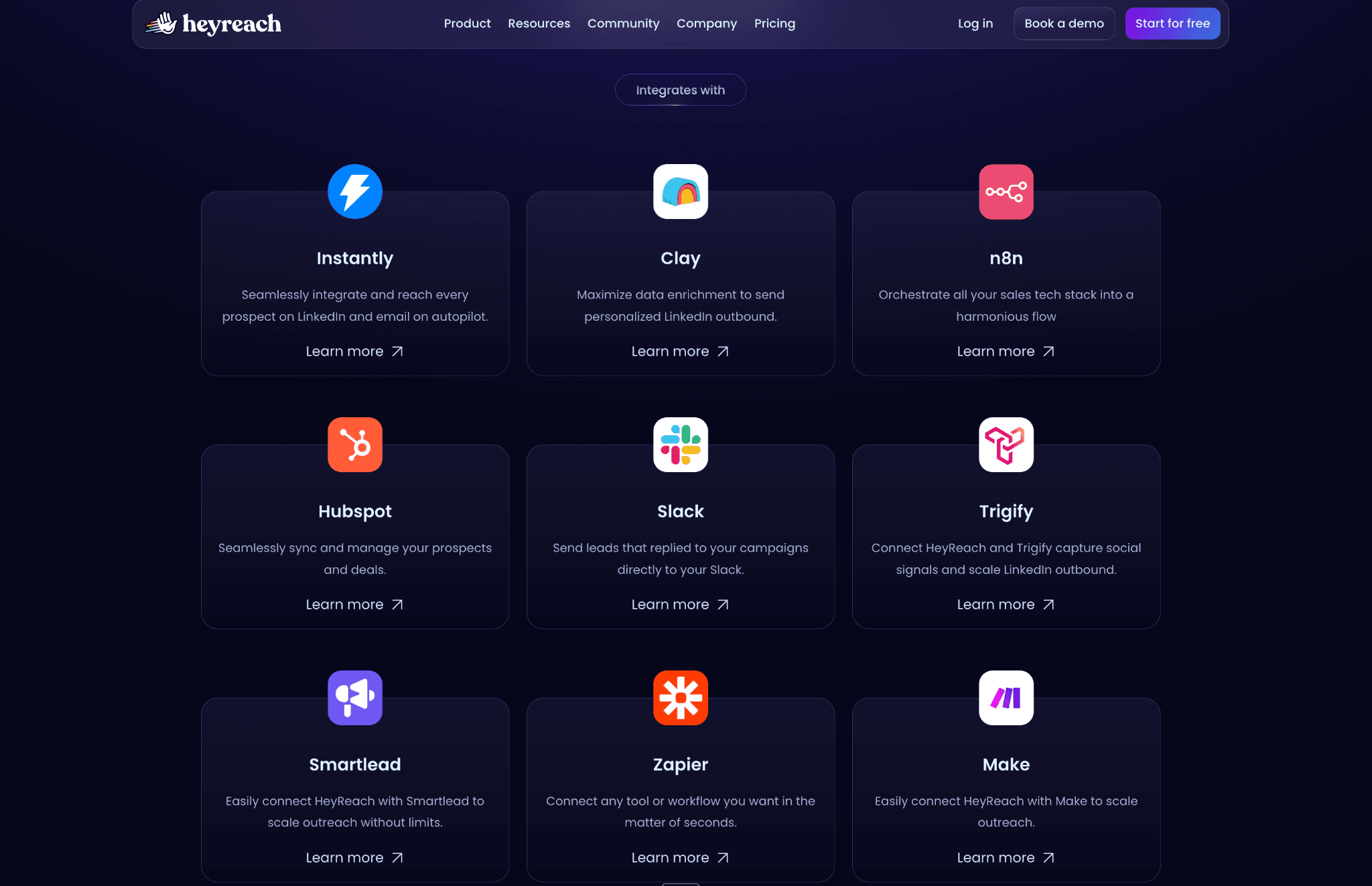
Everything else is a separate mechanism. Salesforce and Pipedrive were not confirmed as native CRM connectors in the July 2026 read; they route through Zapier. Zapier itself is a registered app with 11 read triggers and 22 write/search actions, and Make is native. HeyReach also provides a public REST API using X-API-KEY authentication, and its outgoing webhooks push events out of the platform. No inbound webhook endpoint was confirmed; inbound-style operation is handled through the API instead.
| Surface | Confirmed detail | Reader implication |
|---|---|---|
| Native CRM | 2 native CRM integrations: HubSpot and Breakcold | CRM depth exists, but the native list is narrow |
| Zapier | 11 read triggers and 22 write/search actions | Many workflows run through Zapier rather than direct CRM sync |
| Make | Native Make integration | Available for automation teams already building Make scenarios |
| Public API | REST API with X-API-KEY authentication | Developers can operate outside the UI |
| Webhooks | Outgoing-only webhooks | Inbound workflow entry needs API use, not an inbound webhook URL |
HeyReach integrations and API surface (July 2026)
Integration boundary: HeyReach has API, Zapier, Make and outgoing webhooks, but only two confirmed native CRM connectors and no confirmed inbound webhook endpoint.
Team, Agency & White-label Tools
HeyReach's team model is organized around agencies and teams managing multiple senders. Workspaces are the client-isolation unit: an Admin can see all workspaces, while a Member is scoped. That means workspace design is part of client separation, but admin visibility should be understood before a team maps internal permissions to client boundaries.
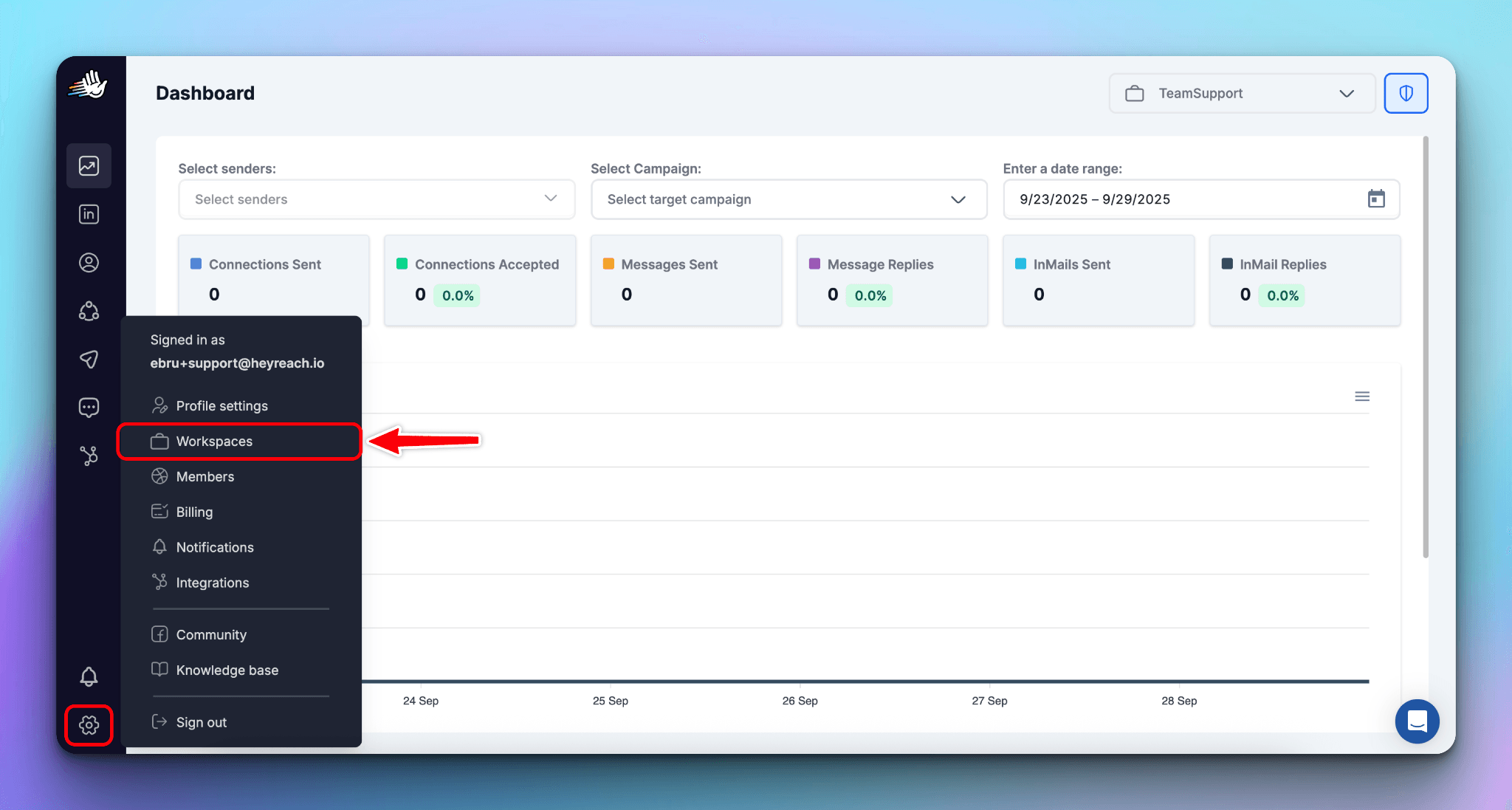
White label is partial and plan-gated. HeyReach documents it for Agency and Unlimited, and setup requires a support request rather than a fully self-service switch. Multi-brand white label on Unlimited is a paid $500 per-brand add-on. For an agency, the implication is simple: white label belongs in the purchasing checklist, not as an assumed feature on every plan.
The team model also intersects with billing. Growth prices per sender, Micro Agency packages 25 senders, Agency packages 50, and Unlimited caps the shared pool at 300. That means a team should model both workspace count and sender count before treating a tier as the natural next step.
Agency setup caveat: White label is plan-gated and support-request-gated, while Unlimited has a documented 300-seat cap; agency buyers should confirm workspace, sender and brand-count needs before purchase.
Is HeyReach Safe?
Short answer: HeyReach has documented safety controls, but my first-hand architecture findings make the safety claim conditional. IP addresses are classified by origin: residential or mobile means a home or phone network, while datacenter means a rented server. For LinkedIn, a datacenter IP on a personal account is a flag because normal personal sessions overwhelmingly come from residential or mobile networks; the point is not that datacenter equals automatic restriction, but that it adds a signal.
IPQualityScore (IPQS) is an independent fraud-prevention service that rates IP addresses on a 0-100 fraud scale and flags proxy, VPN, recent-abuse and bot signals. It is an independent IP-quality signal, not LinkedIn's enforcement verdict. In this section it matters because a cloud tool's safety story depends on the IP and session pattern LinkedIn sees, not only on the limits the vendor applies in its own dashboard.
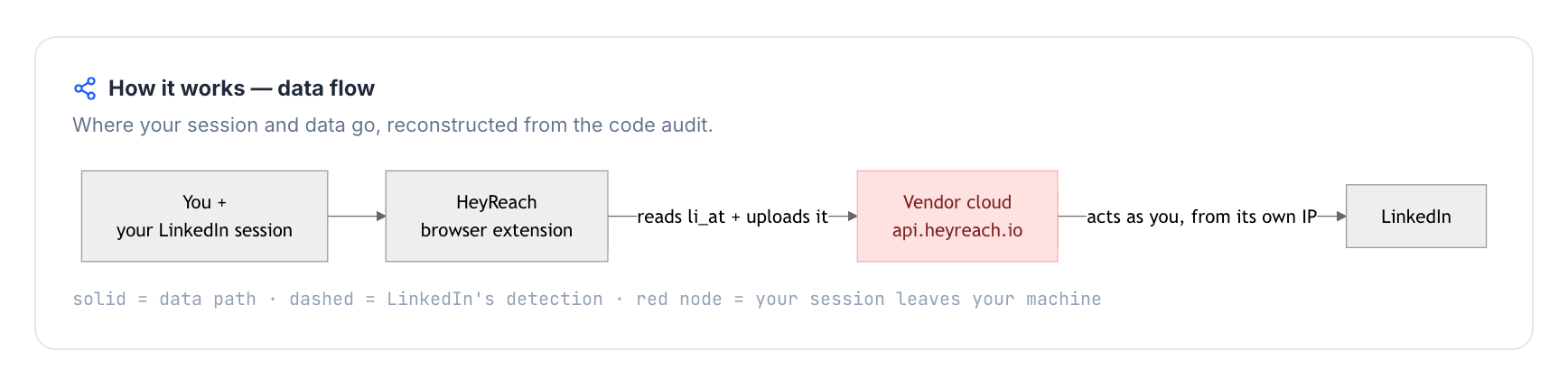
HeyReach's own safety help page says: "HeyReach gives a dedicated static residential proxy (i.e. real IP address that never changes) to each of your LinkedIn accounts, and never shares that IP between two accounts." A second connection-method page says: "a high-quality residential static proxy, and simulating a real person's device (PC or mobile)." In my June 2026 two-account France test, all three observed IPs were datacenter IPs in the same /24, with IPQS fraud_score=100/100 and proxy, VPN, recent-abuse and bot-status flags.
| What was checked | Result |
|---|---|
| Vendor proxy claim | Two vendor pages described dedicated residential proxy behavior |
| Observed exit IPs | 45.146.212.28, 45.146.212.36 and 45.146.212.149; all datacenter |
| IPQS result | 100/100 fraud score on all three observed IPs; proxy, VPN, recent-abuse and bot-status flags present |
| Account isolation | The two accounts did not use the exact same IP, but they did sit in the same /24 subnet and shared provider pattern |
| Fingerprint consistency | Both test accounts showed the same Mac 10.15* / Chrome 135.0 fingerprint |
| Session custody | Extension flow uploaded the LinkedIn cookie jar; credentials flow sends LinkedIn login data to HeyReach |
| Extension detectability | Not listed in LinkedIn's AED target list in this check; no content-script injection found |
| Vendor controls that are real | Daily/weekly limits, Cooldown Mode, reactive Locks, random delay and working-hours scheduling are documented |
HeyReach safety checks - live cloud/IP and extension review (June 2026)
*Since macOS 10.15 officially supports Chrome only up to version 128, Chrome 135 on this OS would require a custom or unofficial build, making the reported browser fingerprint appear outdated or inconsistent with a typical real-world environment.
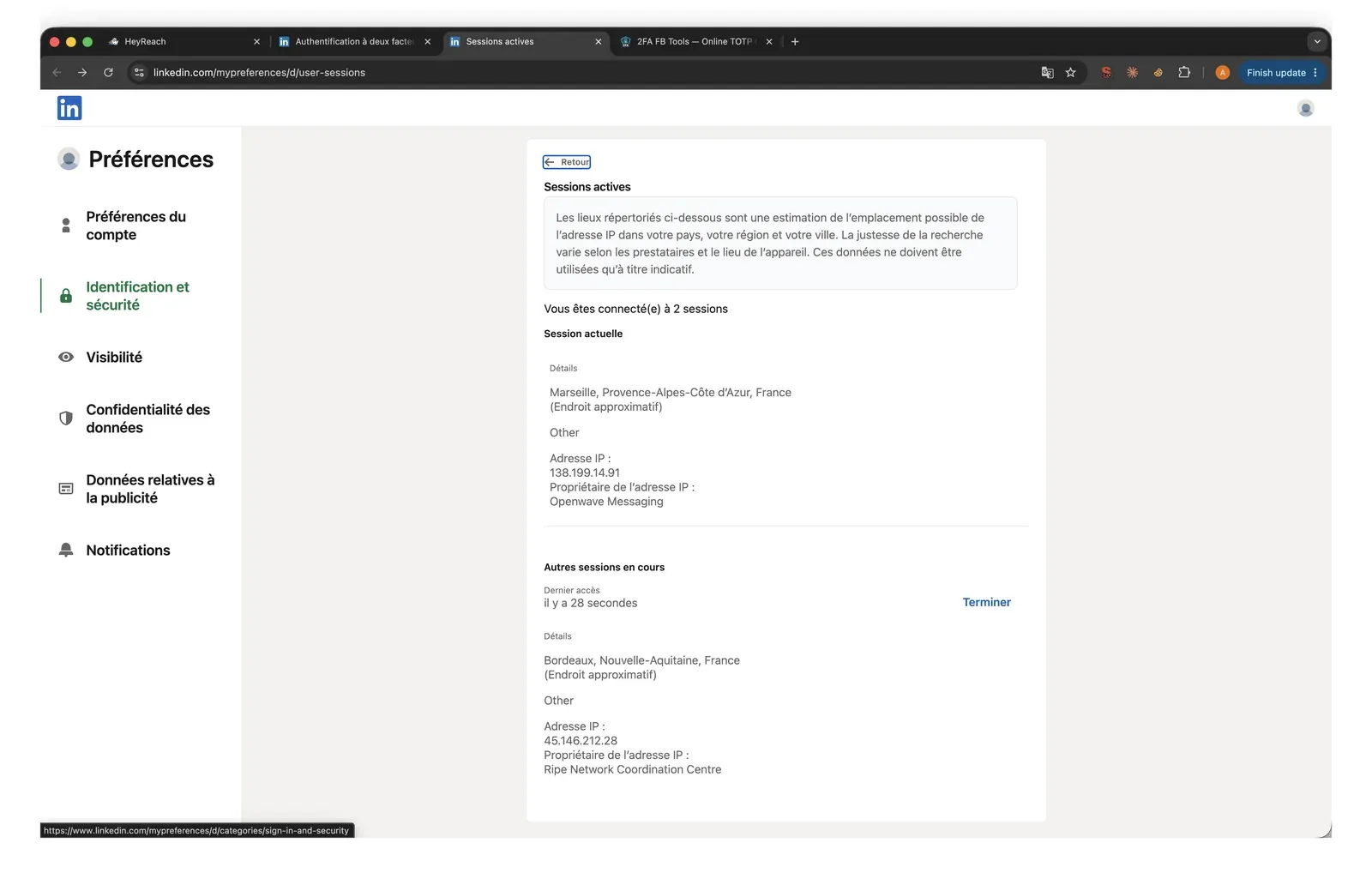
LinkedIn active sessions page showing a second datacenter-IP session during the HeyReach test - July 2026
The extension finding is a different risk layer.
li_at is the LinkedIn session cookie and JSESSIONID carries the CSRF token; whoever holds them can act as the account without the password. HeyReach's extension flow can read the full LinkedIn cookie jar and send it to api.heyreach.io, while the credential path asks HeyReach to log in server-side. In practice, that puts session custody with the vendor cloud, not only with the user's browser.
Active Extension Detection (AED) is the label visible in LinkedIn's production JavaScript for extension-scan events. LinkedIn probes known extension IDs and resources; being on the list means "installed" is visible before a tool acts.
HeyReach's extension was not in the AED target list in this check, which reduces one extension-detection path but does not remove the separate cloud-session and datacenter-IP findings.
Safety read: No tool eliminates LinkedIn restriction risk. HeyReach documents limits, but the observed datacenter IPs, vendor-held session path, and no built-in proxy-quality checker mean the residential-proxy claim should not be taken at face value.
The brand-asset story is also easy to misread. In March 2026, LinkedIn removed HeyReach's company page and a co-founder's profile; Reddit posts and a later founder interview describe that as a brand-asset incident. That is not the same as customer-account safety. The account-risk question remains what a user's LinkedIn account exposes during cloud execution.
For background on the concepts, these explainers cover what proxies do in LinkedIn automation, LinkedIn restriction types, and safe daily-action thresholds.
What Reviews and Reddit Actually Show
The rating picture is positive at the surface and polarized underneath. The review sample I analyzed contains 60 rated reviews: 10 G2 reviews averaging 4.5/5 and 50 Trustpilot reviews averaging 4.04/5, for an overall mean of 4.12/5. A separate public-rating snapshot shows G2 at 4.6/5 across 21 reviews. Capterra has a listing and rating context, but the local review sample has zero Capterra rows, so I would not use Capterra quotes as evidence here.
The recent trend is too thin to print as a direction: only one rated review appears in the trailing six-month window ending July 16, 2026. That means the visible mean is mostly older evidence, not a live momentum signal.
The anomaly scan matters because it explains why the mean needs context.
It flagged volume spikes in the weeks starting July 14 and July 21, 2025, with 8 reviews in each week. Across a deduplicated 58-review cross-platform view, 45 reviews were exactly 5-star and 11 were exactly 1-star, so the distribution is sharply bimodal rather than evenly positive.
Separately, HeyReach's CMO wrote in a co-authored post dated August 22, 2025: "All initiatives that fuel WoM were prioritized over everything else," including a "swag program" with "personalized notes." That is a pattern and a dated public statement, not a fraud conclusion.


