 Updated: October 12, 2026
 26 min read
Key takeaways
- Our pricing-page check found that Snov.io’s advertised $39 Starter plan does not include a LinkedIn account slot. The lowest LinkedIn-enabled setup costs $98/month on monthly billing or $91.25/month equivalent with annual billing. A Pro M setup with 20 LinkedIn slots costs $1,279/month, or $15,771 per year ($1,314.25/month equivalent) with annual billing.
- Across the 1,461 reviews in our dataset, support was the clearest strength at 717 positive versus 73 negative mentions. Reliability was the only topic where negative mentions exceeded positive ones, at 136 versus 79.
- Snov.io is strongest as an email-first platform with lead data, verification, branching, API access, and unlimited team seats. Its LinkedIn layer is narrower: no native event or group actions, a five-account rotation cap per campaign, and only two confirmed native CRM connectors.
- Snov.io documents granular action limits, warm-up, and a dedicated location-based proxy, but we found no independent proxy-quality measurement or disclosure of LinkedIn-session storage. That evidence gap is why our safety verdict remains conditional.
This review is published by Linked Helper and written by Aleksandr Shamrai, who works there. I've made every effort to represent Snov.io accurately using verified data — Snov.io's own documentation, public-source research, and independently sourced reviews.
Snov.io is an email-first lead-finding and outreach platform for sales teams. It combines prospect data, verification, email campaigns, and an optional LinkedIn channel. Sales Suite starts at $39/month. LinkedIn automation is a separate $69 add-on with a paid plan, making the practical entry $98/month on monthly billing. Our verdict is conditional.
The campaign logic, support record, and flat team pricing are substantive. Credit upgrades and add-on billing complicate the sticker price. Its cloud LinkedIn controls are documented. However, the proxy-quality claim has not been independently measured, and the session-storage location is not disclosed.
Verdict
Our verdict is conditional for email-first prospecting teams that also want LinkedIn steps, branching, enrichment, and a shared inbox. The $39 Starter plan includes five condition types, unlimited campaigns, full export, unlimited team seats, and two native CRM connections. The base tier therefore provides the full workflow engine rather than a teaser.
The caveats are total cost and verifiability. One LinkedIn slot raises the practical entry to $98/month on monthly billing. Email-credit shortages require a plan repurchase or upgrade, and a 20-account scenario reaches $1,369/month on monthly billing. Reliability is the only review topic with more negative than positive mentions. The cloud proxy and safety controls may work as described. However, no independent proxy-quality or session test was available, so they remain documented claims rather than measured results.
Pros
- Functional entry tier: Starter includes unlimited campaigns, five condition types, full export, and core integrations rather than withholding the workflow engine.
- Support has a durable record: Support produced 717 positive versus 73 negative topic mentions, including 21 named exceptional-support stories.
- Team headcount is not billed: Every paid Sales Suite plan includes unlimited team seats, which separates user access from LinkedIn-slot costs.
- Cross-channel sequences are native: One campaign can combine email and LinkedIn steps with conditions that move a lead between channels.
- Cloud campaigns keep running: Automation continues with the browser closed, so users do not need a desktop app or VPS for execution.
- Safety limits are specific: Fixed and flexible per-action limits, SSI-based recommendations, and account warm-up are documented numerically.
- Data and developer access start early: Email finding, verification, REST API access, outbound webhooks, Zapier, and Make are available from Starter.
Cons
- The $39 card omits the LinkedIn slot: LinkedIn automation costs another $59/month with a paid plan or $69/month standalone (both monthly billing), making the practical bundled entry $98/month; an annual LinkedIn Automation rate of $62/mo equivalent is also listed, but its interaction with the bundled discount isn't documented.
- Email credits have no top-up: A shortfall requires buying the same plan again or moving to a larger tier, even when no added features are needed.
- Reliability is the negative outlier: In the reviews we analyzed, reliability drew 136 negative mentions versus 79 positive, unlike every other topic measured.
- Tracking-link complaints recur: Independent reviewers reported substituted or suspicious tracking links more than three years apart, alongside deliverability harm.
- Proxy quality is unmeasured: The bundled dedicated-proxy claim has no public fraud-score, subnet, or residential-versus-datacenter result behind it.
- Session custody is not explained: Users connect with LinkedIn credentials, yet the checked security and privacy pages do not state where the resulting session is stored.
- Account screening can interrupt paid users: Reviews describe fraud/KYC and geopolitical false positives, including document demands and suspensions after payment.
Snov.io Pricing: Plans, Traps, and Hidden Costs
Snov.io's pricing page combines three billing surfaces: Sales Suite, LinkedIn Automation, and Phone & Data Enrichment. The Sales Suite grid starts at $39/month, or $29.25/month equivalent annually, with a visible three-month cycle at 5% off shown alongside the monthly and annual toggle — all three billing cycles are on the pricing page itself, not hidden in a separate article.
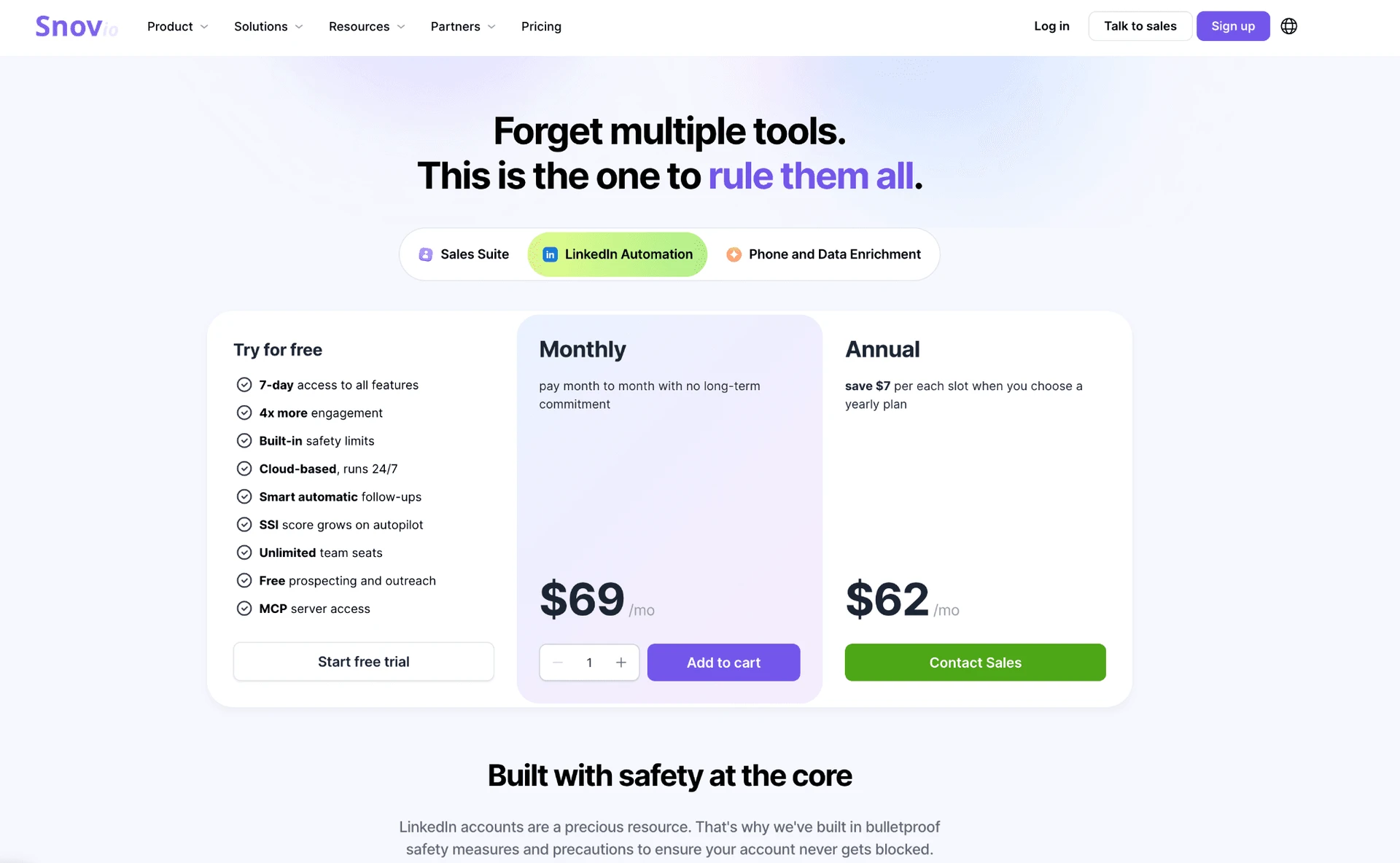
Snov.io's Sales Suite grid and separately billed LinkedIn Automation offer - July 2026
The actual pricing trap sits in the separately billed LinkedIn Automation add-on, whose true bundled cost is disclosed only in the Starter card's hover-tooltip.
| Plan | Price | What's included | What's NOT included |
|---|---|---|---|
| Starter | $39/mo or $29.25/mo equivalent annually | 1,000 email credits; unlimited campaigns and team seats; five condition types; full export; API and integrations | LinkedIn account slot; A/B testing; spintax; email-credit top-ups |
| Pro S | $99/mo or $74.25/mo equivalent annually | 5,000 email credits; Starter features plus A/B testing and spintax | LinkedIn account slot; email-credit top-ups |
| Pro M | $189/mo or $141.75/mo equivalent annually | 20,000 email credits; Pro feature set | LinkedIn account slot; email-credit top-ups |
| Pro L | $369/mo or $276.75/mo equivalent annually | 50,000 email credits; Pro feature set | LinkedIn account slot; email-credit top-ups |
| Pro Ultra | $738/mo or $553.50/mo equivalent annually | 100,000 email credits; Pro feature set | LinkedIn account slot; email-credit top-ups |
| LinkedIn Automation | $69/mo standalone (monthly) or $62/mo standalone (annual); $59/mo with a paid Sales Suite plan (monthly billing — the annual-bundle interaction is not documented) | One LinkedIn account slot; cloud execution; managed proxy; 7-day trial | Sales Suite credits; a second LinkedIn account; independently measured proxy quality |
Snov.io pricing tiers (July 2026)
The central pricing trap is composition: the Starter card displays LinkedIn automation as a checked feature. Its asterisk opens a tooltip stating that account slots are not included and cost $69 each.
With any paid Sales Suite plan the slot falls to $59, so the lowest combined price on monthly billing is $39 + $59 = $98/month. An annual LinkedIn Automation rate of $62/mo equivalent is also listed, but Snov.io's pricing page does not state whether the $10-off bundled-plan discount also applies to that annual rate, so we can't confirm a lower annual-bundle minimum. Buyers who need Pro-only A/B testing or spintax start at $158/month instead.
Hidden add-on: The $39 Starter card does not include a LinkedIn account slot; the practical bundled entry is $98/mo on monthly billing, and the extra cost is disclosed in a hover-tooltip.
Credits create a second step-up: email-search and verification allowances run from 1,000 to 100,000 monthly credits. However, there is no standalone email-credit pack. The vendor's documented remedies are repurchasing the plan, which resets the cycle, or upgrading the whole tier. Phone-enrichment tokens are different: they can be bought at $0.02 each and expire after 90 days. A small email-credit deficit can therefore change the entire monthly plan. A phone-data deficit can be topped up directly.
Agency cost follows slots, not seats: a 20-account setup using Pro M on monthly billing is $189 + 20 × $59 = $1,369/month, or about $16,428/year. LinkedIn slots make up 86% of that bill. The unlimited human-user allowance therefore does not translate into unlimited LinkedIn senders.
The default refund position is no refund for monthly, annual, and add-on payments, with only narrow discretionary exceptions.
Snov.io's Automation & Campaign Engine
Snov.io's documented engine combines email and LinkedIn steps in a cloud campaign.
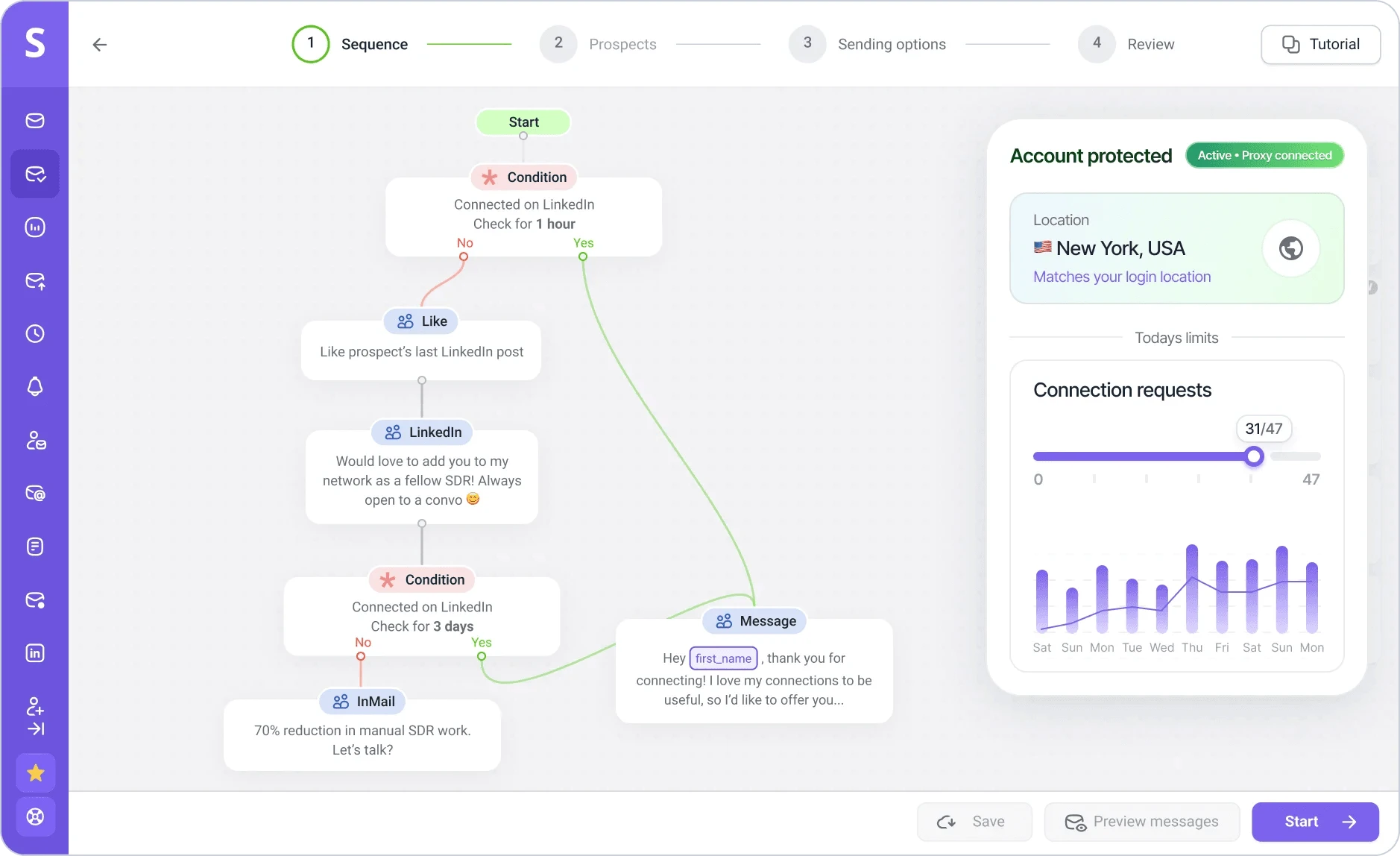
Its LinkedIn action set stops short of events and groups. The documented actions and controls are:
- Send email
- View a LinkedIn profile
- Follow a LinkedIn profile
- Send a connection request
- Send a LinkedIn message
- Send an InMail
- Like a post
- Endorse skills
- Add a condition
- Rotate up to five LinkedIn accounts within a campaign
Event invitations and group invitations are not available as native automation actions. Neither are messages to event attendees or group members. That boundary matters because LinkedIn is an add-on to an email-first system, not the product's original center.
The five confirmed conditions are:
- Email opened
- Email link clicked
- LinkedIn connection degree
- Connected on LinkedIn
- Calendly booking
Condition steps support Yes/No branches and can be stacked. A campaign can route a third-degree contact toward a connection request and move an email-engaged lead down another path. This is included on Starter, which means branching itself does not force an upgrade. Like most outreach tools in this category, Snov.io also supports unlimited campaigns and template-based sequences. Those controls are not tier-gated at entry.
Auto-stop on reply is confirmed for email and LinkedIn InMail. It was not documented for ordinary LinkedIn messages, and the available LinkedIn condition list does not include a generic message-reply trigger. In practice, a buyer planning a message-heavy workflow should verify that ordinary replies stop follow-ups before scaling it.
The cross-channel logic is the more consequential part of the engine. A sequence can check connection degree, stop a LinkedIn path, and send email instead. The operator does not need to maintain two unrelated campaigns. This supports an email-centered workflow even though the LinkedIn action list is narrower than a specialist tool's.
A/B testing and spintax are Pro-only. The unified Unibox combines email and LinkedIn conversations on every tier, including the free plan. Free accounts receive shallower history sync.
Account rotation carries a separate gate. It requires any paid Sales Suite plan and is capped at five LinkedIn accounts per campaign, even though one LinkedIn slot can otherwise work as a standalone product.
Automation boundary: Snov.io covers email, profile views and follows, connection requests, messages, InMail, post likes, skill endorsements, and five branch conditions, but it has no native event- or group-engagement actions.
AI & Agentic Capabilities
Snov.io includes an OpenAI-based AI Email Writer, also presented as AI Studio, on every paid Sales Suite tier. It generates email copy inside Drip Campaigns without a separate AI-credit pool.
The practical ceiling is 15,000 AI tokens per account per day, with no rollover. "Unlimited included" therefore describes billing rather than unlimited technical use.
The model layer is fixed. There is no bring-your-own large-language-model API key or user-selectable provider. A team therefore cannot route generation through its own model account, spending controls, or data policy.
The 15,000-token allowance resets daily and unused capacity does not carry forward. For a team, that makes usage planning an account-level daily constraint rather than a purchasable credit balance.
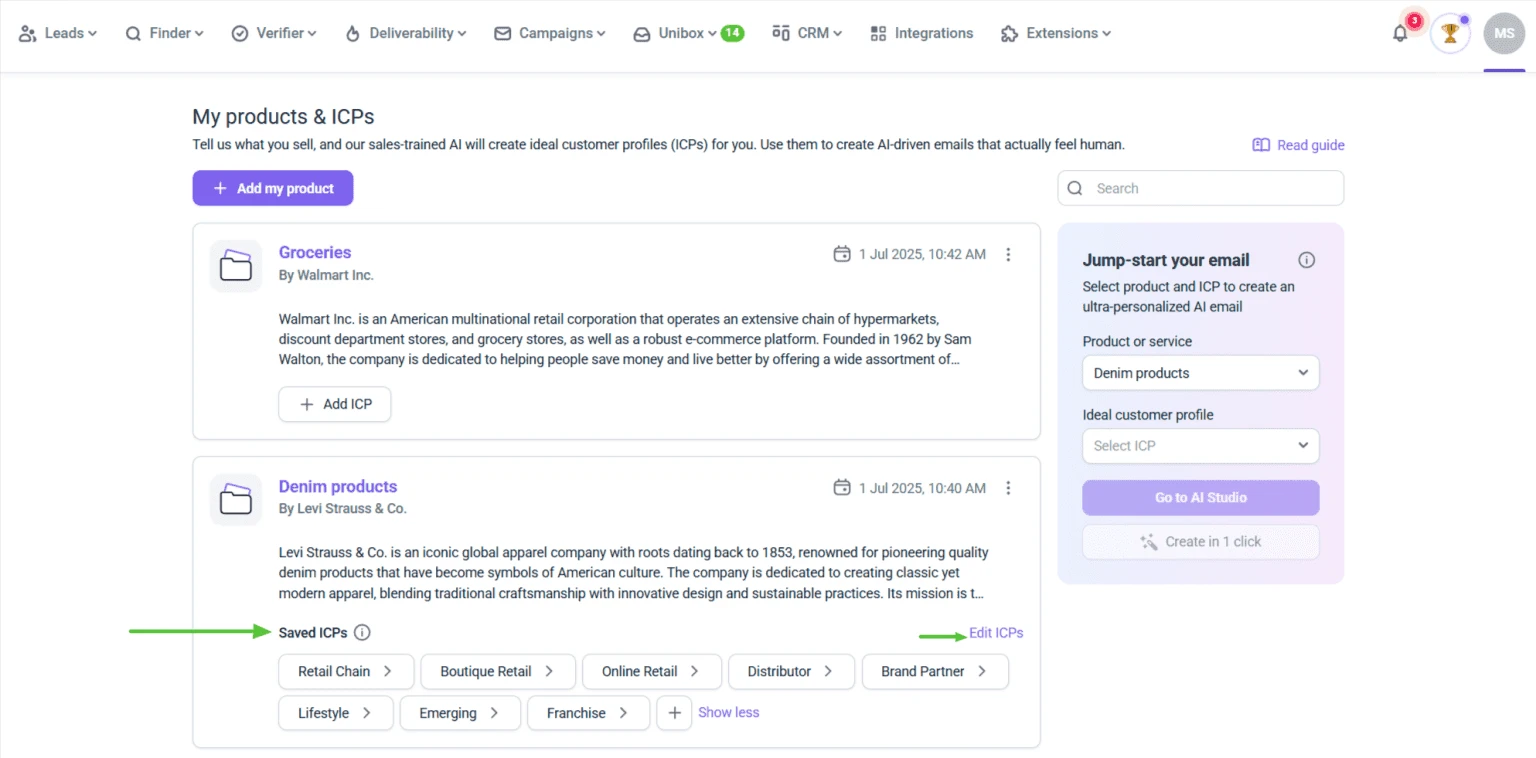
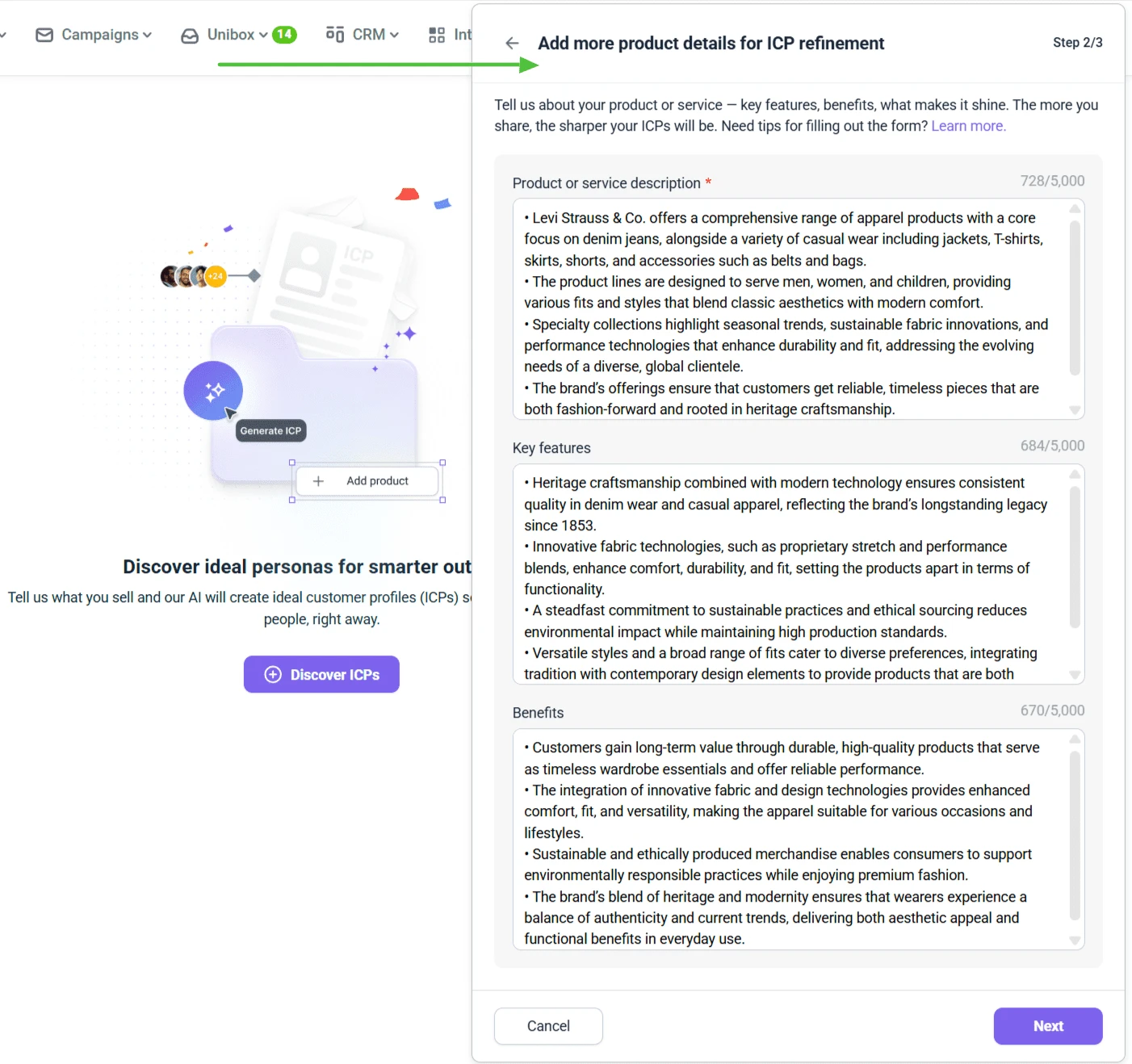
The similarly named AI Buyer Persona Generator creates up to 24 target-customer profiles from a product description. It does not score already-collected leads against an Ideal Customer Profile.
It is therefore not automatic lead qualification. No AI-generated LinkedIn comments are documented either; post engagement stops at likes.
AI scope: AI writes email copy and generates buyer-persona descriptions; it does not score collected leads for ICP fit, generate LinkedIn comments, or accept a user-supplied model key.
Personalization & Message Uniqueness
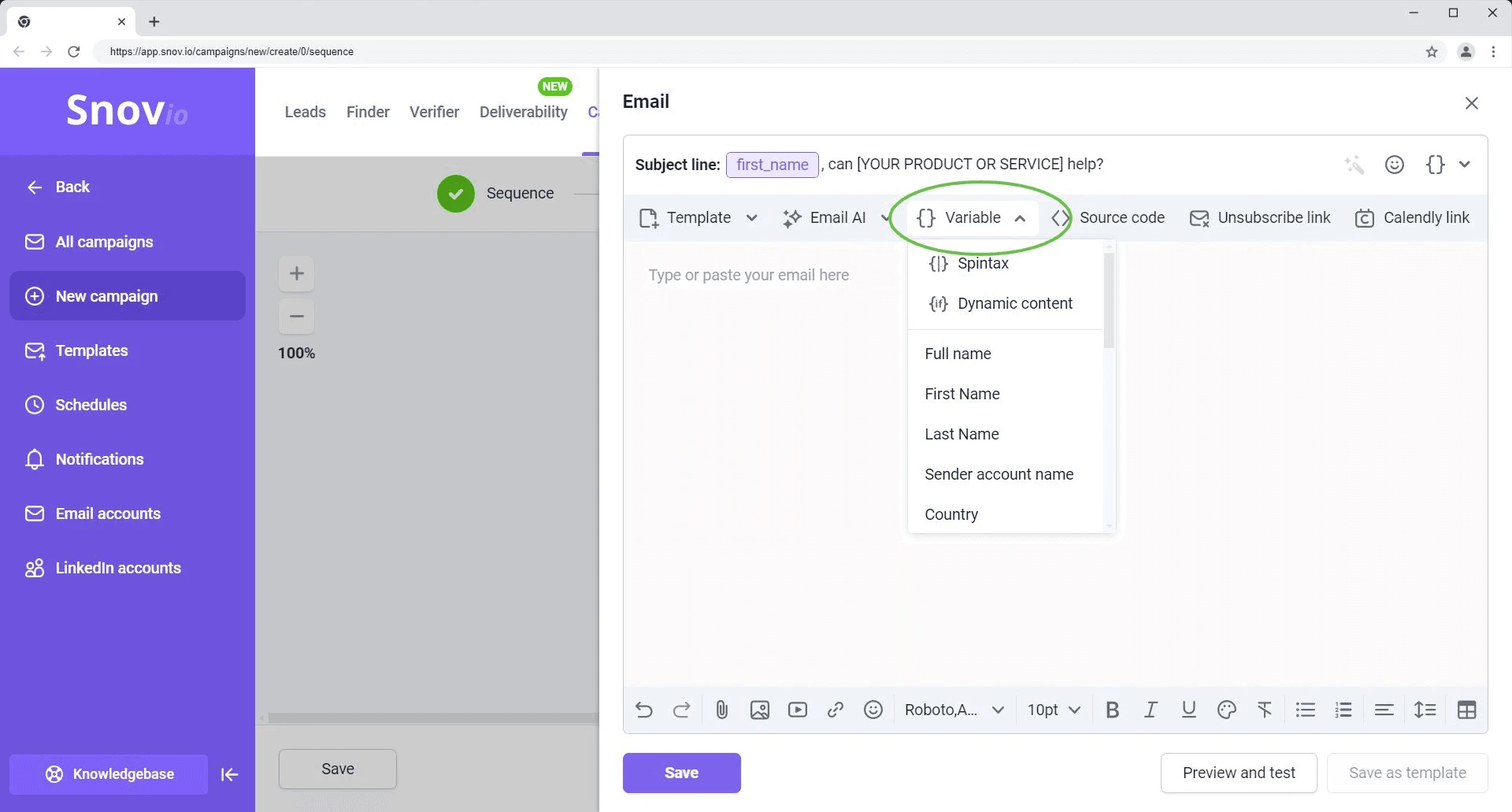
Snov.io supports variable substitution in campaign messages. Pro plans add spintax and A/B testing. Variable substitution fills known lead fields; spintax rotates wording; A/B testing compares defined variants. The $39 tier can personalize known fields but cannot use the two deeper variation tools.
Stacked condition steps add another layer. They change a lead's route after an open, click, connection-state check, LinkedIn connection, or Calendly booking. Mutual-connection-specific variables were not documented. The available evidence also does not establish nested message-template logic beyond stackable campaign conditions.
Message variation can help reduce repetitive patterns and may serve as an additional safeguard against automation detection; Linked Helper offers a similar feature.
However, it is unlikely to materially improve acceptance rates because it rotates generic wording rather than tailoring each message to an individual profile, as tools such as Linked Helper’s AI personalization do. It should therefore be treated as a supporting account-safety measure, not a substitute for personalized outreach, conservative pacing, or action limits.
Plan before importing: If message rotation or experiment reporting is required, budget from Pro S at $99/mo before adding the $59 LinkedIn slot; Starter supports variables but not spintax or A/B testing.
Lead Targeting, List-Building & ICP
Snov.io's LinkedIn collection layer uses LI Prospect Finder in four confirmed modes:
- LinkedIn search results
- Individual profiles
- Company-employee lists
- Event-attendee lists
Collection caps depend on the LinkedIn account type and SSI tier. They are roughly 100-150 daily on free LinkedIn, 500 on Premium, and up to 1,000 on Sales Navigator. These are collection limits, not outreach allowances. They should not be combined with the 20-per-action automation defaults.
LinkedIn itself can cap displayed search results, which is useful context when planning large search-based collections. In practice, source breadth does not guarantee that every matching profile will be visible or collectible in one pass.
The native data layer then finds and verifies emails. One credit is charged for a found or verified email at green or yellow status. Gray and red results are free. Verification uses seven result tiers and carries a vendor claim of 98%+ accuracy.
Sales Navigator is recognized as a separate account type for collection limits and InMail-credit handling. However, no separate Sales-Navigator-specific workflow surface beyond those limits and billing rules was documented.
There is no native AI scoring of already-found leads against an ICP. The buyer-persona generator creates a description of the intended audience instead.
That means teams still need search criteria, campaign conditions, or an external qualification step to decide whether a collected person belongs in outreach.
Targeting gap: Snov.io can collect from four LinkedIn source types and find or verify contact data, but it does not natively score each collected profile against an ICP.
Integrations & Ecosystem
Snov.io has 2 native two-way CRM integrations: HubSpot and Pipedrive. Salesforce, Zoho CRM, Close, and Freshsales appear in the integrations catalog. However, they route through Zapier rather than connecting directly. Listing every Zapier destination as native would overstate the product's own integration layer.
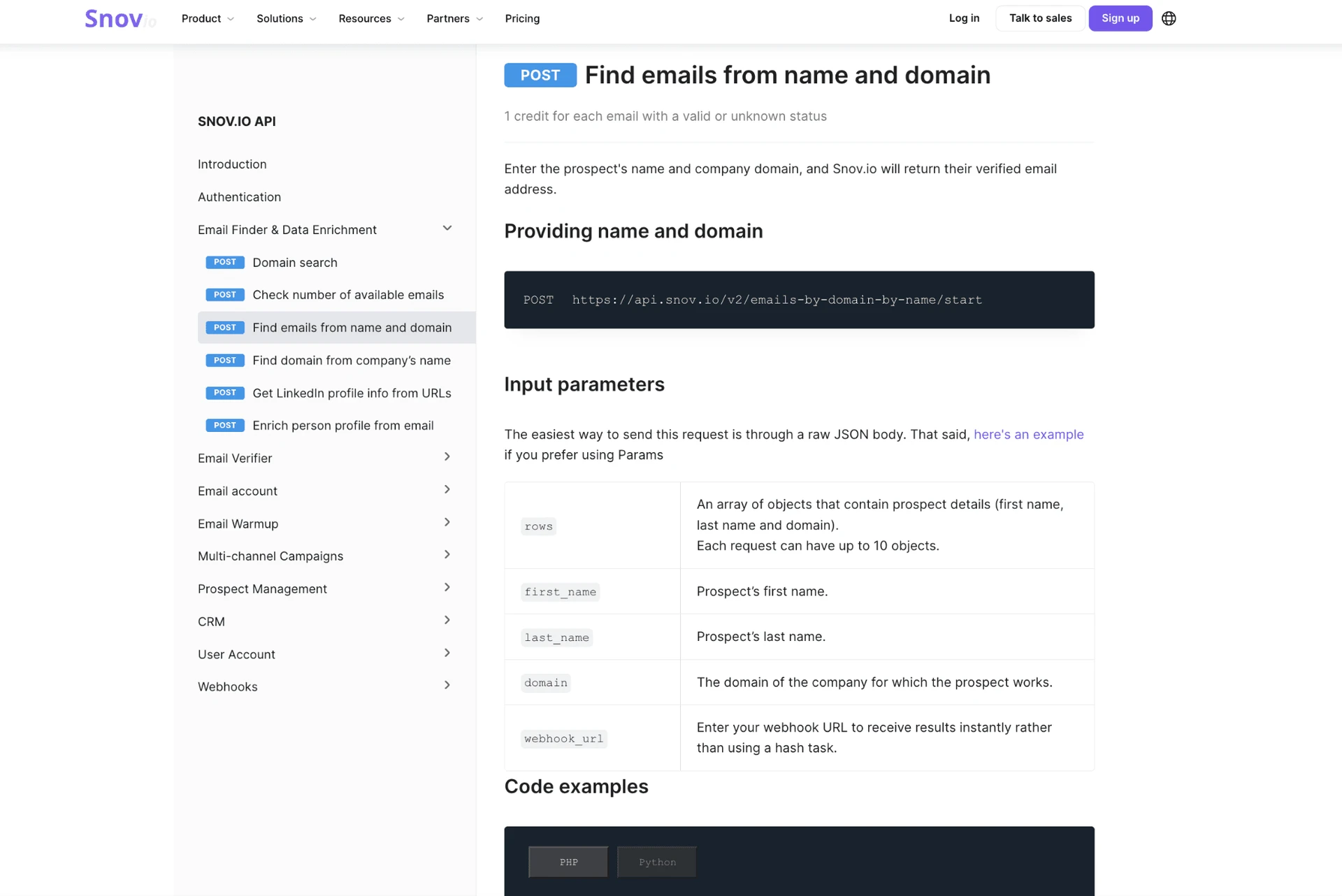
Zapier and Make are supported first-party integration paths. The public REST API is available from Starter at 60 requests per minute with one-hour tokens.
Outbound webhooks allow 50 hooks per account across 15 event types. They retry failed delivery seven times over 38 hours. Developers can therefore receive campaign, reply, and connection events without waiting for a CRM sync.
No inbound webhook endpoint is documented. The integration surface can export events and operate Snov.io through its API. It does not establish that an outside system can push LinkedIn profiles directly into a waiting campaign through a native webhook.
For operations teams, the distinction is direction: event data can leave Snov.io through webhooks, while new campaign inputs need another documented path. That affects how a CRM-triggered workflow is designed.
Integration boundary: The native CRM count is 2: HubSpot and Pipedrive. Other named CRMs use Zapier, and documented webhooks send events out rather than accepting leads into campaigns.
Related reading:
Team, Agency & White-label Tools
Every paid Sales Suite plan includes unlimited team seats. The documented role model distinguishes Team Leader from Team Member. Human access is therefore flat-rate on the Sales Suite side: adding operators does not create another user charge.
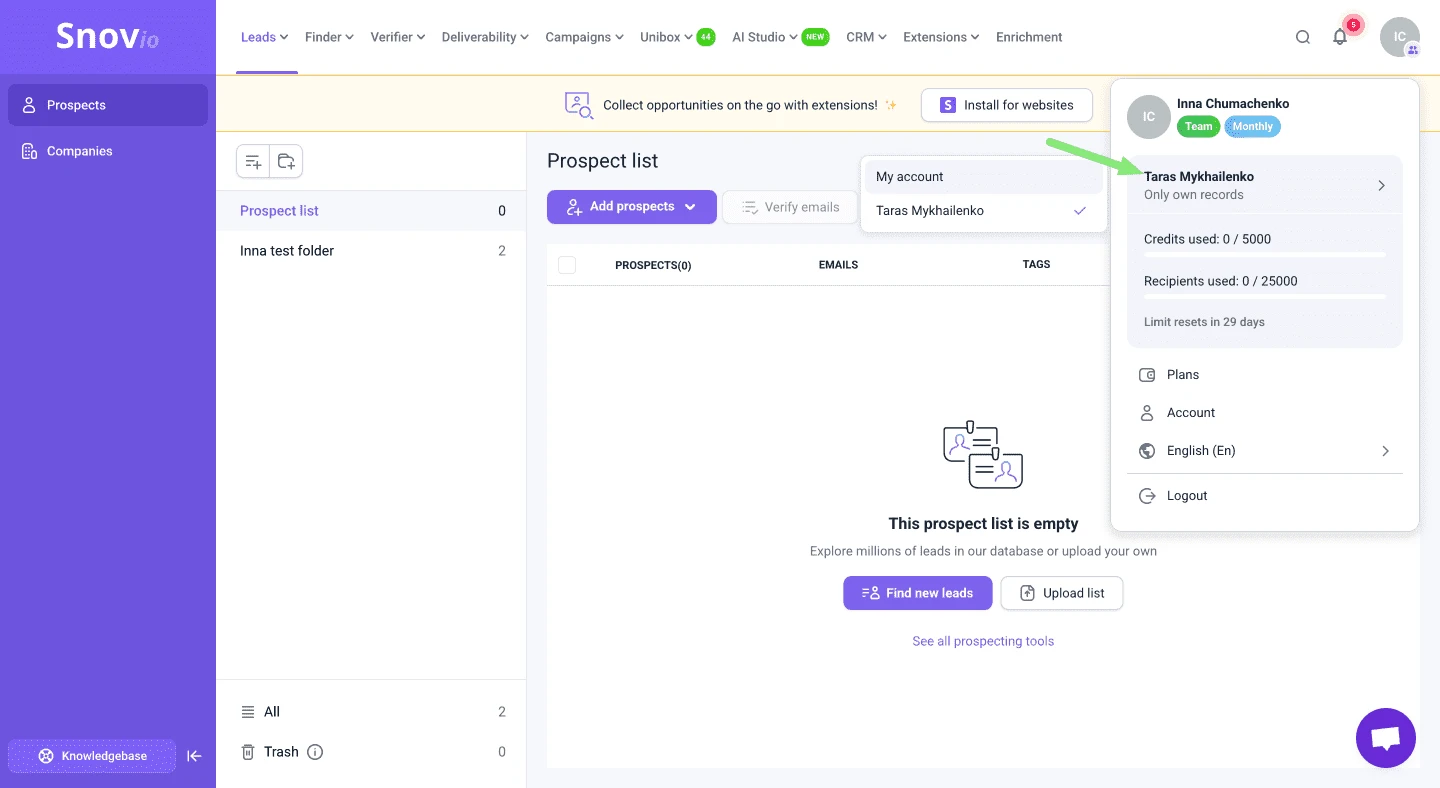
LinkedIn accounts follow a separate model. One automation slot covers one LinkedIn account. Each added sender costs another $59/month when bundled with a paid plan. Running several accounts inside one campaign through account rotation also requires a paid Sales Suite plan. For agencies, multi-account operating practices still matter even when the software separates billing by slot.
We found no hard commercial ceiling on slot count, but we also could not confirm a white-label product. The model separates staff access from sender costs. It does not provide confirmed rebranding for agencies that need a client portal.
Agency cost boundary: Team members are unlimited, but LinkedIn senders are not: each account needs its own $59-69 monthly slot, and no white-label layer is confirmed.
Is Snov.io Safe?
Snov.io documents cloud execution and per-action pacing, account warm-up, and a dedicated location-based proxy for each connected LinkedIn account. Those controls are relevant, but we did not run a live session, IP, or extension-source test. Our safety verdict therefore separates vendor documentation from independently measured evidence.
| What was checked | Result |
|---|---|
| Execution model | Cloud; campaigns continue with the browser closed |
| LinkedIn account connection | Credentials login with email and password; cookie import and OAuth are not documented |
| Session storage | Not disclosed on the four vendor security, connection, and privacy pages checked |
| Proxy claim | Dedicated location-based managed proxy per slot; custom proxy supported; independent quality result not available |
| Action pacing | Default 20/day each for profile views, connection requests, messages, and likes; SSI-tiered recommended fixed limits rise to 40/day at SSI 51-60; the documented ceiling/flexible upper bound is 50/day per category |
| Warm-up | Starts at 5/day, rises by 3 every two days, and targets 20-30/day |
| Collection extension publisher | LI Prospect Finder is offered by info@lipf.store; Snov.io's email-finder extension is attributed to Snovio inc |
| Compliance documents | DPA and joint-controller agreement available by role; no Snov.io SOC 2 or ISO 27001 claim found |
Snov.io LinkedIn safety evidence (July 2026)
What the proxy claim does and does not establish: Snov.io says each account uses a dedicated proxy based on the user's usual login location. It describes this as "blending with normal traffic to stay under the radar." No public assigned-IP, subnet, or reputation result was available to check that statement.
IPQualityScore (IPQS) is an independent fraud-prevention service. It grades IP addresses on a 0-100 fraud scale and reports proxy, VPN, connection-type, and recent-abuse signals. An IPQS reading would provide an independent IP-quality signal, not LinkedIn's enforcement verdict. No such reading was available here.
Snov.io's comparison copy also says a desktop product "is less safe than many cloud-based tools, like Snov.io." The available evidence does not measure that architecture comparison. The statement therefore remains a vendor claim rather than a demonstrated result.
The only documented custom-proxy control is a connection check. It shows whether the proxy works, not whether it is residential, datacenter-hosted, or associated with abuse.
If you are evaluating cloud execution, the underlying egress quality therefore remains unknown. The proxy assignment mechanism is documented, but its quality is not. This plain-language proxy explainer covers why location and address quality are different questions.
Session custody remains the second open item: Snov.io's connection instructions require you to enter your LinkedIn email and password. This lets the service act on the account. A cloud service must maintain an authenticated session to keep working after the browser closes. However, the checked pages do not say where that session is stored. That is an architectural inference, not proof of a particular storage system.
The extension record is checkable: LI Prospect Finder's Chrome Web Store listing names info@lipf.store as the publisher. Snov.io's Help Center presents the extension as its own. The sibling email-finder extension is attributed to Snovio Inc. This mismatch does not establish malicious behavior. It does mean publisher identity is inconsistent across the two extensions.
Controls are still substantive: Snov.io publishes fixed and randomized action limits tied to Social Selling Index ranges. It also documents a warm-up path for new accounts. These controls help manage behavior. However, no failure-triggered circuit breaker or automatic pause after a LinkedIn warning is documented.
Manual behavior can also look automated. Opening many profiles by URL or withdrawing invitations too quickly can trigger warnings without a tool. See the general background on restriction categories and daily action thresholds.
The compliance position is mixed. A live Data Processing Addendum exists and includes EU, UK, and Brazilian transfer terms. Its subprocessor schedule names AWS and Salesforge. The Privacy Policy also names AWS and other processors. The documents therefore show a compliance process with an unresolved list discrepancy. No tool eliminates restriction risk; LinkedIn's usual enforcement term is an account restriction.
Measured vs documented: Snov.io publishes granular limits and a dedicated-proxy claim, but no independent proxy-quality or session-storage result was available for this review.
What Reviews and Reddit Actually Show
In our dataset collected through April 2026, we synthesized a 4.6/5 rating across 1,250+ G2 and Trustpilot reviews. Capterra's 4.5 rating supports that direction but is not included in the weighted figure. Across the wider set of 1,461 reviews in that same dataset, 82.2% of ratings are at least 4.5 stars. The latest six-month slice contains 54 rated reviews averaging 4.41. Recent sentiment is somewhat cooler than the dataset's all-time means, but the sample is too small to establish a reversal.
These platform-review quotes below are cited by source, star rating, and date; a public permalink is included where the underlying review corpus carries one (only the G2 review below), and omitted elsewhere because the corpus does not carry a public URL for every entry.