
 Updated: September 20, 2026
 31 min read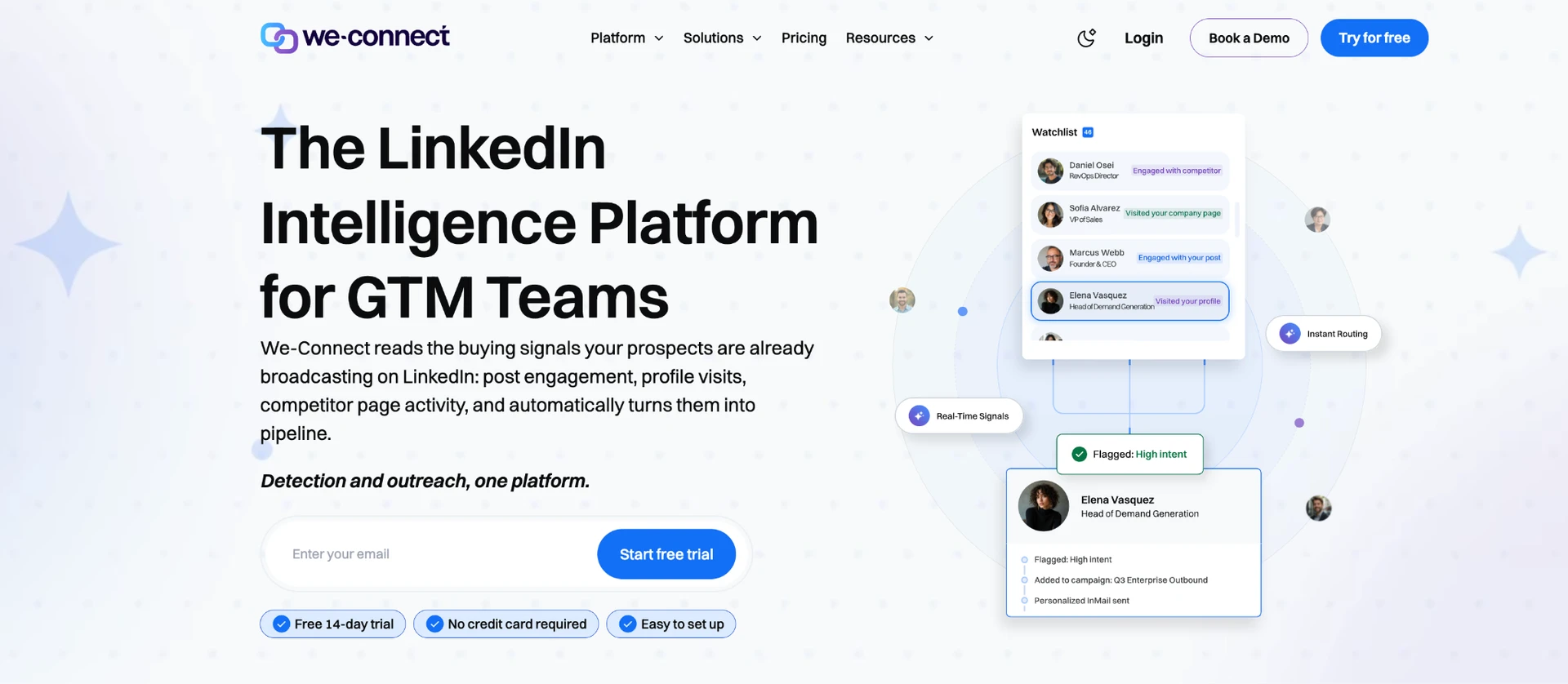
Key takeaways
- The pricing FAQ says simultaneous LinkedIn campaigns are unlimited, while current Help says five; until an authenticated plan-state check resolves that contradiction, capacity planning should treat neither number as settled.
- Free non-sender team members do not offset sender-seat cost: every connected LinkedIn account is a paid seat, Agency begins at 10 seats, and the automatic discount starts only at 25 with the amount visible after login, so the $14,160 20-seat Professional calculation is a floor rather than an Agency quote. Agency terms →
- Professional unlocks LinkedIn-plus-email sequences, but contact and company enrichment remain upcoming and a current native email verifier was not established, so buyers should validate discovery and verification separately from sending.
- Reliability produced 30 negative and 18 positive mentions across the 143-record deduplicated G2/Capterra corpus dated April 1, 2019 through December 20, 2024; because that corpus predates the current Lead Engine and AI state, it is a regression-test list rather than a current prevalence estimate.
This review is published by Linked Helper and written by Milosh Potikj, who works there. I've made every effort to represent We-Connect accurately using verified data — our own first-hand testing, We-Connect's own documentation, and independently sourced reviews.
We-Connect is a cloud platform for LinkedIn campaigns, with email steps from its Professional plan and centralized controls for teams and agencies. Growth costs $69 per connected LinkedIn account monthly; Professional costs $79 monthly and is the entry point for LinkedIn-plus-email outreach. Our verdict is conditional: browser-off execution and documented workflow controls reduce operator work, but users submit LinkedIn credentials to the vendor cloud. In our September 2026 signup test, both French accounts received data-center IPs rather than the residential IPs described in official Help. That two-account result warrants checking an assigned IP before rollout; it does not describe every We-Connect IP, region, or LinkedIn outcome.
| Vendor claim | What we measured | Scope limit |
|---|---|---|
| Residential, static, location-based IP | Two different data-center IPs; independent fraud scores 94 and 87 | Two French signup accounts in September 2026; not the full IP pool or a LinkedIn enforcement result |
We-Connect IP claim and measured sample (September 2026)
As of September 2026 · We-Connect official material and two-account France signup test
Verdict
We-Connect provides browser-off execution, dynamic sequence logic, API access, cross-account duplicate controls, and permission-based team management. Its cloud architecture means campaigns can continue without an open browser, which removes an always-on local-machine requirement. Agencies can manage connected accounts from one billing account, although that is centralized administration rather than separate client tenants.
The condition is custody and validation. Connecting an account requires its LinkedIn email and password, so the vendor controls the LinkedIn-facing environment. Both assigned IPs in our bounded test conflicted with the residential-IP description. We did not run a live campaign. Reply-stop fidelity, imports, action enforcement, AI output, and API behavior remain untested rather than proven unreliable.
Buyers who accept those boundaries should validate the assigned IP, run a representative import-to-reply workflow, and test permissions before adding accounts. Teams that will not provide credentials to a vendor cloud have a reason to look elsewhere. So do those requiring public agency economics and isolated client workspaces.
Company context needs a qualifier too. The G2 profile lists 2018 as the founding year. The Terms use Delaware law, while other public references point to Panama. The exact operating entity and complete legal address were not established.
Conditional verdict: FOR browser-off campaigns, documented branching, API/webhooks, and centralized agency controls. AGAINST vendor custody of LinkedIn credentials or a requirement for isolated client tenants. CONDITIONAL on checking the assigned IP and testing live workflow and permission behavior before scale.
Pros
- Browser-off execution: The cloud platform keeps campaigns running without an open browser, which reduces dependence on an operator's computer.
- Documented branching: The Lead Engine supports behavior-responsive branches and AI scoring nodes, giving operators more than a fixed step chain.
- Visible pacing controls: Global limits, warm-up, randomized activity, and sleep hours make activity settings inspectable, although they do not guarantee outcomes.
- Multiple integration routes: Four native CRMs, Slack, Zapier, webhooks, and a REST API cover direct and bridged handoffs; runtime behavior was not tested.
- Team administration: Free non-sender team members and page-level permissions separate management access from paid LinkedIn seats.
- Cross-account controls: Duplicate suppression can exclude leads already present in another campaign or account, which helps agencies avoid overlapping outreach.
- Separate reseller route: The white-label program documents custom branding, domain, client access, and Stripe rebilling; it is a separately priced product, not an Agency inclusion.
Cons
- Vendor credential custody: Users provide LinkedIn email and password, placing the session environment outside their hardware.
- Assigned-IP mismatch in our sample: Official Help described residential IPs, but both September test accounts received data-center IPs. The sample is material but limited to two French accounts.
- No built-in IP-quality gate: Bring-your-own IP is supported, but a built-in quality checker is absent, leaving validation to the buyer.
- Email discovery is not live: Contact and company enrichment remain upcoming, and future enrichment is slated to use separate credits. A current native email verifier was not established.
- Multichannel starts above entry: Growth is LinkedIn-only; LinkedIn-plus-email sequences begin at Professional, so the $69 entry price does not buy that workflow.
- Agency economics are incomplete: Agency starts at ten seats with custom pricing, while the automatic 25-seat discount amount and white-label wholesale terms are not public.
- Client separation is permission-based: Standard Agency centralizes accounts under one billing account rather than isolated client tenants; cross-seat inbox scope and runtime permission enforcement remain untested.
- Current reliability needs a live run: Documentation covers imports, reply stops, and limits, but we did not execute a representative campaign. Official pricing and Help conflict on unlimited versus five simultaneous campaigns.
We-Connect Pricing: Plans, Seat Costs, and Hidden Gates
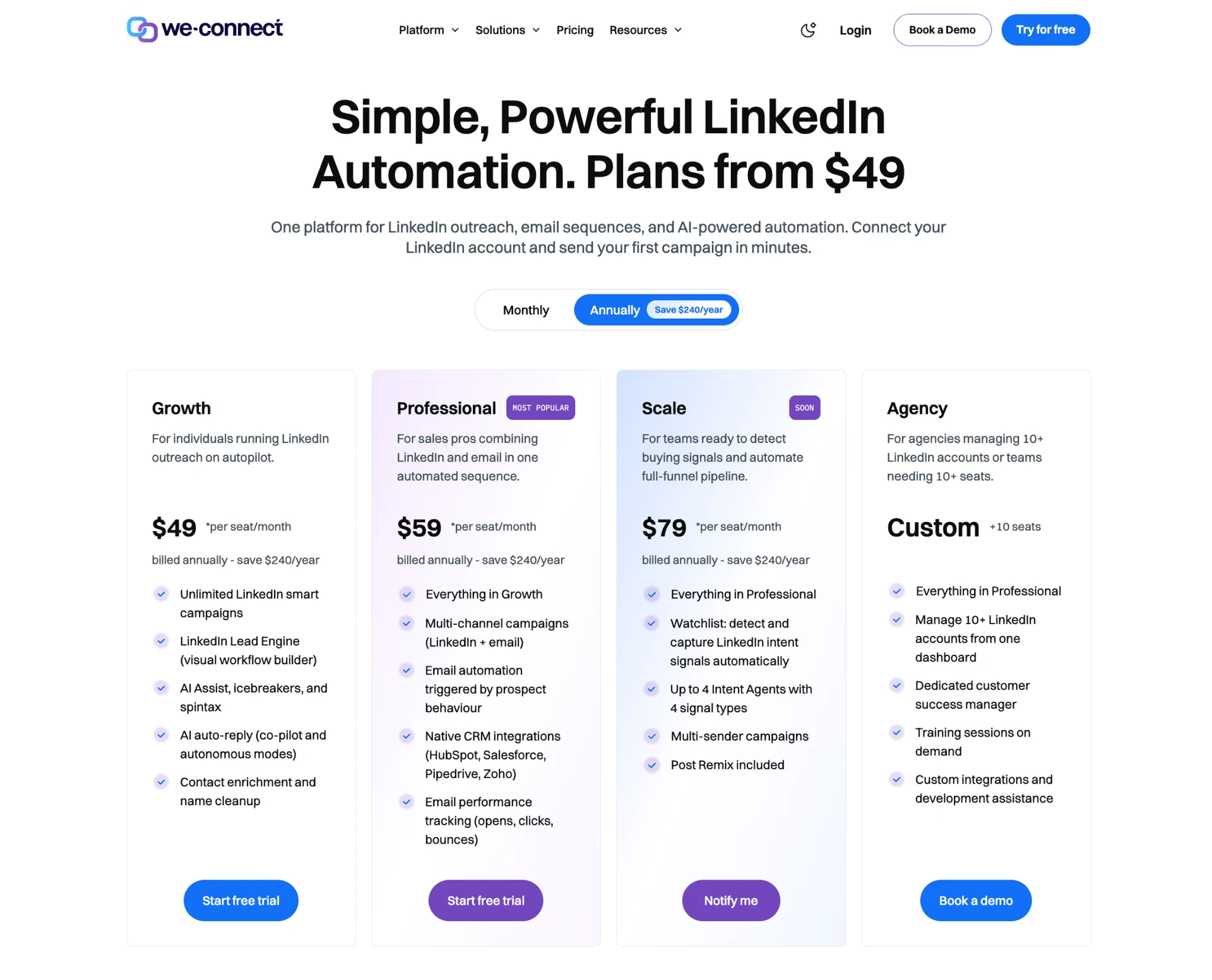
The browser-rendered September 2026 pricing makes individual plan prices visible, but not every buying path. A seat means one connected LinkedIn account; non-sender team members can be added without buying seats. That distinction matters for an agency: managers may be free, but each sender still adds a seat.
| Plan | Price | What’s included | What’s NOT included |
|---|---|---|---|
| Growth | $69/seat monthly; $49/month equivalent, $588 billed yearly | LinkedIn smart campaigns, Lead Engine, AI Assist; native CRM/Slack access labeled Limited time | LinkedIn-plus-email campaigns; permanent assurance of the temporary CRM/Slack access |
| Professional | $79/seat monthly; $59/month equivalent, $708 billed yearly | LinkedIn-plus-email sequences, native CRM access, Zapier and webhooks | A current built-in email finder; public Agency-level volume pricing |
| Scale | Displayed at $99 monthly or $79/month equivalent, $948 yearly | Advertised multi-sender, Watchlist, and related scale features | Current purchase: the plan is marked Coming Soon |
| Agency | Custom pricing from 10 seats | Dedicated customer success manager, training, custom integrations, API access | A public quote, the 25+ seat discount amount, isolated client tenants, or included white label |
| White Label | Separate platform fee plus custom wholesale arrangement | Custom domain and branding, client login, Stripe rebilling | A public platform fee or wholesale rate |
We-Connect pricing tiers (August 2026)
As of August 2026 · We-Connect browser-rendered pricing and commercial terms
The pattern is plan gating, not a simple sticker price. Each displayed self-service plan saves $20 per seat per month with annual billing. That is $240 per year.
Professional is the working minimum for LinkedIn-plus-email. Growth's native CRM and Slack access is labeled “Limited time,” so a temporary promotion should not be treated as a durable entitlement.
For 20 Professional seats, the public annual price produces a $14,160 yearly floor: 20 × $59 × 12. That is not an Agency quote or full total cost. Agency pricing starts at ten seats. White label uses another undisclosed commercial arrangement. Post Remix adds $19 per seat monthly, while the number and cost of additional email mailboxes were not documented publicly.
The 14-day trial requires no card, but the complete trial entitlement is not established. There is no permanent free plan; access is suspended after the trial unless the user subscribes. Paid fees are non-refundable except where law requires, and taxes may be added.
Hidden gate: Scale shows $99/$79 pricing but is not purchasable, Professional is required for LinkedIn-plus-email, and a 20-seat calculation is only a $14,160 Professional-price floor—not a disclosed Agency quote or full total cost.
A final limit remains unresolved: the pricing FAQ says simultaneous LinkedIn campaigns are unlimited, while current Help says five. An authenticated plan-state check is needed; neither number should silently replace the other.
We-Connect Features
We-Connect's public material supports seven feature axes, but the evidence classes differ. Current Help and product pages establish declared capabilities; our September observation establishes only the two-account network result. We did not run live campaigns, authenticated integrations, AI-quality checks, or an agency permission sandbox, so those outcomes remain unresolved. The index below separates pricing checkmarks from tested execution. It distinguishes documented capability, bounded observation, and work that still requires an authenticated test.
| Feature axis | Plan/status | Evidence class | Unresolved boundary |
|---|---|---|---|
| Cloud architecture and assigned IPs | All paid plans; BYOIP available | Primary sources + bounded first-hand observation | Full IP pool and server mechanism |
| Sequences and campaign inputs | Growth+; email steps Professional+ | Current Help documentation | Import, branching, and reply-stop reliability |
| Warm-up and limits | Documented across plans | Current Help documentation | Runtime enforcement |
| Email and AI | Mostly plan-gated; some add-on/roadmap items | Pricing + current Help | Output quality, mailbox count/cost, roadmap timing |
| Integrations and API | Five native destinations plus bridges/API | Current vendor pages | Authenticated behavior, rates, and payloads |
| Agency and white label | Agency custom; white label separate | Current vendor pages | Permission enforcement, isolation, full cost |
| Inbox, reporting, and duplicates | Documented product controls | Pricing + current Help | Cross-seat inbox scope and admin auditability |
We-Connect feature evidence status
As of August 2026 · current We-Connect documentation and dated first-hand observations
Cloud Architecture, Credential Custody, and Assigned IPs
[Diagram: LinkedIn credentials → We-Connect vendor cloud → assigned IP or user-provided IP → LinkedIn. Vendor claim: residential, static, location-based assigned IP. Measured result: two data-center exits. Unresolved: the precise cloud-side request mechanism.]
We-Connect is fully cloud-based and requires no browser extension. A user enters a LinkedIn email and password; the vendor cloud then runs activity without the user's browser staying open. This means the uptime benefit and credential-custody trade-off come from the same architecture. Session-cookie internals are not disclosed, so credential login should not be relabeled as cookie upload.
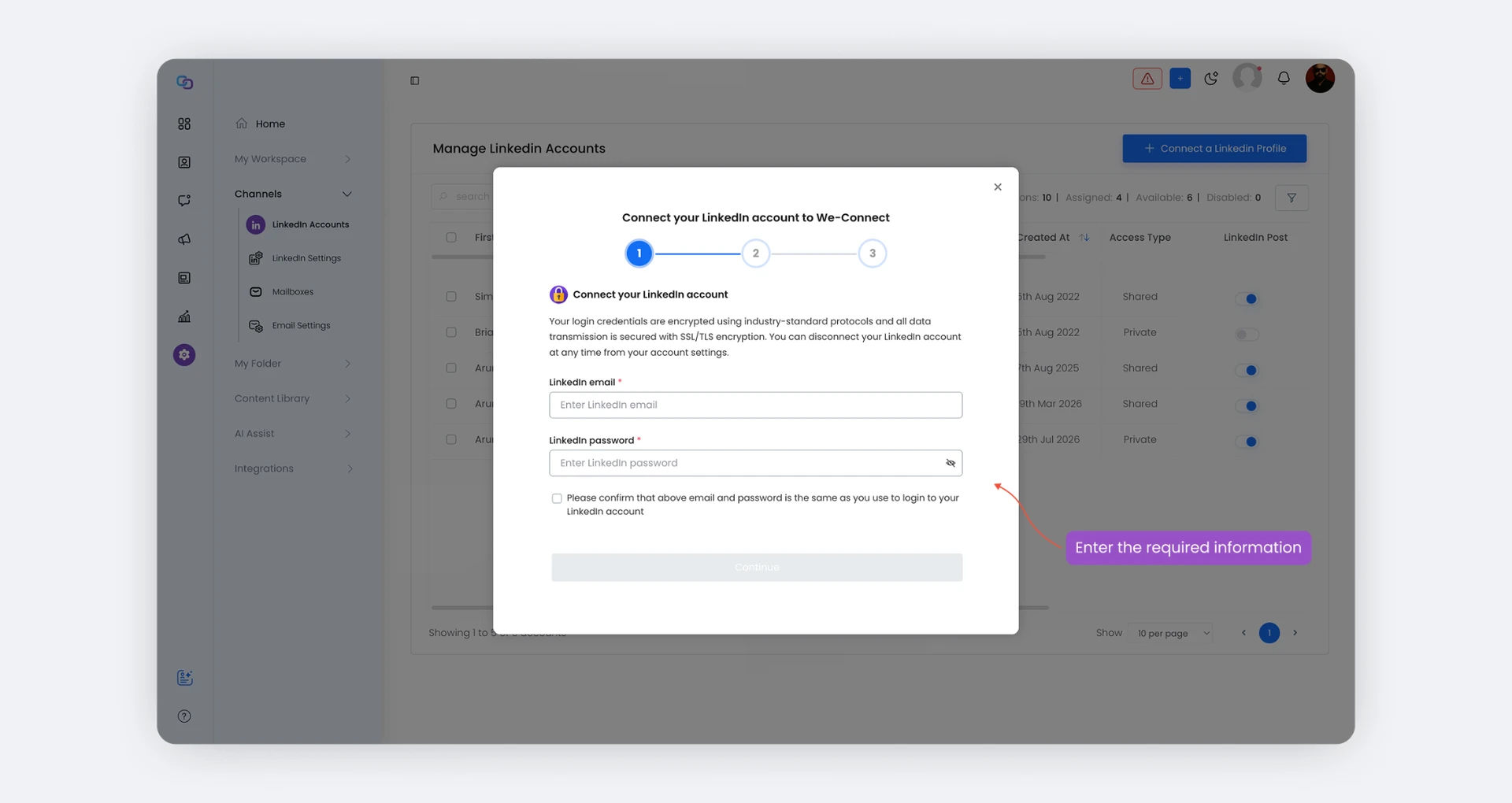
Official Help says activity uses a “residential, static IP address based on your location”. IP addresses are classified by origin. Residential or mobile addresses come from home or phone networks. Data-center addresses come from rented server infrastructure. A data-center route can stand out from ordinary residential or mobile access on a personal LinkedIn session. That makes classification worth checking.
Our two French signup accounts received different IPs and providers. One was 185.255.166.73 on HostRoyale; the other was 168.91.75.167 on M247. IPQualityScore (IPQS) is an independent fraud-prevention service that scores IPs from 0 to 100. On its scale, 75+ is high-risk. It also reports proxy/VPN, connection-type, and abuse signals. It returned 94 and 87. Both observed IPs were Data Center and proxy/VPN, while the second also showed recent abuse. This is an independent IP-quality signal, not LinkedIn's enforcement verdict.
Both accounts reported the same Mac 10.15 / Chrome 135 fingerprint despite different IPs and networks. The matching fingerprint is an observation. API emulation or shared cloud infrastructure remains a hypothesis because no server-code or request-map teardown was completed. Users can supply their own IP, but no built-in checker is available to validate it.
Sample boundary: Both French accounts tested in September 2026 conflicted with the residential-IP description, but two accounts in one geography and signup window cannot establish the behavior of the full IP pool, other dates, or any LinkedIn outcome.
Smart Sequences, Follow-Ups, and Campaign Inputs
Like most tools in this category, We-Connect supports connection requests, messages, waits, and follow-ups. The documented action set includes:
- connection requests, direct messages, InMail, and follow-ups;
- profile visits, follows, post likes, and skill endorsements;
- event invitations and automated greetings for new connections;
- email steps, waits, and conditions.
The documented list has no AI-generated post-comment action or boost-post batch-mention equivalent. Those are confirmed current gaps rather than evidence-search gaps.
The Legacy Smart Sequence is a multi-step builder. The newer Lead Engine documents dynamic behavior-responsive branching, lead inputs from LinkedIn search, groups, events, posts, and CSV, plus AI scoring nodes. Public documentation does not enumerate a closed list of every branch condition, so its full conditional depth remains unresolved.
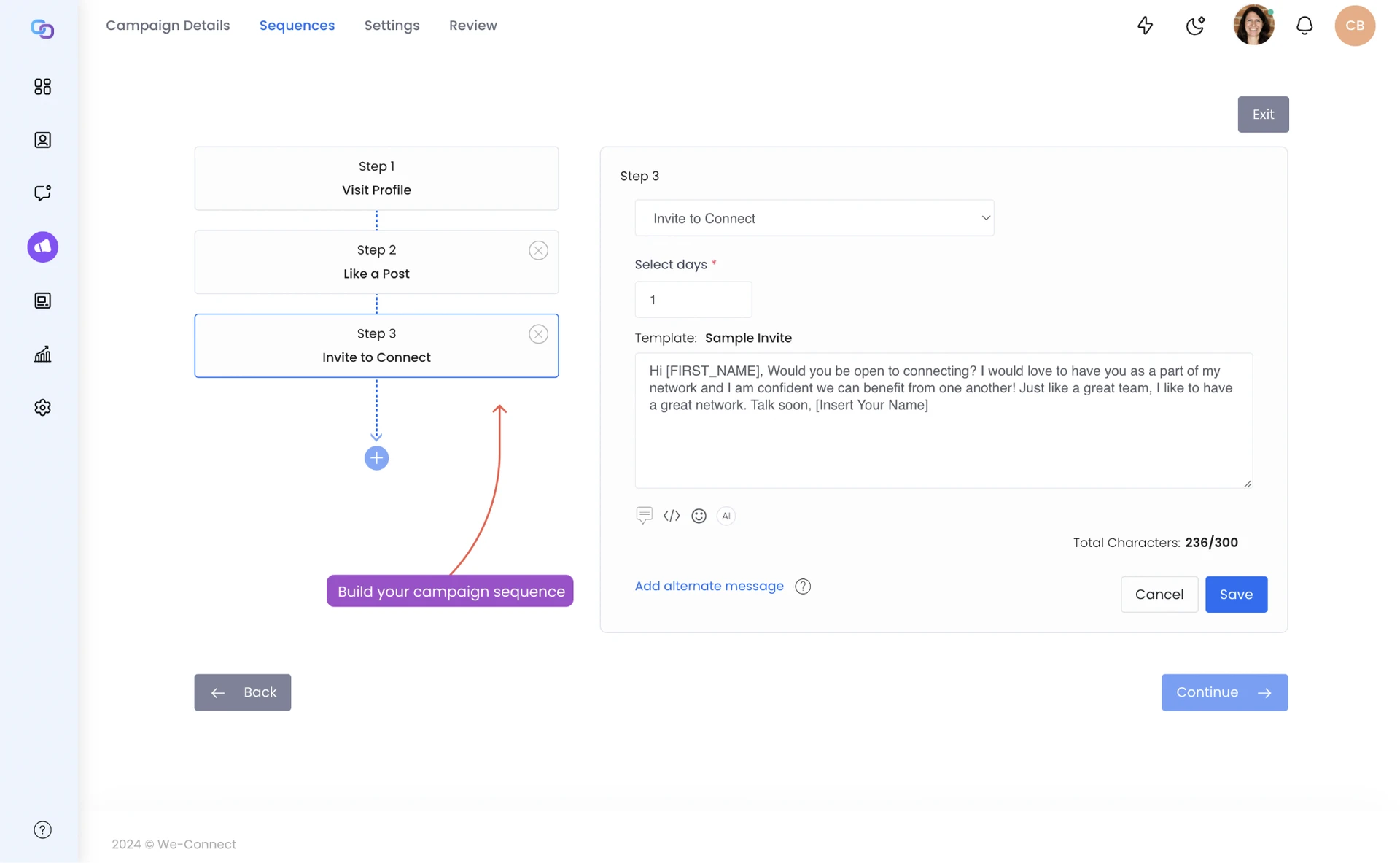
Sequences can stop when a contact replies, and vendor material documents LinkedIn/email message variation testing.
Official pricing says We-Connect works with Standard LinkedIn, Premium, Sales Navigator, and Recruiter, while current Help directly documents Recruiter contact imports.
For background on how steps, waits, and follow-ups fit together, see this drip-campaign workflow guide. It is contextual reading, not evidence that We-Connect executes the documented controls reliably.
[Sequence flow: input/source → LinkedIn action → condition → wait → follow-up → reply stop. Status: documented, not live-tested.]
Runtime boundary: Current Help establishes builders, imports, branches, message variations, and reply-stop behavior as declared capabilities; our review did not run a live campaign to verify import completeness, branch execution, or reply-stop fidelity.
Warm-Up, Global Limits, and Action Pacing
We-Connect separates technical ceilings from recommended pacing. Its global-limits documentation states a combined ceiling of 150 non-message LinkedIn actions per day and 200 LinkedIn messages per day. Individual controls default to 40% of their full potential. Warm-up increases delays and randomizes activity. Those settings show what an operator can configure. We did not observe enforcement in a live campaign.
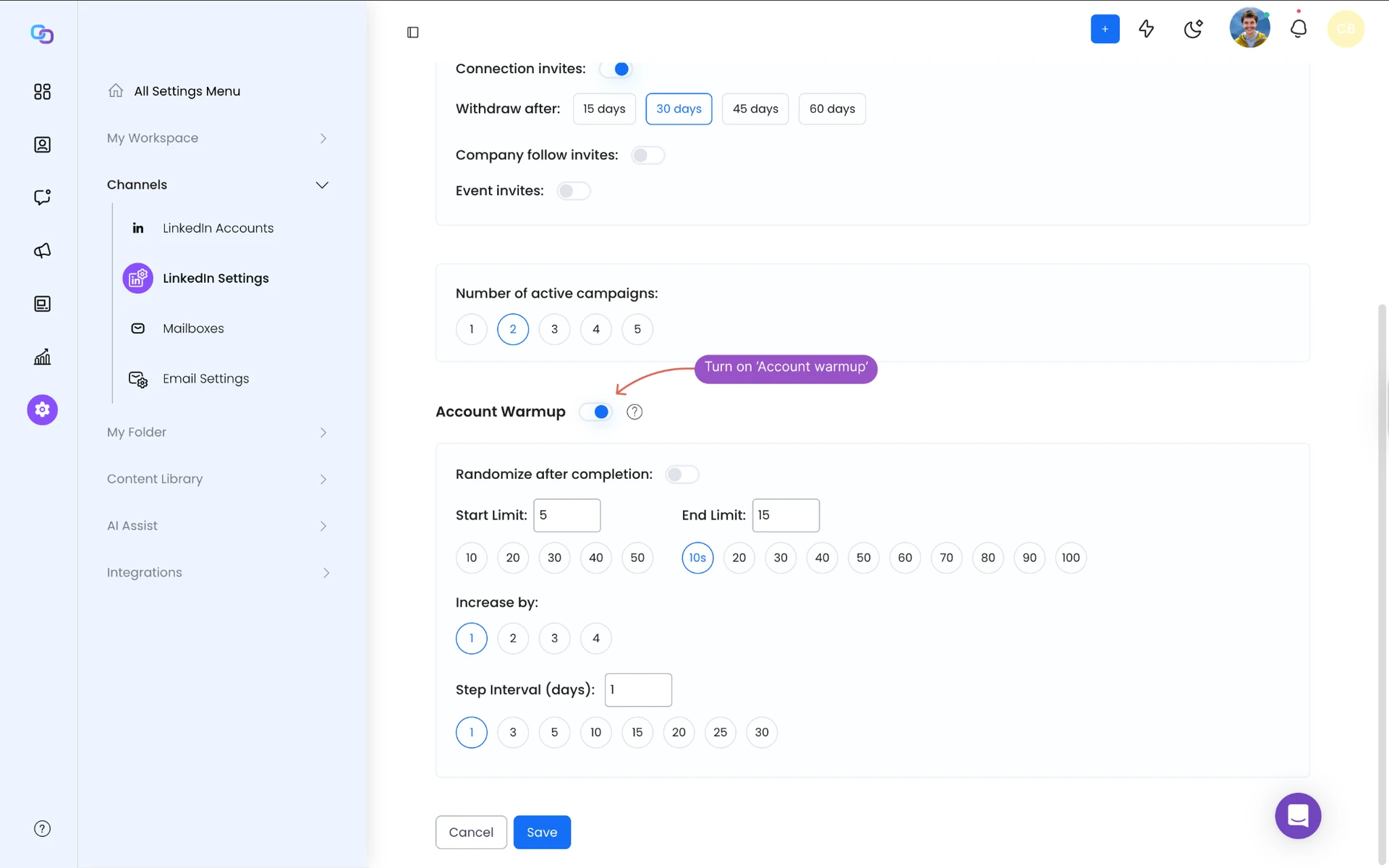
| Action | Technical maximum | Default | Recommended guidance | Tested? |
|---|---|---|---|---|
| Connection invitations | Within the 150 non-message daily ceiling | 40% of the action's full potential | 100/week on Basic; 150/week on Premium, Sales Navigator, or Recruiter | No live enforcement test |
| LinkedIn messages | 200/day global technical ceiling | 40% of full potential | 100/day guidance for messages and 100/day for follow-ups across campaigns | No live enforcement test |
| Profile visits | Within the 150 non-message daily ceiling | 40% of full potential | 100/day; 25/day for accounts with fewer than 100 connections | No live enforcement test |
| Follows and skill endorsements | Within the 150 non-message daily ceiling | 40% of full potential | 100 follows/day and 100 endorsements/day | No live enforcement test |
| Sleep hours | Not an action quota | Minimum six hours/day | Use with warm-up and randomized delays | Documentation only |
We-Connect action limits and pacing guidance
As of August 2026 · current We-Connect Help Center
The vendor's usage guide also documents restriction-triggered campaign pauses and automatic resume after one week. That is a response control, not a guarantee that a restriction will be prevented.
Keep LinkedIn's connection-request rules distinct from higher action ceilings. This weekly-invitation-limit explainer provides neutral context.
Separate every limit: Treat the 150-action and 200-message technical ceilings, 40% defaults, weekly invitation guidance, per-action recommendations, and warm-up behavior as separate controls. None proves runtime enforcement or a restriction-free outcome.
Email, AI Assist, Profile Optimizer, and Post Remix
LinkedIn-plus-email campaigns begin on Professional, while Growth remains LinkedIn-only. Gmail and Outlook use one-click OAuth; other providers connect through SMTP and IMAP. Professional supports multiple email accounts per seat, but the public evidence does not establish a mailbox count or extra-mailbox price. In practice, buyers should test their exact sender topology rather than infer an unlimited mailbox entitlement.
| Capability | Included | Plan-gated | Credit-limited | Add-on | Roadmap |
|---|---|---|---|---|---|
| LinkedIn + email sequences | Yes | Professional+ | No email-sending credit pool documented | No | No |
| AI Assist, icebreakers, reply modes, 0–100 lead scoring | Yes where listed | Varies by feature/plan | Core outreach AI is not shown as one metered pool | No | Some agent/intent surfaces remain beta or Coming Soon |
| Profile Optimizer | Yes | Subscriber/trial status | 1,000 subscriber credits; 250 trial credits | Additional credits referenced, public price not established | No |
| Post Remix | No | Future Scale inclusion | No | $19/seat/month now | Scale inclusion is future |
| Contact/company enrichment | No current finder | Not a live plan entitlement | Future separate enrichment credits | No | Upcoming |
| Native email verification | Not established | Not established | Not established | Not established | Not established |
We-Connect email and AI capability status
As of August 2026 · We-Connect pricing and Help Center
Current AI surfaces include AI settings, profile-based icebreakers, co-pilot or autonomous reply modes, and weighted 0–100 lead scoring. The Profile Optimizer documents 1,000 subscriber or 250 trial credits, while Post Remix costs $19 per seat monthly. We did not test AI output quality or accuracy. Watchlist/intent capability remains Coming Soon, so it is not a current purchased entitlement.
Email sending is distinct from contact discovery. Contact and company enrichment are upcoming and slated for a separate credit system; a current native email verifier was not established. This LinkedIn-plus-email workflow explainer gives background on the channel handoff without serving as proof of We-Connect behavior.
Separate meters: Professional unlocks email sending, Profile Optimizer has 1,000 subscriber or 250 trial credits, Post Remix costs $19 per seat monthly, and future contact enrichment will use separate credits. These are not one interchangeable AI or email allowance.
CRM Integrations, Zapier, Webhooks, and API
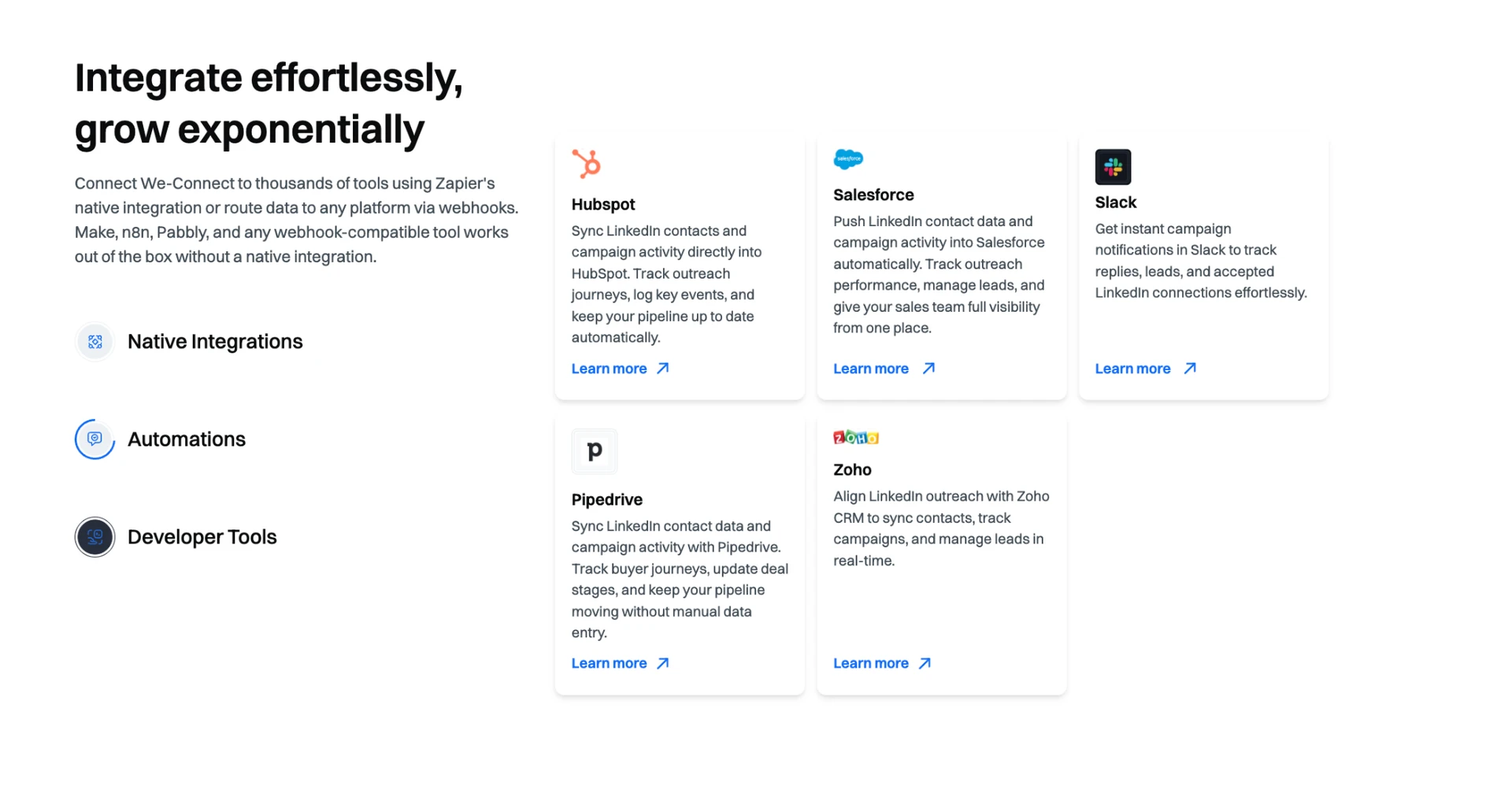
We-Connect documents five native destinations: HubSpot, Salesforce, Pipedrive, Zoho, and Slack. Those are four CRMs and one chat destination, a category count rather than a differentiator. Pricing marks native CRM access on Growth as “Limited time”, while Professional and above show it as an ongoing entitlement.
| Route | Native or bridge | Plan/status | Runtime tested? |
|---|---|---|---|
| HubSpot, Salesforce, Pipedrive, Zoho | Native CRM destinations | Growth limited-time; Professional+ ongoing | No |
| Slack | Native destination | Documented on pricing/integration surfaces | No |
| Zapier | Automation bridge | Documented on all plans | No |
| Make and n8n | Webhook bridge, not native integrations | Documented bridge | No |
| Outbound webhooks | Native outbound route | Current | No |
| REST API | Public developer surface | Documented on all plans | No authenticated request test |
| Incoming campaign webhook trigger | Not current | Coming Soon | No |
We-Connect integration routes
As of August 2026 · We-Connect integration pages and API documentation
The integration overview documents Zapier, outbound webhooks, and REST API access on every plan. It does not establish:
- authenticated endpoint behavior;
- payload completeness;
- rate limits;
- error handling;
- destructive controls.
Those require live-fire tests. The incoming campaign trigger is explicitly future-facing, so it should not be grouped with current outbound webhooks.
For neutral context on what a CRM handoff is intended to accomplish, see this LinkedIn-to-CRM integration guide. We-Connect's own pages remain the evidence for its routes.
Entitlement is not execution: Five native destinations, Zapier, outbound webhooks, and all-plan REST API access are documented. Authentication, rates, representative reads/writes, payload completeness, and failure behavior remain untested.
Teams, Agencies, Permissions, and White Label
We-Connect prices one paid seat per connected LinkedIn account and allows non-sender team members without an extra seat. The current team model documents page permissions with three access levels and centralized administration. Permissions can separate what managers see and do, but they do not create isolated client tenants.
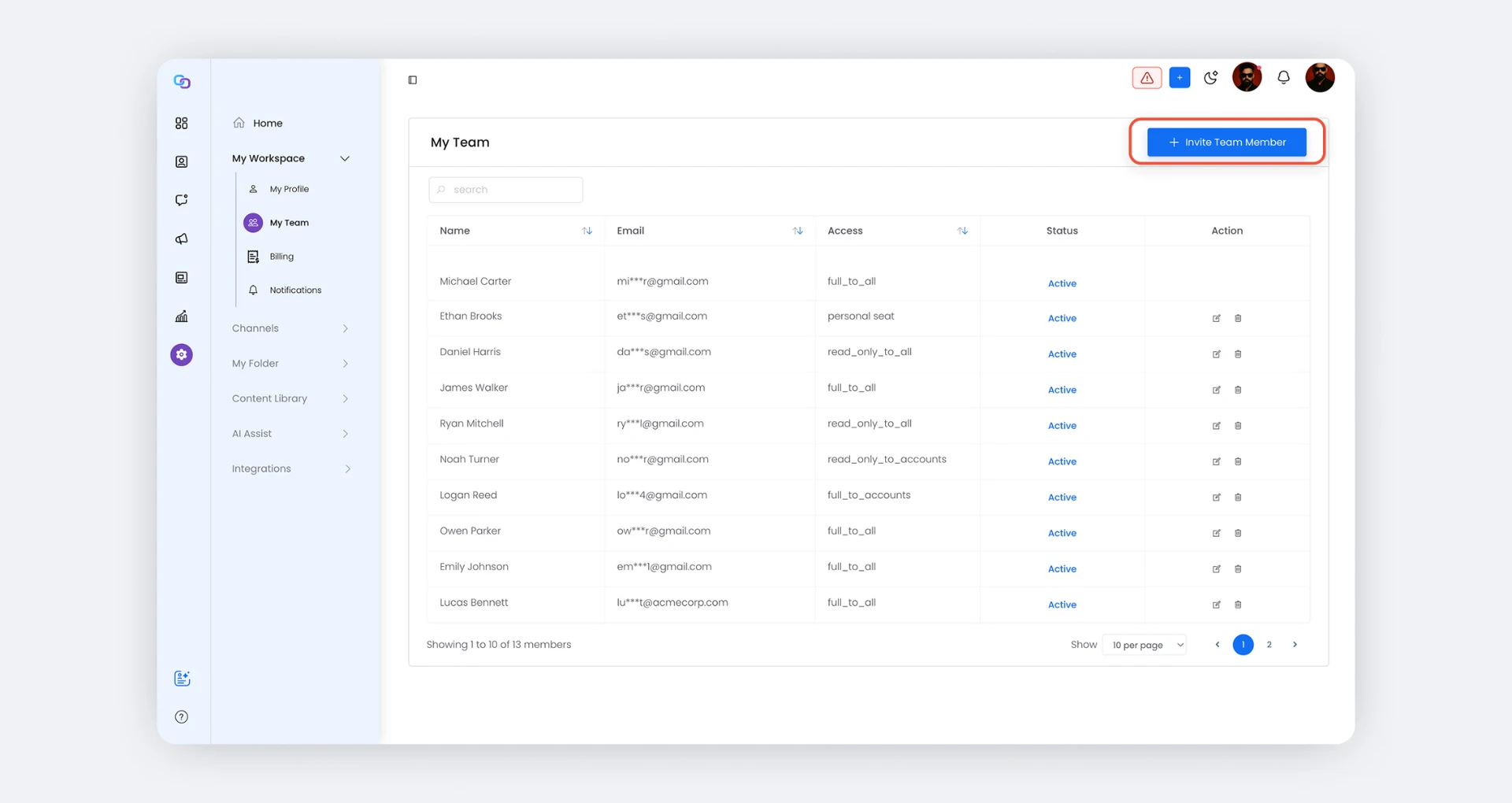
| Capability | Standard Agency | Separate White Label | Unresolved boundary |
|---|---|---|---|
| Sender accounts | One paid seat per connected LinkedIn account; 10+ for Agency | Client accounts under branded service | Current multi-sender campaigns are not purchasable |
| Managers and permissions | Free non-sender team members; page-level permissions | White-label admin and customer access | Runtime permission enforcement not tested |
| Client isolation | Accounts centralized under one billing account with permissions | Branded customer portal | No separate standard-Agency client tenants |
| Duplicate protection | Cross-campaign and cross-account suppression documented | Not separately tested | Runtime cross-account behavior untested |
| Branding and domain | Not included as a standard Agency entitlement | Custom domain and branding | Setup effort and exact fee not public |
| Client billing | Not a standard Agency feature | Stripe rebilling documented | Platform fee and wholesale rate not public |
| Pricing | Custom from 10 seats; automatic discount starts at 25 | Separate platform-fee/wholesale model | Public 10-, 20-, 25-, and 50-seat quotes not established |
We-Connect Agency and White Label scope
As of August 2026 · We-Connect agency, pricing, and white-label pages
Two duplicate controls are documented for agencies: suppress a contact already found in another campaign and prevent overlap across connected accounts. That helps reduce duplicate outreach, but we did not test enforcement across client seats. The unified inbox's cross-client scope is likewise unresolved.
The white-label program is a separate route with custom domain, branding, client login, and Stripe rebilling. It uses a platform fee and wholesale pricing rather than inheriting standard Agency entitlements. Consequently, “Agency” and “white label” should not be treated as synonyms in a cost model.
Current pricing marks multi-sender campaigns as unavailable, including for Agency, while Scale is Coming Soon. Lead distribution is also not a current documented standard-Agency capability; an AI-agent routing surface is future-facing. For operating-model context, see this guide to managing multiple LinkedIn accounts.
Client isolation boundary: Standard Agency centralizes client accounts under one billing account and separates access with permissions. That is not isolated client workspaces; the branded client portal belongs to the separately priced white-label product.
Unified Inbox, Reporting, Logs, and Duplicate Protection
We-Connect lists a unified inbox for LinkedIn, Sales Navigator, and Recruiter, while current Help documents campaign statistics and activity records. Those labels do not establish one manager view spanning every client seat.
| Confirmed object | Scope | Unresolved boundary |
|---|---|---|
| Unified inbox | LinkedIn, Sales Navigator, and Recruiter channels | Whether one manager sees all client-seat conversations |
| Campaign Stats tab | Campaign performance breakdown | Refresh lag and cross-account rollup |
| Campaign activity log | Actions taken within client campaigns | A distinct admin audit log with user-attribution and retention controls |
| Cross-campaign duplicate suppression | Excludes a lead found in another campaign | Runtime fidelity |
| Cross-account duplicate suppression | Prevents overlap among connected accounts | Cross-client enforcement in production |
| CSV lead export | Documented contact fields | Full message-content and per-message metadata export is not established |
We-Connect reporting and control scope
As of August 2026 · We-Connect pricing, Help Center, and agency material
The Lead Engine Stats tab provides a campaign performance breakdown. Agency material describes a record of campaign actions. A separate admin-grade audit log was not established. That evidence gap is not proof that no such capability exists. Similarly, the documented CSV field list does not establish full conversation export.
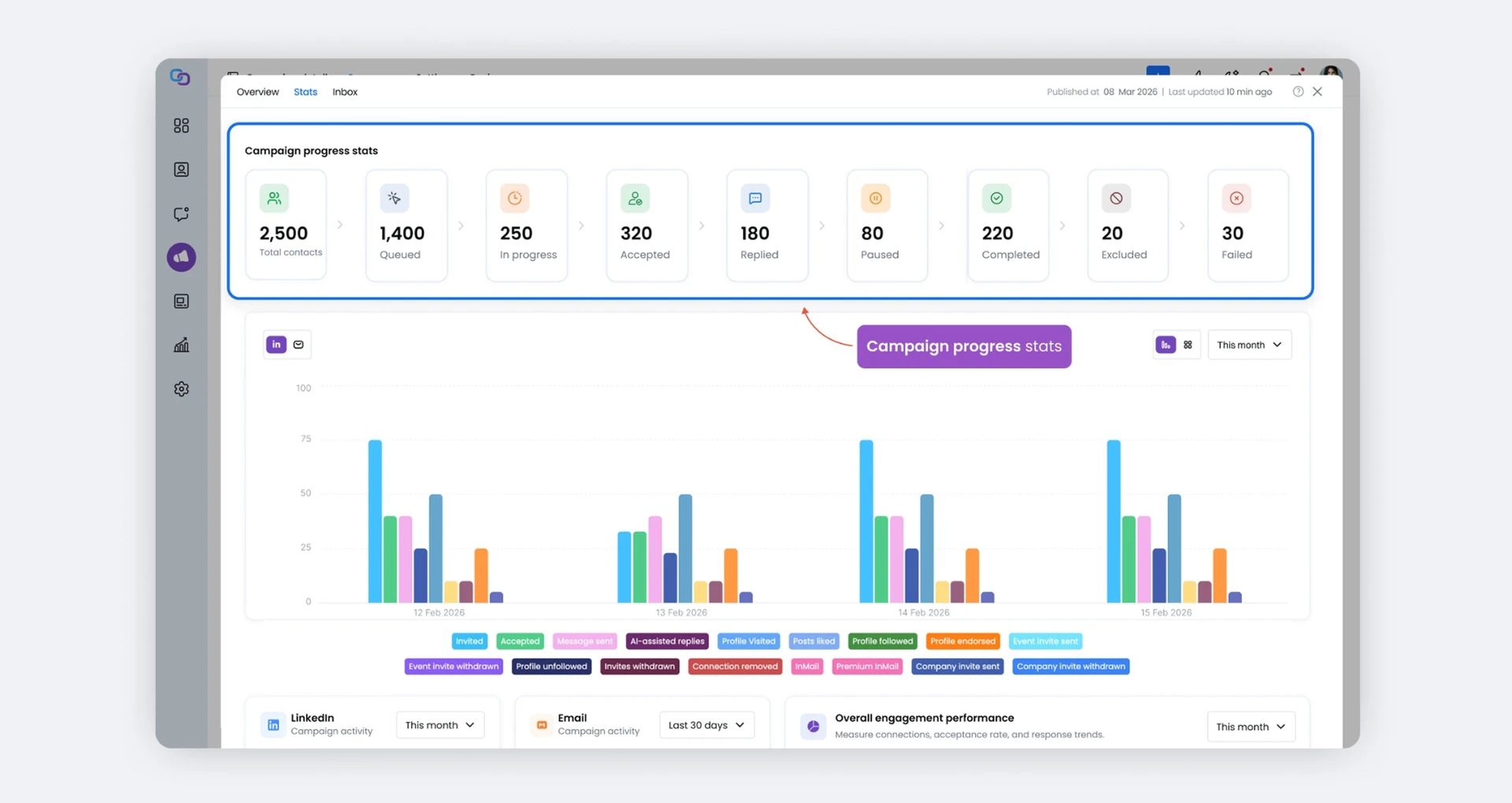
Duplicate prevention is better documented than team-wide visibility. Lead Engine Help confirms within-campaign exclusion, and agency material extends the claim across accounts. We did not execute a multi-client test, so the runtime boundary remains open.
Scope not established: A channel-unified inbox, campaign activity record, and CSV lead export are documented. Cross-client inbox aggregation, a separate admin audit log, and full message-history export were not established and should be verified in the account UI.
Is We-Connect Safe?
No automation tool can make a blanket LinkedIn safety promise. We-Connect documents pacing controls, has no browser extension, and offers per-account IP options. Users still submit credentials to a vendor cloud. The two assigned IPs we measured did not match the vendor's residential wording.
| What was checked | Result |
|---|---|
| LinkedIn connection method | Email and password supplied to We-Connect; Yes |
| Execution location | Vendor cloud; browser can be closed |
| Vendor assigned-IP claim | “Real Residential IPs” and residential/static/location-based wording |
| Test account 1 | Data Center; proxy Yes; VPN Yes; IPQS 94; recent abuse No |
| Test account 2 | Data Center; proxy Yes; VPN Yes; IPQS 87; recent abuse Yes |
| Cross-account fingerprint | Same reported Mac 10.15 / Chrome 135 on both accounts |
| Location and timezone control | 69 locations shown; timezone setting Yes |
| User-provided IP | Yes; built-in quality checker No |
| Pacing controls | Global action controls, 40% defaults, warm-up, randomized actions, sleep hours; enforcement not tested |
| Browser extension detection | Not applicable: no public or companion extension exists |
| Data location | DPA states transfer to and storage in US data centers; EU language is conditional |
| Public SOC 2 / ISO artifact | None established in the checked pages; evidence gap, not proof of no assurance |
We-Connect safety checks (September–September 2026)
As of September 2026 · first-hand two-account cloud/IP test and verified We-Connect primary sources
The vendor's safety Help uses the exact row label “Real Residential IPs”. In our France sample, both addresses were data-center proxy/VPN routes with high IPQS scores. IPQS is independent of LinkedIn: its result describes IP reputation, not whether LinkedIn will restrict an account. The contradiction supports pre-rollout IP checking, not a claim about the full pool or a prediction of restriction.
Active Extension Detection (AED) is the label visible in LinkedIn's production JavaScript. Its probes check specific browser-extension IDs and send scan results as an AedEvent. Being listed can reveal that an extension is installed before it acts. We-Connect has no extension, so an extension check is not applicable. That does not make the separate cloud-login and network path invisible or risk-free.
The DPA says customer personal data is transferred to and stored in US data centers. It also claims encryption in transit and at rest. EU wording is conditional, so procurement should not substitute an EU-residency assumption. Public SOC 2 or ISO evidence was not established in the checked material. That remains a due-diligence question, not proof that certification is absent.
Operators retain pacing controls and can bring their own IP, but a built-in checker is absent. This guide to proxy types and quality checks explains the background.
Manual behavior can also attract scrutiny: opening many profiles directly by URL or withdrawing invitations unrealistically fast may look automated. No tool eliminates LinkedIn restriction risk.
No blanket safety claim: No automation tool eliminates LinkedIn restriction risk. Both tested French accounts received high-risk data-center IPs where official material described residential ones, while the two-account sample cannot establish full-pool behavior or LinkedIn's own assessment.
What We-Connect Reviews and Reddit Actually Show
The review record is positive overall but dated. Across the G2 reviews from April 1, 2019 through December 20, 2024, G2 averaged 4.61★ across 83 rated records. Across the Capterra reviews in that same window, Capterra averaged 4.71★ across 68 rated records. The combined raw G2/Capterra view averaged 4.65★ across 151 rated records in that date window. We collapsed eight near-verbatim same-day G2/Capterra pairs. The resulting G2/Capterra view averaged 4.67★ across 143 deduplicated records in that same window. Those denominators are different and should not be interchanged.
The 143-record deduplicated G2/Capterra view covers April 2019 through December 2024. Reliability was its only major topic with more negative than positive mentions. It had 30 negative versus 18 positive mentions. Those reviews end before the current AI and Lead Engine state. Treat the issues as a retest list, not a current prevalence estimate. The trailing six-month G2/Capterra review window ending August 3, 2026 contained zero records.
The anomaly scan covered the same raw G2/Capterra records. It found weekly concentrations of 7 of 151 raw records, then 5 of 151 and 5 of 151. In that same G2/Capterra review window, it found a two-record same-day negative cluster that becomes one voice after cross-platform deduplication. These are patterns, not conclusions about cause.
| Mined hypothesis | Corroboration status | Next test |
|---|---|---|
| Imports or sends can fail | Present in dated reviews; current prevalence not established | Run representative CSV/import and sending workflow |
| Reply handling can misfire | Dated review hypothesis; current behavior untested | Run reply-stop and inbox reconciliation test |
| Billing/cancellation can create friction | Low-volume dated examples; current Terms confirm self-service cancellation and no-refund policy | Test billing lifecycle only if the claim is needed |
| Support can be fast or slow | Anecdotes range from minutes to 1–2 days; no current measured SLA | Time current tickets across issue types |
| Assigned-IP quality can diverge from residential wording | Corroborated only in our two-account France test | Repeat across dates and regions |
Review-corpus findings and current verification status
As of December 2024 · reconciled raw and deduplicated local review analysis
The title and body of the two Reddit posts we checked contained zero visible We-Connect mentions. That is an evidence gap, not a positive or negative Reddit signal, so no Reddit quote or sentiment percentage is reported.
Who Should Consider We-Connect — and Who Should Look Elsewhere
We-Connect requires an operating model that accepts cloud credential custody and values browser-off execution. Growth covers LinkedIn-only campaigns; teams needing email steps require Professional. Agencies can centralize paid sender seats, free non-sender managers, permissions, and duplicate controls. They should test cross-seat visibility before onboarding clients.
| Use case | Minimum viable plan | Deal-breaker to check |
|---|---|---|
| Solo LinkedIn-only outreach | Growth | Assigned-IP quality and credential-custody policy |
| LinkedIn + email sequence | Professional | Mailbox count/cost, deliverability, and current email discovery gap |
| Sales team with CRM handoff | Professional for durable native CRM entitlement | Authenticated sync, API/webhook behavior, and permissions |
| Agency with 10+ sender accounts | Custom Agency | Final quote, client separation, inbox scope, and multi-sender absence |
| Branded resale to clients | Separate White Label | Platform fee, wholesale rate, setup, and portal behavior |
| Credential-sensitive or residency-constrained procurement | No settled fit from public evidence | Vendor credential custody, US data-center disclosure, and certification evidence |
| Team requiring isolated client tenants, current sender rotation, or a verified admin audit log | No established current plan | Confirm another operating model rather than infer these capabilities |
We-Connect use-case fit and checks
As of August 2026 · verified We-Connect plan and capability evidence
Buyers should look elsewhere—or delay a commitment—when vendor-held LinkedIn credentials conflict with policy. The same applies to permission-based separation, custom pricing, or the lack of a current native email finder. The Agency page and pricing page establish the commercial shape, but not runtime permission enforcement or a 20-seat final quote.
How We-Connect Compares to Alternatives
This comparison is intentionally narrow. It uses only architecture, entry price, and one operating difference from the comparison snapshot; it is not a full ranking. Where a row rests on that snapshot rather than first-hand work, the limitation is stated in the same cell.
| Tool | Architecture | Entry price | Best known for |
|---|---|---|---|
| Linked Helper | Desktop + VPS/Web Version | $15/month | Session runs on the user's machine or controlled VPS; 24/7 operation requires user-managed compute |
| HeyReach | 100% cloud + login connector extension (comparison snapshot) | $79/month | The snapshot records unlimited senders and multi-account support; the architecture description was not independently verified here |
| SalesRobot | Cloud (comparison snapshot) | $59 per LinkedIn account/month | Conditional sequence branches are documented in the snapshot; no first-hand, review, or Reddit evidence was read for this row |
| Expandi | Cloud (comparison snapshot) | $99/month | A global inbox across workspaces/accounts is documented in the snapshot; no first-hand, review, or Reddit evidence was read for this row |
How We-Connect compares
As of August 2026 · approved publisher-product facts and supplied comparison snapshots for named alternatives
We-Connect itself starts at $69 monthly for LinkedIn-only Growth and $79 for Professional multichannel use. The label “cloud” alone does not settle this comparison. Buyers must compare credential/session custody, assigned-IP control, branching, agency separation, and the plan at which email becomes usable. HeyReach's recorded sender model comes with a cloud-and-connector description that was not independently verified. SalesRobot's recorded conditional branches and Expandi's recorded inbox each lack a deeper evidence pass here. Those constraints prevent any row from becoming an unqualified recommendation.
See all LinkedIn automation alternatives →
Where Linked Helper Fits
The two-account data-center-IP result and vendor credential custody make user-controlled execution worth evaluating.
Linked Helper, the publisher's product, is a desktop app for the user's computer or controlled VPS. Web Version provides browser access to the VPS instance. The session uses that hardware's IP or a per-account proxy; this changes control without removing restriction risk.
- IP validation: Its built-in IPQualityScore checker screens a user-provided proxy before use, addressing the missing gate above.
- Local-first records: Campaigns, CRM records, and message history stay in a local per-account database by default, changing the US storage boundary discussed in Safety.
- Current enrichment: Email Finder/Data Enrichment includes 620 monthly Standard or 3,100 monthly Pro data credits on a one-month license; they do not expire.
- CRM routes: It has 11 direct CRM connectors, plus Zapier and Make through outgoing webhooks, versus We-Connect's five native destinations.
Desktop campaigns require an active machine; 24/7 use adds VPS cost. There is no native LinkedIn-plus-email sequence builder or public developer REST API.
Entry pricing is $69/month for We-Connect Growth and $15/month for Linked Helper Standard. Teams prioritizing execution control and local-first records may evaluate Linked Helper too.
Methodology & Disclosure
The publisher relationship and author's employment are disclosed above. We separated first-hand observations, verified primary-source facts, derived patterns, and questions that still require testing.
First-hand work covered September and September 2026. In September 2026, a manual signup test connected two accounts from France and examined their assigned IPs with IPQualityScore. We also recorded the browser fingerprints reported for both accounts. This was a two-account, one-country sample, not a test of every IP, region, date, or LinkedIn outcome.
On September 16, we checked We-Connect's live site and both browser-rendered pricing states. We covered roughly 121 Help Center articles across 21 collections. We also covered current legal and data-processing terms, plus the agency and white-label surfaces. Review and Reddit records served only as issue-discovery inputs. Follow-up verification kept those patterns separate from current product facts.