

 21 min read

Best influencer marketing platforms at a glance
- Modash: Essentials is $199/month on annual billing and includes two seats, 300 profile openings, 150 email unlocks, and tracking for 100 creators.
- GRIN: Free has no subscription charge but adds a 20% wallet-deposit fee and requires a payment method on file; Starter is $200/month plus 10%.
- Custom pricing: Aspire and CreatorIQ require a sales quote; Upfluence also uses custom pricing and has a 12-month minimum contract.
- Creator orders: Collabstr Free charges a 10% hiring fee; Insense's $650 Trial lasts one month, covers one campaign for up to ten creators, and upgrades to quarterly Brand unless canceled at least 48 hours before it ends.
- Five-person budget: For the five-person, 100-creator, $50,000 annual-payout scenario, modeled totals are $7,988 for Modash, $9,500 for GRIN, and $20,916 for Influencer Hero before creator compensation and any unstated payout fee.
What is an influencer marketing platform?
An influencer marketing platform helps a brand find creators, organize partnerships, and measure campaign work. Some products focus on search and outreach; others manage ongoing programs with gifting, affiliate activity, and payouts; marketplaces match brands with individual creators and charge per order. The right fit depends on how often you hire creators and which work needs a shared system.
The best influencer marketing platforms at a glance
The table compares each platform's core job, entry price, and the constraint that changes how a buyer should budget.
| Tool | Best for | Standout feature | Starting price | Main trade-off |
|---|---|---|---|---|
| Modash | Creator search and tracking | 300 profile openings/month | $199/month, billed annually | Two seats; capped trial |
| GRIN | Ecommerce creator programs | Gifting, affiliate, and wallet payouts | Free + 20% wallet fee | Payment method required on Free |
| Aspire | Creator applications and outbound sourcing | Opt-in marketplace plus direct discovery | Custom quote | No public base price |
| Upfluence | Modular creator and affiliate programs | Fixed fee, no sales percentage | Custom quote | 12-month minimum |
| CreatorIQ | Multi-brand enterprise programs | Cross-brand governance | Custom quote | Sales-led scope |
| Collabstr | One-off creator orders | Free marketplace with escrow | Free + 10% order fee | Rights are set per order |
| Insense | UGC and paid-social briefs | One-campaign Trial for ten creators | $650 for one month | Auto-upgrades to quarterly Brand |
| Influencer Hero | Outreach and creator CRM | Public multi-tier pricing | $649/month; 3-month minimum | Standard has one seat |
Influencer Marketing Platforms: What Makes the Best Fit?
- Workflow: Choose between creator discovery, an ongoing campaign and affiliate system, or one-off marketplace orders; some products combine those jobs.
- Creator access: Compare filters, profile openings, contact unlocks, and tracking limits; a large database does not show how many creators fit your brief.
- Team capacity: Match seats, brands, campaigns, and reporting limits to the team that will use the platform.
- Payments and rights: Check whether fees apply to wallet deposits, creator payments, or marketplace orders, and spell out content usage rights in the brief.
- First-year cost: Add software, minimum commitments, mandatory fees, and upfront billing before comparing plans.
1. Modash: Best for creator discovery and relationship management
I like Modash for a lean discovery workflow, but its entry plan is weak for an agency that needs client-level permissions.
Modash is a creator-search and tracking workspace for brands that want to find creators and manage campaign communication. Its official price page lists Essentials at $199 per month or $2,388 paid annually, with two seats, 300 profile openings, 150 email unlocks, and tracking for 100 creators. Performance is $499 monthly or $5,988 paid annually, with five seats, 800 profile openings, 400 email unlocks, and 250 tracked creators.
I walked through Modash's public Manage tour. It keeps the creator profile, conversation history, and assignee in the same view. I like that handoff context, but the three-column workspace is busy, so a trial is the right way to decide whether the layout suits your team.
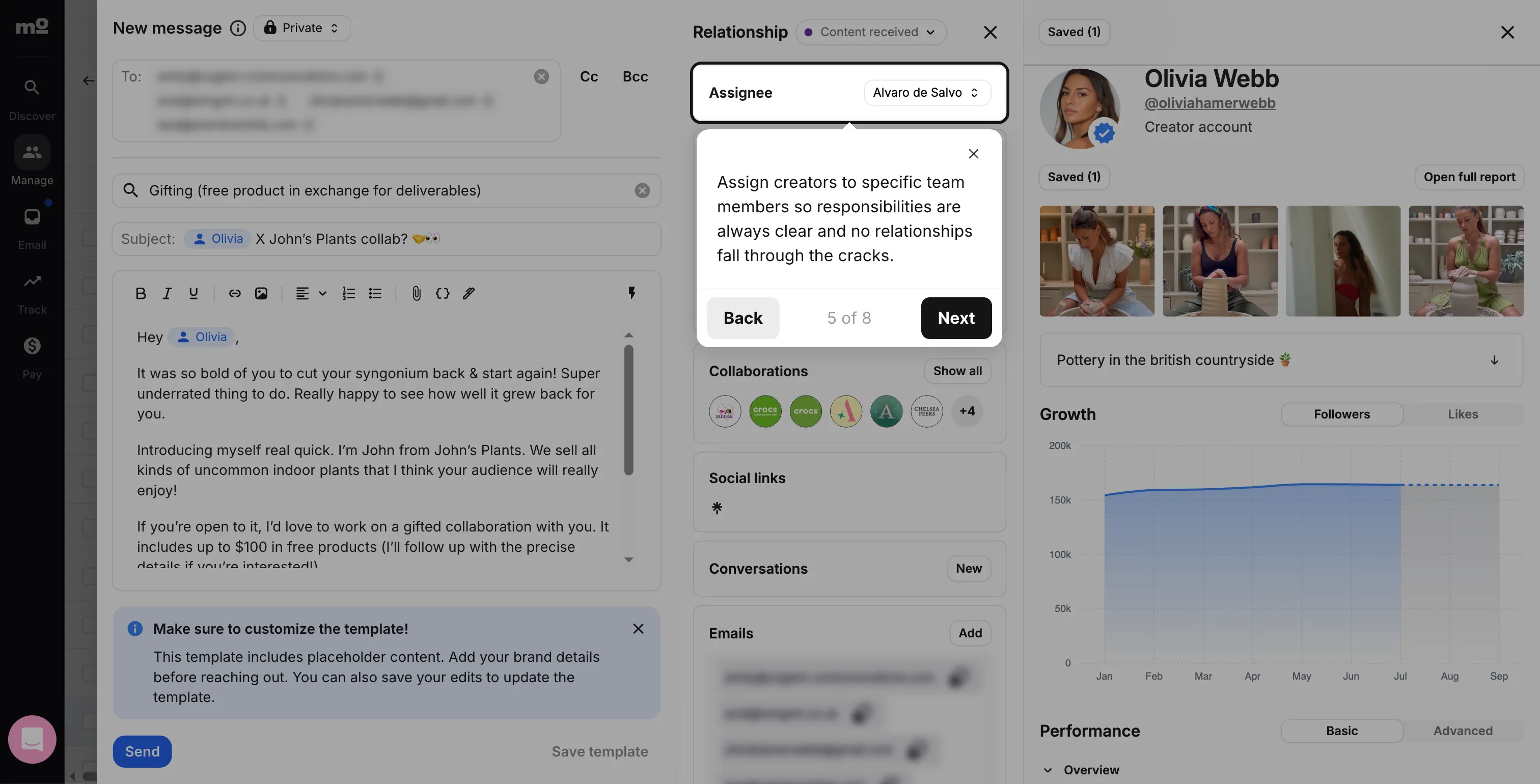
Inside Modash's Manage tour, the assignee appears beside creator details and conversation context.
According to the pricing page, the advertised 14-day trial is capped at 20 profiles, six email unlocks, and ten tracked creators. Performance includes payments and affiliate management with a combined 0% fee up to $10,000 a year, then 5% above that amount. The entry plan has enough tracking capacity for a small program, but the discovery and outreach meters can run out before the creator list does.
Pros
- Creator profile, conversation history, and ownership share one view
- Essentials tracks 100 creators and includes two seats
- Paid plan limits for profiles and email unlocks are published
Cons
- The free trial allows 20 profiles and six email unlocks
- Essentials has only two seats for a growing team
Product pricing — Modash
Essentials: $199/month or $2,388/year upfront | Performance: $499/month or $5,988/year upfront. No annual contract is listed; the annual option stays active through the paid term.
2. GRIN: Best for an ecommerce creator program with wallet-based payments
GRIN fits an ecommerce team prepared to fund a wallet, but I'd skip Free if finance won't put a payment method on file.
GRIN combines creator search, CRM, gifting, paid partnerships, affiliate campaigns, and payouts in an ecommerce-oriented program workspace. The current pricing page lists Free at $0 plus a 20% wallet-deposit fee, Starter at $200/month plus 10%, Growth at $500/month plus 7%, and Scale at $1,500/month plus 5%. Fees are added when you fund the wallet, and the fee on a deposit isn't refunded if you withdraw unused funds.
GRIN's listed search and gifting allowances show how its self-serve tiers differ:
| Plan | Creator searches/month | Gift allowance |
|---|---|---|
| Free | 1,200 | 10 total |
| Starter | 12,000 | 100/month |
| Growth | 36,000 | 300/month |
| Scale | 120,000 | 1,000/month |
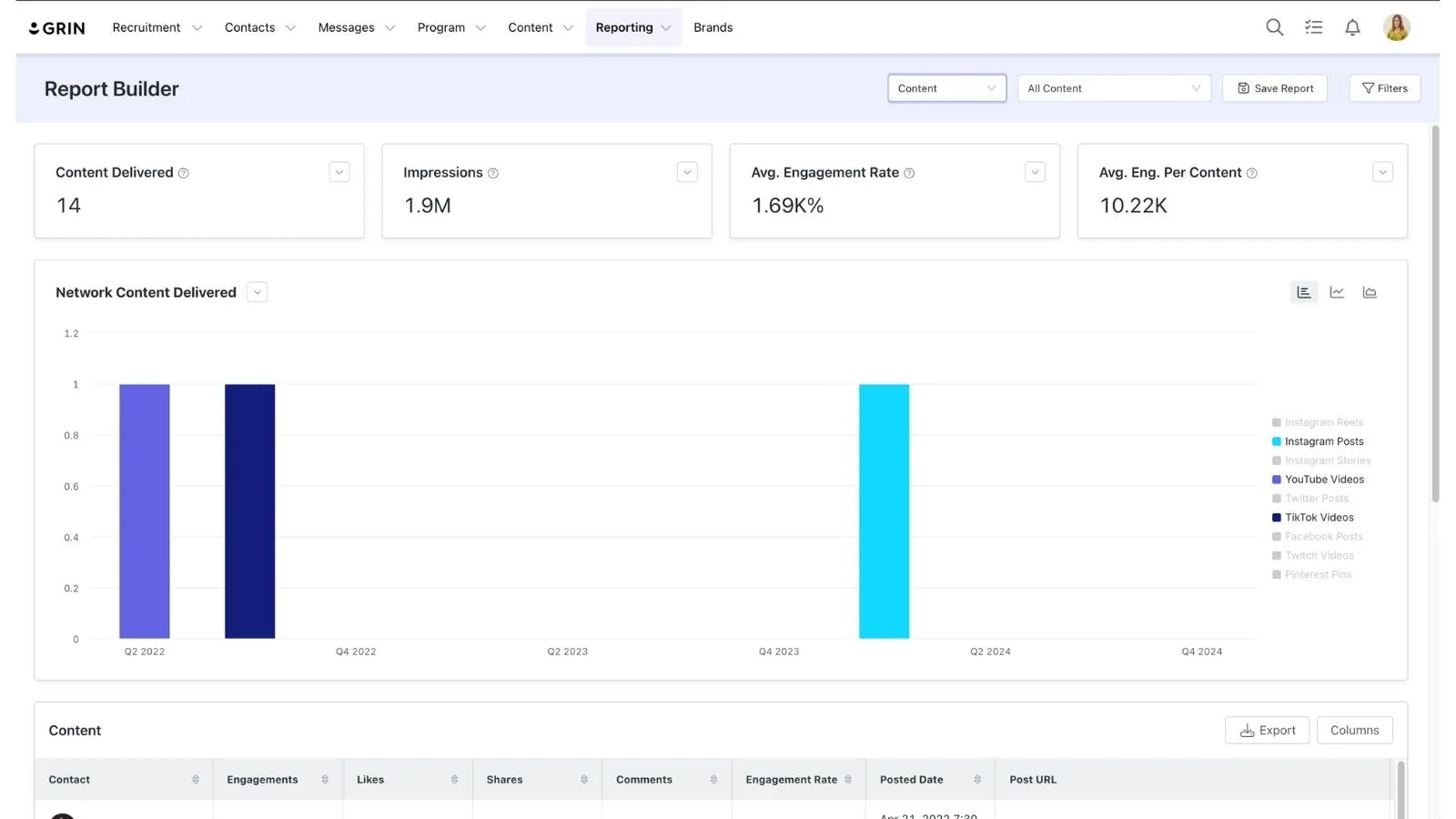
Inside GRIN's Report Builder, campaign KPIs sit above a chart of content delivered across social networks.
Starter raises the Free plan's gift and search allowances, while Growth adds multiple brands. All self-serve prices are monthly in USD, and the plans are month to month. The company says a payment method goes on file at signup, even for the Free option, so Finance should approve the payment requirement before anyone starts the account.
The math changes with the wallet. A $1,000 Starter deposit costs $1,100 before creator compensation is spent, and the corresponding Free deposit costs $1,200. GRIN says Starter's lower fee offsets Free once you fund about $2,000 per month, but limits and gift volume can force a higher tier first. Its pricing page also links GRIN with Gia and GRIN Classic separately, so check which product the quote or signup opens.
Pros
- One workspace covers search, gifting, affiliate, paid partnerships, and payouts
- Growth supports multiple brands and 300 gifts per month
- Month-to-month self-serve plans publish the fee base
Cons
- Wallet deposits carry a nonrefundable 5%–20% fee
- A card or ACH account is required at signup
- Free includes only ten gifts total and two live campaigns
Product pricing — GRIN
Free: $0/month + 20% of wallet deposits | Starter: $200/month + 10% | Growth: $500/month + 7% | Scale: $1,500/month + 5%. Payment method required at signup; GRIN doesn't deduct the fee from creator payouts.
3. Aspire: Best for a brand combining creator applications and outbound sourcing
Aspire suits a brand that can scope its program with sales; solo buyers who need a public monthly price should look elsewhere.
Aspire pairs an opt-in creator marketplace with outbound discovery and campaign tools. It suits a brand that wants creators to apply to a brief as well as a team that can recruit directly. The public site doesn't list a base subscription price or self-serve trial, and Aspire asks buyers to book a demo and its agreement places fees in an order form.
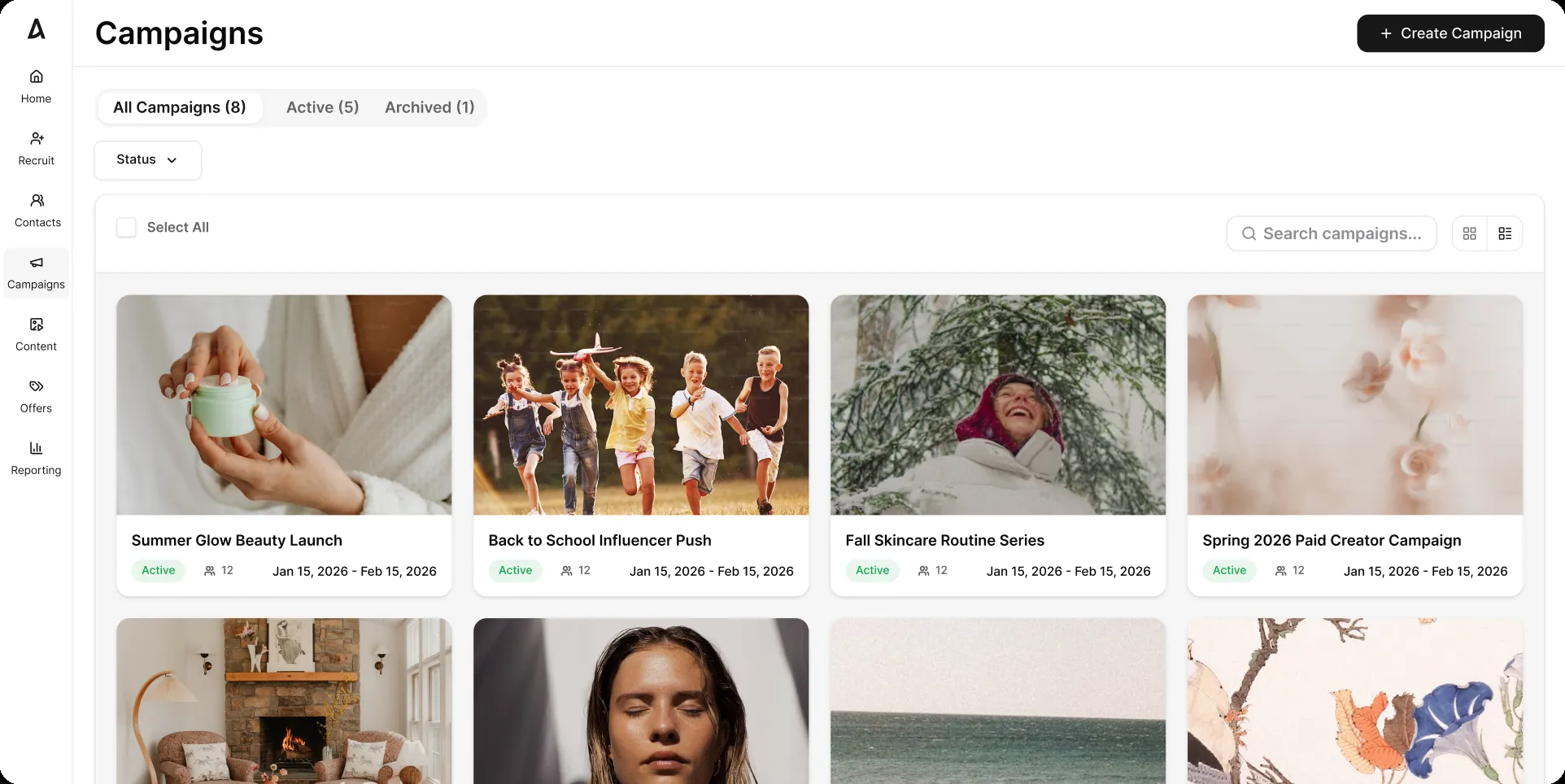
Inside Aspire, campaign cards display status, creator count, and campaign dates.
That makes the product harder to compare on entry cost but avoids pretending that an enterprise quote is a published plan. Aspire offers an optional Curated Creators Plus service, a separate sourcing add-on rather than the software subscription. A handling-fee page lists an 8.5% charge on payments from the budget for creator fees, but the published schedule is dated 2023. Ask Aspire to confirm current payment and processing fees in writing before you budget from that number.
A July 2026 G2 review by Harjot P. praised Aspire's shared hub for applications, profiles, campaigns, approvals, content, and reporting, while also mentioning occasional glitches. That is a useful workflow question for a demo, not evidence that the issue is widespread.
Pros
- Opt-in creator applications and outbound sourcing build a roster in two ways
- Shared campaign workflow connects profiles, approvals, and content
- Optional Curated Creators Plus adds a separate 600-invite sourcing service
Cons
- The base subscription is quote-only
- The published handling-fee schedule dates to 2023 and needs confirmation
Product pricing — Aspire
Custom quote and no public base subscription. Optional Curated Creators Plus: $300/month for 600 invites. Confirm current transaction and processing fees in the order form.
4. Upfluence: Best for teams choosing creator and affiliate modules
I think Upfluence makes sense when a team needs selected creator or affiliate modules, but its 12-month minimum makes it a poor fit for a one-off campaign. The platform sells custom modules for finding creators, scaling programs, and tracking or paying partners. Its current pricing page says the quote depends on the modules, team size, and program volume, and it charges a fixed platform fee rather than a percentage of sales. A free trial follows an initial call, while separate free influencer tools are available without that process.
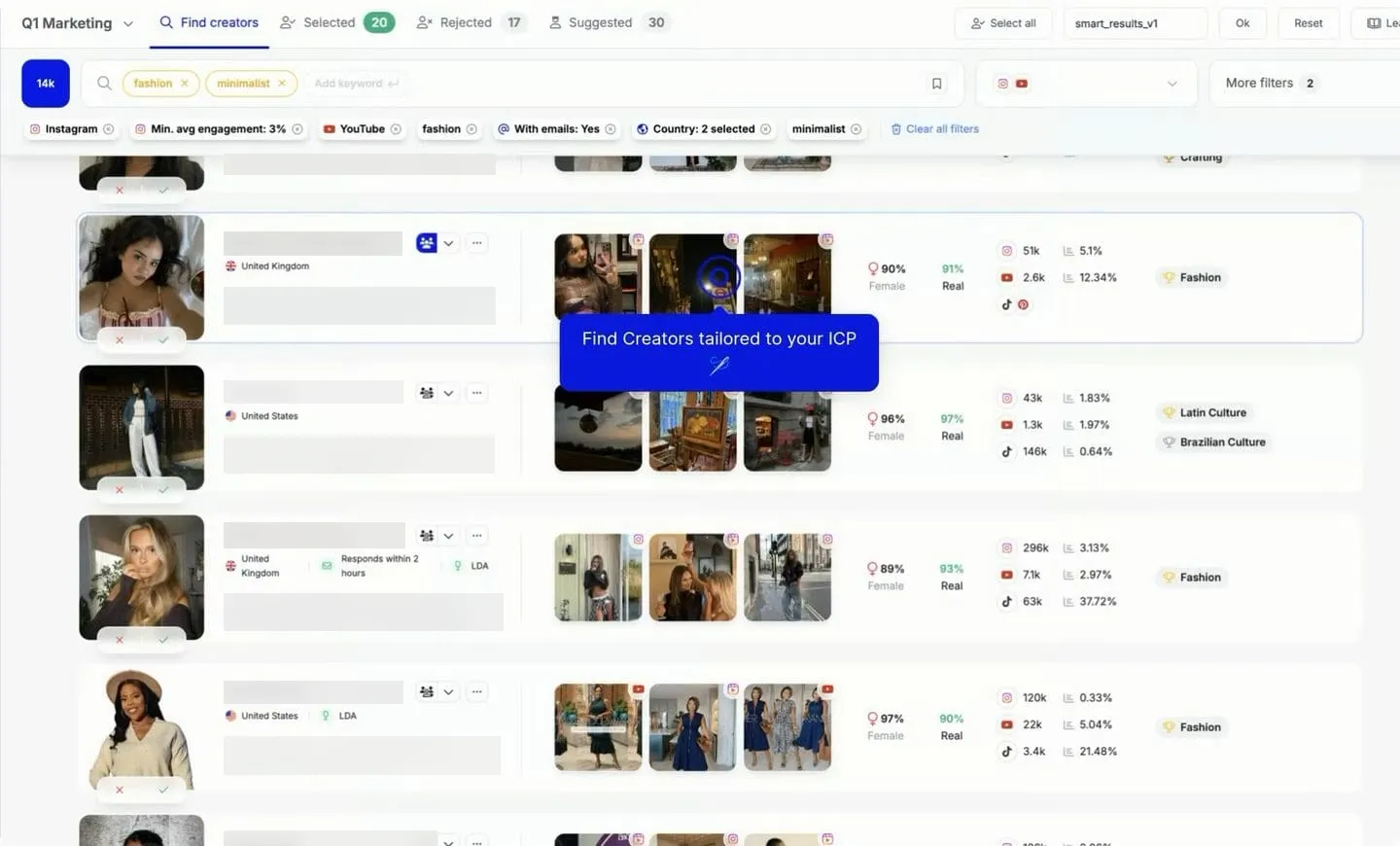
Inside Upfluence, the Find Creators screen filters creators by platform, engagement, country, and email availability.
For a team that only needs discovery, that modular structure can be a better fit than buying a large bundle. The quote should clarify onboarding, integrations, reporting, and support, along with renewal terms and control over creator payments. The vendor says there's no mandatory setup fee and offers optional onboarding help. Cindy Venerio's July 2026, five-star Trustpilot review praises onboarding, and John K.'s July 2026, one-star review alleges an unwanted six-month renewal. Raquel's May 2026, one-star review flags payment and access friction, while Upfluence replies that the sponsoring brand or agency controls those decisions. Read the renewal clause and identify who controls creator payments before signing.
Pros
- Buyers can choose discovery, program, and tracking/payment modules
- Fixed platform fee doesn't take a percentage of sales
- Free trial follows an initial call
Cons
- Custom pricing requires a quote
- Annual plans require a 12-month minimum
- Optional onboarding may add cost
Product pricing — Upfluence
Custom fixed platform fee | 12-month annual minimum | trial follows an initial call. Upfluence says it charges no percentage-of-sales fee.
5. CreatorIQ: Best for governance across enterprise creator programs
I think CreatorIQ is worth a sales-led demo only when a team needs cross-brand governance; smaller teams may find the process too much overhead.
CreatorIQ is built for organizations coordinating creator discovery, evaluation, management, campaign execution, and measurement across teams or brands. Its pricing request page asks buyers to schedule a call to discuss packages and team needs, and there's no public self-serve price to compare with a small-team subscription.
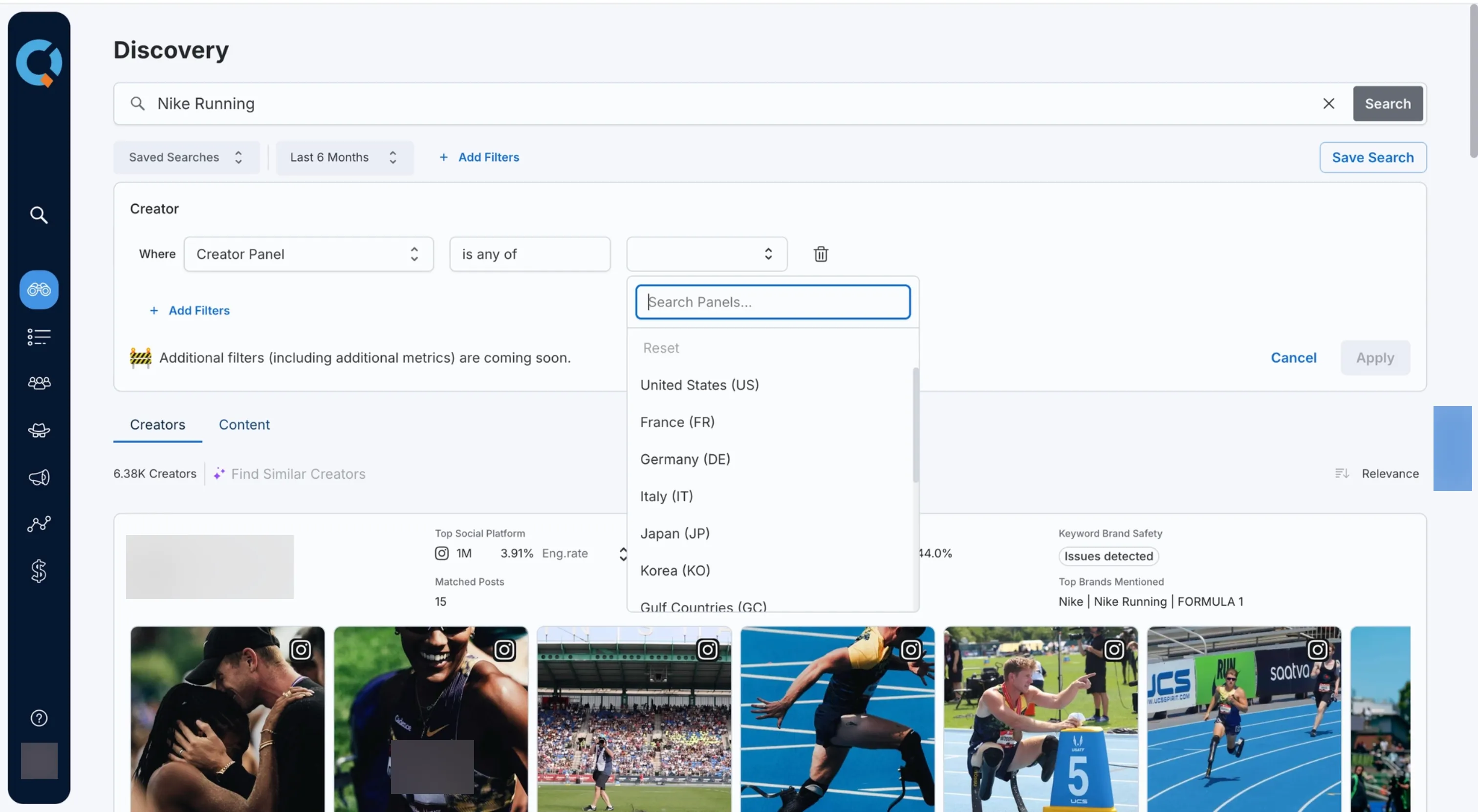
CreatorIQ's Discovery workspace filters creators by panel and shows audience, platform, and brand metrics.
That procurement step is a drawback for a buyer trying to budget quickly, but the relevant question for a large program is whether the proposed package handles permissions, reporting definitions, regional operations, and implementation. In an incentivized October 2026, G2 review, Aileen A. praised campaign tools and integrations while flagging issues with Facebook profiles and with capturing paid metrics, and CreatorIQ replied that both had been flagged to its product team. I'd make metric definitions and data-source coverage part of a proof-of-concept checklist rather than treating a platform average as a guarantee.
Pros
- Discovery, creator evaluation, management, campaigns, and measurement sit in one platform
- Pricing calls can scope packages around team needs
- Current product review praises campaign tools and integrations
Cons
- No public price or self-serve trial terms
- You need a sales conversation before you can compare the package
- A current reviewer flagged issues with Facebook profiles and with capturing paid metrics
Product pricing — CreatorIQ
Custom quote | pricing conversation required. No public base price or free-trial terms are listed on the pricing request page.
6. Collabstr: Best for hiring individual creators from a marketplace
I like Collabstr for occasional creator orders because escrow ties payment to delivery; teams that need ongoing roster governance should consider a CRM.
Collabstr lets a brand search creator profiles and hire people directly, and a paid subscription isn't required for one-off orders. Its current annual-billing page lists Free at $0 with a 10% hiring fee, Pro at $249/month billed annually ($2,988 upfront) with one campaign a month, and Premium at $333/month billed annually ($3,996 upfront) with unlimited campaigns and a 5% hiring fee. The Enterprise/Agency plan starts at $1,000/month billed annually and adds subaccounts, seats, permissions, and white-label reports. The pricing page also offers a monthly billing toggle, but these displayed prices use annual billing.
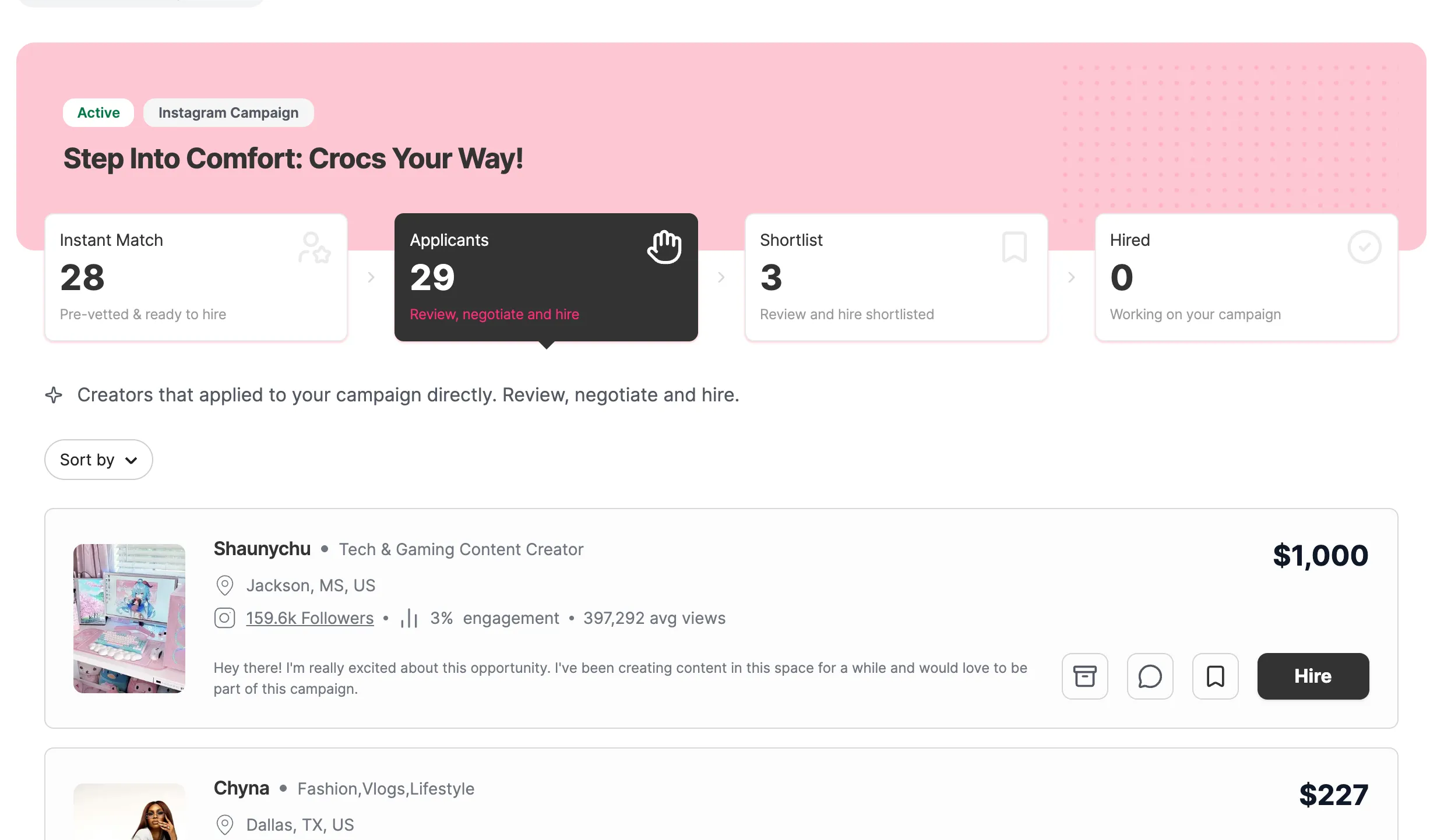
Inside Collabstr, campaign applicants, shortlists, and hires appear as separate stages, with rates beside creator proposals.
The useful distinction is whether you're buying one creator order or a campaign workflow. Collabstr holds marketplace payment in escrow until the order is complete, but the brand and creator need to agree on usage rights in the order. Its Trustpilot profile is 4.5/5 across 507 reviews, many from creators, and the recent sample includes a five-star review that still asks for payout improvements. I'd not compare that score directly with business-software G2 ratings.
Pros
- Search and direct hiring are available on the free plan
- Escrow holds marketplace payments until order completion
- Premium adds unlimited campaigns and tracks 15 posts at a time
Cons
- Free orders carry a 10% hiring fee
- Campaign posting requires a paid plan
- Usage rights are agreed order by order
Product pricing — Collabstr
Free: $0 + 10% hiring fee; Pro: $2,988/year upfront + 10%; Premium: $3,996/year upfront + 5%; Enterprise/Agency: from $12,000/year upfront with a custom fee. Creator compensation is separate.
7. Insense: Best for UGC and paid-social creator content
Insense suits an active paid-social brief; a buyer who needs an unconditional free trial should look elsewhere.
Insense is a marketplace and workflow for sourcing UGC and influencer content, including Meta Partnership Ads. Its paid one-month Trial covers up to one campaign and ten creators, with a 20% marketplace fee; creator payments are extra. It automatically upgrades to Brand at $500 per month billed quarterly unless you cancel at least 48 hours before the trial ends. Brand is $1,500 per quarter with a 10% marketplace fee, and Agency is $2,400 per quarter with a 7% fee and up to five brands.
The published Insense plans differ in commitment, seats, and campaign scope:
| Plan | Subscription commitment | Included scope |
|---|---|---|
| Trial | Paid for one month; auto-upgrades unless canceled 48 hours before the end | 1 seat, 1 brand, 1 Meta Partnership Ads connection, 1 campaign, and up to 10 creators |
| Brand | Billed quarterly | 2 seats, 1 brand, 10 Meta Partnership Ads connections, unlimited campaigns and creators |
| Agency | Billed quarterly | 4 seats, up to 5 brands, unlimited Meta Partnership Ads connections |
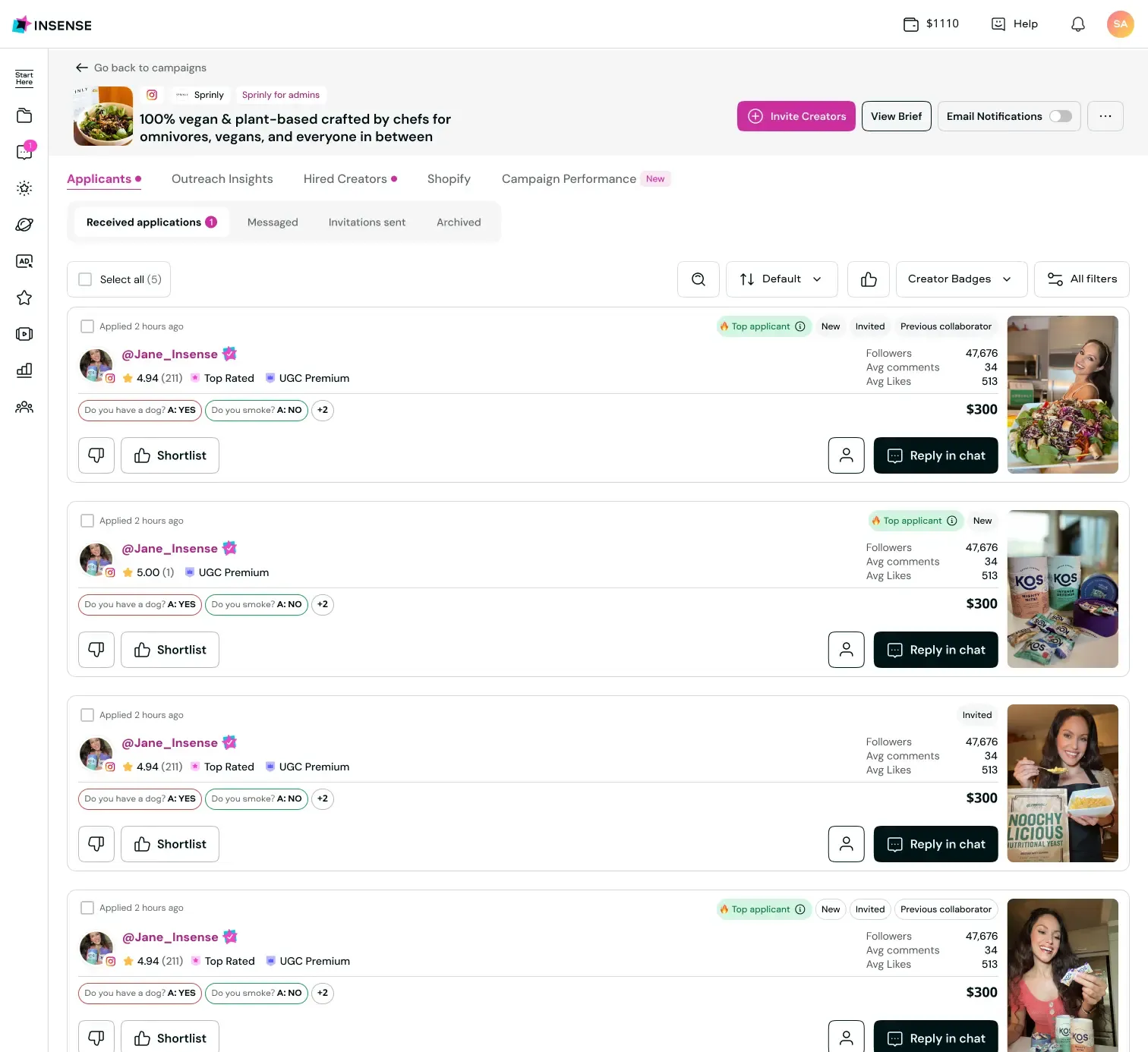
Inside Insense, the Applicants view puts creator signals, rates, shortlisting, and chat controls on each campaign response.
That structure is useful when a team has a concrete content brief and paid-social use in mind. But “trial” sounds lighter than the actual commitment. The cancellation window and separate creator budget belong in the first budget review. A March 2026, seller-invited G2 reviewer asked for more flexible trackers and exports. Advertiser Ronnie Teja's September 2026, one-star Trustpilot review alleges a creator-fit and off-brief payment problem. Check usage rights, revisions, and dispute handling before a campaign starts.
Pros
- UGC and Meta Partnership Ads permissions share a campaign workflow
- Brand and Agency list quarterly prices and fee rates
- Agency includes five brands and unlimited campaigns
Cons
- The paid trial auto-upgrades unless canceled 48 hours early
- Creator payments are separate from subscription and marketplace fees
- The Agency base plan has four seats
Product pricing — Insense
Trial: $650 for one month + 20% fee and creator spend | Brand: $1,500/quarter + 10% | Agency: $2,400/quarter + 7%. The Trial converts unless canceled 48 hours before the end.
8. Influencer Hero: Best for teams that want public pricing for outreach and CRM
For a small business with one outreach owner, Influencer Hero Standard is easier to budget than a quote-only platform; an agency that needs shared client workspaces should skip it.
Influencer Hero combines creator discovery, outreach automation, a CRM, UGC tracking, and payouts in public plan tiers. Standard costs $649 per month with a three-month commitment, or $5,448 billed upfront for a year at the displayed $454 monthly rate. That plan has one seat, 1,000 monthly reach-outs, 200 tracked UGC items, and up to 20 payouts. Pro costs $8,808 per year upfront for three seats, and Business costs $20,916 for eight seats. Annual rates are discounted for prepayment, not billed monthly.
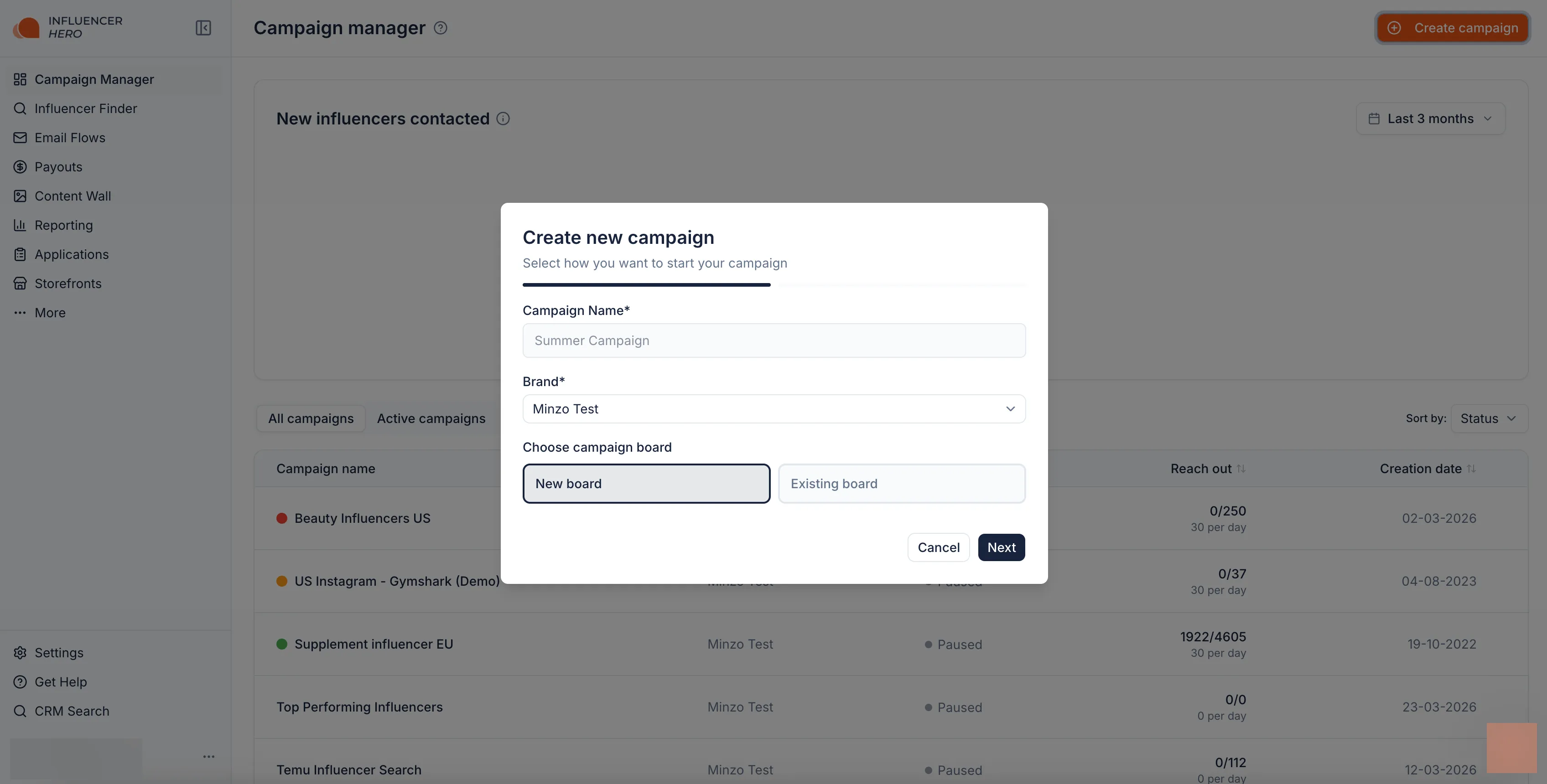
Inside Influencer Hero, campaign setup asks for a campaign name and brand, then lets you choose a new or existing board.
The public tiers make it easier to screen a budget than a sales-only quote, though team seats and discovery/contact credits still matter. Current help material lists separate credits for searches, reports, and contact lookups. An unnamed CMO's August 2026, one-star Capterra review criticizes filters, messaging, payments, and the interface. Cody A.'s April 2026, five-star review still mentions a manual age-fit check. I'd start with a precise creator brief and inspect the contact-credit meter before settling on a tier.
Pros
- Public tiers show upfront annual costs and seat counts
- Standard includes 1,000 monthly reach-outs and 20 payouts
- CRM and outreach automation are included across plans
Cons
- Annual plans require upfront payment
- Search, report, and contact credits are separate meters
- Standard has one seat
Product pricing — Influencer Hero
Standard: $5,448/year upfront | Pro: $8,808/year upfront | Business: $20,916/year upfront. Quarterly rates are paid monthly with a three-month commitment; Enterprise pricing is custom.
Other tools considered: Creator.co
Creator.co's Self Serve plan is another public-price option beside Influencer Hero's individual Standard tier: $199/month on the annual view ($2,388/year), one seat, 100 contact credits, and 50 insight reports. The annual view advertises unlimited collaborations, but those separate research limits still apply, and each extra 100 contact credits costs $99. Its monthly panel shows $299/month and a three-month minimum, and the FAQ also requires 30 days' cancellation notice. I checked the public pricing panel and campaign-builder tour. The plan fits one operator; teams that need shared seats should look elsewhere.
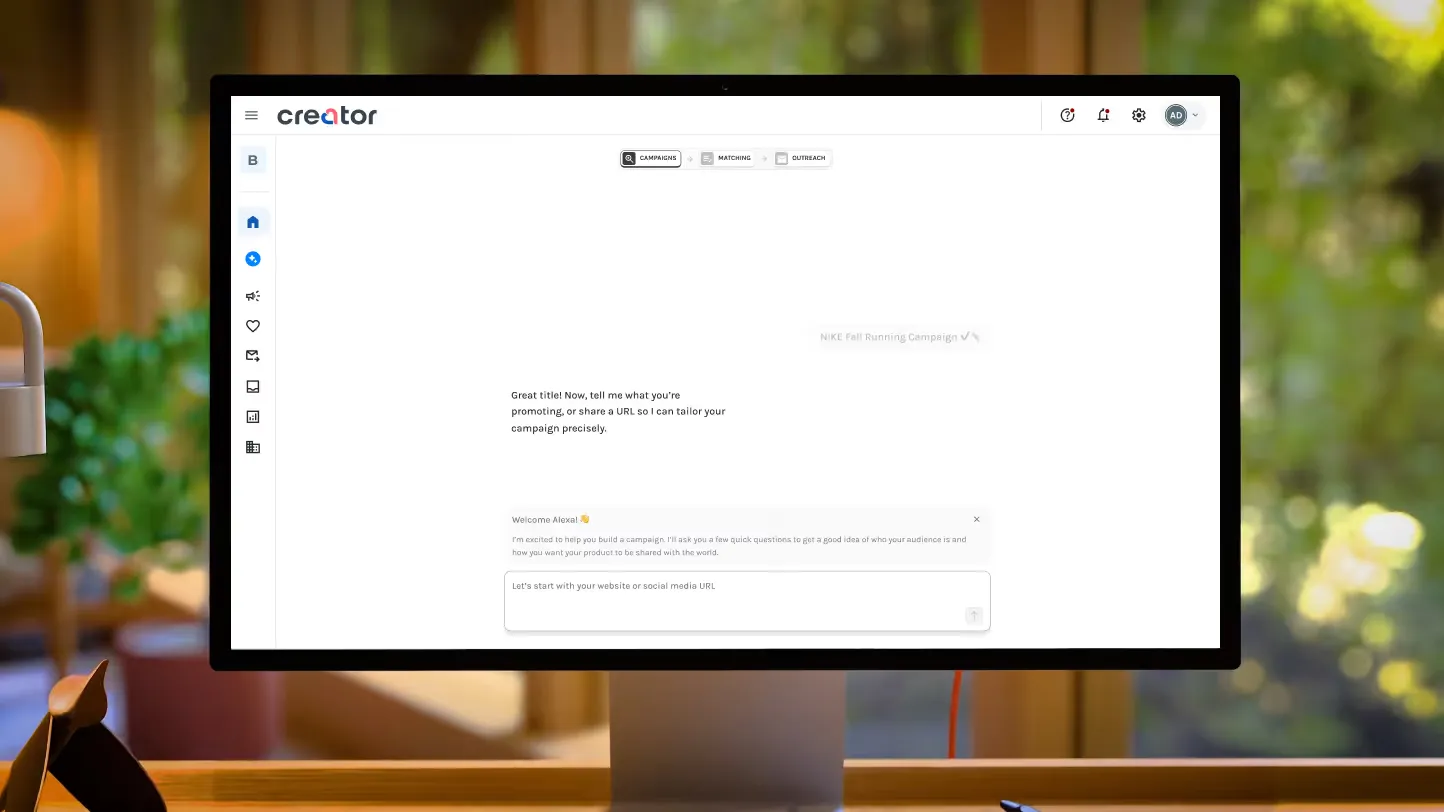
Inside Creator.co, the London campaign builder starts with a website or social media URL.
The image comes from Creator.co's public product tour. Its campaign builder starts with a brief based on deliverables, timing, and usage rights. Before drafting it, check the setup question asking for a website or social media URL.
What does an influencer marketing platform cost for a real workload?
For one operator, Modash Essentials and Influencer Hero Standard cost $2,388 and $5,448 a year upfront; modeled five-person totals range from $7,988 to $20,916 before creator compensation. The scenarios use different features and fee bases, so treat them as budgeting examples, not interchangeable workflows.
One operator: 20 active creators and four campaigns a year
For one operator managing 20 active creators and four campaigns per year, Modash Essentials costs $2,388 upfront and Influencer Hero Standard costs $5,448 upfront. I modeled 20 new contacts per quarter and one tracked content item per active creator; the table gives plan limits.
| Plan | Annual software | Published capacity / fees to check |
|---|---|---|
| Modash Essentials | $2,388 upfront | 2 seats; 100 tracked creators; 300 profile openings and 150 email unlocks per month. |
| Influencer Hero Standard | $5,448 upfront | 1 seat; 200 tracked UGC items; 1,000 monthly reach-outs. Confirm payout fees; the public table doesn't state a transaction rate. |
Neither figure includes creator compensation. Campaign quotas and measurement definitions can still change which plan fits, even when both cover the stated seat and tracking workload.
Five-person ecommerce team: 100 active creators and $50,000 in annual payouts
For five users managing 100 active creators and $50,000 in annual creator payments, Modash Performance totals $7,988, GRIN Growth totals $9,500, and Influencer Hero Business costs $20,916 before any transaction fee not stated publicly. The table gives fee calculations and plan capacity.
| Plan | Annual software and modeled fee | Capacity / fee calculation |
|---|---|---|
| Modash Performance | $5,988 upfront + $2,000 = $7,988 | 5 seats and 250 tracked creators. With no affiliate volume, 5% × ($50,000 payments − $10,000 fee allowance) = $2,000. |
| GRIN Growth | $6,000 in 12 monthly payments + $3,500 = $9,500 | Multiple brands; 300 gifts/month; 7% × $50,000 wallet deposits = $3,500. Card or ACH details go on file. |
| Influencer Hero Business | $20,916 upfront; transaction fee not stated | 8 seats; 1,500 tracked items; 500 payouts. Confirm payout fees because the public table doesn't state a transaction rate. |
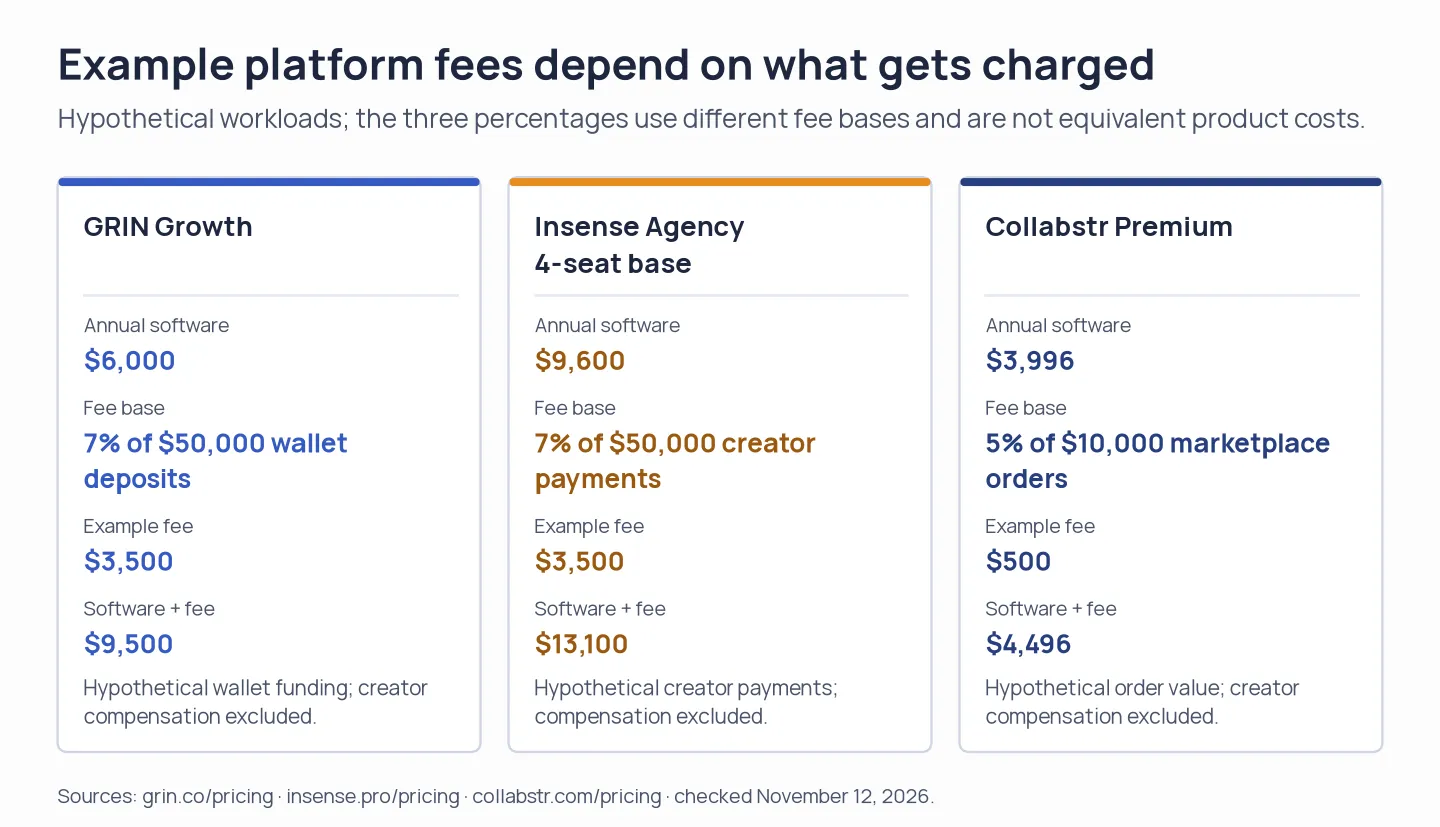
The 7% rate applies to different fee bases, and the shown software subtotals exclude creator compensation and optional extras.
These are arithmetic examples from public plan terms, not quotes. The Modash calculation assumes the entire $50,000 is payments, with no affiliate volume using the combined $10,000 allowance. Creator compensation, taxes, card processing, foreign exchange, and negotiated terms are excluded from software totals. Agency packages remain custom quotes and aren't in this comparison.
How to choose
Choose discovery-led influencer marketing software to find and qualify creators, a program workspace to manage repeated campaigns, gifting, affiliate links, and payouts, or a marketplace to buy one deliverable without building a creator program.
Then price the workload, not the headline. Count seats, profile openings, contact unlocks, tracked posts, campaigns, creator payments, and the fee base. A 5% wallet charge, 5% marketplace hiring fee, and 5% of annual affiliate payments aren't interchangeable. For multi-brand or agency work, confirm separate client workspaces, permissions, report exports, and consolidated billing before you sign.
If you already pay for a commerce or social platform, check its current creator features before adding another subscription. Shopify Collabs lets merchants search, invite, and manage creator relationships inside Shopify, though Shopify says it isn't accepting new creator signups while existing creators and merchant invitations continue. TikTok One offers creator search and brand projects at no platform charge, but you need a verified business to create a project, and availability depends on region. These native tools can cover Shopify affiliate workflows or TikTok campaigns, and they aren't equivalent to a cross-network creator CRM.