7 Best Snov.io Alternatives in 2026: LinkedIn Data, Email Finding, and CRM Integrations Compared

7 Best Snov.io Alternatives in 2026: LinkedIn Data, Email Finding, and CRM Integrations Compared

Milosh Potikj

B2B Content Strategist & Writer

Updated atUpdated: July 21, 2026Read time50 min read
Quick Answer

Linked Helper is the best Snov.io alternative for users who prioritize LinkedIn-sourced lead volume, lower combined tool cost, and integrated email discovery in one flat-rate license. Snov.io's core is a cloud contact database and email-outreach suite; LinkedIn automation (connection requests, messages, InMails, sequences) is a separate cloud-hosted add-on billed per connected LinkedIn account ($59-69/month), distinct from its optional local browser extension used for LinkedIn lead collection and optional email enrichment rather than campaign execution. Linked Helper runs LinkedIn collection, outreach, email finding, and CRM handoff from a $15/month license on the machine or VPS environment you control; it does not require a separate automation add-on, although each concurrently running LinkedIn account still needs its own license. We compared these tools: Linked Helper's 11 direct native CRM connectors and bundled workflow, versus Snov.io's HubSpot/Pipedrive-only native CRM sync and separate per-account LinkedIn Automation pricing, drove the cost and workflow-depth verdict.

ToolTool categoryBilling unit usedDocumented annual costCost vs Snov.io
Linked HelperLinkedIn automation20 Standard licenses$1,58488% less
Instantly.aiCold email1 Hypergrowth team workspace$931.2093% less
GetProspectData enrichment1 shared Growth 20k workspace$1,671.6088% less
LushaSales intelligence20 Starter seats$7,78843% less
Snov.ioData enrichment1 Pro S team plan + 20 LinkedIn slots$13,635Baseline (current tool)
Apollo.ioSales intelligence20 Professional seats$18,96039% more
KasprSales intelligence20 Business seats$18,96039% more
LemlistMultichannel outreach20 Multichannel Expert seats$20,88053% more

What a 20-user, 20-LinkedIn-account workflow really costs after normalizing seats, account slots, and annual billing¹

Publisher disclosure

This article is published by Linked Helper. Linked Helper is our product and our top recommendation. First-hand observations are reported by the author where applicable; rankings and recommendations follow the evaluation framework below.

Key takeaways

  • Data quality—not price—was the leading Snov.io switching signal in our analysis of 10,500+ reviews and 370 Reddit threads. Accuracy and LinkedIn-data-breadth complaints generated 160+ negative mentions, so the first migration test should be a controlled sample of real prospects, not a comparison of headline credit prices.
  • Billing units changed the cost ranking. In a documented 20-user, 20-LinkedIn-account scenario, Snov.io totals $13,635/year because LinkedIn Automation is a separate per-account slot; Linked Helper totals $1,584/year with annual and 20-license discounts. Instantly and GetProspect could not be honestly normalized without a contact-and-credit requirement, so we report no invented 20-seat total for them.
  • Our source-code teardown found all five inspected extensions—Apollo, GetProspect, Kaspr, Lemlist, and Lusha—on LinkedIn's Active Extension Detection probe list. Kaspr and Lemlist also uploaded the LinkedIn session cookie to vendor infrastructure, while Apollo, GetProspect, and Lusha kept session custody local. An extension label alone therefore does not describe the operating risk.
  • Feature labels also hid execution differences: Apollo's current LinkedIn sequence steps are manual, while Snov.io now sells separate cloud LinkedIn Automation with connection requests, messages, InMails, and multichannel sequences. Before migrating, verify who actually performs each step, where the session runs, and which extra plan or account slot is required.

What Is Snov.io?

Snov.io is a cloud sales-engagement and data-enrichment platform that combines a web application, browser extensions, and a contact database.
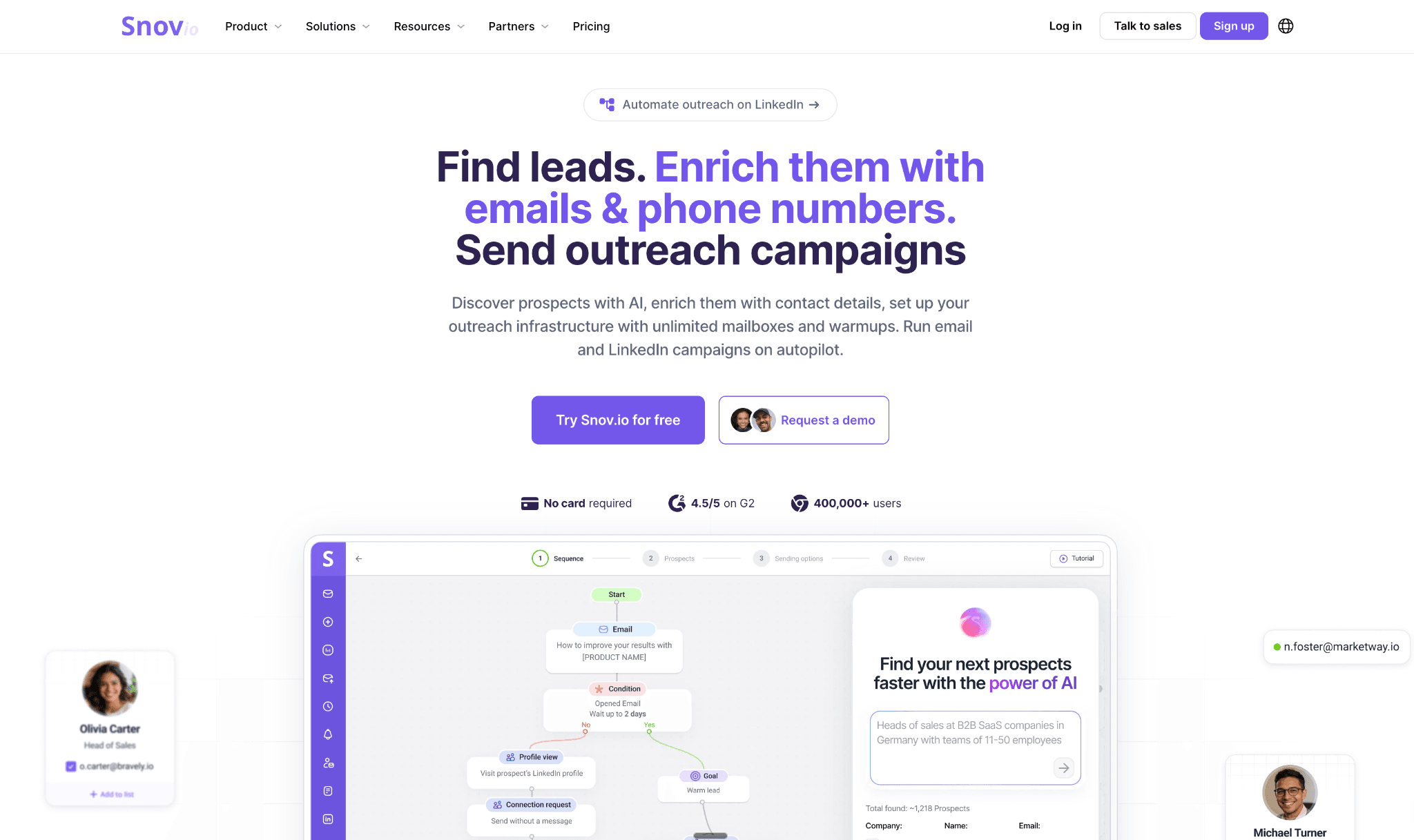
What Is Snov.io?

Its company page lists 2012 as the founded year and dates the launch of its Email Finder product to 2017. Its legal company address is in New York, United States, while the company describes its roots as Ukrainian.

Its main functions are:

  • finding and verifying business email addresses;
  • running drip email campaigns and deliverability checks;
  • automating LinkedIn connection requests, messages, and InMails through a separate cloud-hosted LinkedIn Automation add-on, billed per connected account;
  • managing prospects in a lightweight sales CRM;
  • enriching records through a Chrome extension, integrations, and APIs.

For category context, see our guide to LinkedIn email finder tools compared.

Snov.io at a Glance

The main Snov.io trade-offs in this comparison are LinkedIn data breadth, credit accounting, and data-quality consistency.

Strengths

  • The Chrome extension can add email and company data while a user browses prospect pages.
  • A separate cloud-hosted LinkedIn Automation add-on runs connection requests, messages, InMails, and multichannel sequences from Snov.io's own servers, independent of the browser.
  • Email verification, drip campaigns, deliverability checks, and a lightweight CRM sit in the same product.
  • Plans scale by credit tier.
  • Native two-way CRM sync is available for HubSpot and Pipedrive; Close is available through Zapier.

Limitations

  • LinkedIn collection breadth is narrower than a dedicated LinkedIn-native workflow: the optional extension covers live-page capture and optional email enrichment from profiles, search results, company pages, and event attendee lists, not bulk campaign-list scraping from group memberships or post engagement. LinkedIn Automation is billed per connected account either as a standalone subscription or, at a lower slot price, alongside a Sales Suite plan.
  • Data accuracy was the most common negative theme in the review and Reddit analysis.
  • Finding and verifying can consume separate credits, so the usable cost depends on both data volume and verification volume.
  • Credit rules and multi-step setup add friction when a team needs predictable enrichment at scale.

GDPR due diligence: Snov.io now publishes a DPA and describes controller, joint-controller, and processor roles in its privacy materials. Confirm which role applies to your workflow and whether its lawful-basis, retention, suppression, and deletion terms meet your requirements.

Why Users Switch

Data accuracy, not price, was the leading negative theme in the Snov.io evidence. Across G2, Capterra, and Trustpilot reviews plus 25 Reddit threads, complaints about accuracy and LinkedIn data breadth produced 160+ negative mentions, while cost ranked third. The pattern suggests that lower-priced credits do not fix a workflow when the underlying record is missing, stale, or hard to verify.

ThemeNegative mentions
Data quality / accuracy160+
Reliability150+
Cost / value (dual-credit model)120+
Workflow complexity110+

Recurring negative themes in Snov.io reviews and Reddit discussions

Sources: G2, Capterra, and Trustpilot review analysis plus Reddit discussions mentioning Snov.io. Counts are rounded down for reader-facing use and reflect evidence reviewed as of July 2026.

That ranking makes source coverage and data freshness more useful first checks than the price of another credit bundle.

How We Evaluated These Alternatives

8 tools, 10,500+ reviews, 370 Reddit threads analysed (as of July 2026).

Research Scope

We analysed:

  • 4,702 G2 reviews;
  • 1,624 Capterra reviews;
  • 4,219 Trustpilot reviews;
  • 370 Reddit threads.

We also checked vendor product, integration, privacy, and pricing pages directly.

Hands-on source-code checks covered five published extensions in this comparison. They did not cover every product or Snov.io itself.

Evaluation Framework

LinkedIn and email data extraction breadth carries the most weight. The remaining dimensions test whether that initial advantage holds.

For operating-model comparisons, we distinguished four patterns:

  • desktop standalone;
  • cloud credential login;
  • local-scrape extension;
  • cookie-bridge extension.

See our guide to LinkedIn scraper tools and methods for the broader collection context.

Scoring dimensionWeightEvidence considered
LinkedIn + email data extraction breadth25%Published scrape-source counts, hands-on testing, product documentation
Email finding and verification accuracy15%Product documentation, public review analysis
CRM and ecosystem integrations15%Product documentation, published integration counts
Pricing and value at scale15%Public pricing and documented billing units in the 20-user, 20-LinkedIn-account scenario
AI personalization and message quality10%Feature testing and documentation
GDPR and data compliance10%Vendor documentation, DPA availability
Support quality and ease of use10%Public review analysis, product documentation

LinkedIn and email prospecting scoring model

Each dimension was scored from 1 to 5, weighted, and normalized to a 100-point final score. The assessment combines public documentation, user-review analysis, live product testing, IP/session inspection, and browser-extension analysis. Pricing data and architecture labels reflect information reviewed as of July 2026.

Architecture describes where automation runs: desktop, cloud, or browser extension. Cookie bridge and credential login are cloud authorization methods, not standalone architectures.

Architecture labelWhat it meansWhere automation runsIP LinkedIn seesWho holds the session
DesktopA local app or user-controlled VPS runs the automationUser's machine or user-controlled VPSUser IP, VPS IP, or assigned dedicated proxyUser-controlled environment
CloudCampaigns run inside the vendor's web app and cloud infrastructureVendor cloudVendor-assigned IP, proxy, or dedicated IPVendor-managed cloud session
Browser extensionA browser extension operates inside the user's active LinkedIn browser sessionUser's browserUser IPUser's browser session; the extension reads or acts within that session

LinkedIn automation architecture glossary

Architecture labels describe where automation runs. They do not by themselves determine the final product score; risk also depends on session transparency, proxy controls, throttling, workspace governance, and observed user complaints. Labels reflect public information reviewed as of July 2026.

Session-access methodWhat it meansApplies to
Credential loginThe user connects or logs into LinkedIn through the vendor's cloud app, creating a cloud-managed sessionCloud tools
Cookie bridgeA browser extension or handoff flow transfers an existing browser session to the vendor cloudCloud tools with extension-assisted setup

Cloud session-access methods

Credential login and cookie bridge are authorization/session-access methods, not separate product architectures. Both can result in automation running from the vendor cloud once the session is connected.

7 Best Snov.io Alternatives Compared

Lemlist's cloud-bridge extension—a connector that copies your LinkedIn login to the vendor cloud—puts session custody outside your browser and makes the installed extension visible to LinkedIn before outreach begins.

ToolCategoryLinkedIn Data SourcesBuilt-in Email FinderCRM IntegrationsPrice/moG2 ★ArchitectureLinkedIn Session CustodyOn LinkedIn AED list?
Linked HelperLinkedIn automation13 sourcesYes — email finder; no standalone verifierHubSpot, Instantly, Pipedrive, Salesforce, Zoho (11 total)$15/mo4.56★ (142)DesktopLocal / user-managed VPSn/a — no extension ID
Apollo.ioSales intelligence0 (live profile capture only)YesAdobe Marketo, HubSpot, Pipedrive, Salesforce, Zoho$59/mo4.7★ (7,884)Local-scrape extension (cloud SaaS core)Local browser sessionYes
Instantly.aiCold email0YesHubSpot, Pipedrive$47/mo4.8★ (3,486)Cloudn/a — no LinkedIn sessionn/a
LemlistMulti-channel outreach2 documented current sources (LinkedIn search, Sales Navigator)YesClose.io, HubSpot, Pipedrive, Salesforce, Zoho CRM$109/mo4.47★ (263)Cloud-bridge / session-upload extensionVendor cloudYes
KasprSales intelligence0YesBrevo, HubSpot, Pipedrive, Salesforce, Zoho$65/mo4.44★ (819)Cookie-bridge / session-upload extension (hybrid widget + cloud backend)Vendor cloud (li_at/li_a uploaded)Yes
LushaSales intelligence0YesHubSpot, Outreach, Pipedrive, Salesforce, Salesloft$49.90/mo4.3★ (1,487)Local-scrape browser extensionLocal/browser-sessionYes
GetProspectData enrichment0 named source typesYesHubSpot, Pipedrive, Salesforce, Zoho CRM$49/mo3.97★ (38)Local-scrape extensionLocal browserYes

Snov.io alternatives compared by data breadth, email finding, CRM connectivity, price, reviews, and LinkedIn operating model

As of July 2026 · sources: vendor product and pricing pages, public G2 ratings, and first-hand extension checks where available. Linked Helper is listed first by publisher rule; other tools follow the article's ranked order.

The table summarizes data coverage and operating models. The sections below explain the evidence and trade-offs. Snov.io is the comparison baseline, not an additional alternative row.

1. Linked Helper

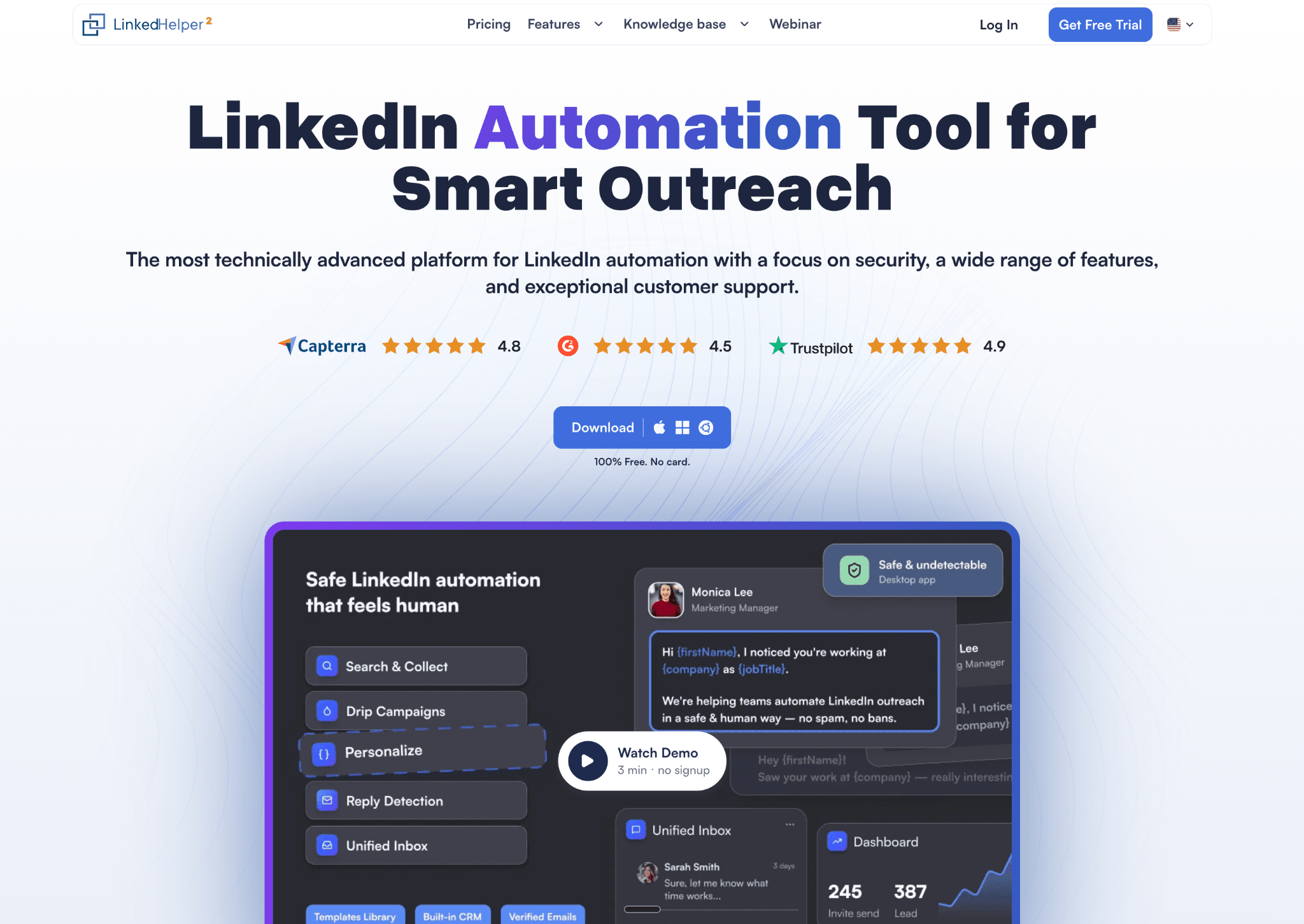
Linked Helper combines 13-source LinkedIn collection, email finding, outreach, and CRM handoff from $15/month. It runs in a standalone desktop browser on the user's machine or user-managed VPS, so the session stays in an environment the user controls rather than vendor cloud infrastructure. This narrows the technical detection surface, but behavior can still trigger restrictions.
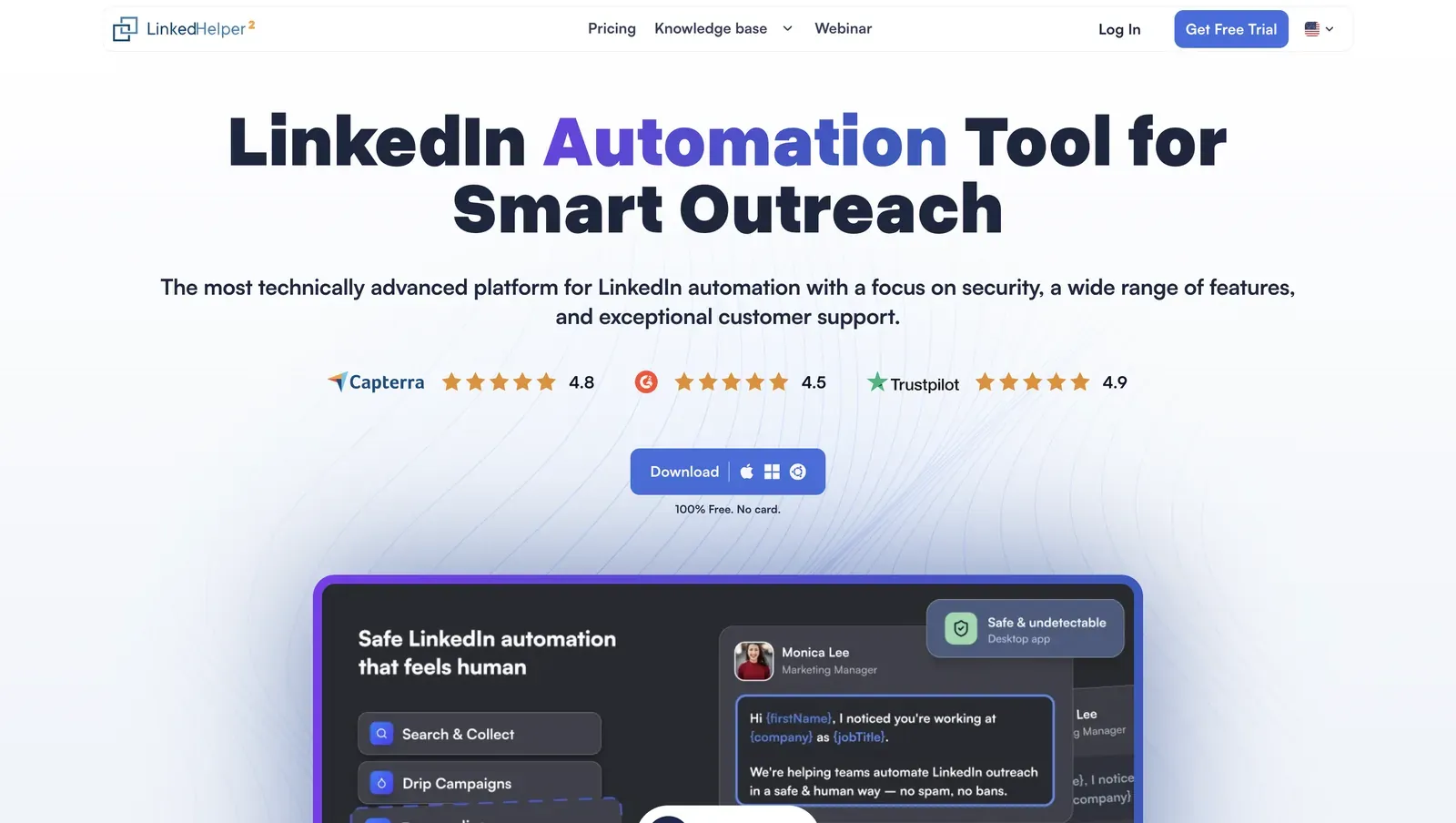
Linked Helper desktop automation homepage - July 2026

Linked Helper presents its desktop app alongside current third-party rating badges - July 2026

Founded in 2016 and headquartered in Wilmington, Delaware, Linked Helper supports contact discovery, multistep outreach, and CRM sync for one LinkedIn account per license.

The Standard license costs the equivalent of $8.25/month when purchased as a non-renewing 12-month term. The 14-day trial requires no card.

For continuous operation, Web Version provides login-based browser access to a user-managed VPS instance.

Quick facts about Linked Helper

  • Founded: 2016
  • HQ: Wilmington, Delaware, United States
  • Pricing: $15/mo ($8.25/mo equivalent on a 12-month license), 14-day free trial with no card
  • G2: 4.56★ (142) · Capterra: 4.9★ (252) · Trustpilot: 4.91★ (431)
  • Last 6 months: 4.76★ across 21 reviews — recent satisfaction remains strong; sample too small for a direction claim
  • Architecture: Desktop standalone — local or user-managed VPS execution

Vendor pricing and support pages (checked April–June 2026) + G2, Capterra and Trustpilot reviews plus Reddit posts (computed July 2026)

Key Features

  • 13-source LinkedIn collection — covers LinkedIn, Sales Navigator, Recruiter, groups, events, post engagement, companies, and relationship lists rather than one search surface.
  • AI ICP detection — scores profiles against an Ideal Customer Profile before outreach so weak matches do not consume the weekly invite budget.
  • Data enrichment with freshness — appends a work email with its freshness date, flagging records that may be stale after a job change.
  • Boost Post — automatically leaves comments under LinkedIn posts and articles and mentions targeted profiles, a step none of the compared alternatives offer.
  • Employees extractor — feeds a list of company URLs and pulls the specific employees at each, without manually walking each org page or paying for Sales Navigator's people-search.
  • 11 native CRM connectors — including ActiveCampaign, Close.io, HubSpot, Instantly, Pipedrive, Salesforce, and Zoho; matches by identifier and fills only empty fields to limit duplicates and overwritten data.
  • Snov.io campaign handoff — passes LinkedIn non-responders into Snov.io, keeping email execution in the specialist tool.

The pattern is breadth: Across 800+ cross-platform reviews, customization, email finding, and CRM handoff recur. G2 alone includes 100+ five-star reviews.

What reviewers say about Linked Helper

A workflow that moved in-product: A Reddit user used Linked Helper for sequencing and an external AI for message variants, avoiding identical text across prospects. The in-flow generator now handles that step inside Linked Helper. The example documents the earlier workaround; it does not present the external AI as a Linked Helper feature.

Reddit
ChatGPT
sequencing and follow-ups go through Linked Helper, but I write the actual message copy myself then ask AI to give me like 4 variations so I'm not blasting the exact same sentence to everyone.

Real-world scenario

A fire-and-security company in Ireland accumulated roughly 180 failed invitations over six months because recipients required an email. Enabling the email-enrichment action fetched an address immediately before each invite, keeping scarce prospects in the workflow.

Bottom line

We recommend Linked Helper when the workflow begins with LinkedIn-sourced leads and needs collection, enrichment, outreach, and CRM handoff in one place. Its 13-source coverage and 11 direct CRM connectors reduce handoffs at $15/month. For email-only prospecting, Snov.io remains a specialist layer; Linked Helper can pass non-responders into a Snov.io campaign rather than replace it.

One integration caveat: the licensing guide caps “Send person to external CRM” on Standard at 20 profiles per 24 hours per account. Messaging-history export to CSV or webhook is reserved for Pro. Teams needing a faster CRM flow or portable conversation history therefore face a $45/month Pro license.

2. Apollo.io

Apollo's LinkedIn-facing component works locally in the user's browser, keeping the session off vendor servers. However, Apollo removed automated LinkedIn steps around January 2026, leaving them as manual tasks. Its contact database and email sequences start at $59/month.

2. Apollo.io

Founded in 2015 and headquartered in the United States, Apollo hosts its core sales workflow. Prospect search and sequences sit alongside credit management and a dialer. API access and CRM sync connect the workflow to other systems.

Its database covers 230M+ contacts and 30M+ companies with 65+ filters. That makes Apollo a structured-data source rather than an arbitrary LinkedIn scraper.

The Basic tier falls to $49/month on annual billing and includes a 14-day trial. Teams can test the hosted workflow before an annual commitment.

Quick facts about Apollo.io

  • Founded: 2015
  • HQ: United States
  • Pricing: $59/mo ($49/mo annual), 14-day free trial
  • G2: 4.7★ (7,884) · Capterra: 4.52★ (385) · Trustpilot: 3.24★ (1,076) — sharp platform split
  • Last 6 months: 2.94★ (trending down) across 125 reviews
  • Architecture: Local-scrape extension — LinkedIn work stays in the user's browser; cloud SaaS core for the rest

Vendor pricing and feature pages (as of May 2026) + G2, Capterra, Trustpilot and Reddit reviews (computed July 2026)

Key Features

The ratings diverge by platform: G2 and Capterra sit around 4.5★, while Trustpilot is 3.24★. The last six months fall to 2.94★ across 125 reviews. We would not collapse the recent billing, data-freshness, and support complaints into one lifetime average.

What reviewers say about Apollo.io

A Reddit discussion adds the freshness caveat that the platform averages obscure:

Reddit
sales
Apollo - huge database and easy UI, but the data's aging fast. Feels like 6-8 months behind in some industries.

Real-world scenario

One G2 reviewer moved from ZoomInfo to Apollo because the lower cost still came with usable prospect data:

switched over to Apollo from ZoomInfo - it's much cheaper, user-friendly, and has solid data.

Read the full review on G2

G2
Rating: 4 out of 5
DV
Daniel V.

Reported Limitations

Customer-account controls: Apollo's own review corpus documents paying-customer account suspensions: a 20+-seat account was permanently banned mid-session for exceeding an undisclosed daily company-add threshold (Trustpilot, December 2025), and two reviews 18 months apart independently describe suspension for VPN use. In practice, teams cannot design reliable internal guardrails around a limit Apollo does not publish.

Apollo decided I was unworthy and issued a permanent ban. No warning, no alert -- I was informed that I had added 'too many companies in one day.' Apollo did not notify me once, at any point, that such a limit even existed.
Trustpilot 1.0★ · 2025-12-04
View Original

Reported limitations

Data-privacy report: The complaint concerns Apollo's contact database and removal process, not a LinkedIn account restriction.

I never authorised them to add my email to their database, and they have deliberately made it nearly impossible to remove it.

Trustpilot
Rating: 1 out of 5
JH
Jules Hickson

Safety and Setup Notes

What was checkedFinding
Ships a public extension?Yes — Apollo.io: Free B2B Phone Number & Email Finder, the connector for live-page capture
Architecture verdictLocal-scrape extension — it reads data inside the user's browser and uploads only results, so the LinkedIn login and IP stay local
Reads the LinkedIn session cookie (li_at)?No — li_at, the LinkedIn login in cookie form, and JSESSIONID were not read or uploaded; Apollo avoids vendor custody of the session
Direct LinkedIn (Voyager) API calls?Yes — 17 Voyager and 3 GraphQL signals; calls run through the browser session, which preserves local custody but still creates an API-request pattern
Injects code into LinkedIn's page (DOM)?Yes — a content script starts on every LinkedIn page at document_start, creating a passive fingerprint surface
Fires synthetic (isTrusted=false) clicks?Yes — 80 synthetic-event signals and 28 programmatic clicks; these differ from trusted human browser input and add a detection signal
Blocks LinkedIn telemetry?No — LinkedIn telemetry remains unobstructed, avoiding the separate signal created by selective blocking
Enforced daily cap in the code?None found — usage guardrails depend on user configuration rather than a hard stop in the extension
On LinkedIn's AED probe list?Yes — AED (Active Extension Detection) is LinkedIn's hardcoded list of extension IDs probed on every visit, so installed status is visible before Apollo performs an action

Apollo.io Chrome extension — source-code teardown (July 2026)

I see a split architecture, not a simple safe-or-unsafe verdict. Apollo avoids vendor custody of the LinkedIn session, removing one common cloud exposure.

I rate the resulting extension exposure Medium because its browser component still presents several detection surfaces at once. Local custody does not make it invisible.

Bottom line

Apollo centers on structured contact search and email finding. Its database-led workflow also includes sequencing and CRM sync. The evidence points to a GTM data platform with a local profile-capture layer.

For Snov.io users who would rather not add a separate per-account LinkedIn Automation subscription, Linked Helper covers LinkedIn collection and outreach in the same flat-rate license -- 13 scrape sources from a standalone browser, plus email discovery, in one $15/month plan.

Linked Helper documented a support case involving a former Snov.io employee who received warnings while using Linked Helper. The investigation found that colleagues were also using the affected LinkedIn accounts in Chrome with Apollo installed. The warnings stopped after Apollo was removed.

3. Instantly.ai

Instantly.ai is cloud cold-email software for campaign and mailbox management. It does not natively scrape LinkedIn, send invitations, or use a LinkedIn session, so LinkedIn outreach requires another vendor. That documented workflow excluded it from this round's hands-on testing.

3. Instantly.ai

Founded in 2021 and headquartered in the United States, Instantly combines cold-email sequencing and mailbox operations with lead data and reply handling.

The Growth plan costs $47/month, or $37.60/month with annual billing, and includes a 14-day trial. SuperSearch and enrichment remain metered separately, so the plan price does not represent the full cost of prospecting volume.

Quick facts about Instantly.ai

  • Founded: 2021
  • HQ: United States
  • Pricing: $47/mo ($37.60/mo annual), 14-day free trial
  • G2: 4.8★ (3,486) · Trustpilot: 4.02★ (1,009) — sharp platform split
  • Last 6 months: 3.78★ (trending down) across 110 reviews
  • Architecture: Cloud cold-email platform; no native LinkedIn session

Vendor pricing and feature pages (as of 2026-04-23) + G2 and Trustpilot reviews plus Reddit posts (computed 2026-07-21)

Key Features

  • Unlimited sending accounts and warmup — paid tiers remove per-inbox account limits for operations spread across many mailboxes.
  • SuperSearch and AI Enrichment — the email-finding waterfall charges roughly one credit for an Instantly-found address and two or more through external partners. Data-source choice therefore changes credit consumption.
  • Email verification — the verification tool can check discovered addresses before they enter a campaign.
  • Multi-model personalization — six supported AI providers plus bring-your-own-key options generate and enrich email copy.
  • LinkedIn-tool handoff — an Automation Builder action sends leads to HeyReach, Aimfox, or Valley. Those third parties, not Instantly, execute the LinkedIn steps.
  • CRM connections — HubSpot and Pipedrive connect natively. Salesforce requires OutboundSync, while Close uses a Zapier recipe. Both routes add another service.

Recent experience is weaker than the G2 headline: Instantly.ai has a 4.8★ G2 rating across 3,400+ reviews, compared with 4.02★ across 1,000+ Trustpilot reviews. The 110 reviews from the past six months average 3.78★, suggesting that recent experiences are more uneven than the lifetime ratings.

What reviewers say about Instantly.ai

Real-world scenario

One r/b2bmarketing contributor described an outreach operation where mailbox administration became the bottleneck instead of prospect conversations. The example shows why teams consolidate email infrastructure, but it does not demonstrate native LinkedIn execution.

Reddit
b2bmarketing
The breaking point: spending more time managing infrastructure (SPF records, inbox rotation, warmup sequences) than actually talking to prospects.

Reported Limitations

Where the economics change: Prospect discovery and enrichment draw from a separate credit currency. Reviewers also report sending ceilings and add-on charges.

Where ownership matters: Two independent Trustpilot reviewers reported Google disabling done-for-you email fleets provisioned through an education-only reseller arrangement. Another said domains bought through the service could not be transferred away. These reports point to continuity and migration risks, not LinkedIn restriction evidence.

Reported limitations

Deliverability signal: The safety reports concern email and domain reputation rather than LinkedIn account restrictions. One reviewer reported every test message landing in spam. Warmup and account scale therefore do not remove the need to validate deliverability on the buyer's own domains.

Every test email I sent when to spam. 0% replies, 100% waste of time, 100% waste of money.

Trustpilot
Rating: 1 out of 5
GA
Gregg Armitage

Safety and Setup Notes

I did not include Instantly.ai in this round's hands-on extension or cloud testing, so I cannot assign it a tested LinkedIn architecture or extension-detection status. Its documented workflow does not use a native LinkedIn session. Once a lead is handed off, LinkedIn restriction risk depends on the partner tool.

Bottom line

Instantly.ai handles account-scale cold-email sending, warmup, and reply management. It still requires another tool for LinkedIn lead collection and outreach.

That leaves the LinkedIn-to-CRM leg outside Instantly: Linked Helper collects the leads, adds email finding, and moves records through 11 direct CRM connectors -- including a direct connector to Instantly itself, so the two can run together for LinkedIn outreach plus email sending without the third-party handoff.

As of our July 2026 check, a still-open request for native LinkedIn automation on Instantly's own feedback board had 65 upvotes, even though its partner workflow had shipped eight months earlier. The request remained open after the integration became available; the release had not formally resolved it.

4. Lemlist

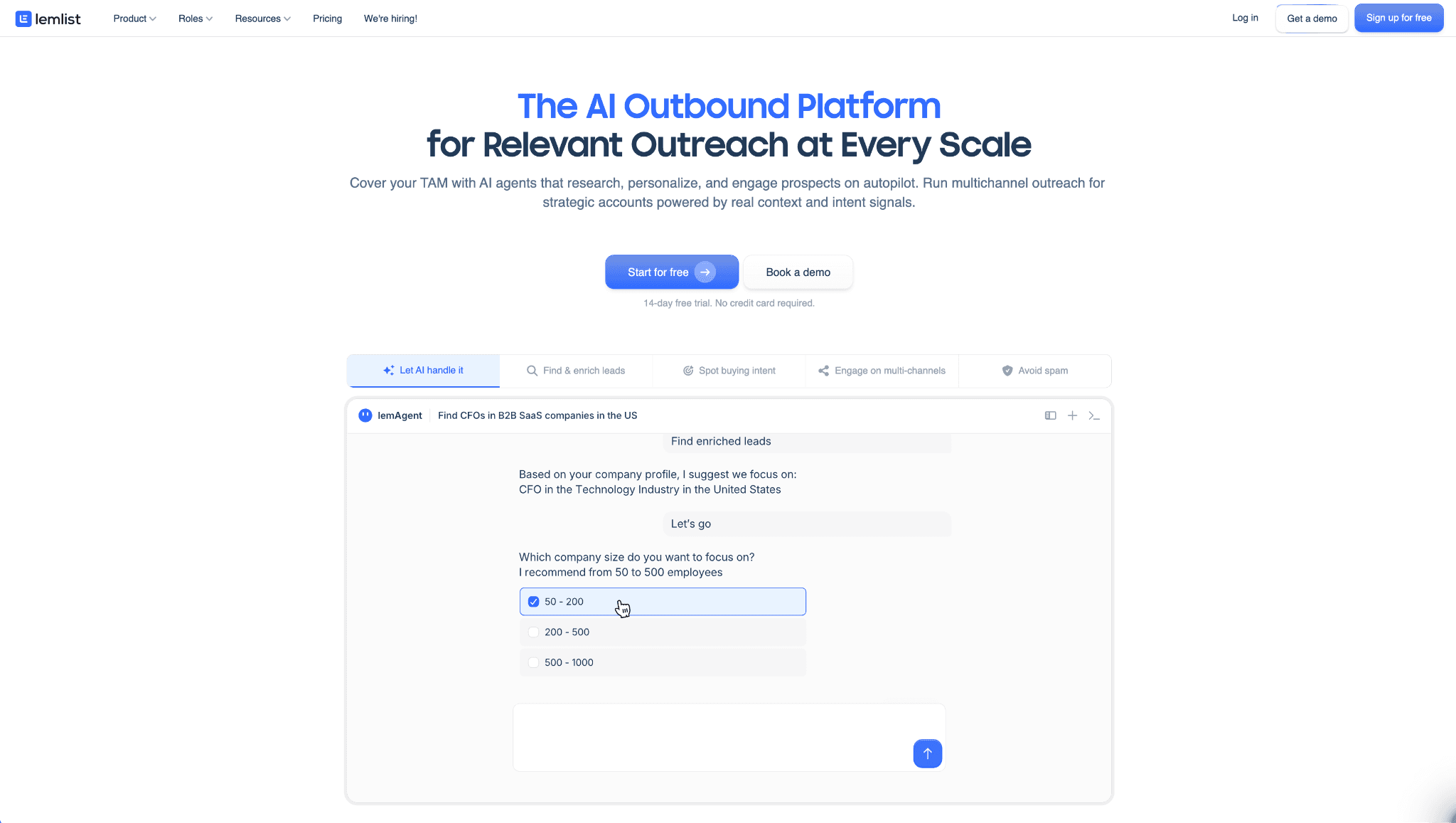
Lemlist is a France-based multichannel outreach platform founded in 2018. It combines an email finder and verifier, enrichment, AI-personalized content, and CRM handoffs. Current documentation covers LinkedIn imports from people search and Sales Navigator; broader sourcing may require another data source.

4. Lemlist

Pricing starts at $109 per user per month, or $87/user/month billed annually, with a 14-day trial. Five named CRM connections include Close.io, HubSpot, Pipedrive, Salesforce, and Zoho CRM. Data is hosted exclusively in the EU and backed by a downloadable DPA, giving privacy teams concrete residency and subprocessor documentation to review.

For a feature-by-feature view, see our Linked Helper vs Lemlist comparison.

Quick facts about Lemlist

  • Founded: 2018
  • HQ: France
  • Pricing: $109/mo ($87/user/mo billed annually), 14-day free trial
  • G2: 4.47★ (263) · Capterra: 4.57★ (385) · Trustpilot: 4.1★ (146) — Trustpilot's recent pattern is qualified below
  • Last 6 months: 4.7★ (up) across 40 reviews — likely influenced by concentrated review solicitation
  • Architecture: Cloud-bridge / session-upload extension

Vendor pricing & feature pages (checked July 2026) + G2, Capterra, Trustpilot & Reddit reviews (computed July 21, 2026)

Key Features

  • Email finder and verifierFinds and checks work emails inside the outreach workflow.
  • LinkedIn list imports — The current help page documents people-search imports capped at 999 leads and Sales Navigator imports capped at 2,500. An older inventory named Recruiter as a third route, but we found no current help-center documentation for it. Current direct source breadth therefore remains two.
  • AI personalization — Generates message content and drafts comments from a prospect's latest LinkedIn post; the comment remains a manual review-and-publish task.
  • CRM handoffsFive named connections move lead records into Close.io, HubSpot, Pipedrive, Salesforce, or Zoho CRM.
  • Lemwarm — Adds email warm-up and deliverability tooling; one switching reviewer named it as the reason for moving from another service.

Limitation: The monthly credit headline is not a common unit: different features consume from 1 to 100 credits, so the same balance buys radically different amounts of work depending on the workflow.

The recent trend needs qualification: In the recent Trustpilot window we checked, 90 of 99 reviews were exactly 5★, versus a 2.64★ historical baseline. Customer-success and onboarding language appeared in the new wave but not the historical set. On the same day an 11-review, six-hour 5★ burst landed, a paying customer reported receiving no onboarding help. That makes active review solicitation, rather than organic product improvement, a plausible driver of the trailing average.

What reviewers say about Lemlist

Real-world scenario

A G2 reviewer replacing Apollo said lemlist centralized lead-information work:

The module to get information from leads has allowed me to replace tools like Apollo and have everything centralized in lemlist.

Read the full review on G2

G2
Rating: 4 out of 5
DV
David V.

The counter-pattern: The negative reports span workflow complexity, broken features, uneven onboarding, and weak targeting relevance rather than one repeated complaint.

Reported limitations

A separate enforcement risk: Lemlist's terms allow it to throttle sending accounts for policy violations without refunding the throttled period. One customer reported a warning about losing platform access over a missing unsubscribe link, which points to vendor enforcement—not evidence of a LinkedIn restriction.

support also regularly chatted with me to tell me I don't have an unsubscribe link, and they could ban me from the platform.

Read the full review on Trustpilot

Trustpilot
Rating: 2 out of 5
L
Lucas
2024-09-14

Safety and Setup Notes

What was checkedFinding
Ships a public extension?Yes — the lemlist connector links a LinkedIn account to the cloud service
Architecture verdictCloud-bridge / session-upload; high-risk teardown verdict — the extension copies the login to the vendor cloud, giving vendor infrastructure the credentials needed to operate the account
Reads the LinkedIn session cookie (li_at)?Yes — li_at, the cookie form of a LinkedIn login, is copied within the full cookie string to app.lemlist.com on install and after every cookie change, handing the vendor server account access without the password
Direct LinkedIn (Voyager) API calls?No — the extension drives page interactions instead of making raw Voyager or GraphQL calls
Injects code into LinkedIn's page (DOM)?Yes — a content script loads at document_start on every LinkedIn page, adding a footprint the page can observe
Fires synthetic (isTrusted=false) clicks?Yes — 38 synthetic-event signals and 21 programmatic clicks were found; browsers mark these as not generated by real user input
Blocks LinkedIn telemetry?No
Enforced daily cap in the code?None found — the shipped extension contains short delays but no auditable daily invite cap or working-hours scheduler; cloud-side limits could not be verified
On LinkedIn's AED probe list?Yes — Active Extension Detection is LinkedIn's hardcoded probe list; being listed means the installed extension is visible before outreach starts

Lemlist connector extension — source-code teardown (July 2026)

My read: several independent detection surfaces compound while the LinkedIn import flow remains narrow. Linked Helper keeps the session in an environment the user controls while collecting from a wider set of LinkedIn surfaces. That narrows exposure, not immunity.

Bottom line

Dynamic personalization and cross-channel sequence building are lemlist's strengths, and its LinkedIn comment drafts preserve a manual-review checkpoint. The narrow import flow is the trade-off: Linked Helper starts from more LinkedIn surfaces and carries those profiles into its built-in email finder.

One Lemwarm pricing wrinkle is easy to miss: lemlist's pricing FAQ says it is included in every plan, while the vendor's seat-billing guide says lemlist and lemwarm use independent seat counts and can charge and prorate separately. The two live vendor pages leave buyers to confirm which rule applies to their account.

5. Kaspr

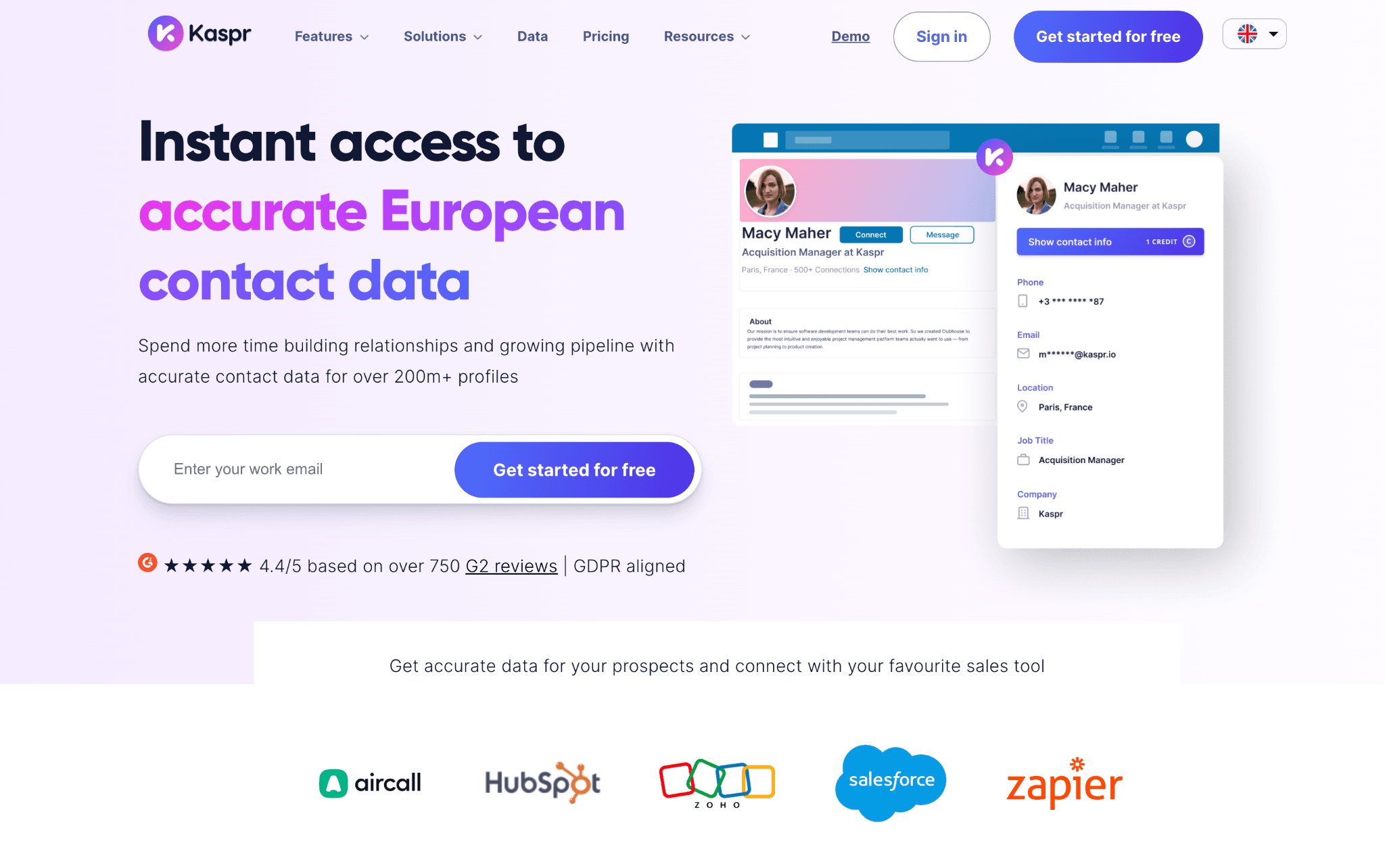
Kaspr is a LinkedIn page widget for Basic, Recruiter, and Sales Navigator profiles. Founded in 2018, headquartered in France, and now part of Cognism, it reveals phone and email data on the profile being viewed, then exports records to sales systems. The workflow centers on per-profile contact enrichment.

5. Kaspr

Kaspr focuses on per-profile European contact data. Starter-plan pricing is $65/month, or $49/month on the annual plan. Usage is credit-based, so spend depends on reveal volume. (The 20-user, 20-LinkedIn-account scenario earlier in this article uses Kaspr's pricier Business tier -- see the at-a-glance table's footnote.)

In our June 2026 source-code teardown, we rated Kaspr's hybrid extension HIGH risk. It sends LinkedIn login cookies to Kaspr's cloud and appears on LinkedIn's extension scanner. Four G2 reviewers also reported account restrictions. Those reports do not prove that the code caused the restrictions, but they add user-reported context to the teardown.

Kaspr publishes a DPA and commits to EU data residency. Those contact-data commitments do not address how the extension handles LinkedIn credentials.

Quick facts about Kaspr

  • Founded: 2018
  • HQ: France
  • Pricing: $65/mo ($49/mo annual), Starter plan; credit quotas make spend volume-dependent
  • G2: 4.44★ (819); no Capterra or Trustpilot sample for a cross-check
  • Architecture: Cookie-bridge / session-upload extension (page widget + cloud relay); LinkedIn credentials leave the browser

Kaspr vendor pages (April 2026) + G2 (July 2026) + source-code review (June 2026)

Key Features

  • Per-profile enrichment — reveals phone and email data on the LinkedIn page being viewed.
  • Email finding and verification — both use Kaspr's plan credits.
  • CRM connections — sends records to Brevo, HubSpot, Pipedrive, Salesforce, and Zoho.
  • AI email drafting — generates email drafts from the paid-tier interface.
  • EU data posture — publishes a DPA and EU-residency commitment on its privacy page.

The platform caveat: every review we analyzed came from G2, so we could not cross-check the pattern against Capterra or Trustpilot.

What reviewers say about Kaspr

Real-world scenario

An r/gtmengineering commenter framed the trade as fresher contact data versus a workflow that still needs other tools:

Reddit
gtmengineering
Apollo's database is large but stale on a lot of records, Kaspr is fresher but narrow. Most people end up stacking anyway.

The structural gap is scope: Kaspr gathers from zero LinkedIn list sources and extracts neither full person nor organization profiles. It reveals one profile at a time rather than building and working a list. All three direct comparison reviews we analyzed say the workflow stops before outreach automation, so another system is still required.

Reported limitations

Account risk reports: four G2 reviewers described LinkedIn restrictions while using Kaspr. One wrote:

Safety and Setup Notes

What was checkedFinding
Ships a public extension?Yes — it links the account and places Kaspr's widget on LinkedIn
Architecture verdictCookie-bridge / session-upload hybrid — it copies the LinkedIn login to Kaspr's cloud, giving the vendor session custody
Reads the LinkedIn session cookie (li_at)?Yes — li_at is the LinkedIn login in cookie form; Kaspr sends it with li_a, sessionId, and userEmail to api.kaspr.io, so its servers can act as the account
Direct LinkedIn (Voyager) API calls?No — the browser relays profile data through Kaspr's backend, so the flow is not local-only
Injects code into LinkedIn's page (DOM)?Yes — scripts and the widget enter linkedin.com, creating a page-level fingerprint
Fires synthetic (isTrusted=false) clicks?Yes — eight synthetic signals and two programmatic clicks add scripted-behavior indicators
Blocks LinkedIn telemetry?No — LinkedIn's detection telemetry remains available
Enforced daily cap in the code?None found — delay and interval controls do not enforce conservative pacing
On LinkedIn's AED probe list?Yes — AED is LinkedIn's hardcoded extension-ID probe list; being listed makes the installed state visible before any action

Kaspr connector extension — source-code teardown (June 2026)

Beyond the scheduled cookie sync, I found an on-demand channel reachable from app.kaspr.io, staging.kaspr.io, and a localhost origin. It can request the full LinkedIn cookie jar and CSRF token outside that sync event, expanding the set of origins that can pull live session credentials.

My read: the visible extension, scripted interaction, and cloud-bound login cookie form a stacked detection surface. Together, they can add to LinkedIn's risk score. I found no conservative daily pacing cap in the inspected extension code.

Bottom line

Kaspr covers per-profile European phone and email enrichment inside LinkedIn. The trade-off is scope: list building and outreach automation still require another system.

Kaspr's cloud-bound login is the pivot when session custody matters: Linked Helper keeps the login in a standalone browser on an environment you control. Its workflow also extends beyond the per-profile reveal into multiple LinkedIn sources, email finding, and 11 direct CRM connectors.

6. Lusha

Lusha is a sales-intelligence service founded in 2016 and based in Massachusetts. Its browser sidebar overlays contact reveals on LinkedIn, Sales Navigator, Recruiter, HubSpot, and Salesforce. The paid plan starts at $49.90/month.

6. Lusha

In a Lusha vs Snov.io decision, Lusha is a per-profile display layer rather than a source-collection engine. It gathers zero LinkedIn lead sources and extracts neither full person nor company profiles, so teams need another process to build lists.

Annual billing works out to $32.45/month as a limited-time promotional rate (35% off, checked July 2026) -- confirm the current non-promotional rate before treating this as a stable figure. Email and phone reveals consume one and five credits respectively, so phone-heavy prospecting depletes the allowance faster.

Quick facts about Lusha

  • Founded: 2016
  • HQ: Massachusetts, US
  • Pricing: $49.90/mo ($32.45/mo annual, limited-time promotional rate as of July 2026)
  • Permanent Free tier: 40 credits/month for 1 user, covering email or phone reveals; no time-boxed trial
  • G2: 4.3★ (1,487) · Capterra: 4.0★ (391) · Trustpilot: 2.33★ (738) — sharp platform split
  • Last 6 months: 1.0★ across 25 Trustpilot reviews, all 1-star — down from the 2.33★ lifetime average
  • Architecture: Local-scrape browser extension (DOM-read reveal layer; no session upload)

Vendor pricing, integration, privacy and company pages (fetched April–May 2026) + G2, Capterra and Trustpilot reviews (computed July 21, 2026)

Key Features

  • Email and phone revealsLusha's pricing page lists verified emails and phone numbers, charged at one and five credits per reveal.
  • Profile-side coverage — the sidebar appears on LinkedIn profiles, search results, Sales Navigator, Recruiter Lite, and Recruiter Pro without turning those surfaces into list-scrape sources.
  • CRM handoff — like other prospecting-data tools at this tier, Lusha connects with HubSpot, Outreach, Pipedrive, Salesforce, and Salesloft.
  • CSV export — revealed contact records can be exported for workflows outside the extension.
  • Compliance documentation — Lusha publishes a GDPR-compliance claim and says European auditors have reviewed it. Recent opt-out complaints still warrant due diligence.

Trustpilot tells a different story: Lusha scores 4.3 on G2 and 2.33 on Trustpilot. G2 praise centers on direct contact reveals and ease of use. All 25 Trustpilot reviews from the last six months were one-star, with complaints focused largely on consent, data removal, billing, and service. The platform source is part of the finding, not a detail to average away.

What reviewers say about Lusha

Real-world scenario

One Capterra reviewer moved from Apollo after Lusha returned more cell numbers, then switched back when the target account changed. Contact coverage therefore needs to be checked against the team's actual market, not assumed from an aggregate rating.

After changing my target account Lusha had far fewer email addresses compared to Apollo, and I switched back. Apollo costs less.

Read the full review on Capterra

Capterra
Rating: 4 out of 5
EN
Enrico N.

Coverage and trust vary: Reviews challenge the positive cards on service delivery and consent, while the Reddit example below raises a separate coverage concern.

Reported limitations

The Reddit post is low-score evidence, but it separately reflects a coverage concern. It does not support an extension-detection claim.

Reddit
LeadGeneration
I have tried appollo, lusha didn't got much useful results. So opened up for tools. Suggest me some!

The complaints here concern personal-data consent, not LinkedIn account restrictions. One reviewer described the escalation this way:

This company have absolutely ruined my email inbox by selling my personal data — when complaining they had the cheek to add me to their mailing list. I am reporting you for GDPR breaches, to the Information Commissioner's Office (ICO).

Read the full review on Trustpilot

Trustpilot
Rating: 1 out of 5
AL
Ant L

Safety and Setup Notes

I found that Lusha keeps LinkedIn account custody in the user's browser, but its injected sidebar leaves a passive fingerprint LinkedIn can see before any reveal.

What was checkedFinding
Ships a public extension?Yes — a Chrome sidebar that links Lusha with supported profile and CRM pages
Architecture verdictLocal-scrape extension — a passive DOM-read reveal layer; the LinkedIn session stays in the user's browser
Reads the LinkedIn session cookie (li_at)?No — li_at, the cookie form of a LinkedIn login, is never read or sent to Lusha; account custody stays local
Direct LinkedIn (Voyager) API calls?No — it reads the visible page DOM instead, so it does not create a bare internal-API request pattern
Injects code into LinkedIn's page (DOM)?Yes — a Lusha sidebar iframe is appended to LinkedIn pages, leaving a passive fingerprint
Fires synthetic (isTrusted=false) clicks?Yes, but only in its Google Calendar integration — none were found on LinkedIn pages
Blocks LinkedIn telemetry?No
Enforced daily cap in the code?None found — Lusha takes no LinkedIn actions, so an action-rate cap does not apply
On LinkedIn's AED probe list?Yes — Active Extension Detection is LinkedIn's hardcoded extension-ID probe; listing means installed status can be visible before the tool acts

Lusha Chrome connector extension — source-code teardown (June 2026)

That fingerprint adds a detection signal. It does not prove automation or guarantee a restriction, especially because Lusha takes no LinkedIn actions.

Bottom line

Lusha centers on phone coverage: direct-dial reveals and named CRM handoffs, but not broad LinkedIn extraction. Linked Helper starts earlier in the pipeline by collecting across Sales Navigator, Recruiter, groups, and event attendees, then adding email finding and 11 direct CRM connectors in a $15/month license.

One March 2026 Trustpilot reviewer reported that unused Lusha credits disappeared after a year, with no advance reminder or recovery path. Linked Helper's Email Finder and Data Enrichment credits do not expire, whether they come with a license or are purchased separately; only license-bundled AI credits expire with the license.

7. GetProspect

For teams needing a bundled CRM and EU-resident data option, GetProspect keeps the LinkedIn session on-device through its local-scrape extension. Our teardown also found a detectable extension footprint, while pacing rests with the user. The email-focused Starter tier costs $49/month.

7. GetProspect

Founded in 2016, GetProspect is a contact-data lookup and email-finding service for individual LinkedIn and Sales Navigator profiles. It combines web search and verification with CSV export and a built-in CRM.

Credit-based finds and verifications are standard for this category; the $49/month Starter tier includes 1,000 valid emails, 2,000 verifications, and 5 phone numbers per month. Annual billing lowers Starter to $34/month equivalent.

The vendor describes itself as Ukrainian, while GetProspect LLC is US-registered. We therefore do not assign a definitive headquarters.

Quick facts about GetProspect

  • Founded: 2016
  • Pricing: $49/mo ($34/mo annual equivalent)
  • Overall: 3.83★ (47 reviews)
  • G2: 3.97★ (38) · Trustpilot: 9 reviews, too thin to average · Capterra: no reviews — uneven platform coverage
  • Architecture: Local-scrape browser extension

GetProspect pricing, privacy, integrations and About pages (fetched April–May 2026) + G2 and Trustpilot reviews (computed July 21, 2026)

Key Features

The data-breadth boundary: Our feature audit recorded zero supported source-list scraper types. GetProspect can look up contacts from LinkedIn and Sales Navigator pages, but it does not extract full people-plus-company records from search results or from group and event audiences. That leaves it as a narrow email-lookup layer rather than a broad LinkedIn prospecting dataset.

Most of the rating signal comes from G2: Trustpilot is too thin to average, and Capterra contributes none. The positive ease-of-use pattern below is therefore not broad cross-platform consensus.

What reviewers say about GetProspect

Real-world scenario

No documented switching story or substantive Reddit narrative surfaced. The most relevant case is a G2 reviewer who tied use of the extension to losing access to a LinkedIn account. It is one report, not an incidence rate, but it is consistent with the detection exposure found in our teardown.

Seems to have strong features but got my LinkedIn account shut down before I could use them.

Negative reports center on reliability and evaluation friction, including delayed onboarding and too few free credits to test the product fully.

Reported limitations

Safety and Setup Notes

I did not run a live cloud/IP test in this round. I read the shipped extension code, so this section makes no claim about an observed vendor IP.

What was checkedFinding
Ships a public extension?Yes — Email Finder - GetProspect, the product’s LinkedIn lookup entry point
Architecture verdictLocal-scrape — it reads data inside the user’s browser and uploads only results, so the LinkedIn session and IP stay local
Reads the LinkedIn session cookie (li_at)?No — li_at, the LinkedIn login in cookie form, is not read or sent; JSESSIONID, the cookie carrying LinkedIn’s CSRF token, is read locally only
Direct LinkedIn (Voyager) API calls?Yes — 30 Voyager and 9 GraphQL references; scripted API traffic can differ from a normal browsing request map
Injects code into LinkedIn’s page (DOM)?Yes — it injects into every LinkedIn page, creating a passive extension-detection surface
Fires synthetic (isTrusted=false) clicks?Yes — MouseEvent, dispatchEvent, and programmatic click calls were present, which the browser marks as scripted rather than human-generated
Blocks LinkedIn telemetry?No — no blocking rules were found, so telemetry-blocking does not add another detection signal
Enforced daily cap in the code?None found — only fixed sub-second delays and an unbounded interval; no daily cap, working-hours scheduler, or randomization range, so pacing rests with the user
On LinkedIn’s AED probe list?Yes — Active Extension Detection is LinkedIn’s hardcoded list of extensions probed on every visit; being listed means installed status is visible before the tool acts

GetProspect Email Finder extension — source-code teardown (May 2026)

My honest read: keeping the login local removes the most serious session-upload risk, but the extension still presents several independent detection signals without hard pacing guardrails. Cookie custody is not the dividing line in the Linked Helper comparison because both keep the login local. The comparison instead turns on extension exposure and enforced pacing.

That supports a medium-risk—not catastrophic—verdict. These findings add to LinkedIn’s scoring surface rather than proving a restriction will occur.

Bottom line

GetProspect combines per-profile email discovery with a bundled CRM, a DPA, and EU residency. Its boundary is the narrow lookup workflow, not its integration count -- 11 total, four of them named CRMs.

If LinkedIn restriction exposure is the deciding factor, the comparison shifts to architecture and pacing. Linked Helper uses a standalone desktop architecture and adds guardrails the tested GetProspect extension did not enforce:

  • rolling daily caps;
  • working-hours controls;
  • randomized delays.

One practical catch to the bundled CRM: a 2023 Trustpilot reviewer reported a 20,000-prospect save cap that they said was not clearly disclosed before purchase. If you plan to use the workspace as a long-term lead database, confirm the current storage ceiling before upgrading.

How To Choose The Right Snov.io Alternative

Start with architecture. Use the first branch that matches how much control you require over the LinkedIn session, then compare data depth within that branch. This keeps a long feature list from obscuring the operating-model trade-off.

If your priority is...Choose...The trade-off
Keep the LinkedIn session in an environment you controlDesktop standaloneMore setup than a cloud signup; the machine or VPS must be operated by your team
Collect data in the active browser without handing the session to a vendor cloudLocal-scrape extensionThe extension remains visible to browser-level detection and may use direct LinkedIn requests
Fast extension-assisted cloud onboardingCookie-bridge extensionThe session is handed to vendor infrastructure and the extension adds a separate observable surface
Coordinate cloud campaigns and multiple channelsCloud credential loginThe session is created and maintained on vendor infrastructure rather than the user's local machine

Four-branch decision tree for choosing a Snov.io alternative

Architecture labels describe observable operating models, not guarantees of product quality, GDPR compliance, or freedom from LinkedIn restrictions. Review current vendor documentation as of July 2026.

After architecture, check data depth:

  • which LinkedIn sources are supported;
  • whether an email carries a freshness date;
  • whether misses consume credits;
  • how records are merged into a CRM.

Our guide to connecting LinkedIn data to your CRM covers the handoff questions. For GDPR email prospecting, confirm the vendor's DPA, processing role, deletion path, and data-residency terms.

Finally, model each product using its actual billing unit: seats or concurrent LinkedIn accounts for per-user tools, and contacts, sends, or credits for volume-priced tools. The At-a-Glance table shows why an entry price alone is not an agency budget.

Our Recommendation: Linked Helper

We recommend Linked Helper for LinkedIn-first prospecting because collection through CRM handoff runs in one campaign.

Our Recommendation: Linked Helper

Email lookup sits inside the same workflow.

  • Freshness: Data Enrichment checks the date before replacing contact data, so it does not overwrite a newer email already stored on the profile with an older result.
  • Fallback: If Linked Helper's own data source misses, the same email-finding step can use a connected Snov.io or Apollo.io account. An internal match avoids spending the third-party credit.
  • CRM handoff: The mapping engine can match records by email, LinkedIn member ID, or public ID. A fill-empty-only merge reduces duplicate records and accidental overwrites.

Linked Helper does not replace a native cold-email sequencer or a standalone verifier for a list already in hand. Those jobs still need a dedicated email tool such as Instantly, which Linked Helper already connects to directly. Setup is the trade-off: a desktop or VPS deployment with Web Version takes more operator work than signing into a browser-only cloud product.

Time saved on LinkedIn outreach with Linked Helper

LinkedIn Safety & Risk Reduction

LinkedIn's policy and detection stack make behavior control more important than any safety label. Its prohibited-software guidance says third-party tools that scrape, modify, or automate LinkedIn are not permitted, so any automation - including every tool compared in this article - carries terms-of-service exposure. Reducing detection risk is not the same as compliance: none of the practices below make automation permitted under LinkedIn's terms, and none guarantee an account will avoid restriction.

Detection can combine several layers:

  • action volume and timing patterns;
  • repeated messages and low-quality engagement signals;
  • browser or device fingerprints;
  • extension traces and unusual request patterns;
  • inconsistent IP, location, and session behavior.

Those behavioral signals also apply to manual workflows. Opening many profiles by URL or withdrawing invitations at unrealistic speed can still trigger warnings.

Readers can reduce the observable surface by:

  • setting conservative daily limits and realistic working hours;
  • using randomized delays and stop-on-reply logic;
  • keeping a stable IP with per-account proxy controls and a built-in proxy checker;
  • pausing immediately when LinkedIn shows a warning.

Our guide to how LinkedIn detects browser extensions and automation explains how those layers interact. Linked Helper provides the limits, timing, and proxy controls listed above, but the operator still controls message quality and volume. The advantage is IP stability, not IP rotation.

Safety note: No tool eliminates the risk of LinkedIn restrictions, and none of the practices above make automation compliant with LinkedIn's User Agreement. 'Safer' means lower technical and behavioral detection risk, not platform-sanctioned or risk-free. Results depend on account age, daily action volume, and activity patterns.

Methodology Deep-Dive

This round supports extension-code conclusions, not live cloud-IP conclusions. I inspected the published browser packages available for five alternatives, kept Snov.io explicitly outside the hands-on subset, and report only behavior visible in the shipped client code.

First-Hand Testing

In May–June 2026, I downloaded the published extensions, restored readable source, and traced session handling and browser-visible detection signals. This narrower pass uses the same static-audit method described in Linked Helper's security study, which covered 16 extensions and seven separate live cloud tests.

CheckQuestions it answeredExample finding
Source-code teardownWhat the extension reads, whether LinkedIn session data leaves the browser, whether it calls LinkedIn directly, what it injects, which events it fires, and whether LinkedIn targets its extension IDLemlist's published package sent LinkedIn cookies to app.lemlist.com and was on the extension-detection target list; see the Lemlist section above

First-hand source-code check used for the Snov.io alternatives roster

The extension packages were inspected in their published versions during the documented test period. A code finding adds an observable signal; it does not predict that LinkedIn will restrict a specific account. Evidence reviewed as of July 2026.

TermWhat it isWhy it matters
li_at / JSESSIONIDThe LinkedIn login in cookie form: li_at is the session cookie and JSESSIONID carries the CSRF tokenWhoever holds them can act as the account; uploading them hands the account session to vendor infrastructure
Cloud-bridgeAn extension that copies the LinkedIn login cookie to the vendor cloud, which then runs the account from its own IPThe session handoff adds a second operating environment and a separate session-custody exposure
AED (Active Extension Detection)The label visible in LinkedIn's production JavaScript for results from probes against known extension IDsBeing listed means installation can be visible before the extension performs an action
Passive DOM/page scanLinkedIn page code can sweep for traces such as injected UI, buttons, panels, or extension resourcesIt can surface an extension footprint even when its ID is not yet on a target list
Synthetic (isTrusted=false) eventsA browser-level flag on clicks or keystrokes fired by code rather than a personAn extension cannot turn the flag into a trusted human event through normal browser-extension APIs
BrowserGateAn independent investigation that reverse-engineered LinkedIn's production JavaScriptIt documented several detection systems; BrowserGate is the research, not the scanner itself

Source-code teardown terms used in the first-hand checks

The glossary explains what can be observed in shipped browser-extension code. Cloud-side behavior is described as highly likely when the vendor's private server code cannot be inspected. Evidence reviewed as of July 2026.

I did not run a live sign-up network test for this comparison, so I recorded no IPQS score. IPQualityScore (IPQS) is an independent service that rates IP reputation on a 0–100 fraud scale, not LinkedIn's enforcement verdict.

I also made no observed datacenter-versus-residential claim. A datacenter address comes from a server farm; a residential address comes from a home or mobile connection. A personal session on a datacenter address can stand out.

For the operational side, see our guide to the best proxies for LinkedIn automation.

Research Limitations

Static inspection can show what an extension reads, injects, and sends. It cannot prove what a vendor's private backend does next, so any server-side interpretation remains highly likely rather than certain.

The findings apply to the published version and test month. An AED listing, cookie transfer, or synthetic event adds a signal to a scoring model; none is an instant restriction trigger. No tool eliminates the risk of LinkedIn restrictions.

First-Hand Snov.io Findings

I did not inspect Snov.io in this teardown, so its extension behavior remains unverified. I did not infer a code verdict from its public product flow.

Architecture

Snov.io's public product flow combines a cloud application, an optional local browser extension (LI Prospect Finder) for lead collection, and a separate LinkedIn Automation module. Per Snov.io's own product documentation, that automation module runs from Snov.io's cloud servers -- campaigns continue after the browser is closed, and the vendor states no extension is required to run it. I did not independently test or tear down that claim, so I did not assign it a local-scrape or cloud-bridge verdict, and its AED status remains unverified in this article; the collection extension's own AED status is likewise unverified.

Findings

The review analysis supports a product-level read on data accuracy, reliability, credits, and workflow complexity. It does not provide source-code evidence for:

  • session-cookie handling or upload destinations;
  • LinkedIn-page injection, direct requests, or synthetic events;
  • extension-list status, observed IP origin, or an IPQS result.

Bottom line

I can describe Snov.io's documented cloud-and-extension setup, but I cannot turn that into a first-hand safety ranking. Snov.io's own documentation says LinkedIn Automation uses SSI-based daily limits with randomization, similar in shape to the safety controls other tools in this article advertise, but none of that is independently verified here. Before connecting an account, ask Snov.io:

  • how the cloud automation handles session credentials day to day;
  • how the daily-limit and randomization controls actually behave in practice;
  • which controls are available on the tier you're buying.

Methodology And Sources

First-hand observations are isolated in Methodology Deep-Dive, and Snov.io is marked untested where the available method could not support a direct result.

Product scope, pricing, and legal terms can change, so re-check vendor pages before purchase.

Publisher disclosure

This article is published by Linked Helper, and our recommendation is our own product. First-hand observations appear only in labeled testing sections; the editorial ranking uses the same documented model for every tool. Read the comparison and Methodology Deep-Dive before deciding.

FAQ

The closest option depends on the job. Linked Helper is our recommendation for LinkedIn-first prospecting because collection, email enrichment, outreach, and CRM handoff share one workflow. Apollo.io is functionally closer to Snov.io as a cloud database and engagement suite, but it brings a different pricing and data-governance model.

¹ Pricing data as of July 2026. This scenario assumes 20 users and 20 concurrently operated LinkedIn accounts where the product supports LinkedIn automation; the billing-unit column shows what is actually multiplied. Snov.io's Sales Suite has unlimited team seats, so its figure is not Starter x 20. It combines one Pro S plan ($74.25/mo annual-equivalent, required for full shared-data teamwork) with 20 LinkedIn Automation slots at the paid-plan annual rate ($59/mo x 0.90 = $53.10/mo/slot): $891 + $12,744 = $13,635/yr. Linked Helper uses 20 Standard licenses with its published 20% bulk discount at the 20-49-license bracket ($8.25/mo annual-equivalent x 0.80 x 12 x 20). Apollo.io uses 20 Professional seats, Kaspr 20 Business seats, and Lemlist 20 Multichannel Expert seats at $87/user/mo annually. Lusha uses 20 Starter seats at its limited-time $32.45/mo annual promotional rate (35% off), which should be re-verified before publication. Volume-priced tools are normalized by combined capacity rather than by multiplying subscriptions: one Instantly Hypergrowth workspace supports team-member access, 25,000 uploaded contacts, and 100,000 emails/month for $77.60/mo annually ($931.20/yr), covering more than 20 Growth allowances combined; one GetProspect Growth 20k workspace supports unlimited team members and 20,000 valid emails/month for $199/mo less the published 30% annual discount ($1,671.60/yr), matching 20 Starter email allowances. Cost vs Snov.io compares each documented total with the $13,635/yr Snov.io baseline.

Try Linked Helper free for 14 days

The most technically advanced platform for LinkedIn automation with a focus on security, a wide range of features, and exceptional customer support. Trusted by over 10,000 businesses worldwide.