
 Updated: September 20, 2026
 30 min read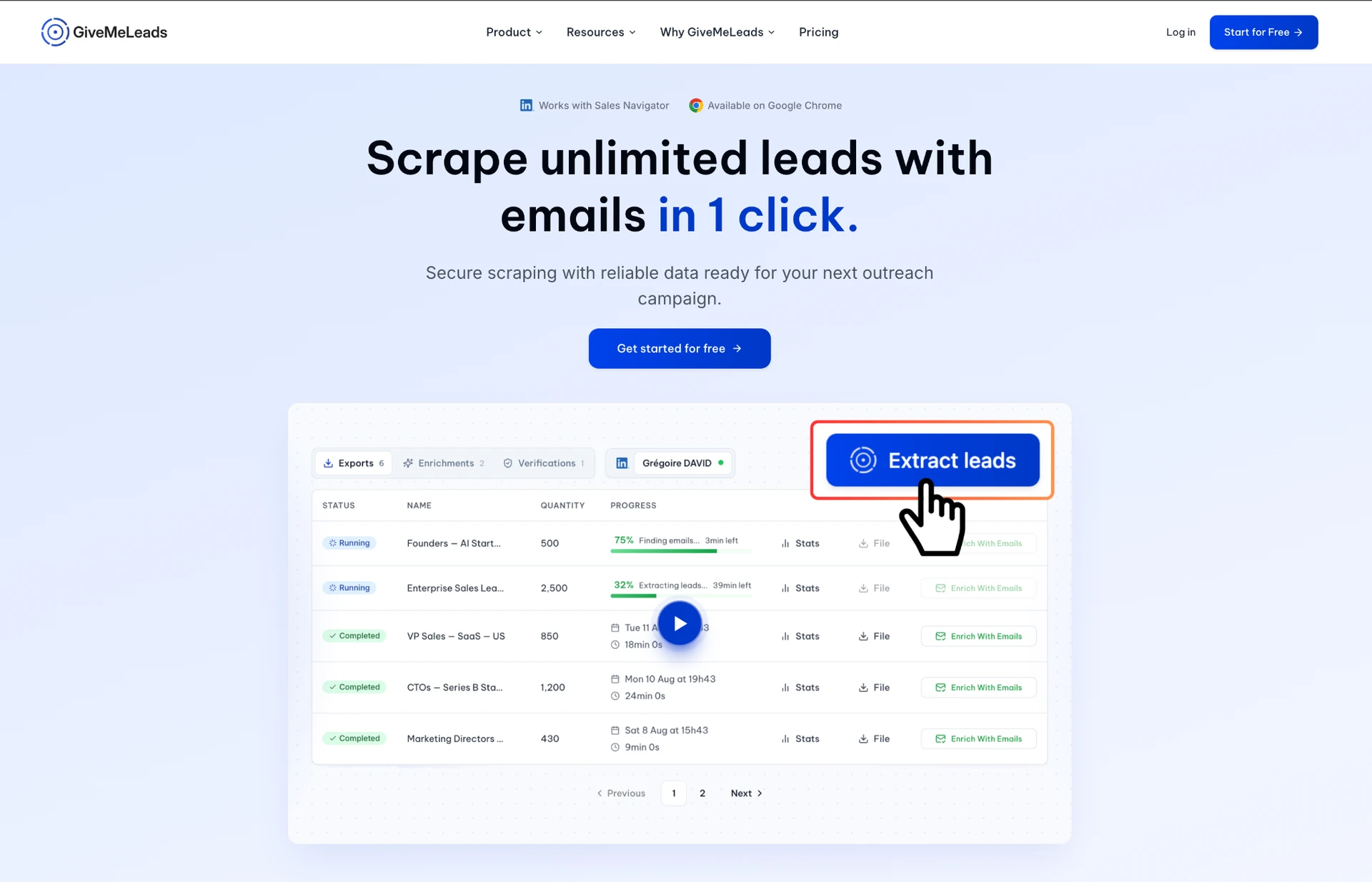
Key takeaways
- An export with a found-and-verified work email can cost two shared credits, while the current queue model allows one active export per account plus one workspace-wide enrichment job and one workspace-wide verification job in flight—so a larger monthly allowance does not guarantee proportionally faster delivery.
- Warm Lead Finder's five signals describe activity or relationship proximity, not verified ICP fit or buying intent; because the documented workflow hands files to an external sender, operators still have to qualify prospects and execute outreach elsewhere.
- The agency setup keeps client searches, lists and histories separate under one login, but public evidence did not establish tenant isolation, RBAC, client access or audit logs; teams moving beyond the six-account self-serve ceiling should get governance terms and Custom economics in writing.
- The 100K card's monthly-to-annual-equivalent figures move from $1,019 to $849—a 16.68% reduction despite a “Save 20%” badge—and purchases are non-refundable, so compare displayed dollars rather than the badge before prepaying.
This review is published by Linked Helper and written by Milosh Potikj, who works there. I've made every effort to represent GiveMeLeads accurately using verified data — our first-hand checks, GiveMeLeads' own documentation, and independent review and community searches.
GiveMeLeads is a cloud-run Sales Navigator list builder for operators who already have somewhere to send or store the resulting prospects. Its Basic plan starts at $35 monthly, but that is only the extraction-and-enrichment subscription: Sales Navigator and an outreach sender remain separate. Our verdict is conditional. The product has a coherent search-to-file workflow and documented pause/resume controls. However, its extension package passes raw LinkedIn session credentials into a vendor URL. That establishes a material session-custody exposure, not a breach or a proven account-restriction outcome.
What Is GiveMeLeads? A List Builder, Not an Outreach Platform
GiveMeLeads is operated by France-based NEW WORKSPACE SAS. It covers lead extraction, work-email discovery, verification and file delivery. Its legal terms define that service boundary. The product workflow starts with a Sales Navigator search or saved list. The Chrome extension hands the search and account session to the web app. Cloud jobs then extract profiles, optionally enrich and verify work emails, and deliver CSV, XLSX or Google Sheets output. For background on this category, see how a Sales Navigator search becomes an exportable lead list.
The practical boundary is the file. The documented product set does not establish a native LinkedIn invitation or message executor. It also does not establish an email campaign sender, reply inbox or current native CRM sync. GiveMeLeads instead prepares data for a CRM or external sender. That means a buyer should evaluate it as a list-preparation layer, not as an all-in-one outreach system.
| Included | External | Not established |
|---|---|---|
| Sales Navigator extraction; waterfall work-email finding; verification; CSV/XLSX/Sheets delivery | Sales Navigator subscription; CRM import; LinkedIn or email sender | Authenticated output quality; native API/webhooks; production throughput |
GiveMeLeads product boundary
Source: GiveMeLeads' extractor documentation and current RevOps workflow page, checked September 2026.
GiveMeLeads Review Verdict: Useful Pipeline, High Session-Custody Risk
The $35 subscription covers a repeatable prospect-file workflow for a solo operator who already pays for Sales Navigator. It remains only one layer of the stack. The operational benefit is specific: one click can initiate extraction, enrichment and verification. A backend job can then continue when the browser page closes. GiveMeLeads documents the Sales Navigator-to-file flow, making the scope easier to assess than a vague “lead generation” claim.
The decisive caution is session custody. In the inspected v1.50 package, li_at is the LinkedIn login in cookie form. It can let its holder act as the account without the password. That credential and the companion li_a Sales Navigator credential enter a GiveMeLeads URL and are submitted to the vendor app. The distributed extension package establishes that transport path. It does not establish misuse, credential leakage, the cloud-assigned IP or a LinkedIn restriction outcome.
Independent outcome evidence is also too thin for an unconditional recommendation. Our identity-matched searches returned no GiveMeLeads user records. That prevents claims about reliability, support quality, accuracy or satisfaction. It does not prove those qualities are poor. Buyers should treat the low entry price and implemented workflow as established. Runtime quality and overall LinkedIn safety remain unresolved.
Best fit: an existing Sales Navigator user who needs enriched files. Works when: a separate CRM and sender are already in place. Avoid if: URL-based session custody or an untested cloud runtime is unacceptable. Decisive risk: replay-capable LinkedIn credentials cross into vendor infrastructure.
GiveMeLeads Pros and Cons: Evidence Before Marketing Labels
The balance below separates documented product behavior from outcomes that still need runtime evidence.
Pros
- Usable entry workflow: Basic includes extraction, enrichment and verification.
- Browser-off continuation: submitted cloud jobs can continue after the page closes.
- Multiple output choices: documented delivery covers CSV, XLSX and Google Sheets.
- Visible limit state: WAITING shows a resume time instead of an unexplained stall.
- Transparent warm signals: the five scoring inputs are named rather than hidden.
- Multi-account organization: client searches, lists and histories stay logically separated.
Cons
- Session custody: raw LinkedIn credentials enter a vendor URL and cloud app.
- Incomplete entry cost: Sales Navigator and an outreach sender remain external.
- Shared-credit yield: extraction plus a found, verified email can cost two credits.
- Constrained queues: one export per account and global enrichment/verification queues apply.
- File-only CRM path: current CRM references describe mappings, not native synchronization.
- Unresolved evidence: runtime safety, accuracy, support and user sentiment are not established.
| Pros | Cons | Evidence class |
|---|---|---|
| Search-to-file flow; browser-off jobs | Session-cookie URL handoff | Shipped package and current app behavior |
| Waterfall finder; four-stage verifier | Coverage and accuracy unmeasured | Vendor-documented process |
| Client-level lists and histories | Roles, portals and audit controls undocumented | Public agency surface |
| WAITING/resume state | Cloud IP and pacing effectiveness untested | App path versus runtime outcome |
GiveMeLeads pros and cons by evidence class
Sources: product workflow, email-verification process and agency model, checked September 2026.
GiveMeLeads Pricing: $35 Is Not the Full Operating Cost
GiveMeLeads publishes prices through six accounts. Basic is $35 monthly or $29 per month equivalent on a $348 annual prepayment. It includes 500 shared credits and one account. VAT is excluded. Premium ranges from 1,500 to 100,000 credits. Custom starts at $500 for quoted scope above six accounts.
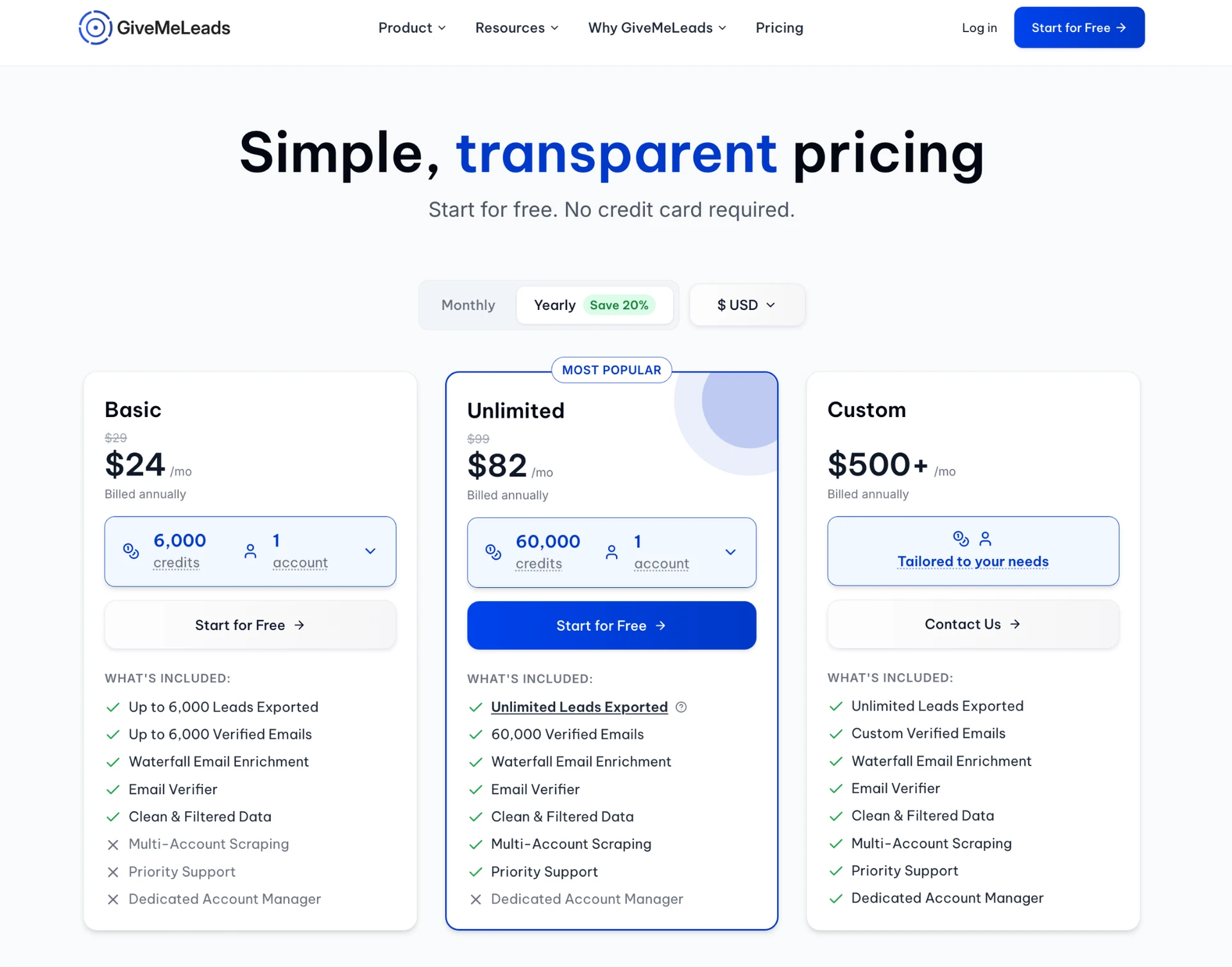
| Plan | Price | What's included | What's NOT included |
|---|---|---|---|
| Free trial | $0; duration undisclosed | Up to 20 leads; one completed export, enrichment and verification job; no card | Permanent free tier; Warm Lead Finder; disclosed trial length |
| Basic | $35 monthly / $29 monthly equivalent billed $348 annually | 500 shared credits; 1 connected account | Sales Navigator; sender; VAT |
| Premium 1.5K | $59 monthly / $49 monthly equivalent ($588 annually) | 1,500 credits; 1 account; Warm Lead Finder; priority support | External stack; VAT |
| Premium 5K | $119 monthly / $99 monthly equivalent ($1,188 annually) | 5,000 credits; 2 accounts | External stack; VAT |
| Premium 15K | $239 monthly / $199 monthly equivalent ($2,388 annually) | 15,000 credits; 3 accounts | External stack; VAT |
| Premium 30K | $479 monthly / $399 monthly equivalent ($4,788 annually) | 30,000 credits; 4 accounts | External stack; VAT |
| Premium 50K | $659 monthly / $549 monthly equivalent ($6,588 annually) | 50,000 credits; 5 accounts | External stack; VAT |
| Premium 100K | $1,019 monthly / $849 monthly equivalent ($10,188 annually) | 100,000 credits; 6 accounts | External stack; VAT |
| Custom | Starts at $500; quote required | More than 6 accounts; quoted scope | Public 20-account price; disclosed users or credit bundle |
GiveMeLeads pricing tiers (September 2026)
The first trap is total cost. In the supplied comparison, required Sales Navigator Core was $119.99 monthly or $1,079.88 annually. Known solo cost is therefore $154.99 monthly pre-VAT, or $1,427.88 annually, before a sender. Sources: GiveMeLeads' requirement and LinkedIn's plan comparison. So, $35 buys list preparation, not a complete outreach stack. See also Sales Navigator pricing context.
The second trap is yield. Export costs one credit. A found, verified work email costs one more. Two known-email verifications cost one. At 100% found-email coverage, 500 credits imply about 250 fully enriched exports. Hypothetical 50%–80% coverage implies about 333–278. These are arithmetic scenarios, not measured yield. Sources: credit rules and Not Found treatment.
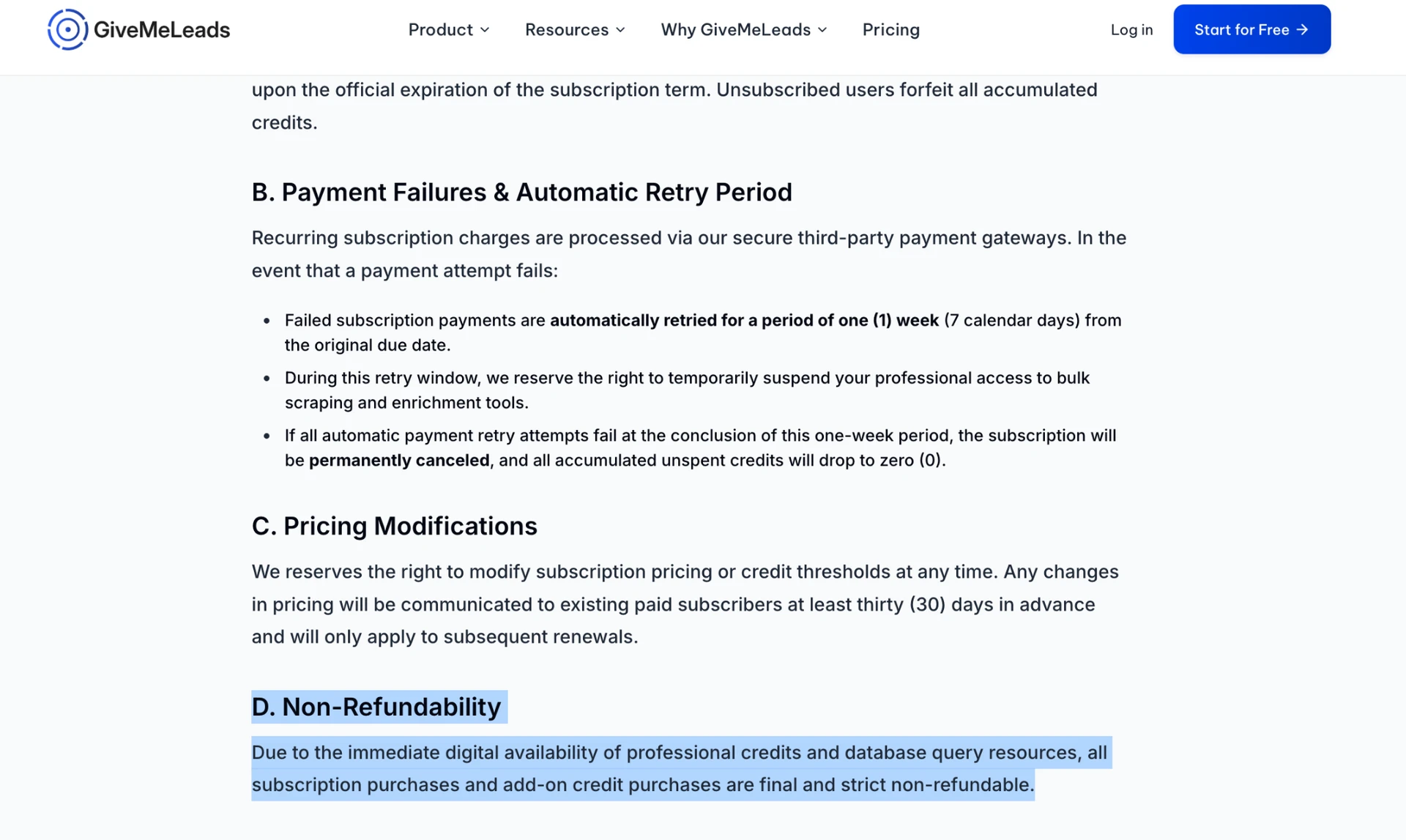
The 100K annual card's $1,019-to-$849 arithmetic is a 16.68% reduction despite a “Save 20%” badge. Purchases are non-refundable. Subscription credits survive only while the subscription is active. Standalone add-on treatment after expiration remains unresolved under the Terms. One current snapshot cannot support a repricing trend.
Using GiveMeLeads prices and Sales Navigator prices, the 20-account workaround uses five Premium 30K workspaces plus 20 Core licenses. It costs $4,794.80 monthly pre-VAT or $45,537.60 annually. This derived five-workspace scenario is not a centralized Custom quote and excludes outreach.
Pricing trap: A headline lead allowance is not the same as fully enriched output: export and a found, verified email can consume two shared credits, while Sales Navigator and the sender sit outside the subscription.
GiveMeLeads Features: Seven Axes From Click to Delivered File
The documented set covers Sales Navigator extraction, work-email enrichment, verification, five-signal scoring, scheduled cloud jobs and CSV/XLSX/Sheets export. These seven axes separate visible paths from measured outcomes.
| Axis | Established | Unmeasured |
|---|---|---|
| Extension | Click-to-credential URL | Retention; runtime use |
| Extraction | Jobs; three file formats | Completeness; reliability |
| Enrichment | Waterfall; four checks | Coverage; freshness; accuracy |
| Limits | Cap; WAITING; queues | Enforcement; throughput |
| Warm scoring | Five disclosed rules | ICP fit; intent |
| Agency | Accounts; lists; dedupe | Governance; tenancy |
| Handoff | Mapped external files | Native sync; outcomes |
GiveMeLeads capability and evidence index
Sources: extractor, app, scoring, agency and CRM.
Evidence boundary: An implemented path does not establish its backend result.
v1.50 Extension: The One-Click URL Credential Handoff
The v1.50 Manifest V3 extension adds an Extract Leads button inside Sales Navigator. After the operator clicks it, the extension reads raw .linkedin.com li_at and li_a values. It passes them through its cookie bridge. The extension then constructs an app.givemeleads.io/search URL containing the credentials and Sales Navigator search. The web app parses those values and posts them to /accounts as the access and premium tokens. It then creates backend jobs. The Chrome listing, distributed v1.50 package and current app asset support this path.
| # | Surface | Action |
|---|---|---|
| 1 | Extension | Injects the Extract Leads button |
| 2 | Cookie bridge | Reads li_at and li_a after the click |
| 3 | URL query | Carries credentials and search to the vendor app |
| 4 | Vendor app | Parses values and posts them to /accounts |
| 5 | Backend | Creates extraction jobs |
LinkedIn session-credential path after an explicit click (July 2026)
What I verified first-hand. In the inspected core package, I found no:
- invitation/message executor;
- LinkedIn write endpoint;
- direct Voyager/GraphQL call;
- synthetic-event routine; or
- dedicated analytics SDK.
I did find the URL handoff above. That distinction matters. Explicit initiation avoids a claim of silent background capture, but it does not make query-string transport safe. URLs may enter browser history. They may also enter ordinary server, reverse-proxy or CDN logs when no separate telemetry tool records the values. This is an exposure surface, not evidence that retention or leakage occurred.
Membership of the extension ID in LinkedIn's Active Extension Detection (AED) list was not established in the reviewed public evidence. The package surface also lacked the specified probe resource, so a successful installation probe was not confirmed.
Credential boundary: The click is explicit, but replay-capable LinkedIn credentials still enter a vendor URL before the cloud job begins; retention and downstream runtime behavior remain unestablished.
Sales Navigator Extraction and Browser-Off Cloud Jobs
Like most tools in this category, GiveMeLeads starts from a Sales Navigator search or saved list and exports tabular prospect data. Documented source cases include groups, company followers and first-degree connections through Sales Navigator filters. Post-liker/commenter and event-attendee collection were not established in the reviewed public surface, so those sources should not be assumed. The extractor page documents the supported search flow.
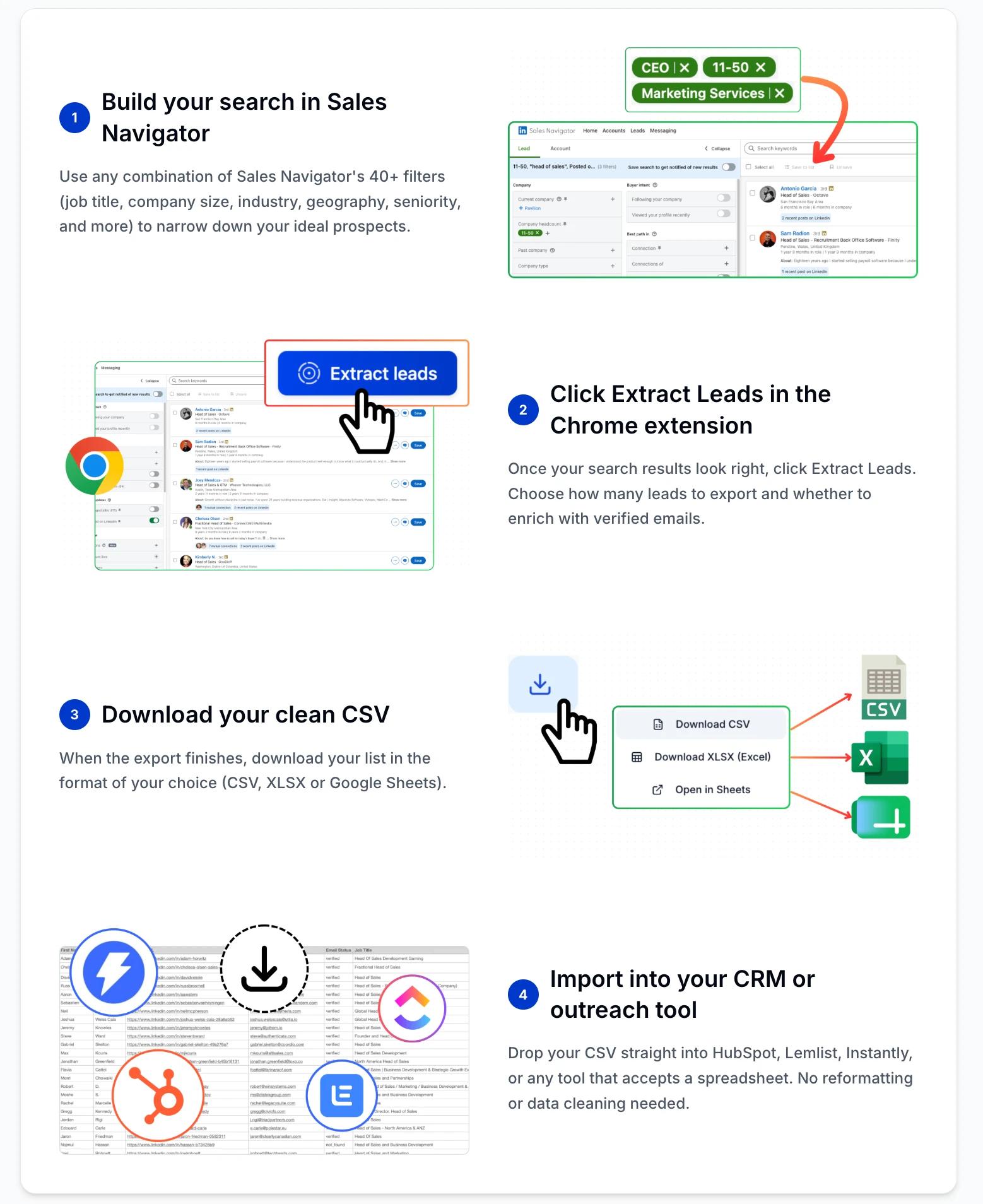
You click Extract Leads, connect the account and submit a backend job. The app says the window can close while work continues. Agencies can also create weekly schedules. Delivery covers CSV, XLSX or Google Sheets with email notification. The extension therefore launches work rather than remaining its execution engine. Sources: browser-off job behavior and weekly schedules.
| # | Stage | What happens |
|---|---|---|
| 1 | User click | Submit a Sales Navigator search or saved list |
| 2 | Account connection | Pass search and session context to the web app |
| 3 | Backend job | Extract, then optionally enrich or verify |
| 4 | Delivery | Provide CSV, XLSX or Google Sheets output |
Sales Navigator search to delivered prospect file (September 2026)
Each search and connected account is capped at 2,500 records per day, so larger searches require segmentation. Authenticated export testing did not cover:
- columns and encoding;
- Sheets authorization;
- completeness, duplicates or failures;
- completion time; or
- restriction behavior.
The cloud-job design establishes convenience, not throughput or reliability.
Runtime limit: Browser-off continuation is documented, but delivered-file quality, completion reliability and behavior under LinkedIn restrictions remain unmeasured.
Waterfall Enrichment, Verification, and Double Credit Consumption
Data enrichment means appending contact data—here, a work email—to a LinkedIn profile. The practical payoff is a file that can feed off-platform follow-up, but usefulness depends on coverage and freshness as well as validity. GiveMeLeads' waterfall checks providers sequentially and stops when it finds a verified work email. A Not Found result does not consume the email-finding credit. The waterfall page documents that sequence. See email finding, extraction and verification context.
The verifier's documented stages are exhaustive: syntax, DNS/MX, SMTP mailbox handshake and catch-all checks, without sending a message. That establishes the process, not its real-world accuracy. Independent testing did not measure:
- coverage;
- false positives;
- catch-all classification;
- bounce rate;
- freshness; or
- delivered-data accuracy.
GiveMeLeads describes the four checks here.
| Operation | Credit debit | Evidence boundary |
|---|---|---|
| Export one lead | 1 credit | A row export, not an enriched-email guarantee |
| Find and verify a work email | 1 additional credit when found | Not Found does not consume this finder credit |
| Verify known emails | 1 credit per 2 addresses | Process documented; accuracy not independently measured |
| Fully enriched export | Up to 2 credits | Exact average depends on found-email coverage |
Shared-credit consumption per record
The pricing page defines one shared credit across these operations. Current app behavior also gates uploaded enrichment and verification files at 2,500 rows and 50 MB. Large source files therefore need splitting even on high-credit plans. The app asset shows those client-side limits. A per-record data-freshness date was not established. The review therefore cannot treat verification as proof that every address is current.
Model your yield: Budget one credit for every exported lead and a second only where a work email is found and verified; do not divide the plan credits by one and call the result fully enriched leads.
Daily Caps, WAITING Auto-Resume, and Job Queues
GiveMeLeads documents two matching extraction ceilings. Each search is capped at 2,500 records. Each connected account is capped at 2,500 exported leads per day. When a job reaches a scraping limit, the current app can place it in WAITING. It shows a resumeDateTimestamp and can automatically resume the job later. This provides a visible state and planned continuation. The extractor page states the caps. The current app asset exposes the PENDING, ONGOING and WAITING states.
| Constraint | Scope | Documented behavior | Unknown |
|---|---|---|---|
| Search size | Per export | Maximum 2,500 records; segment larger searches | Server-side edge-case enforcement |
| Daily cap | Per connected account | Maximum 2,500 exported leads per day | Pacing and hidden thresholds |
| Export queue | Per connected account | One LEAD_EXPORT in flight | Production completion rate |
| Enrichment queue | Whole workspace | One ENRICHMENT job in flight | Backend throughput |
| Verification queue | Whole workspace | One VERIFICATION job in flight | Backend throughput |
| Parallel exports | Across accounts | Separate accounts may export concurrently | Workspace-wide risk budget |
GiveMeLeads limit and queue scopes
Credit volume and concurrency are separate. A 100,000-credit plan does not create unlimited in-flight work. Each account still has one active export slot. The workspace has one global enrichment queue and one global verification queue. Six accounts therefore have an arithmetic outer ceiling of 15,000 exported leads per day before shared credits and any hidden thresholds. That is capacity arithmetic, not measured throughput or a safety conclusion.
The vendor estimates 500 enriched leads in 5–10 minutes and 2,500 in 30–45 minutes on its extension page. Those are estimates, not an SLA. Maximum weekly schedule count, delay ranges, working-hour controls and warning-response behavior were not established. Buyers with large credit packages should therefore test end-to-end queue time instead of inferring speed from monthly credits.
Queue bottleneck: Large monthly credit ceilings do not remove one-export-per-account and global enrichment/verification queues; no production-throughput estimate is established here.
Warm Lead Finder: Proximity Signals, Not Buying Intent
Warm Lead Finder is a Premium-gated rules-based score. It uses five named signals, making the label inspectable. It does not demonstrate an AI model or automatic Ideal Customer Profile scoring. The vendor's Warm Lead Finder page names the inputs.
| Signal | What it shows | What it does not show |
|---|---|---|
| Role change in the last 90 days | Recent employment movement | Need, budget or ICP fit |
| Recent profile view | The person viewed the operator's profile | Purchase timing or intent |
| Company-page follow | Relationship to a page | Buying authority |
| First-degree connection | Existing LinkedIn proximity | Interest in an offer |
| Competitor-network overlap | Network relationship to a named competitor | Product demand or sales readiness |
Warm Lead Finder signal boundaries
The label is narrower than the conclusion some buyers may draw. A profile view, follow, role change, connection or network overlap can help prioritize a list. None alone establishes that the person matches the ICP or plans to buy. Scoring quality, false positives and conversion outcomes were not independently measured. Warm Lead Finder is therefore a transparent ranking aid, not evidence of intent detection.
The reviewed documentation did not establish AI-generated outreach messages, AI-written post comments or campaign-level AI decisions. “Warm” does not imply those functions. The operator must validate fit and run outreach elsewhere.
Semantic limit: “Warm” means a match on disclosed activity or relationship signals; it does not mean verified ICP fit, buying intent or predicted conversion.
Multi-Account and Agency Workspaces: Isolation Without Governance
Public plans include one connected account on Basic and Premium 1.5K. The 5K through 100K tiers increase that limit to two, three, four, five and six accounts. Accounts can export in parallel, and the vendor documents deduplication. Volume can therefore be divided across connected accounts. Each one still keeps its own 2,500-lead daily ceiling. The multi-account page documents the account model and deduplication.
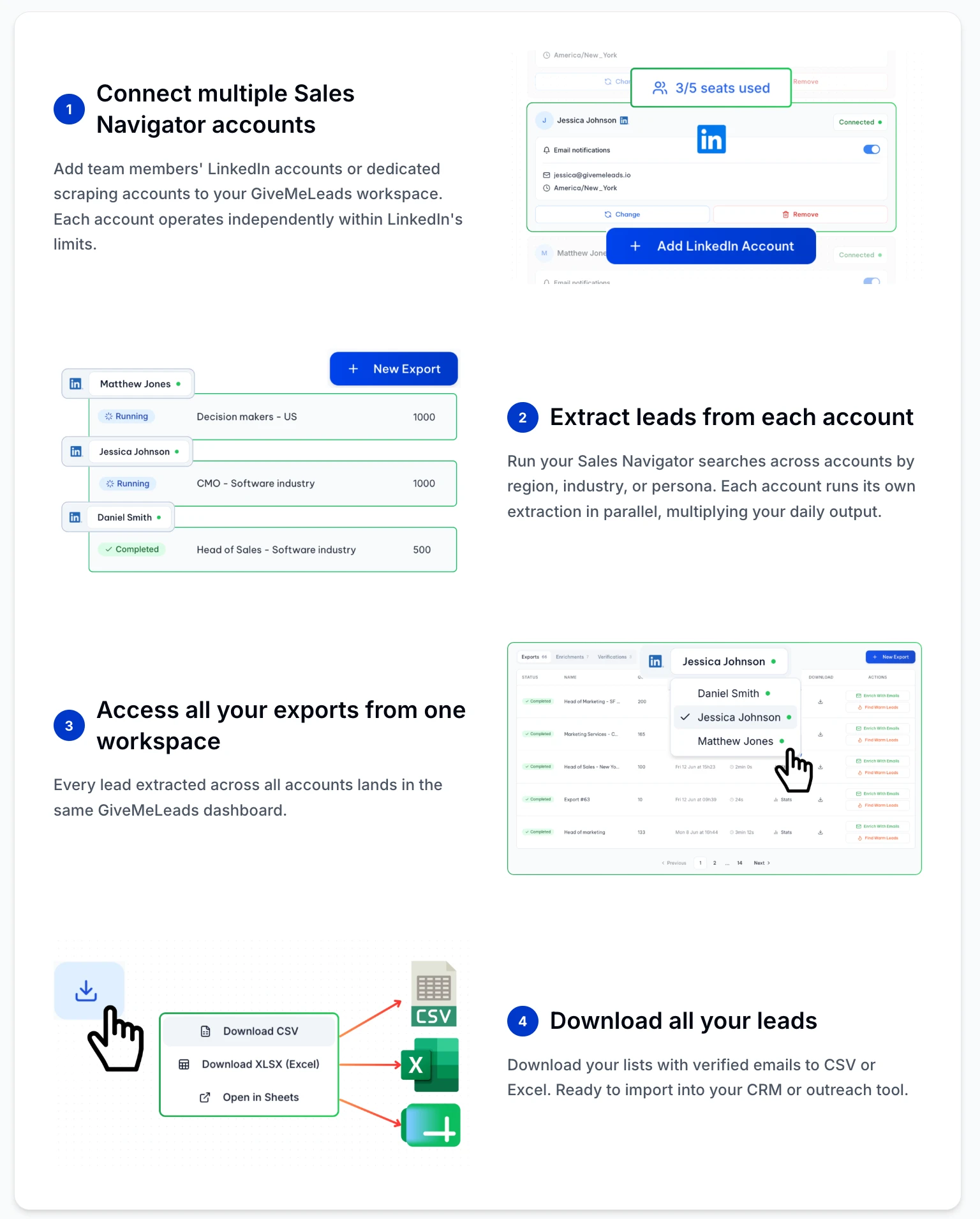
For agencies, separate client searches, lead lists and export histories sit under one login, with weekly schedules available. That can reduce file mixing, but does not establish separate tenants, client self-service or security governance. The agency page supports the one-login operating model.
| Capability | Established | Not established |
|---|---|---|
| Client organization | Separate searches, lists and export histories | Separate tenant or data-residency boundary |
| Account scale | 1–6 accounts on self-serve tiers; more via Custom | Public 20-account centralized quote |
| Parallel work | Accounts may run exports concurrently | Workspace-wide risk budgeting |
| Dedupe | Automatic multi-account deduplication is documented | Authenticated dedupe quality |
| Human access | One-login agency model | Human-seat count, RBAC or granular permissions |
| Client delivery | Exportable files | Client portal, white-label dashboard or audit log |
| Administration | Custom offered above six accounts | Reassignment mechanics, SLA or published governance controls |
Operational separation versus agency governance
The distinction is operational separation versus governance. Public evidence did not establish role-based access control, client login, white-labeling, audit logs, human-seat rules or reassignment. These gaps do not prove a Custom contract excludes them. Documented deduplication is also not an authenticated quality result.
Self-serve economics also stop at six accounts. A 20-account buyer needs a Custom quote to learn centralized credits, users and controls; stacking public workspaces is only a derived workaround. Security-sensitive agencies should ask for the access model and deletion process in writing before treating one dashboard as agency-grade isolation.
Governance gap: Separate client lists under one login are documented; tenant isolation, RBAC, client access, audit logs and reassignment remain publicly unestablished.
CRM Compatibility, File Handoff, and the Missing Sender
GiveMeLeads currently confirms 0 native integrations. HubSpot, Salesforce and Pipedrive appear as clean-file destinations with standard field mappings, while native CRM integrations remain on the roadmap. That means the current mechanism is export, map and import—not live synchronization. The RevOps page defines this file-based boundary. For neutral background, see the difference between file import and native LinkedIn-to-CRM integration.
| # | Layer | Owner |
|---|---|---|
| 1 | GiveMeLeads export | Prepare profile, company and email fields |
| 2 | CSV mapping | Match columns to the destination |
| 3 | External import | CRM or sender receives the file |
| 4 | Campaign execution | External system sends and tracks outreach |
GiveMeLeads file handoff to CRM or outreach software (September 2026)
The reviewed public surface did not establish:
- native invitations/messages;
- email or multichannel sequences;
- reply detection/inbox;
- message templates;
- nested IF-THEN-ELSE outreach;
- email-on-invite;
- cancellation/re-invite or invite-hygiene;
- never-messaged/generic-reply filters;
- message-history dedupe;
- full conversation export;
- AI messages/comments; or
- post boosting.
It also did not document post-engager collection, skill endorsement, “Save as lead” control or platform override. GiveMeLeads describes handing files to an external sender such as Lemlist or Instantly.
No supported customer API, Zapier/Make connector or webhook documentation was found on the reviewed public surface. That leaves incoming lead feeds, late-reply CRM resync, fill-empty merge rules and named Snov.io campaign handoff unestablished rather than proven impossible. In practice, the buyer owns import setup, field mapping, campaign execution and reply tracking in another system.
Workflow boundary: CRM logos describe mapped files, not native sync; the documented product prepares data while another system sends outreach and manages replies.
Is GiveMeLeads Safe for LinkedIn? Controls Versus Session Custody
GiveMeLeads' safety picture separates scraping controls from session custody. The 2,500-export daily cap and WAITING auto-resume govern job volume. They do not answer credential transport, cloud-IP or fingerprint questions.
A session-upload extension copies a LinkedIn login into vendor infrastructure so cloud work can continue. Here, li_at is the login in cookie form. Its holder may operate the account without the password. The flow also transfers li_a for Sales Navigator. Vendor-assigned IP, runtime fingerprint and cross-account isolation were not measured.
What I verified first-hand. In September 2026, I found that v1.50 reads both credentials after an explicit click. It puts them in an app.givemeleads.io URL and submits them to /accounts. Sources: distributed package and current app asset.
The Chrome listing says, “The developer has disclosed that it will not collect or use your data.” The code transfers session credentials to the vendor URL/app. This disclosure-to-code conflict does not prove breach, misuse or restriction.
| What was checked | Result |
|---|---|
| Architecture | Explicit extension click followed by URL credential handoff and vendor-cloud jobs |
| Session credentials | Raw li_at and li_a enter the vendor URL/app |
| URL exposure | Ordinary URL retention is possible; no incident observed |
| Store disclosure | Conflicts with the observed transfer path |
| Extension behavior | No Voyager/GraphQL calls, write endpoints or synthetic events found |
| Detectability | AED-list membership not established; successful resource probe not confirmed |
| Scraping controls | 2,500/day/account; WAITING/auto-resume documented |
| Cloud execution | IP, geo, fingerprint, pacing and isolation untested |
| Public controls | Proxy controls, DPA, trust center and retention schedule not established |
GiveMeLeads safety checks and evidence boundaries
The honest read: static evidence supports a high session-custody concern and documented scraping controls, not an overall safety verdict. URL transport can expose bearer-like credentials to ordinary URL-handling systems. No separate analytics SDK was found, but server retention was not measured. The privacy policy defines Controller/Processor roles without disclosing cloud region or credential retention.
No tool eliminates LinkedIn restriction risk. Manual activity can also look automated, including mass profile-URL opens or unrealistic speed. See scraper architecture trade-offs and restriction context; neither proves a GiveMeLeads outcome.
Safety boundary: The URL credential handoff is established; cloud exit IP, fingerprint isolation, pacing effectiveness and restriction outcomes are not. The daily cap cannot resolve that separate evidence gap.
What GiveMeLeads Reviews Actually Show: No Independent Cohort
We found no identity-matched GiveMeLeads records in the material searched. The review search covered 22,035 normalized records through September 2, 2026. Within that searched set, the per-platform counts were G2: 0, Capterra: 0 and Trustpilot: 0. With zero rated records on each platform in that time-qualified collection, there is no platform rating or mean to print. There is also no star distribution or six-month trend to print. The Capterra page is only an identity/discovery lead here, not review evidence.
The community search found 0 exact or normalized GiveMeLeads matches among 5,061 Reddit posts. Structured switching searches returned 0 migration stories. Those denominators do not establish that there are no customers, reviews, complaints or incidents elsewhere. They establish only that this evidence set cannot support claims about sentiment, reliability, support quality, safety, accuracy, adoption or complaint prevalence.
No anomaly conclusion is available. The weekly check was not run because N=0 is below its 30-review floor. There was no meaningful series to test, not evidence of a flat or healthy pattern.
We also found no authentic publication date, author, rating or quote to place in either a praise or complaint carousel. Inventing cards from first-party product pages would turn vendor claims into user testimony, so both carousels are intentionally omitted.
The visible product pages and legal materials are recent. That does not establish a founding date, relaunch, ownership change or business maturity. Those firmographic points remain unresolved. A buyer who needs reputation evidence should run fresh, identity-matched external research. Any result must refer to this operator and product rather than a similarly named entity.
Evidence availability: Product and package evidence exists; an independent user cohort was not found in the 22,035-review and 5,061-post searches. That gap is not proof of positive or negative user outcomes.
Who GiveMeLeads Is For — and Who Should Look Elsewhere
GiveMeLeads addresses a narrow workflow. You already have Sales Navigator, accept files and operate a CRM/sender. Basic covers solo use. Premium adds volume, Warm Lead Finder and accounts. Sources: founder workflow and plan gates.
| Profile | Fit | Minimum plan | External dependency | Blocker | Test before buying |
|---|---|---|---|---|---|
| Solo founder | Conditional fit | Basic | Sales Navigator, CRM/sender | 500-credit yield | Run representative export/import |
| SDR list builder | Conditional fit | Basic or Premium | Sales Navigator and engagement tool | No campaign execution | Check fields and dedupe |
| Recruiter | Conditional fit | Basic | Sales Navigator and recruiting workflow | No native reply inbox | Verify fields and email coverage |
| Small data team | Conditional fit | Premium | Sales Navigator and data destination | Global enrichment/verification queues | Measure queue time and output quality |
| Multi-client agency | Conditional fit | Premium or Custom | One Sales Navigator license per account | Governance and >6-account terms unresolved | Request users, RBAC, deletion and Custom economics in writing |
| All-in-one outreach buyer | Poor fit | None | Would still require a sender | No documented invitations, messages or sequences | Evaluate a platform that executes the required channel |
| Security-sensitive operator | Unresolved | Any | Internal approval | URL session custody and untested cloud runtime | Verify credential lifecycle, exit IP and account isolation |
| RevOps team requiring live sync | Poor fit today | None established | Manual/file import | Native CRM integrations remain roadmap | Test the complete file-to-CRM handoff |
GiveMeLeads fit by workflow
Sources: agency, CRM and package.
Who should look elsewhere: Buyers needing native outreach, reply detection or live CRM sync should look elsewhere for documented implementations. Public evidence also did not establish API/webhooks, agency roles or public 20-account economics. Security-sensitive buyers do not have the runtime evidence needed for a categorical decision.
Who can trial it: a founder, SDR, recruiter or data team can inspect representative output. The no-card trial allows up to 20 leads, but its duration is undisclosed; it is not repeatability proof. See the vendor trial guide.
GiveMeLeads Alternatives: Compare the Workflow Boundary First
An alternatives decision should start with the job boundary. Compare source access, session model and enrichment economics. Then compare file delivery versus outreach execution, account model and evidence date. The snapshots below are deliberately shallow. They do not establish comparative safety, accuracy or value. The non-anchor prices were not live re-researched for this article.
| Tool | Architecture | Entry price | Best known for |
|---|---|---|---|
| Linked Helper | Desktop + VPS/Web Version | $15/month | LinkedIn invitations, messages and local/VPS execution; linear campaign workflows and no native non-LinkedIn email sequences |
| Wiza | Not established | $49/month snapshot from Apr. 22, 2026 | Sales Navigator scraping plus email finding/verification and 8 recorded integrations; architecture is not established and price is older than 90 days |
| Evaboot | Not established | $9/month snapshot from Apr. 22, 2026 | Sales Navigator scraping plus email finding/verification; architecture is not established and price is older than 90 days |
| PhantomBuster | Cloud | $69/month snapshot from May 27, 2026 | Sales Navigator scraping plus invitation/message actions; the snapshot does not establish current safety or price |
| Apollo | Cloud | $59/month snapshot from May 27, 2026 | Data/email finding, native email sequences and intent/lead-scoring signals; the snapshot does not establish current safety or price |
| Clay | Cloud | $185/month snapshot from Apr. 22, 2026 | Enrichment across 150 recorded data partners plus CRM destinations; price and architecture snapshots are older than 90 days |
How GiveMeLeads compares
Architecture evidence for the first row: security study.
How to read the rows: Wiza and Evaboot overlap most directly with search-to-email-file preparation. Their architecture values were not established in the supplied snapshot. PhantomBuster extends into LinkedIn actions. Apollo includes native email sequences, while Clay emphasizes multi-provider enrichment. Each brings a broader workflow boundary. Each also has a different architecture, price and operating model that this shallow snapshot does not fully test. Search association alone does not make any row safer, more accurate or more economical.
See the deep comparison: PhantomBuster alternative →
See all data and enrichment alternatives →
Where Linked Helper Fits
If GiveMeLeads' URL-based session custody and external-sender requirement are decisive, a workflow that executes outreach from user-controlled hardware is worth evaluating. Linked Helper is a desktop app for Windows, macOS and Ubuntu. It can also run on a VPS and be controlled through its Web Version for 24/7 operation. Its session remains on the local machine or VPS rather than being uploaded to a vendor cloud. Linked Helper's security study discusses this architecture.
- Outreach execution: it runs LinkedIn invitations, messages and ordered campaign steps instead of ending at a prospect file.
- Session boundary: local or VPS execution uses the operator's session and IP, with a dedicated proxy assignable per account.
- CRM handoff: 11 direct CRM connectors are available, plus Zapier and Make through webhooks.
- Operational visibility: a sleeping campaign can report one of seven documented pause reasons rather than only showing a generic state.
GiveMeLeads starts at $35/month. Linked Helper starts at $15/month. They cover different jobs. Linked Helper has no standalone email-verifier action or native non-LinkedIn email sequences, and its campaign workflow is linear. Teams prioritizing native LinkedIn outreach and session-location control may evaluate Linked Helper too. No tool eliminates restriction risk.