
 Updated: September 13, 2026
 23 min read
Key takeaways
- The pricing table gives Advanced and Professional the same documented action ceilings—75 daily invites, messages, and views; 50 daily likes, follows, and endorsements—so moving from $79 Advanced to $99 Professional unlocks team and agency controls without raising those listed ceilings.
- The March 20, 2023–April 3, 2026 local corpus contains 36 G2 records and nine Trustpilot rows representing eight voices, yet only two ratings fall in the six months ending August 3, 2026—too little recent evidence to establish current direction.
- The public AI catalog spans variables, filtering, commenting, scoring, voice/video, and inbox modes, but hidden Coming Soon residue and the lack of an authenticated run leave maturity, moderation, accuracy, and output quality unresolved; feature presence is therefore not production proof.
- Seven vendor-named connections and a token-authenticated public REST API do not settle portability: the documented CSV contains lead data and accepted/replied flags rather than full message text, complete history, or per-message timestamps, while API entitlement and live behavior remain unestablished—so migration teams need a payload test, not a connector count.
This review is published by Linked Helper and written by Milosh Potikj, who works there. I've made every effort to represent SalesRobot accurately using verified data — our own first-hand testing, SalesRobot's own documentation, and independently sourced reviews.
SalesRobot is a cloud LinkedIn and cold-email automation platform for solo outbound operators, sales teams, and agencies. Basic starts at $59 monthly per LinkedIn account. Its one-active-campaign ceiling and feature gates make Advanced at $79 the practical solo floor for many workflows. Current execution is cloud-based and uses no extension. Our safety verdict is conditional. Documented limits, schedules, Safe Mode, and proxy controls coexist with full LinkedIn credential entry and conflicting IP descriptions. The evidence also contains contradictory restriction-risk figures and no independent runtime-network test.
Verdict
Evaluate SalesRobot when its cloud LinkedIn/email workflow justifies Advanced- or Professional-level spend. The documented feature set covers conditional sequences, AI-assisted steps, inbox handling, integrations, and agency controls.
The conditions are commercial and technical. Basic permits one active campaign and gates inbox, A/B, CRM, and webhook functions. Billing multiplies by LinkedIn account, while sending, finding, and Bulk Email have separate meters. Cancellation sources do not describe one consistent exit. Safety controls exist, but the included IP type, session handling, and restriction outcomes were not independently established. Buyers needing settled custody, billing, or cancellation terms should pause.
Decision: conditional: Evaluate it when the Advanced workflow matches the job; pause when session custody, IP evidence, exit terms, or multi-account TCO must be settled first.
Pros
- Cloud execution: Campaigns run without an open browser, removing the local always-on-machine requirement.
- One multichannel canvas: LinkedIn and email actions interleave in one sequence.
- Conditional workflows: Templates, linear sequences, and condition-based branches are documented.
- AI functions: Variables, filtering, and commenting sit alongside listed voice, video, scoring, and inbox functions.
- Central conversations: Smart Inbox combines LinkedIn and email threads with filters.
- Named data routes: The vendor documents CRM, spreadsheet, webhook, and API paths.
- Agency controls: Five fixed roles, multi-account operations, and separate white-label workspaces are documented.
Cons
- Basic is narrow: $59/month buys one active campaign and limited quotas. Basic inbox, A/B, CRM, and webhook access are not documented; CSV entitlement conflicts.
- The bill has several units: Plans bill per LinkedIn account. Sending is $15 per email account, finder/verifier uses credits, and Bulk Email is separate.
- Team economics start on Professional: Roles, Agency View, cross-account deduplication, and priority support require the $99 monthly plan per LinkedIn account.
- Safety copy conflicts: The overview says residential, while pricing says dedicated/local rotation; risk figures differ 100-fold.
- Credentials are handed to the vendor: Connection starts with username and password; session storage and replay remain undisclosed.
- Exit instructions conflict: Self-service cancellation sits beside 15-day chat-notice, no-refund, and deletion wording.
- Migration complaints appear in the record: Four Trustpilot voices objected to AppSumo V1-to-V2 fees or lost functions—historical problem discovery, not universal evidence.
SalesRobot Pricing: Plans, Gates, and Separate Email Costs
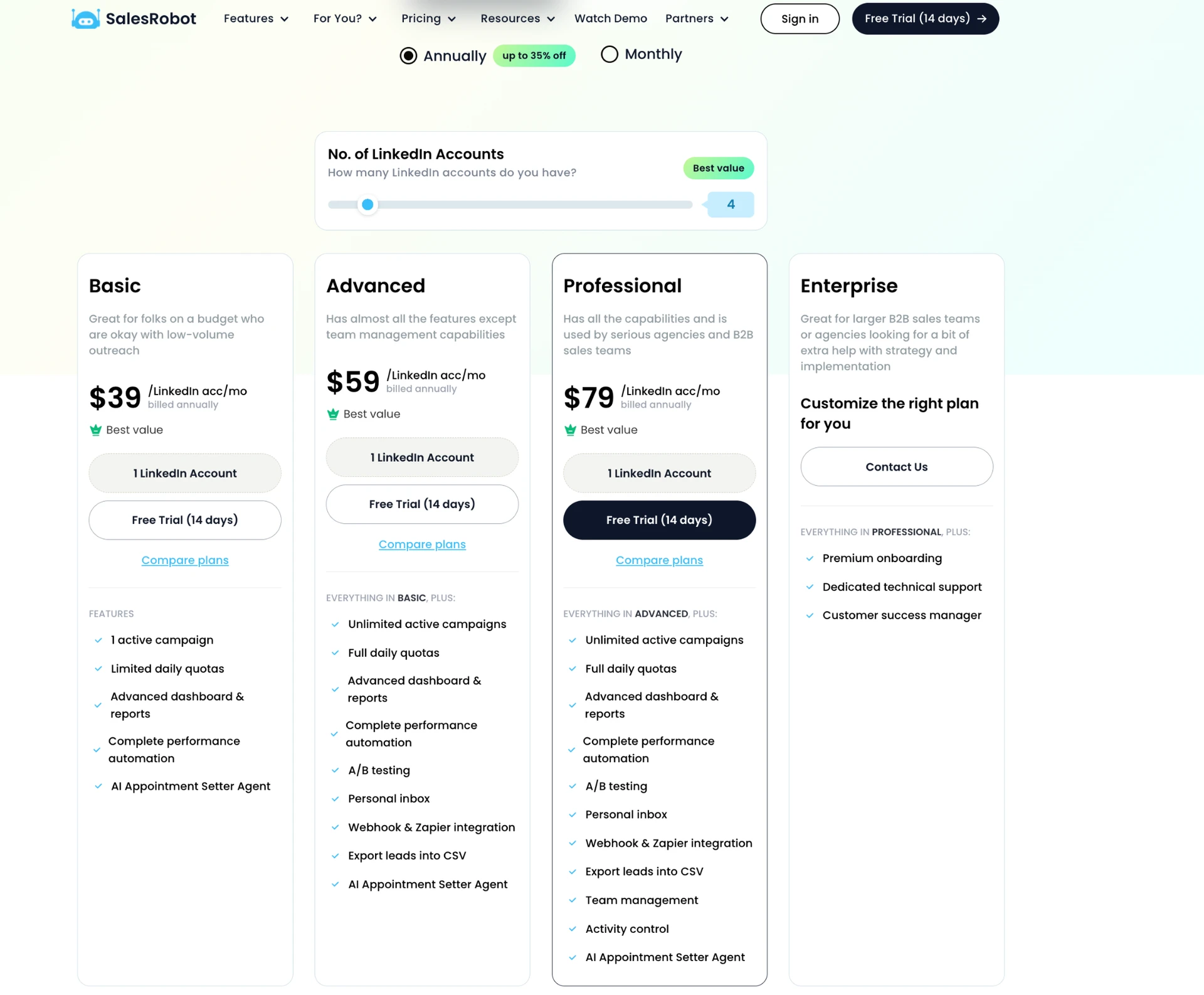
The displayed and practical entries differ. Core billing is per LinkedIn account. Basic is $59 monthly or $39 equivalent on a $468 annual invoice. Its one-campaign ceiling and feature gates make Advanced a practical solo floor for many workflows.
| Plan | Monthly price | Annual monthly equivalent | Annual invoice | Key gate | What's NOT included |
|---|---|---|---|---|---|
| Basic | $59 per LinkedIn account | $39 | $468 | 1 active campaign; limited daily quotas | Personal inbox, A/B testing, native CRM sync, webhooks; CSV entitlement is contradictory |
| Advanced | $79 per LinkedIn account | $59 | $708 | Unlimited active campaigns; full quotas; inbox, A/B, CRM and webhooks | Team management, Agency View, cross-account duplicate prevention, priority-support SLA |
| Professional | $99 per LinkedIn account | $79 | $948 | Advanced plus team and agency controls | Enterprise success manager; separately priced email layers |
| Enterprise | Custom | Custom | Custom | Contact SalesRobot | Public price and complete commercial terms |
SalesRobot pricing tiers (September 2026)
Pricing trap: Basic is the display entry point, but its one-campaign ceiling and workflow gates push many solo production scenarios to Advanced. Confirm Basic CSV export in writing because the plan card and detailed table conflict.
Volume discounts conflict at 10 accounts. The September 2026 pricing calculator showed none at 10 and 33% at 11–19. It showed 45% at 20–35 and custom above 35. The FAQ says 10+, so confirm a 10-account quote.
| LinkedIn accounts | Displayed treatment | Buyer implication |
|---|---|---|
| 1–10 | No volume discount | Exactly 10 still priced at the plan's undiscounted per-account rate |
| 11–19 | 33% discount | First live-calculator discount tier |
| 20–35 | 45% discount | Self-service scale tier used in the scenario below |
| More than 35 | Custom price | Public arithmetic no longer supplies a quote |
SalesRobot live account-slider breakpoints (September 2026)
Email has separate meters. Sending, finder/verifier, Bulk Email, and services do not include one another.
| Layer | Public price or allowance | Separate cap or qualifier |
|---|---|---|
| Email Automation add-on | $15 per email account/month | Flat add-on; no annual or account-slider discount established |
| Finder/verifier | 225 complimentary credits per customer; 3 credits per found-and-verified result | Paid annual-equivalent packs: 3,000/$43, 15,000/$109, 60,000/$219, 150,000/$406 per month; expiry/rollover not documented |
| Bulk Email | Growth $47, Hypergrowth $113, Light Speed $210 monthly; annual equivalents $43/$102/$189 | Separate product; its unlimited-warm-up wording does not erase tier send/contact caps, including Growth 5,000 sends/1,000 contacts and Hypergrowth 100,000 sends/25,000 contacts |
| Done-For-You services | Separate service catalog | Not included in the software plans |
| Taxes | Excluded | Customer responsibility under the cancellation policy |
Separate SalesRobot cost layers (September 2026)
A 20-account scenario shows the multiplier. With Professional annual billing, the 45% tier, 20 accounts, and a 15,000-credit pack, the model totals 20 × $44 plus $109. That equals $989/month or $11,868/year. Adding 20 undiscounted $15 send accounts yields $1,289/month or $15,468/year. These are modeled, not typical, bills.
The 14-day trial needs no card and unlocks all features. Those entitlements were not authenticated, and no permanent free plan is documented. The legal policy gives new customers a narrow 15-day refund exception. Newer Help material documents self-service cancellation. Trial, refund, cancellation, and deletion remain separate questions.
Key SalesRobot Features
SalesRobot's public feature set spans eight operating layers. The documentation establishes available controls and plan gates; it does not establish authenticated reliability, output quality, or campaign outcomes. Each layer below keeps that distinction visible.
Cloud Architecture, LinkedIn Credential Handoff, and the Retired Extension
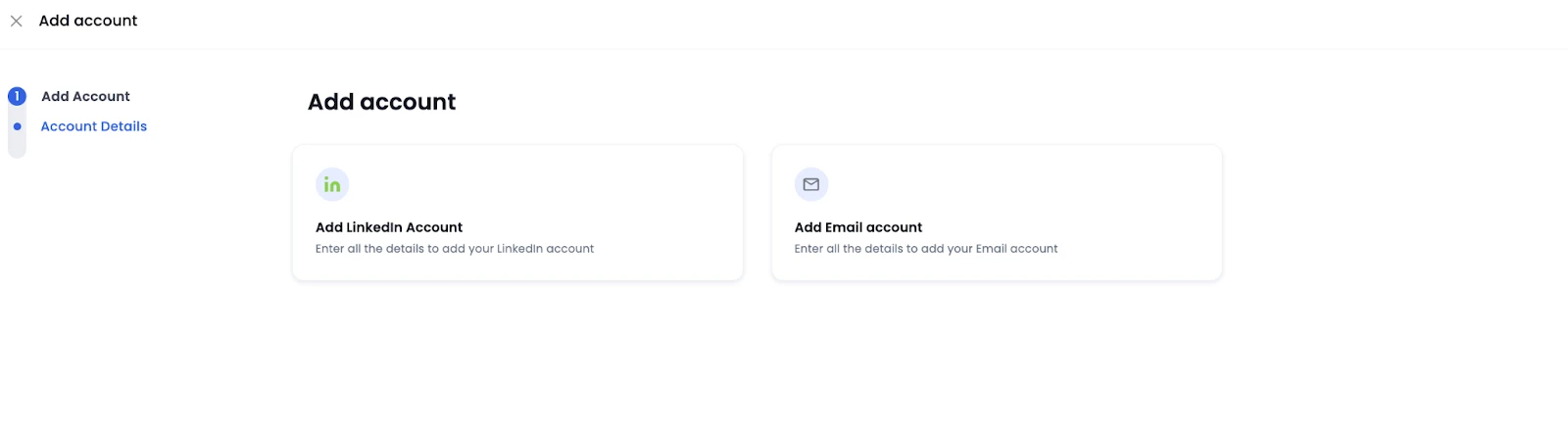
SalesRobot is vendor-cloud. “Cloud-based performance (no browser needed)” removes the open-browser and always-on-computer requirement. Connection does not use OAuth, QR, cookie import, or extension handoff. The setup requires LinkedIn username and password, then CAPTCHA, PIN, or mobile confirmation when required.
Cloud execution makes it highly likely that the active session is maintained on vendor infrastructure. Encryption, retention, replay, and revocation remain undisclosed. The vendor describes mobile-app API use, but we did not capture the actual requests.
The extension belongs to product history, not current setup. A founder AppSumo exchange described extension execution in 2023. A separate founder reply said the unsupported extension's customers had moved to cloud by March 2025. We found no current public extension listing in the checked evidence. That evidence gap does not establish absence on its own. Without a current extension artifact, a present-tense teardown was not applicable to this test.
LinkedIn and Email Sequence Builder and Branching
The campaign builder offers templates, linear sequences, and an Advanced Sequence mode with condition-based branches. An exhaustive condition list and nesting depth were not established.
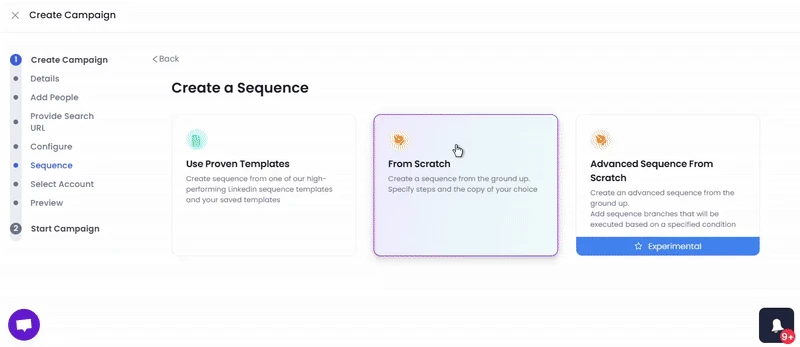
Like most tools in this space, it covers core LinkedIn actions. The closed, documented action list is:
- profile view and profile follow;
- post like and post comment;
- connection request;
- LinkedIn message and follow-up;
- InMail or open-profile message;
- skill endorsement;
- group-member and event-attendee messaging;
- voice message and video message; and
- email.
Inputs include LinkedIn search, Sales Navigator, Recruiter Search, CSV, Lead Lists or Prospect Pool, group members, event attendees, and post engagers. Help articles confirm group campaigns and likes/comments campaigns.
LinkedIn and email steps interleave on one canvas. Replies pause the sequence. “Unpause” handles short replies misclassified as substantive. A/B testing splits prospects between variants, but Basic lacks A/B and permits one active campaign.
Plan gate: Basic can build multistep sequences, but one active campaign and no A/B testing make concurrent workflow experimentation an Advanced-plan decision. Delivery, reply accuracy, and campaign recovery were not authenticated.
AI Variables, Filtering, Commenting, Voice, Video, and Inbox Manager
SalesRobot documents distinct AI mechanisms. AI Variables read headline, job title, summary, and sometimes the company website to rewrite text. AI Filtering checks profiles against a prompt. That is prompt-based Ideal Customer Profile screening, not a calibrated accuracy score.
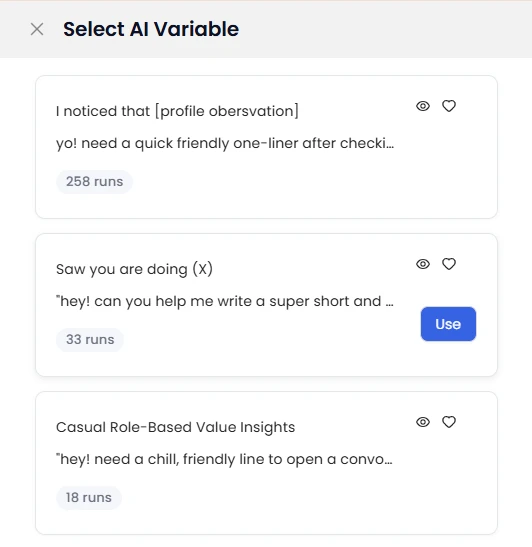
AI Commenting generates a comment from the prospect's latest post and a user-defined angle or tone. No manual approval gate was found in the checked commenting material, but that gap does not prove one is unavailable elsewhere. Pricing also lists:
- AI lead scoring and appointment setting;
- AI Inbox Manager Copilot/Autopilot modes; and
- voice cloning and video avatars.
Two limits matter. Pricing HTML retained a hidden “Coming Soon” badge beside the visible lead-scoring/filtering row. No authenticated run tested accuracy, approval behavior, comments, voice/video, or appointment handling. No separate AI-credit meter or bring-your-own key was found; that gap does not prove usage is unmetered.
AI maturity: Public pages show the AI functions as available, while hidden Coming Soon residue and the lack of an authenticated run leave maturity, moderation, accuracy, and output quality unresolved.
Smart Inbox, Analytics, and Reply Handling
The Smart Inbox consolidates LinkedIn and email conversations. Operators can filter by person, connected account, tag, and response status, then reply or follow up from the same interface. That is a documented conversation and mini-CRM surface; it does not establish reply-sync accuracy or response-classification precision.
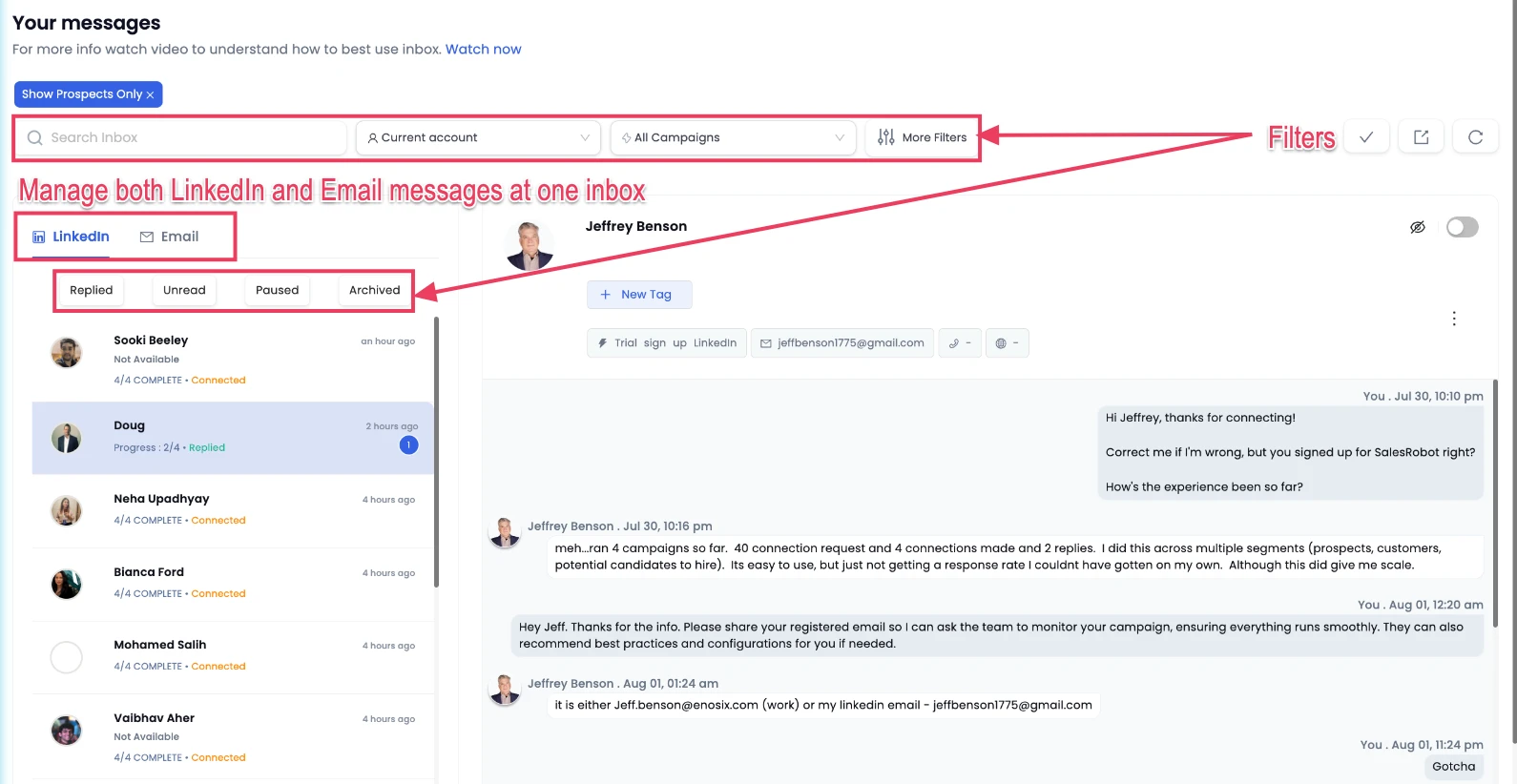
Dashboard material describes daily, weekly, and monthly views plus campaign, account, team, location, and prospect reporting. Metric freshness, latency, export completeness, and pause classification were not authenticated.
Access is the commercial boundary. The personal or unified inbox is absent from Basic's entitlement and begins on Advanced. A buyer using Basic can run a sequence, but cannot assume the same centralized response workflow shown in feature demonstrations.
Inbox boundary: Smart Inbox and multilevel analytics are documented from Advanced upward; reply-detection accuracy, synchronization, metric freshness, and dashboard performance were not established in live use.
CRM, Webhooks, API, Export, and the Advanced Plan Gate
SalesRobot names seven native connections: six CRMs—Copper, GoHighLevel, HubSpot, Pipedrive, Salesforce, and Zoho CRM—plus Google Sheets. Make, n8n, and Zapier are webhook routes, not extra native CRMs. The count does not imply equal depth.
Advanced gates native CRM sync and webhook routes. SalesRobot documents outgoing events and inbound API operations. A public REST API uses access tokens. We did not live-test plan entitlement, key creation, endpoint success, rates, retries, logs, or recovery.
CSV is available at product level, but Basic entitlement conflicts on the pricing page. The documented export fields include lead data and boolean accepted/replied flags; they do not include full message text, complete history, or per-message timestamps. That confirmed export boundary matters for CRM backfill.
For general context, CSV, webhook, and CRM payloads carry different data shapes; it does not validate SalesRobot's live sync.
Developer boundary: Seven vendor-named native connections and a public REST API are documented, but Advanced entitlement, live sync fidelity, API rates, retries, and full message-history export are not established.
Daily Limits, Safe Mode, Proxy Choices, and Professional Activity Control
SalesRobot documents nine daily-limit sliders: invites, follow-ups, profile views, InMail, follows, post likes/comments, endorsements, group messages, and event messages. SalesRobot's pricing table shows Basic at 20 daily for invites, messages, and views versus 75 on Advanced/Professional; likes, follows, and endorsements are 20 versus 50. These are product ceilings, not measured safe volumes.
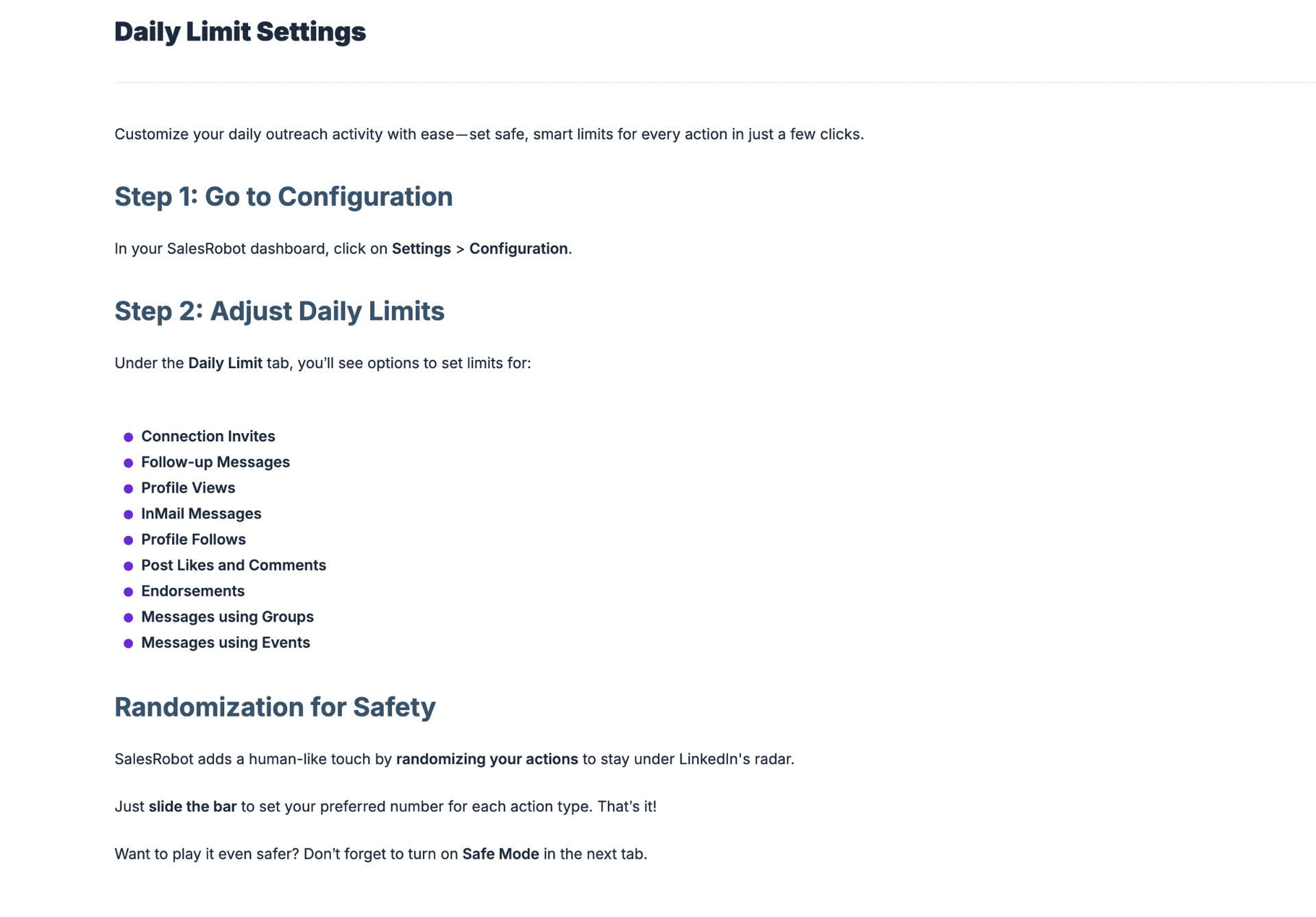
The same material names randomization. Schedules add timezone, hours, up to six working days, and skipped dates. Safe Mode is a toggle with unmeasured effect. SalesRobot's pricing table lists “Anti-duplication & activity control” only for Professional.
The default included proxy can be replaced with a user-provided custom proxy. The checked proxy documentation confirms address, port, username, and password fields; it does not document a built-in IP-reputation checker or threshold.
For context, see action-specific daily limits and working hours versus volume limits. They do not establish SalesRobot's effect.
Control versus outcome: Nine sliders, schedules, randomization, Safe Mode, and proxy choice are documented. Their effect on restrictions is unmeasured, and Professional—not Basic or Advanced—holds the separate activity-control layer.
Agency View, Roles, Prospect Pool, Cross-Account Deduplication, and White Label
Professional is the first plan with team and agency controls. Its five fixed roles are Admin, Account Manager, Account Holder, Read Only, and Watcher. Custom permissions, approval workflows, and an audit log were not established.
Agency View runs a bulk campaign across selected accounts and distributes Sales Navigator profiles. Within one account, Prospect Pool stores prospects and limits repeat outreach. Cross-account prevention is a separate Professional control; within-account reuse is not team-wide isolation.
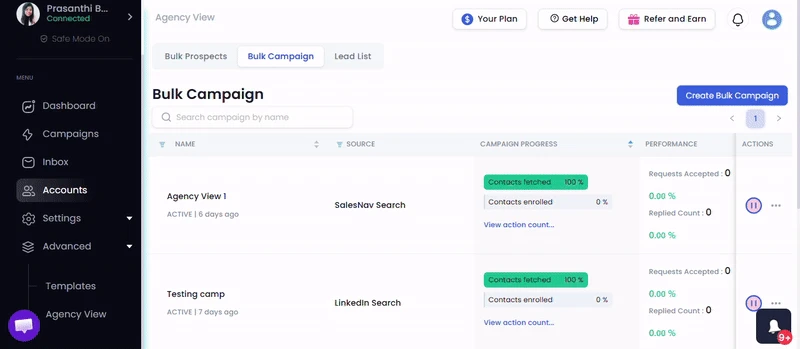
White label requires a separate application. After approval, configuration material documents custom domain and branding. Client-management material describes separate workspaces, Switch to User, and recommended Chargebee billing.
Teammate charges, setup approvals, auditability, revenue-share terms, and the full white-label commercial agreement were not established. No public numeric minimum for agency access was found.
Agency boundary: Professional unlocks ordinary team operations and cross-account controls; isolated white-label client workspaces require a separate application, and teammate pricing plus commercial terms remain unresolved.
For neutral background, within-workflow duplicate prevention and cross-account deduplication solve different problems.
Email Finder Credits, the $15 Inbox Add-on, and Bulk Email as Separate Cost Layers
SalesRobot has three email layers. The core product adds email after Gmail/Outlook OAuth or another provider's SMTP/IMAP, according to its setup guide. Each send account costs $15/month above the LinkedIn plan.
The native finder/verifier uses three credits per found-and-verified email. Thus 225 complimentary credits cover up to 75 results. Paid packs do not add sending capacity; expiry/rollover and standalone verification of an address already held were not established.
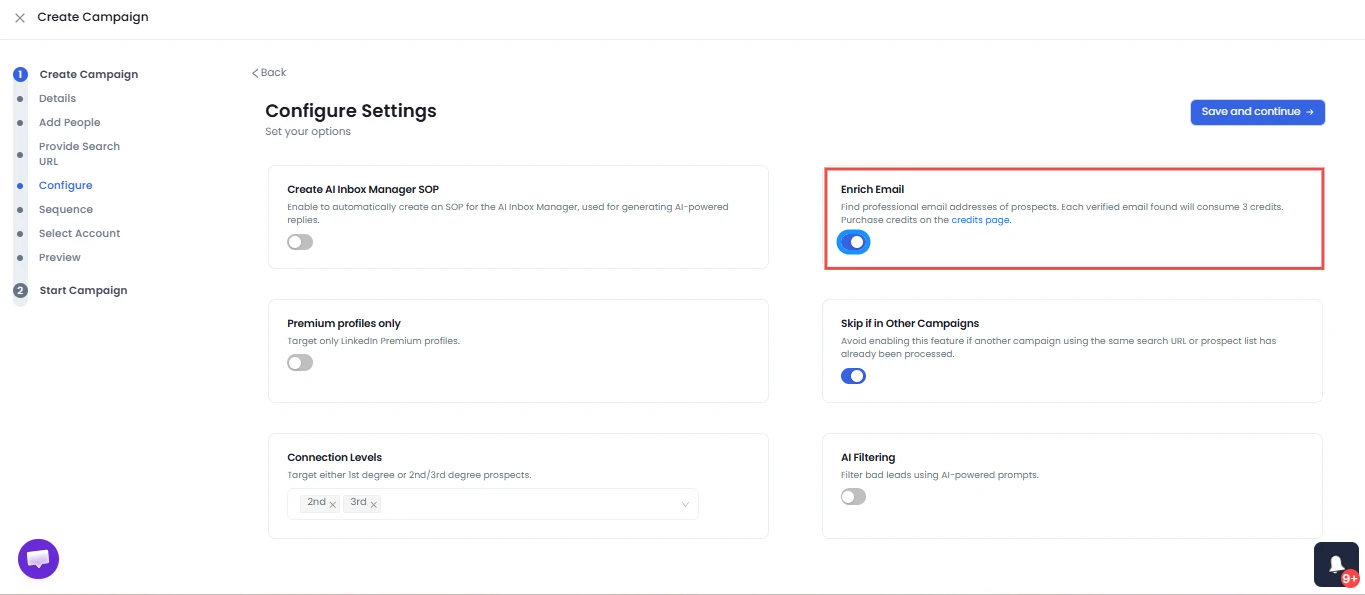
Bulk Email has Growth, Hypergrowth, and Light Speed plans. Its unlimited-warm-up wording applies only to warm-up and retains separate contact/send caps. That warm-up was not established for the $15 core add-on.
Done-For-You services add another commercial line, but not another software entitlement. In practice, buyers should quote the LinkedIn account, each send account, finder capacity, and any Bulk Email product independently.
Keep the meters separate: Do not treat the $15 send account, finder/verifier credits, Bulk Email warm-up, and Done-For-You services as one bundle. Each has its own price, unit, and evidence boundary.
Is SalesRobot Safe?
SalesRobot has documented controls, but the evidence does not support a confident low-risk verdict. Vendor claims, custody inferences, and independent runtime results are not interchangeable.
Credential and session flow. You enter your LinkedIn username and password, then complete CAPTCHA, PIN, or mobile confirmation. Cloud execution makes a valid session on vendor infrastructure highly likely. Credential storage, cookie retention, replay, isolation, and revocation remain undisclosed.
Evidence boundary. The September 2026 fieldwork verified the public no-extension flow and live pricing, Help, and legal descriptions. The required genuine two-account cloud/network/session study with runtime IP-quality measurements remains outstanding. Public-page evidence cannot settle the included IP's type, sharing, reputation, location behavior, session mechanics, or fingerprint isolation.
IPQualityScore (IPQS) is an independent fraud-prevention service that rates IPs on a 0–100 fraud scale and reports proxy, VPN, connection-type, and abuse signals. On its scale, 75+ is high-risk. It is an independent IP-quality signal, not LinkedIn's enforcement verdict. Because the required runtime study remains outstanding, no SalesRobot IPQS score is established; that uncertainty is an evidence gap, not a clean or risky finding.
| Documented control or claim | Source class | What remains unknown |
|---|---|---|
| Cloud operation; no browser needed; no current extension | Vendor pricing plus public applicability check | Actual session storage, request behavior, fingerprint isolation, and revocation |
| Username/password entry with CAPTCHA, PIN, or app confirmation | Vendor Help Center | Credential retention and server-side session mechanics |
| Nine daily-limit sliders, randomization, and schedules | Vendor Help Center | Live enforcement, auto-throttle behavior, and protective effect |
| Safe Mode toggle | Vendor Help Center | Mechanism and measured restriction outcome |
| Included proxy plus optional custom proxy | Vendor Help Center | Default IP type, sharing, provider, reputation, stability, and checker behavior |
| Processing in the US and other provider countries | Vendor Privacy Policy | Exact regions, subprocessors, and session residency |
| “Residential IPs” versus “Dedicated, local IP rotation” | Conflicting vendor pages | Which description matches live infrastructure |
| 0.00001% versus “less than 0.001% across 4100+ users” | Conflicting vendor claims | Independent denominator, methodology, observation period, and incidence |
| Professional anti-duplication and activity control | Vendor pricing | Exact mechanism and effect relative to baseline controls |
SalesRobot safety evidence and open questions (September 2026)
The vendor figures are not measurements. The printed magnitudes 0.00001% and less than 0.001% across 4100+ users differ 100-fold. Neither supplies an auditable cohort, method, or window, so neither is accepted as incidence. The Terms separately acknowledge possible noncompliance with LinkedIn's User Agreement.
IP wording is unresolved. The overview says residential; pricing says “Dedicated, local IP rotation”. Custom proxies offer another route, but no quality score or threshold is documented. See what a proxy changes for context, not SalesRobot verification.
No tool eliminates LinkedIn restriction risk. Manual URL-opening or invitation processing at unrealistic speed can also look automated.
Safety verdict: SalesRobot documents meaningful user controls, but credential custody, the included IP layer, and the restriction-rate copy remain unresolved without an independent authenticated network and session test.
What Review and Community Evidence Actually Shows
Scope first. We analyzed 45 raw reviews and 44 deduplicated voices published March 20, 2023–April 3, 2026. The sample contains 36 G2 records, nine Trustpilot rows representing eight voices, and zero Capterra records. These are per-platform counts from that sample, not current platform totals. Only two ratings fall in the six months ending August 3, 2026, too few to establish direction.
Keep the lanes separate. Mined signals identify questions; current documents may corroborate a mechanism or contradiction; authenticated outcomes remain unresolved.
| Mined signal | Current corroboration | Open question |
|---|---|---|
| Feature breadth, ease, customization | Feature mechanisms are documented | Authenticated ease and customization reliability |
| Support | 24/7 chat is claimed; 65 Help articles were counted | Response, escalation, and resolution were not tested |
| Reliability, bugs, UI friction | Review hypotheses only | Current prevalence, cause, and runtime behavior |
| Pricing transparency and exit | Pricing and cancellation conflicts are documented | Which exit path controls and whether complaints recur |
Review evidence lanes
Patterns remain hypotheses. Weeks starting September 18, 2023 and October 7, 2024 each contain 4/45 raw reviews (8.9%); the latter includes duplicates. Cause is unknown, and no detected negative cluster does not prove problems absent. Four AppSumo/LTD voices raised V1-to-V2 fee or lost-function objections; a later LTD voice defended the fee, one G2 voice described a discretionary refund, and one cancellation voice appears twice. This is dated problem discovery, not current prevalence.
Community evidence is thinner. Eight raw Reddit tags become seven deduplicated posts dated November 18, 2025–March 27, 2026. The only two visible mentions are one founder cross-post, each score 2; none met the score-20 gate. That is sparse signal, not consensus.
Who SalesRobot Is For—and Who Should Look Elsewhere
Evaluate SalesRobot when:
- a solo SDR or founder will use combined LinkedIn and email steps, conditions, A/B tests, Smart Inbox, CRM routes, and webhooks—and can budget Advanced at $79 monthly or $59 annual-equivalent;
- a sales team accepts cloud workspace and vendor-side session execution;
- an agency can price Professional per LinkedIn account and needs fixed roles, Agency View, cross-account deduplication, or a separately approved white-label workspace; or
- the buyer can use the 14-day no-card trial to verify plan gates and the 24/7 live-chat claim; response speed and resolution quality were not tested.
Look elsewhere—or require written answers—when:
- one active campaign is too restrictive but Advanced-level spend defeats the budget;
- each additional LinkedIn account and email account makes the multi-account TCO unacceptable;
- policy requires a tested IP, disclosed custody, local execution, subprocessor detail, or settled residency;
- procurement needs clear cancellation, refund, deletion, CSV-export, or 10-account discount rules; or
- the team requires authenticated API behavior, audit logs, custom permissions, or published white-label commercial terms before rollout.
Procurement also has an identity-reconciliation task. The vendor Privacy Policy names SalesRobot Inc., a Delaware corporation and a Wilmington PMB, while G2 metadata separately identifies New York and another seller record. Those attributions do not establish reconciled headquarters, ownership, or founding chronology.
Basic allows limited exploration. Advanced as a practical floor is a workflow judgment, not a universal rule.
How SalesRobot Compares to Alternatives
This is a dated snapshot, not a winner ranking. Search association selected the roster; it proves no migration, performance, support, or feature parity.
| Tool | Architecture | Entry price | Best known for |
|---|---|---|---|
| Linked Helper | Desktop + VPS/Web Version | Starts at $15/mo | Standalone-browser execution on the user's machine or VPS; Web Version provides browser access to that instance |
| Dripify | Cloud | $59/mo | Conditional LinkedIn/email workflows; this April snapshot was over 90 days old at article research time |
| Botdog | Cloud | $69/mo | In-app inbox and AI snippets/reply workflow; the $69 snapshot is dated May 27, 2026 and deeper parity was not checked here |
| HeyReach | Cloud product; connector extension used for login | $79/mo | Growth price covers one sender and multi-account operation is recorded; deeper connector-architecture details were not established here |
| Octopus CRM | Chrome extension | $9.99/mo | Lower single-account-per-seat entry; execution remains browser-extension dependent |
| Salesforge | Cloud | $48/mo | Pro evidence names unlimited email senders but only one LinkedIn sender; it is email-led rather than a like-for-like LinkedIn peer |
How SalesRobot compares
Read the units before the labels. After recomputing all six entries, HeyReach at $79/month is the largest stated entry. Octopus CRM at $9.99 is the smallest. These are sticker extrema, not equivalent plans. SalesRobot Basic is $59, while its Advanced practical floor is also $79. Cloud, login-connector, extension, and customer-controlled desktop/VPS labels identify custody—not restriction outcomes. Dripify's snapshot records LinkedIn/email logic. Salesforge's “unlimited” names email senders while retaining one LinkedIn-sender cap. Octopus CRM's lower entry is a single-account seat. Each qualifier keeps its scope.
See all LinkedIn automation alternatives →
Where Linked Helper Fits
If SalesRobot's full credential handoff and untested included-IP layer are material to your policy, a customer-controlled execution environment is worth evaluating.
Linked Helper is a desktop application for Windows, macOS, and Ubuntu with its own built-in browser. It can run on a customer-controlled VPS; Web Version is login-based browser access to that VPS instance, giving 24/7 operation while the LinkedIn session remains on hardware the customer controls.
- Session custody: LinkedIn actions run on the user's machine or VPS rather than in a vendor-run campaign cloud, directly addressing the custody question raised in the Safety section.
- Proxy visibility: A dedicated user-provided proxy can be assigned per account, and the built-in IPQS checker exposes fraud, proxy, VPN, bot, crawler, and recent-abuse signals before use—addressing SalesRobot's undocumented reputation check.
- CRM and reply controls: Linked Helper has 11 direct CRM connectors—ActiveCampaign, Capsule, Close.io, HighLevel, HubSpot, Instantly, Pipedrive, Salesforce, Streak, Zoho, and Zoho Recruit—plus Zapier and Make through webhooks; it also supports reply detection and ignoring generic replies.
- Conversation export: Pro can export full messaging history with per-message timestamps and reply counts, addressing the message-history boundary in SalesRobot's documented CSV fields.
- Local-first records: Campaigns, CRM records, and message history are stored in a local per-account database by default; optional cloud storage moves data, not execution.
SalesRobot starts at $59/month for Basic and $79/month for the Advanced practical solo scenario; Linked Helper starts at $15/month for Standard, or $8.25/month equivalent on a 12-month license. Always-on operation can add separately purchased VPS compute and proxies.
Teams prioritizing customer-controlled session custody, visible proxy-quality checks, direct CRM routes, or full conversation export may want to evaluate Linked Helper too.