

 16 min read

TL;DR
- I would start with the quote, not the starting price. Vendors bill by employer size, recruiter seat, or plan, so match the meter to your team.
- Put migration scope on the buying checklist early. Candidate history and attachments are harder to fix after cutover than a missing feature is to replace.
- Treat “everything included” as a prompt to inspect the plan grid. Teamtailor gates approvals and multi-brand controls behind Premium.
- Check subscriptions you already own for candidate tracking, interview feedback, and hiring approvals before adding another system.
An applicant tracking system (ATS) organizes a company's recruiting process, covering job openings, applications, candidate records, and hiring decisions. Greenhouse alternatives may add recruiting CRM, HR tools, branded career sites, or staffing features, so compare the workflow each plan includes—not merely the starting price or the ATS label.
At a glance
Ashby suits recruiting analytics, Lever combines ATS and CRM, Workable and JazzHR show public prices, and Pinpoint covers mixed hiring; each brings a different plan gate or migration tradeoff.
| If you need… | Start with | Why it made this list | Main catch |
|---|---|---|---|
| Recruiting analytics and operations | Ashby | ATS, sourcing, scheduling, and analytics in one recruiting platform | Public entry price is scoped by company size. Upper tiers are quote-led |
| Candidate relationship management alongside ATS | Lever | ATS and CRM are sold as a core platform | Custom quote. Plan and add-on costs need a buyer-specific comparison |
| A visible price for a small employer | Workable | Public headcount-band pricing and a broader HR option | Add-ons and migration may change the total |
| Team collaboration around hiring | Recruitee | Job setup separates application, team, workflow, and pipeline steps | No public dollar price. Conditional workflow automation is in Optimize |
| A branded careers experience | Teamtailor | Careers site, triggers, and interview tools sit alongside the ATS | Approvals and multi-brand controls are Premium |
| Frontline and multi-stream hiring | Pinpoint | Greenhouse comparison page covers different hiring workflows | Annual pricing requires a vendor quote. Migration timing is vendor-estimated |
| A small-team annual budget | JazzHR | Annual plan totals are visible | Posting limits and business eligibility restrictions apply |
| Low seat cost or an existing Zoho stack | Zoho Recruit | Free tier and per-recruiter prices are published | Active-job limits and separate manager licenses affect fit |
How to choose a Greenhouse ATS alternative
Start by listing the workflows and data you can't afford to lose, then compare prices for that exact setup. A five-seat team with interviewers, approvals, multiple brands, and historical candidate records has different needs from one recruiter filling one job. If LinkedIn is one of your candidate sources, Linked Helper's recruiter workflow covers candidate sourcing and personalized outreach.
Map the migration before you sign
Before switching, list the Greenhouse data you need to move: candidate profiles, notes, attachments, scorecards, interview plans, source attribution, custom fields, and consent or deletion history. Ashby has an API migration guide for Greenhouse; Workable lists migration options by plan; Pinpoint estimates about 15 business days for a managed migration. Ask for a field-by-field export/import map before setting a cutover date.
Compare billing units, not just monthly numbers
Workable charges by company size, Zoho Recruit by recruiter license, and JazzHR by annual plan. Ashby shows its company-size selector and annual discount. Lever, Recruitee, Teamtailor, and Pinpoint use quote-led pricing, so give each the same hiring scenario. A “Contact sales” button leaves the cost unknown; it does not mean the plan is free.
Separate recruiters from hiring managers
Do hiring managers need paid seats, free collaborator access, or a separate license pack? Zoho Recruit's calculator treats 10 hiring-manager/employee licenses as a distinct line item. Teamtailor lists unlimited users; other vendors may quote by configuration or company size. Similar seat labels do not guarantee the same access.
Check the plan gate on the feature you actually need
Often, approval flows, multiple brands, workflow automation, reporting, and integrations sit on separate tiers. For example, Teamtailor labels requisitions/approval flows and divisions/multi-brand management as Premium. Recruitee reserves conditional workflow automations for Optimize. Have the vendor demonstrate the exact action in the quoted plan.
Decide whether you need an ATS, a CRM, or an HR suite
Choose an ATS for candidate tracking and approvals, a recruiting CRM for ongoing candidate nurture, or an HR suite when employee records and recruiting need to share one system. Lever bundles ATS and recruiting CRM; Workable can add HR functionality, while Zoho Recruit Corporate HR is separate from its staffing product. Before replacing Greenhouse, check whether HubSpot, Pipedrive, Google Workspace, Microsoft 365, or Zoho People covers candidate tracking, interview feedback, and hiring approvals.
1. Ashby: Best for recruiting analytics and operations
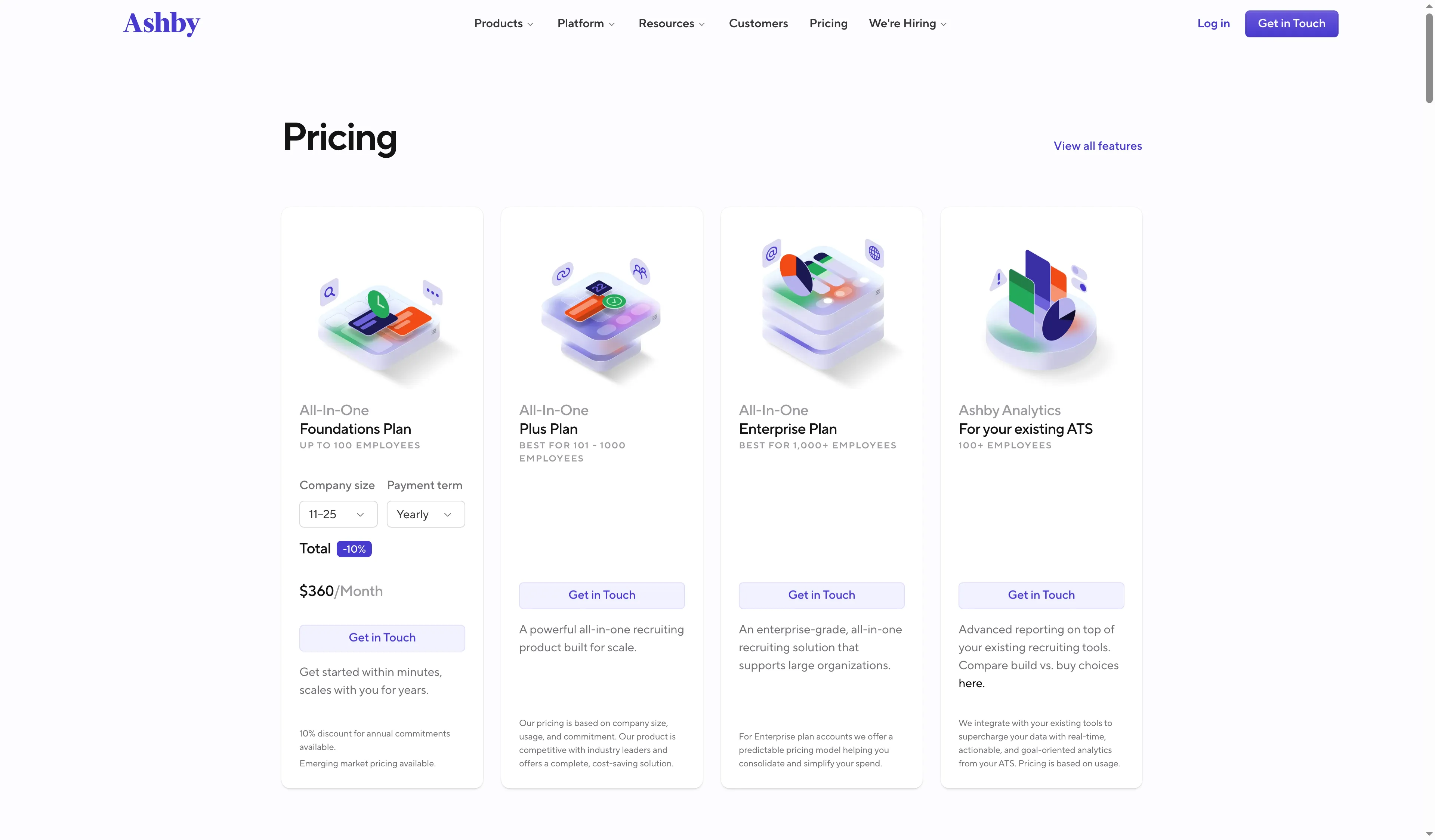
Ashby shows the 11–25 employee selector and its 10% yearly discount.
Ashby brings analytics, sourcing, scheduling, and applicant tracking into one recruiting system. Its Greenhouse API migration guide gives a buyer a practical place to start the data inventory. The 11–25 employee selector lists $400/month, with a 10% annual discount that brings the total to $4,320. The billing unit is the catch. A one-recruiter shop can pay for company-wide capacity; I would choose Ashby when its reporting and scheduling replace separate tools.
Pros — Ashby
- Recruiting, sourcing, scheduling, and analytics sit in one platform.
- Its migration guide covers Greenhouse API migration. The $4,320 price is for the selected employee band.
Cons — Ashby
- The $400/month Foundations example is for the 11–25 employee band; the 10% reduction applies to annual billing.
- Larger employee bands require a quote.
Product pricing — Ashby
Foundations shows $400/month for 11–25 employees. Annual billing at the listed 10% discount comes to $4,320/year. Other tiers require a quote.
2. Lever: Best for combining ATS and recruiting CRM
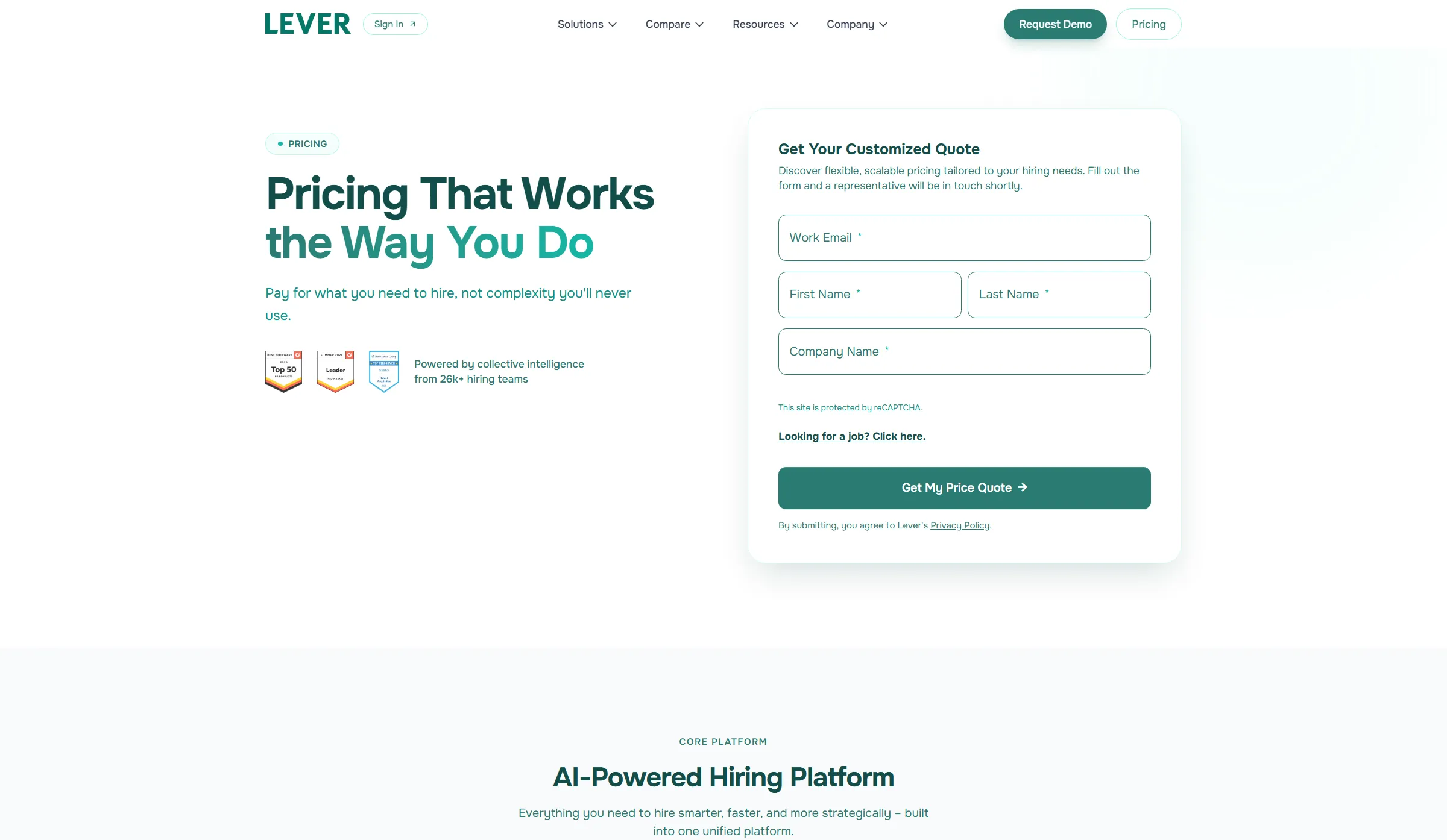
Lever asks buyers to request a configuration-specific quote.
Lever combines candidate tracking and recruiting CRM in one core platform for teams evaluating a Greenhouse replacement. Its pricing page lists reporting in the core offer and separates products such as Candidate Insights, AI Screening by VONQ, and Onboarding.
The core ATS/CRM bundle makes Lever an easy shortlist for candidate nurture and re-engagement. The public page leaves annual pricing to a custom quote, so I would skip it if your team only needs application tracking: the CRM would be extra product to buy and manage.
Pros — Lever
- The core platform bundles CRM along with ATS.
- The core offer includes reporting.
Cons — Lever
- A buyer-specific quote is needed to calculate annual spend.
- Onboarding, Candidate Insights, and AI Screening show up as distinct add-ons.
Product pricing — Lever
Custom quote. The vendor lists ATS + CRM as the core platform and prices additional products separately.
3. Workable: Best for small employers that want visible pricing
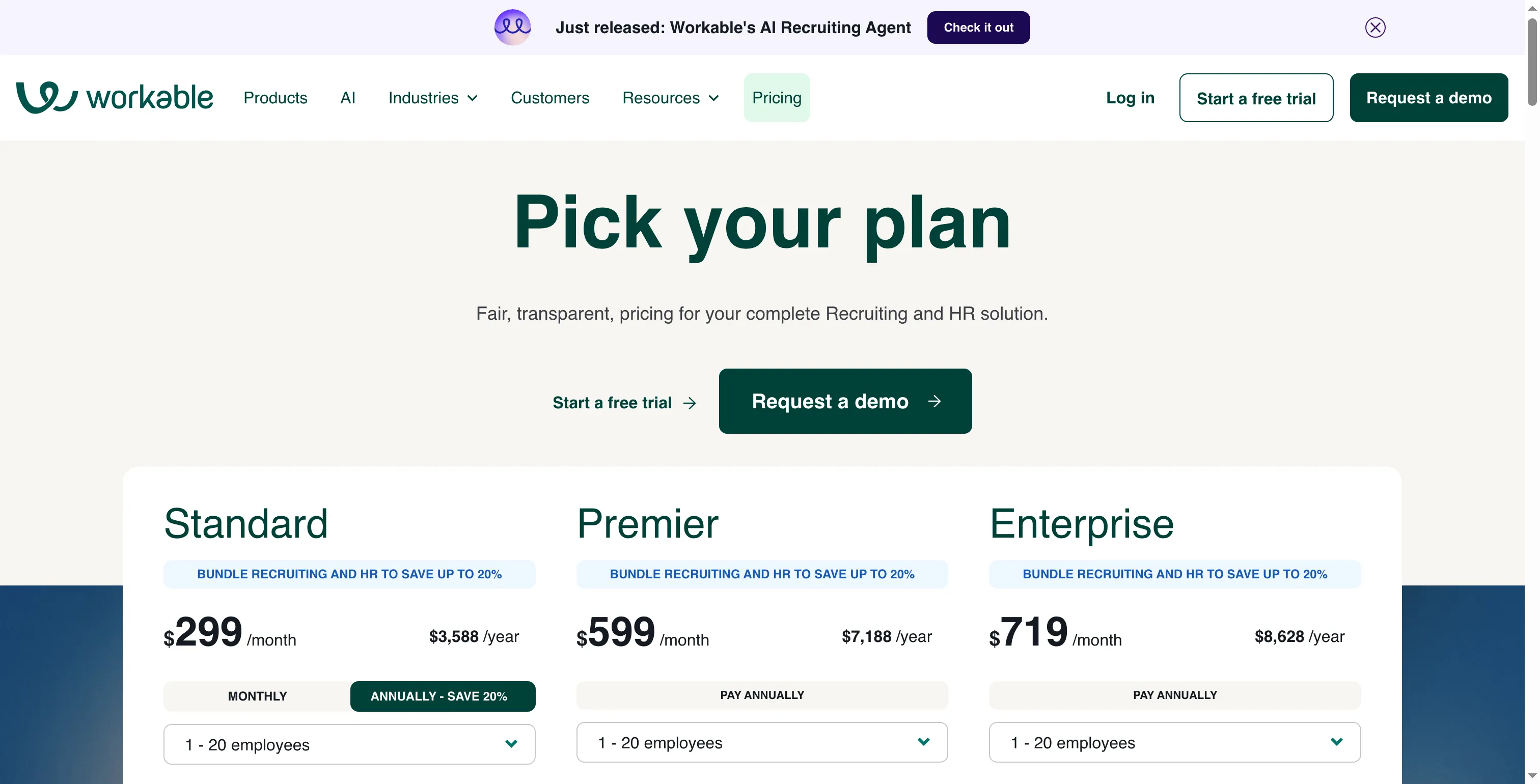
Workable prices this Standard configuration by employer headcount.
Workable offers a sensible Greenhouse substitute for a smaller firm seeking a clear headcount-based price and an optional HR suite. Its US pricing page lists Standard for 1–20 employees at $299/month or $3,588 for 12 months on annual billing. The monthly option is $360, or $4,320 annualized.
Switching the selector to monthly billing showed a higher annualized total. The page advertises a 20% annual discount; the displayed prices work out to 16.9%. I'd budget from the payable annual total and ignore the badge. Texting, video interviews, and assessments are separate Standard add-ons; migration terms also vary by plan.
The selector makes Workable a useful budget anchor. Two 20-person employers land in the same band even if one has a single recruiter, so the price is company-based rather than recruiter-based. I would use it to price the whole company workflow, then check whether add-ons and migration still beat an ATS-only quote.
Pros — Workable
- The $3,588 total is visible for employers with 1–20 employees.
- Alongside recruiting, the product can bundle HR functionality.
Cons — Workable
- The $3,588 annual total is for the stated employee band; it does not show recruiter-seat cost.
- Additional charges apply for texting, assessments, and video interviews. Depending on your plan, migration terms differ.
Product pricing — Workable
Standard starts at $299/month ($3,588/year) for 1–20 employees with annual billing. The monthly option is $360/month. Add-ons cost extra.
4. Recruitee: Best for teams that want a collaborative hiring workflow
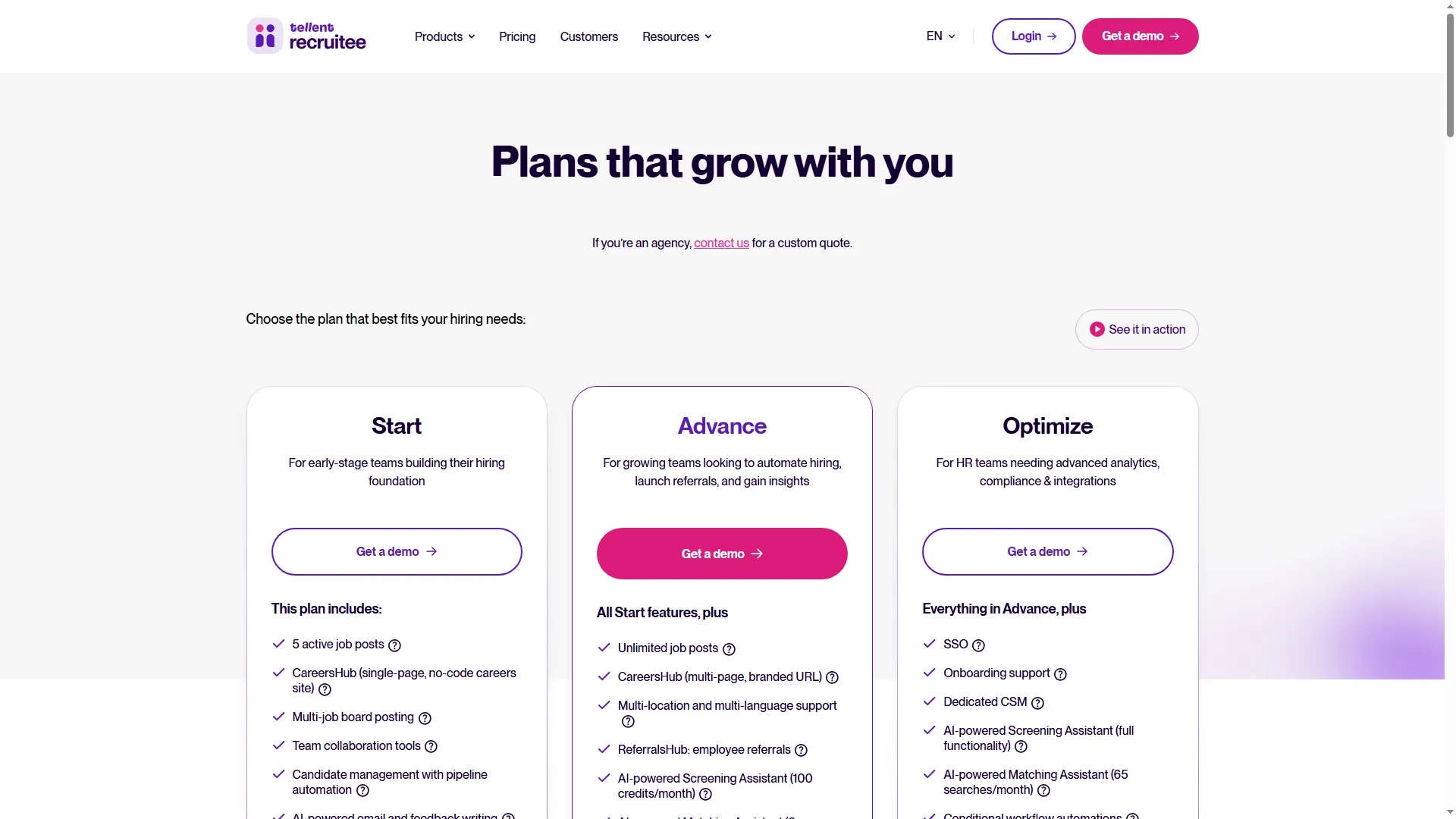
The plan grid distinguishes Start's five active posts from Advance's unlimited posts.
For Greenhouse buyers, Recruitee pulls job setup, applications, hiring teams, workflow, and pipelines into one collaborative process. The public plan grid lists Start with five active job posts and Advance with unlimited job posts.
I went through Recruitee's job-creation guide: it separates setup into job details, application, team, workflow, and pipeline. That gives hiring teams a useful way to map interview handoffs. Conditional automations sit in Optimize, while single sign-on costs extra on Start and Advance; include those controls in the quote if your process needs them.
Recruitee's job-creation sequence is the clearest workflow map I found in this group. I like that it makes handoffs visible; I would rule it out early if you need a firm budget or conditional automation without buying Optimize.
Pros — Recruitee
- Job setup separates application, team, workflow, and pipeline steps.
- The plan grid states that Start has a five active-post limit, whereas Advance's posts are unlimited.
Cons — Recruitee
- Pricing requires a quote.
- On Start and Advance, SSO is a paid add-on, and Optimize is required for conditional workflow automation.
Product pricing — Recruitee
Quote required. Start includes five active job posts, Advance includes unlimited posts, and some security or workflow features cost extra or require Optimize.
5. Teamtailor: Best for a branded careers experience
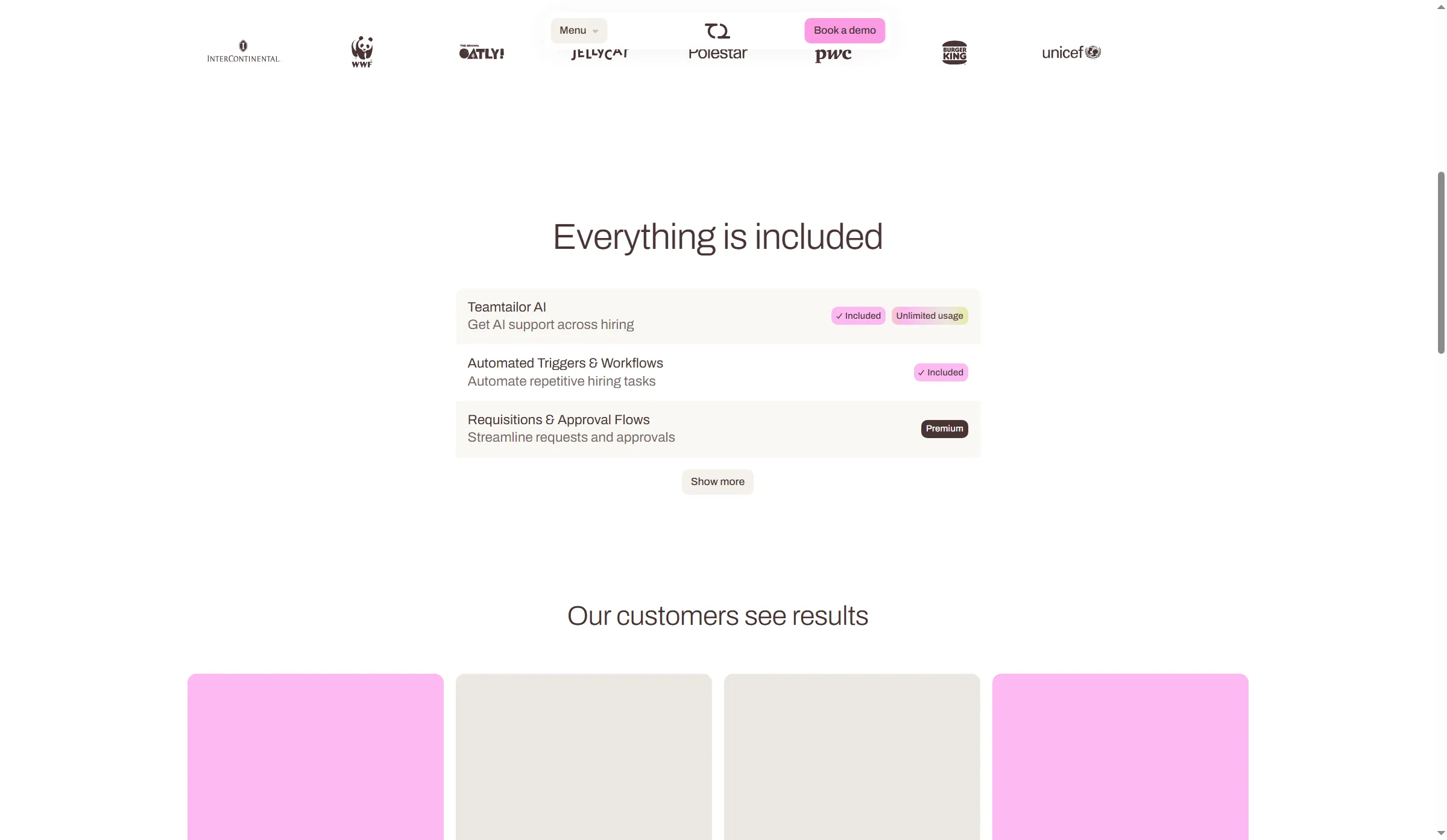
Teamtailor marks Requisitions and Approval Flows as Premium while automated triggers are included.
Teamtailor links a branded careers page to hiring processes for groups weighing a Greenhouse swap. Triggers, interview tools, unlimited job postings, and unlimited users all appear on its pricing page.
The headline reads “Everything is included,” yet requisitions, approval flows, divisions, and multi-brand management are flagged as Premium on the comparison grid. Multi-brand administration is separate from the branded careers page; the quote for a multi-entity team needs to include its brand and approval setup.
I'd choose Teamtailor when candidate brand is a hiring strategy, not just a design preference, and Premium approvals fit the budget.
Pros — Teamtailor
- The pricing page lists unlimited job postings and users.
- Recruiting workflows are accompanied by interview tools, careers pages, and triggers.
Cons — Teamtailor
- A quote is required; no public dollar figure appears.
- Requisitions are flagged Premium, along with approval flows, divisions, and multi-brand management.
Product pricing — Teamtailor
Custom quote. Unlimited users and job posts are listed, while approval flows and multi-brand management are marked Premium.
6. Pinpoint: Best for mixed frontline and corporate hiring
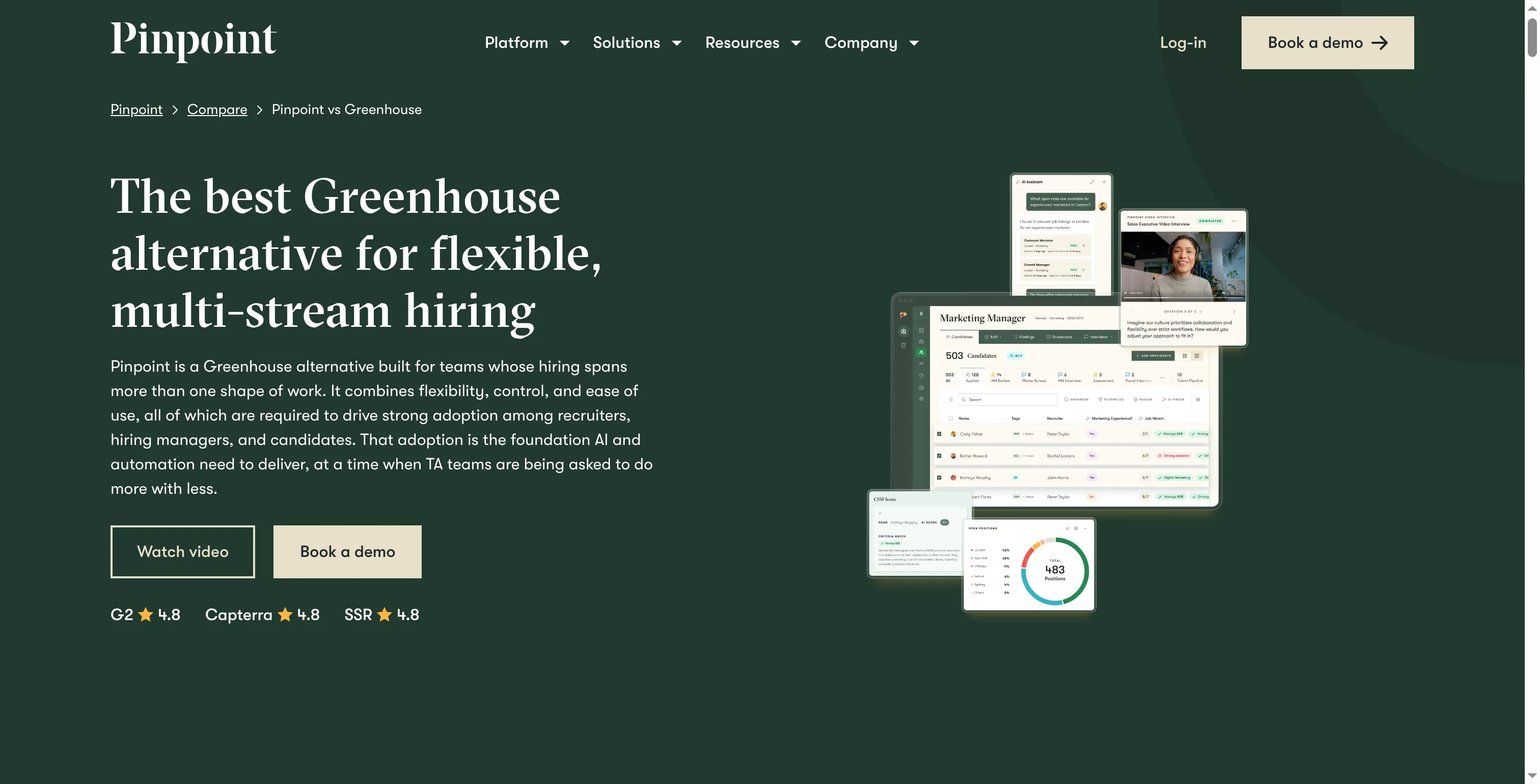
Pinpoint presents its Greenhouse alternative around flexible, multi-stream hiring.
Pinpoint earns a place on a Greenhouse shortlist when frontline and corporate hiring share a system. Its comparison page estimates about 15 business days for managed migration. Use that 15-day window to schedule internal owners; put a firm cutover in the contract. Make records, attachments, and workflows part of the annual quote. For one low-volume process, managed migration is more machinery than you need.
A May 18, 2026, Capterra review by Charlotte T., a Senior Enterprise Systems Analyst, says full DocuSign integration depends on the onboarding module. Have the demo cover the e-signature workflow in the quoted plan.
“Managed migration” becomes useful only when the agreement names the deliverables. Pinpoint gives buyers a 15-day planning anchor; I would not sign until the vendor names the records, attachments, and workflow decisions covered.
Pros — Pinpoint
- Pinpoint's Greenhouse comparison covers migration and several hiring workflows.
- The managed migration estimate gives buyers a concrete timeline to confirm.
Cons — Pinpoint
- The roughly 15-business-day estimate needs a contractual cutover date.
- A five-recruiter configuration requires a custom quote.
Product pricing — Pinpoint
Custom quote. Pinpoint estimates its managed Greenhouse migration at about 15 business days.
7. JazzHR: Best for a small team that wants an annual plan price
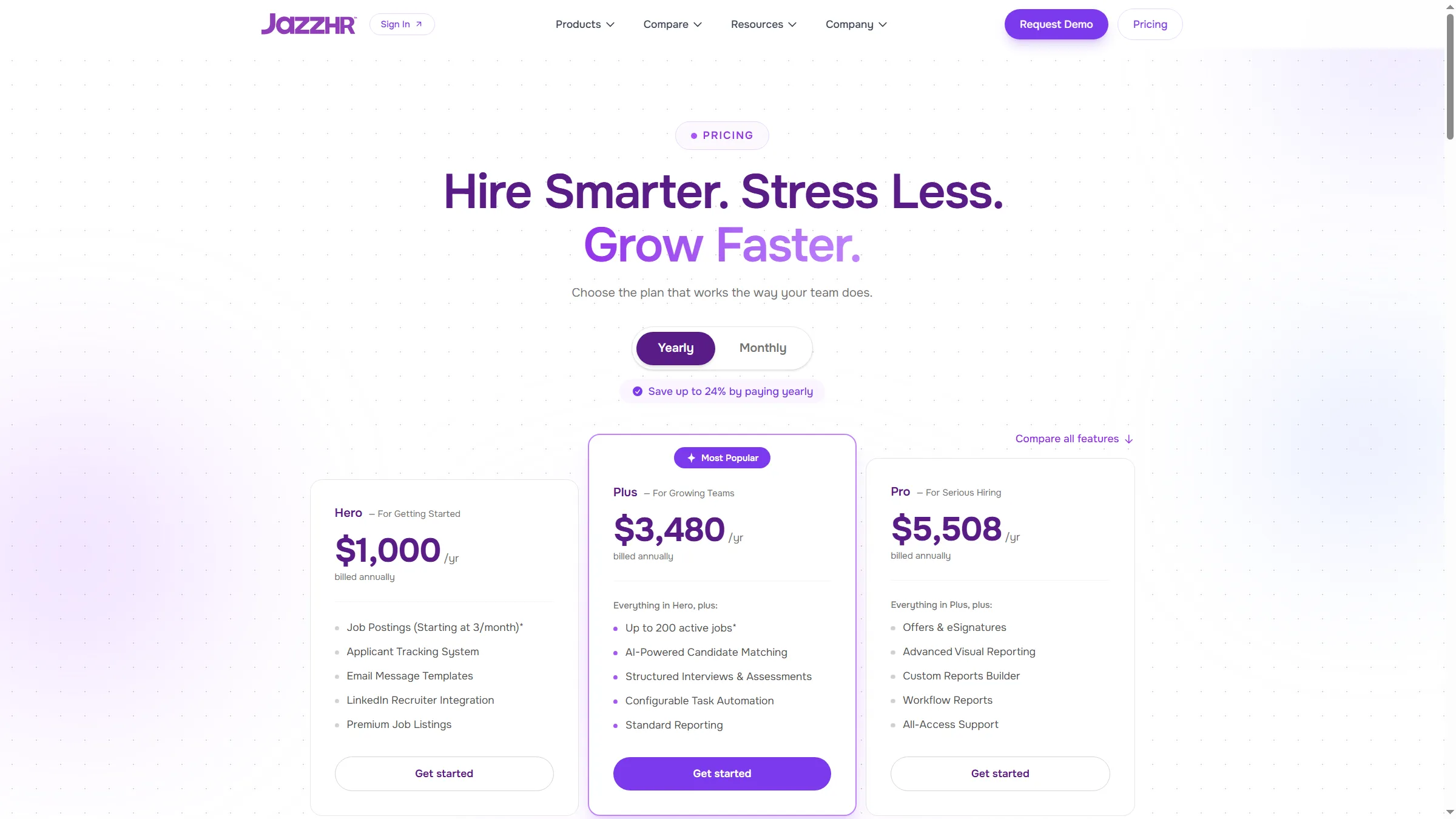
JazzHR shows the annual plan totals and Hero and Plus job-post limits.
JazzHR's annual plans list Hero at $1,000, Plus at $3,480, and Pro at $5,508. Hero allows three job postings a month; Plus allows up to 200 active jobs.
The plan grid puts custom reports and e-signatures in Pro. JazzHR also excludes agencies, HR service providers, franchises, multi-location organizations, and employers with more than 250 employees. That exclusion rules it out as an ATS for recruiting agencies. Its monthly selector shows Plus at $350 and Pro at $549, but does not list Hero monthly. JazzHR makes its price grid easy to scan, but I would confirm business eligibility before spending time on a demo. At $1,000 a year, Hero makes sense only if three monthly postings cover your hiring pace.
Pros — JazzHR
- Hero has a three-post monthly cap, while Plus allows up to 200 active jobs.
- You can see plan prices without building a custom quote.
Cons — JazzHR
- With a busy hiring calendar, Hero's starting point of three job postings each month can feel tight.
- JazzHR excludes franchises, agencies, employers with more than 250 employees, and multi-location companies.
Product pricing — JazzHR
Hero $1,000/year, Plus $3,480/year, and Pro $5,508/year. Eligibility and job limits apply.
8. Zoho Recruit: Best for low per-recruiter cost or an existing Zoho stack
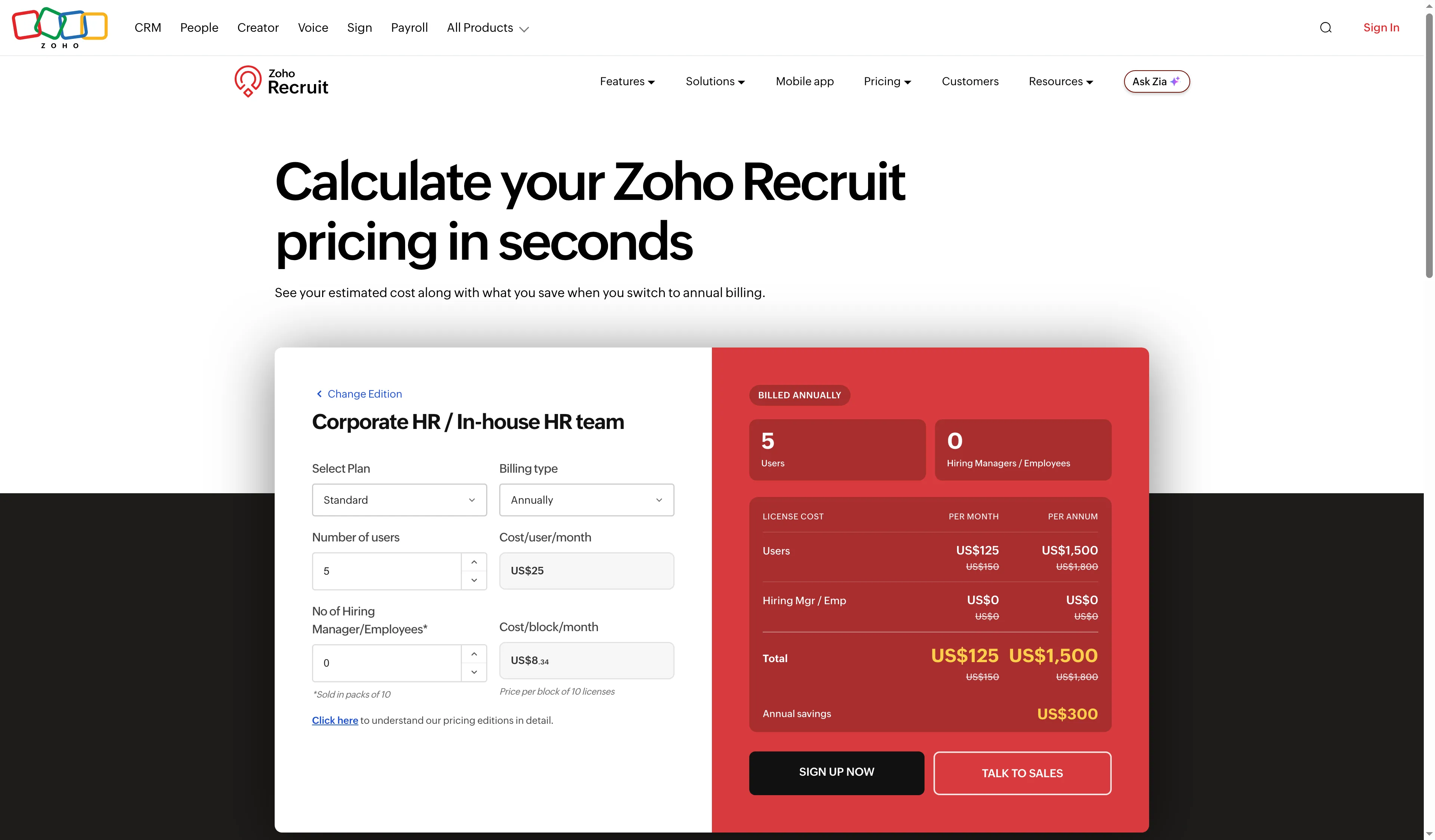
The annual calculator shows five recruiter users, no manager license block, and a $1,500 total.
Zoho Recruit Corporate HR fits small in-house teams that need a free one-job plan or seat-based billing. Free costs $0; Standard costs $25 per recruiter monthly, and Enterprise costs $50. Standard allows 10 active jobs per recruiter; Enterprise allows 20.
I changed the calculator from one recruiter to five, then removed the preselected block of 10 hiring-manager/employee licenses. The annual total went from $1,600.08 to $1,500, which makes the default manager-seat assumption easy to miss. Those licenses add cost, and Corporate HR is a separate edition from Zoho Recruit's staffing-agency product.
A July 16, 2026, Capterra review by Yatish T., a Founder/Managing Partner, says initial setup and advanced customization took time and reporting could be more flexible. That is the right demo agenda: bring one workflow and the report your team actually uses.
Zoho's free tier is a credible way to start with one active job. Standard gives a growing team a paid upgrade path, while Corporate HR remains separate from Zoho Recruit's staffing-agency edition. This is the lowest-friction choice for a team already using Zoho's HR tools; I would check the manager-license default before budgeting.
Pros — Zoho Recruit
- Free includes one recruiter license and one active job.
- Standard's $25 monthly price per recruiter makes the cost easy to estimate once you know the recruiter count.
Cons — Zoho Recruit
- Standard allows 10 active jobs per recruiter; Enterprise allows 20.
- The five-recruiter calculator example gains $100.08 annually from a ten-manager/employee license block.
Product pricing — Zoho Recruit
Free includes one active job. Standard costs $25 per recruiter monthly and Enterprise costs $50, both billed annually. Ten hiring-manager/employee licenses are an additional calculator line item.
Greenhouse ATS alternatives pricing: Billing units change the total
For five recruiter seats and ten active jobs, Zoho Standard costs $1,500 annually without its preselected manager-license block, or $1,600.08 with ten manager/employee licenses. The table compares annual US configurations with public prices; the rows are not functionally equivalent, and figures are before tax.
| Workload | Product and configuration | Annual price | What the number includes or leaves out |
|---|---|---|---|
| One recruiter, one active job | Zoho Recruit Corporate HR Free | $0 | One active job and one recruiter license. More active jobs require a paid tier |
| One recruiter, one active job | Zoho Standard, one recruiter | $300 | $25 × 12, billed annually. Allows up to 10 active jobs per recruiter |
| Small employer, up to 20 employees | Workable Standard, annual selector | $3,588 | Company-size billing; confirm add-ons and migration costs |
| Five recruiter seats, ten active jobs | Zoho Standard, five recruiters | $1,500 | $25 × 5 × 12. Calculator total excludes the preselected manager-license block |
| Five recruiter seats, ten active jobs | Zoho Standard plus ten manager/employee licenses | $1,600.08 | Calculator adds $100.08/year for the ten-license block. Taxes may apply |
| Five recruiters, 11–25 employees | Ashby Foundations annual commitment | $4,320 | $400/month less the stated 10% annual-commitment discount. Confirm selected tier and included modules |
| Up to 200 active jobs | JazzHR Plus annual | $3,480 | Plan price. Eligibility restrictions apply and features differ by tier |
| Any of these workloads | Lever, Recruitee, Teamtailor, or Pinpoint | Quote required | No verified public configuration-specific annual total found |
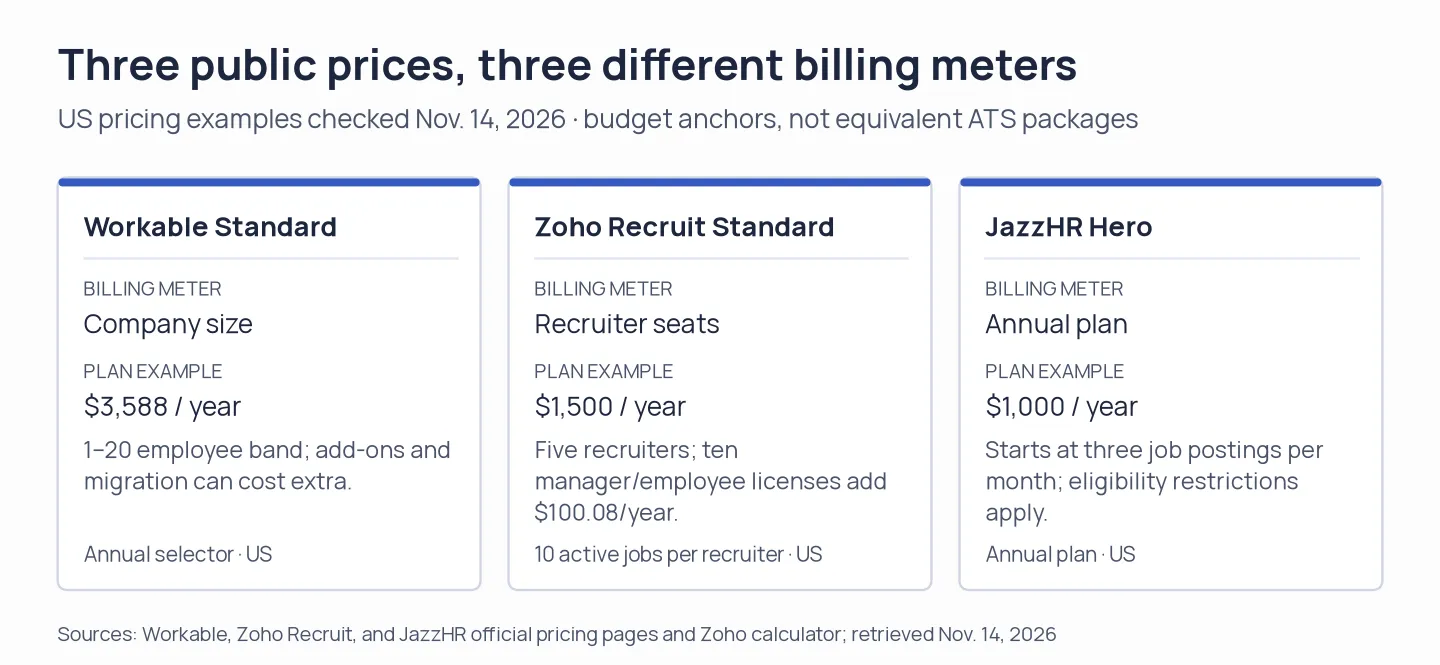
Workable, Zoho Recruit, and JazzHR use different billing units and limits, so compare matched quotes before choosing.
Quote-led vendors need custom annual pricing for a 50-person, multi-brand setup; Teamtailor puts its brand controls in Premium. Zoho, Workable, and JazzHR use different billing bases, so ask each vendor to price the same job volume, recruiter seats, interviewer access, migration, and controls.