

 16 min read
TL;DR
- Ashby is the strongest fit here when analytics and workflow configuration shape the decision; Greenhouse is the better match when structured interviews and governance lead.
- Workable makes plan rates easiest to inspect before a sales conversation, while Breezy HR keeps the pricing model simple for a small team; both still have tier or headcount limits to check.
- Zoho Recruit is worth comparing when your team already works in Zoho, and JazzHR makes sense when its monthly posting allowance matches your hiring cycle.
- Treat migration as a deciding factor: verify notes, attachments, consent, interview feedback, and applications across jobs before moving candidate records.
At a glance
Pricing follows three main meters: Workable uses employee bands, Breezy HR charges a flat company rate, and Zoho Recruit bills per recruiter; Ashby uses employee bands, while Greenhouse and Lever are quote-based.
| ATS | Pricing meter | Public pricing | Purchase check |
|---|---|---|---|
| Ashby | Employee band | Price selector; add-ons | Confirm band, AI Notetaker, and SSO |
| Greenhouse | Quote | Core, Plus, and Pro | Check CRM scope and sourcing automation |
| Workable | Employee band | Standard from $299/month at 1–20 employees | Price the next headcount band |
| Breezy HR | Flat company fee | Startup from $157/month annually | Scorecards and multiple pipelines start at Growth |
| JazzHR | Annual package | Hero from $1,000/year | Hero is three monthly postings, not three active jobs |
| Zoho Recruit | Recruiter license | Standard from $25/recruiter/month annually | Add separate hiring-manager packs |
What makes the best Lever alternatives?
Look for a Lever alternative that matches your hiring workflow and preserves candidate history and interview feedback through migration. If you're comparing plans, start with the work your team needs to move. An applicant tracking system (ATS) should take over job setup, candidate records, interview feedback, and hiring reports. Some also include candidate relationship management (CRM), sourcing, or onboarding, but they aren’t always in the same plan. A lower rate isn’t a replacement if interview feedback and candidate history still live elsewhere. Compare the work your team needs to move, not just the number of checkboxes on a feature grid.
Lever itself combines ATS and candidate CRM; its pricing page lists analytics, AI screening, and interview transcripts and summaries. It doesn't publish a numeric rate on the page reviewed for this article. That’s why a feature-matched quote and migration plan matter more than an estimated “Lever price.”
Compare access, workflow fit, included features, and migration coverage before choosing a Lever alternative.
- How many people need access? When you replace Lever, recruiter-only billing can look cheap until you add hiring managers; you’ll want to count their accounts too. Other vendors price by company headcount or charge a flat company rate, so you'll need to price manager access separately.
- How different are your hiring workflows? A team hiring for one role family may prefer a common process. If you’re hiring across engineering, hourly, executive, and internal-mobility roles, you may need different stages and scorecards.
- Which features are actually included? Structured interviews, sourcing automation, SMS, AI tools, SSO, and analytics don't always sit on the same tier.
- What must survive migration? Validate that candidate notes, attachments, consent, interview feedback, and applications across jobs survive. An import still needs a field-by-field check before recruiters can rely on the records.
Quick picks
Ashby fits analytics-heavy workflows, Greenhouse fits structured interviews, Workable suits teams that want a trial, and Breezy HR suits small teams that prefer flat pricing.
| Hiring priority | Tool | Why it fits | Limitation to weigh |
|---|---|---|---|
| Build a configurable process around analytics | Ashby | ATS, CRM, and analytics work in one product | More settings and add-ons make plan fit harder to compare |
| Standardize interview decisions across a growing team | Greenhouse | Interview kits, scorecards, and reporting support a structured process | Sourcing automation is in Plus |
| Try the workflow before committing | Workable | A 15-day trial lets the team inspect its recruiting flow | Your employee count sets the Standard price band |
| Keep administration simple for a small recruiting team | Breezy HR | A flat company plan avoids per-recruiter billing | Scorecards and multiple pipelines start at Growth |
| Match hiring volume to a posting allowance | JazzHR | The package structure is easy to compare with a defined hiring cycle | Hero covers three monthly postings, not three active jobs |
| Keep recruiting beside existing Zoho tools | Zoho Recruit | Recruiter tiers include visible job caps | Hiring-manager access uses separate licenses |
1. Ashby: Best for analytics and configurable workflows
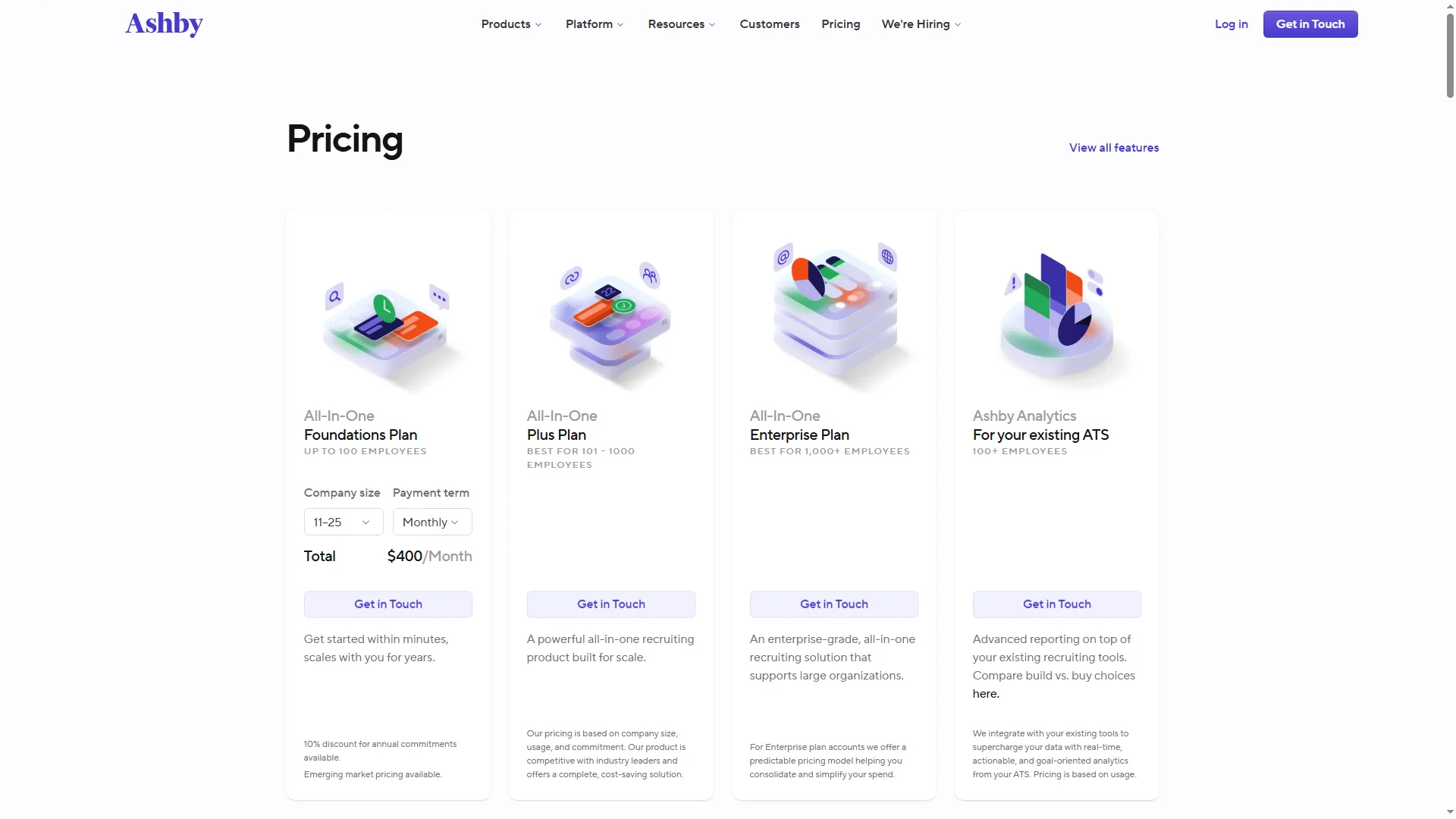
Ashby is a strong Lever alternative for recruiting teams that want an ATS, CRM, and analytics in one system. I’d put it on a shortlist when a recruiting lead will own custom reporting and workflow changes; teams wanting a fixed funnel may pay for flexibility they won’t use.
Ashby’s public pricing page uses a company-size selector, so the displayed monthly amount applies to the selected employee band. The page lists All-in-One plans and separate Analytics for companies keeping another ATS. AI Notetaker is an add-on across plans, and SSO is a paid option on Foundations. Those extras aren’t part of the displayed starting price. Ask for the price at your current employee band and the next band you expect to reach.
Ashby says contract buyouts may be available for qualifying companies, which could reduce contract overlap. If you don’t qualify, that discount won’t lower your quote. Its import tooling can move data; your team still needs to map fields, rebuild interview plans, and train users.
A 5/5 G2 review from an agency recruiter (Oct. 29, 2026) praises reporting and automation but asks for easier profile sharing with clients outside Ashby. Flavia C., a Senior Recruiter on Capterra (Aug. 7, 2026), likes rediscovery and filtering but says the AI Criteria Filter still needs manual review. If you recruit for clients, verify how external sharing works; Recruiters still need to review AI filter results and apply their own judgment.
Pros — Ashby
- ATS, CRM, and analytics are available in an all-in-one product.
- Public pricing lets buyers select an employee band and review add-ons.
Cons — Ashby
- The bill depends on employee band, and AI Notetaker and SSO may cost extra.
- A flexible setup takes more administrator decisions than a fixed hiring process.
Ashby earns my shortlist when a recruiting lead can own configuration and reporting. My advice: skip its flexibility if your team only needs one standard funnel.
Product pricing — Ashby
Public pricing varies by employee band and billing term; AI Notetaker and SSO may cost extra. Confirm the current band and package in a quote.
2. Greenhouse: Best for structured interviews and governance
I rate Greenhouse’s structured interview controls as its clearest reason to switch. Its Core plan includes structured interview kits and scorecards, scheduling, reporting and analytics, SSO, and sourcing and CRM features.
Greenhouse doesn't publish list prices on its pricing page. Core, Plus, and Pro are sales-led plans. The difference matters: Plus adds sourcing automation and texting, while Pro adds more governance and developer controls. You won’t get the same workflow on every tier. Ask which CRM events, automation, integrations, and reporting functions your quote includes. “CRM included” doesn’t mean every sourcing workflow is included in every plan.
Before buying the flexibility, name the person who'll own configuration. Dan G., a Head of People whose G2 review was updated on Oct. 27, 2026, praises customization and support but says templates, rules, and approval queues can overwhelm a part-time administrator. Before buying the flexibility, name the person who'll own setup.
Pros — Greenhouse
- Core lists interview kits, scorecards, scheduling, analytics, and CRM features.
- Plus and Pro add higher-tier automation and controls for larger processes.
Cons — Greenhouse
- There is no public price for budgeting or comparison.
- Sourcing automation and texting require Plus.
I like Greenhouse when structured interview governance is a team-wide practice. If one part-time admin will own every template and approval rule, I'd trial the setup before signing.
Product pricing — Greenhouse
Pricing is quote-based; request a written breakdown for Core, Plus, and Pro, including implementation and any usage limits.
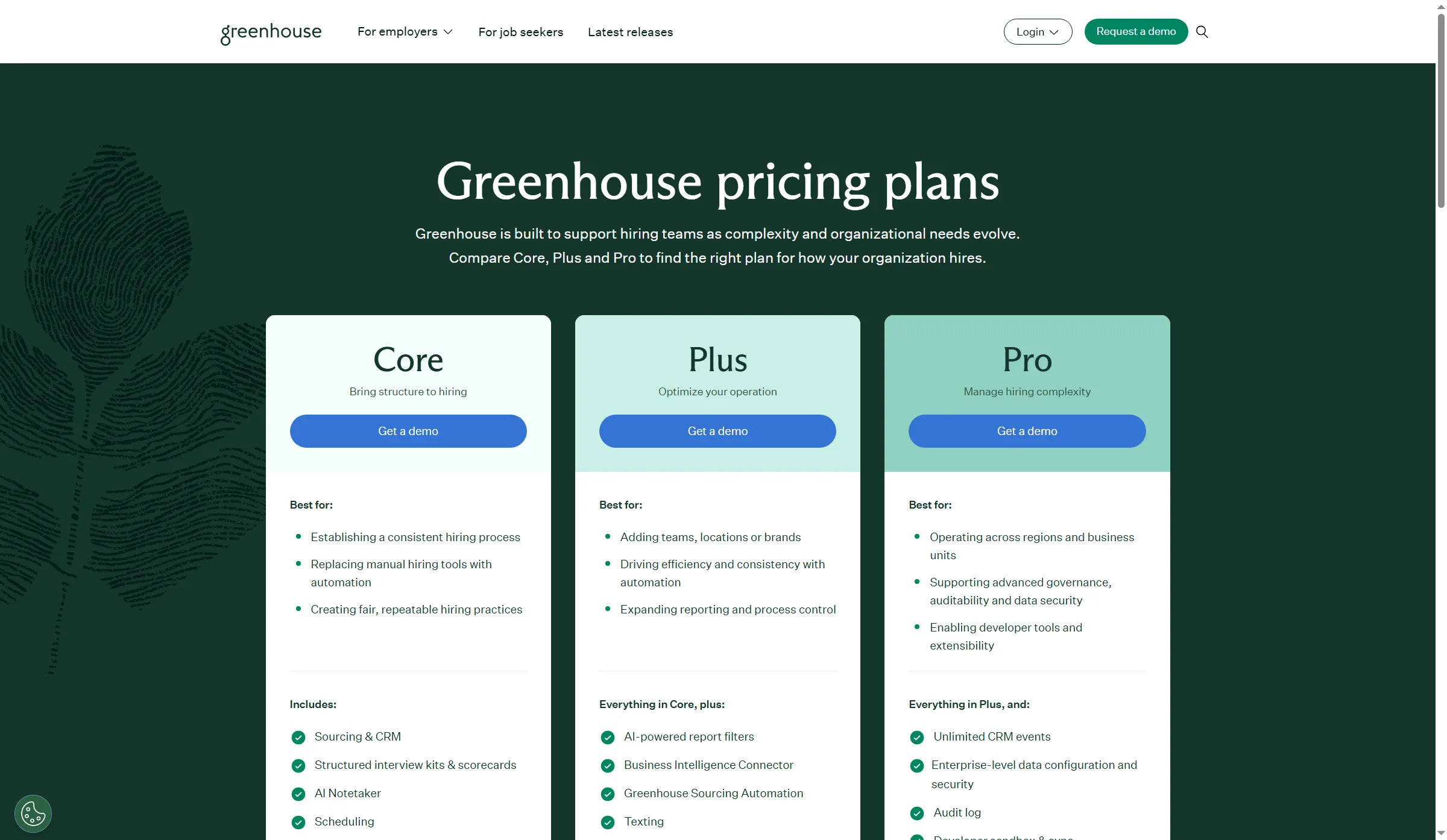
Greenhouse groups its recruiting features into Core, Plus, and Pro plans.
3. Workable: Best for a visible trial and transparent plan rates
I like Workable’s no-card trial as a way to inspect Standard, but I would not treat the starting rate as a team quote. Its pricing page offers a 15-day trial without a card and says the trial includes Standard features but not Workable Agent.
For companies with 1–20 employees, the page lists Standard at $299 per month ($3,588 per year), Premier at $599 per month ($7,188 per year), and Enterprise at $719 per month ($8,628 per year). The price changes with total employee band. Standard lists texting, video interviews, and assessments as paid add-ons; Premier includes those tools. They aren’t part of the Standard core price. The low end of the calculator isn't a reasonable quote for a larger company.
I reached Workable’s trial form during the check. Hamilton Q., a Freelance International Recruiter, gave Workable 5/5 on G2 (Nov. 3, 2026), praising central candidate tracking but wanting more flexible reports and filters. I'd ask to see the specific report and candidate views your recruiters use every week.
Pros — Workable
- A no-card, 15-day trial means you won’t have to enter payment details just to inspect the Standard feature set.
- The pricing page lists plan rates and the included Premier recruiting tools.
Cons — Workable
- The total depends on company headcount, not only recruiter seats or open roles.
- Standard charges extra for texting, video interviews, and assessments.
I would not choose Workable on its starting rate alone: headcount sets the bill, even when your hiring volume stays flat. Check the next employee band before comparing quotes.
Product pricing — Workable
Standard starts at $299/month for 1–20 employees, billed monthly, or $3,588/year at the displayed annual rate. Premier is $599/month or $7,188/year for that band; confirm the current band before budgeting.
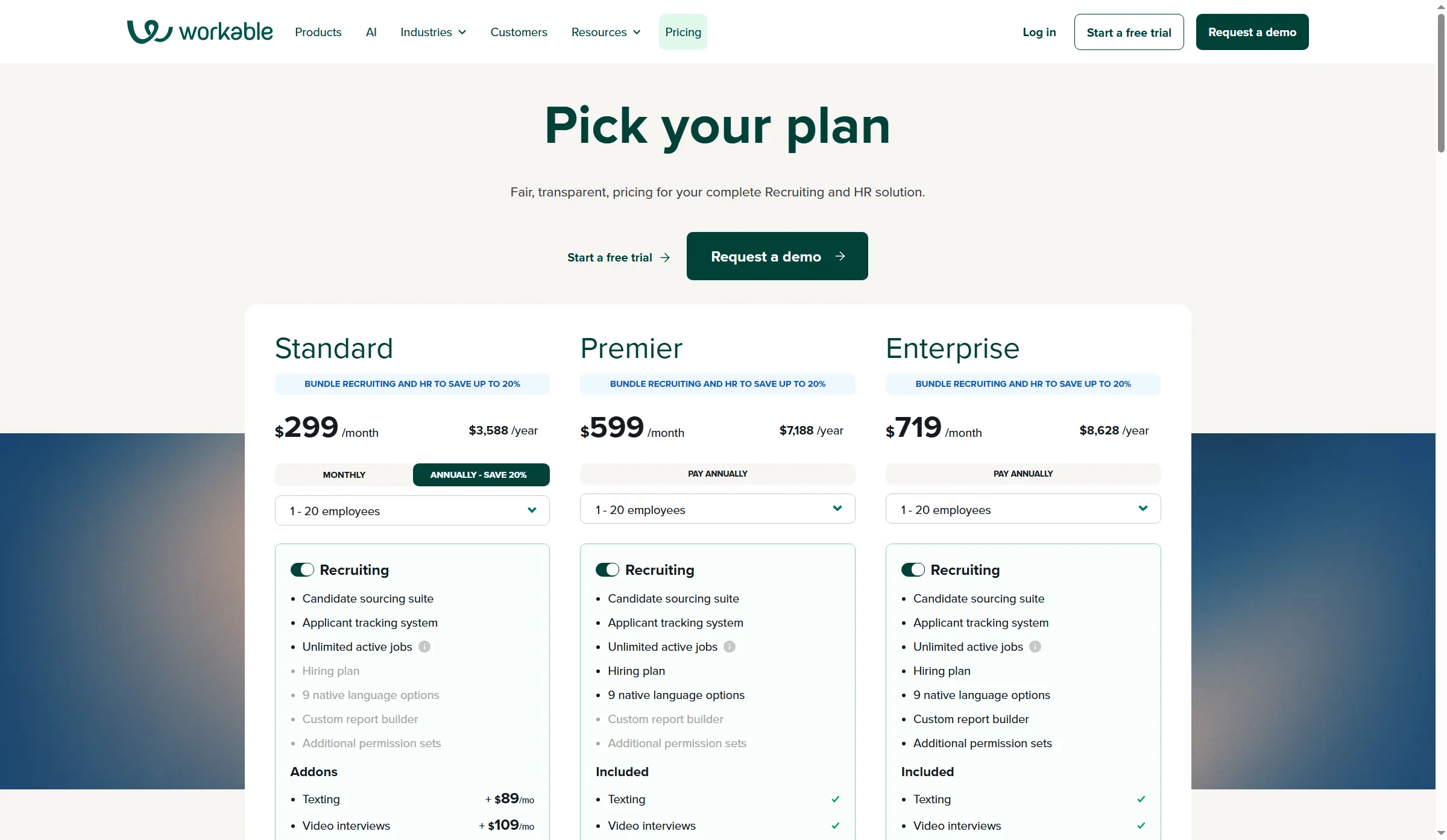
Workable’s visible price changes with company size and plan tier.
4. Breezy HR: Best for flat pricing on a smaller team
I’d favor Breezy HR for a small team that wants one shared pipeline and a flat bill. Its current pricing page says new customers don't get a free plan, though it offers a 14-day trial without a card.
Startup costs $157 per month with annual billing or $189 month-to-month. Growth is $273 per month annually or $329 monthly, and Business is $439 or $529. The listed plans include unlimited users and positions. Growth adds scorecards, interview guides, and multiple pipelines; Business adds candidate nurture, HRIS integrations, approval flows, and role permissions. If you need scorecards, you’ll need Growth or above; Startup won't cover that workflow. AI, SMS, and onboarding are separately priced add-ons.
Do not mistake the old Bootstrap offer for a new-user free tier. Current Breezy terms limit the free ATS plan to paused existing accounts, with one active position or candidate pool and access only to candidate data added in the past 30 days. That plan only applies to paused existing accounts.
Mariana V., a Talent Lead, gave Breezy HR 5/5 on G2 (Aug. 17, 2026), praising its candidate workflow while reporting friction when internal applicants and scorecards moved between pipelines. My advice: check that handoff if internal mobility is part of your hiring process.
Pros — Breezy HR
- Paid plans list unlimited users and positions at a flat company price.
- Growth includes scorecards, interview guides, and multiple pipelines.
Cons — Breezy HR
- New customers don't get a permanent free plan.
- Startup lacks scorecards and multiple pipelines; AI, SMS, and onboarding add-ons cost extra.
I like Breezy HR’s flat price for a small team that wants one collaborative pipeline. Choose Growth if structured interviews are part of the process; Startup doesn't include its scorecards and multiple pipelines.
Product pricing — Breezy HR
Startup $157/month billed annually or $189 month-to-month; Growth $273/$329; Business $439/$529. Check add-ons separately.
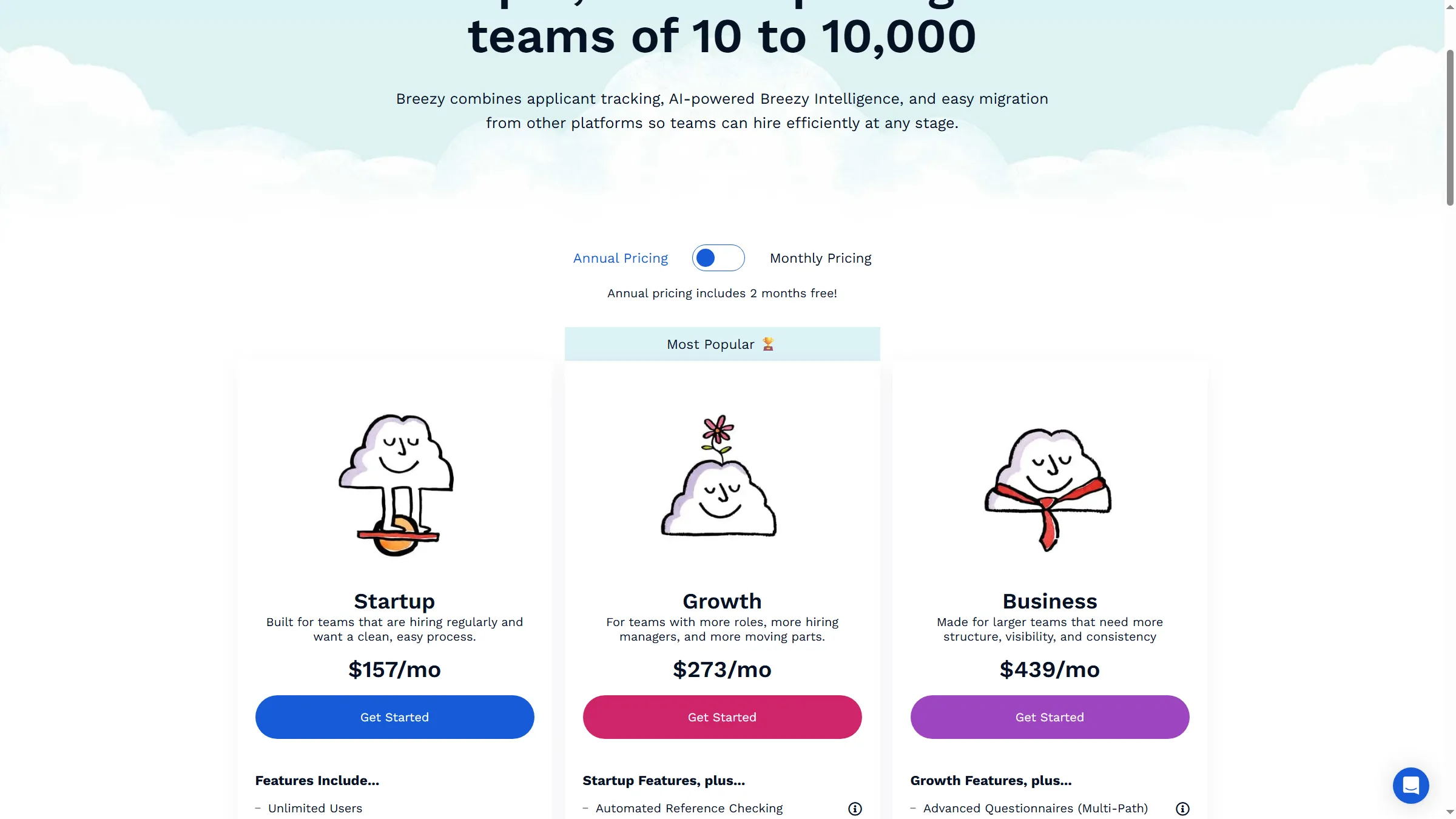
Breezy HR presents flat company plans for different recruiting workflows.
5. JazzHR: Best for teams that want published annual packages
I prefer JazzHR Plus when structured interviews and automation matter; the annual package price makes initial budgeting easier than a quote-only plan. Hero starts at $1,000 per year and includes three job postings per month. Plus is $3,480 per year and lists up to 200 active jobs, structured interviews, assessments, and automation. Pro is $5,508 per year and adds offer and e-signature features and advanced reporting.
Hero includes three job postings per month, while Plus lists up to 200 active jobs. If you hire in bursts, you’ll want to know whether each repost uses another monthly posting and when inactive roles release a slot. Verify eligibility and included seats in the quote before comparing annual totals.
Pros — JazzHR
- Annual prices are visible for Hero, Plus, and Pro.
- Plus lists structured interviews, assessments, automation, and up to 200 active jobs.
Cons — JazzHR
- Hero’s three-posting monthly allowance leaves concurrent-active capacity unanswered.
- The pricing page leaves seat and implementation terms open.
I like Plus when structured interviews matter and its active-job cap fits your hiring pattern. Hero’s monthly posting allowance leaves concurrent capacity unspecified.
Product pricing — JazzHR
The current pricing page lists Hero at $1,000/year, Plus at $3,480/year, and Pro at $5,508/year. Validate posting scope and eligibility before purchase.
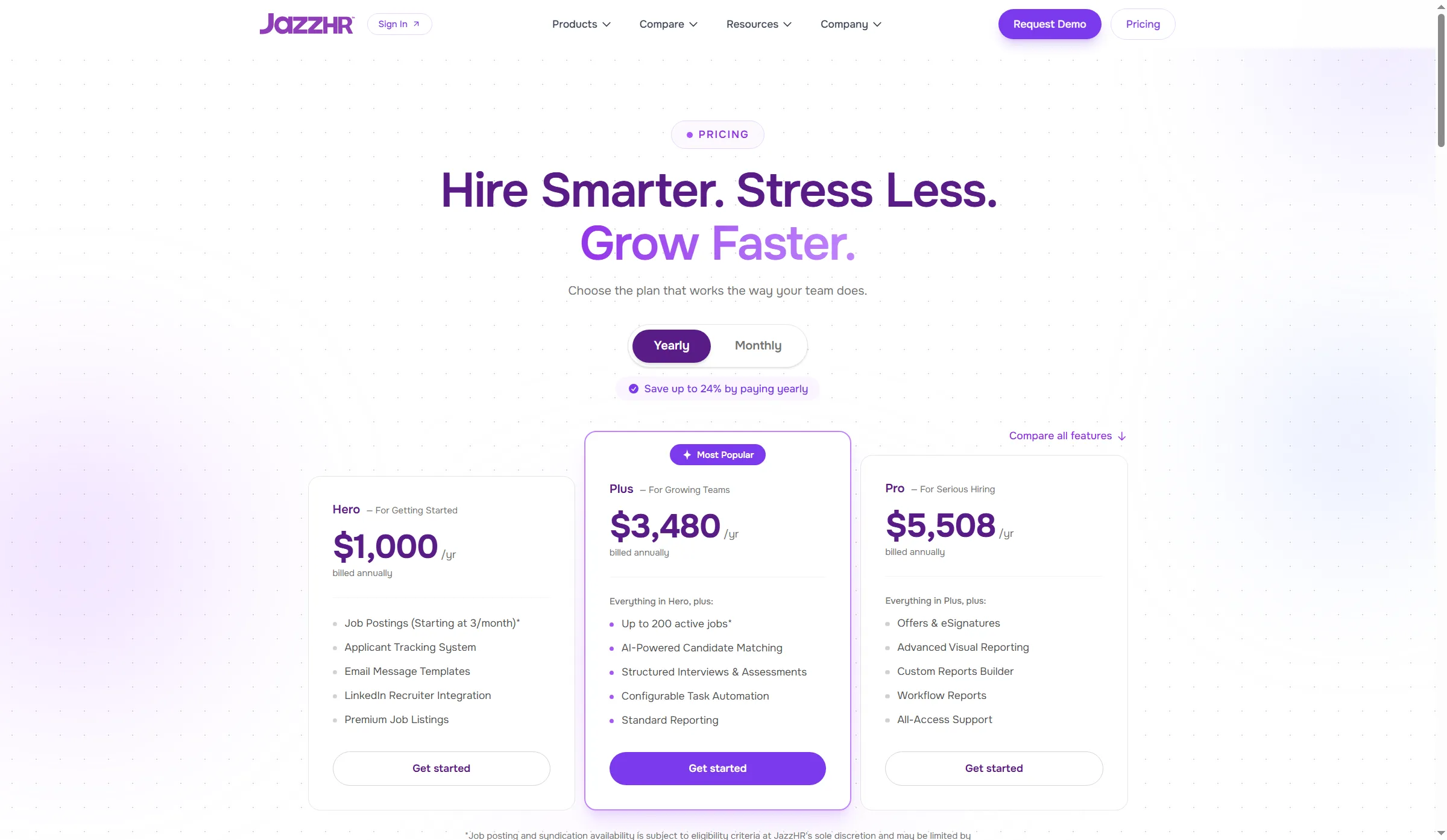
JazzHR’s pricing page shows annual package prices and job-posting terms.
6. Zoho Recruit: Best for Zoho users and recruiter-led teams
I’d choose Zoho Recruit when your team already uses Zoho and recruiter-only access fits the workflow. In the US Corporate HR edition, the public page shows Standard at $25 per recruiter per month with annual billing and Enterprise at $50. The monthly rates are $30 and $60. Standard allows 10 active jobs per recruiter; Enterprise allows 20. A free tier allows one active job per recruiter.
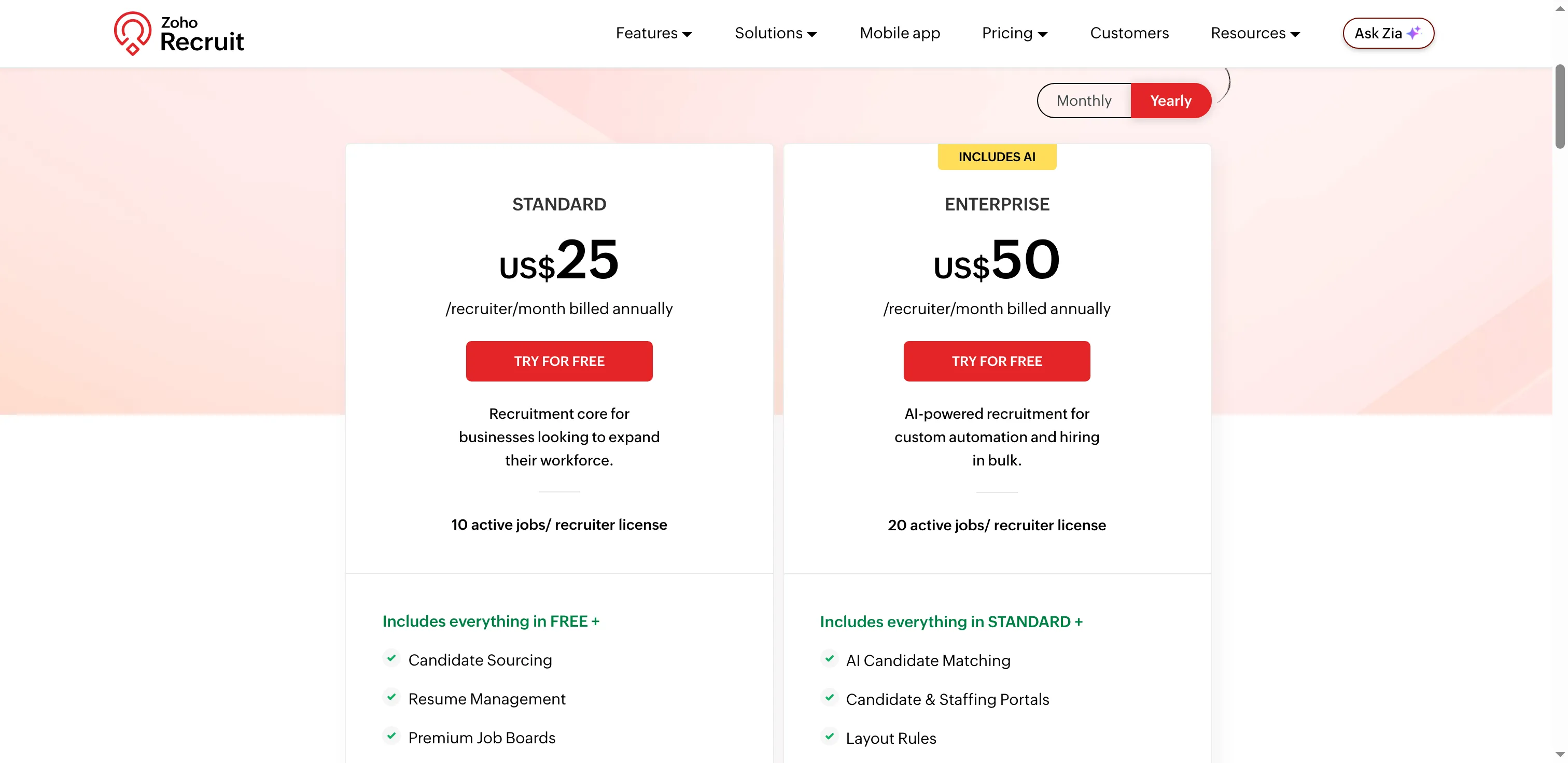
Zoho Recruit prices Corporate HR plans by recruiter license; hiring-manager access is separate.
The pricing page separates Corporate HR from Staffing Agency, so don't compare the two editions as if they were the same package. Employee and hiring-manager referral licenses are separate and sold in packs of ten. You'll need to add those packs if managers review candidates directly; recruiter-seat arithmetic alone will understate deployment cost.
The Corporate HR signup path separates employers from staffing agencies and asks for phone and region. On the pricing page, the annual/monthly selector shows recruiter rates and active-job caps side by side; I could calculate recruiter licensing from that screen, but manager access uses separate packs.
Pros — Zoho Recruit
- The public page lists free and paid Corporate HR rates, with active-job caps.
- Recruiter-seat costs are straightforward to calculate for a known team size.
Cons — Zoho Recruit
- Hiring-manager licenses are sold separately in packs of ten.
- The free tier allows one active job per recruiter; higher caps require a paid tier.
My pick is Zoho Recruit when recruiter counts and manager access are predictable, especially if you already use Zoho. Add the manager packs before comparing its total with flat-price products.
Product pricing — Zoho Recruit
Free plan with one active job per recruiter; Standard $25 annual/$30 monthly and Enterprise $50 annual/$60 monthly per recruiter. Manager licenses are separate.
Lever alternatives pricing: annual core-ATS examples
For one recruiter and one active role, annual core ATS starts at $300 for Zoho Recruit Standard, $1,884 for Breezy HR Startup, and $3,588 for Workable Standard in the 1–20 employee band. Both rows price the same basic ATS workload: one active role per recruiter, recruiter access only, and no paid add-ons, structured scorecards, video interviews, SMS, assessments, or hiring-manager seats. Breezy Startup is a flat company plan, Workable Standard uses the 1–20 employee band, and Zoho Recruit Standard bills per recruiter. The plans cover core job and candidate tracking; they don't include identical advanced workflows.
| Scenario | Breezy HR Startup | Workable Standard | Zoho Recruit Standard |
|---|---|---|---|
| 1 recruiter, 1 active role | $157 × 12 = $1,884/year | $299 × 12 = $3,588/year | $25 × 1 × 12 = $300/year |
| 5 recruiters, 5 active roles | $157 × 12 = $1,884/year | $299 × 12 = $3,588/year | $25 × 5 × 12 = $1,500/year |
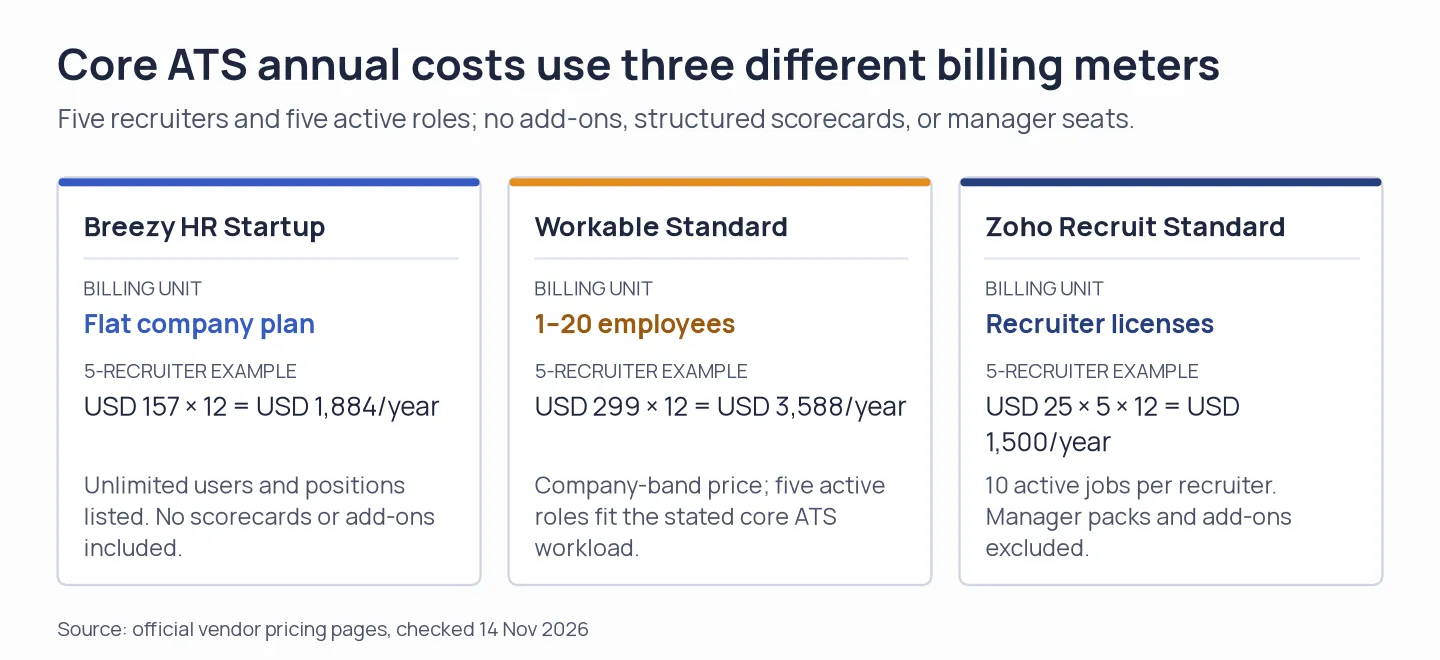
The same core ATS workload uses a flat company fee, an employee-band price, or recruiter licenses; add-ons and manager seats are excluded.
Breezy lists unlimited users and positions on paid plans; Workable’s 1–20 employee price is company-based; Zoho Standard allows 10 active jobs per recruiter. The examples assume annual billing and exclude applicable add-ons and manager access. These examples compare core ATS access; upgrade decisions need a separate feature-by-feature quote.
Ashby, Greenhouse, and Lever require a quote or a confirmed company-size configuration. JazzHR’s posting allowance is a different billing measure, so it is not in this core-ATS table. If structured interviews, analytics, or automation are required, compare the specific tier and add-on that provides that workflow before using these totals.
Which Lever alternative should you choose?
Start with the reason you are leaving. For analytics and a configurable recruiting process, compare Ashby’s plan selector with a Greenhouse quote. For a small team that wants a visible subscription rate, compare Workable’s employee-band price with Breezy’s flat fee. If your recruiters already use Zoho, count the separate manager licenses. Keep JazzHR in the running when its annual packages and monthly posting allowance match your hiring cycle.
Before signing, use a synthetic role and candidate to check the process your team will rely on; you’ll see whether the steps fit your hiring managers too. Then confirm the export and import of candidate notes, uploaded files, consent status, interview feedback, and cross-job applications. Request the migration field map and name the administrator who will own rollout.