

 16 min read

TL;DR: best ATS for small business in October 2026
-
One hiring owner: Manatal costs $180/year for one Professional user plus free manager guests. Managers need to be comfortable with restricted access.
-
Shared hiring: Breezy HR comes with unlimited users. But the free Bootstrap tier shows only candidates that were added in the past 30 days, so you'd need to be careful with a slow hiring process.
-
Modest ongoing expenses: Zoho Recruit Corporate Standard keeps recruiter seats apart from manager licenses. One recruiter plus a manager pack comes to $400.08 annually.
-
Consistent interviews: JazzHR Plus includes structured interviews at $3,480/year. Hero's lower price leaves those tools out.
-
Growing requirements: Workable adds sourcing to applicant management and prices by company size. Tellent Recruitee offers collaborative hiring, with a quote needed to compare the cost.
-
Test scope: I created synthetic candidate records in Manatal, Breezy HR, and Zoho Recruit's staffing trial, and assessed the other products through public pricing controls and guides. Checks and prices date to October 26, 2026.
Linked Helper publishes this blog; the six picks are ATS products for employers hiring their own staff. How we tested explains the checks behind this comparison.
What makes an ATS useful for a small business?
An applicant tracking system (ATS) stores applications, resumes, candidate notes, and hiring stages in one place. When you're replying to applicants between customer calls, you need to know who's waiting on a response, and you need the department manager to be able to leave feedback without yet another spreadsheet.
I care about the handoff between you and the hiring manager conducting the interview. Can they pull up the correct candidate and leave a note without purchasing a full recruiter seat? That feedback should also be available a month from now, when the next opening comes up and you're attempting to recall why a promising applicant didn't progress further.
The bill needs a closer look too. A full recruiter, a restricted manager, and an employee counted for company-size pricing can all affect the total differently. And once several interviewers assess the same applicant, reusable evaluation forms become worth paying for.
Before adding an ATS, check the recruiting module in your existing HR subscription. You may already have a careers page and candidate stages, with enough manager feedback and export options for the next vacancy. An organized inbox and spreadsheet can still work for an occasional hire. Missed replies and unclear ownership are better reasons to switch than an unused feature in a demo.
1. Manatal: Best for one hiring owner with occasional manager input
Manatal is my budget pick when one person runs hiring and managers review assigned candidates. Its free guest model lets you bring managers into the process without paying for full recruiting access they won't use.
Manatal pros
-
Free, unlimited hiring-manager guests
-
Guest access can be limited to selected jobs
-
Creating a manual candidate requires no resume.
Manatal cons
-
Guests don't replace full recruiting users
-
Workflow automation requires Enterprise
-
Set up users, roles, and guests separately
I created a name-only candidate and saved a review note. Manatal's manual form is useful for a referral who hasn't sent a resume yet: you can record the conversation while it's still fresh.
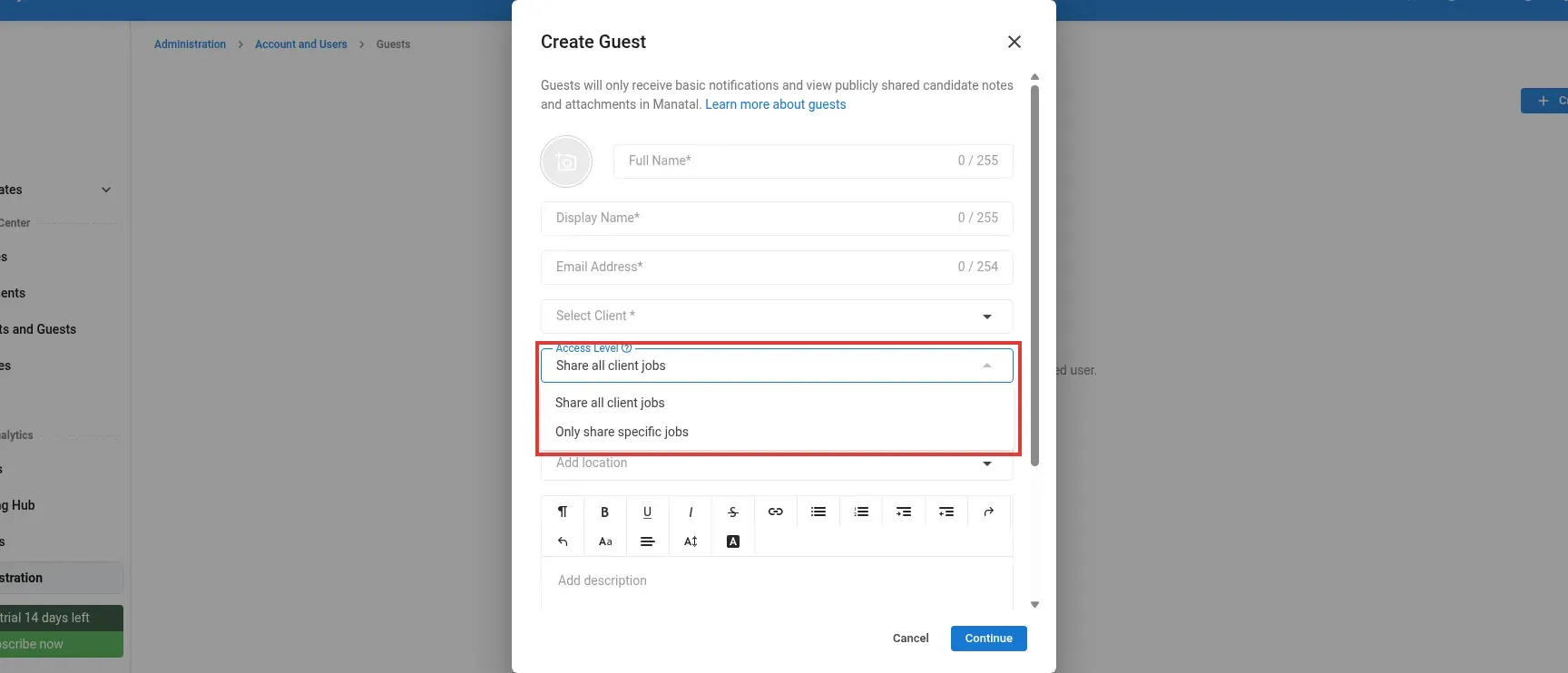
The guest form deserved a closer look. I could choose all jobs within the assigned client or department, or specific jobs, and a warning explained that guests see publicly shared notes and attachments. My saved note displayed a lock icon. Before handing a candidate to a manager, check that the note you're relying on is actually shared with them.
For an owner with a couple of reviewing managers, I like this setup. But if everyone needs to administer recruitment across the account, you'll need to budget for full users and spend time on permissions.
Manatal pricing
Manatal Professional runs $15/user/month on annual billing—or $19 monthly—and comes with 15 jobs plus 10,000 candidates per account. Annually, Enterprise is $35/user/month or $39 month-to-month; it adds workflow automation, unlimited jobs, and unlimited candidates. You can try Manatal free for 14 days.
2. Breezy HR: Best for hands-on hiring managers
Breezy HR suits teams whose managers participate regularly and don't want each extra login to change the bill. Unlimited users make it easier to involve the people doing the interviews.
Breezy HR pros
-
Unlimited users, including on Bootstrap
-
Startup includes unlimited positions and custom pipelines
-
Notes and the current candidate stage appear together
Breezy HR cons
-
Free candidate access has a rolling time limit
-
Interview scorecards require Growth
-
Text messaging costs extra
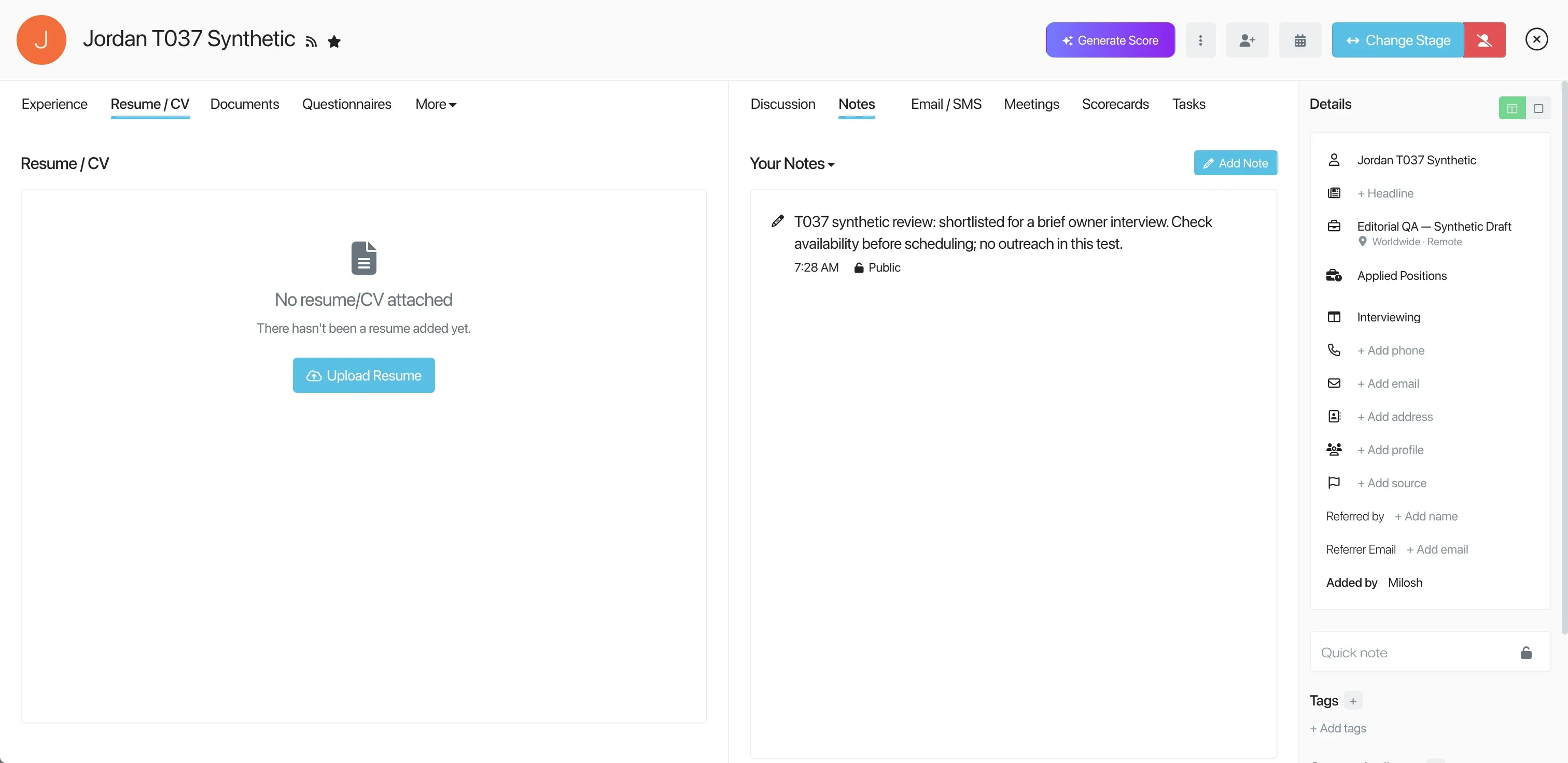
In the trial, I added a name-only applicant, saved an owner-interview note, and moved the record from Applied to Interviewing. The note stayed visible beside the current stage. I like that arrangement when the next person reviewing a candidate has only a few minutes between other work.
Startup handles custom stages, questionnaires, and stage actions. Growth adds interview scorecards, so choose around the feedback you need: ordinary notes may be enough for an owner and a manager, while several interviewers assessing the same criteria justify looking at Growth.
Bootstrap allows one active position or pool and access only to candidates added within the last 30 days. A slow-moving hire can outlast that window. I wouldn't make the free plan the long-term home for a shortlist you expect to revisit next quarter.
Breezy HR pricing
Breezy HR offers free Bootstrap, while Startup costs $157/month with annual billing or $189 monthly. Growth costs $273/month annually or $329 monthly. The annual Growth cost is $273 × 12 = $3,276 for a team needing interview scorecards.
3. Zoho Recruit: Best for a small in-house team watching costs
Zoho Recruit Corporate HR keeps the paid setup modest by separating recruiter seats from manager licenses. Choose the Corporate HR edition when comparing it for an employer hiring its own staff, since the staffing edition has different limits.
Zoho Recruit pros
-
Separate licenses for manager feedback
-
Corporate Standard includes interview feedback forms
-
You can downgrade later to the Free edition, which is available.
Zoho Recruit cons
-
Manager licenses come in packs
-
Staffing and corporate plans come with separate caps.
-
Removing a user doesn't cancel the purchased license
I entered one recruiter and two hiring managers in the Corporate HR calculator. Zoho Recruit rounded the managers up to a ten-license pack. You're paying for spare manager capacity even with a tiny team, but you don't have to buy each reviewer a full recruiter seat.
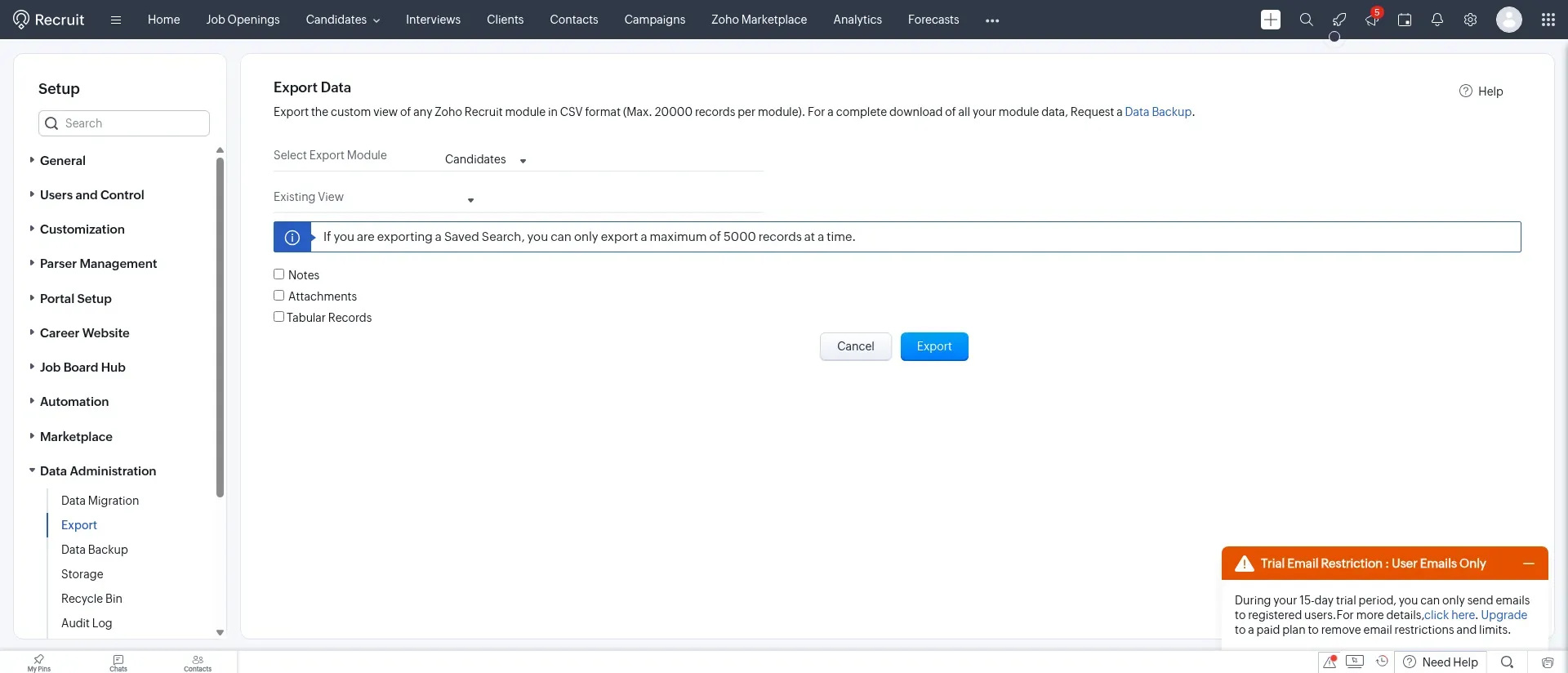
During the staffing trial, I built a synthetic candidate and left a note for the following hiring season. I noticed that Notes and Attachments each had their own checkbox on the export screen. When you expect an export to include everything visible on a candidate's profile, that little detail is simple to overlook.
I like Zoho for a team that can keep recruiter and reviewer duties separate. It needs more attention if colleagues move between those roles frequently. When a temporary recruiter leaves, reduce the purchased license count as well as deactivating their login, or the bill can stay the same.
If you source candidates on LinkedIn, Linked Helper's Zoho Recruit LinkedIn integration can send their profile data into Zoho Recruit.
Zoho Recruit pricing
With yearly billing, Zoho Recruit Corporate Standard runs $25 per recruiter each month or $30 on a monthly plan—each recruiter gets 10 active job slots. For ten manager licenses, a pack is priced at $8.34 monthly when paid annually or $10 month-to-month. Advanced automation in Corporate Enterprise begins at $50 per recruiter per month on annual terms.
4. JazzHR: Best for consistent interviews across a small team
JazzHR Plus combines structured interviews and task automation for a team that needs consistent assessments. Unlimited users let you involve another department manager without increasing the seat count on the bill.
JazzHR pros
-
No per-seat fees and no limits on the number of users
-
Plus merges task automation with structured interviews.
-
Pro adds offers and electronic signatures
JazzHR cons
-
Hero leaves out structured interview tools
-
Standard pricing excludes agencies and franchises
-
The Hero monthly purchase option needs to be clarified.
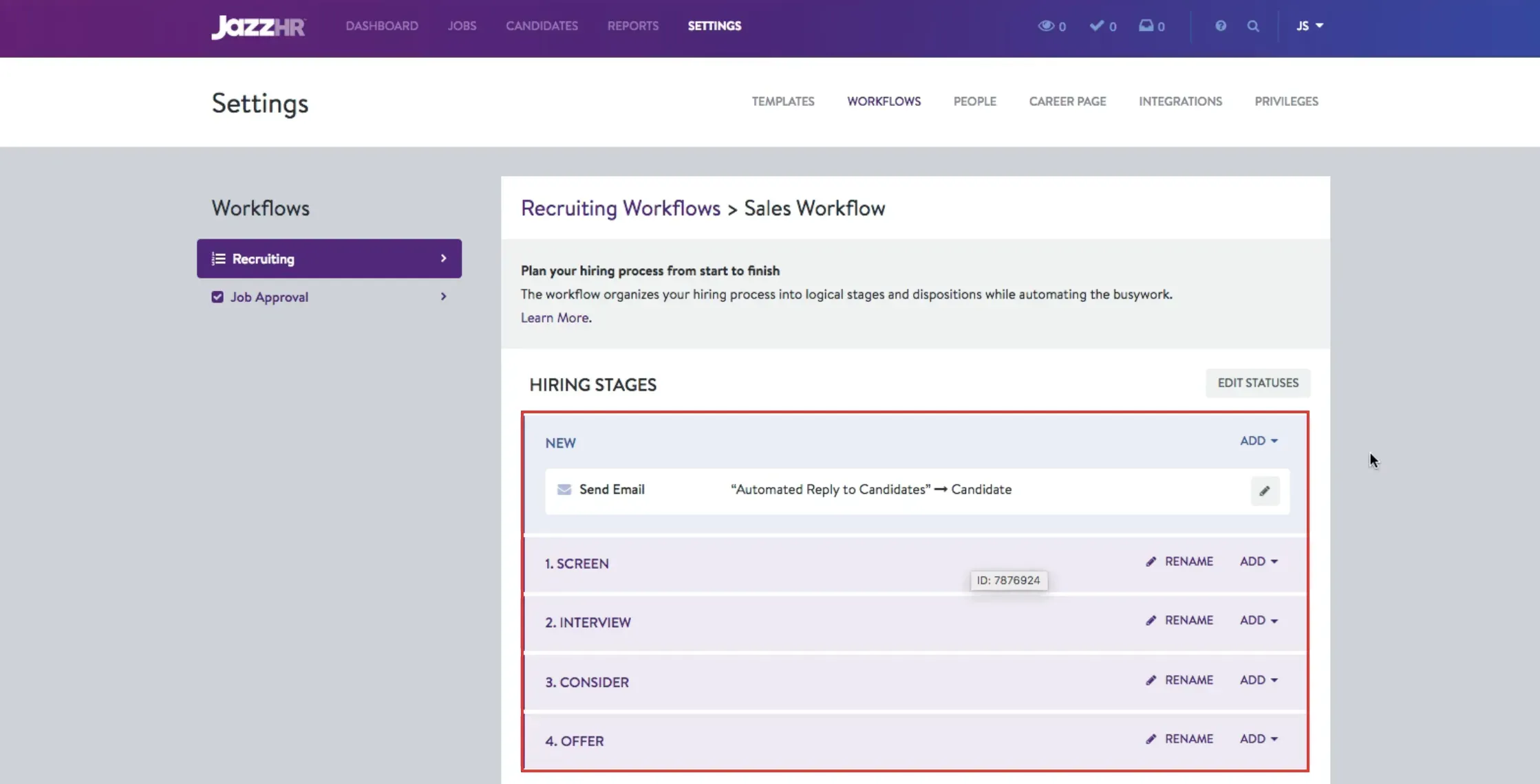
The plan choice is straightforward if inconsistent feedback is slowing you down: compare Plus. In the vendor workflow video, an automatic reply is attached to New before candidates move through Screen and Interview. I like the connection between a stage change and its next action, especially when the hiring owner is already chasing interviewers for feedback.
Standard rates leave out agencies, franchises, and multi-location businesses, among other categories. Before you put them into a budget, verify eligibility.
JazzHR pricing
JazzHR offers annual Hero and Plus subscriptions (costed in the team comparison), while Pro costs $5,508/year. Hero's allowance starts at three postings per month; Plus supports up to 200 active jobs. Monthly purchase cards list Plus at $350 and Pro at $549. A 14-day free trial is available.
I found a mismatch in the monthly pricing view: the comparison header showed Hero at $110, while the top purchase cards offered Plus and Pro. Use the clearly listed annual Hero price for planning until that monthly option is clarified.
5. Workable: Best for frequent hiring and sourcing
Workable suits employers that need sourcing alongside applicant management throughout the year. I like the broader scope for regular recruiting, though it's a bigger subscription to justify for an occasional vacancy.
Workable pros
-
Sourcing alongside applicant management
-
Separate Recruiting and HR pricing selections
-
Standard supports a collaborative hiring team
Workable cons
-
A company's invoice may increase as the company expands, even without an additional recruiter.
-
Additional permission sets require Enterprise
-
Assessments, video interviews, and texting carry an additional charge
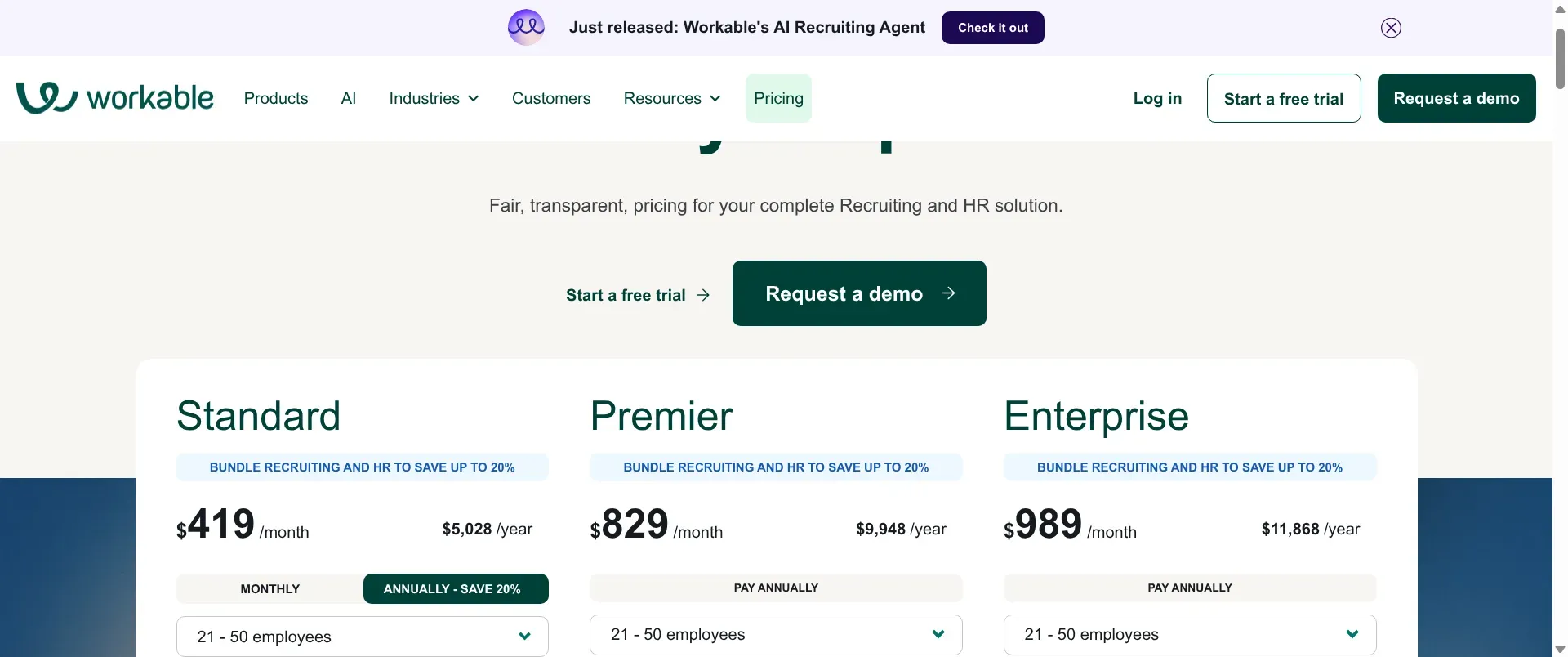
I switched Recruiting on and HR off in the pricing selector, then changed the company size. The subscription rose even though the hiring team could stay the same. Check that count before you compare a quote with a per-user ATS, especially if your company has contractors who don't appear on the employee roster you normally use.
Under Workable's rules, an employer that has 18 employees plus three contractors is already considered 21 people. Workers at affiliates and subsidiaries count as well, and part-time staff do too. If you count only full-time employees on your own payroll, it's easy to cross a price boundary.
Standard can cover ordinary hiring participation, but additional permission sets require Enterprise. If managers need unusual combinations of access, check those permissions before choosing Standard.
Workable pricing
Workable Standard Recruiting runs $299/month when billed yearly or $360 per month for 1–20 people. It's $419/month on the annual plan or $500 monthly for 21–50 people. HR and optional extras aren't included in those numbers.
6. Tellent Recruitee: Best for a growing collaborative process
Tellent Recruitee gives growing hiring teams a choice between shared applicant review and more automated coordination. Start has five job slots and unlimited users, while Advance adds unlimited jobs, evaluation forms, self-scheduling, workflow automation, and offers.
Tellent Recruitee pros
-
Unlimited users on Start
-
Advance adds structured evaluation forms
-
Larger plans combine workflow automation and scheduling.
Tellent Recruitee cons
-
Prices require a quote
-
At a level above Start, you'll find self-scheduling, along with offers.
-
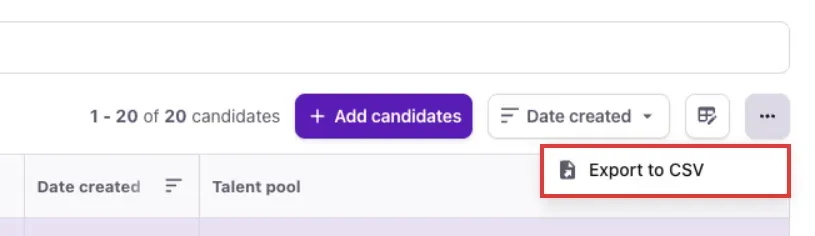
You need technical help to export resumes in bulk.
I like having an option that ranges from shared applicant review to more automated coordination. When feedback keeps coming in late, the evaluation and scheduling tools from Advance matter more than just purchasing additional job slots.
For a small team with straightforward reviews, Start is the more sensible plan to price. But if you're coordinating recurring interviews across departments, Advance is worth comparing. Either way, a quote needs to include the billing term and any required implementation charges before you can place it beside the fixed-price options.
Tellent Recruitee pricing
Tellent Recruitee offers a free trial, with Start, Advance, and Optimize priced by quote. Don't carry forward an old fixed monthly rate from another review. If you need to compare and purchase from a public entry price today, this option takes an extra step.
What does an ATS cost for a small hiring team?
Manatal's one-user-and-guests setup costs $180 annually, the least among the selected configurations. To compare the bill as a company grows, I calculated subscriptions for these workloads:
-
Smaller employer: 10 people, one hiring owner, two reviewing managers, and one active job.
-
Larger employer: 30 people, one hiring administrator, four reviewing managers, and three active jobs.
Both are single-location employers hiring their own staff. Company sizes include contractors and part-time employees. Managers review assigned candidates and leave feedback, rather than administer recruitment. These USD totals exclude taxes, paid ads, and optional extras.
The table compares annual costs with a hiring season's three monthly payments. Annual totals use the annual-billing monthly rates multiplied by 12 where applicable; seasonal totals use monthly rates multiplied by three. Zoho includes a manager pack in both calculations.
| Configuration | Smaller employer: annual cost | Larger employer: annual cost | Smaller employer: three monthly payments |
|---|---|---|---|
| Manatal Professional | $180 | $180 | $57 |
| Breezy HR Startup | $1,884 | $1,884 | $567 |
| Zoho Recruit Corporate Standard | $400.08 | $400.08 | $120 |
| JazzHR Hero / Plus | $1,000 for Hero | $3,480 for Plus | $1,050 for Plus |
| Workable Standard Recruiting | $3,588 | $5,028 | $1,080 |
| Tellent Recruitee Start | Quote required | Quote required | Quote required |
JazzHR Hero's allowance is postings per month, so I used Plus for simultaneous vacancies. Treat Hero as an entry-price reference and check your required manager permissions. Structured feedback may also require an upgrade; compare the interview tools in each product card.
Which ATS works for a three-month hiring season?
Manatal and Zoho Recruit offer cancellable monthly options, while the other products need a closer check of the purchased term. The payment totals in the cost comparison need to be read alongside the access and export rules you'll face when hiring stops.
| Tool | Access after paid hiring stops | Export before leaving |
|---|---|---|
| Manatal Professional | Cancel before the cycle ends; access ends with that cycle | Exporting a job spreadsheet requires administrator or job-owner access |
| Breezy HR Startup | Canceled paid data can be recovered by restarting within a year; Bootstrap keeps its rolling candidate-access window | Selected CSV columns; resumes appear as PDF links |
| Zoho Recruit Corporate Standard | Downgrade to Free; settings for unavailable paid features can disappear after 15 days | Include notes and attachments when preparing the export |
| JazzHR Plus | Order form controls the term; access ends at expiry | Export while the subscription is active |
| Workable Standard Recruiting | Agreed-term fees can remain due after early termination; access ends | Ordinary candidate CSV omits resumes; arrange a full archive separately through support |
| Tellent Recruitee | Account and database access end with the billing period; storage beyond 30 days isn't guaranteed | Essential candidate-data CSV; bulk resumes require the API and a developer |
Before committing to the monthly payments, verify the earliest end date. JazzHR requires written nonrenewal notice at least 30 days before the term ends, while Recruitee requires at least 90 days for annual subscriptions. Prior to the hiring season becoming busy, place the relevant notice date on your calendar.
Breezy's retention policy is useful if you restart, but keeping data on a server won't help you search a shortlist while you're on a restricted free plan. For Zoho, save the workflow setup as well as candidate information before a long downgrade. For Recruitee, arrange the technical help for resume export while you can still open the account.
Which small-business ATS should you choose?
Choose Manatal for a single hiring owner with reviewing managers, Breezy HR for broader participation, or JazzHR Plus for consistent interviews. The quick picks narrow the field, but a manager should be able to open an assigned candidate, find the resume, and leave feedback from a restricted account without relying on your administrator login.
Take one identical synthetic applicant and push it through each tool on your shortlist (plus that recruiting module you're already paying for). Jot a brief note, move the stage forward, and pull up an export outside the app. Then verify whether the résumé arrives as a file or as a link, and whether that note made it through. That handoff will teach you more than yet another feature checklist.
Keep email and calendar integrations disconnected until you're ready to test communications deliberately. Then add automation one step at a time, checking recipients and message text before enabling a stage-triggered email. An accidental stage change shouldn't become an accidental rejection.
How we tested
I tested ATS trial workspaces with synthetic candidates and researched the six products’ pricing and workflows in October 2026. I didn't test real hiring outcomes.