Updated: September 7, 2026
 27 min read
Key takeaways
- Starter is not just a teaser: it includes unlimited-step sequences, unlimited campaigns, CSV import/export, Sales Navigator, Recruiter, and multiple LinkedIn collection sources, so the paid upsell is mainly about AI, API, and middleware access rather than basic LinkedIn outreach.
- The annual discount copy needs a checkout-level read: the pricing page shows a 50% annual badge while another line says annual billing saves about 17%, which makes the live plan math more reliable than the surrounding discount language.
- The review signal is positive but thin: we found praise for fast setup and simple operation, while the same evidence base also points to advanced-feature depth as the ceiling, so review sentiment should not be treated as proof of agency-scale maturity.
- Agency use has an operations gap beyond seat count: Client Organizations and team dedup exist, but no white-label, lead distribution, sender rotation, client-ready report export, or messaging-history export was confirmed.
- Custom proxy support does not close the safety-observability gap: the setup checks whether a proxy is reachable, not whether it has a clean independent reputation, so buyers still need to evaluate cloud session handling separately.
This review is published by Linked Helper and written by its editorial team. We've made every effort to represent Botdog accurately using verified public data from Botdog's own documentation, public pricing and support pages, and independently sourced reviews.
Botdog is a cloud LinkedIn automation tool for solo operators and small teams that want LinkedIn-only outreach without keeping a browser or desktop app running. The live entry price is $69/month per LinkedIn account, or $35/month equivalent with a $420 annual prepayment.
Our safety read is conditional: Botdog documents random delays, working hours, dynamic throttling, and a refund-on-suspension guarantee, but no independent IP/fingerprint test has been run for this review. Because Botdog processes the LinkedIn session on its own cloud servers and publishes no data region, DPA, GDPR language, or SOC2/ISO status, compliance-sensitive buyers should treat the cloud model as an open evaluation item.
Verdict
Botdog gets a conditional verdict. A LinkedIn-only operator may use it when the priority is a cloud dashboard, a no-card 7-day trial, entry-tier Sales Navigator and Recruiter support, and a campaign engine that runs without a local machine staying on.
The case against it is in the fine print. The $35/month headline requires a non-refundable $420 annual prepayment; the true month-to-month entry is $69/month. The pricing copy is inconsistent: a generic FAQ mentions "plan limits," but a newer Botdog comparison explicitly says the only restrictions are LinkedIn's limits. CRM workflows require Professional-tier API or webhook access plus an external integration layer such as Zapier, Make, or n8n; the documented HubSpot route specifically adds paid Zapier Professional.
With the missing IP/fingerprint test and sparse compliance disclosure, Botdog reads as a simple cloud LinkedIn tool with visible billing and compliance caveats, not as a settled low-risk default.
Pros
- The trial removes a payment step: Botdog advertises a 7-day free trial with no credit card and full access, which lets a buyer inspect the workflow before any charge.
- Safety controls are documented: Random delays, 8am-7pm working hours, dynamic throttling, and sequential action language are public and not gated to higher plans.
- Several LinkedIn data sources are entry-tier: Regular search, Sales Navigator, Recruiter, company employees, event attendees, group members, and post likes/comments are listed as exportable sources - Sales Navigator and Recruiter access require the buyer's own paid LinkedIn subscription to those products; Botdog does not provide it.
- Cancellation is self-service: The vendor describes account-settings cancellation and continued access through the paid billing period, so cancellation is not presented as a support-only path.
Cons
- The $35/month price is not month-to-month: Starter costs $69/month without commitment; $35/month equivalent requires a $420 annual prepayment, and Botdog's terms say fees are non-refundable except where law requires.
- The "Unlimited" claim still has a copy inconsistency: Botdog's pricing FAQ mentions generic "plan limits," but a newer Botdog comparison says its campaigns and LinkedIn actions have no tool-imposed restrictions beyond LinkedIn's limits. Treat this as unclear vendor copy, not evidence of an undisclosed Botdog cap.
- CRM sync has a double paywall: Botdog states it has zero direct CRM integrations; HubSpot, Salesforce, Pipedrive, and Attio require Zapier/Make/n8n, and HubSpot specifically needs Zapier Professional.
- It is LinkedIn-only: The vendor's own comparison page says there is no email or social-channel automation, so Botdog does not cover multichannel outbound in one sequence.
- Compliance disclosure is thin: Botdog processes the LinkedIn session in the cloud but publishes no data region, no subprocessor list, no GDPR mention in the privacy policy, no live DPA page, and no SOC2/ISO claim.
- The safety evidence has a test gap: Public pages describe safety mechanics, but no independent IP/fingerprint test was available for this article, so the default cloud IP and fingerprint behavior remain unverified.
- Agency tooling is limited: No white-label, branded client portal, lead distribution, sender rotation, or team-member audit log was found; bulk pricing appears in a blog post, not the pricing page.
Botdog Pricing: Plans, Traps, and Hidden Costs
Botdog's pricing page presents three self-service tiers for one LinkedIn account: Starter at $69/month or $35/month equivalent ($420 prepaid annually), Professional at $79/month or $39/month equivalent ($468 prepaid annually), and Professional + AI at $99/month or $49/month equivalent ($588 prepaid annually).
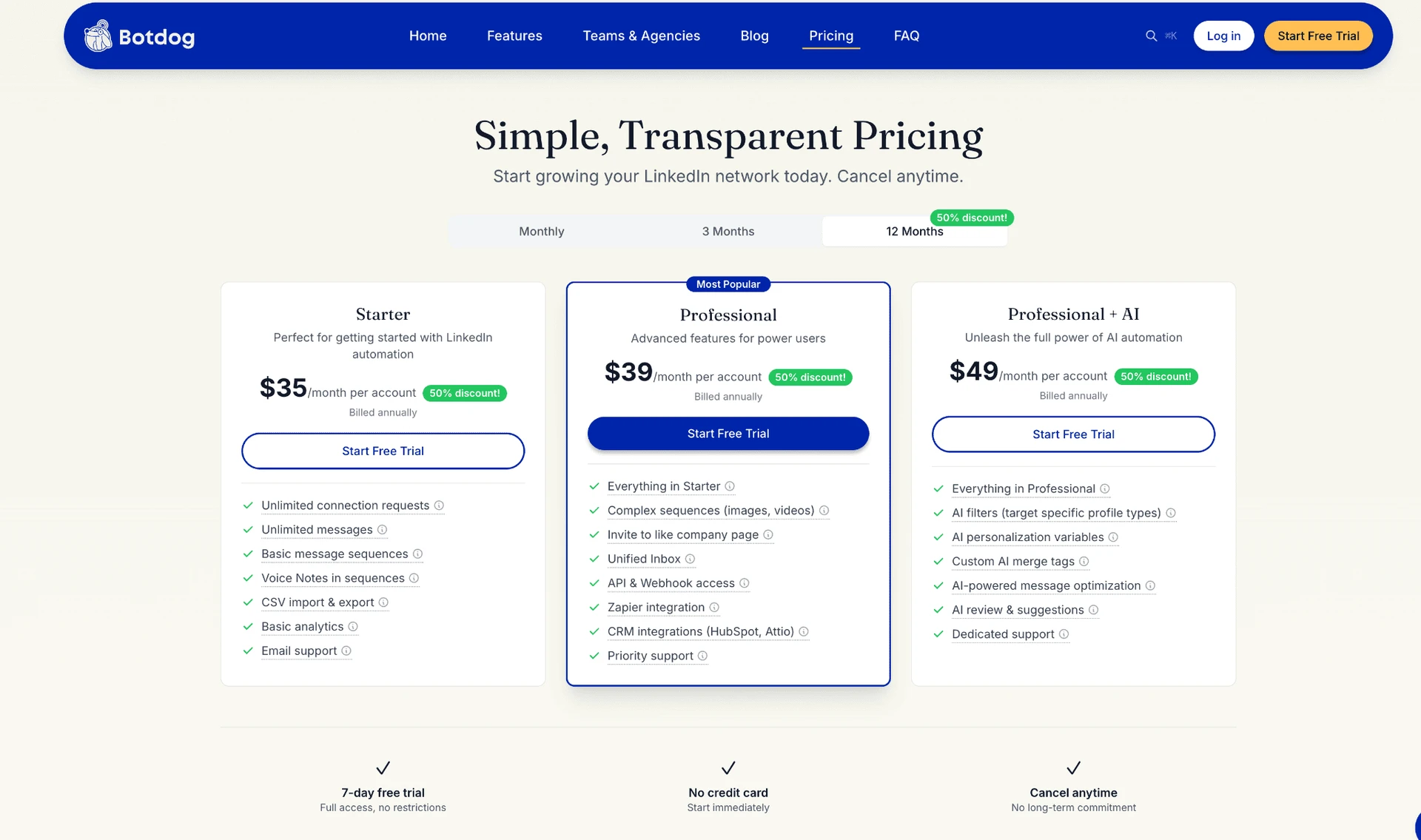
The first implication is straightforward: the public $35/month number is not the price for trying Botdog month to month. It is the annual-equivalent price, and the terms page says "All fees are non-refundable except as required by law."
| Plan | Price | What's included | What's NOT included |
|---|---|---|---|
| Starter | $69/mo, or $35/mo equivalent ($420 paid upfront annually) | 7-day no-card trial; unlimited campaigns; unlimited-step sequences; auto-stop on reply; CSV import/export; Sales Navigator and Recruiter support; documented safety controls | API, Zapier, CRM routing, priority support, and all AI features |
| Professional | $79/mo, or $39/mo equivalent ($468 paid upfront annually) | Starter features plus API, Zapier/Make/n8n routing, and the pricing-page CRM feature claim | Actual direct CRM integrations; AI features; the separate Zapier Professional subscription required for HubSpot sync |
| Professional + AI | $99/mo, or $49/mo equivalent ($588 paid upfront annually) | Professional features plus AI message generation, AI personalization, and AI Lead Review | A native CRM sync layer; multichannel email outreach; published credit rollover rules |
| Enterprise | Not listed on pricing grid | Named in the FAQ as an enterprise tier | Self-service price, public checkout path, and included-volume details |
Botdog pricing tiers (July 2026)
Botdog uses "Unlimited connection requests" and "Unlimited messages" on its pricing page. A generic FAQ also asks what happens when a user exceeds "plan limits," but a newer Botdog comparison states there are no restrictions other than LinkedIn's limits. The current evidence therefore does not establish a hidden Botdog tool cap.
For a buyer, "unlimited" still cannot override LinkedIn's own activity restrictions. This Help Center explainer on weekly invitation warnings gives neutral background on why invite volume cannot be evaluated from vendor copy alone.
Pricing trap: Botdog's advertised $35/mo equivalent requires a non-refundable $420 annual prepayment, while the actual month-to-month Starter price is $69/mo per LinkedIn account.
The CRM cost is the second trap: Botdog's dedicated integrations page says, "Botdog doesn't have direct integrations with any CRM." The path to HubSpot, Salesforce, Pipedrive, and Attio is Zapier, Make, or n8n, and the Botdog HubSpot help article says Zapier Professional is required because Webhooks are not available on Zapier's free or starter plans.
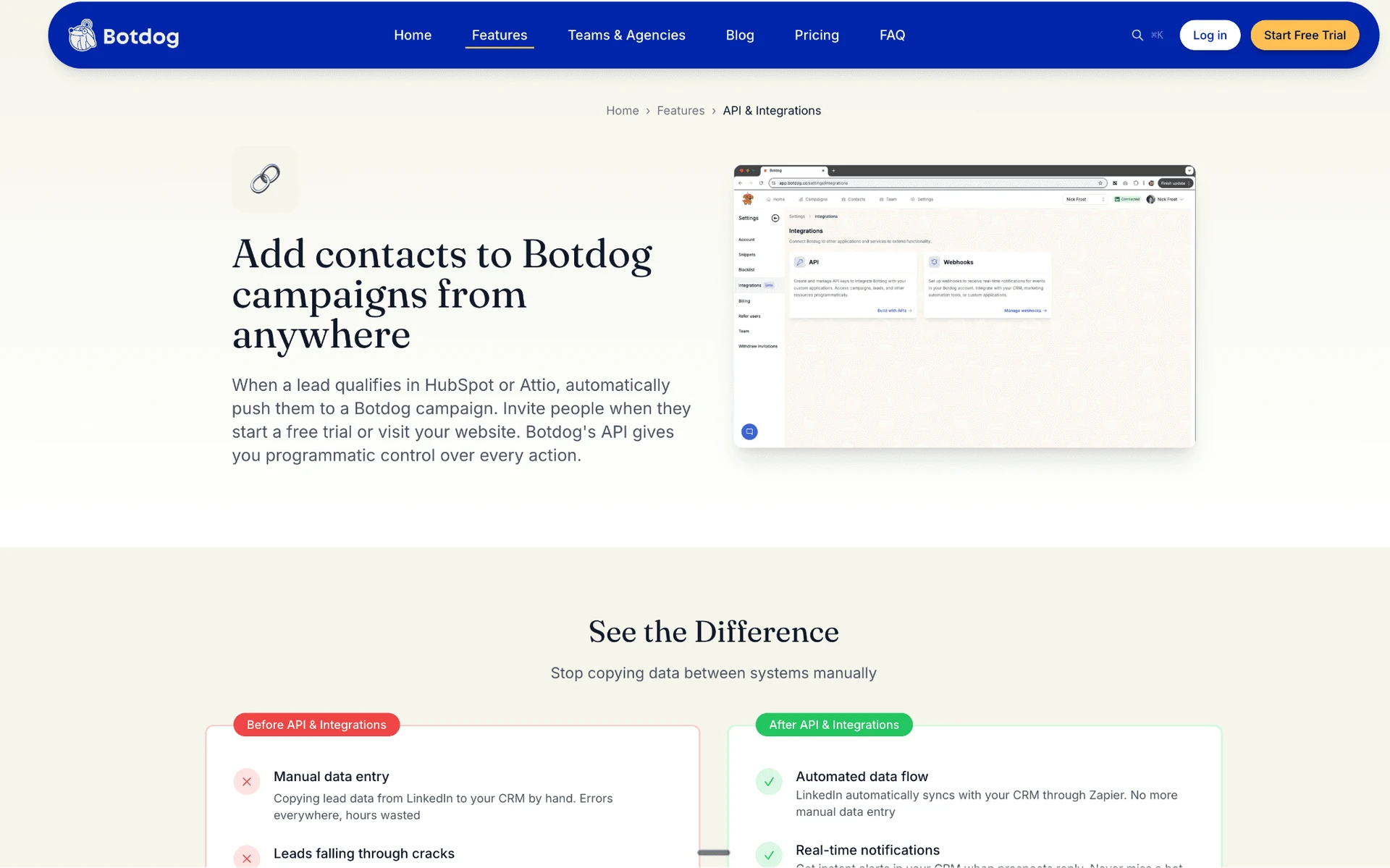
In practice, a CRM-centered buyer needs at least Botdog Professional plus roughly $19.99/month for Zapier Professional, before counting any CRM subscription itself.
The evidence does not support a repricing trend. The available pricing evidence is a live July 2026 snapshot and a vendor blog confirming the same monthly range, not two dated snapshots of the same tier moving over time.
What is supported is a vendor-page discount contradiction: the pricing page calls the annual discount "50%" in a badge while body copy says annual billing saves approximately 17%. The math on $99 monthly versus $49 annual equivalent ($588 prepaid annually) backs the 50% figure; the 17% line reads like stale copy, which is still relevant because it is buyer-facing pricing text.
For daily-volume planning, pair any vendor limit claim with a platform-limit assumption. This neutral guide to LinkedIn activity limits is useful context before treating "unlimited" outreach language as an operating plan.
Botdog's Automation & Campaign Engine
Botdog's confirmed campaign engine is a LinkedIn sequence system. The evidence supports:
- unlimited-step sequences and unlimited campaigns;
- auto-stop-on-reply;
- CSV import/export and personalization variables;
- Sales Navigator support and Recruiter support;
- regular LinkedIn search collection, Sales Navigator list scraping, and Recruiter data-source support;
- company-employee collection, event-attendee collection, group-member collection, and post-like/comment collection.
That set is enough for a basic LinkedIn-only outbound workflow, and it also explains why the entry tier is not merely a teaser.
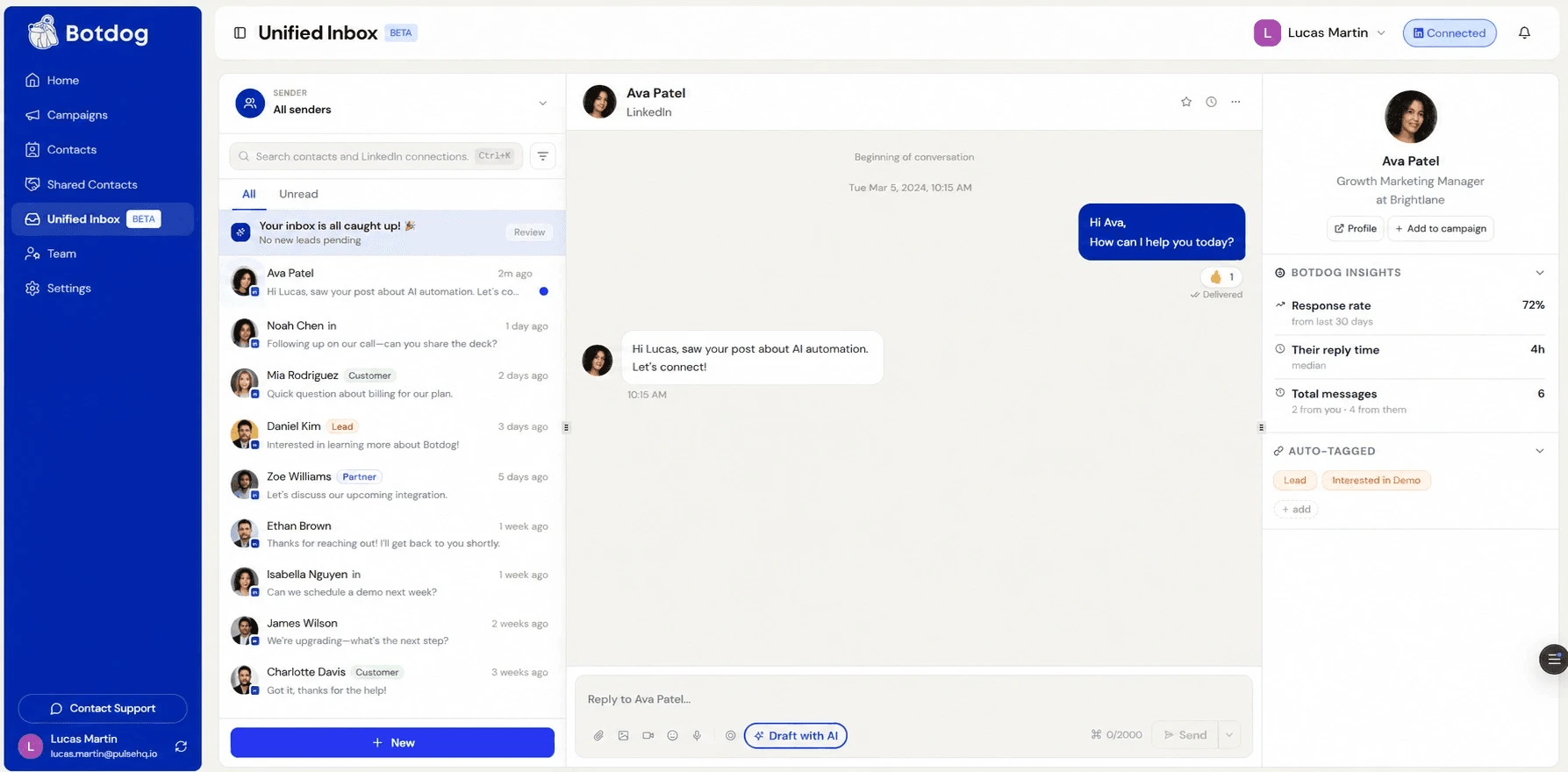
Like most tools in this space, Botdog uses sequences, CSV import/export, random delays, working hours, and Sales Navigator support. The useful part is not that those exist; it is that the entry plan includes them. For a solo user, that means the first paid tier can collect leads, export them, run a campaign, and stop follow-ups when someone replies.
The unresolved part is branching depth. A Botdog blog post claims conditional logic and A/B testing on Professional, but product pages did not confirm those mechanics, and third-party review language describes sequences as linear. Those signals should not be averaged into a confident "yes" or "no." If branching logic is a deciding factor, confirm the exact supported conditions in the trial before buying annually.
Botdog's confirmed action set is narrower than Linked Helper's: no skill endorsements, group or event invitations, automated post comments or lead-name mentions, profile follows, or full company-profile extraction were confirmed. Botdog does support post reactions, company-page invitations, and employee collection, so the practical limitation is narrower brand-building and pre-invite warming coverage—not a complete absence of engagement or company data. It is LinkedIn-only, with no email or social-channel automation and no native connector to an email-outreach platform.
Adding an email step requires a separate tool plus an integration layer such as Zapier, Make, n8n, or Botdog's API/webhooks, which adds another subscription and setup layer.
Message-history CSV export was searched for and not found. LinkedIn says Sales Navigator messages become inaccessible after cancellation, and Recruiter Lite cancellation blocks access to previously sent InMail responses. Botdog does not document a portable message-history export, so its inbox should not be treated as a backup before canceling those LinkedIn products.
Deduplication evidence supports a manual account-level blacklist and a team-wide lead-dedup toggle, but not content-based or regex-based deduplication from message history.
Automation boundary: The evidence supports LinkedIn-only sequences and a wide set of LinkedIn collection sources, but conditional branching, A/B testing, and message-history export were not confirmed on product pages.
AI & Agentic Capabilities
Botdog's AI layer is tier-gated. The confirmed set is AI message generation, AI personalization, and AI Lead Review, which filters leads against plain-English ICP criteria. ICP detection means automatic scoring of collected profiles against an Ideal Customer Profile: the AI reads the profile and judges whether the person matches the target buyer instead of relying only on search filters.
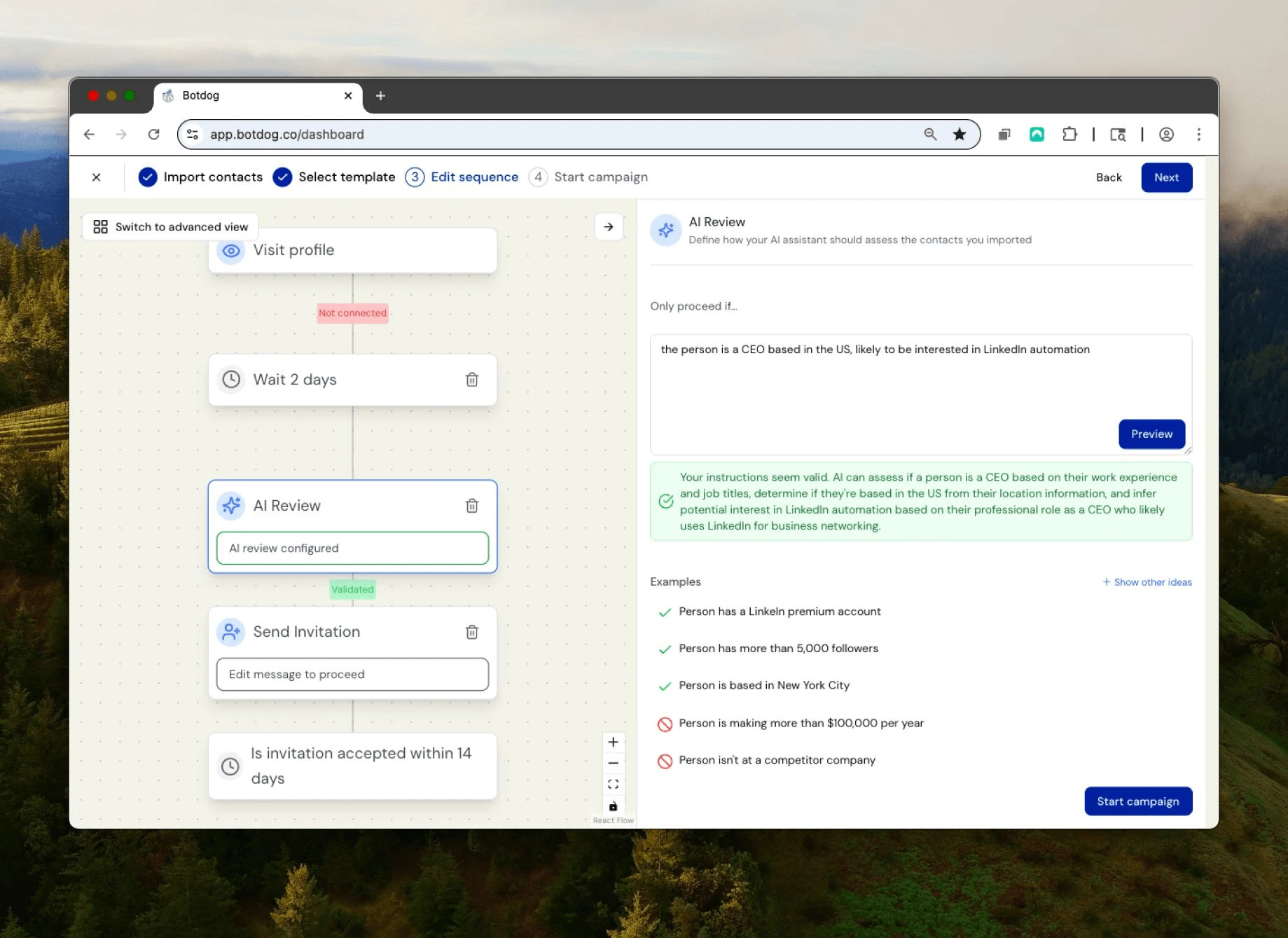
That matters because LinkedIn search results can be noisy; every invite spent on a poor-fit profile consumes part of a limited weekly invite budget.
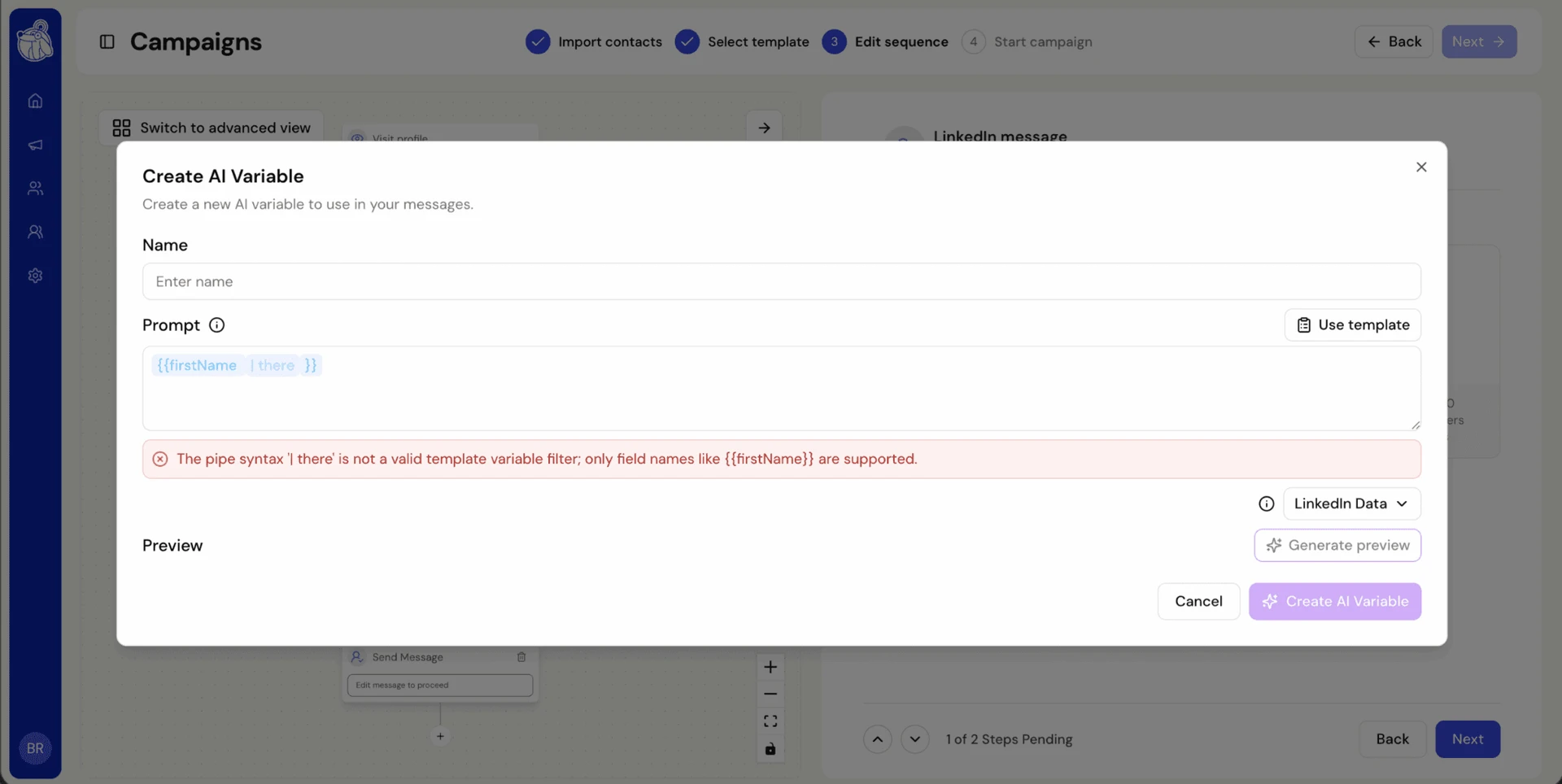
The commercial implication is that AI is not part of the $69/month Starter tier. A buyer who wants AI Lead Review or AI-written outreach needs Professional + AI at $99/month billed month to month, or $49/month equivalent with a $588 annual prepayment. The available evidence did not find a broad credit system for those AI features, so the buying question is plan access, not how many AI credits roll over.
The unconfirmed pieces are also specific. No AI-generated comment feature was found; Botdog's post-comment evidence is about exporting existing LinkedIn post comments, not generating new comments. The evidence also did not confirm a moderation queue where AI messages can be held for manual review before sending.
AI boundary: Botdog's documented AI layer is plan-gated to Professional + AI; AI-generated comments and a confirmed hold-for-review message gate were not found in the evidence.
Personalization & Message Uniqueness
Botdog supports personalization variables on Starter and above. That means a sequence can insert known lead fields into messages instead of sending one identical string to every recipient. In practice, variable substitution is a basic copy-quality mechanism: it helps avoid obvious generic outreach, but the output is only as accurate as the imported or scraped fields.
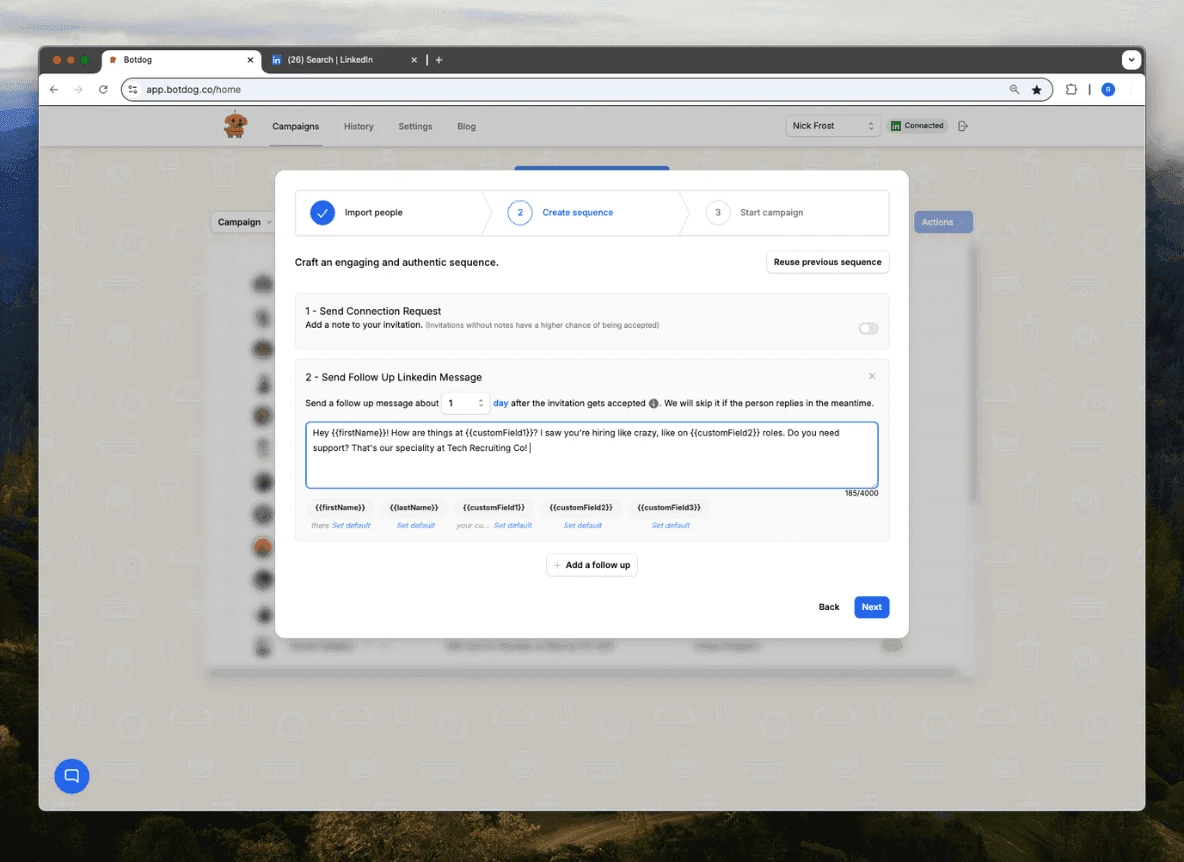
The evidence does not support turning this into a broader personalization claim. Conditional logic and A/B testing appear in a vendor blog claim, but not in the product pages checked for this review. Mutual-connection variables, nested if/then/else message templates, spintax, and copy-cleaning with an audit trail were not confirmed either. Those may sound like small template details, but they matter when a team is trying to prevent broken openers such as empty company fields or stale profile data from reaching prospects.
Personalization boundary: Botdog supports standard variables and plan-gated AI Variables. Its AI Variables generate openers from a prospect's recent activity, role, or profile; nested conditions, mutual-connection variables, spintax, and native A/B testing still were not confirmed on product pages.
The safety overlap is pattern visibility. Message variation can reduce a visible pattern, but it does not change the architecture: Botdog still runs the LinkedIn account from its cloud. Treat personalization as a copy-quality feature, not as a substitute for volume limits, working hours, or session-risk analysis.
Lead Targeting, List-Building & ICP
Botdog's targeting evidence is strongest on LinkedIn data-source breadth. The confirmed sources are:
- regular LinkedIn search;
- Sales Navigator;
- Recruiter;
- company employees;
- event attendees;
- group members;
- post likes and post comments.
All are exportable to CSV or Excel. For a LinkedIn-only workflow, that means Botdog can pull several common prospect lists without forcing every source through a CSV import first.
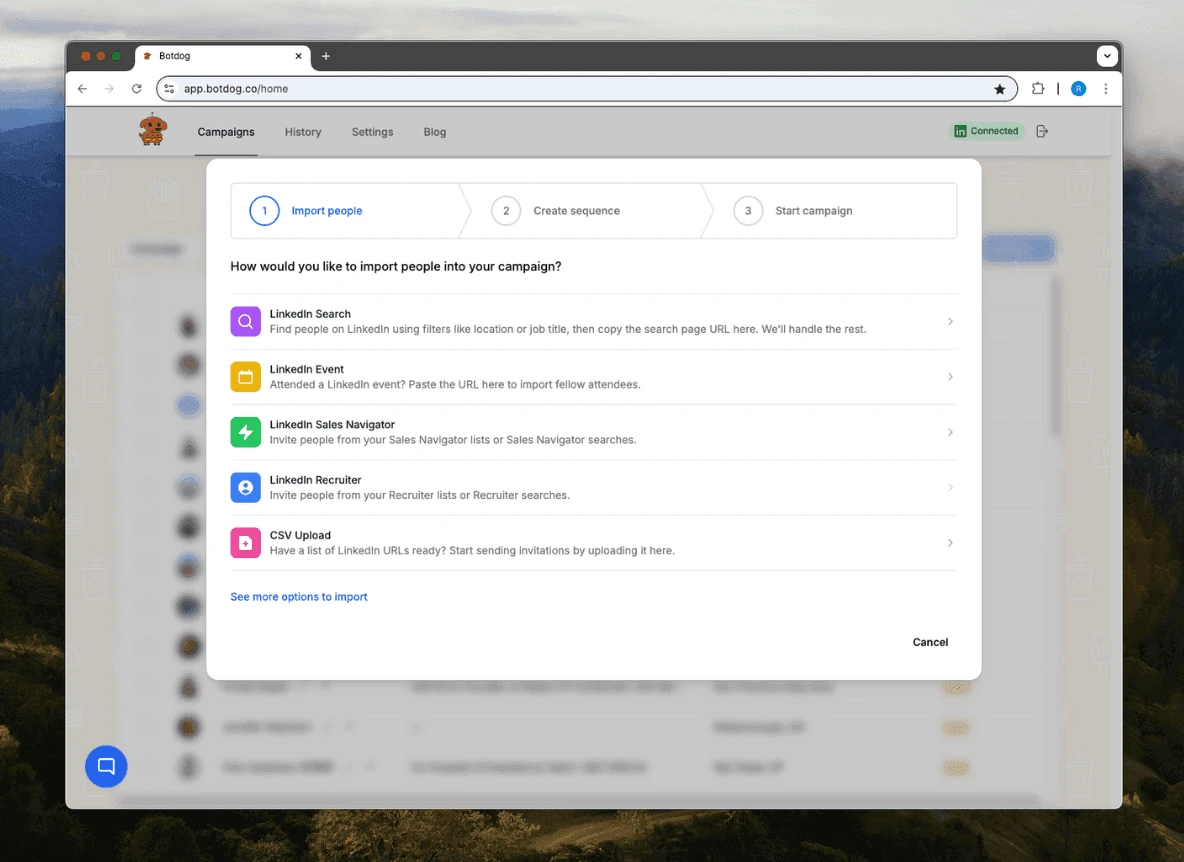
Sales Navigator and Recruiter support matter for two reasons. First, they let users collect from higher-intent or recruiter-specific surfaces when the account has access. Second, Recruiter and SSO accounts may require the cookie-based connection path using li_a, which is a session/access artifact tied to those LinkedIn products. That means the targeting surface and the session-connection model are connected; a buyer should evaluate both before rolling the tool into a team process.
Botdog's AI Lead Review adds an ICP-filter layer, but only on Professional + AI. That is useful for reducing list noise when the criteria are clear, yet it is not the same as email outreach, data enrichment with freshness dates, or a native multichannel workflow. The vendor's own comparison post says Botdog is "LinkedIn-only (no email or social channel automation)," so the list-building strength stays inside LinkedIn.
Targeting read: Use Botdog's LinkedIn-source breadth for LinkedIn-only prospecting, but do not assume email enrichment, data-freshness scoring, or multichannel follow-up unless the specific workflow is confirmed in the trial.
Integrations & Ecosystem
Botdog's native CRM integration count is zero. The vendor's own integrations page states that Botdog does not have direct CRM integrations with any CRM; instead, it connects through Zapier, Make, or n8n.
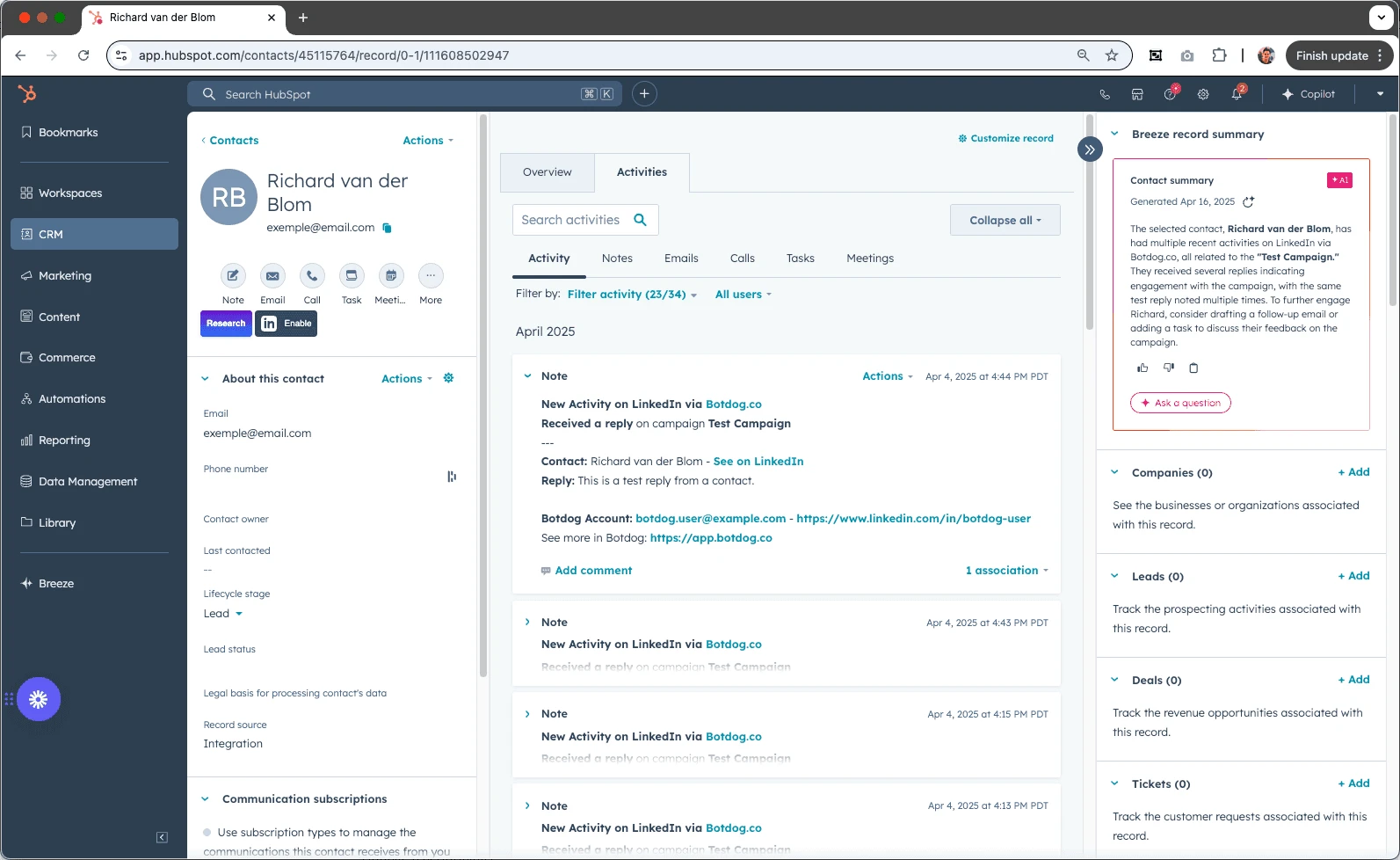
That matters because zero direct CRM integrations is not a small native-connector set; it is an absent one.
| Surface | Confirmed detail | Reader implication |
|---|---|---|
| Native CRM | 0 native CRM integrations | CRM sync depends on an automation layer rather than direct CRM connectors |
| Zapier | Available on Professional+; HubSpot sync requires Zapier Professional because Webhooks are not on free/starter Zapier plans | CRM workflows add a separate paid tool for common use cases |
| Make / n8n | Supported as automation-layer paths | Useful only if the team already accepts a middleware step |
| API / Webhooks | Professional+; live Swagger docs at api.botdog.co/docs; two-way push/pull is documented | Developer access exists, but not on Starter |
| Email channel | Vendor says LinkedIn-only, no email or social-channel automation | Multichannel outbound needs another tool |
Botdog integrations and API surface (July 2026)
Integration cost: A HubSpot workflow needs Botdog Professional or higher plus Zapier Professional; Botdog does not provide a direct HubSpot connector to remove that extra subscription.
The pricing-page phrase "CRM integrations (HubSpot, Attio)" is therefore not enough on its own. The dedicated integrations page and the HubSpot help article explain the mechanism more precisely: Botdog routes through middleware. For a reader, the practical question is whether the added Zapier/Make/n8n layer is acceptable for error handling, mapping, and billing.
Team, Agency & White-label Tools
Some Botdog team structure is documented, but the evidence supports a narrower scope than a full agency platform. Three roles were found, Client Organizations exist as a dashboard context switcher, and a team-wide lead-dedup toggle shipped in the changelog. Those are useful controls for separating client work inside the app, but they do not prove tenant-level data isolation, branded client access, or a complete agency operating layer.
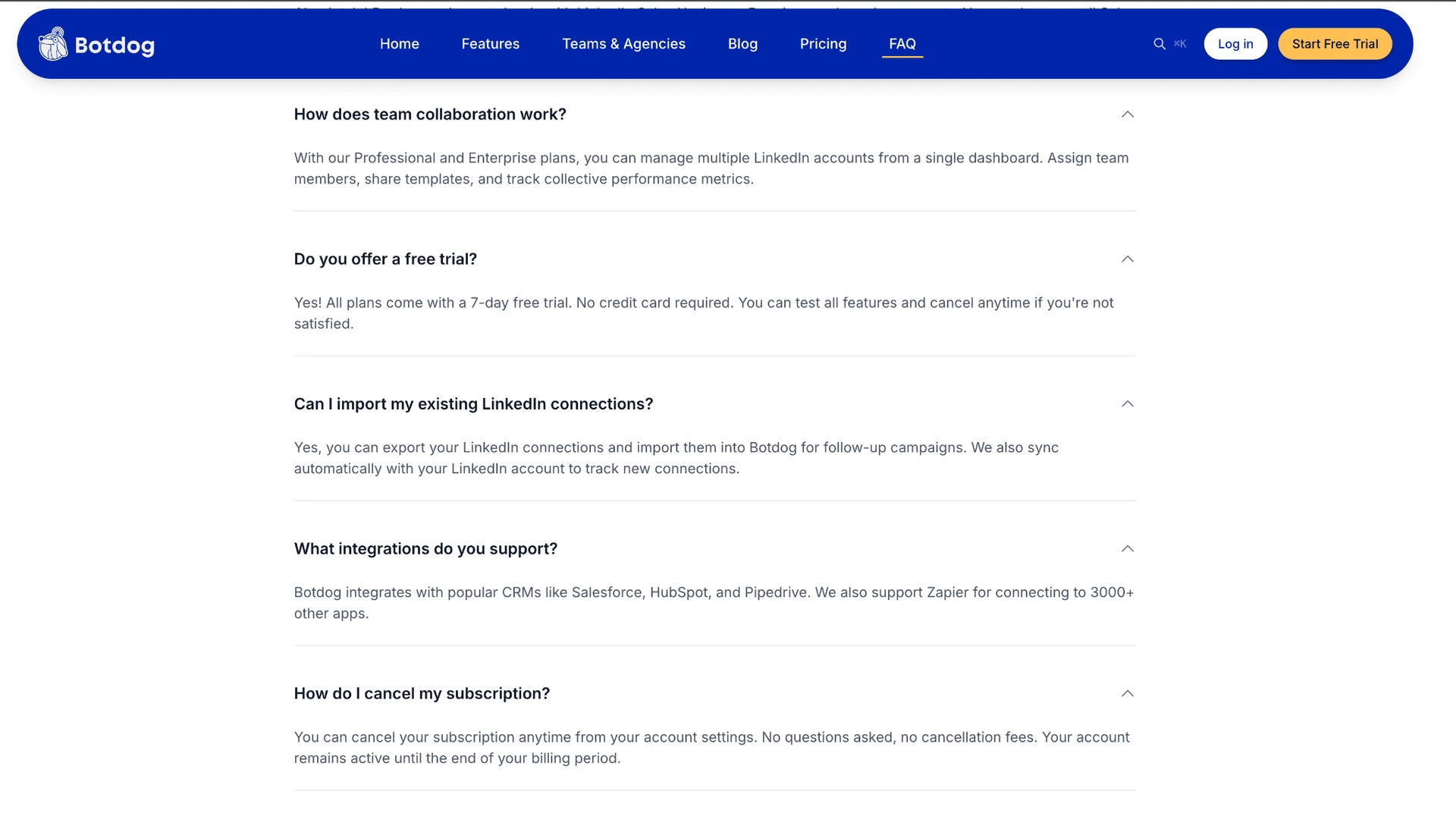
Current public self-service pages did not confirm white-labeling, a branded client portal, lead distribution, sender rotation, or a team-member audit log; only a campaign-level activity log was found. Custom or sales-only enterprise arrangements were not verified. Bulk pricing is also not in the official pricing grid; the $28/account figure for 10+ accounts appears in a vendor blog post. That means an agency buyer has to confirm account count, billing, client separation, and audit needs before treating Botdog as an agency system.
Agency boundary: Botdog has Client Organizations and team lead dedup, but its public self-service pages did not confirm white-labeling, a branded client portal, lead distribution, sender rotation, or a bulk-pricing calculator. Verify any custom or sales-only enterprise scope directly.
Licensing also matters. Botdog prices per LinkedIn account, not per human user. That is simple when one person runs one account; it becomes a budget model when a team operates many senders. The supported agency cost range for 20 accounts is $6,960-$9,600/year once annual bulk pricing and the required Zapier add-on are considered, which is a better planning range than multiplying the cheapest single-account sticker price.
Analytics & Reporting
The dashboard/export boundary is the reporting takeaway. Botdog has in-app analytics, but report export was not found. The vendor itself suggests taking screenshots where reporting output is needed, which implies that analytics are primarily dashboard-visible rather than a packaged reporting workflow.
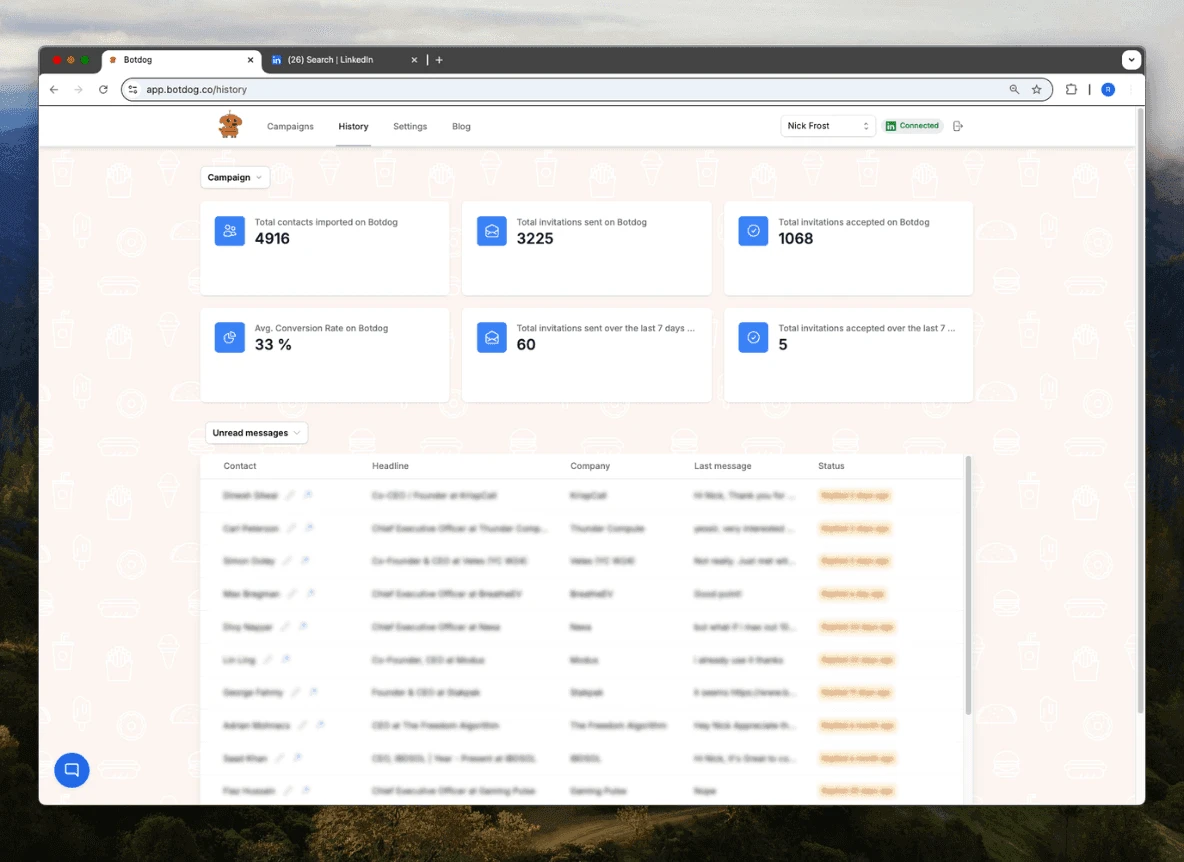
That distinction matters for teams. A solo user can inspect campaign performance in the dashboard and adjust sequences manually. A manager or agency may need a repeatable export for clients, finance, or CRM backfill. The evidence supports dashboard analytics; it does not support report export, messaging-history export, or per-message metadata export as confirmed features.
Reporting boundary: Botdog analytics exist in-app, but report export and messaging-history CSV export were not found in the evidence reviewed.
Is Botdog Safe?
Botdog's safety read has two parts: documented controls and unresolved architecture evidence. On the documented side, Botdog publishes random delays of 30 seconds to 5 minutes, working hours from 8am to 7pm on user-selected days, dynamic action throttling by account type and recent activity, and sequential action language. Those controls are useful because LinkedIn restrictions often come from volume and behavior, not only from tool architecture; this neutral guide to LinkedIn restriction types is helpful background for that distinction.
On the architecture side, Botdog is cloud-only. The LinkedIn session is connected through a redirect-token login or, for Recruiter/SSO cases, by manually pasted li_at and li_a cookies. li_at is your LinkedIn login in cookie form: whoever holds it can act as the account without needing the password again. When a cloud tool processes that token, the practical question is who controls the server, IP, region, and retention boundary around that session.
| What was checked | Result |
|---|---|
| Architecture | Cloud-only; Botdog says it runs 24/7 with the user's computer off |
| Session connection | Redirect-token login or manually pasted li_at plus li_a cookies for Recruiter/SSO accounts |
| Independent IP/fingerprint test | Not available for this review, so no tested default-IP or fingerprint verdict is printed |
| Browser extension review | Not applicable; Botdog is cloud-only and no public Chrome extension evidence supported a teardown |
| Vendor safety controls | Random delays, working hours, dynamic action throttling, and sequential action language are publicly documented |
| Proxy support | User-provided custom proxy is supported, but the visible Save & Test check is reachability, not a published IP reputation score |
| Compliance disclosures | No data region, no subprocessor list, no GDPR mention in the privacy policy, a live 404 DPA page, and no SOC2/ISO claim found |
Botdog safety checks and evidence limits (July 2026)
Botdog's safe automation page also says, "You get a 100% refund if your account gets suspended, even temporarily." That is a concrete commercial promise. It does not prove the architecture has low restriction risk; it says what the vendor promises financially if the account is suspended.
The same safety surface has a separate contradiction. Botdog's FAQ says, "We've been operating safely since 2020 with zero account bans." Tracxn states Botdog was founded in 2024, the domain registration snapshot is 2024-02-09, and the G2 profile also lists 2024 as the founding year.
We are not turning that into an accusation; the reader-facing conclusion is narrower: the safety-history claim needs clarification before it carries weight.
IPQualityScore (IPQS) is an independent fraud-prevention service that rates IP addresses for proxy, VPN, bot, and recent-abuse signals. It is an independent IP-quality signal, not LinkedIn's enforcement verdict.
Botdog supports a user-provided custom proxy, but its custom-proxy help article describes a Save & Test reachability check rather than an IPQS-style reputation score, so a proxy can be reachable without the user seeing whether it looks risky to an anti-fraud system.
This Help Center article on what proxies are for in LinkedIn automation gives neutral background on why that distinction matters.
Safety read: No tool eliminates LinkedIn restriction risk. Botdog documents useful limits, but the missing independent IP/fingerprint test and sparse compliance disclosure mean the cloud-session risk is not fully observable from public pages.
Finally, do not confuse "cloud" with "unsafe by definition." The evidence does not prove that Botdog's cloud infrastructure is harmful. It proves a narrower point: the vendor asks users to trust cloud-side session handling while publishing little about data region, DPA, GDPR posture, sub-processors, SOC2/ISO, IP reputation, or fingerprint behavior.
That is enough to make safety conditional for procurement, IT, and regulated teams. For operating behavior, the vendor's working-hours model also aligns with the general working-hours and limits concept buyers should evaluate in any LinkedIn automation tool.
What Reviews and Reddit Actually Show
Botdog's public review evidence is positive but thin. The review set used for this article contains 4 reviews: 1 from G2 and 3 from Trustpilot. Because every platform is below the 10-rating floor, the computed mean is suppressed rather than printed as a meaningful average. The field research also found a live Capterra listing at 4.3/5 across 3 reviews, while the G2 rating is reported around 4.9/5 across roughly 60 reviews.
Those are different snapshots, so they should not be summed into one clean denominator.
A volume-anomaly read was not meaningful because there were only 4 dated local reviews, below the 30-review floor. That means there is no supported review-volume anomaly to report. The honest reading is "too thin to conclude," not "no issues exist."
Reddit is also thin and skewed. Eight posts mention Botdog, but five are authored by the BotDog account itself, often in the founder-run subreddit or cross-posted to growth communities. One founder-authored example starts, "Creator of Botdog here! Been getting a lot of questions from CRE professionals..." on r/Botdog. The genuinely organic mentions we found are neutral, such as a r/linkedinautomation post that names Botdog alongside Expandi while worrying generally about LinkedIn detection. That is a presence signal, not a complaint pattern.
For the two Trustpilot praise cards below - "Super easy to setup, very straightforward, got value immediately!!!" and "Set it once and it ran perfectly." - local review records preserve platform, rating, and date, but no URL available for either card; the cards therefore keep link="" rather than inventing a public review link.