
 Updated: October 12, 2026
 27 min read
Key takeaways
- Solo's 2,500-credit pool is an action budget, not a contact count: finding and then verifying one email can consume at least two credits before AI work, so forecast cost per usable record.
- Starter advertises REST API, MCP, and webhooks, but the Platform and standalone API pages conflict on account and credit sharing; confirm entitlements and balance semantics before designing an integration.
- Agency workspaces separate client data while sharing organization credits, yet members, workspaces, sender identities, and external-sender fees remain separate meters; the $649 Teams card is a floor, not a disclosed multi-account total.
- The 91-review cross-platform-deduplicated G2, Capterra, and Trustpilot corpus is overwhelmingly historical: 85 reviews predate 2023, and the February 2–August 2, 2026 window contained no rated reviews, so older complexity and reliability patterns cannot establish a current-v3 trend.
This review is published by Linked Helper and written by Ryan Frawley, who works there. I've made every effort to represent TexAu accurately using verified data. That includes our own first-hand testing, TexAu's documentation, and independently sourced reviews.
TexAu v3 is a cloud go-to-market data and orchestration platform. Teams use it to source, enrich, score, sync, and route lead data. It is not a native sequencer. TexAu says an external sender owns message delivery and replies. Solo was advertised at $99 per month. However, new Platform signup led to a paused-signup page during our July 2026 review. We could not verify checkout or the advertised trial. The safety verdict is also conditional. TexAu documents cloud controls, but current LinkedIn execution, session custody, limits, and assigned IP were not established.
Verdict
TexAu's Platform connects enrichment, verification, AI columns, CRM sync, schedules, a REST API, hosted MCP, and webhooks. This structure gives GTM operations teams, agencies, and developers a data layer alongside an existing sender. TexAu draws the boundary clearly: it does not ship a sequencer. Buying it therefore does not create an end-to-end LinkedIn outreach stack.
We would pause a new purchase decision until self-serve access is verifiable. On July 28, 2026, live plan cards and a 14-day no-card trial CTA led to a paused-signup page. That blocked authenticated checks of checkout, exports, credit metering, and current LinkedIn execution. Annual-contract language, credit rollover, and several safety controls also remain unresolved. The available evidence does not support a TexAu-only LinkedIn outreach setup.
Conditional verdict: Works when a team already owns a sender and needs a data-orchestration layer. Pause when immediate signup, native sequencing, or verified current LinkedIn safety controls are requirements.
Pros
- Reusable workflow state: Versioned actions, chains, schedules, and table schemas can be deployed from templates.
- Pay-on-match enrichment: The published email waterfall charges for a successful find rather than every lookup attempt.
- Row-level AI work: AI Columns can extract, classify, score, and draft from table context, with OpenAI, Anthropic, or Gemini keys.
- Clear sender handoff: TexAu states that external systems own sequencing, which clarifies where delivery and reply state live.
- Developer surfaces: The product publishes a REST API, hosted MCP, webhooks, and asynchronous jobs.
- Client separation: The agency design describes isolated workspaces, shared organization credits, scoped subkeys, reusable templates, and workspace reporting.
Cons
- Signup was paused: The Platform signup flow prevented a new tester from reaching the advertised trial on July 28, 2026.
- A sender is still required: TexAu says it does not ship a sequencer, so native message delivery, reply-stop, and inbox state must live elsewhere.
- Three surfaces can be confused: Current v3 cloud, the legacy V2 extension, and the separate Desktop preorder have different execution claims.
- Commercial terms conflict: Pricing, About, and Terms did not establish one consistent annual-contract interpretation.
- Current LinkedIn controls are not established: Public evidence did not establish v3-specific caps, session and IP execution, adaptive throttling, restriction-stop behavior, or proxy controls.
- Documentation access was not established: Public docs and help routes returned 404s during the July 2026 review, so no usable current public implementation runbook was established.
- Review evidence is old: Across the G2, Capterra, and Trustpilot set, 85 of 91 cross-platform-deduplicated reviews predated 2023, which limits what they say about v3.
TexAu Pricing: The $99 Data Layer and the Sender Cost Outside the Card
TexAu's August 2026 pricing page displayed three monthly plans: Solo at $99, Starter at $249, and Teams at $649. Enterprise was priced by quote. The page also showed annual-effective monthly figures of $79, $199, and $549. Those figures imply $948, $2,388, and $6,588 per year, respectively. The visible comparison row mislabeled these effective monthly values as annual totals, so the arithmetic matters more than the label.
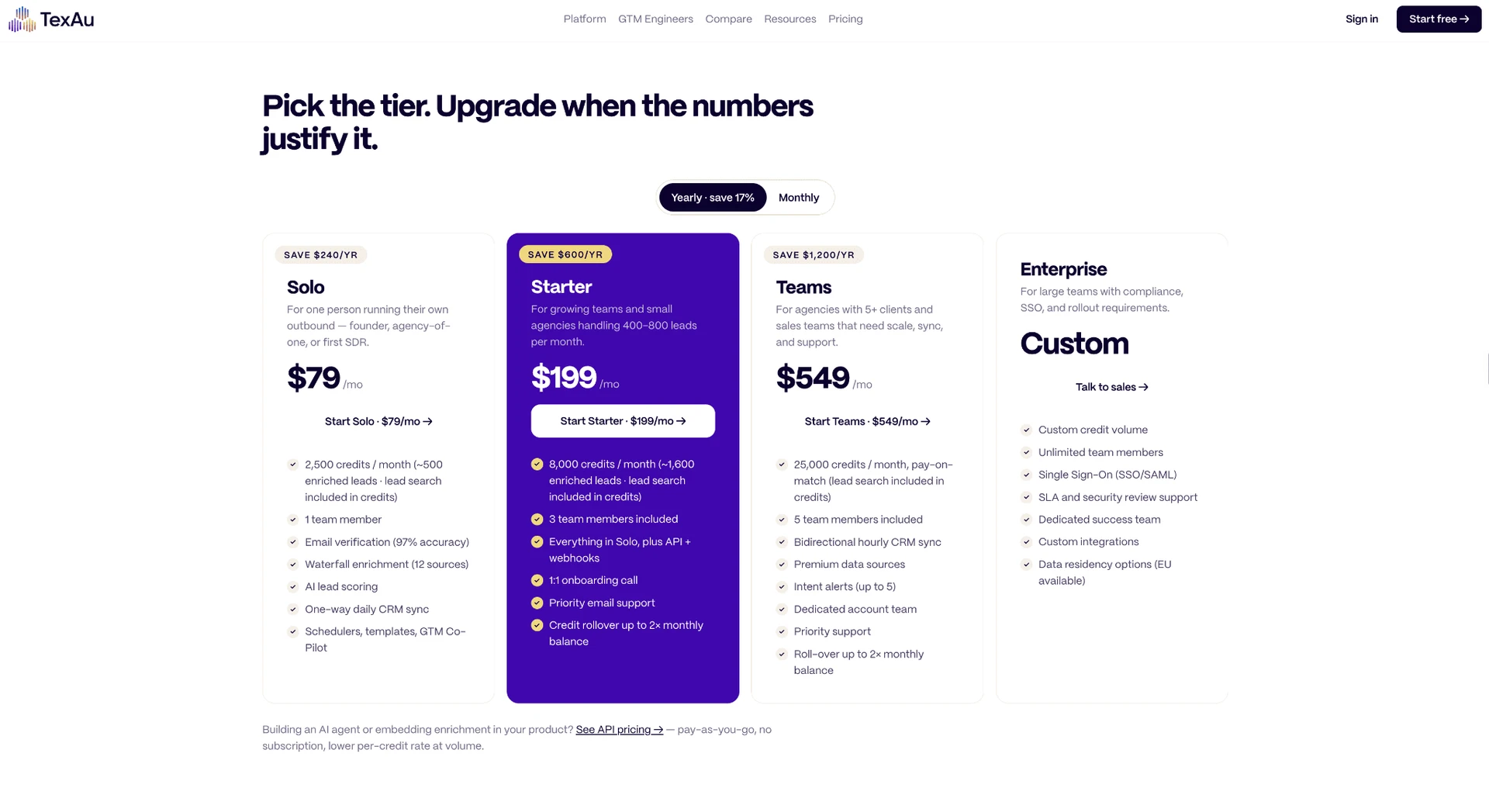
| Plan | Price | What's included | What's NOT included |
|---|---|---|---|
| Solo | $99/mo; displayed $79/mo annual equivalent ($948/yr) | 1 member; 1 workspace; 2,500 shared action credits | A complete outreach stack; verified checkout; external sender, Sales Navigator, and taxes |
| Starter | $249/mo; displayed $199/mo annual equivalent ($2,388/yr) | 3 members; 3 workspaces; 8,000 credits; API, MCP, and webhooks advertised | External sender; published Platform top-up price; settled annual-contract semantics |
| Teams | $649/mo; displayed $549/mo annual equivalent ($6,588/yr) | 5 members; 5+ workspaces; 25,000 credits; CRM sync and team features advertised | A disclosed 20-sender total; external execution; extra-member fees beyond the package |
| Enterprise | Custom | Unlimited members and unlimited workspaces; custom credits; dedicated support advertised | A public price or authenticated entitlement result |
TexAu pricing tiers (July 2026)
Source: TexAu pricing, checked July 2026. Displayed terms were not verified at checkout because signup was paused.
The first trap is availability. TexAu advertised a 14-day trial with no credit card. However, the live CTA led to paused signup. The trial was advertised but unavailable to a new tester on the research date. This does not establish current trial access, a Platform free tier, or the allowance a new account would receive. Separate 50-credit API/MCP signup copy cannot be treated as a Platform free tier.
The second trap is credit arithmetic. The plans use shared action pools of 2,500, 8,000, and 25,000 credits. According to the email-verification and pricing pages, a successful email find can cost one credit. Verification can cost another, while AI actions can draw from the same pool. In practice, 2,500 credits do not mean 2,500 verified contacts. A found-and-verified email can consume at least two actions before AI work. Solo rollover wording conflicted on the same pricing surface. Platform top-up prices and retry treatment were not established in the public evidence.
The third trap is package scope. Starter and Teams advertised extra members at $99 per month. Members, workspaces, client organizations, LinkedIn sender identities, and credits are different meters. Teams therefore establishes a five-member agency floor of $649 per month pre-tax, not a complete 20-account total. The complete formula is TexAu package + external sender + optional Sales Navigator + taxes + any extra members, API bundles, or credits. Several inputs were not established, so a single full-cost number would be false precision.
Cost boundary: $99 buys the advertised Solo data and orchestration layer, not native outreach execution. Checkout was unavailable, and complete operating cost remains scenario-dependent because sender, credit, member, workspace, API, and tax meters are separate or unresolved.
Refund language is product-specific. The Platform payments policy says subscription fees are not refunded for partial months. Separate billing-error or outage provisions apply. Desktop's 14-day post-release money-back copy belongs to that offer and cannot be applied to Platform subscriptions. We found only one dated price snapshot for these current tiers, so there is no supported repricing trend to calculate.
Key TexAu Features
The public evidence establishes a closed current-v3 capability set:
- table and CSV inputs;
- LinkedIn people, post, lead-list, and Sales Navigator sourcing;
- enrichment and email verification;
- AI extraction, classification, and drafting, plus scoring;
- CRM sync, templates, schedulers, REST API and webhooks, and MCP;
- workspace reporting and external-sender handoff.
That is a data-workflow system, not proof of a native reply-aware outreach campaign.
v3 Cloud, V2 Extension, and Desktop Are Different Execution Surfaces
TexAu presents three surfaces, and each needs its own label. The v3 Platform is a cloud table, enrichment, workflow, API, and MCP system. The legacy TexAu V2 Chrome extension is a connector from a prior generation.
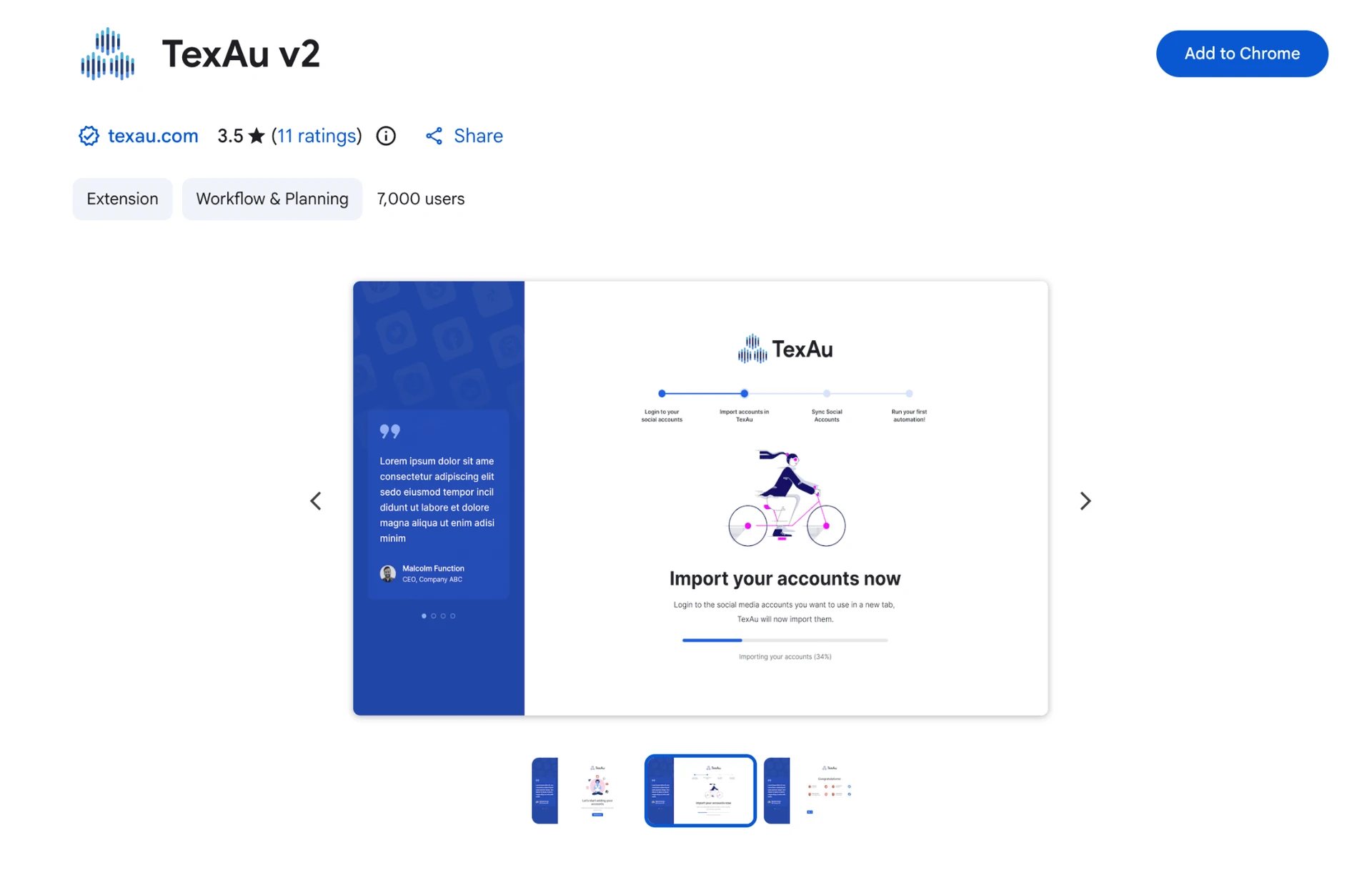
TexAu Desktop separately claims local browser, session, and IP execution. However, the page still showed PreOrder after its advertised ship date.
| Surface | What the evidence establishes | What remains unresolved |
|---|---|---|
| Current v3 Platform | Cloud data workflows, enrichment, AI, CRM, API, MCP, and sender handoffs | Authenticated plan gates and a clear native LinkedIn DM executor |
| Legacy V2 extension 1.6.6 | Static analysis found a server-configured recipe that packaged selected LinkedIn session material and sent it to TexAu's API, with a two-hour resync path | Server retention, replay, exit IP, and applicability to v3 |
| Desktop offer | Vendor claims local execution from the user's machine and IP | Whether the advertised build had shipped and how it behaved in use |
TexAu execution surfaces (July 2026)
Sources: TexAu Platform, legacy V2 Chrome listing, and TexAu Desktop, checked July 2026.
The legacy finding concerns transport, not observed server behavior. V2 handed selected session material across a vendor boundary. The finding does not establish which exact LinkedIn cookies were retained, whether they were replayed, or how current v3 authenticates. Likewise, the Desktop page is a claim, not a completed installation test.
Generation boundary: Do not transfer the V2 session-bridge finding to current v3, or Desktop's local-execution claim to the cloud Platform. Current v3 LinkedIn authentication and execution were not established.
Tables, Templates, Schedulers, and Reusable Workflow State
TexAu stores workflow state in tables, then applies reusable actions and chains to rows. The documented template types cover single actions, chains, schedules, and table schemas. They support versioning, visibility controls, and deployment across workspaces.

Inputs can come from CSV or configured sources. Outputs can return to tables, exports, CRMs, webhooks, or sender handoffs.
The scheduler supports three trigger styles:
- cron;
- calendar;
- signal-style triggers.
It also documents queue, skip, and parallel policies for overlapping runs. Timezone handling, daylight-saving handling, pause/resume, and run logs are documented too. In practice, these settings determine what happens when a data job is late or already running.
The exact numeric concurrency ceilings were not established. More importantly, scheduled or parallel data runs do not establish LinkedIn campaign pacing, last-24-hour action accounting, adaptive risk throttling, or restriction handling. Those are separate control layers.
Workflow boundary: TexAu templates and schedulers govern data-job state. They do not establish a native message sequence, reply-stop rule, or LinkedIn-specific safety limit.
Like most tools in this space, TexAu supports reusable automation and scheduling. Its documented distinction is one workflow abstraction across tables, templates, REST API, and hosted MCP. We did not test reliability or time-to-value inside an authenticated tenant because signup was paused.
Email Finding, Verification, Credits, and Retry Economics
TexAu's email workflow describes a 12-source waterfall that checks sources until it finds an address. It can then route verification through NeverBounce, ZeroBounce, MillionVerifier, or Kickbox. A failed search is described as free. A successful find consumes one credit, while verification is a separate action that can consume another. The economic unit is therefore an action, not a completed contact.
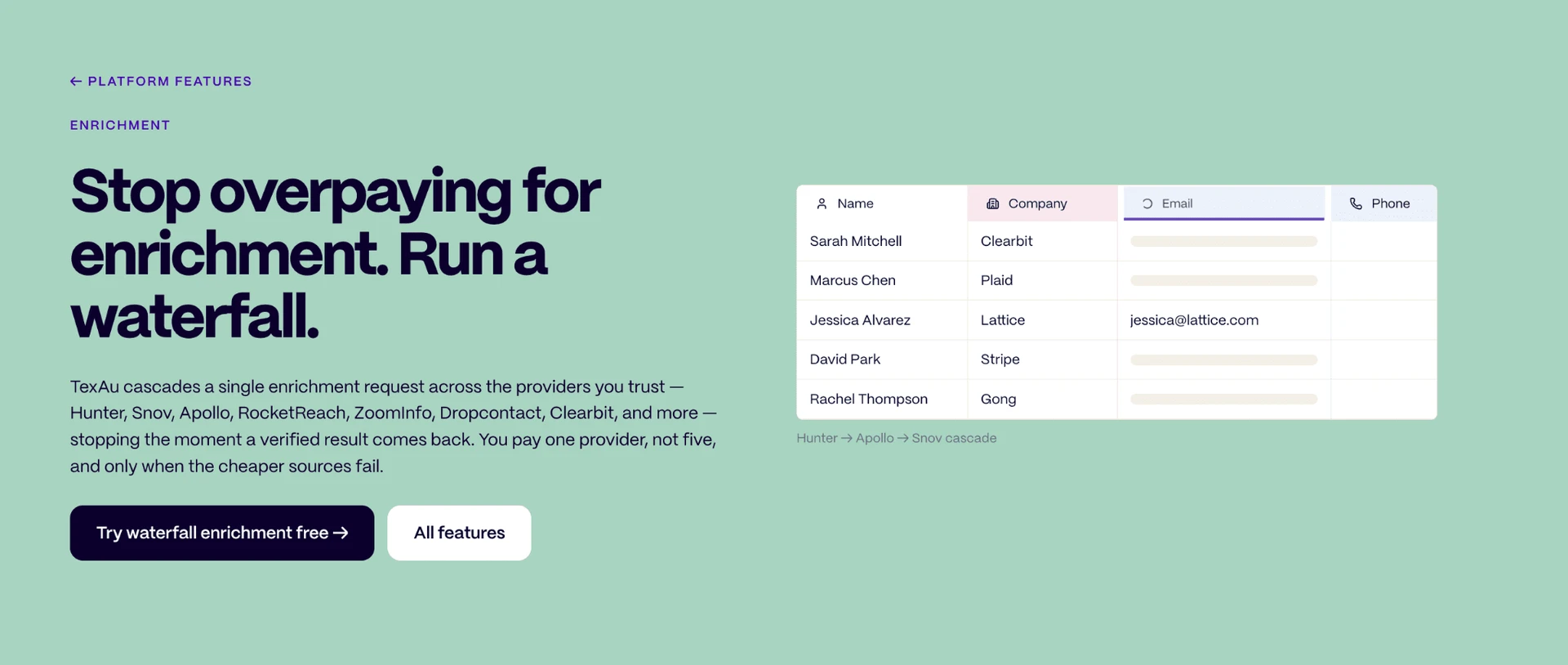
For a 500-row list, a theoretical successful find on every row would use about 500 credits. Verifying every found address would use about 500 more before AI scoring or other paid actions. This explains the pricing page's description of Solo's 2,500-credit pool as roughly 500 enriched leads. It does not make that phrase a guaranteed yield. Actual match rates, retry behavior, and the share of usable verified addresses were not independently measured.
We did not test the vendor's accuracy copy. Finding an address and verifying it are separate stages and cost meters. This email-finder guide provides neutral background on that workflow. Platform top-up prices, failed-verification treatment, Solo rollover, and shared Platform/API balance semantics were not established.
Budget by usable contact: Model at least one credit for a successful find and another for verification, then add AI actions. Do not divide the plan pool by one and call the result verified leads.
AI Columns, ICP Scoring, BYOK, and Personalization Outputs
AI Columns can summarize, classify, extract, score, and draft text from row context. TexAu also publishes bring-your-own-key support for OpenAI, Anthropic, and Gemini. The output can become a table field or personalization variable for an external sender. Drafting and delivery therefore remain separate stages.
The AI lead-scoring surface describes a user-authored rubric that produces a 0–100 score or tier. This is automatic ICP scoring. The system evaluates available lead context against an Ideal Customer Profile instead of relying only on search filters. Teams can operationalize their own qualification rules. However, this does not establish a predictive model trained on closed-won outcomes. This lead-scoring guide explains why a rules-based rubric and an outcome-validated model answer different questions.
We did not independently test output accuracy or cost per usable score or opener. A native send queue, per-message approval gate, reply lift, and closed-won model were not established. Current public-v3 evidence also did not establish a native AI-generated LinkedIn post-comment action. AI generation consumes TexAu credits unless the applicable BYOK path changes the billing boundary. We could not authenticate that boundary.
AI evidence: Feature presence is established; output quality, predictive accuracy, reply impact, moderation controls, and credit burn per usable result are not.
CRM Sync, External Senders, and Who Owns Campaign State
TexAu's current CRM page names HubSpot, Pipedrive, Zoho, GoHighLevel, Close, Attio, and Copper. Salesforce also appears, but its status conflicts across TexAu pages. It is alternatively listed and described as coming soon or on the roadmap. The defensible count is therefore seven currently named connectors plus one disputed Salesforce entry, not an inflated settled total.
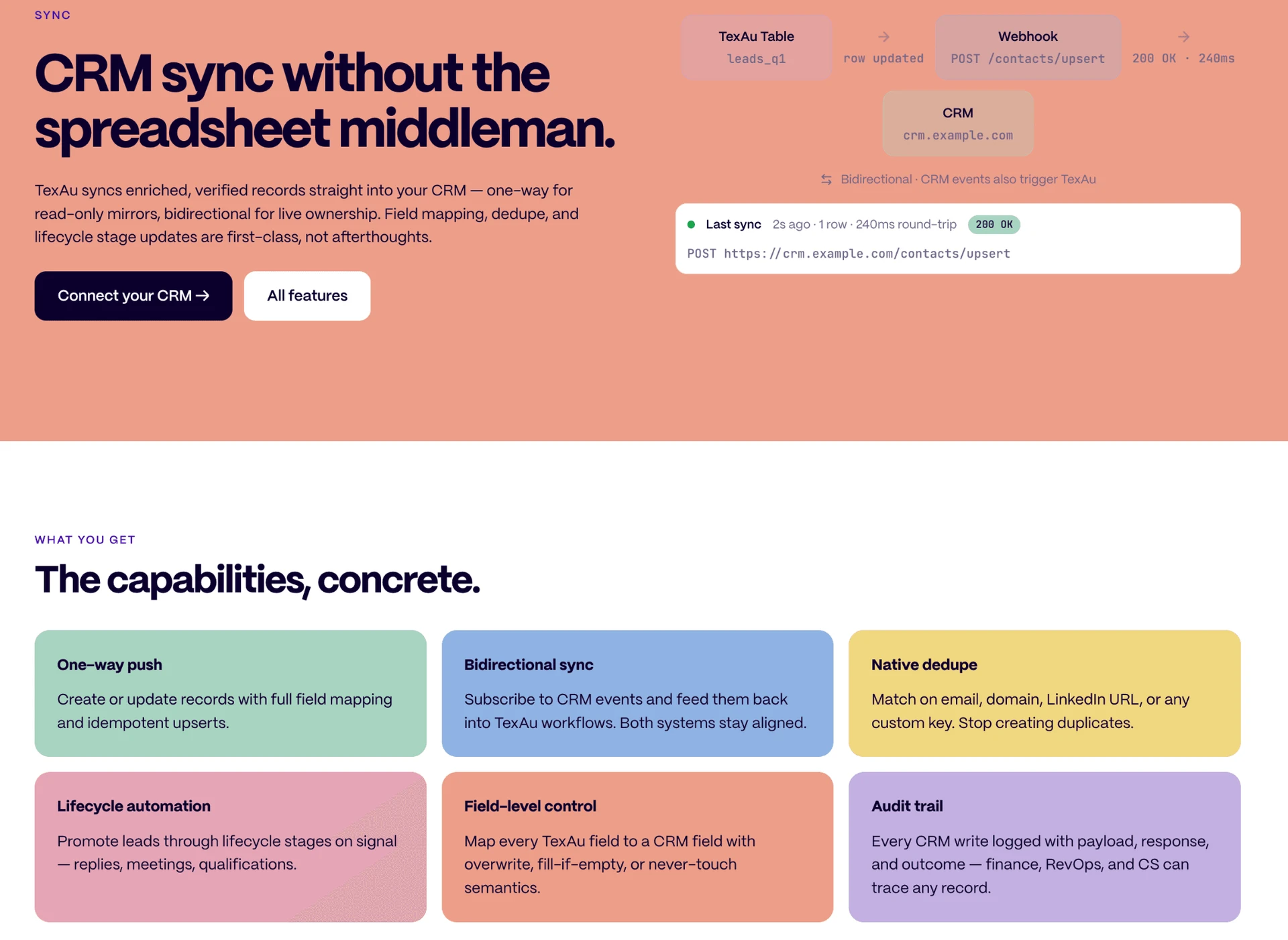
The plan copy distinguishes one-way daily sync from bidirectional hourly sync on higher tiers. It also describes idempotent upserts. Repeated synchronization is therefore intended to update matching records instead of creating a new one each time. We did not authenticate the exact merge and overwrite behavior.
Sending lives elsewhere. TexAu's About page states: “We don't ship a sequencer.” The integrations page names Smartlead, Instantly, Lemlist, Reply, Apollo/Outreach, and HeyReach. These outbound systems own delivery, native campaign steps, and reply state. TexAu can receive engagement or meeting signals back into a table. A returned signal does not create a TexAu inbox or native reply-stop mechanism. This multichannel handoff explainer explains why data ownership and sending ownership should be mapped separately.
Current Zapier and Make connectors were not established in the public current-v3 evidence. A native unified inbox, message A/B tests, combined LinkedIn-plus-email sequence, and full conversation-history export were likewise not established.
State ownership: TexAu owns data rows and handoffs; an external sender owns message delivery and replies. Native reply-stop, unified inbox, and current Zapier/Make connectors were not established.
REST API, MCP, Webhooks, Async Jobs, and Rate Limits
TexAu publishes a workspace-scoped REST API, hosted MCP, Starter-plus webhooks, and asynchronous jobs. MCP means Model Context Protocol. It is a standard interface through which an AI client can call tools exposed by a service. Here, an agent can operate the published TexAu surface. It does not gain undocumented plan entitlements or bypass usage credits.
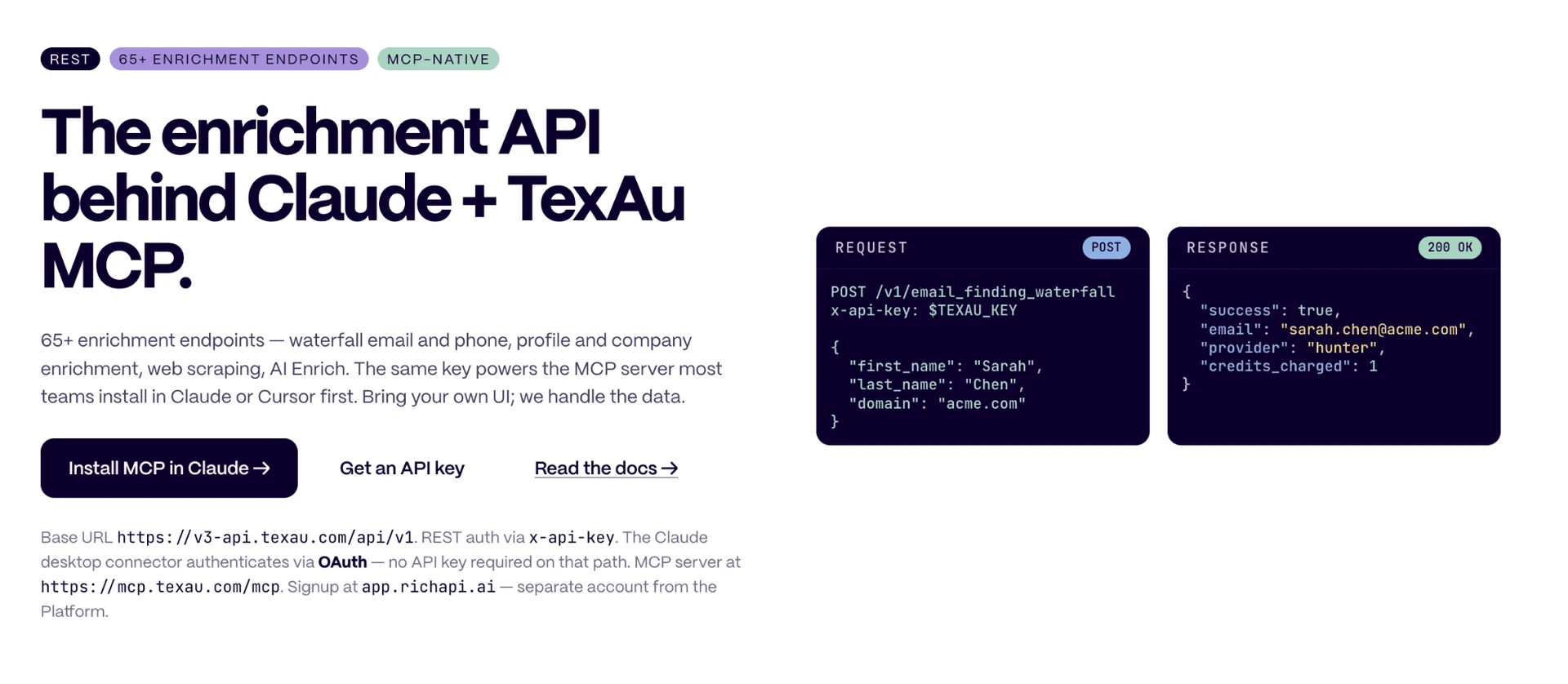
The API material describes x-api-key authentication, while hosted MCP can use OAuth or an API key. Published bulk endpoints accept up to 100 records per request. Rate limiting can return HTTP 429 when a quota is exceeded. Async jobs separate submission from later status and result retrieval. This matters when enrichment cannot finish inside one request.
The commercial terms remain unresolved. Platform pricing advertises API, MCP, and webhooks from Starter. The standalone API surface describes separate bundles and 50 signup credits. First-party pages conflict on whether the same account and credit balance serve both products. Published endpoints establish an integration surface, not the entitlement or reliability of an unavailable tenant.
API entitlement: REST, MCP, webhooks, and async jobs are documented, but Platform-versus-standalone account and credit semantics conflict and could not be resolved in a new tenant.
Agency Workspaces, Shared Credits, Sub-keys, and White Label
TexAu's agency page describes an organization containing isolated client workspaces. Lists, CRM connections, templates, and members are separated per workspace. Credits are shared at organization level. Reusable templates can be deployed between workspaces. Scoped API subkeys can constrain access, and reporting is available by workspace. In practice, an agency can separate client data without buying a new workflow for every client.
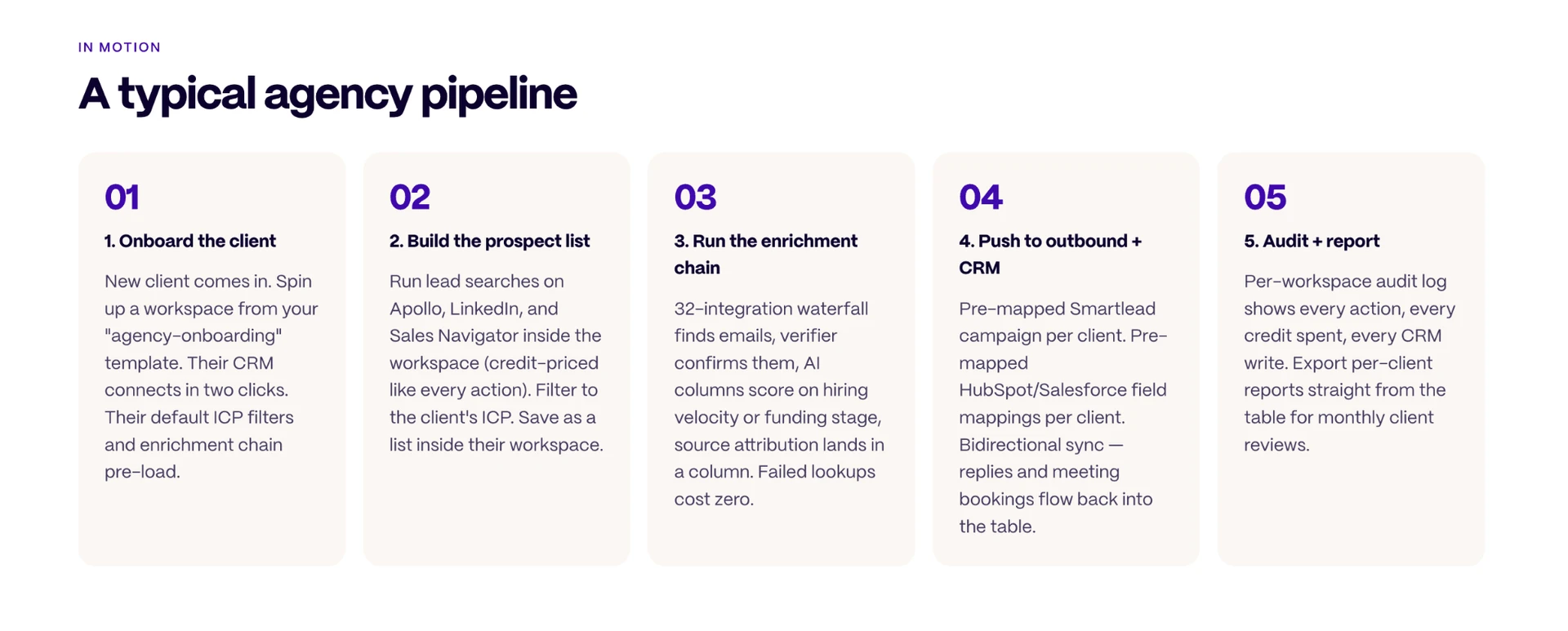
The meters remain distinct. Solo, Starter, and Teams advertise one, three, and five members. Their workspace allowances are one, three, and five-plus. Teams adds $99 per extra member. None of those values establishes how many LinkedIn sender identities can run because TexAu delegates sending to external systems. Roles, a free client-viewer role, the ceiling behind 5+ workspaces, cross-workspace deduplication, and complete 20- or 50-account economics were not established.
TexAu's white-label workflow is an Enterprise/reseller API pattern. The agency builds its own interface over TexAu. This is not evidence of a ready branded portal or a self-service logo toggle.
The published design therefore establishes a vendor-described workspace model, not authenticated permission or client-viewer behavior.
Agency boundary: A workspace, member, client, and LinkedIn sender identity are four different meters. The public evidence does not establish sender-account economics or a ready client portal.
Cloud Security, Data Lifecycle, and Missing LinkedIn Controls
TexAu's Trust Center states TLS 1.2+ in transit and AES-256 at rest. It also names AWS KMS and Secrets Manager, hardware-key MFA, and audit-logged production access. The stated AWS regions are us-east-1 and eu-west-1. The page says a DPA with Standard Contractual Clauses is available on request. It also says Enterprise supports SAML/OIDC SSO. These are vendor statements. The availability of a DPA does not prove every customer has executed one.
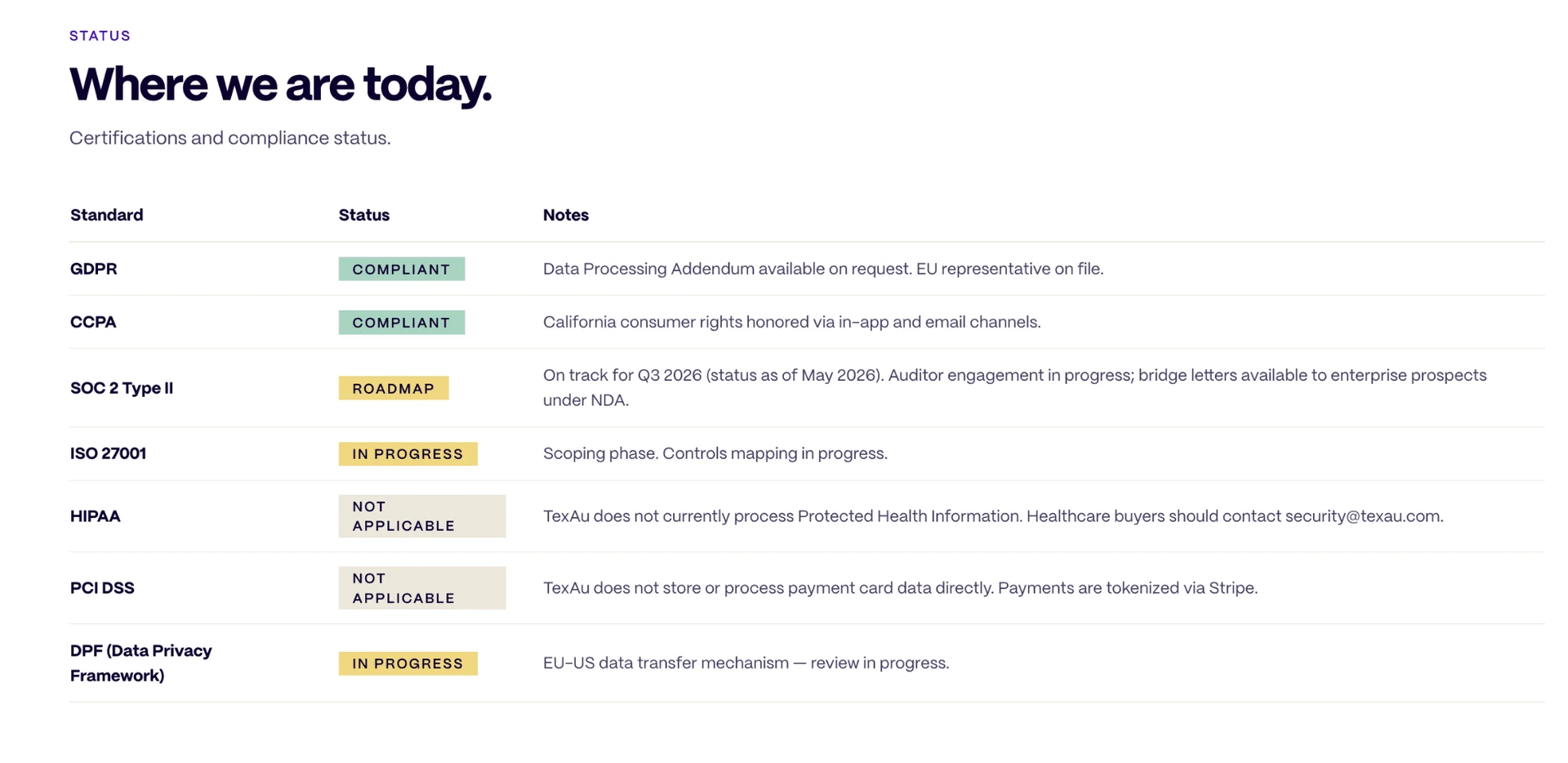
The two named regions document deployment options, but EU-only residency was not established as a universal default.
The same source presented SOC 2 Type II and ISO 27001 as in progress or on the roadmap. It did not present them as completed certifications. For procurement, published controls and an independent completed audit are not interchangeable.
The lifecycle language also conflicts. Terms mention a 60-day export window after termination. Privacy uses 30-day retention language. The Trust Center starts a 30-day deletion clock from a different event. The available public evidence does not reconcile which clock controls cancellation, termination, or account deletion.
Current v3 LinkedIn-specific caps and a last-24-hour ledger were not established. Neither were adaptive throttling, restriction-stop behavior, warm-up, disconnect recovery, InMail protection, session and assigned-IP execution, or proxy-quality controls. Scheduler concurrency is an operational control, not evidence for those safety mechanisms.
Control boundary: TexAu documents cloud-data controls, but completed SOC 2/ISO certification, reconciled deletion clocks, and current LinkedIn-specific risk controls were not established.
Is TexAu Safe?
TexAu's cloud-security documentation and its LinkedIn account-risk evidence answer different questions. Current v3 session execution, assigned IP, action caps, and restriction behavior were not established. No tool eliminates ban risk.
What I verified first-hand
I unpacked the public legacy V2 extension 1.6.6 and read its shipped code. Static analysis found a server-configured recipe that packaged selected LinkedIn session material. The recipe sent that material to TexAu's API and provided a two-hour resync path. This establishes transport for V2. It does not establish retention, replay, assigned IP, restriction outcomes, the exact cookie set, or applicability to v3. The package is tied to TexAu's Chrome Web Store listing.
Active Extension Detection (AED) is the label visible in LinkedIn's production JavaScript for scans that probe specific extension IDs. The page can detect a listed installation before the tool acts. That adds a signal rather than proving a restriction. The legacy TexAu ID appeared in the checked AED target list. That finding does not apply to v3 or Desktop. The scoped teardown rated the V2 session-bridge architecture High risk because session material crossed the vendor boundary. It did not rate current v3 or Desktop.
| What was checked | Result |
|---|---|
| Cloud data controls | Vendor claims TLS 1.2+, AES-256, AWS key management, hardware-key MFA, logged access, and US/EU regions |
| Certifications | SOC 2 Type II and ISO 27001 were in progress or on the roadmap |
| Legacy V2 | Static analysis found selected session material sent to TexAu's API with two-hour resync |
| Current v3 execution | Auth/session path, exit IP, proxy behavior, native LinkedIn execution, and fingerprint behavior not established |
| Current v3 controls | LinkedIn caps, action ledger, adaptive throttling, restriction-stop, warm-up, recovery, and InMail protection not established |
| Desktop | Local execution is a vendor claim; the offer remained marked PreOrder and was not measured |
| Historical incident evidence | No restriction incident appeared in 91 deduplicated reviews; absence of a report is not safety proof |
TexAu cloud controls and LinkedIn-risk evidence (July 2026)
Sources: TexAu Trust Center, Desktop, Schedulers, and the public legacy V2 extension listing, checked July 2026.
Cloud controls address data protection, not LinkedIn session behavior. Historical V2 limits and current scheduler controls do not establish a v3 LinkedIn safety runbook. Desktop's local claim could change the boundary. We did not measure it.
LinkedIn risk: Current v3 session custody, exit IP, LinkedIn-specific caps, restriction behavior, and proxy controls were not established. The V2 teardown and Desktop marketing cannot fill those gaps.
Even manual work can look automated when someone opens many profiles by URL or processes invitations at unrealistic speed. This guide to LinkedIn account restrictions explains the general risk. TexAu's current controls remain unresolved.
What Reviews and Reddit Actually Show
TexAu's review evidence is positive overall but historical. The raw set analyzed for this article contains 92 dated reviews:
- G2 averages 4.36★ across 57 stored raw reviews through August 2, 2026.
- Capterra averages 4.05★ across 20 stored raw reviews through August 2, 2026.
- Trustpilot averages 4.73★ across 15 stored raw reviews through August 2, 2026.
These are historical computations, not live platform-profile ratings. Each platform's denominator belongs only to its own mean.
One exact G2/Trustpilot duplicate reduces the cross-platform-deduplicated view to 91 unique voices: 56 G2, 20 Capterra, and 15 Trustpilot. In that separate 91-review view, 85 reviews predate 2023. Sentiment labels were 61 delighted, 17 satisfied, 7 mixed, and 6 furious. Complexity appeared in 41 of 91 records and reliability in 29 of 91. These values describe the deduplicated historical set, not current v3 or the raw per-platform rating denominators above. The trailing six-month window from February 2 through August 2, 2026 contained zero rated reviews. No current six-month average or direction can therefore be printed.