
 Updated: September 6, 2026
 27 min read
Key takeaways
- Six separately configurable LinkedIn caps of 30 actions per rolling 24 hours still draw from plan-level Social Action pools, so conservative daily pacing does not create extra monthly capacity.
- A reply can stop later steps for that contact, and Stop Multithreading can also stop other contacts at the same domain, but CRM integrations, API access, and webhooks are Growth-gated; Pro users get reply-aware sequencing without those documented downstream handoffs.
- The Growth plan's connected-mailbox capacity and 50,000-email pool exclude mailbox and domain infrastructure, while the Terms may cap connected email accounts at 99 per workspace; buyers need an infrastructure budget and a placement test rather than treating the email allowance as delivered capacity.
- Current first-party pages conflict on Primebox AI drafts: Help says one personalization credit per draft, while pricing says three, so AI-usage forecasts need an authenticated meter check rather than either figure alone.
- Cancellation requires live-chat notice at least seven days before term end, while a full messaging-history CSV export was not established; teams should export available contact data before cancellation rather than assume every conversation remains portable.
This review is published by Linked Helper and written by Milosh Potikj, who works there. I've made every effort to represent Salesforge accurately using verified data. Sources include our first-hand checks, Salesforge's documentation, and independently sourced reviews.
Founded in 2023, Salesforge is a cloud sales-engagement platform. It combines email and LinkedIn actions in one reply-aware workflow. This Salesforge review covers Human Path Pro and Growth, Primebox, AI personalization, and the separately priced Agent Frank and Forge products. The evidence comes from July 2026 public-page checks and an undated version 2.0.7 extension teardown. Pro starts at $48 monthly. Its one-user, one-sender allowance and metered execution pools make that price a starting point, not a workload total. Verdict: conditional. The workflow scope is documented. Deliverability, agency governance, and the separate cloud sender’s session and IP behavior remain unmeasured. Evaluate the execution bill and evidence gaps, not just the subscription card.
Verdict
The verdict is conditional for teams that need email and LinkedIn steps in one cloud workspace and can work within Growth-level gates. Pro opens the product at $48 monthly. Its 300 monthly Social Actions fall below Salesforge’s own 400–500-actions-per-profile full-capacity estimate. Growth at $96 monthly is therefore the operating floor in our sustained-workload model. It also unlocks A/B testing, integrations, the API, priority support, and onboarding.
This conclusion covers documented scope, not outcomes. Neither plan establishes inbox placement, LinkedIn account outcomes, cross-workspace governance, or export completeness. It applies when a buyer accepts metered execution and validates those operational questions before scaling.
Consider Salesforge for cloud email-plus-LinkedIn orchestration when Growth-level access and variable execution costs match the workload; do not treat the base price or documented controls as proof of deliverability, account safety, or agency governance.
Pros
- One multichannel sequence: Email, LinkedIn messages, InMail, delays, conditions, and subsequences can live in the same workflow.
- Reply-aware stopping: A contact reply halts later steps, while Stop Multithreading can also stop outreach to other contacts at the same domain.
- Reusable contact capacity: The same Active Contact documentation describes slots that reopen after completion or removal rather than a monthly spend.
- Central reply context: Primebox collects email and LinkedIn replies with labels, sentiment, lead context, and AI drafts.
- Flexible sender connection: A profile owner can connect through Magic Link without entering an agency workspace.
- Growth handoffs: Seven native CRM connections, Make, Zapier, outbound webhooks, and a public API cover several operational transfer paths.
- Cloud execution claim: Salesforge says sequences continue without an open browser or awake laptop, which can reduce operator-side uptime work, although we did not measure that execution.
Cons
- Pro is a constrained entry tier: One user, one sender, and 300 monthly Social Actions leave limited room for a sustained multichannel workload.
- Execution is metered: The same pricing page puts email, validation, personalization, and Social Action pools behind the flat account subscription; separate data and infrastructure can add more cost.
- Growth holds portability features: A/B testing, integrations, the API, priority support, and onboarding require the $96 monthly tier.
- Cancellation is support-mediated: Live-chat cancellation requires at least seven days’ notice before the term ends; prepaid fees are generally nonrefundable.
- Agency governance remains unsettled: Broad workspace capacity does not establish granular client roles, global deduplication, audit logs, lead distribution, or a master inbox.
- Cloud safety is not yet measured: Managed shared proxies and session-token custody are vendor-described. Current assigned IP, isolation, fingerprint, and revocation behavior remain untested.
- AI metering conflicts: Help says one credit, while pricing says three for one Primebox AI draft.
Salesforge Pricing
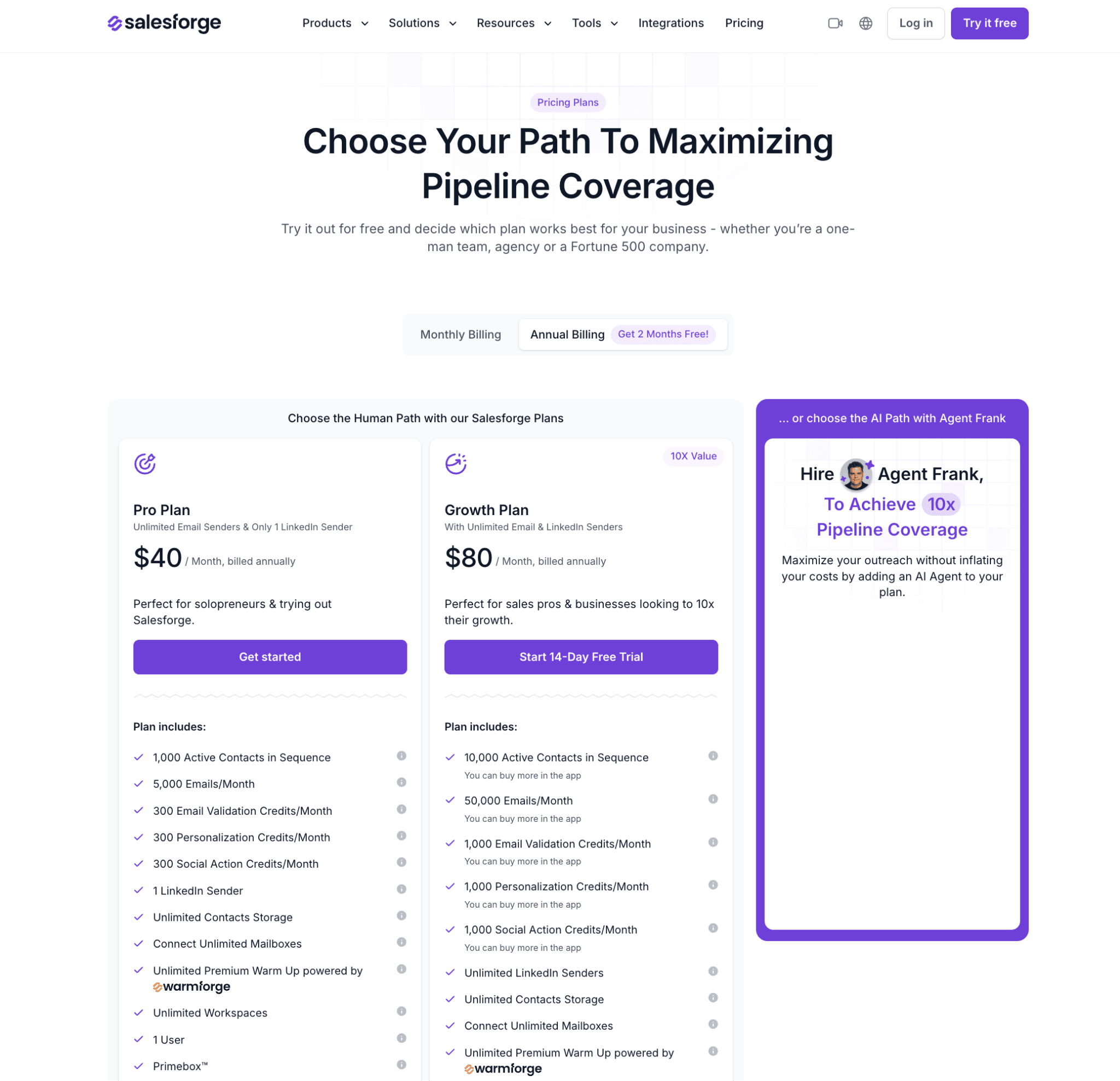
Salesforge’s pricing page lists Pro at $48 monthly. Its annual equivalent is $40 per month on a $480 term. Growth costs $96 monthly or $80 equivalent on a $960 annual term.
Pro includes one user, one LinkedIn sender, 1,000 reusable Active Contacts, 5,000 emails, and 300 each of validation, personalization, and Social Actions. Growth raises those pools to 10,000 contacts, 50,000 emails, and 1,000 each. It also adds A/B testing, integrations, API access, priority support, and onboarding. The plan choice therefore changes capacity and portability.
| Plan | Price | What's included | What's NOT included |
|---|---|---|---|
| Pro | $48 monthly; $40/mo equivalent billed $480 annually | 1 user; 1 LinkedIn sender; 1,000 Active Contacts; 5,000 emails; 300 validation, 300 personalization, and 300 Social Actions per month | A/B testing, integrations, API, priority support, onboarding, mailbox/domain infrastructure, and separate Forge products |
| Growth | $96 monthly; $80/mo equivalent billed $960 annually | 10,000 Active Contacts; 50,000 emails; 1,000 validation, 1,000 personalization, and 1,000 Social Actions per month; Growth gates | Extra action/data usage, mailbox/domain infrastructure, taxes, and separate Forge products |
| Agent Frank | $599/mo billed quarterly; $499/mo billed annually | Separate AI Path with a complimentary Salesforge account | Not included in Pro or Growth; other Forge products remain separately scoped |
Salesforge Human Path and AI Path pricing (July 2026)
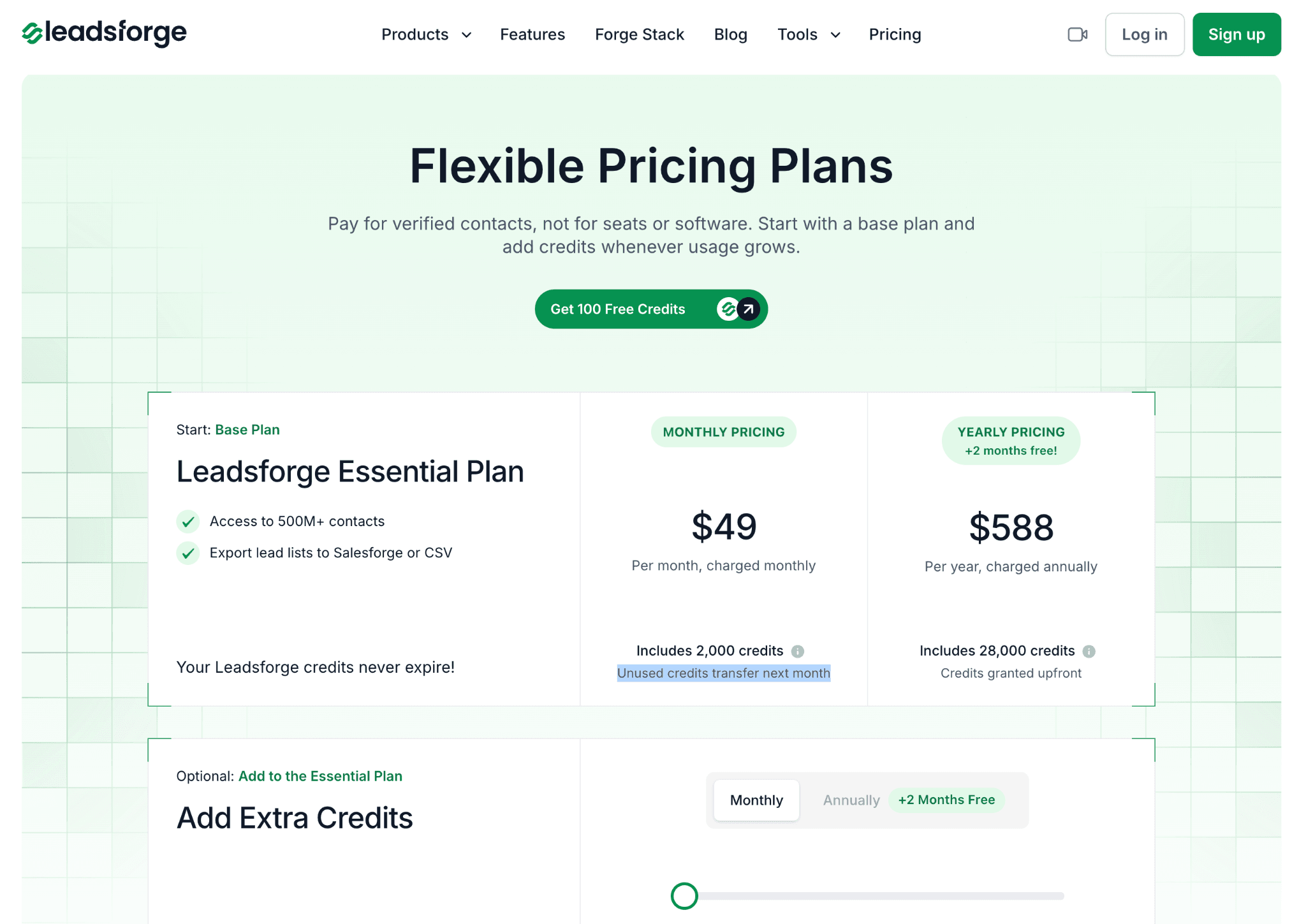
The practical floor depends on actions. Pro’s 300 Social Actions are below the vendor’s 400–500-actions-per-profile monthly full-capacity estimate. Our fixed-workload model therefore starts with $96 Growth, not $48 Pro. Action top-ups and lead data come later. Included Salesforge credits reset on the billing date. Leadsforge says its separate credits do not expire. The product boundary determines the rollover rule.
Two fixed models show why this distinction matters. These are pre-tax assumptions, not universal bills. The one-account case combines Growth, 2,000 Social Actions, and Leadsforge base. The 20-profile case assumes 8,000 finder lookups, 8,000 invites, 17,000 follow-ups, 30,000 Social Actions, and Leadsforge 8,000.
| Scenario | Base subscription | Metered/data costs | Monthly total | Annual total |
|---|---|---|---|---|
| One-account model — monthly billing | $96 Growth | $149 for modeled Social Actions and Leadsforge | $245 | — |
| One-account model — annual billing | $80/mo equivalent ($960/year) | $132.33/mo equivalent under the model | $212.33/mo equivalent | $2,548 |
| 20-profile model — monthly billing | $96 Growth | $779 for 30,000 Social Actions plus Leadsforge 8,000 | $875 | — |
| 20-profile model — annual billing | $80/mo equivalent ($960/year) | $664/mo equivalent under the model | $744/mo equivalent | $8,928 |
Fixed-workload Salesforge cost scenarios (pre-tax)
The trial is narrow despite Growth access. The 14-day trial and quotas are public. The no-card flow and extension conditions appear in the public app asset. It allows 50 contacts, 100 emails, 50 validation credits, 50 personalization credits, 100 Social Actions, and one social profile. A quiz and teammate invitation can each conditionally add seven days. They do not make the standard trial 28 days.
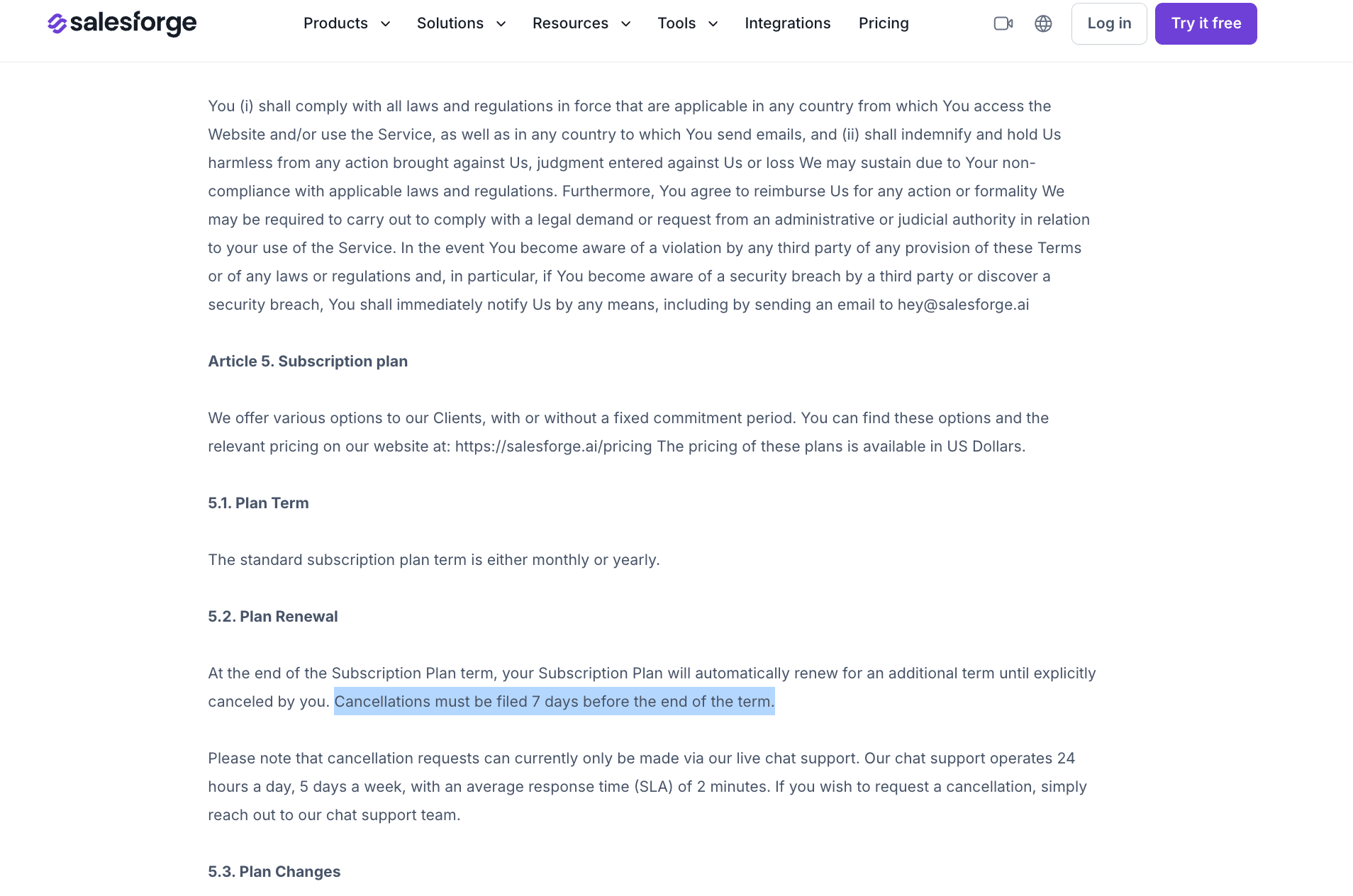
Cancellation changes the downside. Salesforge’s Terms require live-chat notice at least seven days before term end. Otherwise, the subscription auto-renews. Prepaid fees are generally nonrefundable, and a remaining commitment may become due. A buyer should therefore export needed contact data and start cancellation before the notice window. Actual cancellation handling and export completeness were not tested.
Pricing boundary: The $48 Pro card does not represent a full-capacity multichannel workload. Growth, metered actions, lead data, mailbox/domain infrastructure, taxes, and separately priced Forge products can move the operating bill materially above the base subscription; cancellation is support-mediated.
Multichannel Sequence, Branching, and Reply Stop
Like most tools in this space, Salesforge provides sequences, schedules, delays, variables, and reply detection. One workflow can also combine email, LinkedIn messages, InMail, delays, conditions, and reusable subsequences. Public material confirms conditions and branching. It does not establish the exact condition catalog, nesting depth, sequence-step ceiling, or simultaneous active-sequence ceiling. Teams using deeply nested logic must therefore verify its limits. See the documented multichannel mechanics and this neutral background on coordinating LinkedIn and cold email.
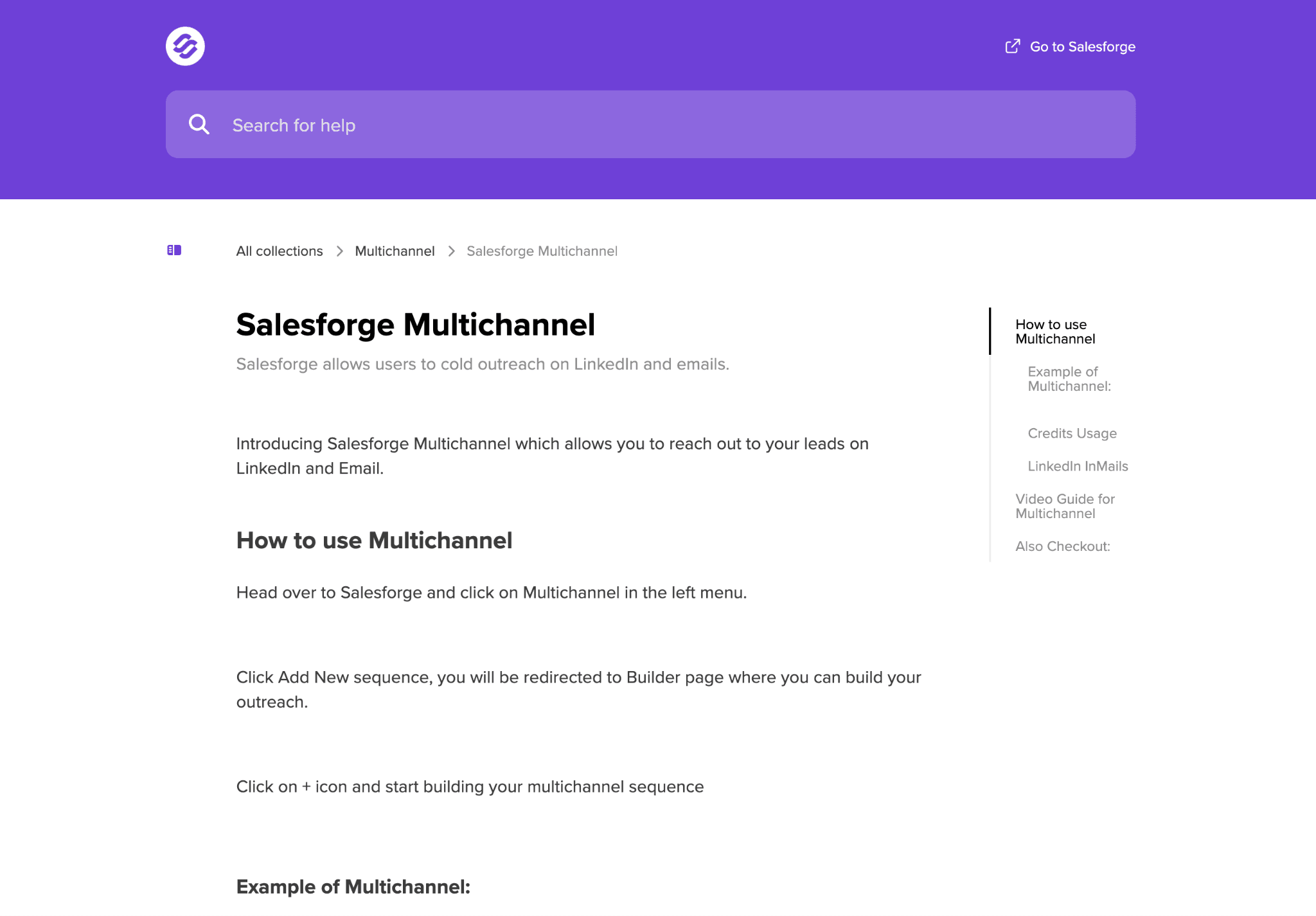
Replies change the workflow state. A contact reply stops later steps for that person. A LinkedIn reply can therefore pause the remaining email outreach. Stop Multithreading on Reply can also stop sequences for other contacts at the same domain. This can prevent parallel outreach into one company after a response. The documented behavior is bounded to that control. Domain-matching reliability and edge cases were not measured. Salesforge explains the reply and Active Contact behavior here.
| Trigger or step | Documented behavior | Boundary |
|---|---|---|
| Native sequence step | Mailbox capacity and email pool still apply | |
| LinkedIn message or InMail | Can share a sequence with email | Social Action pool and sender caps still apply |
| Delay, condition, or subsequence | Controls timing and path reuse | Exact nesting and step ceilings were not established |
| Contact reply | Stops later steps for that contact | Operational reliability was not measured |
| Stop Multithreading on Reply | Can stop other contacts at the same domain | Separate control; not proof of global deduplication |
Salesforge reply-aware sequence flow
A/B testing is available only on Growth. Pro users can build sequences but cannot use that documented comparison feature.
Workflow boundary: Conditions and subsequences are confirmed, but their exact condition set, nesting depth, step ceiling, and reliability under a live campaign were not established.
LinkedIn Sender, Extraction, Actions, and Quotas
Salesforge’s extension captures and enriches records from LinkedIn People Search and Sales Navigator, syncs selected contacts, and launches a workflow. These are the only confirmed source surfaces. Public evidence did not establish Recruiter variants, group/event/post-engager extraction, or full message-history export. Compare the Salesforge extraction guide with this general Sales Navigator export guide.
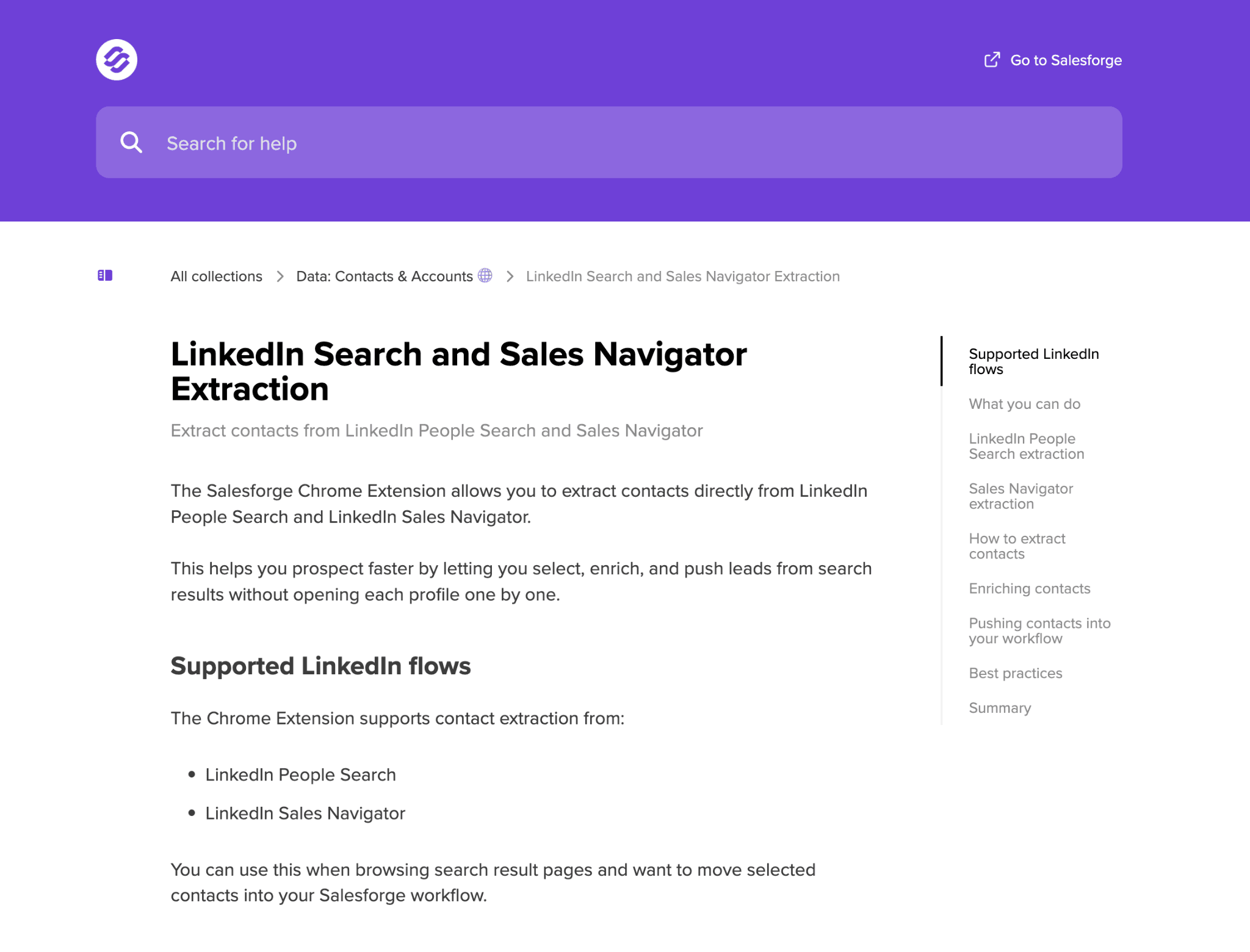
The LinkedIn action list is closed and specific. The six action types appear in the table below. Each action has a separately configurable cap of 30 per rolling 24 hours for each sender. These controls sit alongside the monthly Social Action pool rather than replacing it. Pro includes 300 Social Actions per month, Growth 1,000, and the trial 100. Once a pool is exhausted, the daily cap alone cannot create more monthly capacity. Salesforge documents the six caps and restriction warning. Current pricing supplies the plan pools.
| Action | Rolling 24-hour cap | Monthly pool impact | Evidence boundary |
|---|---|---|---|
| Connection request | 30 | Consumes the applicable Social Action pool | Manual activity is not fully reconciled in the visible counter |
| Message | 30 | Consumes the applicable Social Action pool | Live throttling outcome was not tested |
| InMail | 30 | Consumes the applicable Social Action pool | InMail-credit protection was not established |
| Profile view | 30 | Consumes the applicable Social Action pool | Vendor-documented cap only |
| Follow | 30 | Consumes the applicable Social Action pool | Vendor-documented cap only |
| Post like | 30 | Consumes the applicable Social Action pool | AI commenting and post-engager collection were not established |
Salesforge LinkedIn daily caps versus monthly Social Action pools
Quota boundary: Six separate daily caps do not equal unlimited throughput: the same actions also draw from 300 Pro, 1,000 Growth, or 100 trial Social Actions per month, and visible counters do not reconcile every manual LinkedIn action.
Email Sending, Mailboxes, and Deliverability
Salesforge sends native email through connected mailboxes. The checked Google Workspace path uses OAuth. The documented Microsoft 365 setup uses Authenticated SMTP. These methods establish how a sender is attached, not whether messages land in the inbox. See the vendor’s Google OAuth setup and Microsoft 365 SMTP instructions.
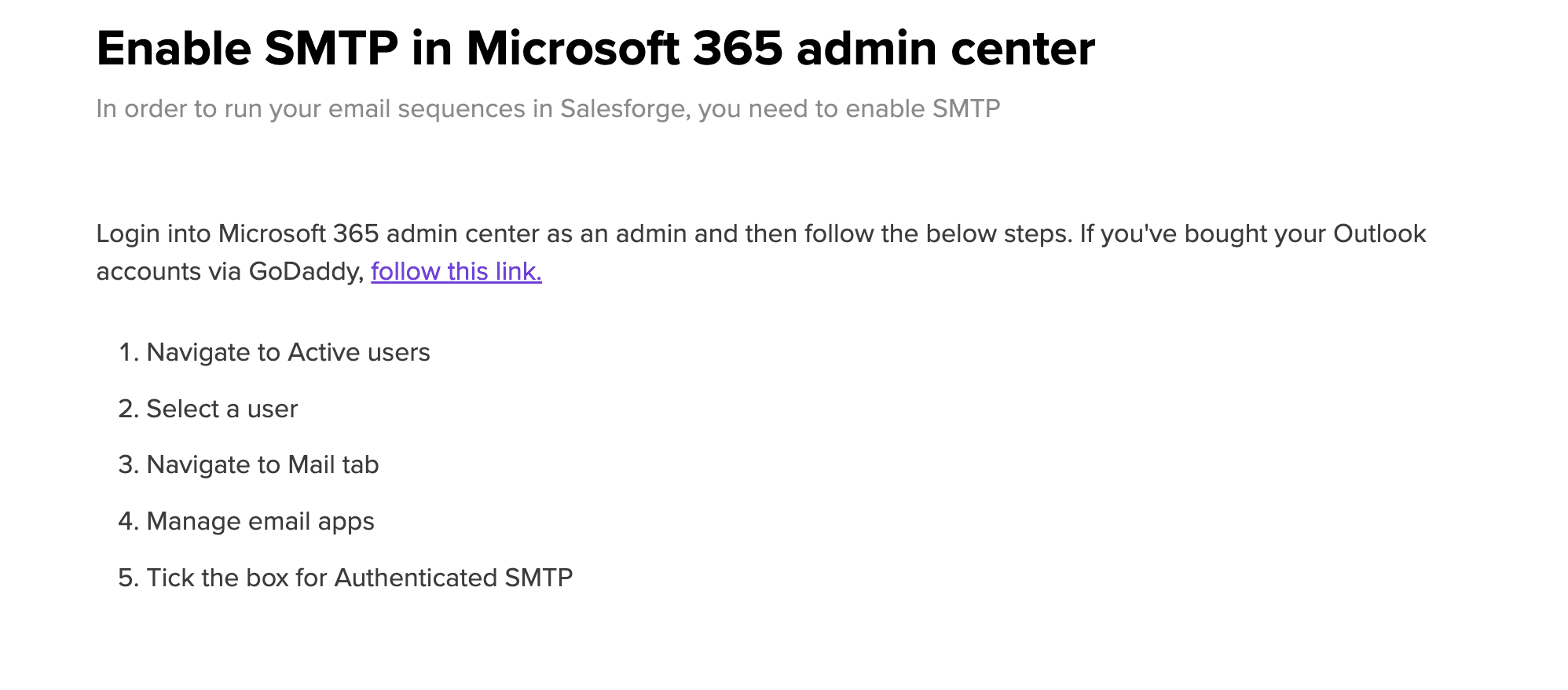
Plan pools and mailbox topology are different limits. Pro includes 5,000 emails per month; Growth includes 50,000. Growth marketing uses broad connected-mailbox language. However, the Terms may cap connected email accounts at 99 per workspace. “Unlimited connected mailboxes” refers to connected-mailbox capacity under the marketed plan. It does not include domains or mailbox infrastructure. It also does not erase the 99-per-workspace legal qualification or the plan’s email pool. Salesforge’s sequence-building guidance uses roughly 30 cold emails per mailbox daily and gives follow-ups priority within that capacity.
Salesforge includes warm-up tooling in the documented entitlement. Like most email-first engagement products, warm-up and deliverability controls are category-standard. Their availability does not establish inbox placement, bounce, acceptance, or response performance. No seed-inbox test was completed. Reviewer claims about deliverability therefore remain individual experiences, not measured outcomes.
| Layer | What is documented | What remains unmeasured |
|---|---|---|
| Mailbox connection | Google Workspace via OAuth; checked Microsoft 365 path via Authenticated SMTP | Connection success across every provider and tenant policy |
| Plan capacity | Pro: 5,000 emails/month; Growth: 50,000 emails/month | Actual send acceptance at workload scale |
| Connected mailboxes | Broad Growth capacity; Terms may cap 99/workspace | How the legal cap is enforced operationally |
| Infrastructure | User supplies domains and mailbox infrastructure | Total infrastructure bill varies by setup |
| Warm-up and controls | Warm-up tooling is included | Inbox placement, bounce, acceptance, reply, and long-run reputation outcomes |
Mailbox entitlement, infrastructure, and deliverability evidence
The implication is practical: a 50,000-email allowance is not 50,000 delivered emails, and a connected-mailbox entitlement is not mailbox infrastructure. Buyers need a separate infrastructure budget and their own placement test before treating either number as operating capacity.
Deliverability boundary: Warm-up access, sender guidance, and email allowances document available tooling; they do not prove inbox placement or deliverability outcomes, and no seed-inbox test was completed.
AI Personalization, Primebox AI, and Credit Pools
Salesforge AI can generate a full first email or an icebreaker. It also produces email, LinkedIn, and reply copy with tone, language, fallback, and regeneration controls. The available model labels are Standard and Overdrive. A bring-your-own LLM path was not documented. Buyers therefore should not assume they can select or fund their own provider. The sequence-building guide supports the generation scope. The credit guide says usage draws from personalization allowances.
The plan pool and generation rates are clear. Pro includes 300 personalization credits per billing period; Growth includes 1,000. Included credits reset on the billing date. The credit guide sets a Standard personalization preview at one credit, an Overdrive preview at two, regeneration at no charge, and a generated multichannel message or reply at one credit.
Primebox AI drafts responses inside the unified inbox, but current first-party pages conflict. Help says one personalization credit per draft. The pricing page says three. Until authenticated metering resolves the conflict, both values must remain open.
| AI action | Documented credits | Status or conflict |
|---|---|---|
| Standard personalization preview | 1 personalization credit | Confirmed |
| Overdrive personalization preview | 2 personalization credits | Confirmed |
| Multichannel message or reply | 1 personalization credit | Confirmed |
| Regeneration | Free | Confirmed |
| Primebox AI response draft | 1 credit in Help; 3 credits on pricing | Unresolved first-party conflict |
| Monthly plan pool | Pro 300; Growth 1,000 | Included credits reset on billing date |
Salesforge AI actions and credit rules
Agent Frank is not a larger Human Path AI allowance. It is a separately sold AI Path. Pricing starts at $599 per month billed quarterly or $499 per month billed annually, with a complimentary Salesforge account. AI cost comparisons must separate Human Path personalization, Primebox drafts, and Agent Frank’s subscription.
We did not establish native numeric ICP scoring in core Salesforge. Prompt-based qualification belongs to separately scoped Leadsforge. Product attribution therefore matters when evaluating an “AI” claim across the Forge ecosystem.
Unresolved meter: Current first-party sources put a Primebox AI response draft at both one and three personalization credits. Preserve the conflict and verify the live meter before forecasting usage.
Primebox, Analytics, CRM, API, and Automation Handoffs
Primebox centralizes documented email and LinkedIn replies with lead context, labels, sentiment, and AI drafts. This can keep response context near sequence execution. However, the Primebox page does not establish a single master inbox across every client workspace. Cross-workspace consolidation therefore remains an operational question, not an included governance claim.
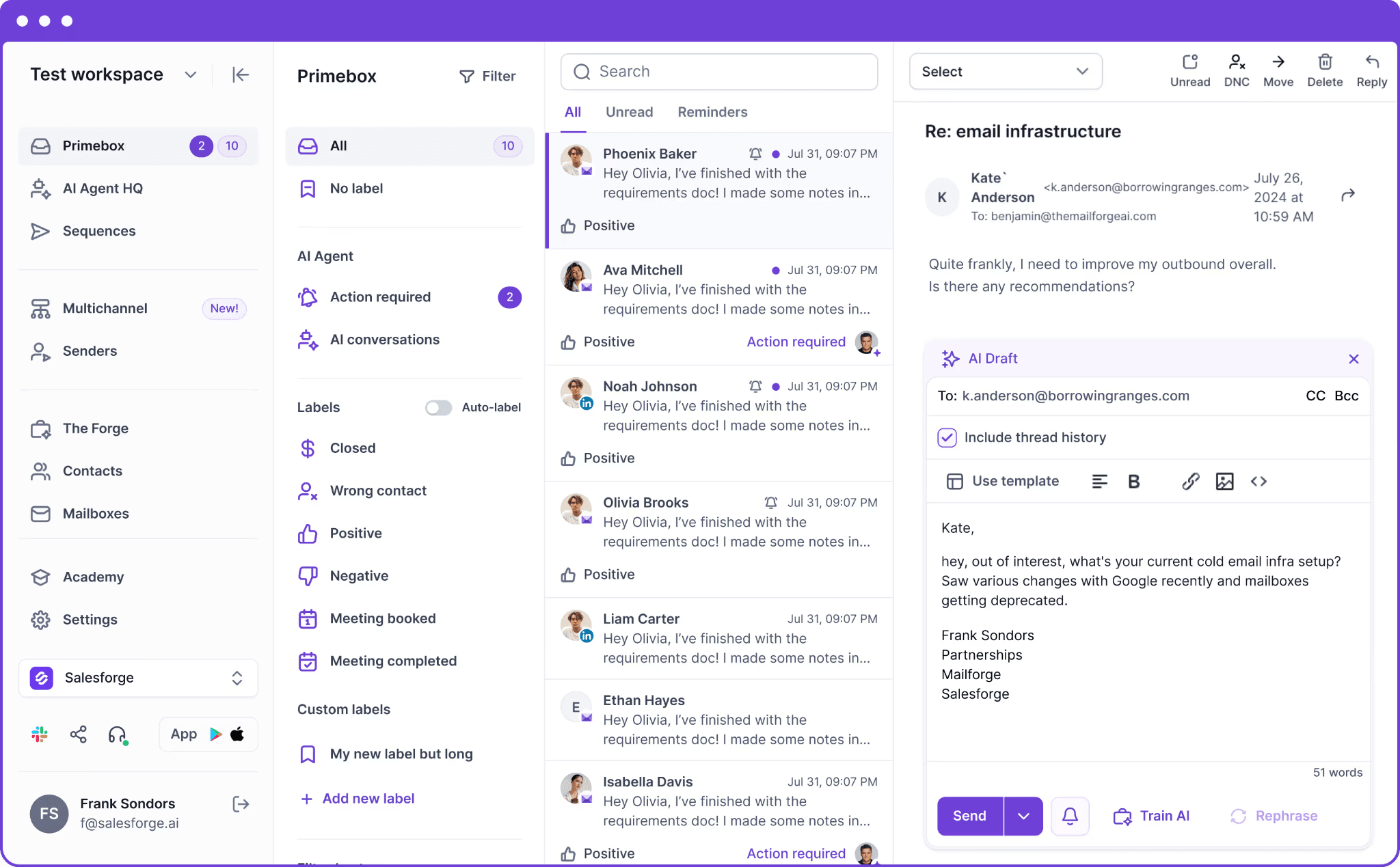
Campaign and contact analytics report:
- statuses
- opens and clicks
- replies and bounces
- out-of-office responses
- unsubscribes
- do-not-contact state
These are the visible reporting fields. They do not establish reporting freshness, attribution accuracy, cross-workspace rollups, or CSV-exportable reports. Those points remained untested or unestablished in public evidence.
The native count is seven CRM integrations: GoHighLevel, Salesforce, HubSpot, folk, Attio, Pipedrive, and Breakcold. Salesforge’s live integrations directory supports those names. Make, Zapier, outbound event webhooks, and the public REST API expand the handoff options. They are Growth-gated and are not native CRM connections. Middleware reach is not a native-integration count. For neutral background, see how LinkedIn workflow data can hand off to a CRM.
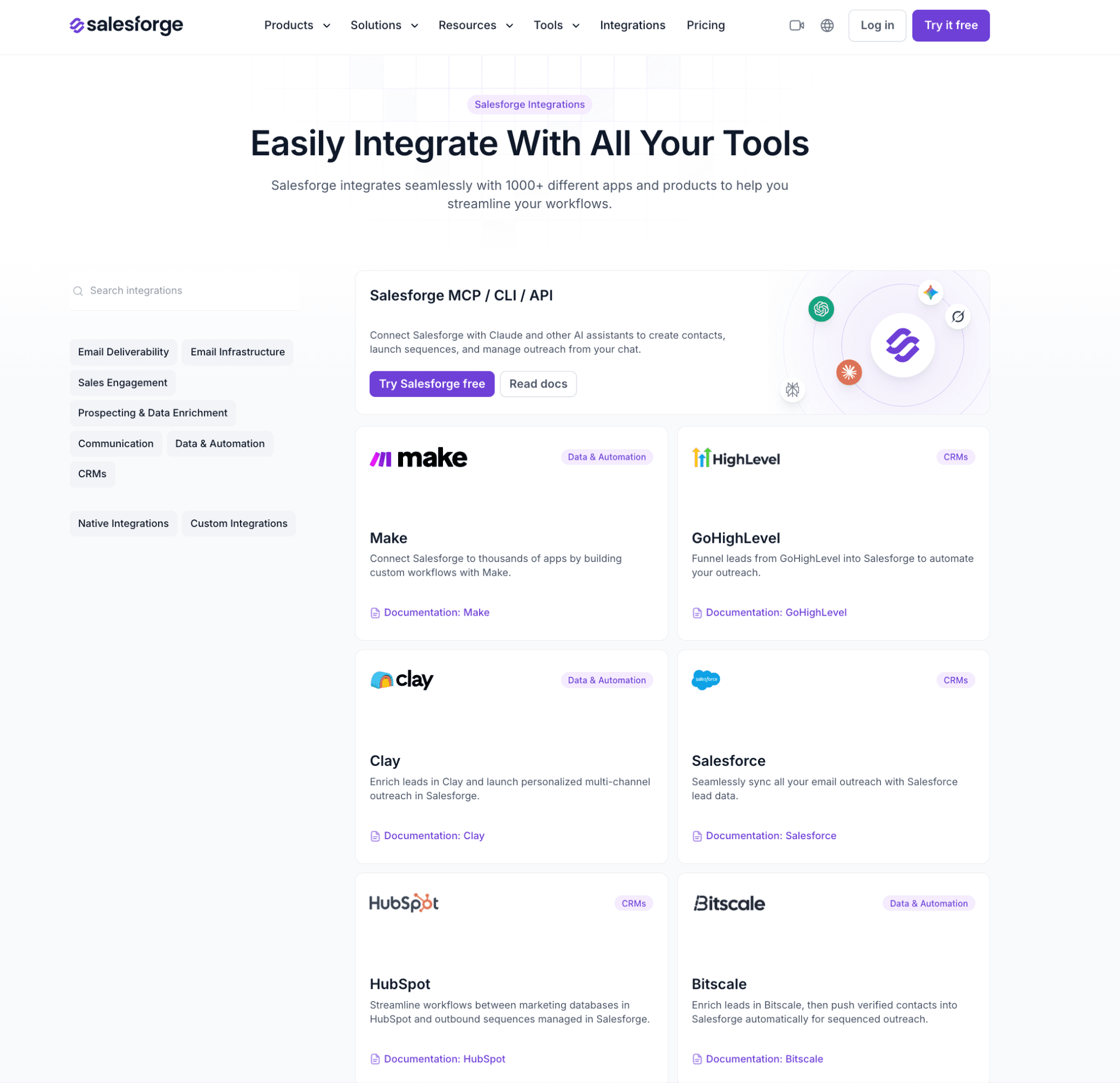
The Growth-only public REST API uses Bearer-key authentication and publishes a Swagger v2 contract; it covers workspaces, contacts, sequences, sender profiles, conversations, and webhooks. Zoho is absent from the current native integrations directory. Outbound event webhooks are documented; an inbound lead-enrollment webhook was not established, so those two directions should not be conflated.
| Connection type | Confirmed surface | Plan gate or boundary |
|---|---|---|
| Native CRM | GoHighLevel, Salesforce, HubSpot, folk, Attio, Pipedrive, Breakcold | 7 verified native CRMs; Growth-gated |
| Automation platforms | Make and Zapier | Growth-gated; middleware reach is not a native count |
| Webhooks | Outbound events | Growth-gated; inbound lead enrollment was not established |
| REST API | Workspaces, contacts, sequences, sender profiles, conversations, webhooks | Growth-only; live integration behavior was not tested |
| CSV/contact surfaces | Import with tags, mapping, custom variables; contact-list Export documented | Format, row caps, plan gate, and full messaging-history CSV remain unestablished |
Salesforge native CRM, API, and automation handoffs
Salesforge documents CSV contact import with tags, field mapping, and custom variables. It also documents a contact-list Export button. A full messaging-history CSV export was not established. API access to conversations is a different mechanism. Primebox supplies inbox context, not proof that Salesforge is a full CRM system of record.
Reporting boundary: Primebox and analytics expose useful reply and campaign context, but a cross-workspace master inbox, report-export scope, freshness, attribution quality, and full messaging-history CSV export were not established.
Teams, Agencies, Governance, and Ecosystem Economics
Growth lowers the marginal subscription cost of adding users, workspaces, and sender topology. Marketed capacity and verified governance remain separate questions. Salesforge’s Terms allow up to 500 social profiles per workspace. They may also cap connected email accounts at 99 per workspace. These caps qualify broad capacity language. They do not establish how client data, permissions, and collisions behave across workspaces.
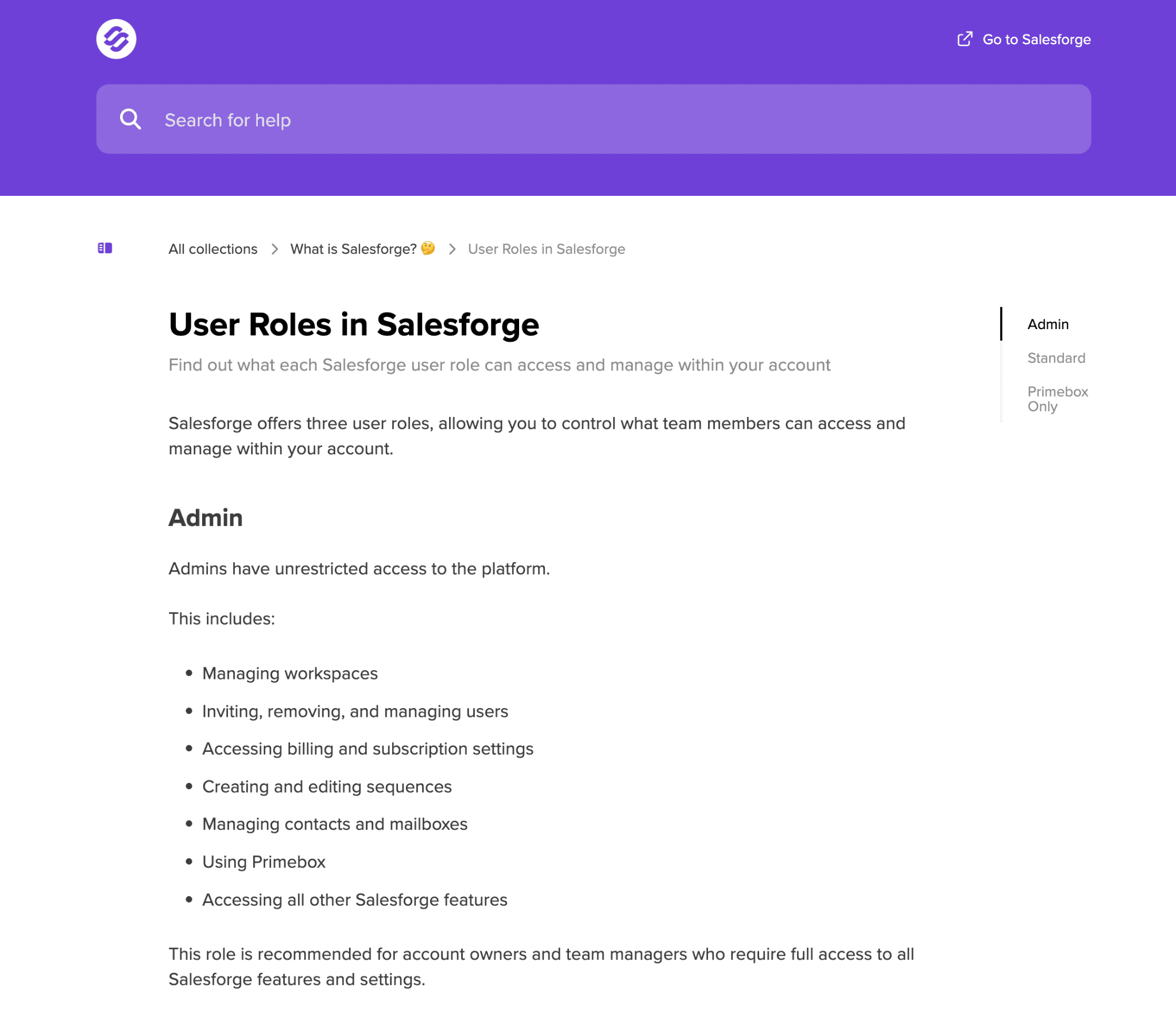
Roles are fixed at three: Admin, Standard, and Primebox Only. The role documentation establishes that structure. Granular custom or client roles and a public admin audit log were not established. Magic Link lets a profile owner connect LinkedIn without entering the agency workspace. This can reduce credential-handling friction, but it does not prove client isolation or session revocation behavior. The Magic Link flow is documented here.
Within documented scopes, active-sequence duplicate prevention and do-not-contact controls exist. Cross-workspace governance remains unestablished. Agencies should treat the table below as an acceptance-test list instead of inferring controls from the number of workspaces. This multi-account operations guide gives platform-level context for separation. It does not serve as evidence for Salesforge.
| Agency requirement | Documented capability | Unverified or absent control |
|---|---|---|
| Users and workspaces | Broad Growth capacity under a flat account subscription | Cross-workspace permission behavior and isolation remain untested |
| Sender profiles | Up to 500 social profiles/workspace under Terms; Magic Link connection | Rotation, revocation behavior, and cross-workspace collisions remain unestablished |
| Roles | Admin, Standard, Primebox Only | Granular client/custom roles and public audit log were not established |
| Duplicate and DNC handling | Controls documented within active-sequence scopes | Global cross-workspace dedupe and round-robin assignment were not established |
| Client branding | Separate whitelabel reseller program | Not included as a standard Pro/Growth client portal |
| Agency inbox | Primebox reply context | One master inbox across client workspaces was not established |
Salesforge agency topology versus verified governance
The fixed 20-profile model shows the commercial consequence. It totals $875 monthly pre-tax. Of that, $779 covers 30,000 Social Actions plus Leadsforge 8,000, compared with the $96 Growth base. The annual version is $8,928 under the same 8,000-lookups, 8,000-invites, and 17,000-follow-ups assumptions. This is a model, not an agency price quote. It shows that inexpensive topology does not make execution inexpensive.
Salesforge also offers a separate whitelabel reseller program. Its branded client tooling and workspace management should not be described as included Growth functionality.
Capacity is not governance: Broad users, workspaces, and sender profiles do not establish granular client roles, global deduplication, audit logs, lead distribution, sender rotation, or one cross-workspace inbox; the 20-profile model also puts $779/month into actions and data rather than the base plan.
Is Salesforge Safe for LinkedIn Accounts?
Salesforge publishes six separately adjustable limits of 30 actions per rolling 24 hours. It also warns that high manual activity, multiple automation tools, or exceeding thresholds can cause restrictions. These are vendor-documented settings, not measured restriction outcomes. The safety guide states both the limits and the warning.
Cloud custody remains the central unknown. Salesforge says LinkedIn actions use a managed shared proxy by default and accepts user-supplied proxy credentials. No current test established exit IP, isolation, reputation, location, fingerprint, or revocation behavior. See the own-proxy documentation. The vendor says it retains the LinkedIn session token, not the password; token encryption, storage region, retention, revocation, and subprocessor handling were not established.
What I verified first-hand. I reviewed extension v2.0.7 as shipped. The audited code paths showed a capture and enrichment helper. I found no LinkedIn cookie access, direct Voyager calls, session upload, or synthetic LinkedIn action execution. The package had broad page access and a probeable extension resource. Installation detectability therefore remains a signal, although the audited code paths did not upload the session. This version-bounded static finding does not reveal how the separate cloud sender executes.
| What was checked | Result |
|---|---|
| Published action controls | Six separate 30-per-rolling-24-hour caps, adjustable downward; actual enforcement outcomes were not tested |
| Default and custom proxy | Managed shared proxy by default; user-supplied proxy documented; exit IP, quality, isolation, location, and fingerprint unmeasured |
| Session custody | Vendor says password is not stored and only a session token is retained; encryption, lifecycle, and revocation remain unestablished |
| Extension v2.0.7 | No LinkedIn cookie access, Voyager calls, session upload, or synthetic action execution found in audited code paths |
| Separate cloud sender | Execution method and cloud IP/session behavior remain unmeasured |
| Compliance surface | EU database hosting and standard DPA documented; Trust Center SOC 2 labels remain first-party claims without a public report, auditor, period, or scope |
Salesforge LinkedIn safety: documented controls versus observed evidence
The Privacy Policy places database servers in the EU and permits service-data retention for up to three years after closure; Terms can end access. The DPA is available by request. None settles session-token lifecycle. The Trust Center SOC 2 labels remain first-party claims because no public report details were exposed, and no Salesforge ISO 27001 certification was established there. A July 29 direct check of status.salesforge.ai did not resolve, and no live operational status page was established.
Risk remains: No tool eliminates the risk of LinkedIn restrictions. Salesforge’s limits, pacing, and proxy choices are documented, but current cloud IP, session isolation, fingerprint, checkpoint behavior, and account outcomes were not measured.
What Salesforge Reviews and Community Mentions Actually Show
The sample contains 29 unique reviews: G2 10, Trustpilot 19, and Capterra 0. These are not current platform scores. The G2 2023–2024 subset averages 5.00★ across 10 reviews; the Trustpilot 2025–2026 subset averages 4.26★ across 19. A cross-platform local February 3–August 3, 2026 subset of G2 and Trustpilot reviews averages 3.8★ across 10 rated reviews. Platform, period, and product maturity differ, so the gap cannot establish a decline. At least one Salesforge-labeled G2 review substantively reviews Mailforge, so its infrastructure praise cannot be attributed to the core Salesforge subscription.
| Evidence set | Exact sample | Date range | What it can and cannot show |
|---|---|---|---|
| Deduplicated reviews | 29: G2 10, Trustpilot 19, Capterra 0; sentiment 23 delighted, 2 satisfied, 2 mixed, 2 furious | 2023-10-10 to 2026-04-07 | Hypotheses only; not current ratings, prevalence, or causality |
| Trailing local review subset | 10 cross-platform G2 and Trustpilot rated reviews; 3.8★ average | 2026-02-03 to 2026-08-03 | Local aggregate; not a live score or trend proof |
| Reddit tagged set | 12 tagged posts; 4 visible names in those rows; full-text check found 5 visible posts and 8 likely comment-derived tags | 2025-11-19 to 2026-03-24 | Sparse mentions, not defect prevalence or migration |
Salesforge review and Reddit samples, dates, and confounding factors