
 Updated: September 6, 2026
 32 min read
Key takeaways
- A 2,500-result Sales Navigator source ceiling and a 10,000-row paid export ceiling apply to different stages, while pricing also uses both ‘no daily limit’ and batching language; capacity planning therefore needs separate source, export, and daily-throughput checks rather than treating any one limit as total capacity.
- Across the 55-experience G2 and Trustpilot cross-platform deduplicated local sample spanning the week beginning October 30, 2023 through February 28, 2026, 42 records fall in March–April 2024 or September–December 2025; topic frequencies from that corpus are clustered historical evidence, not continuous market consensus.
- Across that same 55-experience cross-platform deduplicated local sample and publication window, data quality appears positively in 29/55, yet SMTP verification is a checking process rather than measured freshness, inbox placement, or bounce performance; validate a sample before turning review praise into a deliverability assumption.
- White-label workspaces isolate client campaigns, senders, lists, and inboxes, but global cross-client suppression and a fixed workspace or account entitlement under the current partner program were not established; agencies need both governance and commercial units confirmed in writing before scaling.
This review is published by Linked Helper and written by Milosh Potikj, who works there. I've made every effort to represent Scrupp accurately using verified data — our own first-hand testing, Scrupp's own documentation, and independently sourced reviews.
Scrupp is a data-to-email platform for teams handling LinkedIn, Sales Navigator, or Apollo records. It extracts and enriches them before running email outreach. One paid plan starts at $29 monthly for 1,000 credits, with larger credit volumes available. Its included-feature list covers email outreach and REST API access. Scrupp does not document LinkedIn invitations or message sending. Our verdict is conditional. However, a static inspection of extension v1.3.6 confirmed LinkedIn session upload. We did not check the live request origin, retention, replay, revocation, or restriction rate. The architecture therefore receives a high-risk assessment rather than a safety assurance.
| Product boundary | Paid floor | Outreach floor | Safety finding |
|---|---|---|---|
| LinkedIn, Sales Navigator, and Apollo extraction; enrichment; export; API/webhooks; email outreach | $29/month for 1,000 credits | Listed in the same paid plan; sending limits need confirmation | Session upload confirmed; runtime route not checked |
Scrupp at a glance (pricing refreshed September 2026)
Pricing refreshed September 2026; other checks August 2026 · Sources: Scrupp pricing, product scope, and the official extension package.
Verdict
Scrupp is a candidate for a controlled evaluation. The relevant workflow starts with LinkedIn, Sales Navigator, or Apollo data and ends in email. Its current product surfaces establish extraction, enrichment, exports, background jobs, email campaigns, REST API access, webhooks, and agency workspaces. Together, these surfaces form a data-to-email chain rather than a scraper alone.
Four gates block an unconditional recommendation. First, pricing uses a single volume-based plan, but still conflicts on complete-lead credit cost and email inclusion. Headline allowances therefore do not produce a dependable cost per usable lead. Second, Email campaign mechanics such as reply auto-stop, branching, A/B tests, and numeric sending limits were not established. Third, connector claims do not all resolve to operational apps. Fourth, static extension evidence confirms session upload, while cloud routing and session lifecycle remain unmeasured.
| Established | Must be tested before scale |
|---|---|
| Extraction, enrichment, email sequences, API/webhooks, team and agency surfaces | Transaction-level credit events, campaign recovery, connector installation, billing/cancellation execution |
| Extension session upload and local LinkedIn reads | Cloud request origin, fingerprint, retention, replay, revocation and restriction rate |
Scrupp conditional verdict
As of August 2026 · Sources: features, pricing, API documentation, and the official extension package.
The decision supports a bounded data-and-email pilot. It does not support scaling until those four gates are tested in the intended account and billing setup.
Pros
- Broad source coverage: Scrupp documents people, companies, jobs, posts, reactions, connections, Sales Navigator, Apollo, and Recruiter inputs, subject to source ceilings.
- Background export continuity: According to pricing and Help, started jobs can continue after the browser closes. This reduces open-tab dependence without proving a scheduler or uptime level.
- Built-in enrichment: Like most data tools in this category, Scrupp combines an email waterfall, SMTP verification, phone lookup, and CSV/XLSX delivery. The feature page does not establish current accuracy.
- Email features listed in the paid plan: Email outreach, AI sequences, and a unified reply inbox appear in the current included-feature list. The pricing FAQ still describes sending as separate, so confirm account access and limits (pricing).
- Documented developer routes: The paid feature list includes REST API access; the documented API is asynchronous, while webhooks publish events, signing, retries, and replay limits (API; webhooks).
- Client workspaces: Agency surfaces document isolated client workspaces, branding, intake, reports, and an Activity Log. Global cross-client suppression was not established (white label).
Cons
- Session leaves the browser: The official v1.3.6 package uploads LinkedIn cookies, user agent, and identity to Scrupp endpoints. This changes who can hold the authenticated session.
- Credit yield conflicts: Pricing implies four credits for scraping, a verified email, and a phone. The same pricing page also uses a one-credit-per-lead headline.
- Documentation is not synchronized: The main pricing selector presents one paid plan, while Help retains named tiers and the pricing FAQ conflicts with the email feature list. Confirm unclear entitlements in the account (pricing; Help).
- Connector readiness is uneven: HubSpot has a documented route, but Salesforce and Pipedrive pages conflict with Help. Zapier is labeled coming soon rather than established (webhooks).
- Safety controls lack numbers: Scrupp names throttling, limits, batching, and delays. Pricing publishes no daily budget, delay range, working hours, or adaptive-stop rule.
- Failure recovery remains untested: A small review sample contains support and reliability complaints. Those reports identify test scenarios, not current universal behavior.
| Limitation | Operational effect | Evidence class |
|---|---|---|
| Session bundle upload | Session custody crosses the local-browser boundary | First-hand static package inspection |
| One-credit versus four-credit complete-lead claims | Usable-lead yield can vary fourfold | Conflicting statements on the pricing page |
| Email controls unresolved | Sequence presence does not establish reply-aware execution | Published paid features plus public-evidence gap |
| Connector drift | Landing-page presence does not establish installation or write-back | Conflicting first-party pages |
| No numeric safety controls published | A buyer cannot audit the claimed pacing budget | Vendor claim with undisclosed settings |
| Support and reliability complaint tail | Recovery behavior needs a current pilot | Small-sample review observation |
Scrupp limitations and evidence classes
As of August 2026 · Sources: pricing, Help, webhooks, and the official extension package.
Scrupp Pricing: One Plan, Credit Volumes, and Extra Costs
Scrupp now presents one paid plan with a selectable credit volume rather than a ladder of feature-gated named tiers. The entry option is $29 per month for 1,000 credits. Monthly volumes range from 1,000 to 100,000 credits; the entry option lists up to three team members and 10,000 leads per Finder search. See current pricing for the selected volume.
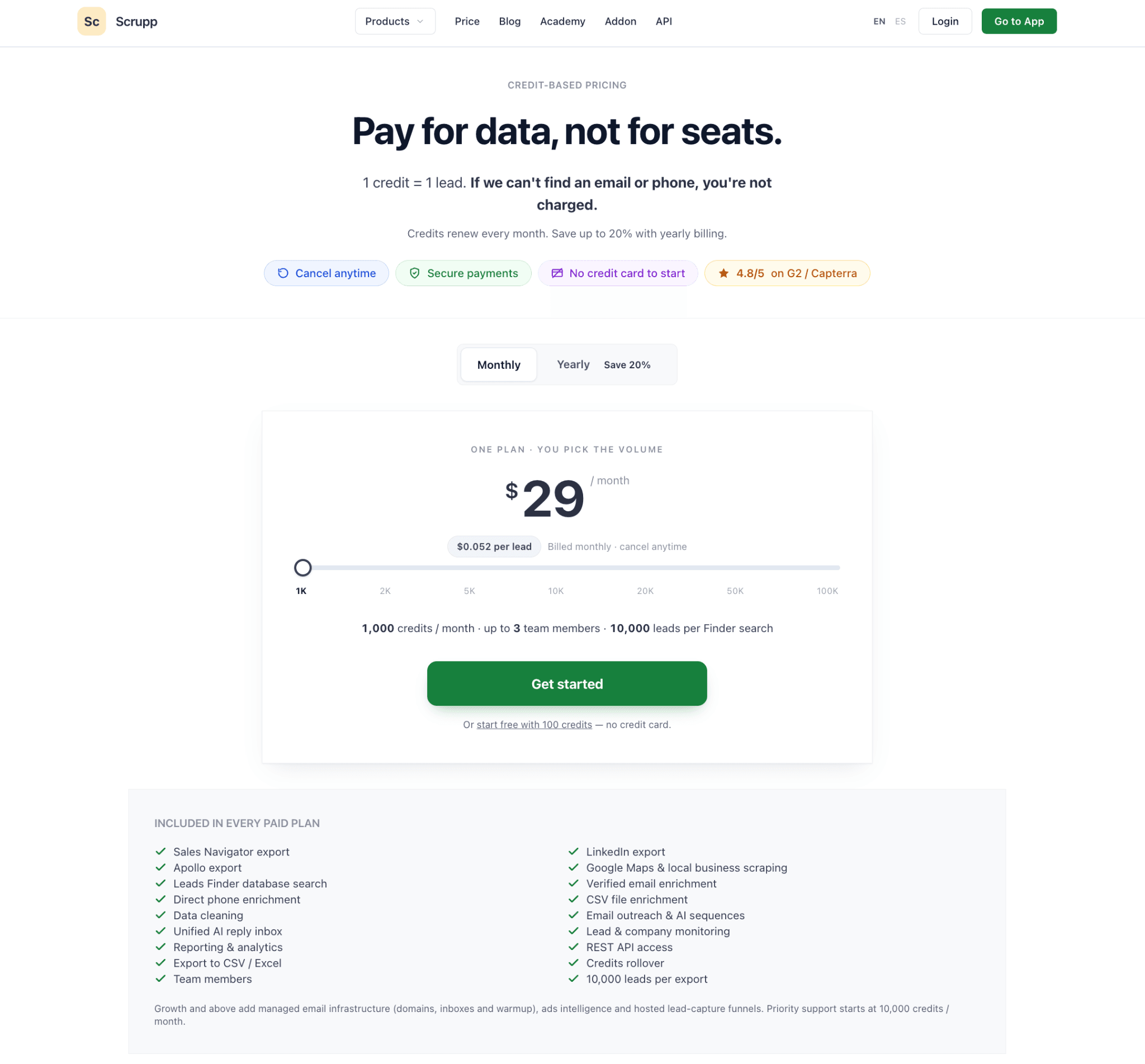
| Option | Price | What's included | Limits and exclusions |
|---|---|---|---|
| Free start | $0; no credit card | 100 free credits to test scraping and enrichment | Do not assume a recurring monthly allowance or all paid entitlements from the signup offer |
| One paid plan; choose credit volume | From $29/month for 1,000 credits | Extraction, enrichment, CSV/Excel export, email outreach and AI sequences, reply inbox, REST API, rollover; up to 3 teammates at entry volume | Credits limit data usage; sending caps and managed infrastructure are not specified for the entry option; external Sales Navigator subscription is separate |
Scrupp pricing options (September 2026)
Pricing refreshed September 2026 · Source: Scrupp pricing. Email outreach and REST API are listed in the common paid feature set; the page does not publish the old tier-specific inbox, contact, or campaign caps.
Yearly billing is advertised as saving up to 20%, with credits delivered monthly. Check the selected volume's annual checkout total before committing; do not reuse annual totals from earlier named-tier tables. A remaining footnote mentions Growth and above for managed domains, inboxes, warmup, ads intelligence, and lead-capture funnels, without mapping them to the new volume selector. Confirm those extras separately; priority support is listed from 10,000 credits per month.
Credit consumption still needs clarification. The pricing page's detailed formula charges one credit per exported lead, one additional credit for a verified email, and two additional credits for a phone. Yet its headline says one credit equals one lead and unsuccessful contact lookups are not charged. Treat the detailed formula as budgeting scenarios until a sample transaction confirms the actual deductions.
| Scenario | Credits per lead | 1,000-credit yield | Evidence status |
|---|---|---|---|
| Pricing headline: one credit per lead | 1 | 1,000 leads | Headline claim; conflicts with the detailed formula |
| Scrape plus verified email | 2 | 500 leads | Pricing arithmetic; transaction behavior not tested |
| Scrape plus verified email plus phone | 4 | 250 leads | Pricing arithmetic; transaction behavior not tested |
Scrupp credit-yield scenarios (September 2026)
Pricing refreshed September 2026 · Source: Scrupp pricing: headline, credit formula, and FAQ. These are arithmetic scenarios, not measured delivery yields.
Pricing trap: The same 1,000-credit allowance can imply 250, 500, or 1,000 leads depending on which first-party charging statement applies. Verify a sample transaction before calculating cost per usable lead.
One-time credit purchases work separately from the subscription:
- The entry pack costs $35 for 1,000 credits;
- The selector also offers 2,000, 5,000, 10,000, 20,000, 50,000, and 100,000 credits;
- The selected pack's current price must be checked before purchase;
- Payment is one-off, with no recurring subscription charge; and
- Purchased credits do not expire and can stack with subscription credits.
The published $35 entry pack equals $0.035 per credit, not necessarily per enriched lead. For the $29 monthly entry option, the two- and four-credit scenarios above imply $0.058 and $0.116 per lead respectively, assuming all 1,000 credits are used successfully. Larger-pack prices are not inferred from earlier pricing snapshots.
Current pricing says unused subscription credits roll over while the subscription remains active; one-time credits do not expire. Help retains older rollover restrictions, so confirm what happens to subscription credits after cancellation. Written terms allow period-end cancellation and generally exclude refunds for unused credits or partial periods. That policy does not establish what every account UI currently shows.
White-label and wholesale arrangements require a separate partner quote. The current partner page bases pricing on volume and the chosen delivery model; neither the standard credit selector nor older Agency app pricing establishes a fixed 20-account package.
Hybrid Architecture and LinkedIn Session Custody
Scrupp uses a hybrid architecture rather than operating only as “an extension” or “a cloud tool.” The extension performs authenticated LinkedIn reads locally, then sends session material to Scrupp. Started export jobs, enrichment, storage, API tasks, and webhooks can continue in cloud infrastructure. Browser-side collection therefore does not keep every part of the authenticated workflow inside the browser.
What we verified first-hand: We inspected the official extension v1.3.6 package. It reads li_at, li_a, and JSESSIONID, along with the browser user agent and account identity. li_at is the LinkedIn login in cookie form, while JSESSIONID carries the anti-forgery token. Whoever holds that bundle may be able to act as the authenticated account without the password. Uploading it therefore transfers session custody to another environment.
The shipped source also performs local Voyager and Sales API reads. Voyager is LinkedIn's internal web API used by the browser interface. In practice, “local reads” and “session upload” coexist. Neither description alone captures the architecture.
| Stage | Observed or documented behavior | What it means |
|---|---|---|
| Chrome extension | Reads LinkedIn cookies, user agent, identity, and Voyager/Sales data | The browser participates in authenticated collection |
| Scrupp account endpoints | Receive the session bundle from the extension | Session custody crosses the browser boundary |
| Cloud jobs | Started exports can continue after the browser closes | Job continuity exists, but a 24/7 scheduler or uptime level is not established |
| LinkedIn-facing runtime | Not checked | Request origin, fingerprint, retention, replay and revocation remain unresolved |
Scrupp browser-to-vendor session and data flow
As of August 2026 · Sources: the official extension package, Chrome Web Store listing, and Scrupp Help.
First-party descriptions do not resolve the mode split. Pricing describes extension-plus-server-side scraping. Help calls the extension optional, while feature copy describes browser or user-IP execution. Those statements may refer to different workflows, but mode-by-mode behavior was not dynamically traced.
Custody boundary: Static inspection confirms the session bundle leaves the browser. It does not establish Scrupp's live LinkedIn-facing IP, cookie retention, replay behavior, revocation handling, fingerprint, or restriction rate.
LinkedIn, Sales Navigator, and Apollo Extraction
Scrupp's documented collection surface extends beyond a single Sales Navigator scraper. The reviewed material documents these sources:
- LinkedIn people, companies, jobs, posts, commenters, reactions, and connections;
- Sales Navigator lead searches, account searches, and saved lists;
- Apollo searches and lists; and
- Recruiter or Recruiter Lite; current purchase entitlement needs confirmation.
The LinkedIn scraper documentation supports the LinkedIn surface. Scrupp can also export person and company records with roles, titles, firmographic fields, and contact data. A project can move from a source search to a file or enrichment job without changing products. This workflow does not measure field accuracy or freshness.
| Source | Capability | Source ceiling | Boundary |
|---|---|---|---|
| LinkedIn Basic | People, company, jobs, posts, commenters, reactions, connections | 1,000 source results | Source bound, not daily capacity |
| Sales Navigator | Lead, account and saved-list extraction | 2,500 source results | Requires separate active Sales Navigator access |
| Apollo | Search/list extraction | 2,500 source results | Included in the paid feature list; free-account access needs confirmation |
| Recruiter / Recruiter Lite | Recruiter-source extraction | Not established | Current purchase entitlement and exact source ceiling not established |
| Paid export | CSV/XLSX output | 10,000 per export | Daily throughput still conflicts across public pages |
Scrupp extraction sources and ceilings
As of August 2026 · Sources: LinkedIn extraction, product features, and Scrupp Help.
A 2,500-result source ceiling and a 10,000-row paid export ceiling describe different layers. Neither proves unlimited daily extraction, especially because Scrupp also publishes both “no daily limit” and references to daily limits and batching. This Sales Navigator export guide explains the underlying list-export workflow without resolving Scrupp's conflicting daily language.
Scrupp's confirmed scope ends at extraction for LinkedIn actions. The reviewed product material documents no built-in connection requests, LinkedIn messages, likes, comments, or endorsements. Scrupp's listed outreach channel is email, so export capacity must not be treated as LinkedIn engagement capacity.
Channel boundary: Scrupp collects LinkedIn data but does not document LinkedIn invitations, messages, likes, comments, or endorsements. Its confirmed campaign channel is email.
Enrichment, Verification, Credits, and Dedupe
Scrupp combines discovery, checking, and export in one data flow. A vendor-verified address is not a measured inbox-delivery result.
Data enrichment means appending contact fields, usually a work email or phone, to an existing profile. Scrupp uses a multi-provider email waterfall, then applies real-time SMTP checks before labeling the result. Scrupp's feature page also documents phone lookup and CSV/XLSX delivery.
| Step | Documented function | Provisional credit event | Evidence boundary |
|---|---|---|---|
| Scrape | Collect a person or company record | 1 credit | Source and export ceilings apply |
| Email waterfall | Search multiple providers for a work email | 1 additional credit when using pricing formula | One-credit pricing headline conflicts with the detailed formula |
| SMTP verification | Check the found address in real time | Bundled into the email step in published formula | Deliverability was not benchmarked |
| Phone lookup | Append a mobile number | 2 additional credits in published formula | Hit rate and accuracy were not benchmarked |
| Match Contacts / cleaning | Reduce duplicates within documented list or database scope | No separate event established | Global cross-workspace suppression not established |
Scrupp enrichment and credit-event funnel
As of August 2026 · Sources: features, pricing, and the standalone verifier.
The standalone email verifier provides ten no-signup checks per day. The current pricing FAQ includes re-checking an existing email for free, while finding a new verified email adds one credit to the export charge. The standalone utility's daily limit is not an in-account bulk allowance. Likewise, the word “verified” describes Scrupp's checking process. It does not guarantee inbox placement, current employment, or a zero-bounce outcome.
This email-finder overview gives category context for finding and checking work emails. Scrupp's own hit rate, accuracy, and deliverability still require a controlled sample because review praise is not a benchmark.
Dedupe has a similar boundary. Match Contacts and cleaning can reduce duplicates at list or database level. No global suppression control across isolated agency clients was confirmed. The evidence therefore does not establish that two client workspaces cannot contact the same person.
Scrupp also does not document full LinkedIn messaging-history export. Its confirmed exports are lead and company data.
Verification boundary: SMTP verification is not measured deliverability, and list-level dedupe is not proof of global cross-client suppression. Test both with the intended data and workspace topology.
Email Outreach, Reply Inbox, and AI
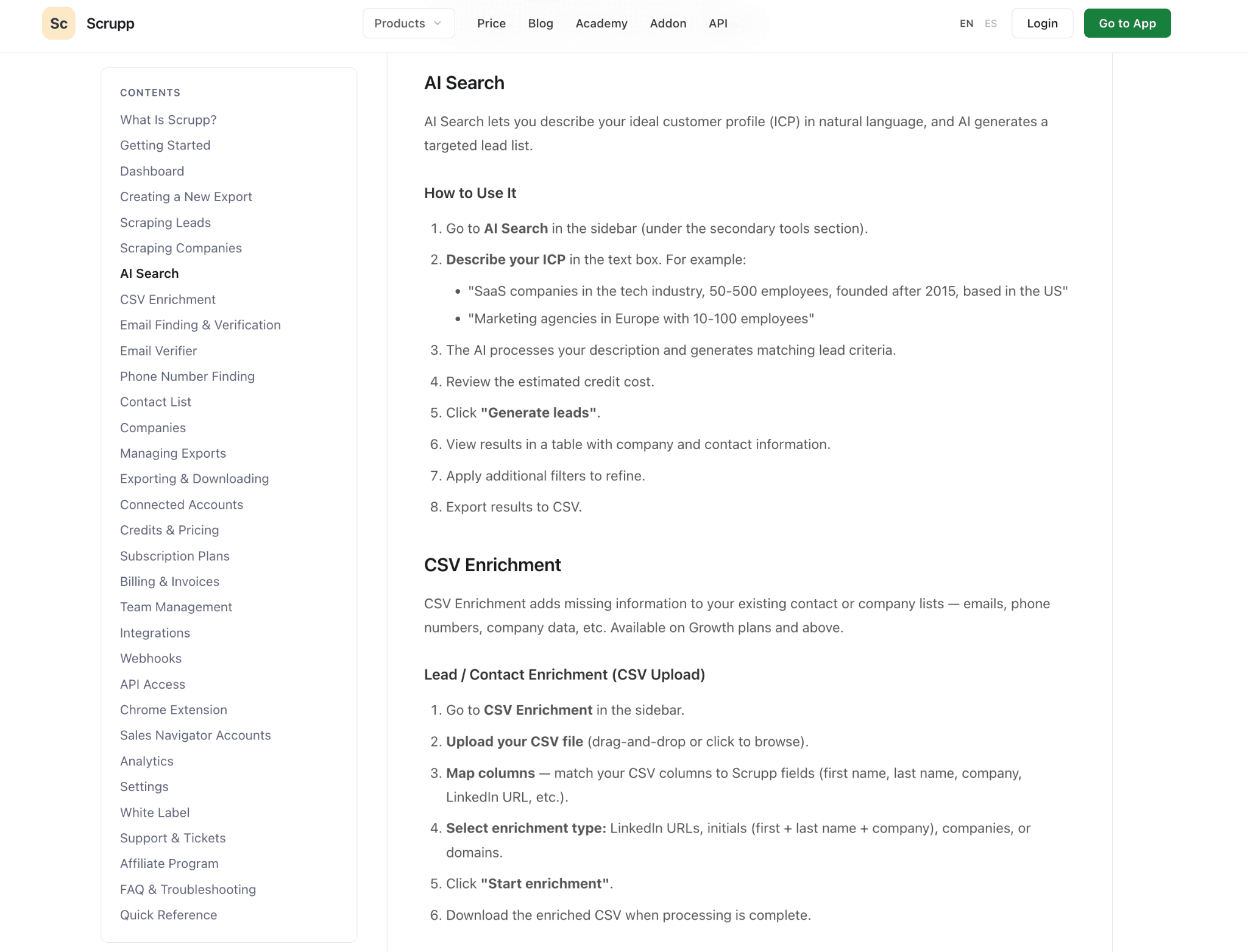
Like most data-to-email platforms, Scrupp offers sequences, sending inboxes, a reply inbox, and AI-assisted copy. The current paid feature list includes email outreach, AI sequences, and a unified reply inbox, but does not publish inbox, active-contact, or campaign caps by credit volume. Earlier app material shows editable sequence timing and copy; it is not proof of current plan limits. The visible AI surfaces are AI Campaign Builder, drafted replies, and AI Search. This evidence does not establish LinkedIn engagement actions.
| Purchase scope | Inboxes | Active contacts | Campaigns | Execution gaps |
|---|---|---|---|---|
| Entry subscription: 1,000 credits/month | Reply inbox listed; sender count unpublished | Cap unpublished | Email/AI sequences listed; cap unpublished | Pricing FAQ contradicts email inclusion; confirm access and reply/send controls |
| Higher monthly credit volumes | No volume-specific count published | No volume-specific cap published | No volume-specific cap published | More data credits do not establish higher sending or campaign limits |
| Managed email infrastructure | Domains, inboxes and warmup mentioned separately | Not specified | Not specified | Legacy Growth wording is not mapped to current volume options; obtain written inclusion and pricing |
Scrupp email allowances: published versus unconfirmed
Pricing refreshed September 2026 · Source: Scrupp pricing. Its common paid feature list includes email outreach, but its FAQ still describes sending as a separate product. The old named-tier limits are not treated as current entitlements.
Sequence presence is not workflow depth. The reviewed public material did not establish maximum steps or follow-ups. It also did not establish conditional branching, automatic stop on reply, A/B testing, or a numeric daily sending range. These are evidence gaps rather than proof the controls are absent. They matter because a reply-aware campaign and a timed series can behave differently under live traffic.
AI Search turns a natural-language Ideal Customer Profile description into target criteria or a list. It is not established as automatic profile-by-profile ICP scoring, and its model, provider, standard-plan charges, and output accuracy were not documented. AI-drafted replies and campaign copy are visible surfaces, but moderation, edit gates, and autonomous quality were not tested.
The email and LinkedIn channel guide helps separate email follow-up from LinkedIn actions. Here that distinction is decisive: Scrupp lists email campaigns in its paid feature set, while the reviewed Scrupp scope does not execute connection requests or LinkedIn messages.
Campaign-control gap: The paid feature list includes email sequences and a reply inbox, but current numeric inbox, contact, and campaign limits are not published. Confirm these alongside reply auto-stop, branching, A/B tests, daily send limits, and mailbox-authentication behavior.
API, Webhooks, CRM Integrations, and Connector Drift
Scrupp's developer surface is more specific than its connector catalog. The REST API is included in the paid feature list and is asynchronous: a request returns a process_id, and the result is retrieved later. That model supports long-running enrichment and extraction work, but published routes do not establish latency, idempotency, or partial-failure recovery under production load.
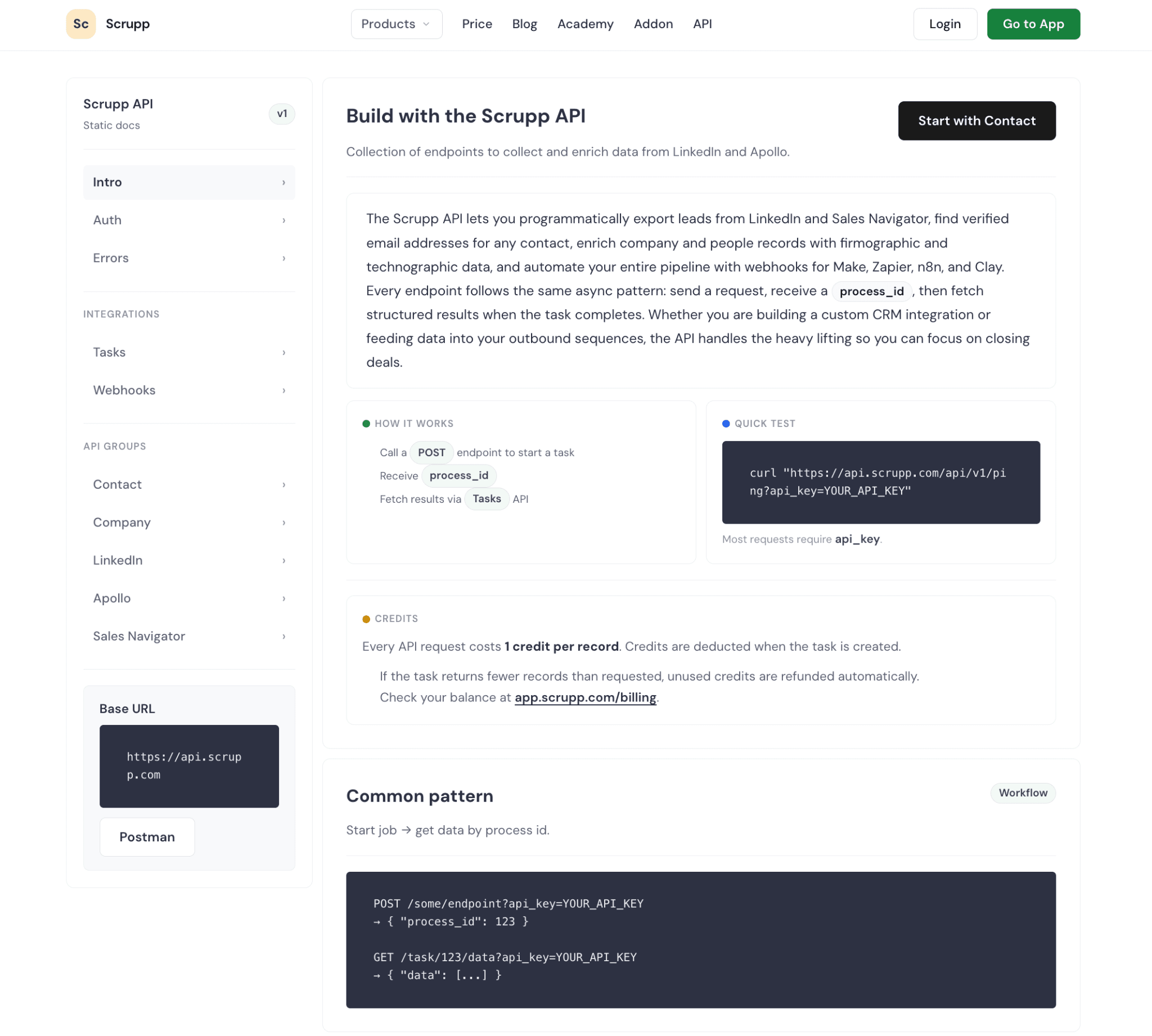
Webhooks are documented on all plans. The webhook page names:
- completion and enrichment events;
- HMAC-SHA256 signing;
- three retries after server errors;
- replay;
- ten webhooks per account; and
- 100 requests per second per endpoint.
These numbers make the interface auditable. They do not replace a live replay and duplicate-delivery test.
| Connector | Published route | Operational status | Test needed |
|---|---|---|---|
| HubSpot | Direct vendor-documented route | 1 confirmed direct CRM path | Install, field mapping and write-back |
| Salesforce | Dedicated landing page | Conflicts with current Help | Install and bidirectional behavior |
| Pipedrive | Dedicated landing page | Conflicts with current Help | Install and dedupe behavior |
| Zapier | Vendor says coming soon; directory URL returned 404 | Native connector not currently established | Directory availability and trigger/action execution |
| Make | Webhook or HTTP/API handoff | Not established as a native app | Payload, retries and error recovery |
Scrupp connectors: advertised versus operationally confirmed
As of August 2026 · Sources: HubSpot, Salesforce, Pipedrive, and webhooks.
That leaves one currently confirmed direct CRM route: HubSpot. Salesforce and Pipedrive remain advertised but conflicted. Zapier is not operationally established, and Make is a generic webhook or API path. This CRM integration overview provides category context for checking data direction and field ownership rather than counting every landing page equally.
Connector boundary: A landing page or webhook recipe is not an installed native connector. Confirm authentication, field mapping, write-back, dedupe, retries, and partial-failure behavior before production use.
Teams, Agencies, and White-Label Workspaces
Standard team accounts document three roles: Admin, Member, and Viewer. Teams can share accounts, exports, folders, data, and credits through Scrupp Help. Current pricing lists up to three team members at the 1,000-credit monthly option. Caps for other volumes and every permission boundary still need confirmation.
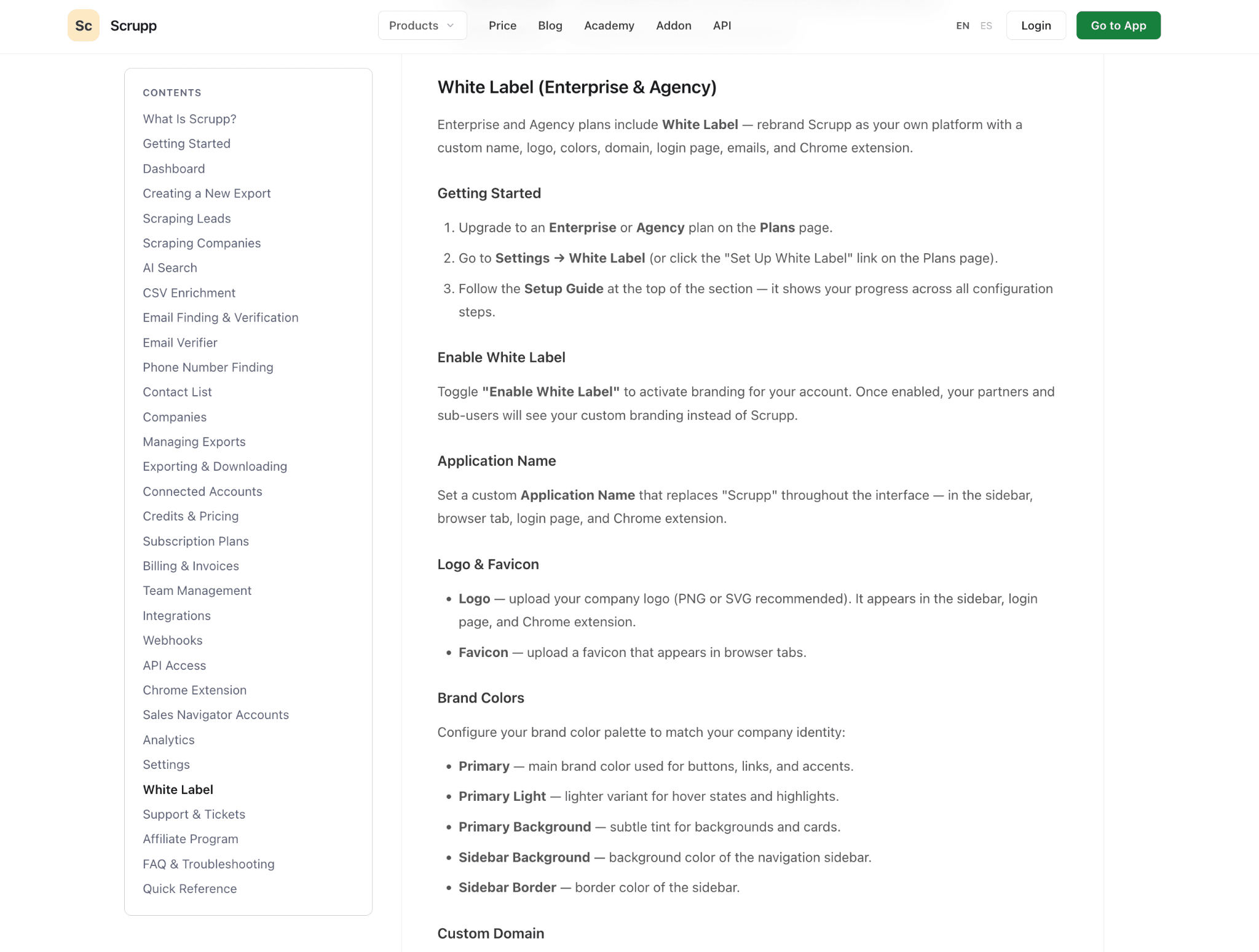
Agency surfaces add a different layer. Scrupp's white-label page describes isolated client workspaces, separate campaigns, senders, lists, and inboxes. It also documents branded portals, intake, reports, and an Activity Log. These client-operation controls are separate from a standard team folder.
| Layer | Confirmed capability | Commercial or governance boundary |
|---|---|---|
| Standard team | Admin, Member, Viewer; shared credits, accounts, exports, folders and data | Up to 3 teammates at entry monthly volume; larger-volume caps and detailed permissions need confirmation |
| Client workspace | Isolated lists, campaigns, senders and inbox | Global cross-client do-not-contact control not confirmed |
| White label | Branding, custom domain, intake/report portals, Activity Log | Setup and full client-facing analytics were not executed |
| Partner app model | Rebranded app/dashboard with client accounts and seats | Volume and seat entitlements require a partner quote; no fixed current Agency price established |
| Wholesale track | Sales-led minimum-volume pricing | Minimum commitment and exact rate agreed on the partnership call |
| Connected LinkedIn accounts | Vendor claims unlimited connected accounts | Plan gate, concurrency and per-account economics not established |
Scrupp workspace hierarchy and unresolved governance
As of August 2026 · Sources: Scrupp white label, pricing, and Help.
Agency economics should come from a current written quote covering the chosen model, credit volume, and client-seat allocation. The partner page offers either a rebranded app/dashboard or API-based delivery, with wholesale pricing agreed on a partnership call. An older Agency app amount is not a current quote, and dividing a credit-package price by 20 would invent an account entitlement.
Client isolation creates a governance question. Match Contacts is documented at list or database level, while no global suppression layer across all client workspaces was confirmed. That does not prove collisions occur. It means an agency should test whether one client's do-not-contact record suppresses the same lead in another workspace before onboarding several clients.
Confirm the agency unit: Ask sales to state the number of workspaces, LinkedIn accounts, senders, teammates, and credits in writing. A credit-volume allowance alone is not a documented 20-account quote.
Is Scrupp Safe?
Scrupp's safety verdict is conditional and architecture-based. The extension uploads session material that could support authenticated replay, while the live LinkedIn-facing route was not tested. That combination supports a high-risk architecture assessment. It does not establish that replay occurred, identify a cloud IP, or measure a restriction rate.
What I verified first-hand: I read the shipped source in the official v1.3.6 package. It reads li_at, li_a, and JSESSIONID, then posts the bundle with user agent and identity to Scrupp account endpoints. It also performs local Voyager/Sales reads and has LinkedIn page access.
Active Extension Detection, or AED, is the label visible in LinkedIn's production code for probes of specific extension IDs. If an ID appears in that list, installation can be observable before an action runs. Scrupp's extension ID was not listed in the August 2026 audit snapshot. That negative result is one dated signal—not proof the extension is invisible or safe. This extension-detection explainer provides category context for why code injection and extension identity remain separate signals.
| What was checked | Result |
|---|---|
| Public extension | Yes — v1.3.6, Store ID jkjncafjiaikoihdaejkdeimnbjdmbfp (listing) |
| LinkedIn session handling | li_at, li_a, JSESSIONID, user agent and identity sent to Scrupp account endpoints in the official package |
| LinkedIn access method | Local Voyager/Sales reads plus session upload; exact runtime split not checked |
| Extension visibility | ID not listed in the August 2026 AED snapshot; injected-page and synthetic-event signals still exist |
| Cloud request origin and fingerprint | Not checked; IP, provider, location, fingerprint and cross-account isolation unmeasured |
| Session lifecycle | Not checked; retention, replay, revocation and deletion behavior unmeasured |
| Restriction outcome | Not checked; no restriction-rate test performed |
Scrupp safety checks and evidence boundaries (August 2026)
As of August 2026 · Sources: the official extension package and Chrome Web Store listing.
Scrupp claims “smart throttling,” rate limits, batching, and delays on pricing, but it publishes no numeric action budget or delay range. The same public material mentions both “no daily limit” and daily limits for high-volume work. Source ceilings of 1,000 or 2,500 are extraction bounds, not safety budgets. The controls may exist, but their effectiveness and enforcement were not tested.
On data security, Scrupp's DPA names Hetzner Germany, AWS, TLS 1.2+, storage encryption, role controls, MFA, VPN, and audit controls. These are vendor contractual statements, not an independent certification. Public evidence for a SOC 2 or ISO certificate was not found in the reviewed material. Component-level residency remains incomplete, as do LinkedIn-cookie retention, deletion, and key management. The Terms also put third-party-platform use at the customer's risk (Terms).
No substantive LinkedIn restriction pattern appeared in the 55-experience deduplicated review sample. This is a limited negative finding, not a runtime safety test.
Manual activity patterns can also trigger LinkedIn warnings, so architecture is only one part of the risk model. This restriction overview explains the platform-level distinction.
Safety verdict: Session upload is confirmed. Cloud routing, fingerprint, retention, replay, revocation, restriction rate, and numeric safety-control enforcement were not checked. Those gaps prove neither safe operation nor a measured incident.
No tool eliminates ban risk.
What Reviews and Social Mentions Actually Show
The review evidence is positive overall but too clustered to represent continuous market consensus. We analyzed 56 dated reviews: 10 from G2, 46 from Trustpilot, and none from Capterra. Removing one G2/Trustpilot cross-post left 55 independent experiences: 9 G2 and 46 Trustpilot. Publication dates span the week beginning October 30, 2023 through February 28, 2026.
Each aggregate needs its own denominator. In the G2 local sample as of August 3, 2026, 10 rated reviews average 4.3 stars. In the Trustpilot local sample as of August 3, 2026, 46 rated reviews average 4.22 stars. Across the 55-experience, cross-platform deduplicated G2-and-Trustpilot view spanning the week beginning October 30, 2023 through February 28, 2026, the mean is 4.309 and the median is 5. In that same 55-experience G2-and-Trustpilot view and publication window, 40 of 55 are five-star records and 7 of 55 are one-star records. These are local-sample statistics, not live profile ratings. Only one rated review falls in the February 3-August 3, 2026 trailing window, so no trailing mean is printed.
Temporal concentration matters. In the 55-experience deduplicated view, 42 records fall in March-April 2024 or September-December 2025. The separate 56-review view found two weekly volume spikes. They were 10 of 56 in the week beginning April 1, 2024 and 7 of 56 in the week beginning December 8, 2025. It found no negative cluster. These are patterns, not explanations. They do not establish solicitation or manipulation.
Topic-level tails are smaller. Support appears in 10 of 55 experiences: 7 negative, 2 positive, and 1 mixed. Reliability appears in 9 of 55: 7 negative and 2 positive. Pricing transparency appears in 3 of 55, all negative. Positive topic incidences were:
- data quality in 29 of 55;
- ease in 24 of 55;
- features in 19 of 55; and
- performance in 11 of 55.
Those topic incidences do not prove current product behavior.