

 6 min read

TL;DR: McKinsey B2B sales in November 2026
- Main report: McKinsey’s July 16, 2026 research focuses on integrating AI across sales work, from prospect selection to seller coaching.
- Customer experience: McKinsey’s 2026 B2B Pulse identifies inconsistent information across teams as the leading reason buyers switch suppliers.
- Evidence: Read McKinsey’s reported benefits as survey responses, and assess your own pilot against an agreed baseline.
- Starting point: Choose one sales bottleneck, assign an owner, and measure the customer outcome alongside the time saved.
McKinsey’s latest B2B sales report focuses on five connected workflows
McKinsey’s The future of B2B sales: How growth champions rewire their playbooks with AI, published July 16, 2026, centers on five workflows: opportunity discovery, sales coverage, account growth, pricing, and seller development. The table pairs those areas with suggested pilot questions for your team. Read the report.
| Workflow | Question for your sales team | A result to track |
|---|---|---|
| Opportunity discovery | Can a seller explain why this account belongs in the pipeline? | Accepted opportunities with a recorded reason for fit |
| Sales coverage | Which accounts need a specialist before a useful conversation can happen? | Time from qualification to the right person taking ownership |
| Account growth | Which customer requirement remains unresolved after the meeting? | Agreed next steps completed by their due date |
| Pricing | Can the person preparing a quote see the applicable terms and approval rules? | Quotes returned for correction |
| Seller development | Which recurring customer question causes hesitation or an inaccurate answer? | Repeat errors after coaching |
The questions and measures are practical suggestions, rather than McKinsey benchmarks. Choose the row that matches an observable problem. A team with accurate quotes but poor lead qualification has a different starting point from one losing deals while waiting for approvals.
For a small team, a spreadsheet can be enough to establish a baseline. Record the starting event, the responsible person, the completion event, and the customer consequence. This makes it easier to judge a proposed AI feature against a specific job. If LinkedIn is one of your channels, consider the built-in CRM in Linked Helper’s desktop app to filter collected profiles by company before choosing a campaign audience.
McKinsey connects AI adoption with ownership, skills, and shared data
McKinsey’s operating-model recommendations cover business priorities, human–AI roles, governed data and technology, and sustained adoption. Source: the July report’s organizational chapter.
Turn those requirements into responsibilities before the pilot starts. Name who approves a customer-facing recommendation, who corrects the underlying record, and who reviews performance with the seller. Try a sample case with missing information: the handoff should make clear who resolves it instead of leaving the salesperson to improvise.
McKinsey’s AI benefits data measures reported outcomes, not improvement rates
McKinsey reports seller efficiency at 59% and better customer experiences at 53% among growth leaders that embedded AI into core workflows. These percentages count respondents identifying benefits; they are not percentage gains in productivity or satisfaction. Source: the July 2026 report.
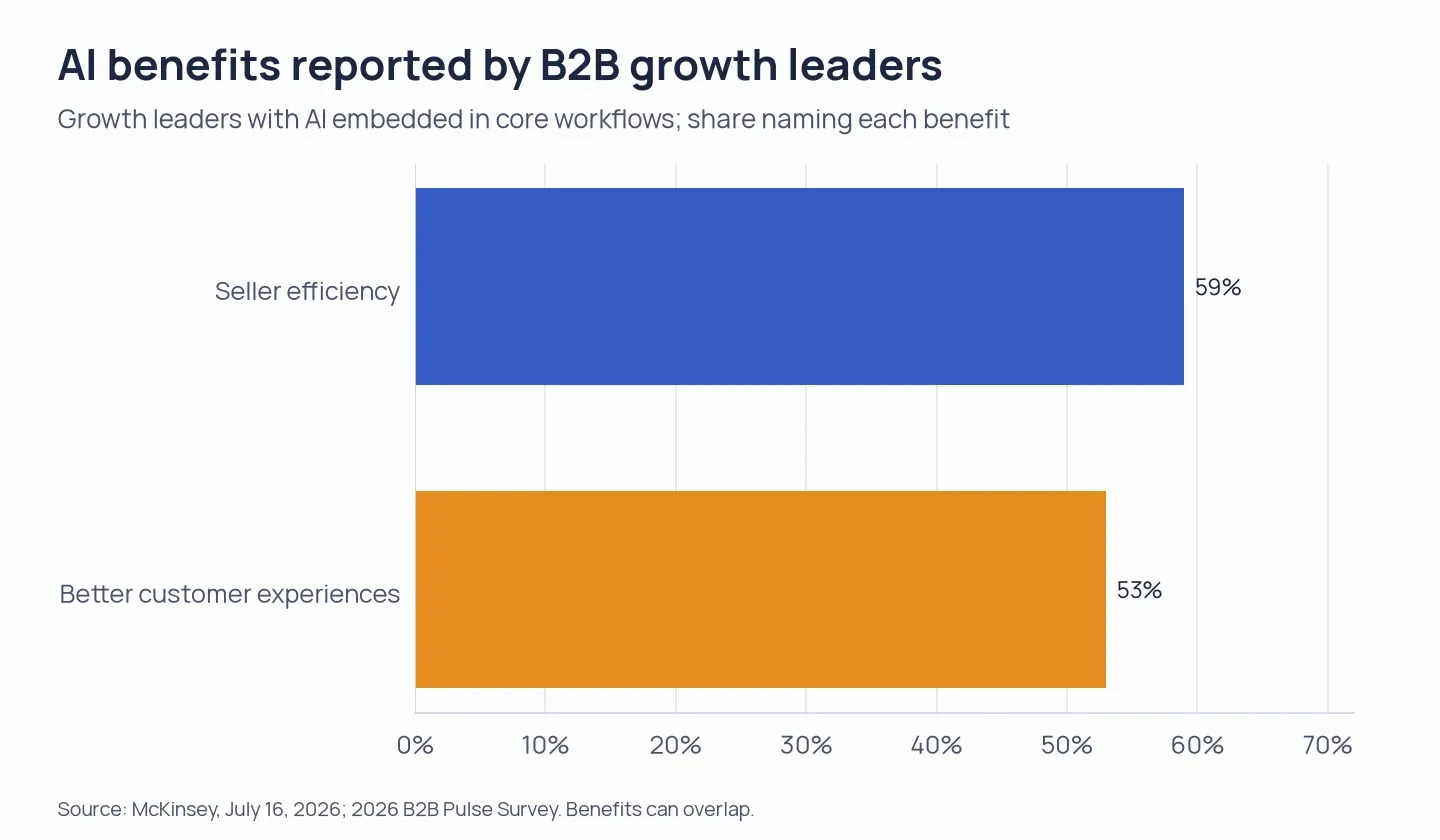
McKinsey’s July 2026 report compares the share identifying each benefit. The categories can overlap.
Keep separate measures for your own pilot. If a drafting assistant saves preparation time, also check whether the seller sends fewer corrections and answers the customer’s actual question. Otherwise, a faster internal task can look successful while the buyer still waits for a usable answer.
McKinsey’s customer-experience finding puts consistent information first
McKinsey’s 2026 B2B Pulse identifies conflicting information across teams as the leading reason buyers switch suppliers, followed by difficulty accessing knowledgeable representatives. It also reports that buyers use an average of ten channels during their purchasing journey. Source: the May 28, 2026 B2B Pulse report.
For your team, the useful question is whether the answer stays consistent when a buyer changes channels. Consider a hypothetical prospect who asks about delivery on LinkedIn, receives a quote by email, and then speaks to a sales representative. Check whether everyone is working from the same availability, price, and promised next step.
A practical audit starts with a recent conversation. Compare the initial promise with the proposal and the final handoff. Where they differ, identify which record needs updating and who owns that update. More messages will not resolve a contradiction in the underlying information.
McKinsey’s steel-sales case shows how connected information changes the conversation
McKinsey’s ArcelorMittal Brazil case study, featured in its collection on July 20, 2026, shows an implementation of connected sales work. The AMis mobile application brought inventory, pricing, and delivery information into the salesperson’s workflow. Representatives could prepare voice-generated quotes and capture structured notes during customer interactions. Read the ArcelorMittal case study.
McKinsey reports a pilot with a control group, estimated margin impact of 53 million Brazilian reais, and customer contacts that nearly tripled. The implementation also changed performance measures and coaching routines. Those results belong to this company’s pilot; the public case does not provide enough detail to calculate a transferable return for another team.
The useful design question is concrete: which answer currently requires your salesperson to end the conversation and call someone else? Test whether bringing an approved answer into their workflow removes that delay. Review incorrect answers and unnecessary escalations as well as successful ones.
McKinsey’s industrial research helps identify the first sales bottleneck
McKinsey’s August 11, 2026 industrial article distinguishes problems by business model: custom-engineered products create quoting and design challenges, configured products create pricing complexity, and aftermarket businesses need visibility into installed equipment and service opportunities. Source: McKinsey’s industrial commercial-transformation article.
Use that distinction when setting priorities. A general instruction to “use AI in sales” leaves the team guessing. A brief such as “reduce quote corrections caused by missing specifications” gives the project a defined input, owner, and outcome.
Write down what a successful pilot must demonstrate before selecting software. Include a customer measure, such as receiving a complete answer, and an internal measure, such as time spent preparing it. Review a sample of the underlying conversations so an attractive dashboard does not hide a recurring error.
For LinkedIn prospecting, start with the transition from a relevant reply to a qualified conversation. Capture what the prospect asked, route the reply to a responsible seller, and agree the next step. The LinkedIn sales strategy guide covers the channel workflow; the B2B sales guide provides the broader process.
Method: sources checked in November 2026
McKinsey’s July report combines executive interviews with its B2B Pulse, described as nearly 4,000 buyers and sellers across 13 countries; the Pulse’s latest wave is dated December 2025. Sources were checked on November 11, 2026; the pilot suggestions are editorial applications.